Turn off MathJax
Article Contents

ZHAO Zhenkun, DU Changjian, YANG Hui, et al. Identification of Arachis hypogaea NPF gene family based on the T2T genome and analysis of the response patterns to salt and drought stress[J]. Journal of Zhejiang A&F University, 2026, 43(X): 1−13 doi:  10.11833/j.issn.2095-0756.20260325
Citation: ZHAO Zhenkun, DU Changjian, YANG Hui, et al. Identification of Arachis hypogaea NPF gene family based on the T2T genome and analysis of the response patterns to salt and drought stress[J]. Journal of Zhejiang A&F University, 2026, 43(X): 1−13 doi:  10.11833/j.issn.2095-0756.20260325

OnlineFirst articles are published online before they appear in a regular issue of the journal. Please find and download the full texts via CNKI.

Identification of Arachis hypogaea NPF gene family based on the T2T genome and analysis of the response patterns to salt and drought stress

DOI: 10.11833/j.issn.2095-0756.20260325
  • Received Date: 2026-06-16
  • Accepted Date: 2026-10-26
  • Rev Recd Date: 2026-10-25
  • Available Online: 2026-11-27
  •   Objective  Based on the high-quality telomere-to-telomere (T2T) reference genome of Arachis hypogaea, this study aims to systematically identify members of the A. hypogaea NPF gene family, analyze the expression response patterns of AhNPF genes under salt and drought stress, and screen candidate genes responsive to stress, so as to provide candidate genetic resources for functional research of A. hypogaea NPF genes and stress-resistance breeding.   Method  Members of A. hypogaea NPF family were identified using bioinformatic approaches, and their sequence characteristics, phylogenetic evolution, gene structures, chromosomal distribution and duplication expansion patterns were analyzed. Based on promoter cis-acting element prediction and public transcriptome data, the expression patterns of AhNPF genes under salt and drought stress were analyzed, and partial gene expression patterns were validated by RT-qPCR. Meanwhile, plant height and above-ground fresh weight of A. hypogaea seedlings under graphene oxide (GO) treatment were measured to evaluate its mitigating effects on salt and drought stress.   Result  A total of 134 AhNPF genes were identified, which were distributed across 20 A. hypogaea chromosomes and classified into 8 subfamilies. Most AhNPF proteins were localized on the plasma membrane and hydrophobic. Members of the same subfamily were relatively consistent in terms of gene structures and conserved motif composition. Segmental duplication was the major driving force for the expansion of the AhNPF family. Most duplicated gene pairs had Ka/Ks values lower than 1, indicating that this family was mainly subjected to purifying selection during evolution. Promoter regions were rich in cis-elements associated with hormone signaling and stress response. Transcriptome analysis revealed that AhNPF6.5 and AhNPF6.6 significantly responded to salt stress, whereas AhNPF1.5 and AhNPF1.6 persistently responded to drought stress. RT-qPCR further verified the expression trends of the aforementioned genes. GO treatment alleviated the growth inhibition of A. hypogaea seedlings caused by salt and drought stress at the phenotypic level.   Conclusion  The A. hypogaea NPF gene family is relatively conserved in structure, with obvious subfamily differentiation. Multiple AhNPF members exhibit distinct expression responses to salt and drought stress. Among them, AhNPF6.5 and AhNPF6.6 can serve as candidate genes in response to salt stress, while AhNPF1.5 and AhNPF1.6 can be used as candidate genes for drought-stress response. GO treatment can alleviate the inhibitory effects of salt and drought stress on the growth of A. hypogaea seedlings to a certain extent and affect the expression response patterns of related AhNPF candidate genes. [Ch, 7 fig. 1 tab. 39 ref.]
  • [1] YU Shuo, FU Pengyue, BAO Ping’an, QU Guanzheng, SUN Jingshuang, HU Ruiyang, WANG Junhui, YUN Huiling.  Genome-wide identification of MYB gene family and screening of key members under salt stress in Catalpa bungei . Journal of Zhejiang A&F University, doi: 10.11833/j.issn.2095-0756.20260188
    [2] XIANG Ruizi, BA Tingting, JIANG Yan, GUO Ziyu, LIU Chang, ZHANG Ning, ZHANG Yue, FU Xuehao, SUN Ming.  Role of flavonoids and mining of drought-tolerant genes in the drought response of Opisthopappus taihangensis . Journal of Zhejiang A&F University, doi: 10.11833/j.issn.2095-0756.20250468
    [3] ZHENG Lin, WANG Fengmin, FAN Tingting, WANG Ketao, HU Hengkang, HUANG Jianqin, ZHANG Qixiang.  Response of JrGA3ox gene expression to growth and drought stress in Juglans regia . Journal of Zhejiang A&F University, doi: 10.11833/j.issn.2095-0756.20240327
    [4] LI Jiaxuan, CHEN Yuewen, ZHOU Tie, SHI Jun, YANG Junfeng, LU Xiaopeng, LI Feifei.  Genome-wide identification and drought stress response analysis of the OSCA gene family in Poncirus trifoliata . Journal of Zhejiang A&F University, doi: 10.11833/j.issn.2095-0756.20250103
    [5] ZHANG Lei, CHEN Hui, ZHANG Zijie, SHANG Xulan, YANG Wanxia, FANG Shengzuo.  Identification of the GATA gene family in Cyclocarya paliurus and expression analysis under salt stress . Journal of Zhejiang A&F University, doi: 10.11833/j.issn.2095-0756.20250263
    [6] HUANG Qingchen, LAI Jianxin, HUANG Lichao, LU Mengzhu.  Effects of peroxidase gene PagPRX19 on salt tolerance of poplar ‘84K’ . Journal of Zhejiang A&F University, doi: 10.11833/j.issn.2095-0756.20220387
    [7] CHEN Xuebing, LIU Cong, CHENG He, JIANG Tingbo, XIA De’an, WEI Zhigang.  Genome-wide identification of ZHD gene family of Populus trichocarpa and its expression under drought stress . Journal of Zhejiang A&F University, doi: 10.11833/j.issn.2095-0756.20210373
    [8] LIU Zheng, HU Suntian, SHEN Xiaofei, ZHU Pei, CHU Xudong, LI Zhuoya, LUO Ping.  Alleviation of exogenous melatonin on rose seedlings under salt stress . Journal of Zhejiang A&F University, doi: 10.11833/j.issn.2095-0756.20190604
    [9] LIU Hua, XUE Jinman, XU Qianyu, YI Xin, WANG Weiyan, LIU Hongbo.  Spatio-temporal expression of fatty acid desaturase genes AhFAD2A and AhFAD2B in peanuts . Journal of Zhejiang A&F University, doi: 10.11833/j.issn.2095-0756.2019.01.003
    [10] HOU Jiaojiao, SUN Tao, YU Zhongdong, KANG Yongxiang, BU Fangfang, GAN Mingxu.  Effect of endophytic fungi on growth and physiology of saline stressed Sophora japonica seedlings . Journal of Zhejiang A&F University, doi: 10.11833/j.issn.2095-0756.2017.02.013
    [11] MA Jin, ZHENG Gang, PEI Cuiming, ZHANG Zhenya.  Identification and characterization of salt-responsive transcription factors in roots of southern type alfalfa . Journal of Zhejiang A&F University, doi: 10.11833/j.issn.2095-0756.2016.02.003
    [12] ZUO Zhaojiang, ZHANG Rumin, GAO Yan.  Advances in plant cell ion flux with salt stress:a review . Journal of Zhejiang A&F University, doi: 10.11833/j.issn.2095-0756.2014.05.023
    [13] YANG Sheng, ZHANG Hua-xin, LIU Tao.  Morphological changes and physiological characteristics of seedlings from 16 tree species with salt stress . Journal of Zhejiang A&F University, doi: 10.11833/j.issn.2095-0756.2012.05.018
    [14] MA Jin, LIU Zhi-gao, ZHENG Gang.  Differential proteomics and its application in plant salt stress . Journal of Zhejiang A&F University, doi: 10.11833/j.issn.2095-0756.2011.01.022
    [15] XIE Fu-chun, CHEN Cai-ye, ZHANG Wen-ting, WEI Juan, LI Yuan-yuan, WANG Hua-tian.  Soil NaCl stress and photosynthetic characteristics with Clerodendrum trichotomum . Journal of Zhejiang A&F University,
    [16] ZHU Xiao-lou, LOU Lu-huan, WANG Hui.  Physiological and biochemical characteristics of four species of Carex with drought stress . Journal of Zhejiang A&F University,
    [17] ZENG Xiao-hong, WU Jian-rong, MA Huan-cheng.  Biochemical response of drought stressed Acacia richii seedlings inoculated with rhizobia . Journal of Zhejiang A&F University,
    [18] WANG Wei, HUANG Sheng-li, DING Guo-jian, HUANG You-jun, HUANG Jian-qin, ZHENG Bing-song.  Morphological and physiological changes accompanying the induction of salt tolerance in Neolitsea sericea seedlings . Journal of Zhejiang A&F University,
    [19] XIANG Zuo-xiang, XUGui-fang, JIANG Wen-jun.  Drought stress on physiological and biochemical processes in four spiny plant species . Journal of Zhejiang A&F University,
    [20] WANG Shu-feng, CHEN Yi-tai, PAN Hong-wei, WU Tian-lin.  Changes of physiological characteristics of eight Alnus cremastogyne clones under salt stress . Journal of Zhejiang A&F University,
  • [1]
    LU Qing, HUANG Lu, LIU Hao, et al. A genomic variation map provides insights into peanut diversity in China and associations with 28 agronomic traits[J]. Nature Genetics, 2024, 56(3): 530−540. DOI: 10.1038/s41588-024-01660-7.
    [2]
    CHEN Kuoen, CHEN Huiyu, TSENG C S, et al. Improving nitrogen use efficiency by manipulating nitrate remobilization in plants[J]. Nature Plants, 2020, 6(9): 1126−1135. DOI: 10.1038/s41477-020-00758-0.
    [3]
    ROBERTSON G P, VITOUSEK P M. Nitrogen in agriculture: balancing the cost of an essential resource[J]. Annual Review of Environment and Resources, 2009, 34: 97−125. DOI: 10.1146/annurev.environ.032108.105046.
    [4]
    WANG Hongwei, MA Chenyu, XU Fangji, et al. Root endophyte-enhanced peanut-rhizobia interaction is associated with regulation of root exudates[J]. Microbiological Research, 2021, 250: 126765. DOI: 10.1016/j.micres.2021.126765.
    [5]
    LUO Yan, CHEN Yue, PENG Qingwen, et al. Nitrogen and phosphorus resorption of desert plants with various degree of propensity to salt in response to drought and saline stress[J]. Ecological Indicators, 2021, 125: 107488. DOI: 10.1016/j.ecolind.2021.107488.
    [6]
    JAN N, RATHER A M, JOHN R, et al. Proteomics for abiotic stresses in legumes: present status and future directions[J]. Critical Reviews in Biotechnology, 2023, 43(2): 171−190. DOI: 10.1080/07388551.2021.2025033.
    [7]
    LÉRAN S, VARALA K, BOYER J C, et al. A unified nomenclature of nitrate transporter 1/peptide transporter family members in plants[J]. Trends in Plant Science, 2014, 19(1): 5−9. DOI: 10.1016/j.tplants.2013.08.008.
    [8]
    KRAPP A, DAVID L C, CHARDIN C, et al. Nitrate transport and signalling in Arabidopsis[J]. Journal of Experimental Botany, 2014, 65(3): 789−798. DOI: 10.1093/jxb/eru001.
    [9]
    CORRATGÉ-FAILLIE C, LACOMBE B. Substrate (un) specificity of Arabidopsis NRT1/PTR FAMILY (NPF) proteins[J]. Journal of Experimental Botany, 2017, 68(12): 3107−3113. DOI: 10.1093/jxb/erw499.
    [10]
    WANG Yayun, CHENG Y H, CHEN Kuoen, et al. Nitrate transport, signaling, and use efficiency[J]. Annual Review of Plant Biology, 2018, 69: 85−122. DOI: 10.1146/annurev-arplant-042817-040056.
    [11]
    LI Ping, LUO Ting, PU Xiaojun, et al. Plant transporters: roles in stress responses and effects on growth and development[J]. Plant Growth Regulation, 2021, 93(3): 253−266. DOI: 10.1007/s10725-020-00684-3.
    [12]
    KOU Yuchen, XIE Yining, YUAN Yanhui, et al. Plant nitrate transport family NPF and its regulatory mechanism of protein modification[J]. Hereditas, 2025, 47(10): 1118−1131.
    [13]
    LI Zhihui, ZHU Mingqiang, HUANG Jinqiu, et al. Genome-wide comprehensive analysis of the nitrogen metabolism toolbox reveals its evolution and abiotic stress responsiveness in rice (Oryza sativa L.)[J]. International Journal of Molecular Sciences, 2023, 24(1): 288. DOI: 10.3390/ijms24010288.
    [14]
    JIA Lihua, HU Desheng, WANG Junbo, et al. Genome-wide identification and functional analysis of nitrate transporter genes (NPF NRT2 and NRT3) in maize[J]. International Journal of Molecular Sciences, 2023, 24(16): 12941. DOI: 10.3390/ijms241612941.
    [15]
    DONG Qiang, WANG Guoxin, IQBAL A, et al. Identification and expression analysis of the NPF genes in cotton[J]. International Journal of Molecular Sciences, 2022, 23(22): 14262. DOI: 10.3390/ijms232214262.
    [16]
    WANG Huadun, WAN Yongfang, BUCHNER P, et al. Phylogeny and gene expression of the complete nitrate transporter 1/peptide transporter family in Triticum aestivum[J]. Journal of Experimental Botany, 2020, 71(15): 4531−4546. DOI: 10.1093/jxb/eraa210.
    [17]
    WANG Huadun, ZHANG Peng, MA Hongxiang. Research advances on NPF gene families in plant nitrogen uptake and utilization[J]. Journal of Plant Nutrition and Fertilizers, 2022, 28(8): 1520−1534.
    [18]
    CHIBA Y, SHIMIZU T, MIYAKAWA S, et al. Identification of Arabidopsis thaliana NRT1/PTR FAMILY (NPF) proteins capable of transporting plant hormones[J]. Journal of Plant Research, 2015, 128(4): 679−686. DOI: 10.1007/s10265-015-0710-2.
    [19]
    ZHANG Hui, LI Zefeng, XU Guoyun, et al. Genome-wide identification and characterization of NPF family reveals NtNPF6.13 involving in salt stress in Nicotiana tabacum[J]. Frontiers in Plant Science, 2022, 13: 999403. DOI: 10.3389/fpls.2022.999403.
    [20]
    XUE Bing, LI Ming, XUE Yang, et al. Identification of the NPF gene family in melon and functional analysis of CmNPF7.3 in conferring salt tolerance[J]. Scientia Horticulturae, 2025, 353: 114483. DOI: 10.1016/j.scienta.2025.114483.
    [21]
    CHEN Xiaoping, LU Qing, LIU Hao, et al. Sequencing of cultivated peanut, Arachis hypogaea, yields insights into genome evolution and oil improvement[J]. Molecular Plant, 2019, 12(7): 920−934. DOI: 10.1016/j.molp.2019.03.005.
    [22]
    BERTIOLI D J, JENKINS J, CLEVENGER J, et al. The genome sequence of segmental allotetraploid peanut Arachis hypogaea[J]. Nature Genetics, 2019, 51(5): 877−884. DOI: 10.1038/s41588-019-0405-z.
    [23]
    WANG Xiaobo, SUN Ziqi, QI Feiyan, et al. A telomere-to-telomere genome assembly of the cultivated peanut[J]. Molecular Plant, 2025, 18(1): 5−8. DOI: 10.1016/j.molp.2024.12.001.
    [24]
    MISTRY J, CHUGURANSKY S, WILLIAMS L, et al. Pfam: the protein families database in 2021[J]. Nucleic Acids Research, 2021, 49(D1): D412−D419. DOI: 10.1093/nar/gkaa913.
    [25]
    DUVAUD S, GABELLA C, LISACEK F, et al. Expasy, the Swiss bioinformatics resource portal, as designed by its users[J]. Nucleic Acids Research, 2021, 49(W1): W216−W227. DOI: 10.1093/nar/gkab225.
    [26]
    HORTON P, PARK K J, OBAYASHI T, et al. WoLF PSORT: protein localization predictor[J]. Nucleic Acids Research, 2007, 35(suppl_2): W585−W587. DOI: 10.1093/nar/gkm259.
    [27]
    MINH B Q, SCHMIDT H A, CHERNOMOR O, et al. IQ-TREE 2: new models and efficient methods for phylogenetic inference in the genomic era[J]. Molecular Biology and Evolution, 2020, 37(5): 1530−1534. DOI: 10.1093/molbev/msaa015.
    [28]
    LETUNIC I, BORK P. Interactive Tree Of Life (iTOL) v5: an online tool for phylogenetic tree display and annotation[J]. Nucleic Acids Research, 2021, 49(W1): W293−W296. DOI: 10.1093/nar/gkab301.
    [29]
    CHEN Chengjie, CHEN Hao, ZHANG Yi, et al. TBtools: an integrative toolkit developed for interactive analyses of big biological data[J]. Molecular Plant, 2020, 13(8): 1194−1202. DOI: 10.1016/j.molp.2020.06.009.
    [30]
    BAILEY T L, JOHNSON J, GRANT C E, et al. The MEME suite[J]. Nucleic Acids Research, 2015, 43(W1): W39−W49. DOI: 10.1093/nar/gkv416.
    [31]
    LESCOT M, DÉHAIS P, THIJS G, et al. PlantCARE, a database of plant cis-acting regulatory elements and a portal to tools for in silico analysis of promoter sequences[J]. Nucleic Acids Research, 2002, 30(1): 325−327. DOI: 10.1093/nar/30.1.325.
    [32]
    WANG Yupeng, TANG Haibao, DEBARRY J D, et al. MCScanX: a toolkit for detection and evolutionary analysis of gene synteny and collinearity[J]. Nucleic Acids Research, 2012, 40(7): e49. DOI: 10.1093/nar/gkr1293.
    [33]
    YAN Ning, CAO Junfeng, WANG Jie, et al. Seed priming with graphene oxide improves salinity tolerance and increases productivity of peanut through modulating multiple physiological processes[J]. Journal of Nanobiotechnology, 2024, 22(1): 565. DOI: 10.1186/s12951-024-02832-7.
    [34]
    JIANG Chunji, LI Xinlin, ZOU Jixiang, et al. Comparative transcriptome analysis of genes involved in the drought stress response of two peanut (Arachis hypogaea L.) varieties[J]. BMC Plant Biology, 2021, 21(1): 64. DOI: 10.1186/s12870-020-02761-1.
    [35]
    YOU Hongguang, LIU Yuanming, MINH T N, et al. Genome-wide identification and expression analyses of nitrate transporter family genes in wild soybean (Glycine soja)[J]. Journal of Applied Genetics, 2020, 61(4): 489−501. DOI: 10.1007/s13353-020-00571-7.
    [36]
    O’BRIEN J A, VEGA A, BOUGUYON E, et al. Nitrate transport, sensing, and responses in plants[J]. Molecular Plant, 2016, 9(6): 837−856. DOI: 10.1016/j.molp.2016.05.004.
    [37]
    FAN Xiaorong, NAZ M, FAN Xiaoru, et al. Plant nitrate transporters: from gene function to application[J]. Journal of Experimental Botany, 2017, 68(10): 2463−2475. DOI: 10.1093/jxb/erx011.
    [38]
    CUTLER S R, RODRIGUEZ P L, FINKELSTEIN R R, et al. Abscisic acid: emergence of a core signaling network[J]. Annual Review of Plant Biology, 2010, 61: 651−679. DOI: 10.1146/annurev-arplant-042809-112122.
    [39]
    DUBOS C, STRACKE R, GROTEWOLD E, et al. MYB transcription factors in Arabidopsis[J]. Trends in Plant Science, 2010, 15(10): 573−581. DOI: 10.1016/j.tplants.2010.06.005.
  • 加载中
通讯作者: 陈斌, bchen63@163.com
  • 1. 

    沈阳化工大学材料科学与工程学院 沈阳 110142

  1. 本站搜索
  2. 百度学术搜索
  3. 万方数据库搜索
  4. CNKI搜索

Figures(7)  / Tables(1)

Article views(14) PDF downloads(1) Cited by()

Related
Proportional views

Identification of Arachis hypogaea NPF gene family based on the T2T genome and analysis of the response patterns to salt and drought stress

doi: 10.11833/j.issn.2095-0756.20260325

Abstract:   Objective  Based on the high-quality telomere-to-telomere (T2T) reference genome of Arachis hypogaea, this study aims to systematically identify members of the A. hypogaea NPF gene family, analyze the expression response patterns of AhNPF genes under salt and drought stress, and screen candidate genes responsive to stress, so as to provide candidate genetic resources for functional research of A. hypogaea NPF genes and stress-resistance breeding.   Method  Members of A. hypogaea NPF family were identified using bioinformatic approaches, and their sequence characteristics, phylogenetic evolution, gene structures, chromosomal distribution and duplication expansion patterns were analyzed. Based on promoter cis-acting element prediction and public transcriptome data, the expression patterns of AhNPF genes under salt and drought stress were analyzed, and partial gene expression patterns were validated by RT-qPCR. Meanwhile, plant height and above-ground fresh weight of A. hypogaea seedlings under graphene oxide (GO) treatment were measured to evaluate its mitigating effects on salt and drought stress.   Result  A total of 134 AhNPF genes were identified, which were distributed across 20 A. hypogaea chromosomes and classified into 8 subfamilies. Most AhNPF proteins were localized on the plasma membrane and hydrophobic. Members of the same subfamily were relatively consistent in terms of gene structures and conserved motif composition. Segmental duplication was the major driving force for the expansion of the AhNPF family. Most duplicated gene pairs had Ka/Ks values lower than 1, indicating that this family was mainly subjected to purifying selection during evolution. Promoter regions were rich in cis-elements associated with hormone signaling and stress response. Transcriptome analysis revealed that AhNPF6.5 and AhNPF6.6 significantly responded to salt stress, whereas AhNPF1.5 and AhNPF1.6 persistently responded to drought stress. RT-qPCR further verified the expression trends of the aforementioned genes. GO treatment alleviated the growth inhibition of A. hypogaea seedlings caused by salt and drought stress at the phenotypic level.   Conclusion  The A. hypogaea NPF gene family is relatively conserved in structure, with obvious subfamily differentiation. Multiple AhNPF members exhibit distinct expression responses to salt and drought stress. Among them, AhNPF6.5 and AhNPF6.6 can serve as candidate genes in response to salt stress, while AhNPF1.5 and AhNPF1.6 can be used as candidate genes for drought-stress response. GO treatment can alleviate the inhibitory effects of salt and drought stress on the growth of A. hypogaea seedlings to a certain extent and affect the expression response patterns of related AhNPF candidate genes. [Ch, 7 fig. 1 tab. 39 ref.]

ZHAO Zhenkun, DU Changjian, YANG Hui, et al. Identification of Arachis hypogaea NPF gene family based on the T2T genome and analysis of the response patterns to salt and drought stress[J]. Journal of Zhejiang A&F University, 2026, 43(X): 1−13 doi:  10.11833/j.issn.2095-0756.20260325
Citation: ZHAO Zhenkun, DU Changjian, YANG Hui, et al. Identification of Arachis hypogaea NPF gene family based on the T2T genome and analysis of the response patterns to salt and drought stress[J]. Journal of Zhejiang A&F University, 2026, 43(X): 1−13 doi:  10.11833/j.issn.2095-0756.20260325
  • 花生 Arachis hypogaea是全球广泛种植的油料与经济作物,在保障国内食用油安全体系中占据重要地位[1]。氮是植物生长发育必需的大量元素,参与叶绿素、核酸、蛋白质等生物大分子合成,直接决定作物产量与品质[2−3]。花生兼具根系直接吸氮与根瘤菌共生固氮双重氮素获取途径。氮素代谢调控机制具有物种特异性[4]。近年来,全球气候异常导致干旱、土壤盐渍化等非生物胁迫频发[5]。花生对干旱、盐胁迫高度敏感[6]。胁迫环境会显著抑制花生根系对氮素的吸收与转运,同步加剧氮素利用效率降低与减产问题。因此,挖掘兼具氮素转运与逆境响应潜力的候选基因,分析其表达响应特征,对培育节氮、抗逆花生新品种具有重要意义。

    硝酸盐是植物从土壤中吸收氮素的主要形态,其跨膜转运过程由特异性硝酸盐转运蛋白家族介导,其中NPF (NRT1/PTR)家族是成员最多、功能最广泛的超家族[7]。与高亲和性硝酸盐转运蛋白NRT2家族不同[8],NPF家族成员多为低/双亲和性转运蛋白,不仅能介导硝酸盐、肽类、氨基酸的跨膜转运,还能转运生长素(IAA)、脱落酸(ABA)、赤霉素(GA)等植物激素,是连接氮素代谢网络与激素信号通路的关键节点[9−10]。近年来研究表明:NPF家族成员还参与植物对干旱、盐渍、低温等非生物胁迫的响应过程[11]。目前,NPF基因家族的全基因组鉴定与功能解析已在多种植物中取得系列进展[12]。全基因组水平的鉴定结果显示,拟南芥Arabidopsis thaliana中53个NPF成员分属8个亚家族[7],水稻 Oryza sativa、玉米 Zea mays、棉花 Gossypium hirsutum中分别鉴定出93、79、75个成员[13−15],而小麦 Triticum aestivum作为异源六倍体作物,其NPF家族规模显著扩张,共鉴定出331个成员,介导复杂的氮素响应与分配过程[16]。功能研究进一步表明:该家族成员兼具氮素转运与逆境响应的双重功能[17],拟南芥AtNPF6.3 (AtNRT1.1)以双亲和特性调控硝酸盐的吸收与信号感知,同时可介导脱落酸转运参与干旱胁迫响应[18];烟草 Nicotiana tabacum NtNPF6.13的过表达能同步提升植株耐盐性与氮素吸收效率[19];甜瓜 Cucumis melo CmNPF7.3可通过提高植株硝酸盐积累、增强抗氧化能力与光合效率显著提升耐盐性[20]。然而,作为重要油料作物的花生,其NPF家族的系统鉴定尚未开展,关于家族进化扩张特征、亚家族分化及非生物胁迫响应模式仍缺乏系统研究,这极大限制了该基因家族在花生氮高效利用与抗逆分子育种中的靶向应用。

    栽培花生为异源四倍体作物,以往研究依赖碎片化基因组组装序列,存在序列缺口、组装错误等问题,导致NPF基因家族鉴定不完整、结构分析存在偏差[21−22]。花生端粒到端粒(T2T)无缺口高质量基因组的发布,实现了20条染色体的完整组装,为基因家族的完整鉴定与系统分析提供了可靠数据基础[23]。本研究基于花生T2T基因组系统鉴定NPF基因家族,并结合进化分析、结构特征、启动子元件、公开转录组和实时荧光定量聚合酶链式反应(RT-qPCR)验证,解析其盐、干旱胁迫响应模式。同时,通过氧化石墨烯(GO)处理下的幼苗表型和生长指标评价其对非生物胁迫的缓解作用。

    • 本研究所用基因组数据为栽培花生品种‘远杂9102’‘YZ9102’的T2T高质量基因组,其蛋白序列及基因组注释文件从Figshare数据库下载[23],‘远杂9102’为异源四倍体栽培花生,基因组组成为AABB,染色体数为2n=4x=40。氧化石墨烯表型试验及RT-qPCR表达验证以栽培花生品种‘豫花9326’‘YH9326’为材料。上述材料均为异源四倍体栽培花生。

    • 以拟南芥NPF蛋白为查询序列对花生蛋白序列进行BLASTP搜索,E的阈值设为1×10⁻⁵。从Pfam数据库[24]下载MFS_1结构域(PF00854) HMM模型,采用HMMER 3.0进行搜索,E的阈值设为1×10⁻¹⁰。合并2种方法获得的候选序列,并经CDD和Pfam验证结构域完整性,去除冗余和缺失完整结构域的序列,最终获得AhNPF家族成员。

    • 利用在线工具ExPASy-ProtParam[25]分析筛选出的花生NPF基因家族蛋白序列氨基酸数量、分子质量、等电点、不稳定系数和亲水性等理化性质。同时,借助WoLF PSORT[26]预测花生NPF蛋白的亚细胞定位。

    • 使用MUSCLE对花生与拟南芥NPF蛋白序列进行多序列比对,并基于iqtree[27]采用最大似然(ML)方法构建进化树,Bootstrap值设置为1 000次重复。参照拟南芥NPF家族经典的亚家族分类标准[7],结合进化树的聚类分支特征对AhNPF基因进行命名和亚家族划分,并利用在线软件iTOL[28]对进化树进行美化。

    • 基于基因组注释文件,使用TBtools软件[29]展示AhNPF基因外显子/内含子结构。使用MEME Suite[30]预测保守基序,基序数量设为10,并利用TBtools进行可视化。

    • 使用PlantCARE[31]在线工具分析AhNPF基因上游2 000 bp的基因组序列中的顺式作用元件,利用TBtools进行顺式作用元件的可视化。

    • 使用TBtools绘制染色体位置分布图,采用MCScanX[32]分析基因复制与种间共线性关系,并计算重复基因对的非同义替换率(Ka)、同义替换率(Ks)及Ka/Ks比值。

    • 本研究采用的花生盐、干旱胁迫转录组数据均来自公开发表的高通量测序研究[33−34],其供试材料分别为栽培花生品种‘花育5号’‘HY5’和‘农花5号’‘NH5’,两者均为异源四倍体栽培花生。盐胁迫与氧化石墨烯预处理:设蒸馏水对照(ck1)、200 mmol·L−1 氯化钠(NaCl)胁迫(T1)、400 mg·L−1氧化石墨烯(G400)处理(T2)、400 mg·L−1氧化石墨烯+200 mmol·L−1氯化钠复合处理4个组(T3);干旱胁迫处理:设霍格兰氏营养液对照(ck2)、20% PEG 6000处理4 h (DT1)、20% PEG 6000处理8 h (DT2)、20% PEG 6000处理24 h (DT3) 4个组。基于前期鉴定的花生NPF基因序列,从转录组数据中提取AhNPF基因的每百万映射读数中每千碱基转录本的片段数FPKM (FPKM),剔除平均FPKM<1的低表达基因,经log2(FPKM +1)转换后绘制热图。差异响应基因依据公开数据中各处理间表达变化进行筛选,筛选标准为|log2FC|>1、FDR<0.05 (FC为差异倍数,FDR为错误发现率)。

    • 花生种子经表面消毒后播种于蛭石/营养土混合基质中,在人工气候室内培养。培养温度为25 ℃、光周期为16 h光/8 h暗、相对湿度为60%。待幼苗长至三叶期后进行胁迫处理。氧化石墨烯溶液经超声分散后使用,处理方式为灌根。盐胁迫试验设置5个处理:蒸馏水对照(ck3)、200 mmol·L−1 氯化钠(YT1)、200 mmol·L−1 氯化钠+50 mg·L−1氧化石墨烯(YT2)、200 mmol·L−1 氯化钠+100 mg·L−1氧化石墨烯(YT3)、200 mmol·L−1 氯化钠+200 mg·L−1 氧化石墨烯(YT4);干旱胁迫试验设置5个处理:蒸馏水对照(ck4)、15% PEG 6000 (GT1)、15% PEG 6000+50 mg·L−1氧化石墨烯(GT2)、15% PEG 6000+100 mg·L−1氧化石墨烯(GT3)、15% PEG 6000+200 mg·L−1氧化石墨烯(GT4)。每个处理设置3个生物学重复,每个重复包含8株幼苗。处理期间保持光照、温度、湿度和水分管理条件一致。胁迫处理21 d后拍照记录植株表型,并测定株高和地上部鲜质量。试验数据采用单因素方差分析比较不同处理间差异,P<0.05表示差异显著。

    • RT-qPCR验证以‘豫花9326’‘YH9326’为材料,对于处理后的花生幼苗采集相同部位叶片用于RNA提取和cDNA合成。以Actin作为内参基因,每个处理设置3个生物学重复,每个样品设置3个技术重复。候选基因相对表达量采用2-ΔΔCt法计算,并进行单因素方差分析,P<0.05表示差异显著。

    • 对花生T2T基因组进行系统性搜索与保守结构域验证,共鉴定获得134个AhNPF成员。理化性质分析表明(表1):AhNPF蛋白的氨基酸序列长度为116~627 aa,分子量为12.82~69.62 kDa,理论等电点(pI)为5.45~9.73,其中107个成员的理论等电点>7.00;不稳定系数为17.30~51.08,108个成员不稳定系数<40,为稳定蛋白;脂肪系数均较高,为86.98~121.81;所有成员的疏水性指数(GRAVY)均为正值,表明AhNPF蛋白整体表现为疏水性。亚细胞定位预测结果显示:134个AhNPF成员中,127个定位于质膜,其余少数成员定位于叶绿体、液泡或胞外,说明AhNPF蛋白主要发挥膜转运相关功能。

      基因名称 氨基酸数/aa 分子量/kDa 等电点 不稳定系数 脂肪系数 疏水性指数 亚细胞定位
      AhNPF1.1 573 62 424.47 7.03 41.06 105.01 0.364 质膜
      AhNPF1.2 573 62 574.66 7.03 41.22 104.83 0.361 质膜
      AhNPF1.3 574 64 078.58 8.63 46.03 100.80 0.245 质膜
      AhNPF1.4 576 64 301.03 9.20 45.47 101.81 0.252 质膜
      AhNPF1.5 585 64 383.98 5.71 34.91 104.56 0.406 质膜
      AhNPF1.6 545 59 923.64 5.93 36.95 101.49 0.348 质膜
      AhNPF1.7 614 66 996.80 8.77 47.16 98.68 0.196 质膜
      AhNPF1.8 613 67 050.94 8.77 45.12 99.48 0.197 质膜
      AhNPF1.9 621 68 482.90 9.13 38.08 101.82 0.237 质膜
      AhNPF1.10 588 65 017.23 9.55 36.08 102.57 0.284 质膜
      AhNPF1.11 570 63 502.39 8.72 36.47 109.98 0.344 质膜
      AhNPF1.12 570 63 578.49 8.91 37.30 109.47 0.328 质膜
      AhNPF2.1 314 34 850.47 9.39 17.30 88.79 0.080 质膜
      AhNPF2.2 314 34 850.47 9.39 17.30 88.79 0.080 质膜
      AhNPF2.3 618 68 802.18 9.14 33.32 95.13 0.160 质膜
      AhNPF2.4 618 68 930.42 9.27 33.26 94.35 0.150 质膜
      AhNPF2.5 605 67 450.47 8.80 35.47 100.08 0.206 质膜
      AhNPF2.6 605 67 456.46 8.80 36.81 100.73 0.197 质膜
      AhNPF2.7 616 68 190.36 8.91 33.21 99.35 0.224 质膜
      AhNPF2.8 616 68 200.44 9.02 32.62 99.68 0.228 质膜
      AhNPF2.9 611 68 793.79 8.97 46.54 101.46 0.238 质膜
      AhNPF2.10 604 67 748.49 8.33 45.56 102.47 0.258 质膜
      AhNPF2.11 626 69 623.71 8.74 42.07 96.23 0.189 质膜
      AhNPF2.12 626 69 443.46 8.64 40.45 95.93 0.191 质膜
      AhNPF2.13 518 57 549.17 8.88 39.41 103.71 0.254 质膜
      AhNPF2.14 587 65 169.50 8.79 36.18 108.43 0.395 质膜
      AhNPF2.15 602 67 511.65 9.21 33.20 99.30 0.164 质膜
      AhNPF2.16 602 67 515.64 9.21 34.12 99.47 0.156 质膜
      AhNPF2.17 602 67 673.64 9.12 36.24 97.71 0.132 质膜
      AhNPF2.18 602 67 666.73 9.21 37.70 98.67 0.148 质膜
      AhNPF2.19 535 58 961.78 8.97 35.74 105.66 0.487 质膜
      AhNPF2.20 280 30 411.16 9.19 32.67 98.54 0.431 液泡
      AhNPF2.21 545 60 402.37 9.15 32.57 104.28 0.431 质膜
      AhNPF2.22 546 60 507.53 9.22 33.65 105.33 0.447 质膜
      AhNPF3.1 578 63 966.42 9.07 28.85 99.05 0.223 质膜
      AhNPF3.2 578 63 988.37 8.81 29.47 98.88 0.233 质膜
      AhNPF3.3 605 67 910.67 8.96 45.02 104.25 0.217 质膜
      AhNPF3.4 614 69 007.05 8.66 43.50 102.54 0.066 质膜
      AhNPF3.5 612 68 327.28 8.70 41.97 97.17 0.102 质膜
      AhNPF3.6 612 68 333.24 8.70 41.14 96.70 0.092 质膜
        说明:仅列举部分基因。

      Table 1.  Physicochemical properties and subcellular localization prediction of NPF gene family proteins in A. hypogaea

    • 为明确AhNPF基因家族的进化关系,构建花生与拟南芥NPF蛋白的系统进化树(附图1)。结果表明:134个AhNPF基因可清晰划分为8个独立的亚家族(NPF1~NPF8),其中NPF5亚家族成员数量最多,为34个;NPF4亚家族次之,为26个;NPF3亚家族成员最少,为6个。NPF5和NPF4成员合计占家族总数的44.8%,提示这2个亚家族在花生中发生了明显扩张。

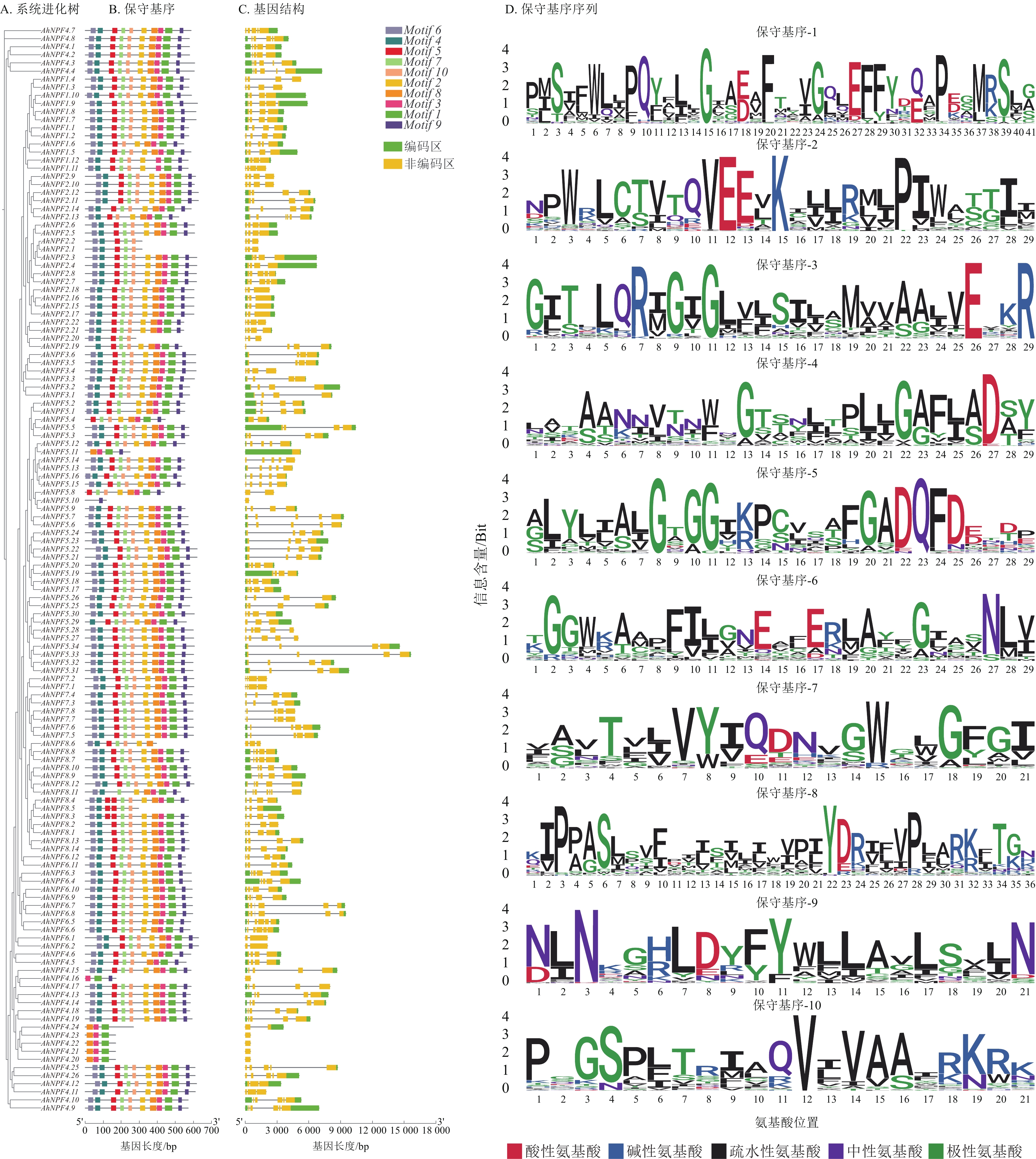
    • 为进一步揭示基因序列与结构特征,对AhNPF基因的结构与保守基序进行分析(图1)。结果表明:AhNPF基因家族具有高度的结构保守性。134个AhNPF基因的外显子数量为1~6个,其中122个成员含3~5个外显子,是花生NPF家族的典型基因结构特征,且同一亚家族的成员具有几乎一致的外显子/内含子数量与分布模式,如NPF3亚家族所有成员均含4个外显子,NPF2亚家族成员均含3~4个外显子,进一步支持了亚家族划分的合理性。保守基序分析共鉴定出10个核心基序,其中97个AhNPF成员包含完整的10个基序,表明AhNPF家族基序组成较为保守。
      Figure 1.  Conserved motifs and gene structure of AhNPF genes family

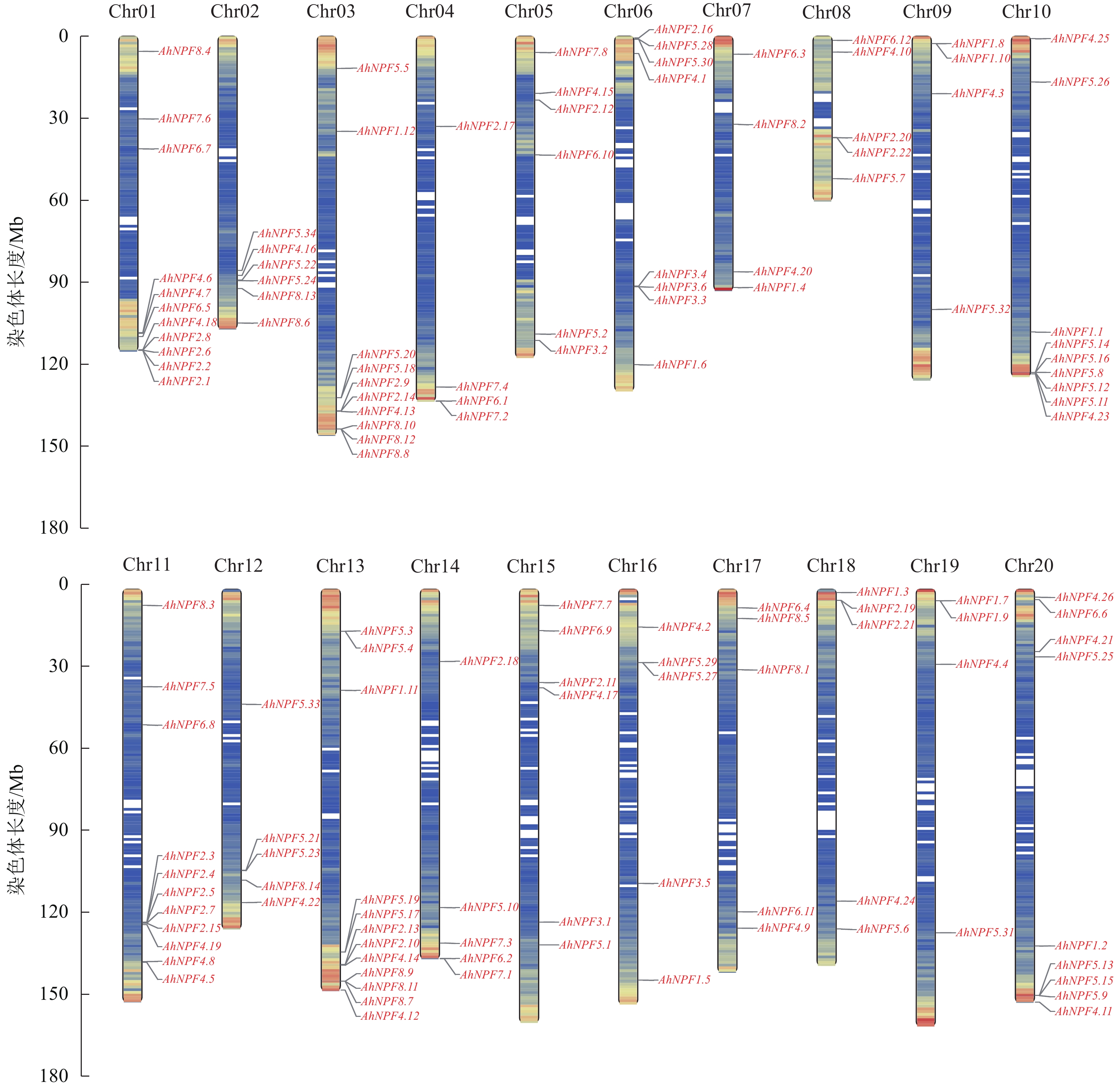
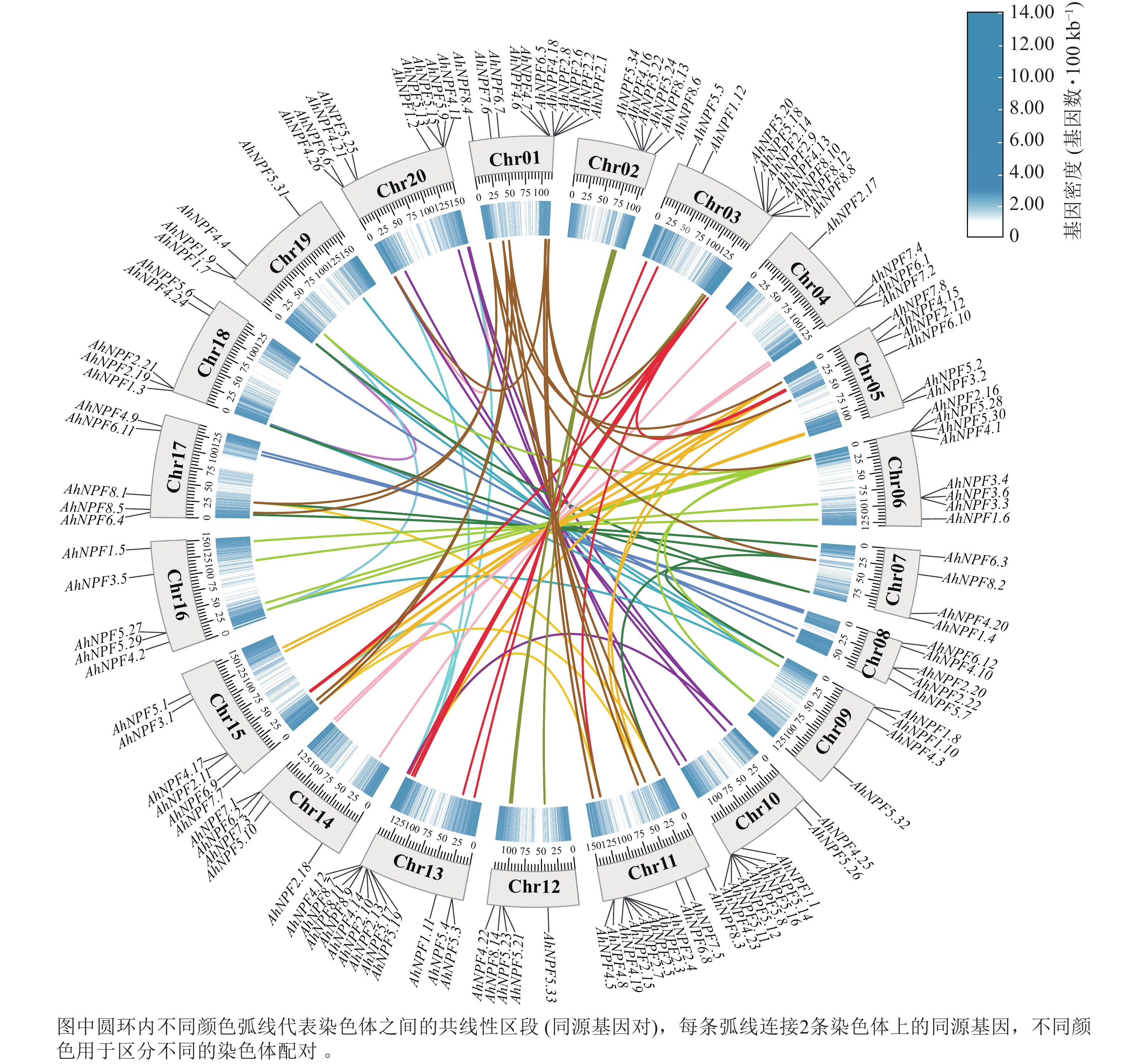
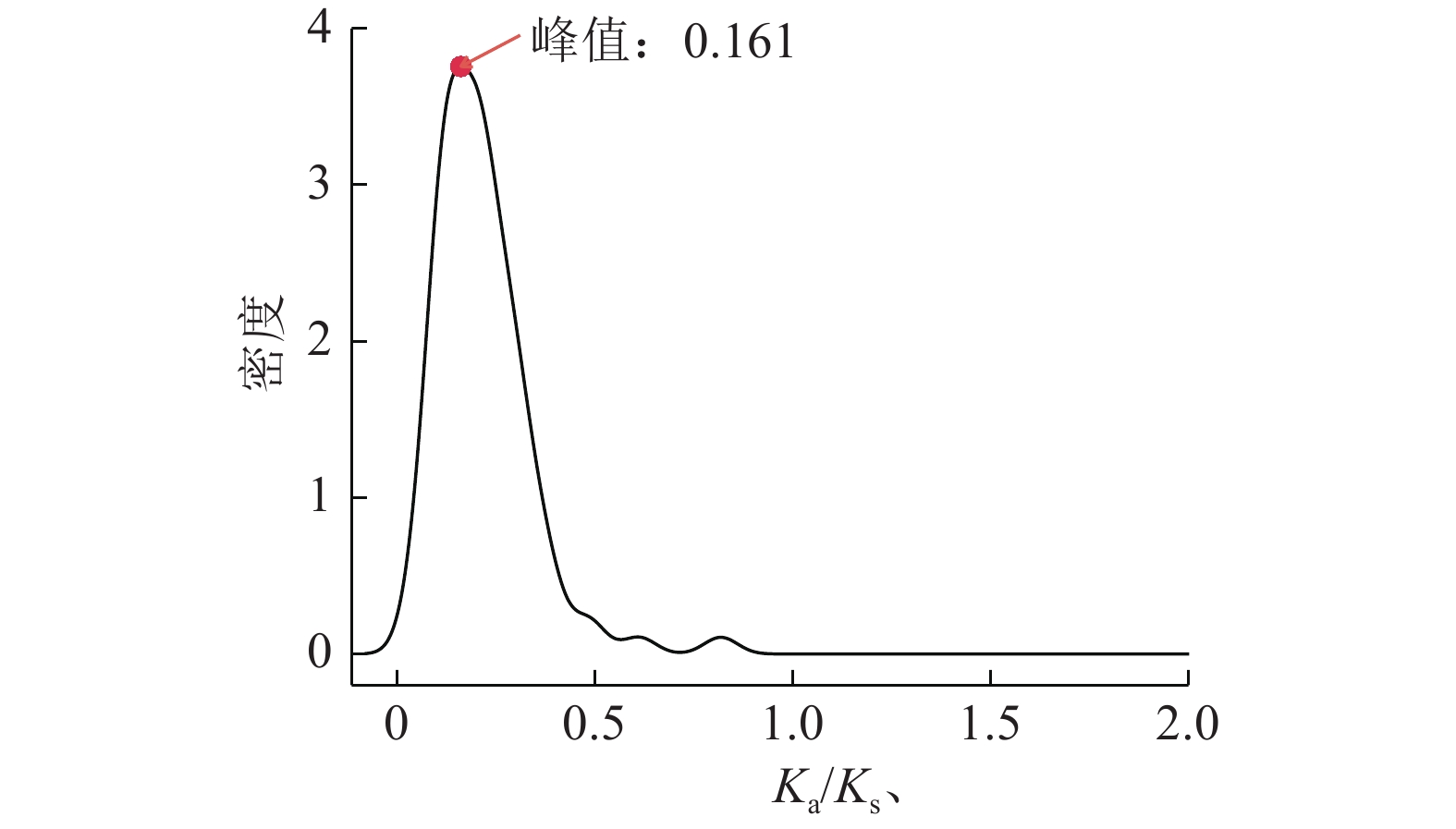
    • 染色体定位分析结果表明(图2):134个AhNPF基因不均匀地分布在花生的20条染色体上。其中,Chr13上分布的基因数量最多,并在Chr03、Chr13等染色体末端形成明显串联重复基因簇。本研究通过Circos图分析了花生AhNPF基因家族的染色体分布与复制事件(图3)。结果显示:AhNPF基因家族成员在20条染色体上广泛分布,但分布不均匀,部分染色体存在基因聚集现象。基因复制事件分析共鉴定出24对串联重复基因和68对片段重复基因,表明片段重复是AhNPF基因家族扩张的主要方式,而串联重复也在局部扩张中发挥了补充作用。为解析花生AhNPF基因家族复制基因对的进化选择压力,本研究计算了所有片段复制和串联复制基因对的Ka/Ks值,并绘制了核密度分布曲线(图4)。结果显示:AhNPF基因对的Ka/Ks值的分布峰值为0.161,绝大多数基因对的比值显著小于1。
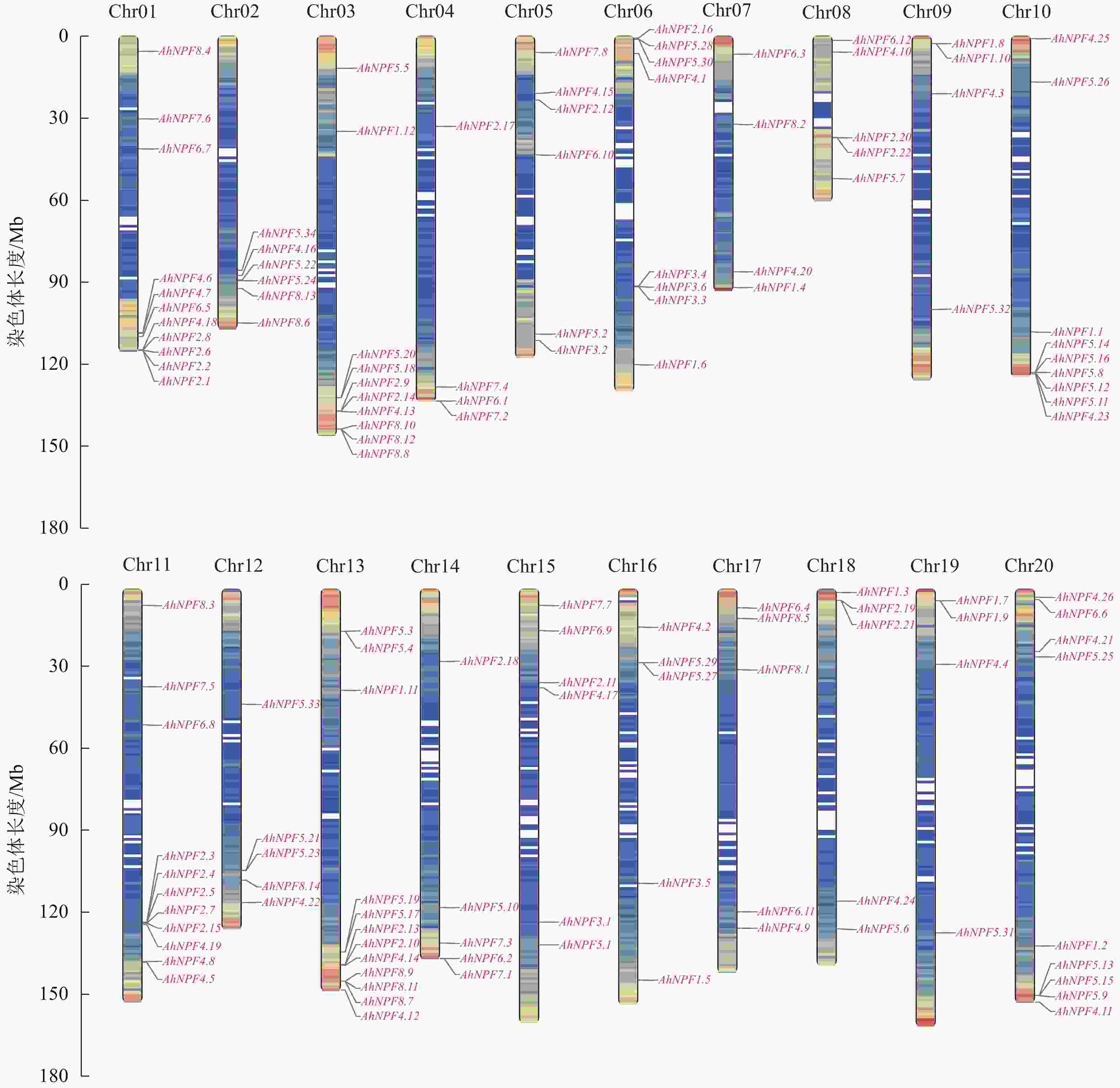
      Figure 2.  Chromosome mapping of NPF gene family members in A. hypogaea
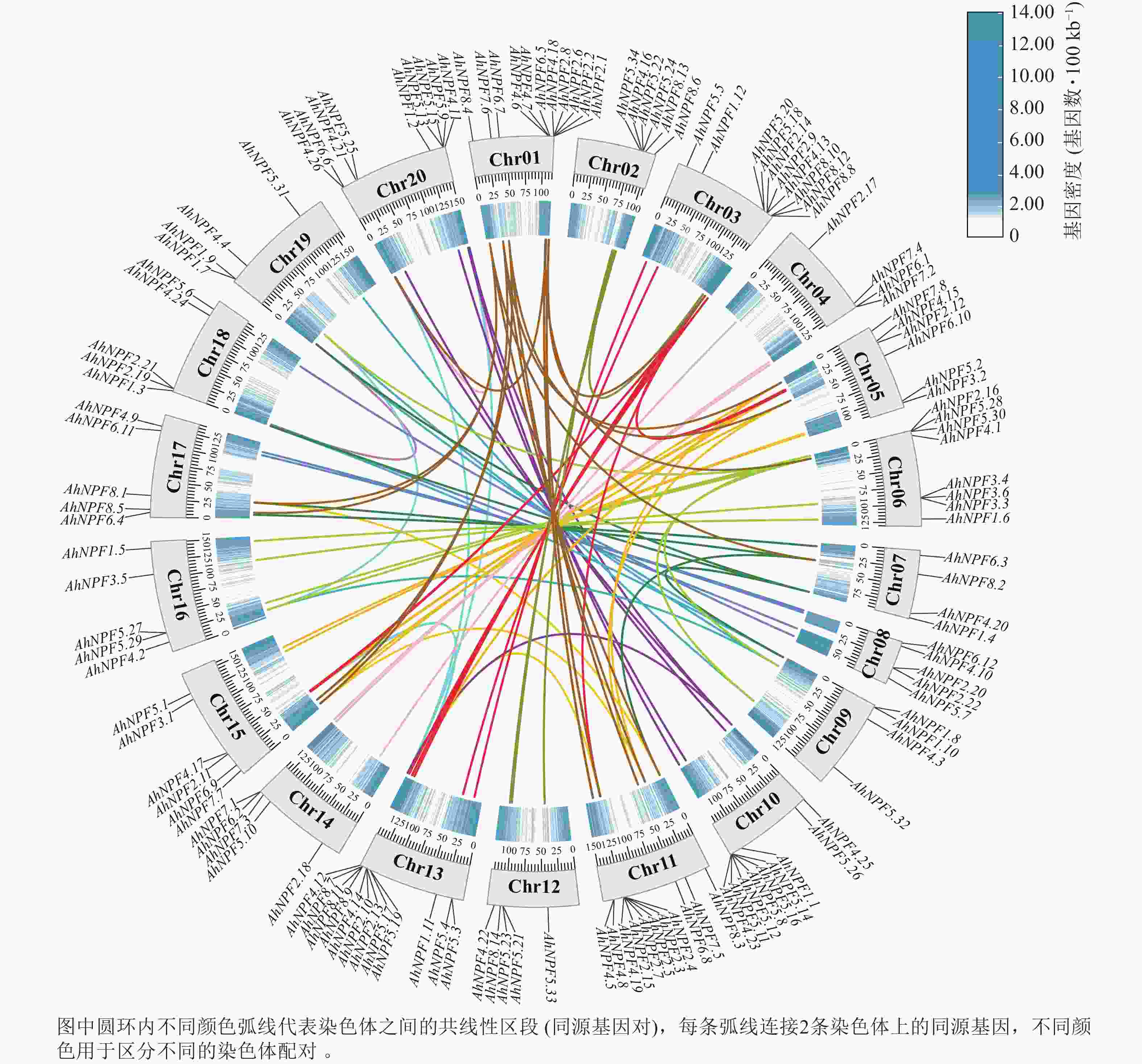
      Figure 3.  Distribution of segmentally duplicated NPF genes in the A. hypogaea genome generated by Circos
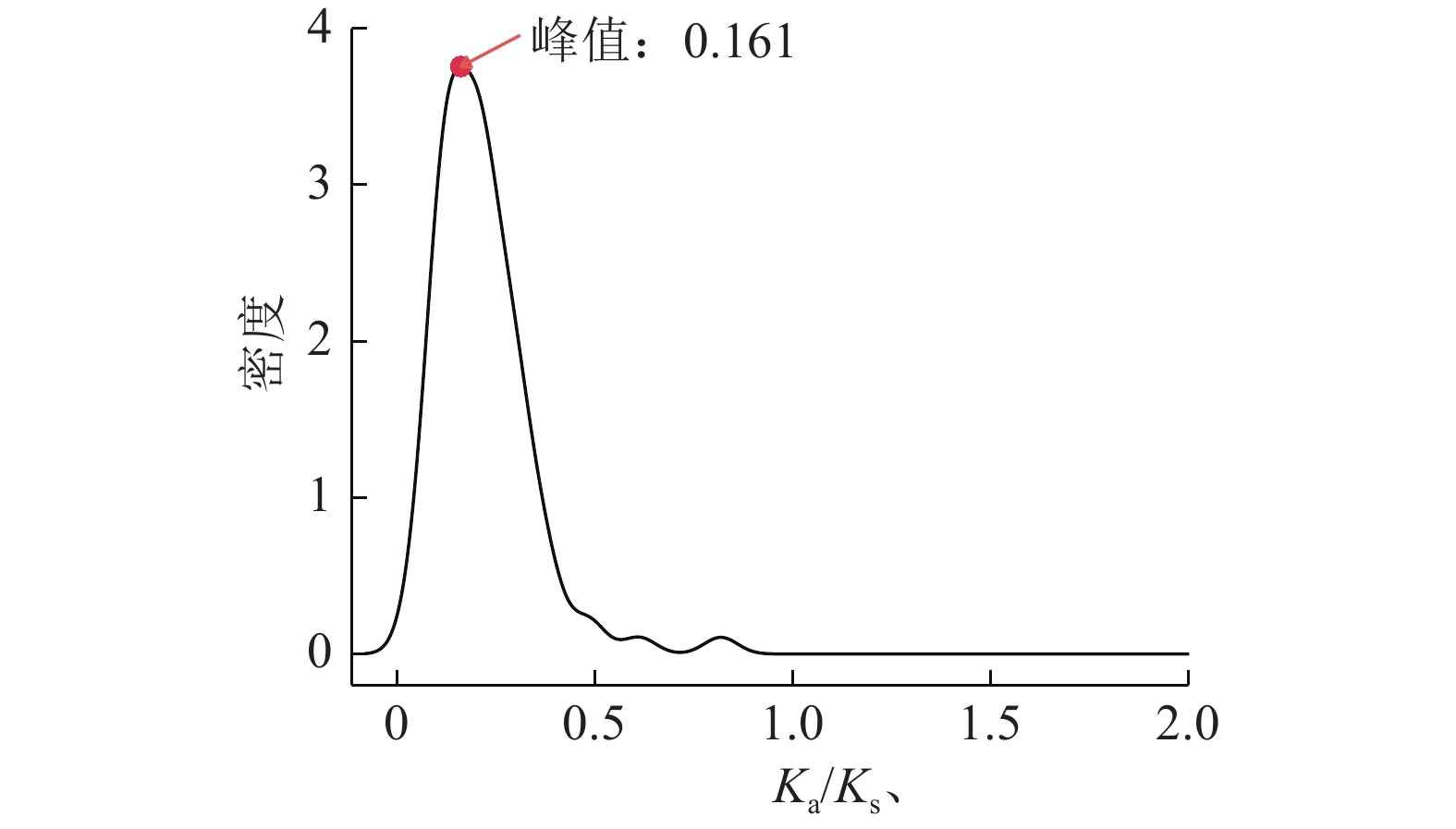
      Figure 4.  Density distribution plot of Ka/Ks values for the NPF gene family in A. hypogaea

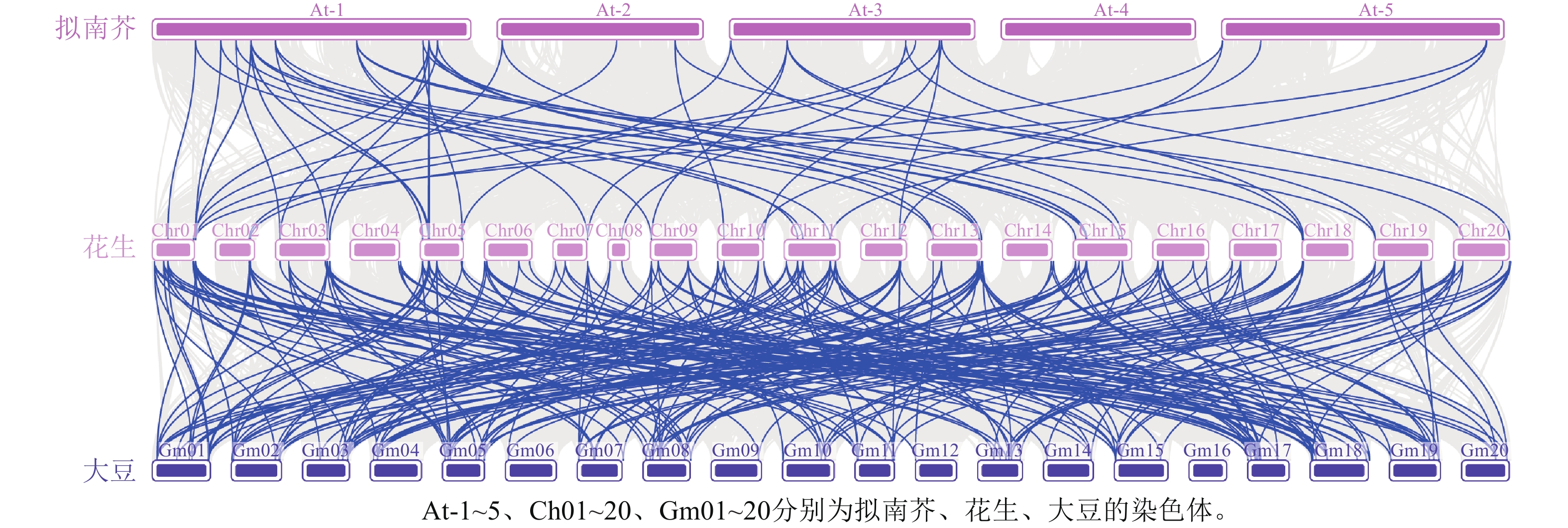
      种间共线性分析结果表明(图5):花生与大豆Glycine max间存在高度的共线性关系,两者20条染色体间形成了密集的共线性连线,共鉴定出271对同源共线性基因;花生与拟南芥Arabidopsis thaliana共线性关系相对稀疏,仅鉴定出74对同源共线性基因,在拟南芥与花生多条染色体间保留了部分保守的同源基因对。这一结果表明,NPF家族在豆科Fabaceae植物的进化过程中具有高度的保守性,且花生在进化过程中发生了物种特异性的基因复制事件,可能与NPF5和NPF4亚家族扩张有关。
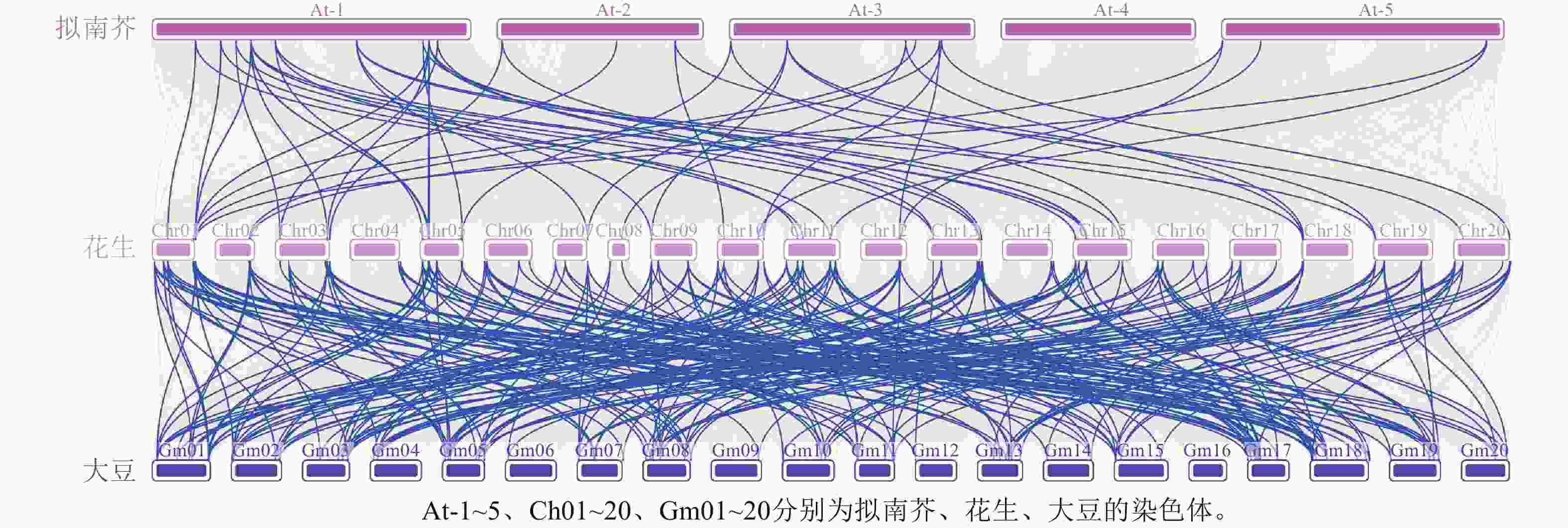
      Figure 5.  Syntenic analysis of NPF genes among Arachis hypogaea, Arabidopsis thaliana and G. max

    • 对花生NPF基因上游启动子区域的顺式作用元件进行分析(附图2),结果表明:转录因子结合元件中,MYB元件有583个,MYC元件有498个,两者常与植物胁迫响应和次生代谢调控相关,表明NPF家族可能通过MYB/MYC介导的信号通路参与花生的抗逆调控;激素响应元件中,脱落酸响应元件ABRE的数量最多,为307个;其次为乙烯(ETH)响应元件ERE (293个)、茉莉酸甲酯(MeJA) 响应元件TGACG-motif和CGTCA-motif (各141个),提示AhNPF基因可能受到脱落酸、乙烯和茉莉酸甲酯等激素信号的调控;光响应元件G-box (242个)和GT1-motif (196个)的分布表明,AhNPF基因可能参与花生光合作用或光周期调控的生物学过程;非生物胁迫相关元件中,检测到厌氧诱导元件ARE (201个)、机械损伤响应元件WUN-motif (111个)和干旱响应元件MBS (69个),提示NPF基因家族可能参与花生对厌氧、机械损伤和干旱等胁迫的响应。

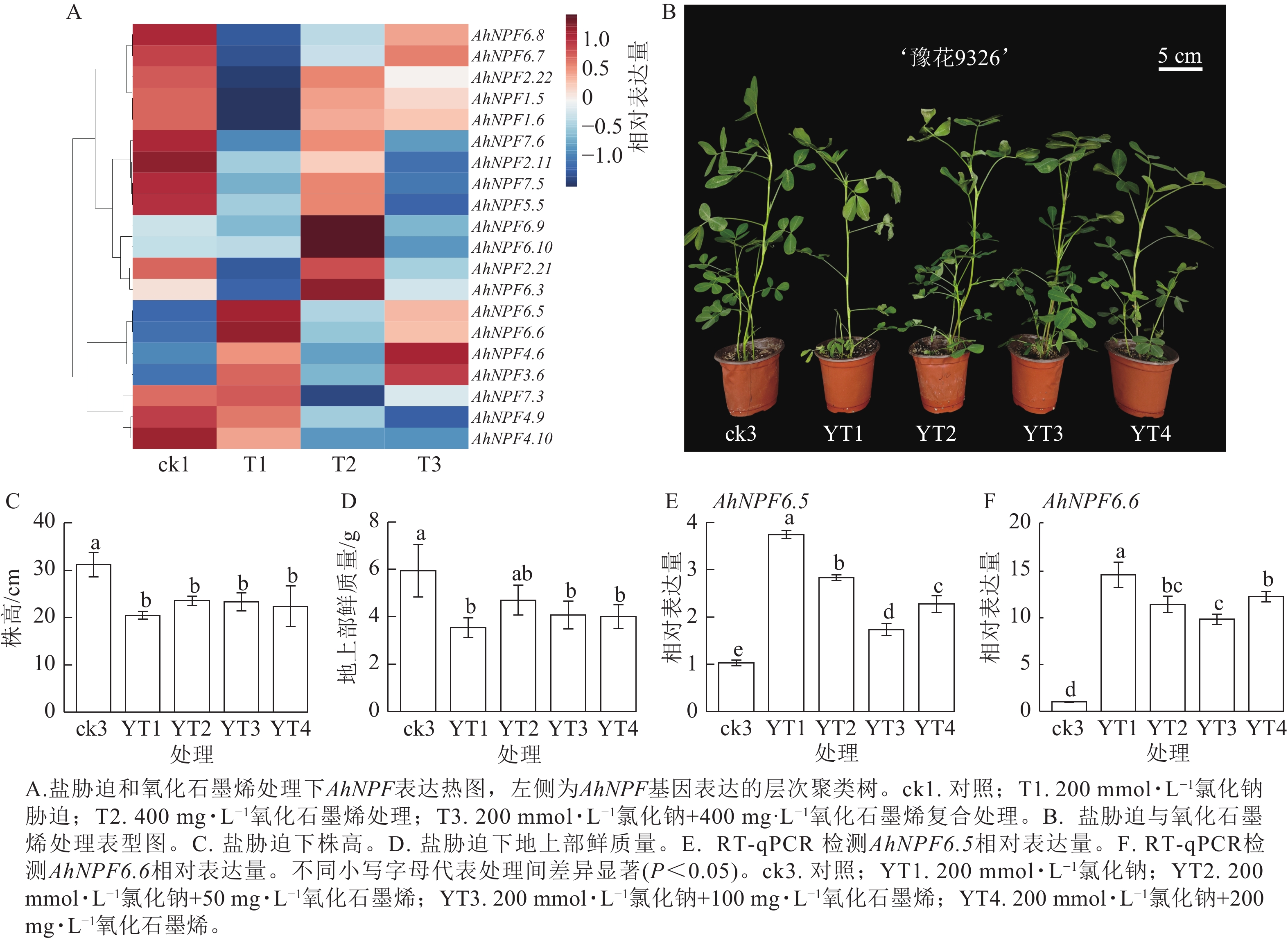
    • 基于公开转录组数据分析盐胁迫下AhNPF基因家族的表达变化。在134个AhNPF家族基因中,筛选获得20个盐胁迫响应基因。结果显示:氯化钠胁迫显著改变了部分AhNPF基因的表达模式,其中部分基因在盐胁迫处理后明显上调,表现出较强的盐胁迫响应特征;另有部分基因表达水平下降,说明AhNPF家族成员对盐胁迫存在差异化转录响应。与氯化钠单独处理相比,氧化石墨烯与氯化钠复合处理后部分盐胁迫诱导型基因的表达水平出现回落,提示氧化石墨烯可能影响盐胁迫条件下AhNPF基因的表达响应(图6A)。
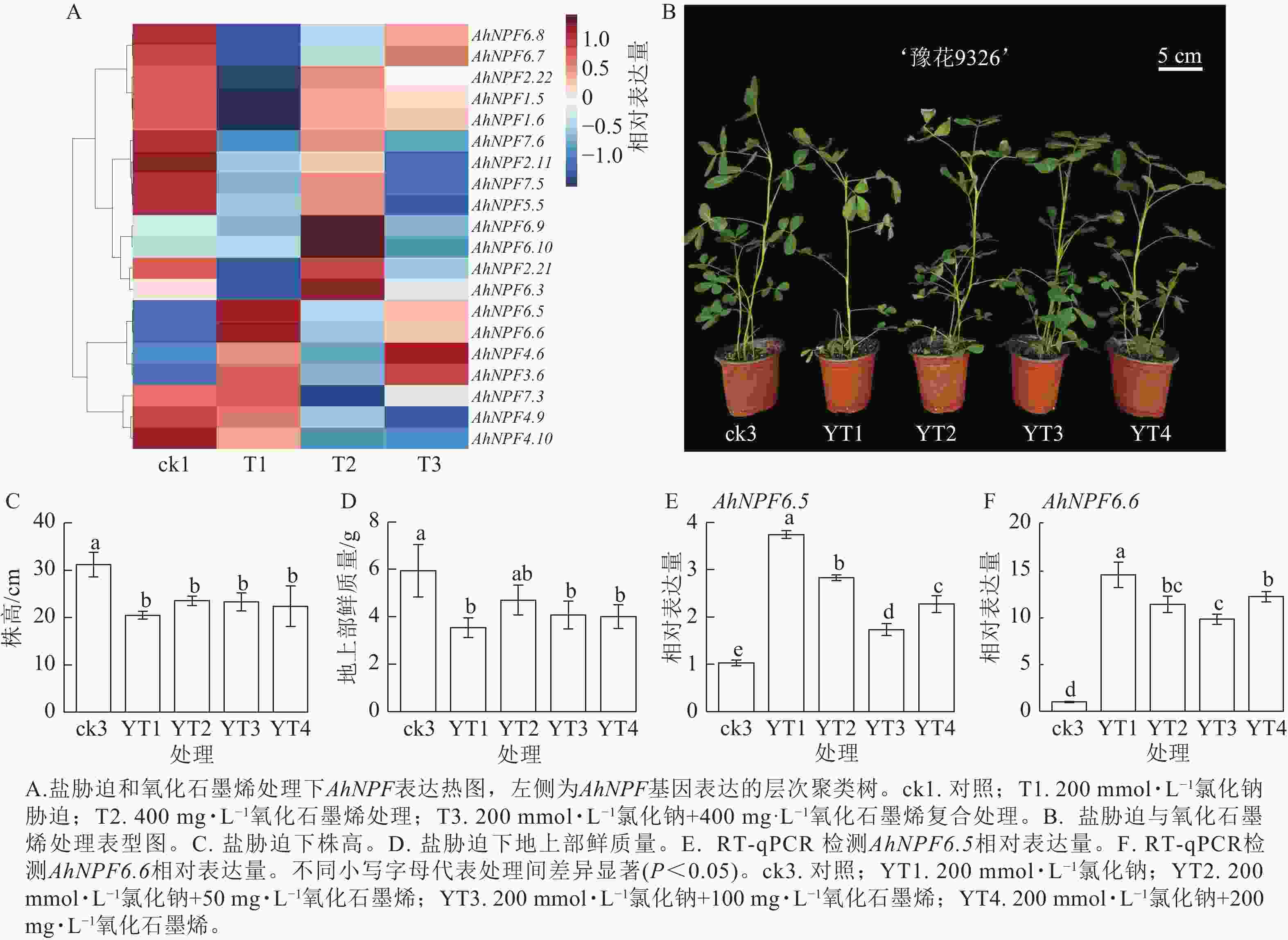
      Figure 6.  Expression validation of AhNPF genes and growth parameters of A. hypogaea under salt stress

      表型分析结果显示:氯化钠胁迫显著抑制花生幼苗生长,表现为株高和地上部鲜质量降低(P<0.05);氧化石墨烯复合处理可不同程度缓解盐胁迫造成的生长抑制,其中100 mg·L−1 氧化石墨烯处理效果较为明显(图6B~D)。为进一步验证转录组分析结果,本研究从盐胁迫下显著上调的基因中选取AhNPF6.5和AhNPF6.6进行RT-qPCR验证。结果表明,AhNPF6.5和AhNPF6.6在氯化钠胁迫下均显著上调(P<0.05),而氯化钠+氧化石墨烯复合处理使2个基因表达量出现不同程度下降,其中氯化钠+100 mg·L−1 氧化石墨烯处理下回调幅度较明显。RT-qPCR结果与转录组表达趋势基本一致(图6E、F),表明AhNPF6.5和AhNPF6.6可作为花生盐胁迫响应候选基因,氧化石墨烯处理可能通过缓解胁迫强度而降低盐胁迫诱导的转录响应水平。

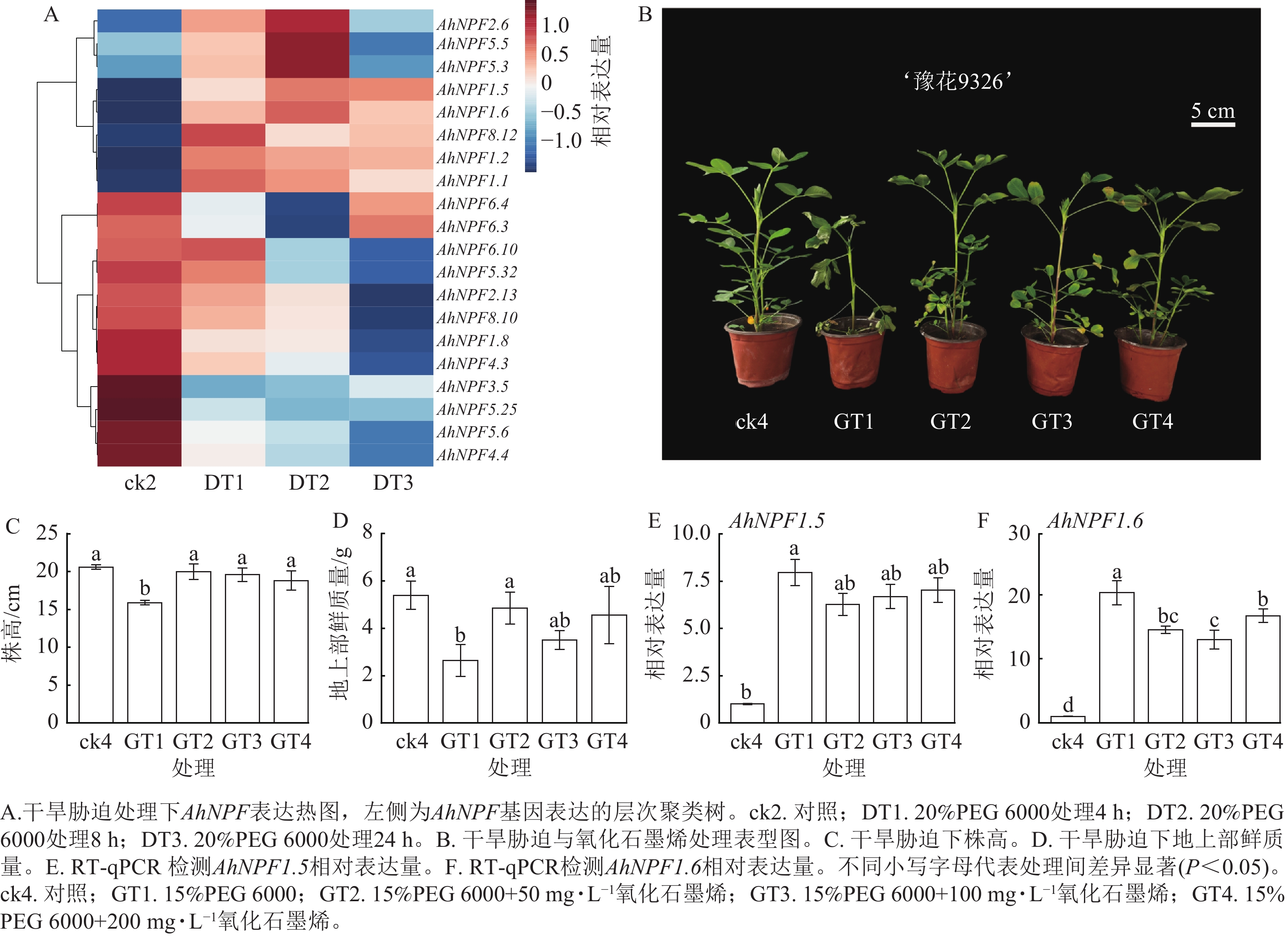
    • 基于公开转录组数据分析干旱胁迫下AhNPF基因家族的表达变化(图7A)。在AhNPF基因家族中,筛选出干旱胁迫响应基因。结果显示:家族成员对干旱胁迫呈现差异化的表达模式,部分基因在干旱处理后表达水平显著上调,另一部分基因表达受到抑制,表现出明显的转录响应差异。部分成员在PEG 6000处理组(DT1、DT2、DT3)中诱导表达显著(P<0.05),提示这些AhNPF基因可能参与花生对干旱逆境的应答过程,不同亚家族成员对干旱胁迫的响应程度存在区别。
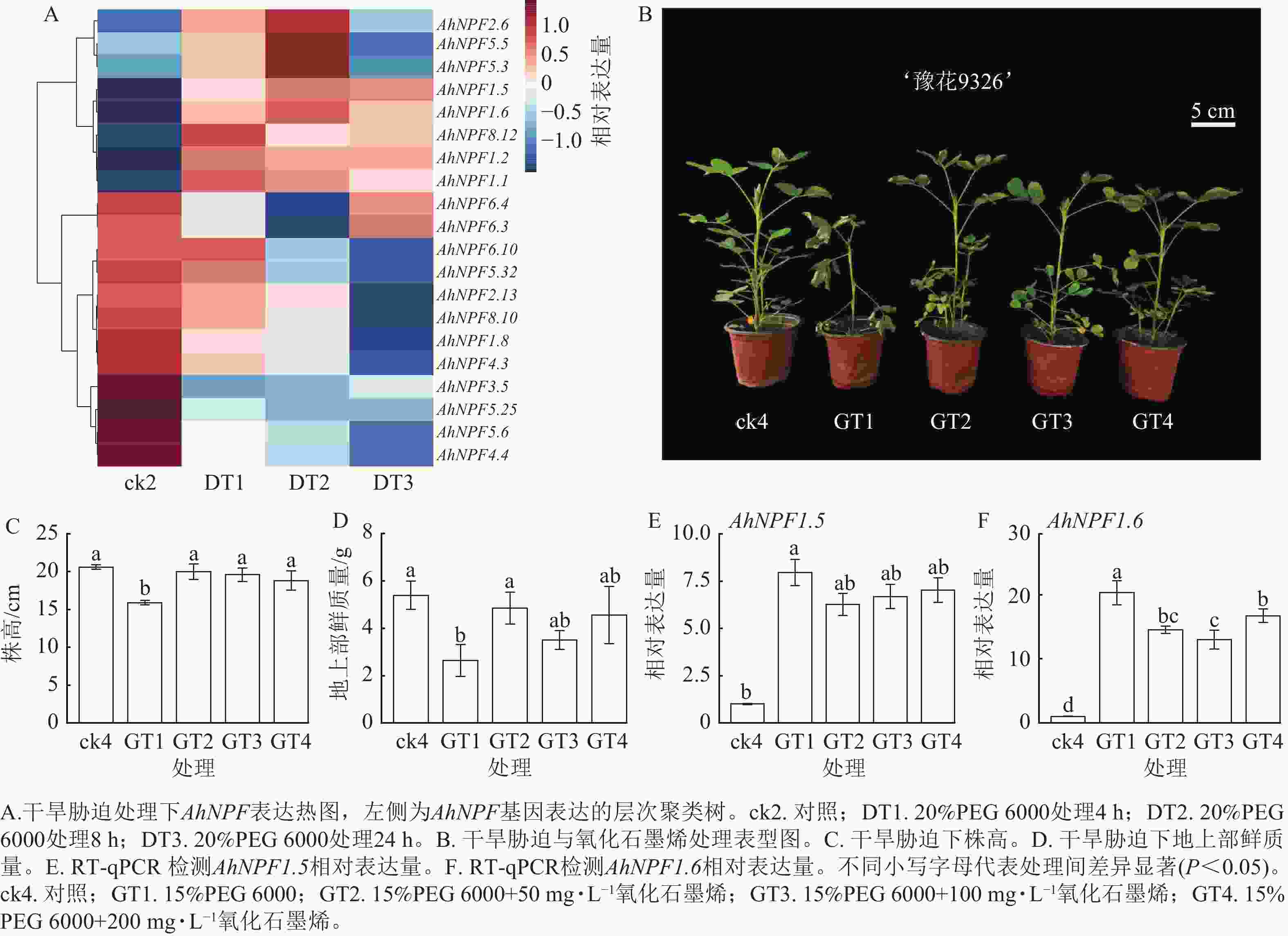
      Figure 7.  Expression validation of AhNPF genes and growth parameters of A. hypogaea under drought stress

      表型分析结果显示:PEG 6000模拟干旱胁迫显著抑制花生幼苗生长(P<0.05),表现为株高和地上部鲜质量降低;而PEG 6000与氧化石墨烯复合处理可不同程度缓解干旱胁迫造成的生长抑制,改善幼苗生长状态(图7B~D)。为进一步验证转录组分析结果,本研究从干旱胁迫响应基因中选取AhNPF1.5和AhNPF1.6进行RT-qPCR验证。结果表明:PEG 6000处理显著诱导AhNPF1.5和AhNPF1.6表达(P<0.05),与转录组分析结果基本一致;与PEG 6000单独处理相比,PEG 6000+氧化石墨烯复合处理后2个基因表达水平均出现不同程度下降(图7E、F)。上述结果表明,AhNPF1.5和AhNPF1.6可作为花生干旱胁迫响应候选基因,氧化石墨烯处理可能通过缓解干旱胁迫而影响相关基因的诱导表达水平。

    • 基因家族的全基因组鉴定高度依赖于基因组组装的完整性。以往基于碎片化基因组的研究常因序列缺口导致鉴定不全或启动子分析偏差。基于花生T2T基因组,本研究鉴定获得134个AhNPF成员,为花生NPF家族系统分析提供了基因资源。这一数量远高于拟南芥(53个)[7]、水稻(93个)[13],低于小麦(331个)[16],说明异源四倍体化和后续基因复制事件可能是驱动该家族扩张的重要原因。

      共线性和复制模式分析表明:片段重复是AhNPF家族扩张的主要驱动力,串联重复在局部形成了部分基因簇。这一扩张模式与大豆[35]、棉花[15]等其他异源多倍体作物中NPF家族的进化特征相符,表明全基因组复制和片段复制是植物NPF家族规模扩大的重要机制。Ka/Ks分析结果进一步揭示了AhNPF家族扩张后的进化选择约束。绝大多数基因对的比值显著小于1,表明该家族在进化过程中主要受到强烈的纯化选择压力,非同义突变受到严格的选择约束,以维持蛋白序列和功能的保守性。这一结果表明,NPF家族作为植物中负责硝酸盐、寡肽、植物激素等多种底物跨膜转运的核心蛋白家族[36],其转运功能相关核心结构域通常需要保持较高保守性,破坏核心功能的非同义突变可能更易受到负选择作用[37]。这种纯化选择趋势与Motif和基因结构的保守性基本一致。与此同时,基因结构和保守基序分析显示,同一亚家族成员之间外显子-内含子结构和Motif组成高度一致,而不同亚家族之间又存在明显差异,说明该家族既保持了较强的结构保守性,又在不同进化分支上形成了潜在的功能分化,为后续基于亚家族推测功能提供了依据。

    • NPF家族不仅参与硝酸盐等营养物质跨膜转运,也与植物激素运输和逆境响应密切相关。本研究在AhNPF基因启动子区域鉴定到大量ABRE、ERE、MYB、MYC和MBS等激素及胁迫响应元件,提示AhNPF基因具备参与非生物胁迫调控的潜力[38−39]。结合公开转录组数据可以看出,AhNPF6.5和AhNPF6.6在盐胁迫条件下显著诱导,AhNPF1.5和AhNPF1.6在干旱胁迫条件下持续高表达,提示这几类基因可能是花生响应盐和干旱胁迫的重要候选成员。与此同时,部分基因在胁迫下被抑制,说明NPF家族在不同亚家族、不同成员之间存在明显的表达分化,这种分化可能与其启动子元件组成及进化来源差异有关。

      为进一步验证转录组筛选结果,本研究对AhNPF6.5、AhNPF6.6、AhNPF1.5和AhNPF1.6进行了RT-qPCR分析。结果表明:AhNPF6.5和AhNPF6.6在氯化钠胁迫下显著上调,AhNPF1.5和AhNPF1.6在PEG 6000模拟干旱胁迫下明显诱导,RT-qPCR结果与转录组表达趋势基本一致,增强了候选基因筛选结果的可靠性。AhNPF6.5和AhNPF6.6属于NPF6亚家族,该亚家族在烟草[19]、甜瓜[20]等作物中已被证实兼具硝酸盐转运与耐盐功能。这一结果与其他作物中NPF6亚家族参与盐胁迫响应的报道相一致,提示AhNPF6.5和AhNPF6.6可能参与花生盐胁迫响应。AhNPF1.5和AhNPF1.6属于NPF1亚家族,其在干旱胁迫下持续上调,提示其可能参与干旱条件下氮素转运、渗透调节或激素信号调控过程。

      氧化石墨烯复合处理后,上述胁迫诱导型AhNPF基因表达水平均较单一胁迫处理出现不同程度回调。该现象可能并不意味着氧化石墨烯直接抑制AhNPF基因表达,而更可能反映氧化石墨烯缓解盐、干旱胁迫后,植株所感受到的胁迫强度降低,从而导致胁迫响应基因表达水平下降。表型结果也支持这一推测,盐胁迫和PEG 6000模拟干旱胁迫均显著抑制花生幼苗生长,而氧化石墨烯复合处理可提高胁迫条件下的株高和地上部鲜质量,说明氧化石墨烯能够在一定程度上缓解非生物胁迫造成的生长损伤。

    • 本研究基于花生T2T高质量基因组,全基因组鉴定获得134个AhNPF基因,划分为8个亚家族。AhNPF蛋白主要定位于质膜,多数成员表现为疏水性稳定蛋白特征;片段重复是驱动家族扩张的主要方式,纯化选择在维持家族功能保守性中发挥重要作用。AhNPF基因启动子富含激素及非生物胁迫响应元件,在盐和干旱胁迫下呈现差异化表达模式。转录组分析和RT-qPCR验证表明:AhNPF6.5和AhNPF6.6在氯化钠胁迫下显著上调,可作为盐胁迫响应候选基因;AhNPF1.5和AhNPF1.6在PEG 6000模拟干旱胁迫下明显诱导,可作为干旱胁迫响应候选基因。氧化石墨烯处理可在表型层面缓解盐和干旱胁迫对花生幼苗生长的抑制,并使相关胁迫诱导型AhNPF基因表达水平发生回调。本研究为花生NPF基因家族后续功能研究及抗逆育种提供了候选基因资源和参考依据。

Reference (39)

Catalog

    /

    DownLoad:  Full-Size Img  PowerPoint
    Return
    Return