






-
2023年全国城乡建设统计数据显示:中国现有自然村约234万个,农村常住人口达6.2亿人,农村生活污水年排放量高达345.3亿t。在污水排放总量持续高位运行与水资源供需矛盾日益突出的双重压力下,推动农村生活污水从末端治理对象向可利用资源转变,已成为缓解农业用水短缺、促进乡村绿色发展的关键路径。近10 a来,关于“农村生活污水”与“资源化利用/农业回用”领域的相关研究迅速发展,中国知网(CNKI)和Web of Science (WOS)两大数据库在该领域的年度发文量整体均呈增长态势。研究热点从前期的“水质特征与处理工艺评价”,向“土壤肥力与物理属性提升”“微生态响应机制”,再向“微塑料与抗生素等新污染物风险评估”逐步转变。科学合理的资源化利用能有效提升土壤有机质含量,补充氮磷等养分,改善土壤肥力与保水保肥能力,促进作物生长、提高产量[1]。同时,与工业废水相比,农村生活再生水水质差异小、水体分散、氮磷含量高、生物降解性好,一般不含重金属等有毒物质,作为营养补剂时,灌溉回用安全性更易保障[2−4]。然而,农村生活污水回用于农田易引发土壤盐渍化及引入新型污染物等潜在生态环境风险[5−7],其安全回用阈值的界定及其与长期生态效应之间的内在关联,仍有待深入探究。本研究系统梳理农村生活污水资源化利用的“双刃剑”效应,剖析对土壤与作物的影响及环境健康风险,为农村生活污水的安全可持续利用提供科学依据。
-
农村生活污水源于居民烹饪、洗涤等日常活动,按来源与污染特性可分为灰水和黑水。灰水主要来自厨房的洗涤、烹饪以及家庭的沐浴和洗衣等活动,约占农村生活污水的60%[8]。其主要成分包括食物残渣、油脂、表面活性剂、有机物、氮和磷等[9]。此外,灰水中还可能含有抗生素、环境激素等新型微量污染物,构成潜在的环境与健康风险[10]。黑水是冲洗厕所粪便产生的高浓度生活污水,其特点是富含氮磷等营养物质。中国部分省份农村生活污水水质情况显示:黑水质量浓度均显著高于灰水(表1),表明黑水是农村生活污水污染物的主要来源[17−18]。同时,农村生活污水水质存在地域差异:北方因气候干燥、降水少,污水易因蒸发浓缩而污染物浓度偏高[19];南方气候湿润、降雨充沛,雨季雨水会稀释污水,但旱季污染物浓度会快速回升[20−21]。
表 1 中国部分省份农村生活污水水质特征情况
Table 1. Characteristics of rural domestic sewage quality in some provinces of China
类型 省份 水质指标/(mg·L−1) 参考文献 化学需氧量 固体悬浮物 铵态氮 总氮 总磷 黑水 江西 626.5 216.2 112.6 183.6 20.1 [11] 湖北 1 042.0 1 139.7 97. 4 158.4 35.9 [12] 江苏 957.0 123.0 411.3 29.2 [13] 浙江 1 042.5 124.2 187.5 [14] 灰水 江西 487.5 67.5 19.4 33.9 1.7 [11] 湖北 549.0 6.0 21.2 2.4 [12] 四川 135.0 7.2 8.7 1.0 [15] 山东 504.4 64.4 3.1 14.5 1.9 [16] 农村生活污水的产生与排放也存在明显的时空特征分布。首先,污水排放量普遍呈现“夏高冬低”的规律,夏季排放量通常比冬季高20%至50%[22]。这主要是因为夏季高温导致居民洗浴、洗衣等用水活动增加。其次,是经济发达地区(如华东城郊)的人均日排放量远高于欠发达地区[23−24]。发达地区用水设施完善,生活方式趋于城市化,促使用水量和污水产生量增加。
-
污水灌溉可以通过输入大量溶解性有机物和悬浮颗粒物,促进土壤大团聚体的形成与稳定,从而降低土壤容重,提高土壤孔隙度和持水能力。然而,物理属性的改善并非绝对,WANG等[25]分析指出:污水灌溉显著改变了土壤的水力学特性,长期灌溉含钠盐较高的污水或未经充分沉淀的污水,可能导致土壤胶体分散,引起土壤毛细孔隙堵塞,进而导致土壤板结、降低入渗率和导水率,影响根系呼吸。
-
农村生活污水资源化利用可直接影响土壤肥力[26]。国内外多数研究证实:无论污水处理程度如何,灌溉均能有效提升土壤有机质含量(表2)。污水本身是外源有机碳的直接来源[34],通过三维荧光光谱等技术解析发现:污水溶解性有机物(DOM)中既包含易于降解的类蛋白组分,也包含大量结构复杂、化学性质稳定的类腐殖质与类富里酸组分[35]。易分解有机碳与矿物表面结合形成稳定的微团聚体[36−37];而难降解组分则作为持久结合剂促进大团聚体形成,延缓了有机质的分解[38]。谢芳[39]针对棕壤水稻土的研究证实:再生水灌溉能显著促进深层土壤有机碳的累积;马鑫文[27]在安岳县的长期试验进一步表明:农村生活污水资源化利用显著改变了浅层土壤的地球化学特征和养分分布规律。
表 2 农村生活污水对土壤有机质的影响
Table 2. Impact of rural domestic sewage on soil organic matter
地点 农村生活污水类型 灌溉的植
物/作物灌溉时长 试验场地 土壤深
度/cm土壤有机质变化 参考
文献四川省安岳县南薰镇红山村 化粪池处理 蔬菜 123 d 农田 0~20 增长150.00% 玉米、红薯、
油菜0~20 少水量灌溉增加10.00%,
多水量灌溉增加29.00%[27] 山东省莱西市河头店镇东大寨村 经厌氧、好氧、沉淀预处理 小麦、玉米 自2006年起 农田 0~20 距污水进水口0~20、20~40和40~60 m处分别比对照提高6.30%、8.50%和9.30% [28] 浙江省金华市永康农村生活污水处理及回用基地 经多级处理及生态塘净化 水稻 2 a 试验小区 0~20 增加6.00% [29] 湖北省十堰市茅箭区南部山区 经二级处理的农村生活再生水 菠菜 5个月 农田 0~30 大约增加18.00% [30] 摩洛哥Tidili村 经混合人工湿地系统处理 紫花苜蓿 9个月 农田 0~20 增长约159.15% [31] 未经处理的原污水 增长177.46% 浙江省金华市永康市舟山镇集镇区舟三村 经一级处理 水稻 101 d 农田 0~20 平均增长52.80% [32] 江苏省苏州市农业科学院 经农村生活污水处理站处理 白菜 40 d 盆栽 0~15 农村生活再生水和化肥配
比为66.00%时增长8.26%[33] 说明:玉米Zea mays;红薯Ipomoea batatas;油菜Brassica napus;小麦Triticum aestivum;水稻Oryza sativa;菠菜Spinacia oleracea;紫花苜蓿Medicago sativa;白菜Brassica campestris chinensis。 农村生活污水作为一种富含氮磷等养分元素的水源,对土壤养分库具有显著影响。污水中的氮磷主要以铵态氮、硝态氮和可溶性磷酸盐等高生物有效性的形态存在,灌溉后可显著提升土壤表层全氮、速效磷和速效钾的含量,直接为作物生长提供养分,长期施用甚至可以部分替代化肥[30]。
-
在已有的研究中,污水灌溉对土壤pH的影响呈现升高、降低或无显著变化3种结果[40]。这种多样化的结果主要源于污水施用对土壤的酸化与碱化拮抗作用机制。一方面,污水可使土壤酸化:①污水中富含的氯化物与碳酸盐发生中和反应导致pH下降[41];②高浓度的铵态氮在氨氧化细菌(AOB)和氨氧化古菌(AOA)驱动的硝化过程中释放大量氢离子[42−43];③有机质矿化释放的有机酸引起酸碱度降低[44]。另一方面,污水也具有碱化能力,富含的碳酸氢根能有效中和产生的酸[29, 45]。土壤pH的最终变化是这2种作用相互博弈及土壤自身缓冲性能共同决定的结果。
-
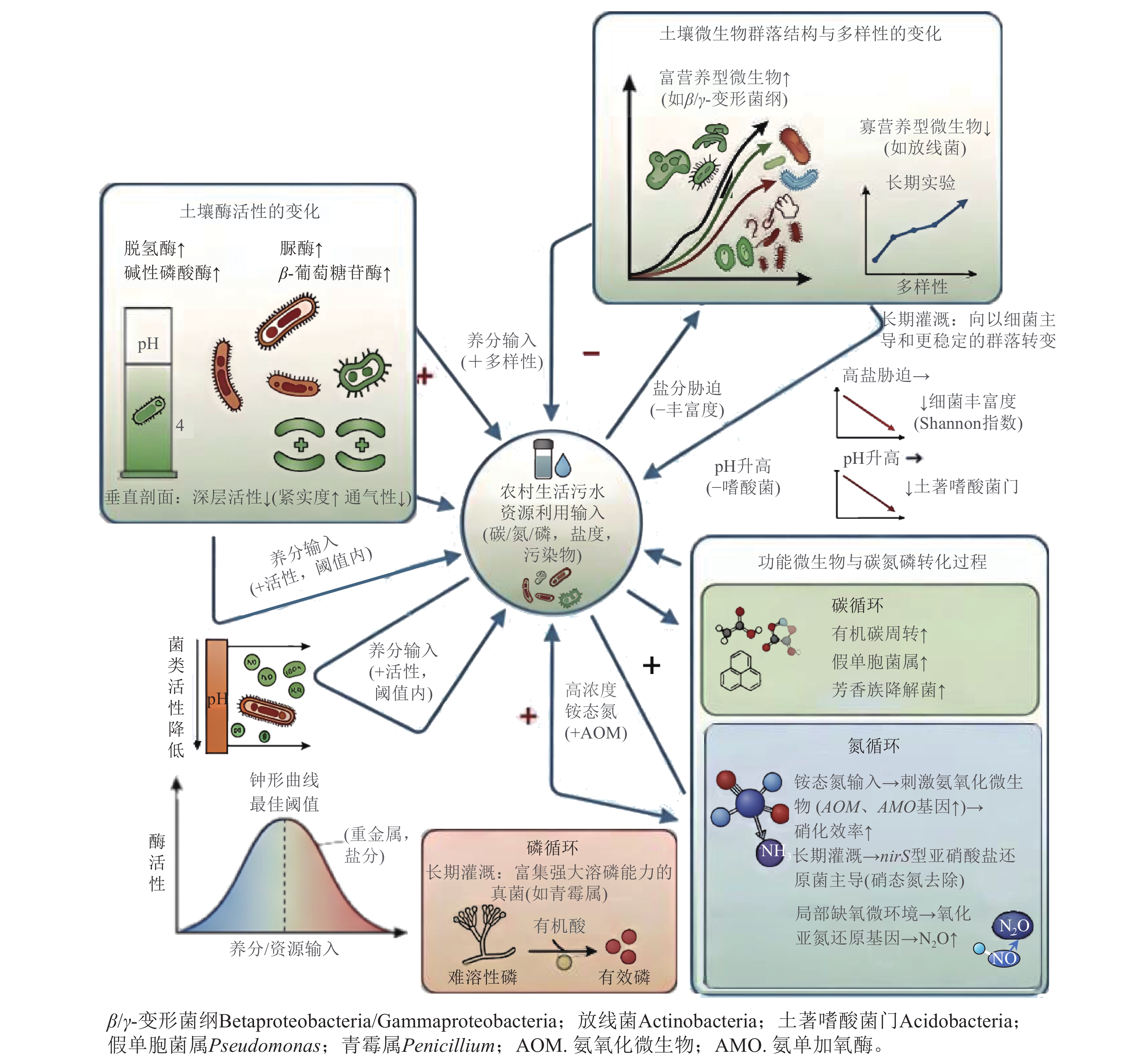
为了更清晰地展示资源化利用对土壤微生态的复杂驱动机制,本研究归纳了该机制的内在关联性,并构建了相应的结构示意图(图1)。
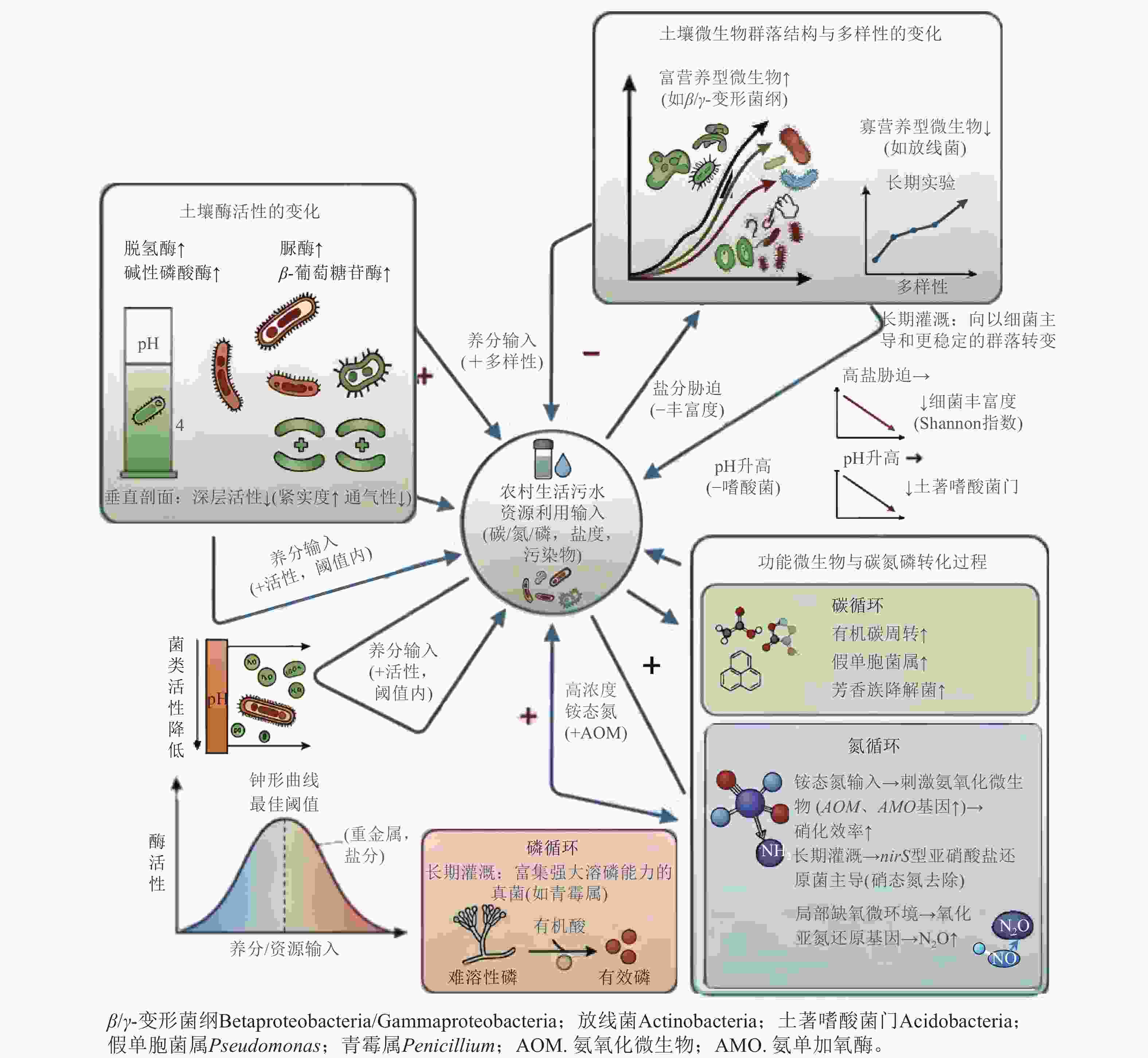
图 1 农村生活污水资源化利用对土壤微生态的驱动机制
Figure 1. Mechanisms driving the effects of rural domestic sewage recycling on soil microecology
农村生活污水通过输入营养物质,可显著提高土壤中β-变形菌纲Betaproteobacteria、γ-变形菌纲Gammaproteobacteria等富营养型微生物的相对丰度,降低放线菌Actinobacteria等寡营养型菌群比例[46−47]。长期研究发现:细菌、真菌和放线菌的群落多样性均随灌溉年限延长呈递增趋势[48]。然而,高盐环境会显著抑制细菌的物种丰富度,表现为细菌Shannon-Wiener指数随盐度升高而递减[49];灌溉导致的pH升高则会显著抑制土著嗜酸菌门Acidobacteria的丰度[50]。尽管存在短期波动,长期灌溉最终会促使土壤微生物群落向更稳定且以细菌为主导的类型转变[51]。
-
污水资源化利用可影响参与碳氮磷循环功能微生物的群落结构。在碳循环方面,污水中的脂肪族烷烃使得假单胞菌属Pseudomonas丰度显著增加,加速了有机碳周转;残留的芳香族组分会诱导芳香族降解菌上调降解基因的表达[47, 52]。在氮转化过程中,污水中高浓度的铵态氮作为底物直接刺激氨氧化微生物(AOM)的生长,提高氨单加氧酶(AMO)功能基因丰度,提升了硝化效率[53]。同时,长期灌溉下nirS型亚硝酸盐还原菌成为截留去除硝态氮的主导群落[54],而局部缺氧微环境会引起氧化亚氮还原基因(nosZ)表达异常,可能导致温室气体一氧化二氮(N2O)排放增加[55]。在磷转化方面,长期灌溉显著富集了具有强大溶磷能力的真菌(如青霉属Penicillium),通过分泌有机酸将无效磷转化为植物可利用的有效磷[56−57]。
-
酶活性是反映微生态代谢活力的关键指标。污水资源化利用可显著提升表层土壤中脱氢酶、脲酶、碱性磷酸酶及β-葡萄糖苷酶的活性[58−60]。然而,该效应的影响呈现典型的“钟形曲线”特征,即在特定阈值内酶活性随养分输入而递增,一旦超过该阈值,则可能因重金属累积或盐分胁迫等负面效应而产生抑制作用[61]。在垂直剖面上,深层土壤的酶活性也可能因物理紧实度增加和通气性变差,而呈现下降的趋势[62]。
-
农村生活污水富含植物生长所必需的营养元素,能够被植物根系更迅速地吸收利用,在贫瘠土壤中能呈现出类似化学施肥的增产效应[63−66]。据已有研究报道:通过污水灌溉可使玉米Zea mays、小麦Triticum aestivum等粮食作物增产10%~25%,蔬菜类作物(如白菜Brassica campestris chinensis、菠菜Spinacia oleracea)增产幅度可达15%~30%[27, 33]。在品质方面,再生水不仅降低了空心菜Ipomoea aquatica的硝酸盐含量,还能显著提升辣椒Capsicum annuum的维生素C含量[67−68]。
相较于传统化肥,配合污水灌溉的养分表观利用率平均可提升5%~12%[45]。从经济效益分析,污水资源化就近利用大幅减少了地下淡水的开采成本和化肥施用量,据测算,每公顷农田平均可节约农业综合生产成本15%~20%,展现出极高的经济与生态双重效益[46]。但需注意的是,长期过量灌溉可能伴随土壤盐分积累,通过渗透胁迫抑制根系吸水[69]。因此,必须集成精准调控技术以防范潜在风险。
-
在农村生活污水农田回用过程中,病原微生物带来的传播风险不容忽视。污水中通常含有沙门氏菌Salmonella、诺如病毒Norovirus等病原微生物,可通过气溶胶或直接接触途径对人体构成高危暴露,引发肠道疾病[70−71]。为保障农业安全,依据GB
5084 —2021《农田灌溉水质标准》以及世界卫生组织(WHO)指南,均对安全阈值做出了严格限定,如每100 mL回用水的粪大肠菌群安全阈值通常要求≤103 CFU或更低。因此,资源化利用前采用紫外线辐照、膜过滤等消毒技术至关重要[72]。农村生活污水中携带的微塑料对土壤系统的物理结构和生态功能也构成潜在威胁。研究表明:污水中的微塑料极易随优先流途径向深层土壤迁移,从而对地下水构成污染风险[73−74]。微塑料不仅破坏土壤团聚体导致保水能力下降[75],还会抑制脲酶等胞外酶活性[76],甚至穿透植物细胞在体内累积[77−79]。目前学术界对微塑料的土壤安全阈值尚无统一标准,但已有研究表明:当土壤微塑料质量分数超过1%时,作物的生物量和抗氧化系统将受到显著抑制,亟需研发如生物炭强化人工湿地等阻控技术[80]。
抗生素的累积是另一重大环境风险。由于农村抗生素使用不规范,四环素类等稳定型抗生素易在表层土壤强络合累积(半衰期长达9~180 d)[81−84]。高质量浓度抗生素不仅破坏碳氮磷循环微生物的功能[85−86],更会导致抗生素抗性基因(ARGs)在环境中的水平转移富集。环境管理上,目前正致力于将污水中目标抗生素的质量浓度降至预测无效应质量浓度(PNEC,多数抗生素的水生生态PNEC集中在10~1 000 ng·L−1)以下,利用厌氧消化等生物技术强化去除是降低此类风险的有效途径[87]。
-
本研究系统梳理了农村生活污水资源化利用的正面效应和潜在风险。科学合理的污水资源化利用不仅补充了宝贵的水资源,还能有效改善土壤物理结构、提升土壤肥力与酶活性,从而实现作物10%~30%的增产及经济成本的节约。但污水中携带的病原微生物及微塑料、抗生素等新污染物在超出安全阈值时,会严重损害微生态功能并威胁人类健康。未来研究可以从以下几个方面展开:①构建全方位长期定位观测与综合评估体系。鉴于目前缺乏长期、系统的监测数据,亟须在不同气候区域、土壤类型及技术模式下建立具有代表性的长期定位观测网络。通过对“土壤-地下水-农产品”系统进行连续跟踪,构建涵盖土壤健康、生态稳定性及农业经济效益的综合评估指标体系。基于长期实测数据,开发资源化利用的风险预警模型与决策支持系统,为实现分区域、差异化的灌溉定额管理与工艺参数优化提供坚实的数据支撑。②解析污水回用情境下的长期土壤微生态响应机制。深入探究长期污水灌溉对土壤微生物群落多样性、群落组成及关键功能菌群演替的驱动机制,特别是其对碳氮循环、有机物降解等关键生态过程的影响。重点关注抗生素抗性基因在土壤环境中的富集特征与传播风险,从微生态视角阐明资源化利用对土壤生态功能与生物安全的影响机制。③阐明污染物在“土壤-作物”系统中的多介质迁移转化归趋。针对重金属及微塑料、抗生素等新污染物,重点解析其在复杂环境介质中的吸附-解吸、生物转化等界面过程。探究污染物从土壤向作物可食用部位迁移的通量与富集规律,界定累积阈值。同时,建立污染物长期迁移转化的数学模拟模型,实现从污染源头到受体终端的全过程风险预测,为制定精准的阻控策略提供理论依据。
本文已在中国知网网络首发,可在知网搜索、下载并阅读全文。
农村生活污水资源化利用对土壤-作物的影响与风险研究进展
DOI: 10.11833/j.issn.2095-0756.20260114
Research progress on the impacts and risks of rural domestic sewage resource utilization on soil-crop systems
-
摘要: 随着水资源短缺问题日益严峻,将富含氮磷等营养元素的农村生活污水进行资源化利用,是实现“治污”与“兴农”双赢的重要途径。本研究综述了农村生活污水的水质特性及时空产排特征,系统剖析了污水资源化利用对土壤和作物的复杂影响及潜在的环境风险。研究表明:合理回用不仅能显著降低土壤容重、提升土壤有机质含量与肥力,还能重塑微生物的群落结构与酶活性,实现农作物10%~30%的增产及农业生产成本的节约,其效果受污水水质、灌溉时长、土壤深度等因素的综合影响。同时,资源化利用过程中,污水所含病原微生物及微塑料、抗生素等新污染物在土壤-作物系统中的迁移转化亦不可忽视,一旦超出安全阈值,可能通过食物链危及农产品质量安全及人类健康。本研究旨在厘清污水资源化利用的“双刃剑”效应,以期为建立安全、高效、可持续的农村生活污水资源化利用模式提供科学依据和理论支持。图1参87Abstract: As water scarcity becomes an increasingly pressing issue, the resource recovery of rural domestic sewage rich in nutrients such as nitrogen and phosphorus represents a crucial approach to achieving a win-win outcome for both pollution control and agricultural development. This paper reviews the water quality characteristics of rural domestic sewage and its spatiotemporal generation and discharge patterns, and systematically analyzes the complex impacts of sewage resource recovery on soil and plants, as well as its potential environmental risks. Studies have shown that appropriate reuse of rural domestic sewage can reduce soil bulk density and increase soil organic matter content and fertility. It can also reshape microbial community structure and enzyme activity, leading to a 10%–30% increase in crop yields and savings in agricultural production costs. These effects are influenced by a combination of factors, including sewage quality, irrigation duration, and soil depth. Meanwhile, the migration and transformation of pathogenic microorganisms, microplastics, antibiotics, and other emerging pollutants carried in sewage within soil-plant system during the resource recovery process must not be overlooked. If these pollutants exceed safety thresholds, they may pose potential threats to agricultural product quality and safety as well as human health through the food chain. This paper aims to clarify the “double-edged sword” effect of sewage resource recovery, and to provide scientific evidence and theoretical support for establishing a safe, efficient, and sustainable model for the resource recovery of rural domestic sewage. [Ch, 1 fig. 87 ref.]
-
Key words:
- rural domestic sewage /
- resource utilization /
- soil environment /
- crop growth /
- environmental risk
-
图 1 农村生活污水资源化利用对土壤微生态的驱动机制
Figure 1 Mechanisms driving the effects of rural domestic sewage recycling on soil microecology
表 1 中国部分省份农村生活污水水质特征情况
Table 1. Characteristics of rural domestic sewage quality in some provinces of China
类型 省份 水质指标/(mg·L−1) 参考文献 化学需氧量 固体悬浮物 铵态氮 总氮 总磷 黑水 江西 626.5 216.2 112.6 183.6 20.1 [11] 湖北 1 042.0 1 139.7 97. 4 158.4 35.9 [12] 江苏 957.0 123.0 411.3 29.2 [13] 浙江 1 042.5 124.2 187.5 [14] 灰水 江西 487.5 67.5 19.4 33.9 1.7 [11] 湖北 549.0 6.0 21.2 2.4 [12] 四川 135.0 7.2 8.7 1.0 [15] 山东 504.4 64.4 3.1 14.5 1.9 [16]  下载: 导出CSV
表 2 农村生活污水对土壤有机质的影响
Table 2. Impact of rural domestic sewage on soil organic matter
地点 农村生活污水类型 灌溉的植
物/作物灌溉时长 试验场地 土壤深
度/cm土壤有机质变化 参考
文献四川省安岳县南薰镇红山村 化粪池处理 蔬菜 123 d 农田 0~20 增长150.00% 玉米、红薯、
油菜0~20 少水量灌溉增加10.00%,
多水量灌溉增加29.00%[27] 山东省莱西市河头店镇东大寨村 经厌氧、好氧、沉淀预处理 小麦、玉米 自2006年起 农田 0~20 距污水进水口0~20、20~40和40~60 m处分别比对照提高6.30%、8.50%和9.30% [28] 浙江省金华市永康农村生活污水处理及回用基地 经多级处理及生态塘净化 水稻 2 a 试验小区 0~20 增加6.00% [29] 湖北省十堰市茅箭区南部山区 经二级处理的农村生活再生水 菠菜 5个月 农田 0~30 大约增加18.00% [30] 摩洛哥Tidili村 经混合人工湿地系统处理 紫花苜蓿 9个月 农田 0~20 增长约159.15% [31] 未经处理的原污水 增长177.46% 浙江省金华市永康市舟山镇集镇区舟三村 经一级处理 水稻 101 d 农田 0~20 平均增长52.80% [32] 江苏省苏州市农业科学院 经农村生活污水处理站处理 白菜 40 d 盆栽 0~15 农村生活再生水和化肥配
比为66.00%时增长8.26%[33] 说明:玉米Zea mays;红薯Ipomoea batatas;油菜Brassica napus;小麦Triticum aestivum;水稻Oryza sativa;菠菜Spinacia oleracea;紫花苜蓿Medicago sativa;白菜Brassica campestris chinensis。
下载: 导出CSV
-
[1] MARÍA L G D. The use of (treated) domestic wastewater for irrigation: current situation and future challenges[J]. International Journal of Water and Wastewater Treatment, 2015, 1(2): 133015556. DOI: 10.16966/2381-5299.107. [2] 栗岩峰, 李久生, 赵伟霞, 等. 再生水高效安全灌溉关键理论与技术研究进展[J]. 农业机械学报, 2015, 46(6): 102−110. LI Yanfeng, LI Jiusheng, ZHAO Weixia, et al. Review on irrigation technology applying sewage effluent-advances and prospects[J]. Transactions of the Chinese Society for Agricultural Machinery, 2015, 46(6): 102−110. DOI: 10.6041/j.issn.1000-1298.2015.06.01. [3] BOECHAT C L, de SANTANA ARAUCO A M, de OLIVEIRA RIBEIRO M, et al. Soil chemical attributes and initial growth of corn crop by adding domestic and industrial sewage sludge[J]. Bioscience Journal, 2017, 33(4): 886−896. DOI: 10.14393/bj-v33n4a2017-36746. [4] ZALACÁIN D, BIENES R, SASTRE-MERLÍN A, et al. Influence of reclaimed water irrigation in soil physical properties of urban parks: a case study in Madrid (Spain)[J]. CATENA, 2019, 180: 333−340. DOI: 10.1016/j.catena.2019.05.012. [5] MINHAS P S, SAHA J K, DOTANIYA M L, et al. Wastewater irrigation in India: current status, impacts and response options[J]. Science of the Total Environment, 2022, 808: 152001. DOI: 10.1016/j.scitotenv.2021.152001. [6] 王波, 何军, 车璐璐, 等. 农村生活污水资源利用: 进展、困境与路径[J]. 农业资源与环境学报, 2023, 40(5): 1255−1264. WANG Bo, HE Jun, CHE Lulu, et al. Utilization of rural domestic sewage as a resource: progress, dilemmas, and future[J]. Journal of Agricultural Resources and Environment, 2023, 40(5): 1255−1264. DOI: 10.13254/j.jare.2023.0089. [7] 顾浩, 梁文伯, 李永木, 等. 农村生活污水处理与资源化利用及新污染物控制探讨[J]. 能源环境保护, 2024, 38(1): 181−190. GU Hao, LIANG Wenbo, LI Yongmu, et al. Situation of treatment and resource utilization of rural domestic sewage and discussion of emerging contaminants[J]. Energy Environmental Protection, 2024, 38(1): 181−190. DOI: 10.20078/j.eep.20231208. [8] 何源, 吕锡武, 郑向群, 等. 巢湖地区农村生活污水产排污调研方法及实证[J]. 农业资源与环境学报, 2022, 39(2): 319−325. HE Yuan, LÜ Xiwu, ZHENG Xiangqun, et al. Investigation and demonstration of rural domestic sewage generation and discharge in the Chaohu area, China[J]. Journal of Agricultural Resources and Environment, 2022, 39(2): 319−325. DOI: 10.13254/j.jare.2021.0131. [9] 李云, 何志琴, 夏训峰, 等. 国内外灰水处理技术研究进展[J]. 环境工程技术学报, 2021, 11(5): 935−941. LI Yun, HE Zhiqin, XIA Xunfeng, et al. Research progress of greywater treatment technology at home and abroad[J]. Journal of Environmental Engineering Technology, 2021, 11(5): 935−941. DOI: 10.12153/j.issn.1674-991X.20200301. [10] LEAL L H. Removal of Micropollutants from Grey Water: Combining Biological and Physical/Chemical Processes[D]. Wageningen: Wageningen University, 2010. DOI: 10.18174/146492. [11] 胡飞超, 姚建峰, 刘璐, 等. 江西省典型地形农村生活污水排放特征及影响因素分析[J]. 长江流域资源与环境, 2024, 33(3): 615−624. HU Feichao, YAO Jianfeng, LIU Lu, et al. Discharge characteristics of the rural domestic sewage and its influencing factors in different terrains of Jiangxi Province[J]. Resources and Environment in the Yangtze Basin, 2024, 33(3): 615−624. DOI: 10.11870/cjlyzyyhj202403014. [12] 苏青青, 高婷, 宋林旭, 等. 湖北省村镇污水特征与污水处理设计研究[J]. 环境科学与管理, 2024, 49(1): 34−38. SU Qingqing, GAO Ting, SONG Linxu, et al. Research and characteristics and treatment of rural sewage in Hubei Province[J]. Environmental Science and Management, 2024, 49(1): 34−38. DOI: 10.3969/j.issn.1673-1212.2024.01.008. [13] 程方奎, 汪晨晨, 温仓祥, 等. 太湖流域农村生活污水产污特征及治理模式分析[J]. 东南大学学报(自然科学版), 2022, 53(3): 578−585. CHENG Fangkui, WANG Chenchen, WEN Cangxiang, et al. Analysis on generation characteristics and management mode of rural domestic sewage in Taihu Lake Basin[J]. Journal of Southeast University (Natural Science Edition), 2022, 53(3): 578−585. DOI: 10.3969/j.issn.1001-0505.2022.03.020. [14] 刘中, 金树权, 罗艳. 宁波地区农村生活污水产污特征分析研究[J]. 环境污染与防治, 2017, 39(10): 1127−1130. LIU Zhong, JIN Shuquan, LUO Yan. Pollution characterization study of rural domestic sewage in Ningbo area[J]. Environmental Pollution and Control, 2017, 39(10): 1127−1130. DOI: 10.15985/j.cnki.1001-3865.2017.10.017. [15] 谢燕华, 刘壮, 勾曦, 等. 西南地区农村生活污水水质分析及村民意愿调查[J]. 环境工程, 2018, 36(8): 165−169, 188. XIE Yanhua, LIU Zhuang, GOU Xi, et al. Analysis on quality of domestic sewage and investigation of villagers’ willingness from the rural areas of southwest China[J]. Environmental Engineering, 2018, 36(8): 165−169, 188. DOI: 10.13205/j.hjgc.201808033. [16] 吴召富. 南四湖流域农村生活污水现状调查与处理工艺研究[D]. 青岛: 中国海洋大学, 2013. WU Zhaofu. A Survey of Discharge State of Rural Sewage in Nansihu Lake Drainage Area and Its Treatment Processes Research[D]. Qingdao: Ocean University of China, 2013. [17] 邢光熹, 施书莲, 杜丽娟, 等. 苏州地区水体氮污染状况[J]. 土壤学报, 2001, 38(4): 540−546. XING Guangxi, SHI Shulian, DU Lijuan, et al. Situation of nitrogen pollution in water bodies in Suzhou region[J]. Acta Pedologica Sinica, 2001, 38(4): 540−546. DOI: 10.3321/j.issn:0564-3929.2001.04.012. [18] 金文进. 西部山区农村生活污水产污特征分析[J]. 中国资源综合利用, 2025, 43(5): 262−264. JIN Wenjin. Analysis of the pollution characteristics of rural domestic sewage in western mountainous areas[J]. China Resources Comprehensive Utilization, 2025, 43(5): 262−264. DOI: 10.3969/j.issn.1008-9500.2025.05.079. [19] CHEN Xuefeng, CHAO Liqiang, WAN Yanlei, et al. Study of the characteristics of pollutants in rural domestic sewage and the optimal sewage treatment process: a Chengdu Plain case study[J]. Water Science & Technology, 2023, 87(9): 2373−2389. DOI: 10.2166/wst.2023.139. [20] 陈茂霞, 王欢, 周后珍, 等. 成都市城乡结合部排污渠污水水质规律分析[J]. 四川环境, 2013, 32(3): 66−71. CHEN Maoxia, WANG Huan, ZHOU Houzhen, et al. Analysis of water quality of sewage ditch in rural-urban fringe area[J]. Sichuan Environment, 2013, 32(3): 66−71. DOI: 10.3969/j.issn.1001-3644.2013.03.016. [21] 陆海, 张先智, 吴程, 等. 洱海流域农村生活用水与污水排放调查分析[J]. 环境影响评价, 2020, 42(6): 20−25. LU Hai, ZHANG Xianzhi, WU Cheng, et al. Investigation and analysis of rural domestic water use and sewage discharge in Dali Erhai Lake Basin[J]. Environmental Impact Assessment, 2020, 42(6): 20−25. DOI: 10.14068/j.ceia.2020.06.005. [22] 范先鹏, 熊桂云, 张敏敏, 等. 湖北省三峡库区农村生活污水发生规律与水质特征[J]. 湖北农业科学, 2011, 50(24): 5079−5083. FAN Xianpeng, XIONG Guiyun, ZHANG Minmin, et al. Study on rural domestic wastewater producing dynamics and characteristic of wastewater quality in Three Gorges Reservoir area of Hubei Province[J]. Hubei Agricultural Sciences, 2011, 50(24): 5079−5083. DOI: 10.3969/j.issn.0439-8114.2011.24.018. [23] 杜欢, 曹楠, 邹渝. 川西高原地区农村污水现状调查及处理模式探究[J]. 绿色科技, 2019, 21(14): 127−129. DU Huan, CAO Nan, ZOU Yu. Investigation on the present situation of rural sewage in western Sichuan Plateau and exploration on its treatment mode[J]. Journal of Green Science and Technology, 2019, 21(14): 127−129. DOI: 10.3969/j.issn.1674-9944.2019.14.044. [24] 张儆醒, 黄锦楼, 姜姗, 等. 北方地区典型城郊型村镇生活污水排放特征[J]. 环境工程学报, 2024, 18(1): 13−21. ZHANG Jingxing, HUANG Jinlou, JIANG Shan, et al. Discharge characteristic of rural domestic sewage in typical northern suburban village[J]. Chinese Journal of Environmental Engineering, 2024, 18(1): 13−21. DOI: 10.12030/j.cjee.202307065. [25] WANG Lin, BLANCHY G, CORNELIS W, et al. Changes in soil hydraulic and physio-chemical properties under treated wastewater irrigation: a meta-analysis[J]. Agricultural Water Management, 2024, 295: 108752. DOI: 10.1016/j.agwat.2024.108752. [26] RATTAN R K, DATTA S P, CHHONKAR P K, et al. Long-term impact of irrigation with sewage effluents on heavy metal content in soils, crops and groundwater-a case study[J]. Agriculture, Ecosystems & Environment, 2005, 109(3/4): 310−322. DOI: 10.1016/j.agee.2005.02.025. [27] 马鑫文. 安岳县农村生活污水资源化利用对土壤地球化学特征的影响[D]. 成都: 成都理工大学, 2022. MA Xinwen. Effect of Rural Domestic Sewage Resource Utilization On Soil Geochemical Characteristics in Anyue County[D]. Chengdu: Chengdu University of Technology, 2022. DOI: 10.26986/d.cnki.gcdlc.2022.001146. [28] 张增伟, 刘庆花, 华雪洁, 等. 农村生活污水土地处理对土壤理化性质的影响[J]. 青岛农业大学学报(自然科学版), 2012, 29(1): 26−30. ZHANG Zengwei, LIU Qinghua, HUA Xuejie, et al. Effect of rural sewage treatments on soil physicochemical properties[J]. Journal of Qingdao Agricultural University, 2012, 29(1): 26−30. DOI: 10.3969/J.ISSN.1674-148X.2012.01.006. [29] XIAO Menghua, LI Yuanyuan, ZHENG Shizong, et al. Effect of rural domestic sewage regeneration irrigation on paddy soil properties and water and nitrogen utilization in Southern China[J]. Irrigation and Drainage, 2023, 72(2): 515−529. DOI: 10.1002/ird.2788. [30] LU S B. The effects of rural domestic sewage reclaimed water drip irrigation on characteristics of rhizosphere soil[J]. Applied Ecology and Environmental Research, 2017, 15(4): 1145−1155. DOI: 10.15666/aeer/1504_11451155. [31] ELFANSSI S, OUAZZANI N, MANDI L. Soil properties and agro-physiological responses of alfalfa (Medicago sativa L. ) irrigated by treated domestic wastewater[J]. Agricultural Water Management, 2018, 202: 231−240. DOI: 10.1016/j.agwat.2018.02.003. [32] 代健健. 再生水灌溉下对稻田污染物排放及土壤的性质影响研究[D]. 镇江: 江苏大学, 2021. DAI Jianjian. Effects of Reclaimed Water Irrigation on Pollutant Emission from Paddy Field and Soil Properties[D]. Zhenjiang: Jiangsu University, 2021. DOI: 10.27170/d.cnki.gjsuu.2021.002021. [33] 周新伟, 沈明星, 陆长婴, 等. 再生水灌溉对白菜产量、品质及土壤化学性状的影响[J]. 江苏农业科学, 2014, 42(1): 130−132, 133. ZHOU Xinwei, SHEN Mingxing, LU Changying, et al. Effects of reclaimed water irrigation on yield, quality and soil chemical properties of Chinese cabbage[J]. Jiangsu Agricultural Sciences, 2014, 42(1): 130−132, 133. DOI: 10.3969/j.issn.1002-1302.2014.01.047. [34] ABOU JAOUDE L, KAMALEDDINE F, BOU SAID R, et al. Treated wastewater reuse and its impact on soil properties and potato and corn growth[J]. Science of the Total Environment, 2025, 958: 178130. DOI: 10.1016/j.scitotenv.2024.178130. [35] SAO S, ROZANAH U N, OZAWA R, et al. Impacts of continuous irrigation using treated municipal wastewater on rice-soil systems: a three-year study[J]. Science of the Total Environment, 2025, 971: 179089. DOI: 10.1016/j.scitotenv.2025.179089. [36] CLARK G J, SALE P W G, TANG C. Organic amendments initiate the formation and stabilisation of macroaggregates in a high clay sodic soil[J]. Soil Research, 2009, 47(8): 770−780. DOI: 10.1071/sr09119. [37] SCHÖNING I, MORGENROTH G, KÖGEL-KNABNER I. O/N-alkyl and alkyl C are stabilised in fine particle size fractions of forest soils[J]. Biogeochemistry, 2005, 73(3): 475−497. DOI: 10.1007/s10533-004-0897-0. [38] HALDER M, LIU S, ZHANG Z B, et al. Effects of organic matter characteristics on soil aggregate turnover using rare earth oxides as tracers in a red clay soil[J]. Geoderma, 2022, 421: 115908. DOI: 10.1016/j.geoderma.2022.115908. [39] 谢芳. 再生水灌溉对棕壤水稻土土壤影响分析[J]. 山东农业大学学报(自然科学版), 2023, 54(1): 119−123. XIE Fang. Influence of reclaimed water irrigation on the brown paddy soil[J]. Journal of Shandong Agricultural University (Natural Science Edition), 2023, 54(1): 119−123. DOI: 10.3969/j.issn.1000-2324.2023.01.019. [40] 范春辉, 袁文静, 辛意贝. 生活源再生水短期灌溉对表层农业土壤理化性质的影响[J]. 沈阳师范大学学报(自然科学版), 2021, 39(6): 544−548. FAN Chunhui, YUAN Wenjing, XIN Yibei. Effect of short-term irrigation on physicochemical characteristics of surface agricultural soil with reclaimed water from domestic sources[J]. Journal of Shenyang Normal University (Natural Science Edition), 2021, 39(6): 544−548. DOI: 10.3969/j.issn.1673-5862.2021.06.013. [41] 陈东海, 徐婷婷, 李丹丹, 等. 农村生活污水原污水、再生水灌溉对林地植物生长及土壤理化性质的影响[J]. 陕西农业科学, 2024, 70(3): 78−89. CHEN Donghai, XU Tingting, LI Dandan, et al. Effect of untreated and recycled wastewater irrigation from rural areas on forest plant growth and soil physicochemical properties[J]. Shaanxi Journal of Agricultural Sciences, 2024, 70(3): 78−89. DOI: 10.3969/j.issn.0488-5368.2024.03.016. [42] LIU Qian, CHEN Yuhao, XU Xuewei. Genomic insight into strategy, interaction and evolution of nitrifiers in metabolizing key labile-dissolved organic nitrogen in different environmental niches[J]. Frontiers in Microbiology, 2023, 14: 1273211. DOI: 10.3389/fmicb.2023.1273211. [43] YERLI C, SAHIN U, OZTAS T, et al. Fertility and heavy metal pollution in silage maize soil irrigated with different levels of recycled wastewater under conventional and no-tillage practices[J]. Irrigation Science, 2025, 43(2): 221−238. DOI: 10.1007/s00271-024-00927-5. [44] AYDIN S, MUCEVHER O, ULVI A, et al. Effects of long-term wastewater irrigation on microplastics pollution in agricultural soil[J]. Environmental Science and Pollution Research, 2025, 32(20): 12340−12359. DOI: 10.1007/s11356-025-36452-x. [45] XIAO Menghua, ZHENG Shizong, LI Yuanyuan. Effect on efficient utilization and availabilityof nitrogen in paddy field under rural domestic reclaimed water irrigation[J]. Polish Journal of Environmental Studies, 2025, 34(2): 1375−1387. DOI: 10.15244/pjoes/187127. [46] 王燕. 不同来源再生水灌溉土壤中新型污染物与微生物群落的互作关系[D]. 西安: 长安大学, 2021. WANG Yan. Interactions between Emerging Contaminants and Microbial Communities in Soil Irrigated with Treated Wastewater from Different Sources[D]. Xi’an: Chang’an University, 2021. DOI: 10.26976/d.cnki.gchau.2021.001228. [47] SUN Xinzhan, WANG Yuanyuan, FANG Fei, et al. Effects of treated rural domestic sewage irrigation on soil physicochemical properties and microbial communities in semi-arid ecosystems[J]. Environmental Technology & Innovation, 2025, 40: 104624. DOI: 10.1016/j.eti.2025.104624. [48] 陈妍. 处理后的农村生活污水对土壤环境的长期影响[J]. 资源节约与环保, 2025(1): 91−94. CHEN Yan. Long-term impact of treated rural domestic sewage on soil environment[J]. Resources Economization & Environmental Protection, 2025(1): 91−94. DOI: 10.3969/j.issn.1673-2251.2025.01.020. [49] 张丹丹, 郑向群, 李厚禹, 等. 含盐农村生活污水灌溉对土壤微生物的影响[J]. 环境科学研究, 2022, 35(8): 1873−1884. ZHANG Dandan, ZHENG Xiangqun, LI Houyu, et al. Effects of rural domestic sewage irrigation with different salinity on soil microorganisms[J]. Research of Environmental Sciences, 2022, 35(8): 1873−1884. DOI: 10.13198/j.issn.1001-6929.2022.05.01. [50] WANG Xinru. Effect of swine wastewater irrigation on soil microbial diversity and structure[C]//2022 International Conference on Biotechnology, Life Science and Medical Engineering (BLSME 2022). Ottawa: Clausius Scientific Press, 2022. DOI: 10.23977/blsme.2022032. [51] KAYIKCIOGLU H H. Short-term effects of irrigation with treated domestic wastewater on microbiological activity of a Vertic xerofluvent soil under Mediterranean conditions[J]. Journal of Environmental Management, 2012, 102: 108−114. DOI: 10.1016/j.jenvman.2011.12.034. [52] KUMARI S, DAS S. Bacterial enzymatic degradation of recalcitrant organic pollutants: catabolic pathways and genetic regulations[J]. Environmental Science and Pollution Research, 2023, 30(33): 79676−79705. DOI: 10.1007/s11356-023-28130-7. [53] HELLMAN M, VALHONDO C, MARTÍNEZ-LANDA L, et al. Nitrogen removal capacity of microbial communities developing in compost- and woodchip-based multipurpose reactive barriers for aquifer recharge with wastewater[J]. Frontiers in Microbiology, 2022, 13: 877990. DOI: 10.3389/fmicb.2022.877990. [54] WAFULA D, WHITE J R, CANION A, et al. Impacts of long-term irrigation of domestic treated wastewater on soil biogeochemistry and bacterial community structure[J]. Applied and Environmental Microbiology, 2015, 81(20): 7143−7158. DOI: 10.1128/AEM.02188-15. [55] SENNETT L B, ROCO C A, LIM N Y N, et al. Determining how oxygen legacy affects trajectories of soil denitrifier community dynamics and N2O emissions[J]. Nature Communications, 2024, 15(1): 7298. DOI: 10.1038/s41467-024-51688-w. [56] WANG Wenmin, WANG Zhen, LING Hongbo, et al. Effects of reclaimed water irrigation on soil properties and the composition and diversity of microbial communities in northwest China[J]. Sustainability, 2025, 17(1): 308. DOI: 10.3390/su17010308. [57] GÓMEZ-MUÑOZ B, PITTROFF S M, de NEERGAARD A, et al. Penicillium bilaii effects on maize growth and P uptake from soil and localized sewage sludge in a rhizobox experiment[J]. Biology and Fertility of Soils, 2017, 53(1): 23-35. DOI: 10.1007/s00374-016-1149-x. [58] DÍAZ F J, SANCHEZ-HERNANDEZ J C, NOTARIO J S. Effects of irrigation management on arid soils enzyme activities[J]. Journal of Arid Environments, 2021, 185: 104330. DOI: 10.1016/j.jaridenv.2020.104330. [59] 马如龙, 段婧婧, 于建光, 等. 生活污水尾水回用对稻田土壤微生物量碳氮和土壤酶活性的影响[J]. 农业环境科学学报, 2023, 42(1): 216−226. MA Rulong, DUAN Jingjing, YU Jianguang, et al. Effects of domestic sewage tail water reuse on soil microbial biomass carbon and nitrogen contents and soil enzyme activities in paddy fields[J]. Journal of Agro-Environment Science, 2023, 42(1): 216−226. DOI: 10.11654/jaes.2022-0366. [60] ADROVER M, FARRÚS E, MOYÀ G, et al. Chemical properties and biological activity in soils of Mallorca following twenty years of treated wastewater irrigation[J]. Journal of Environmental Management, 2012, 95: S188−S192. DOI: 10.1016/j.jenvman.2010.08.017. [61] 白保勋. 生活污水灌溉对土壤微生物生物量及酶活性的影响[J]. 河南科学, 2013, 31(10): 1628−1630. BAI Baoxun. Effect of domestic wastewater irrigation on soil microbial biomass and enzymes activities[J]. Henan Science, 2013, 31(10): 1628−1630. DOI: 10.3969/j.issn.1004-3918.2013.10.015. [62] 张增伟, 华雪洁, 郭一令, 等. 农村生活污水土地处理对土壤微生物和酶活性的影响[J]. 河北农业科学, 2011, 15(9): 75−78. ZHANG Zengwei, HUA Xuejie, GUO Yiling, et al. Effects of land treatment for rural sewage on soil microorganisms and enzyme activities[J]. Journal of Hebei Agricultural Sciences, 2011, 15(9): 75−78. DOI: 10.16318/j.cnki.hbnykx.2011.09.001. [63] OBIJIANYA C C, YAKAMERCAN E, KARIMI M, et al. Agricultural irrigation using treated wastewater: challenges and opportunities[J]. Water, 2025, 17(14): 2083. DOI: 10.3390/w17142083. [64] ALKHAMISI S A, ABDELRAHMAN H A, AHMED M, et al. Assessment of reclaimed water irrigation on growth, yield, and water-use efficiency of forage crops[J]. Applied Water Science, 2011, 1(1): 57−65. DOI: 10.1007/s13201-011-0009-y. [65] 朱永福. 生活再生水滴灌水肥和限根对苹果光合、产量及品质的影响[D]. 银川: 宁夏大学, 2021. ZHU Yongfu. Effects of Recycled Water Drip Irrigation Fertigation and Root Pruning on Photosynthesis, Yield, and Quality of Apple Trees[D]. Yinchuan: Ningxia University, 2021. DOI: 10.27257/d.cnki.gnxhc.2021.000448. [66] POUSTIE A, YANG Yu, VERBURG P, et al. Reclaimed wastewater as a viable water source for agricultural irrigation: a review of food crop growth inhibition and promotion in the context of environmental change[J]. Science of the Total Environment, 2020, 739: 139756. DOI: 10.1016/j.scitotenv.2020.139756. [67] 李应海. 生活再生水灌溉对辣椒产量、品质及土壤离子的影响试验及数值模拟[D]. 银川: 宁夏大学, 2022. LI Yinghai. Effects of Irrigation with Reclaimed Water on Yield and Quality of Pepper and Numerical Simulation of Soil Ions[D]. Yinchuan: Ningxia University, 2022. DOI: 10.27257/d.cnki.gnxhc.2022.001987. [68] 李欣. 农村生活污水农业利用的可行性及其对作物与土壤的影响研究[D]. 杭州: 浙江大学, 2018. LI Xin. Possiblity of the Agricultural Uitilization of Rural Domestic Sewage and Its Influence on Soil and Crop Production[D]. Hangzhou: Zhejiang University, 2018. [69] AL-HAMAIEDEH H, BINO M. Effect of treated grey water reuse in irrigation on soil and plants[J]. Desalination, 2010, 256(1/3): 115−119. DOI: 10.1016/j.desal.2010.02.004. [70] 张崇淼, 袁培华. 再生水利用中的微生物风险研究进展[J]. 微生物学杂志, 2024, 44(5): 1−15. ZHANG Chongmiao, YUAN Peihua. Research progress on microbial risk in reclaimed water utilization[J]. Journal of Microbiology, 2024, 44(5): 1−15. DOI: 10.3969/j.issn.1005-7021.2024.05.001. [71] UNGUREANU N, VLĂDUȚ V, VOICU G. Water scarcity and wastewater reuse in crop irrigation[J]. Sustainability, 2020, 12(21): 9055. DOI: 10.3390/su12219055. [72] LANREWAJU A A, ENITAN-FOLAMI A M, SABIU S, et al. A review on disinfection methods for inactivation of waterborne viruses[J]. Frontiers in Microbiology, 2022, 13: 991856. DOI: 10.3389/fmicb.2022.991856. [73] WEI Su, LUO Hongtu, ZOU Jinte, et al. Characteristics and removal of microplastics in rural domestic wastewater treatment facilities of China[J]. Science of the Total Environment, 2020, 739: 139935. DOI: 10.1016/j.scitotenv.2020.139935. [74] RILLIG M C, INGRAFFIA R, de SOUZA MACHADO A A. Microplastic incorporation into soil in agroecosystems[J]. Frontiers in Plant Science, 2017, 8: 1805. DOI: 10.3389/fpls.2017.01805. [75] JU Tianhang, YANG Kai, CHANG Lei, et al. Microplastics sequestered in the soil affect the turnover and stability of soil aggregates: a review[J]. Science of the Total Environment, 2023, 904: 166776. DOI: 10.1016/j.scitotenv.2023.166776. [76] SHAH T, ALI A, HAIDER G, et al. Microplastics alter soil enzyme activities and microbial community structure without negatively affecting plant growth in an agroecosystem[J]. Chemosphere, 2023, 322: 138188. DOI: 10.1016/j.chemosphere.2023.138188. [77] 王海龙, 卢春梅, 王晓明, 等. 土壤微/纳米塑料对植物的毒害效应及防治措施研究进展[J]. 环境化学, 2025, 44(6): 2027−2043. WANG Hailong, LU Chunmei, WANG Xiaoming, et al. Recent advances on the toxic effects of soil micro/nanoplastics on plants and mitigation measures[J]. Environmental Chemistry, 2025, 44(6): 2027−2043. DOI: 10.7524/j.issn.0254-6108.2024091101. [78] LI Ye, ZHANG Junjie, XU Li, et al. Leaf absorption contributes to accumulation of microplastics in plants[J]. Nature, 2025, 641(8063): 666−673. DOI: 10.1038/s41586-025-08831-4. [79] PEIJNENBURG W. Airborne microplastics enter plant leaves and end up in our food[J]. Nature, 2025, 641(8063): 601−602. DOI: 10.1038/d41586-025-00909-3. [80] KARKI B K. Amended biochar in constructed wetlands: roles, challenges, and future directions removing pharmaceuticals and personal care products[J]. Heliyon, 2024, 10(21): e39848. DOI: 10.1016/j.heliyon.2024.e39848. [81] 肖菲菲, 李海明, 香宝, 等. 农村生活污水处理系统中抗生素分布规律与去除效应[J]. 环境工程技术学报, 2025, 15(1): 227−237. XIAO Feifei, LI Haiming, XIANG Bao, et al. Study on antibiotic distribution and removal effect in rural domestic wastewater treatment systems[J]. Journal of Environmental Engineering Technology, 2025, 15(1): 227−237. DOI: 10.12153/j.issn.1674-991X.20240023. [82] 纵亚男, 邵美玲, 梁梦琦, 等. 长三角某城镇典型小流域水体抗生素的污染分布特征[J]. 农业环境科学学报, 2018, 37(5): 965−973. ZONG Ya’nan, SHAO Meiling, LIANG Mengqi, et al. Occurrence and distribution of antibiotics in the surface water of a typical urban river in the Yangtze River Delta[J]. Journal of Agro-Environment Science, 2018, 37(5): 965−973. DOI: 10.11654/jaes.2017-1445. [83] ZHANG Qianqian, YING Guangguo, PAN Changgui, et al. Comprehensive evaluation of antibiotics emission and fate in the river basins of China: source analysis, multimedia modeling, and linkage to bacterial resistance[J]. Environmental Science & Technology, 2015, 49(11): 6772−6782. DOI: 10.1021/acs.est.5b00729. [84] PAN Min, CHU L M. Fate of antibiotics in soil and their uptake by edible crops[J]. Science of the Total Environment, 2017, 599: 500−512. DOI: 10.1016/j.scitotenv.2017.04.214. [85] von WINTERSDORFF C J H, PENDERS J, van NIEKERK J M, et al. Dissemination of antimicrobial resistance in microbial ecosystems through horizontal gene transfer[J]. Frontiers in Microbiology, 2016, 7: 173. DOI: 10.3389/fmicb.2016.00173. [86] CYCOŃ M, MROZIK A, PIOTROWSKA-SEGET Z. Antibiotics in the soil environment-degradation and their impact on microbial activity and diversity[J]. Frontiers in Microbiology, 2019, 10: 338. DOI: 10.3389/fmicb.2019.00338. [87] de ILURDOZ M S, SADHWANI J J, REBOSO J V. Antibiotic removal processes from water & wastewater for the protection of the aquatic environment: a review[J]. Journal of Water Process Engineering, 2022, 45: 102474. DOI: 10.1016/j.jwpe.2021.10. -

-
链接本文:
https://zlxb.zafu.edu.cn/article/doi/10.11833/j.issn.2095-0756.20260114
 点击查看大图
计量
- 文章访问数: 3
- HTML全文浏览量: 0
- PDF下载量: 0
- 被引次数: 0
