






-
萜类化合物是植物中种类最丰富、结构最多样的次生代谢产物,广泛参与植物生长发育、信号转导与逆境防御等过程[1−2],在医药[3−4]、香料[5−6]和工业[7]等领域具有极高价值。萜烯合酶(TPS)是萜类生物合成的关键酶,可催化香叶基二磷酸、法尼基二磷酸等前体生成单萜、倍半萜及二萜等产物[1, 8]。植物TPS基因家族是中等规模但高度可变的基因家族,编码参与萜类合成的核心酶,根据系统发育关系和功能特征可划分为TPS-a、TPS-b、TPS-c、TPS-d、TPS-e/f、TPS-g等,其成员保守的功能结构域与催化基序已在多种植物中得到广泛研究[8−11]。根据进化与功能分工,TPS-c与TPS-e/f是陆生植物中起源最早的古老亚家族,主要参与初级代谢[2, 12−13]。TPS-c是最原始的萜类合酶亚家族,其编码参与赤霉素合成相关的二萜合酶在陆生植物中高度保守,为生长发育所必需。TPS-e/f亚家族同样包含参与赤霉素合成途径的二萜合酶基因,广泛分布于维管植物中。TPS-a、TPS-b与TPS-g是被子植物特有的亚家族:TPS-a广泛参与病虫害防御、化感作用及特征次生代谢物积累;TPS-b在挥发物释放、香气形成以及抗逆响应中发挥作用;TPS-g与TPS-b密切相关,但功能更侧重于香气物质合成和种间生物互作[2, 8, 12]。TPS-d则为裸子植物特有的亚家族,在被子植物中普遍缺失[14]。近年来,泛基因组与比较基因组学的发展深化了对木本植物TPS家族的扩张机制、功能分化规律及物种特异性进化特征的认识,为非模式木本植物的TPS家族功能解析提供了重要的参考[15−16]。
降香黄檀Dalbergia odorifera为豆科Fabaceae黄檀属Dalbergia半落叶乔木,系中国海南岛特有珍稀树种,为国家二级保护植物,其心材具有极高的美学、经济与药用价值[17]。研究表明:萜类化合物不仅是降香黄檀心材的特征成分,还在降香黄檀次生代谢物积累和生长发育过程发挥重要作用[18−19]。不仅如此,降香黄檀成材缓慢且心材品质因萜类积累差异而严重分化,优质心材致密油润、药香醇厚,普通心材则疏松且活性成分含量低下,制约了其可持续利用与产业化发展。现有研究已在大豆Glycine max、花生Arachis hypogaea等物种中证实TPS家族成员在植物次生代谢及生长调控中发挥重要作用[13, 20]。虽然有研究已鉴定出部分降香黄檀TPS家族成员[21],但这不足以揭示其家族全貌,相关研究仍亟待深入。
本研究鉴定了降香黄檀基因组中所有TPS基因,对其染色体分布、结构特征、进化关系、基因复制事件、顺式作用元件及表达模式进行了系统分析,同时对保守性较高的DoTPS2进行了功能验证,为深入解析降香黄檀TPS家族的基因功能及开展降香黄檀速生优良品种的定向改良提供理论依据。
-
本研究所用材料为拟南芥Arabidopsis thaliana哥伦比亚野生型及本氏烟草Nicotiana benthamiana,植株在温室中培养,培养温度为25 ℃,光周期为16 h光照/8 h黑暗。
-
从TAIR、Phytozome和Uniprot数据库中下载拟南芥、毛果杨Populus trichocarpa、水稻Oryza sativa和大豆的全基因组数据。降香黄檀全基因组数据来源于海南大学热带珍稀名贵树种创新研究团队前期工作获得的染色体水平高质量参考基因组,基因组大小约1.20 Gb,Contig N50达58.21 Mb,注释包含56 679个蛋白编码基因,组装质量可靠,可充分支撑本研究的序列比对与基因家族分析。
基于拟南芥TPS蛋白序列,使用TBtools[22]对降香黄檀蛋白序列进行BLASTP比对,并结合Pfam结构域(Terpene_synth和Terpene_synth_C)筛选候选序列,经美国国家生物技术信息中心(NCBI)CD-Search验证后鉴定DoTPS家族成员,并对其进行染色体定位可视化与命名。
-
使用ProtParam和ProtComp9.0在线网站,预测DoTPS蛋白的理化性质与亚细胞定位。
-
使用MEME预测DoTPS蛋白序列保守基序,最大检索值为15个。使用NCBI-CDD分析DoTPS的保守结构域。使用TBtools完成基因结构与保守元件可视化。
-
基于最大似然法(ML),使用TBtools软件对降香黄檀、拟南芥、毛果杨、水稻和大豆的TPS蛋白序列构建系统发育树,比对方法为Clustal W,模型选用JTT,自展值为1 000,以自展值≥70%作为可信分支标准,参照拟南芥TPS家族的分类体系与拓扑聚类划分DoTPS亚家族,使用iTOL平台美化进化树。同时,对DoTPS进行种内及种间的共线性分析,并计算种内共线基因的非同义替换率(Ka)与同义替换率(Ks)。
-
提取DoTPS基因上游2 kb的启动子序列,使用PlantCARE在线工具分析。
-
提取5株3年生降香黄檀的韧皮部、边材、过渡区(心材与边材之间的过渡区域)和叶片样本的总RNA。转录组测序及原始数据分析由北京安诺优达基因科技股份有限公司完成。实验数据已提交至国家基因组科学数据中心(CNCB-NGDC) BIG子库(CRA061096)。利用TBtools软件绘制DoTPS基因的表达量热图。
-
构建pCAMBIA1300-35S-DoTPS2-GFP融合表达载体,通过热激法转化根癌农杆菌Agrobacterium tumefaciens GV3101 (pSoup)。采用农杆菌瞬时转化法侵染本氏烟草叶片,培养2~3 d后,剪取侵染部位的烟草叶片组织,使用激光共聚焦显微镜观察亚细胞定位。
-
构建pCAMBIA1302-DoTPS2过表达载体,通过热激法转化根癌农杆菌GV3101。采用花序浸蘸法转化拟南芥,经3代抗性筛选及PCR鉴定,获得T3代纯合过表达株系。利用钢尺测量株高,游标卡尺测量茎粗,分析天平称量地上部鲜质量和干质量。使用GraphPad Prism 10软件进行单因素方差分析(one-way ANOVA)与Dunnett事后检验,检验野生型与转基因株系的差异显著性(α=0.05)。
-
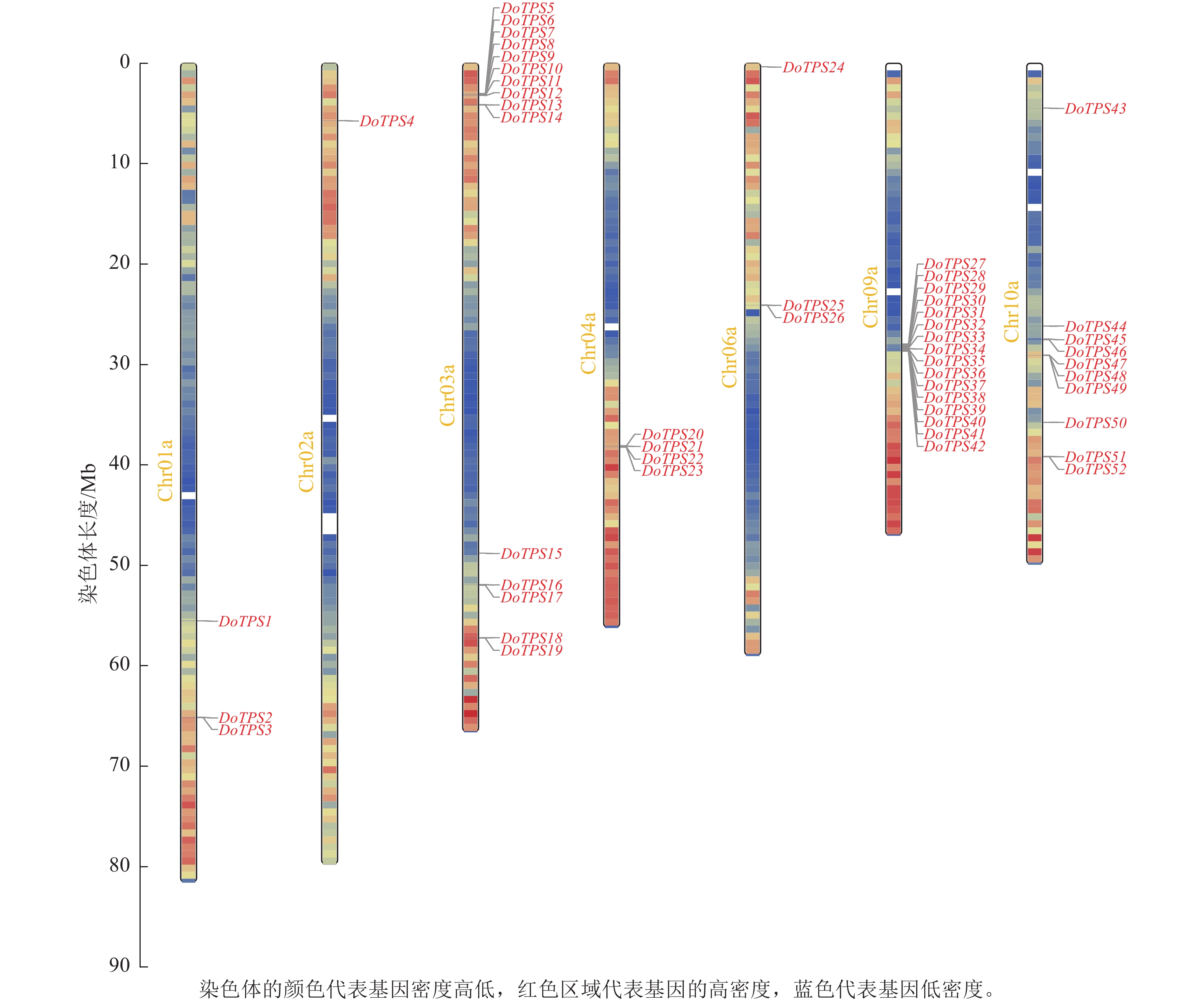
本研究从降香黄檀基因组共鉴定出52个DoTPS基因,分布在7条染色体上,部分成员成簇聚集,根据在染色体上的位置分别命名为DoTPS1~DoTPS52 (图1)。
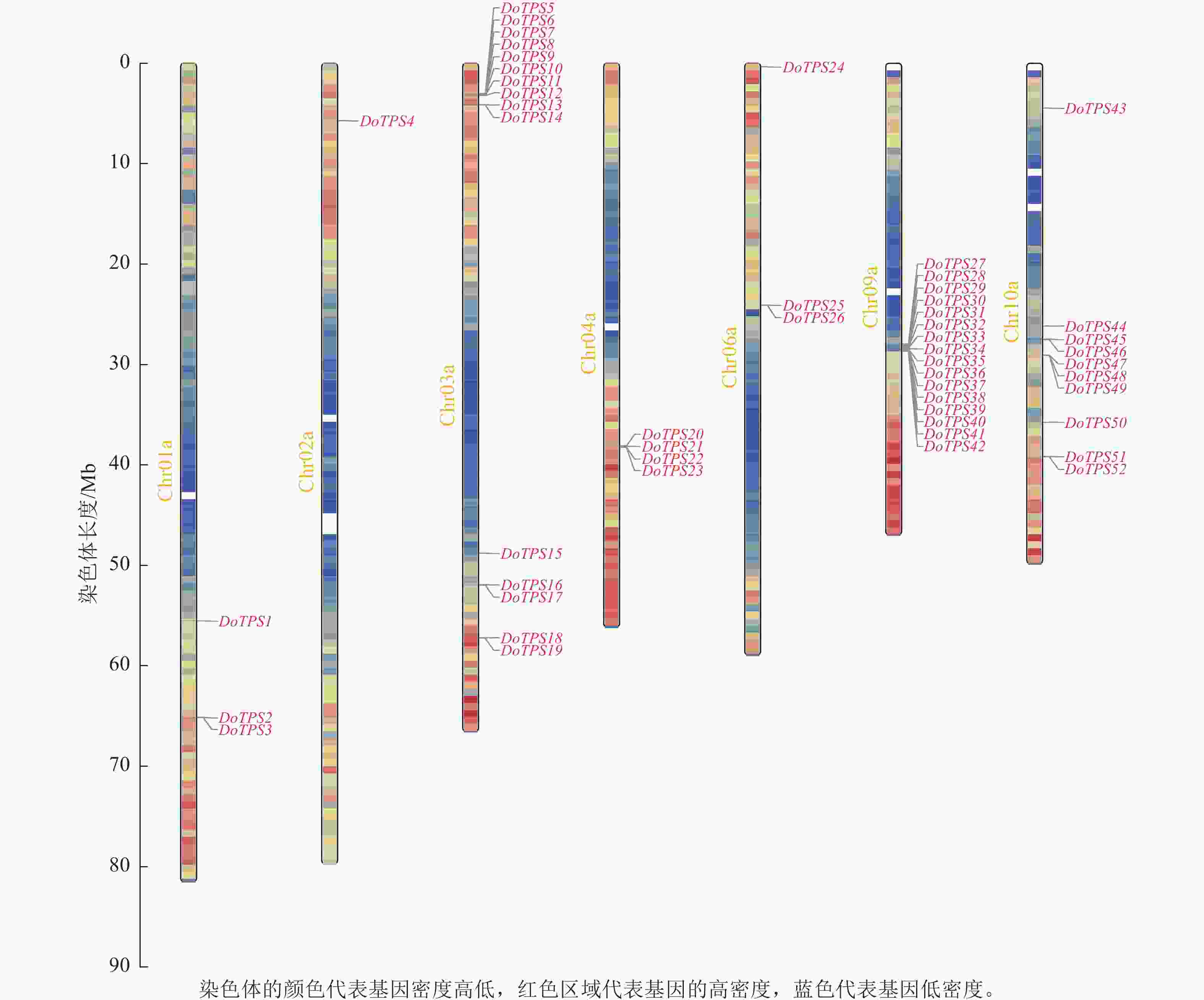
图 1 DoTPS基因染色体定位
Figure 1. Chromosome localization of DoTPS genes
由表1可见:DoTPS蛋白编码178~881个氨基酸;平均分子量为60.49 kDa;理论等电点为4.96~7.79,大多数蛋白为酸性蛋白;亲水性平均值均为负值,整体均为亲水性蛋白;不稳定系数为31.81~57.25,大多数蛋白为不稳定蛋白;脂肪系数为83.56~113.42,蛋白热稳定性良好。DoTPS蛋白主要分布在细胞质(57.69%)和叶绿体(42.31%)中。
表 1 DoTPS基因的理化性质和亚细胞定位预测
Table 1. Physicochemical properties and subcellular localization prediction of DoTPS genes
基因名 氨基酸
数/个分子量/
kDa理论等
电点不稳定
系数脂肪
系数亲水性
平均值亚细胞
定位基因名 氨基酸
数/个分子量/
kDa理论等
电点不稳定
系数脂肪
系数亲水性
平均值亚细胞
定位DoTPS1 520 60.14 5.63 37.58 96.94 −0.25 叶绿体 DoTPS27 501 58.07 5.48 41.03 97.72 −0.12 细胞质 DoTPS2 807 92.71 5.50 46.67 87.83 −0.33 叶绿体 DoTPS28 178 21.01 5.75 40.60 102.47 −0.16 叶绿体 DoTPS3 881 100.50 7.79 38.72 91.77 −0.21 叶绿体 DoTPS29 471 54.44 6.05 44.13 102.06 −0.15 细胞质 DoTPS4 712 82.42 5.45 44.40 89.61 −0.30 叶绿体 DoTPS30 202 23.26 5.70 43.76 113.42 −0.23 叶绿体 DoTPS5 568 65.24 5.51 45.81 87.57 −0.27 细胞质 DoTPS31 501 58.19 5.38 43.79 97.13 −0.16 细胞质 DoTPS6 511 58.97 5.10 44.71 95.44 −0.27 细胞质 DoTPS32 202 23.38 5.77 44.48 110.54 −0.12 叶绿体 DoTPS7 519 59.65 5.29 42.29 87.94 −0.26 叶绿体 DoTPS33 564 65.19 5.71 48.35 94.38 −0.20 细胞质 DoTPS8 511 58.97 5.13 43.52 96.38 −0.25 细胞质 DoTPS34 281 32.30 4.96 46.33 93.02 −0.16 细胞质 DoTPS9 511 59.01 5.06 43.86 96.58 −0.25 细胞质 DoTPS35 379 44.14 5.55 48.99 91.58 −0.19 细胞质 DoTPS10 514 59.39 4.99 45.75 97.53 −0.23 细胞质 DoTPS36 427 49.01 5.30 41.41 104.12 −0.13 细胞质 DoTPS11 546 62.23 6.13 40.08 92.67 −0.22 细胞质 DoTPS37 367 42.26 5.21 42.88 93.27 −0.22 细胞质 DoTPS12 522 60.56 5.29 45.33 85.75 −0.33 细胞质 DoTPS38 501 58.15 5.29 45.83 99.06 −0.13 细胞质 DoTPS13 830 94.73 5.69 42.66 85.43 −0.23 细胞质 DoTPS39 568 65.84 5.33 45.34 92.52 −0.31 细胞质 DoTPS14 837 95.11 6.67 39.48 85.78 −0.23 细胞质 DoTPS40 501 58.22 5.59 46.23 94.97 −0.17 细胞质 DoTPS15 545 63.11 5.76 41.85 95.69 −0.27 细胞质 DoTPS41 222 25.49 6.39 36.35 97.93 −0.35 叶绿体 DoTPS16 590 67.96 6.42 50.36 90.24 −0.33 叶绿体 DoTPS42 501 58.10 5.38 44.03 93.61 −0.20 细胞质 DoTPS17 329 38.48 5.31 47.23 102.89 −0.08 叶绿体 DoTPS43 512 59.22 6.09 47.03 89.73 −0.25 细胞质 DoTPS18 355 40.79 6.13 31.81 91.21 −0.21 叶绿体 DoTPS44 794 90.47 5.64 51.39 92.39 −0.27 叶绿体 DoTPS19 558 64.46 5.77 33.89 93.66 −0.21 叶绿体 DoTPS45 561 64.53 6.05 48.26 87.43 −0.31 细胞质 DoTPS20 594 68.06 6.01 42.97 87.51 −0.31 细胞质 DoTPS46 512 59.21 5.77 46.94 87.97 −0.34 叶绿体 DoTPS21 501 57.36 6.16 40.26 89.94 −0.39 叶绿体 DoTPS47 521 61.80 5.18 53.48 86.24 −0.38 叶绿体 DoTPS22 567 64.57 5.60 44.35 90.99 −0.20 细胞质 DoTPS48 568 66.97 5.12 53.68 83.56 −0.38 叶绿体 DoTPS23 567 64.84 5.57 43.74 86.53 −0.27 细胞质 DoTPS49 601 70.88 5.47 52.94 84.18 −0.41 叶绿体 DoTPS24 604 68.45 5.08 35.90 88.21 −0.36 细胞质 DoTPS50 529 61.08 5.69 48.65 84.40 −0.32 细胞质 DoTPS25 590 68.69 5.71 44.80 88.44 −0.35 叶绿体 DoTPS51 575 65.78 6.65 57.25 88.09 −0.28 细胞质 DoTPS26 536 62.65 6.27 48.90 88.79 −0.30 叶绿体 DoTPS52 605 69.61 5.88 52.02 83.65 −0.43 叶绿体 -
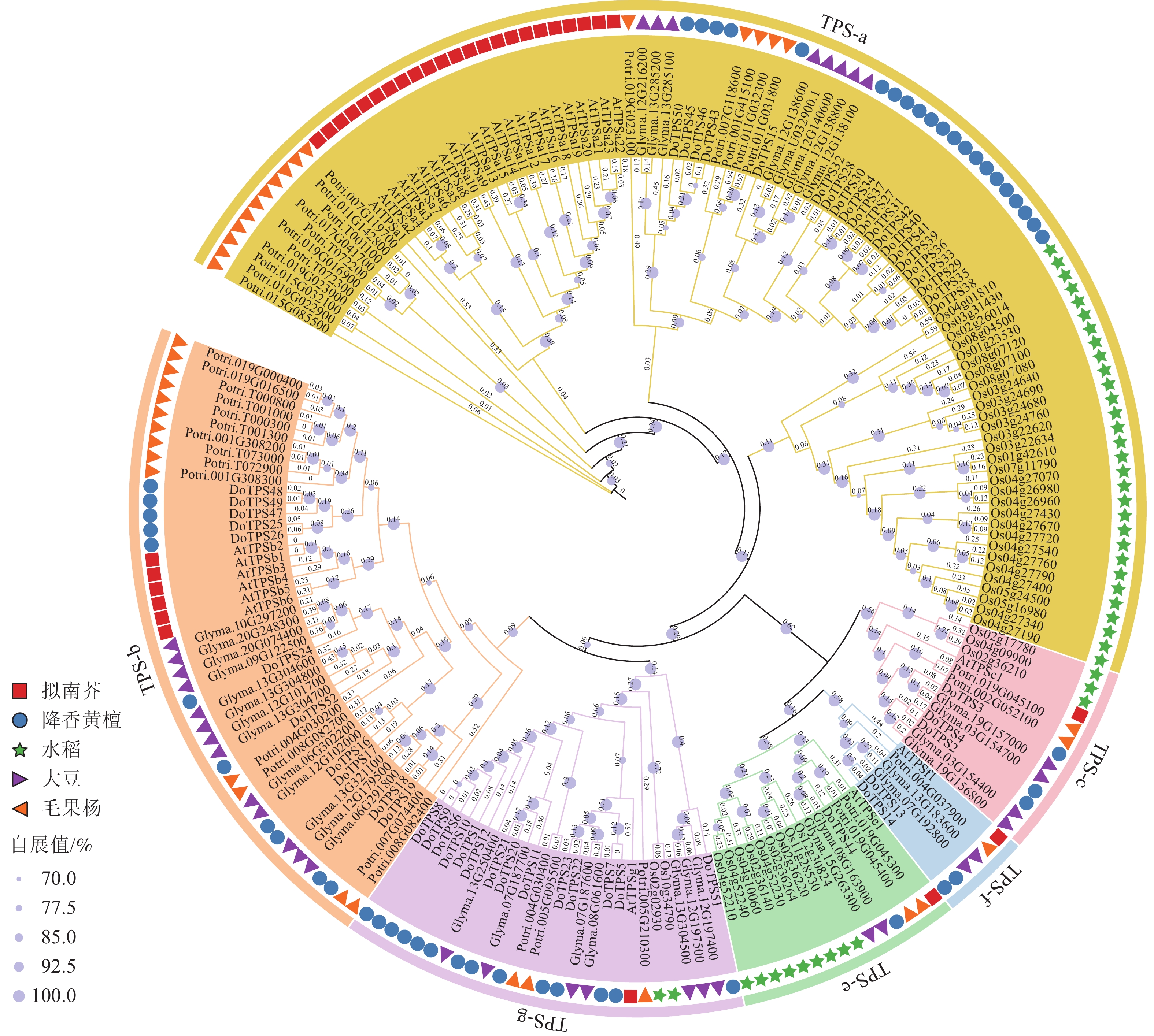
基于拟南芥TPS分类体系将DoTPS家族分为6个亚族:TPS-a、TPS-b、TPS-c、TPS-e、TPS-f和TPS-g (图2)。降香黄檀TPS-a (21)、TPS-b (11)和TPS-g (14)成员数量远多于TPS-c (3)、TPS-e (1)和TPS-f (2)。降香黄檀与同属豆科的大豆TPS序列同源性最高,其次为毛果杨、拟南芥,与水稻亲缘关系最远。
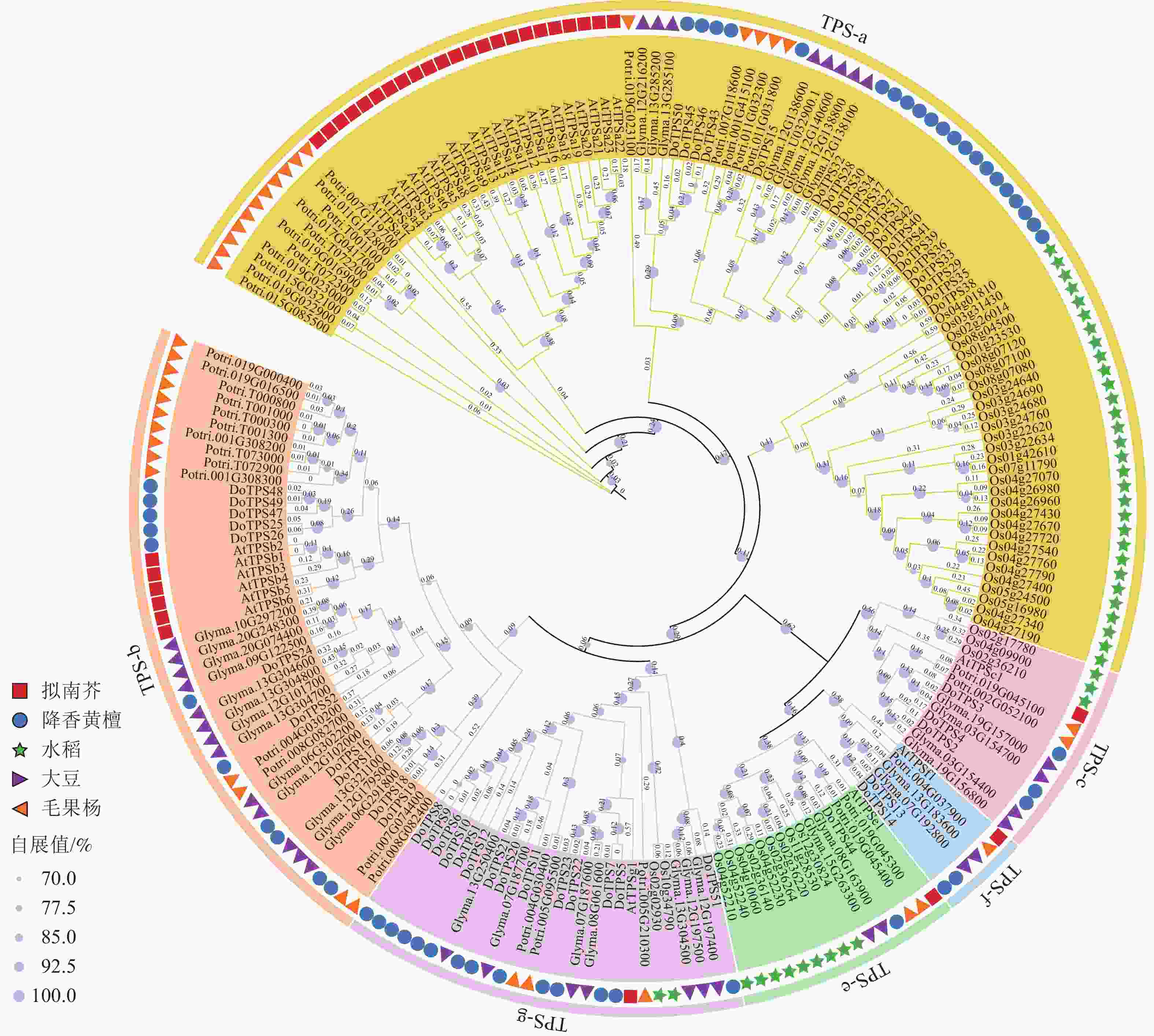
图 2 降香黄檀DoTPS系统发育分析
Figure 2. Phylogenetic analysis of DoTPS family in D. odorifera
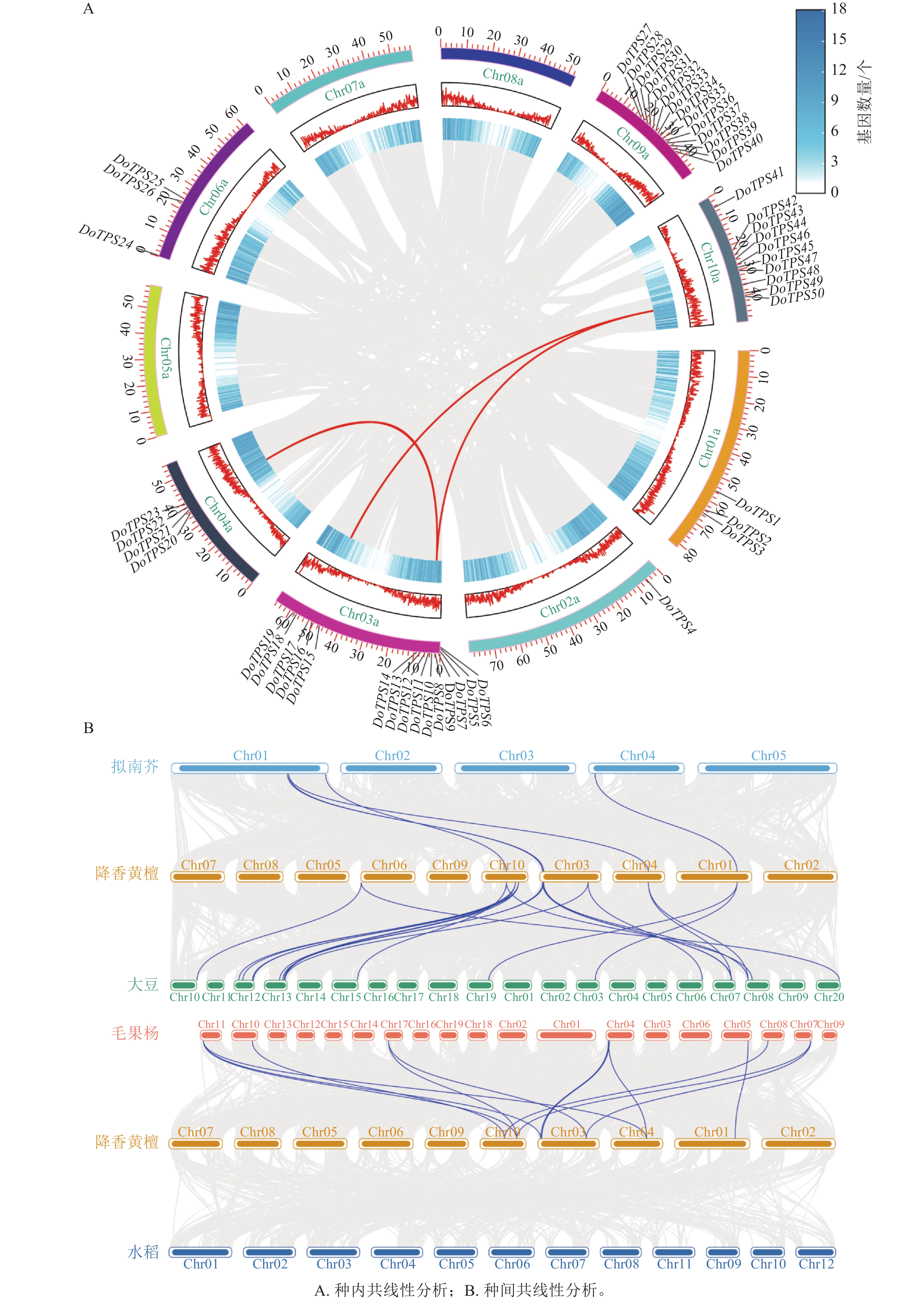
种内共线性分析显示:共有6个DoTPS基因存在共线性关系(图3A)。种间共线性分析显示:降香黄檀与大豆、毛果杨和拟南芥分别存在22、15、5对共线基因,与水稻无共线基因(图3B)。其中,DoTPS2、DoTPS5、DoTPS13和DoTPS44较为保守,在拟南芥、大豆和毛果杨中都存在共线性关系。
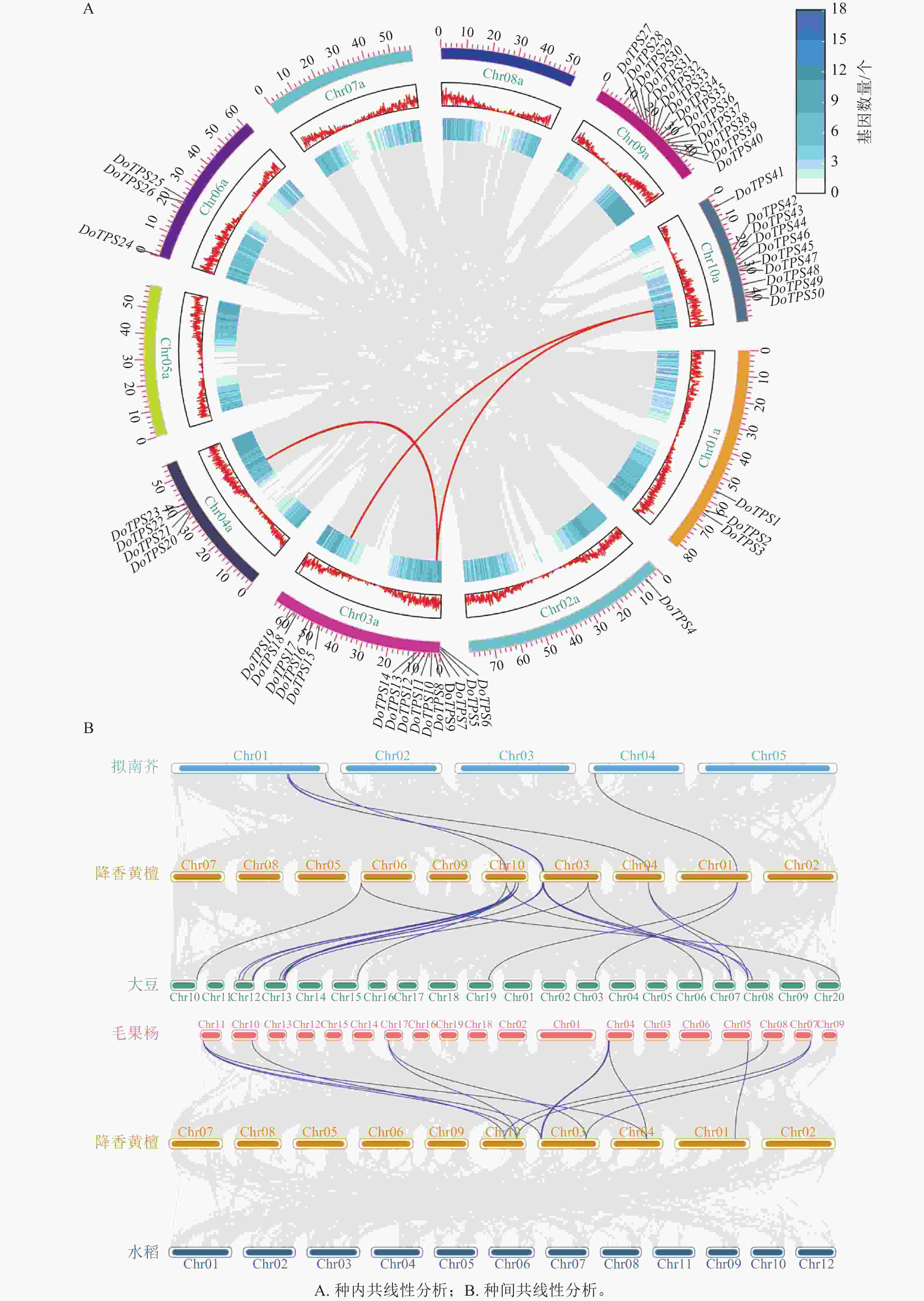
图 3 降香黄檀DoTPS家族共线性分析
Figure 3. Collinearity analysis of DoTPS family in D. odorifera
种内共线性基因对Ka/Ks均小于1,DoTPS5~DoTPS51因Ks无效被剔除,表明降香黄檀DoTPS共线基因在进化中受到纯化选择(表2)。基因复制事件分析结果显示:DoTPS基因家族的扩张主要依赖串联(50.00%)和近端复制(28.85%),而全基因组复制或片段复制则较少(表3)。
表 2 降香黄檀DoTPS共线性对及Ka/Ks值
Table 2. Colinearity and Ka/Ks values of DoTPS in D. odorifera
基因对 Ka Ks Ka/Ks DoTPS5-DoTPS20 0.434 2.792 0.156 DoTPS16-DoTPS51 0.585 3.172 0.185 DoTPS17-DoTPS52 0.355 1.526 0.233 说明:Ka为非同义替换率;Ks为同义替换率。Ka/Ks<1为纯化选择;Ka/Ks=1为中性选择;Ka/Ks>1为正选择。 表 3 降香黄檀DoTPS基因复制事件
Table 3. DoTPS genes replication event of D. odorifera
基因名 基因复制事件 基因名 基因复制事件 基因名 基因复制事件 基因名 基因复制事件 DoTPS1 串联复制 DoTPS14 串联复制 DoTPS27 近端复制 DoTPS40 串联复制 DoTPS2 近端复制 DoTPS15 分散复制 DoTPS28 串联复制 DoTPS41 近端复制 DoTPS3 近端复制 DoTPS16 全基因组或片段复制 DoTPS29 串联复制 DoTPS42 近端复制 DoTPS4 近端复制 DoTPS17 全基因组或片段复制 DoTPS30 串联复制 DoTPS43 分散复制 DoTPS5 全基因组或片段复制 DoTPS18 近端复制 DoTPS31 近端复制 DoTPS44 分散复制 DoTPS6 近端复制 DoTPS19 近端复制 DoTPS32 近端复制 DoTPS45 串联复制 DoTPS7 近端复制 DoTPS20 全基因组或片段复制 DoTPS33 近端复制 DoTPS46 串联复制 DoTPS8 串联复制 DoTPS21 串联复制 DoTPS34 串联复制 DoTPS47 串联复制 DoTPS9 串联复制 DoTPS22 近端复制 DoTPS35 串联复制 DoTPS48 串联复制 DoTPS10 串联复制 DoTPS23 近端复制 DoTPS36 串联复制 DoTPS49 串联复制 DoTPS11 串联复制 DoTPS24 分散复制 DoTPS37 串联复制 DoTPS50 分散复制 DoTPS12 串联复制 DoTPS25 串联复制 DoTPS38 串联复制 DoTPS51 全基因组或片段复制 DoTPS13 串联复制 DoTPS26 串联复制 DoTPS39 串联复制 DoTPS52 全基因组或片段复制 -
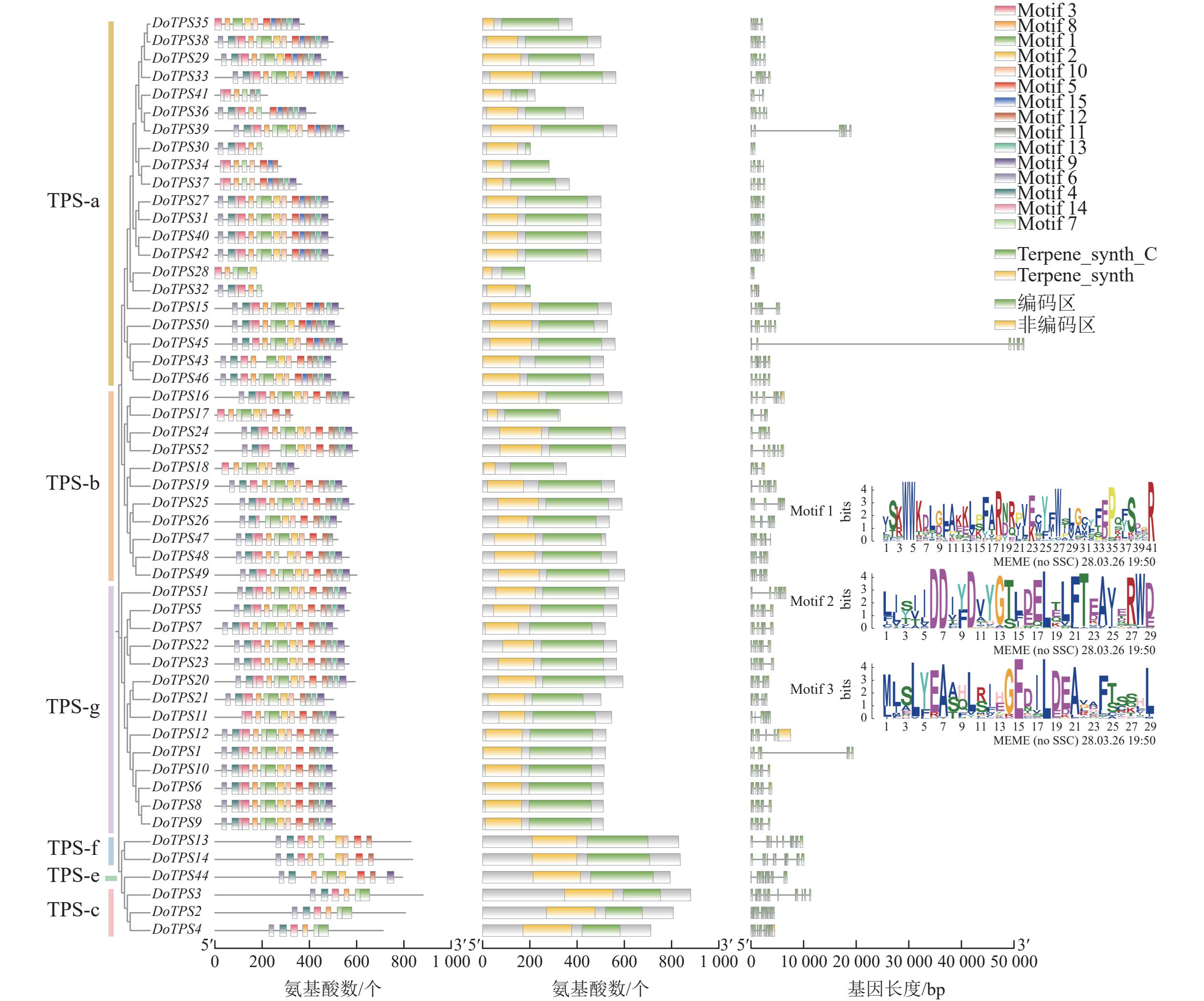
基因结构分析显示:DoTPS基因家族的外显子数量为2~15个。各亚族外显子结构保守性不同:TPS-a、TPS-b外显子数量变化大,TPS-g (7个)和TPS-f (12个)高度保守,TPS-c外显子数量最多,仅1个成员含12个外显子,其余均为15个(图4)。保守结构域分析显示:所有DoTPS蛋白均包含Terpene_synth和Terpene_synth_C保守结构域。DoTPS蛋白序列共鉴定出15个保守基序(Motif 1~Motif 15)。其中,Motif 7分布最广(96.15%),其次为Motif 3 (92.31%)、Motif 2 (82.69%)与Motif 1 (75.00%)。
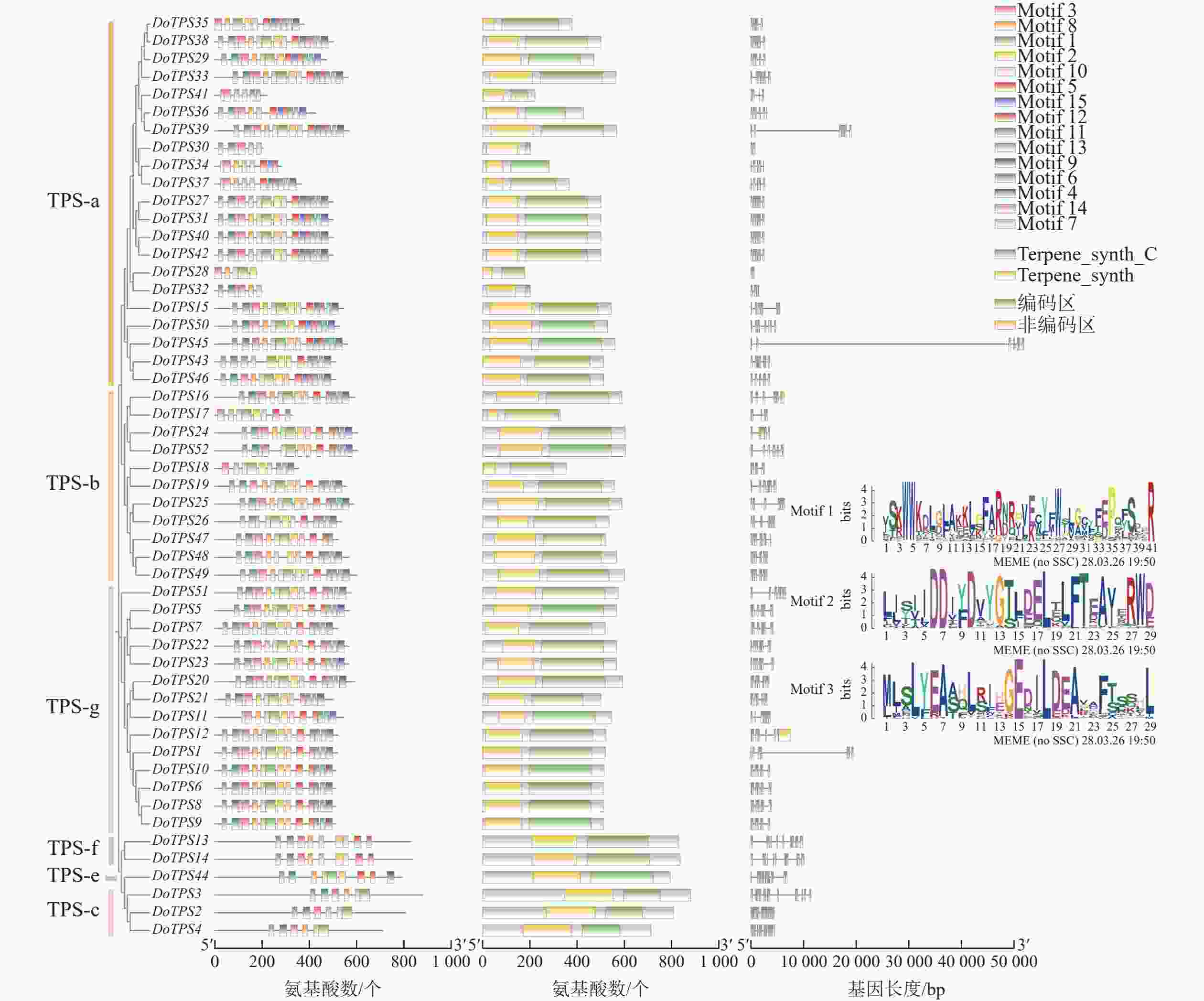
图 4 DoTPS基因结构、保守结构域及保守基序分析
Figure 4. Analysis of gene structure, conserved domains and conserved motifs of DoTPS
-
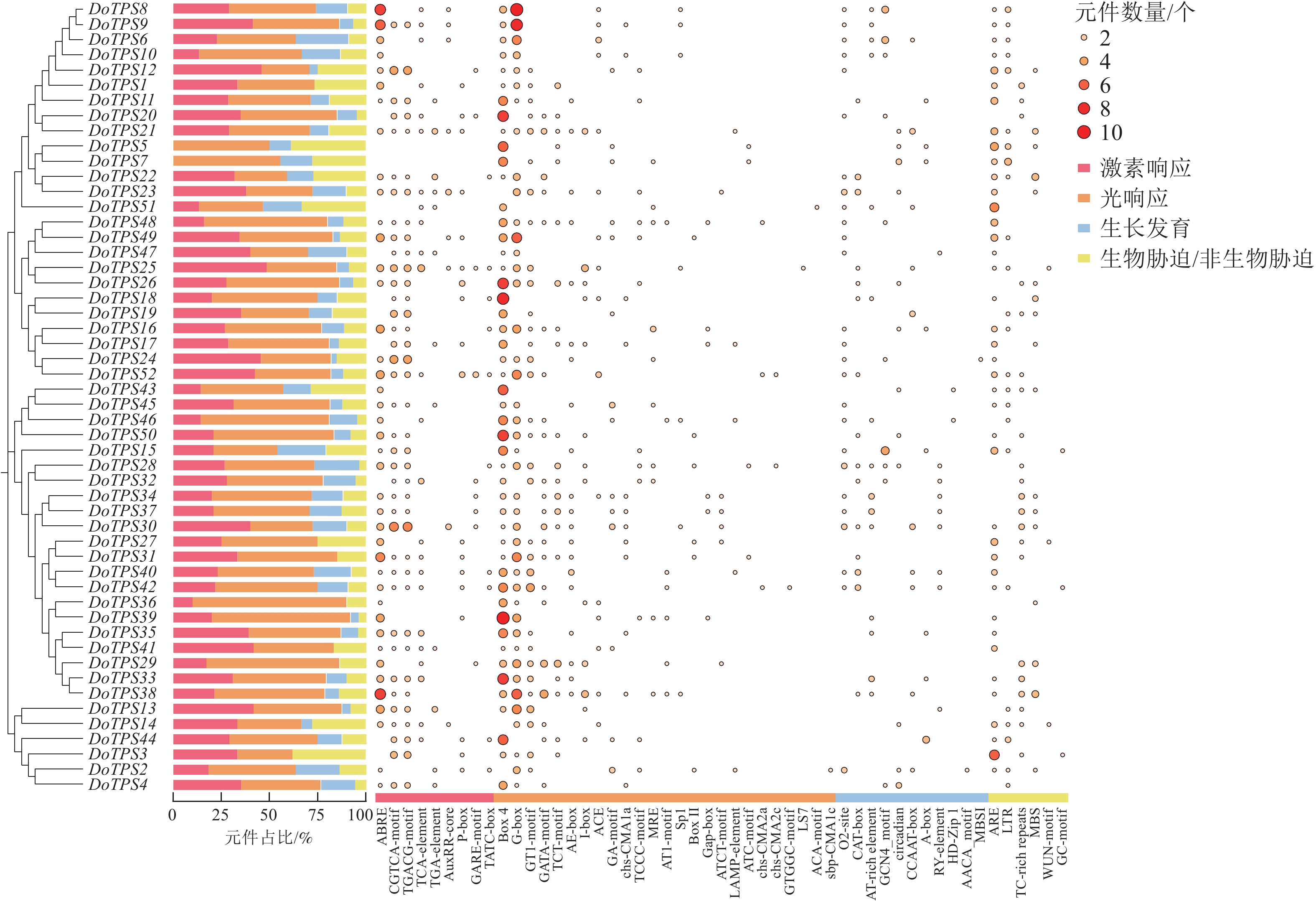
在DoTPS基因启动子区域检测到1 212个顺式作用元件,其中光响应元件数量最多,为569个,其次为激素响应元件(344个)、胁迫响应元件(165个)、生长发育相关元件(134个)。DoTPS启动子区均含有光响应元件和生物/非生物胁迫响应元件。半数DoTPS基因的启动子区域预测到MYB转录因子结合位点,如MBS、MRE等(图5)。
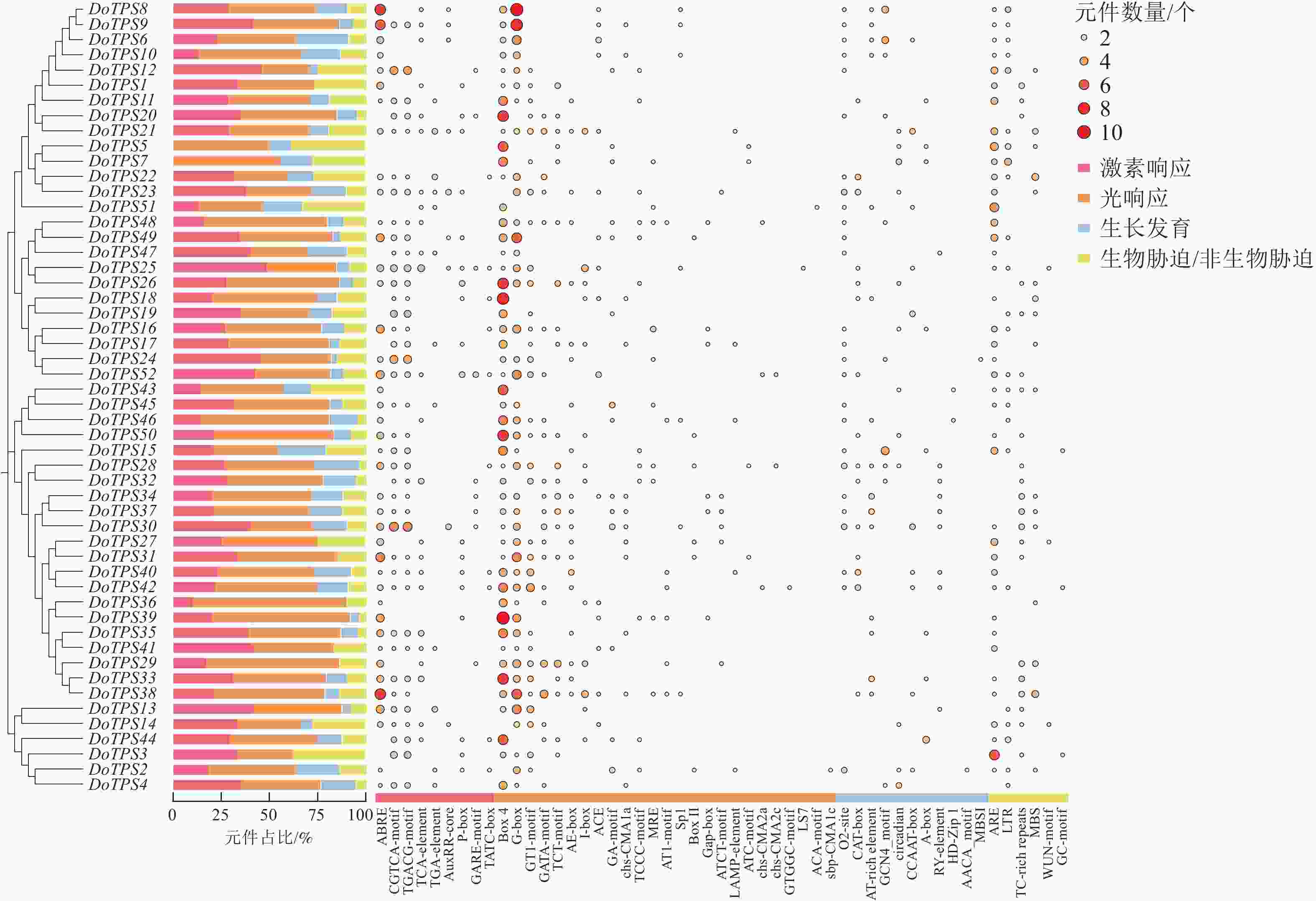
图 5 DoTPS启动子顺式元件的类型和数量分布
Figure 5. Type and quantity distribution analysis of cis-elements in DoTPS promoters
-
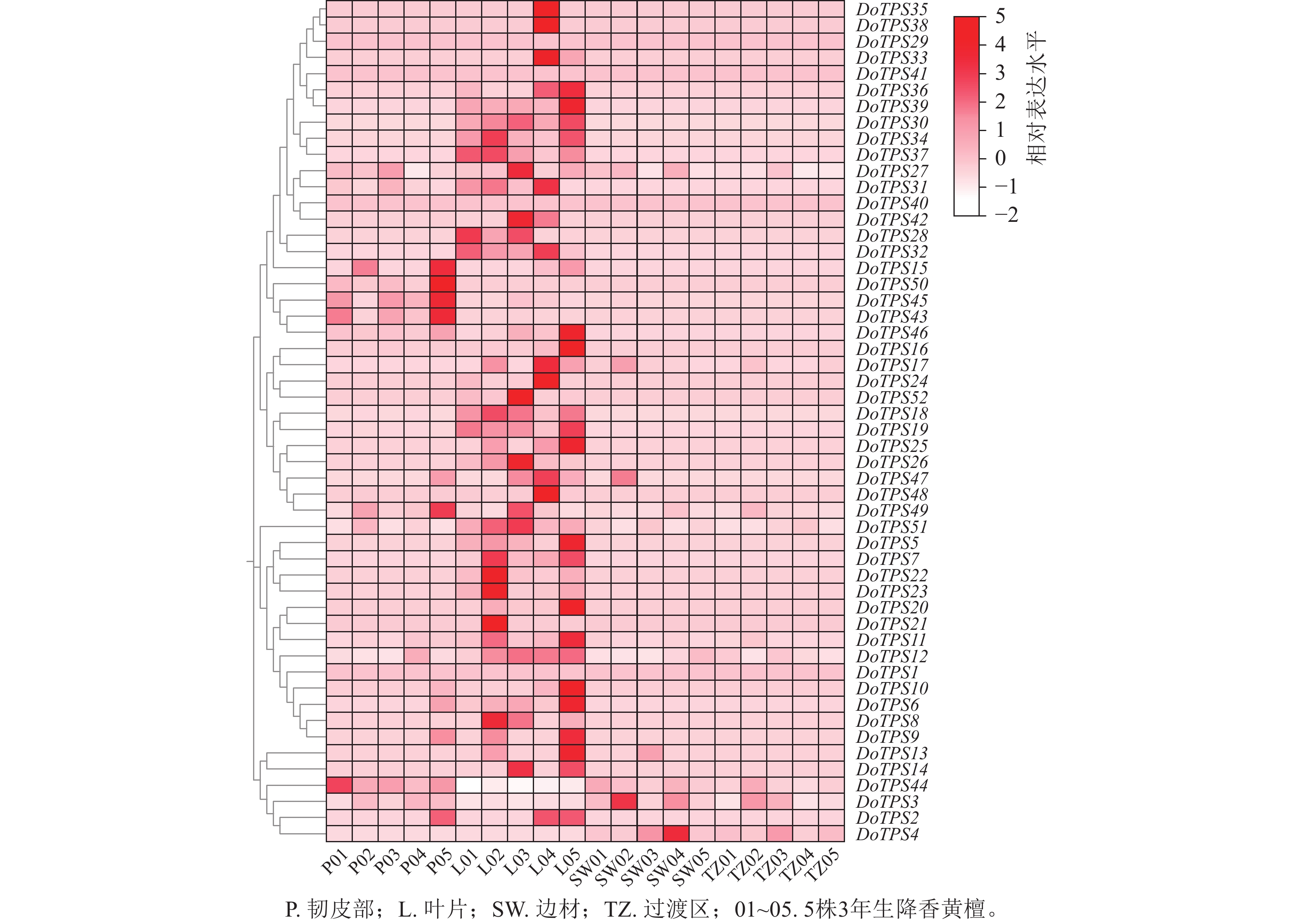
转录组数据揭示:DoTPS基因家族在降香黄檀不同部位呈组织特异性表达(图6)。叶片是DoTPS家族成员表达最活跃的组织,韧皮部和边材次之,过渡区最弱。在进化保守性较高的DoTPS2、DoTPS5、DoTPS13与DoTPS44中,除DoTPS44外,其余3个基因均主要在叶片中表达,与家族整体表达趋势相符。其中DoTPS2表达较广谱,因此对其开展进一步研究。
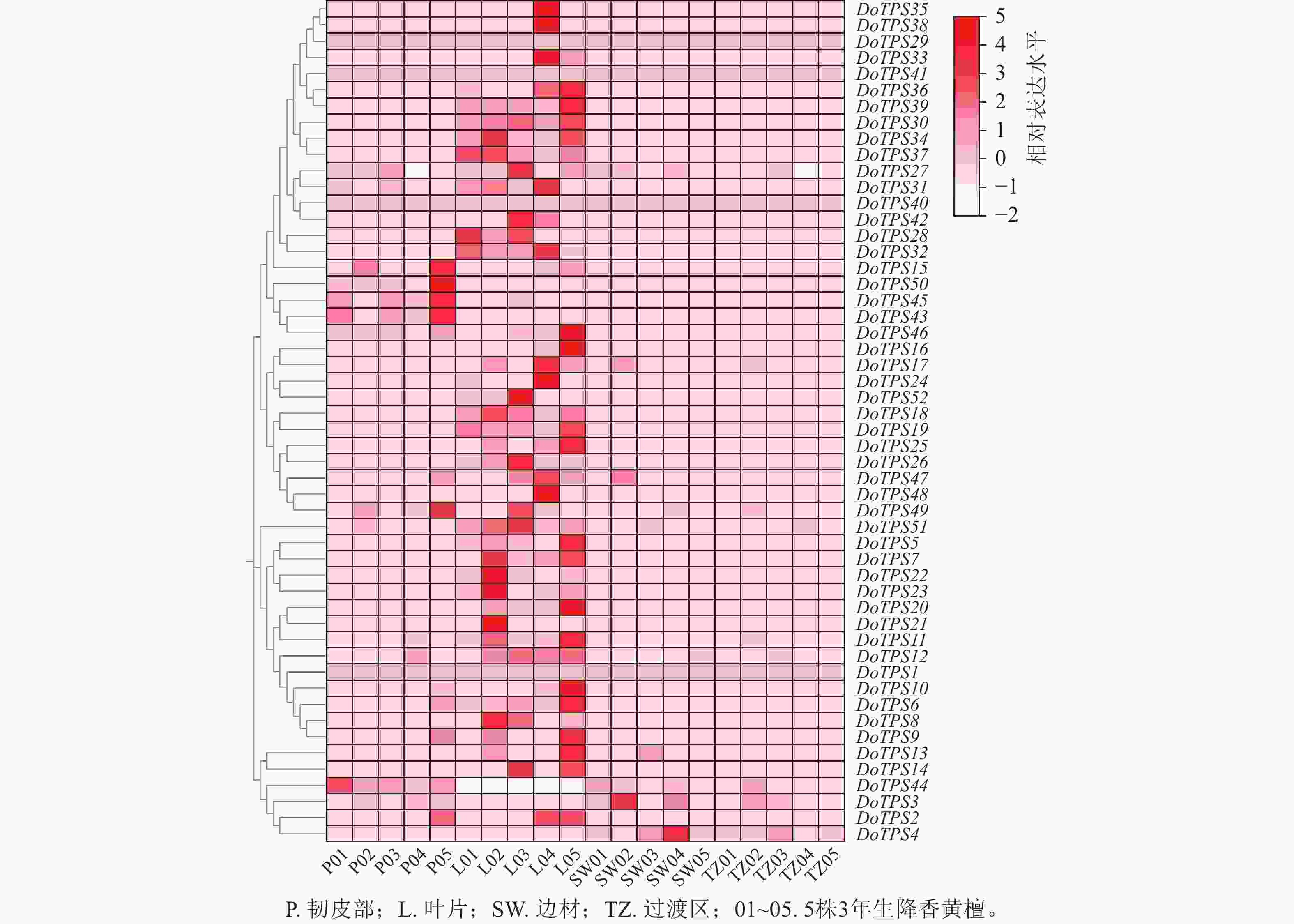
图 6 降香黄檀DoTPS成员表达模式分析
Figure 6. Expression pattern analysis of DoTPS members in D. odorifera
-
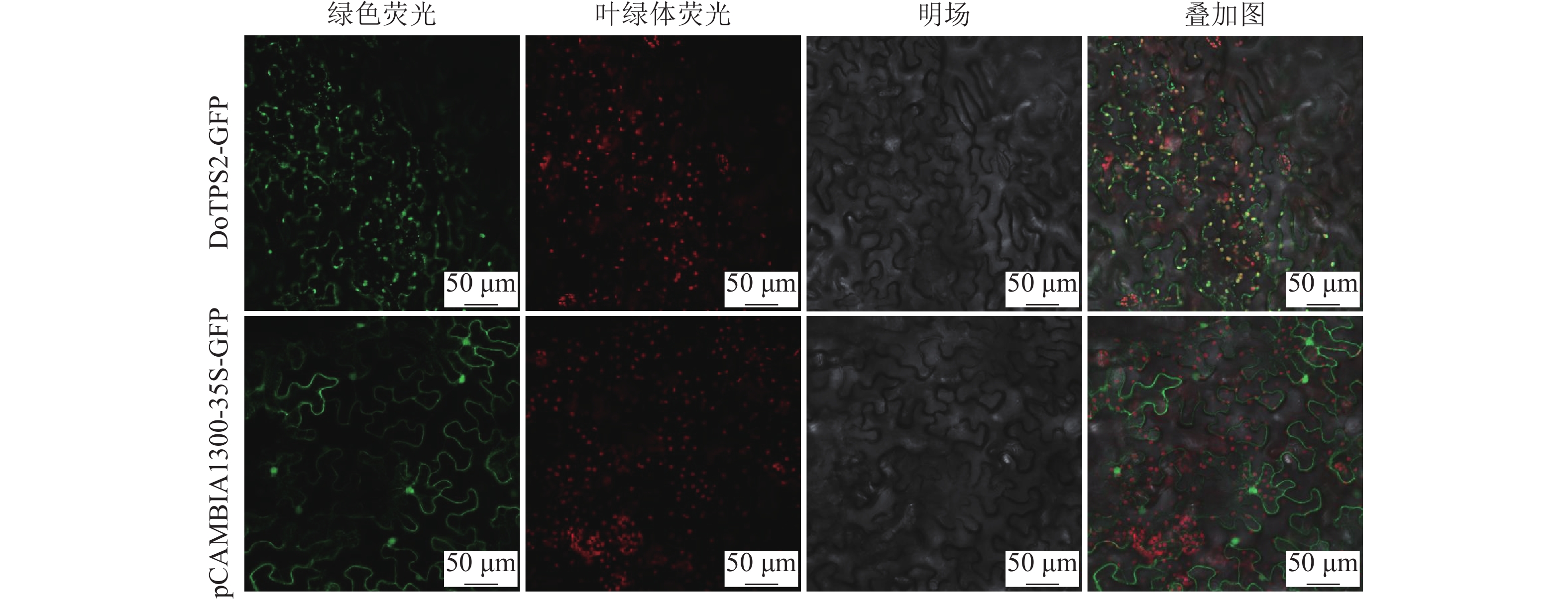
以pCAMBIA1300-35S-GFP注射烟草作为对照,其绿色荧光信号在烟草细胞膜与细胞核中均匀分布,说明其本身无特定亚细胞定位偏好。叠加图像显示:DoTPS2-GFP的绿色荧光信号与叶绿体的红色荧光信号重合,证实DoTPS2蛋白定位于叶绿体,与预测结果一致(图7)。
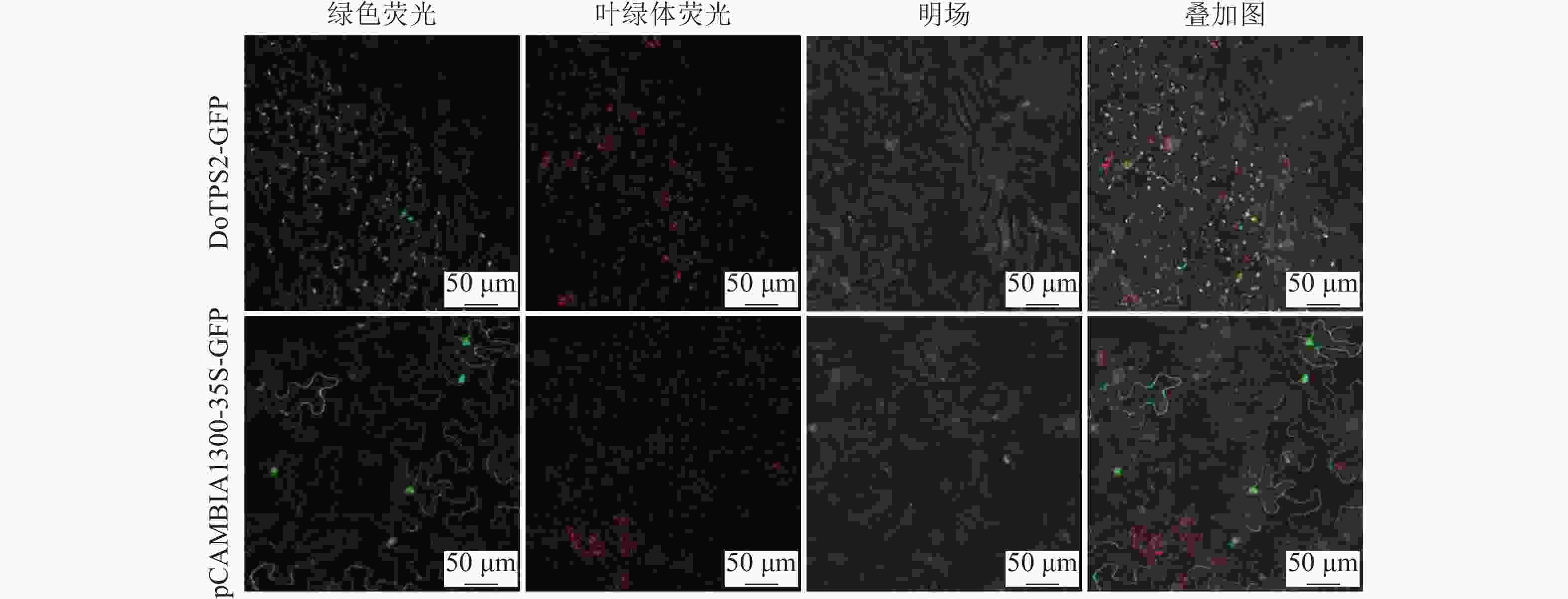
图 7 DoTPS2亚细胞定位
Figure 7. Subcellular localization of DoTPS2
-
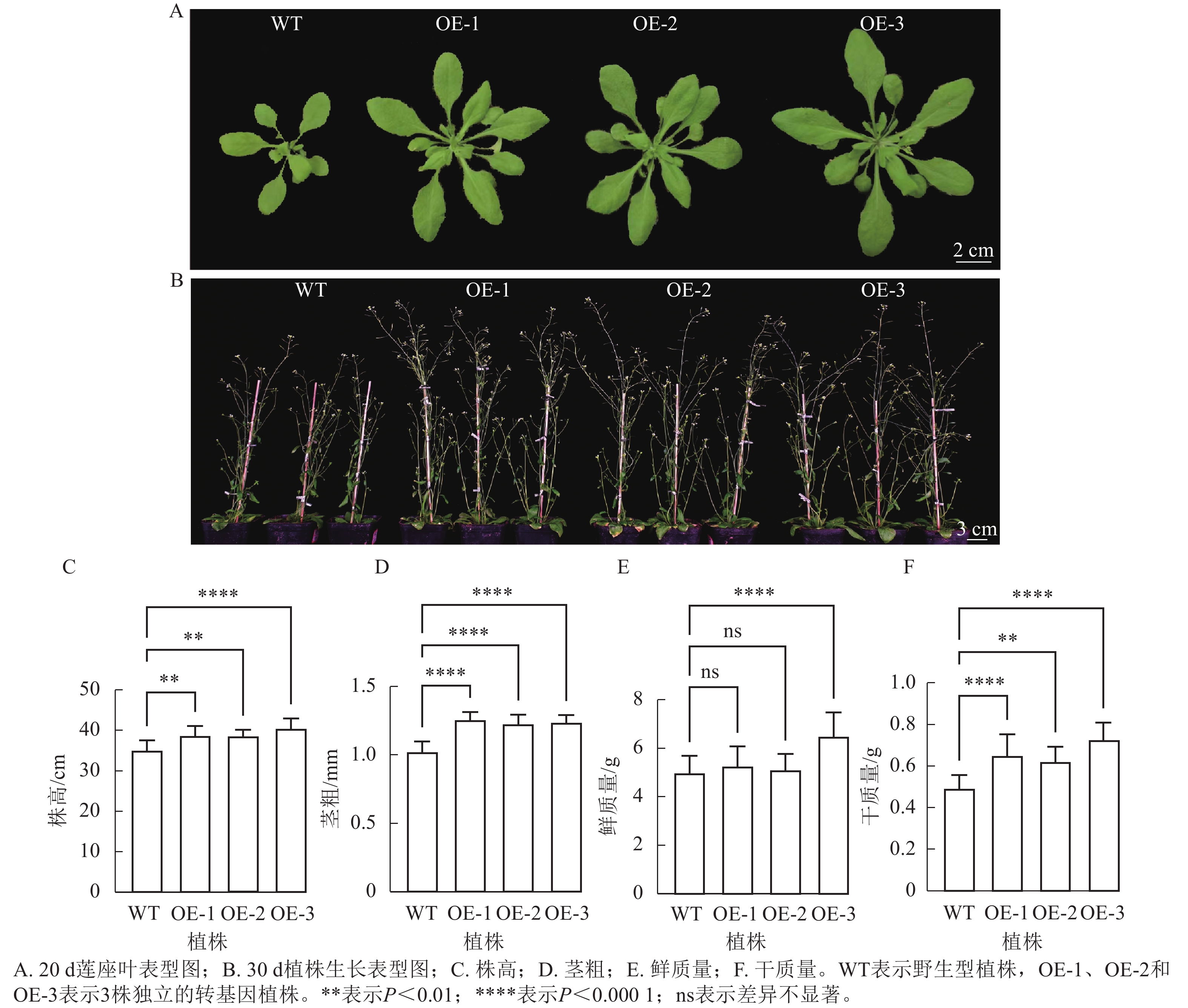
为探究DoTPS2的功能,在拟南芥中过表达DoTPS2。生长20 d时,过表达株系莲座叶面积明显大于同期野生型植株(图8A),但生长至25~30 d时,两者莲座叶大小无明显差异,过表达DoTPS2可能促进了拟南芥早期的叶片扩展。30 d时,过表达株系平均株高显著高于野生型(P<0.01),茎粗极显著高于野生型(P<
0.0001 ),平均鲜质量和平均干质量均高于野生型(图8B~F)。上述结果表明过表达DoTPS2促进了拟南芥植株的生长发育。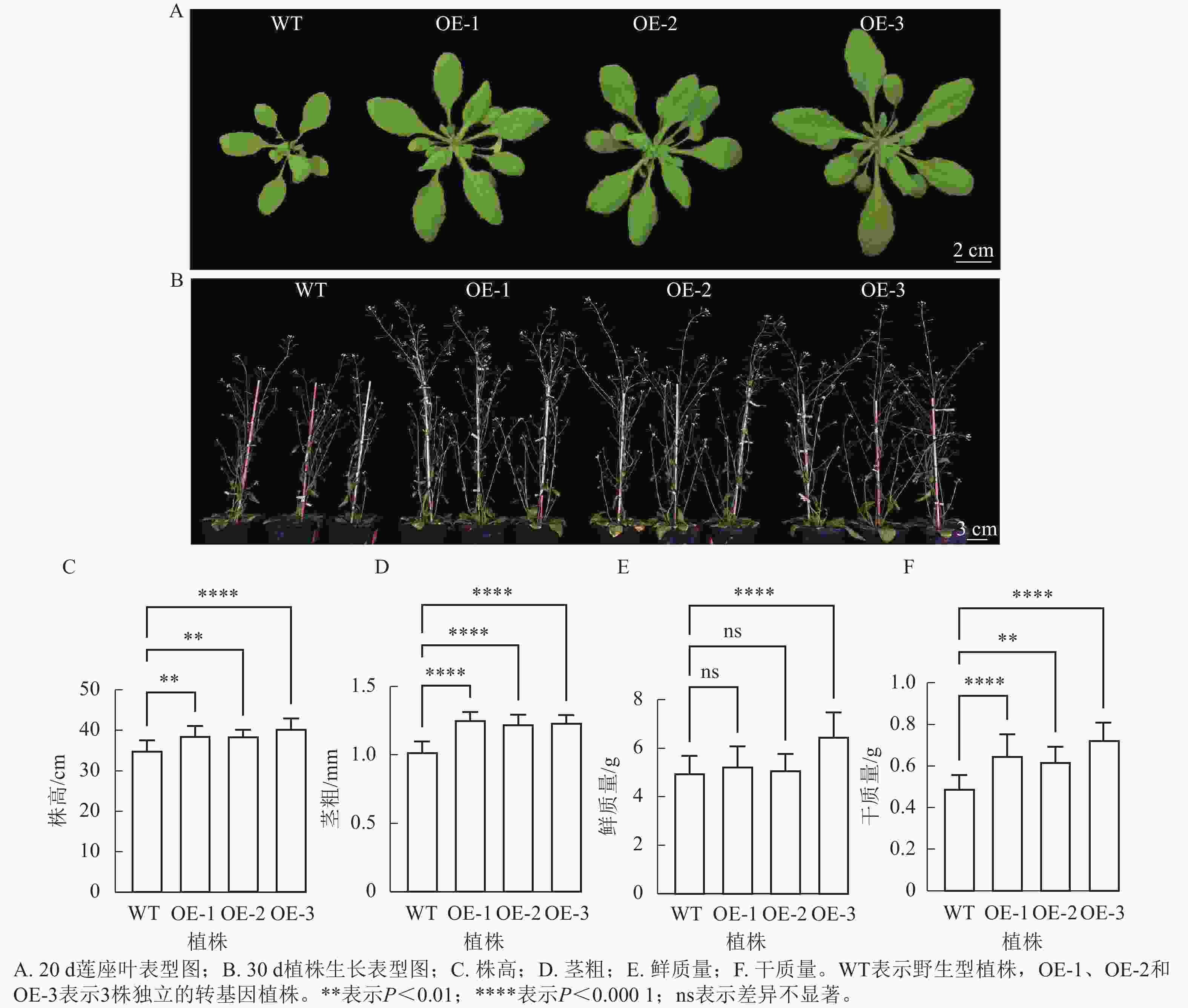
图 8 过表达DoTPS2植株的生长表型特征
Figure 8. Growth phenotypic characterization of DoTPS2-overexpressing plants
-
萜类化合物是植物中最大的一类次生代谢产物,广泛参与植物生长发育、逆境防御等过程,是许多药用植物活性成分的核心物质基础。降香黄檀作为中国名贵的红木与药用树种,其心材中富含的萜类化合物是决定其木材品质与药用价值的核心因素[17]。本研究共鉴定出52个DoTPS成员,多为酸性不稳定的亲水性蛋白,推测主要定位于细胞质和叶绿体,这可能与萜类合成途径的空间分工有关[8]。系统进化分析将DoTPS划分为6个亚家族,与多数木本植物的TPS家族分类一致[2, 11],其中TPS-a、TPS-b、TPS-g亚族显著扩张。基因复制事件分析表明:DoTPS扩张主要依赖串联复制与近端复制,而由全基因组或片段复制产生的基因均受纯化选择[1, 2]。种间共线性及表达分析表明:DoTPS2进化保守且表达广谱。
基因结构与保守基序的保守性是基因功能分化的重要标志。DoTPS成员均含保守的Terpene_synth和Terpene_synth_C结构域,外显子数量为2~15个,符合被子植物TPS家族特征。15个保守基序中,Motif 1、Motif 2、Motif 3分别对应植物TPS家族保守的RRx8W、DDxxD、DxxD基序,分布于多数成员中[8−10]。其中,Motif 1的序列特征为R(B)RxxxxxxW,可能是DoTPS的特有变异特征。在各亚家族中,TPS-a含有Motif种类最多且特有Motif 15;TPS-b均含有Motif 2和Motif 10;TPS-g高度保守,基本都含有Motif 1~Motif14;TPS-c、TPS-e和TPS-f均含有Motif 4、Motif 6、Motif 7、Motif 8。TPS-c是DoTPS中外显子数量最多的亚族,所有成员均含有Motif 3、Motif 4、Motif 6、Motif 7、Motif 8,这可能与它们主要负责赤霉素等初级代谢前体合成的“管家”功能密切相关[8, 23]。DoTPS基因结构与基序组成具有亚族特异性,同亚族成员间高度相似,这与TPS家族的进化规律一致[8]。
顺式作用元件分析发现:DoTPS启动子区富集光响应和激素响应元件,提示光与植物激素是DoTPS基因的核心调控因子。光响应元件的富集与萜类合成依赖光提供能量与前体相符[1, 24];激素响应元件以脱落酸和甲基茉莉酸为主,其次是赤霉素、生长素和水杨酸,表明这五类信号通路可能是调控DoTPS的核心激素通路。
已有研究证实:赤霉素合成通路上游调控基因ent-古巴焦磷酸合酶(ent-CPS)的表达水平能影响植物体内赤霉素的合成速率和生长发育进程[25−26]。本研究过表达了保守且广谱表达的TPS-c成员DoTPS2 (预测编码ent-CPS),发现其可促进拟南芥生长发育。值得注意的是,过表达DoTPS2能促进拟南芥早期莲座叶扩展,但后期差异消失,符合赤霉素合成的负反馈调控机制:过表达ent-CPS虽能增加赤霉素前体合成,但活性赤霉素受下游酶严格调控而不会无限积累[23]。以上结果表明:DoTPS2可能编码降香黄檀中参与赤霉素生物合成的ent-CPS酶,在调控降香黄檀生长发育中发挥着重要作用,DoTPS2有望作为分子育种的靶点,为降香黄檀的遗传改良提供重要的基因资源。
-
本研究在降香黄檀基因组中共鉴定到52个TPS基因,明确了其基本理化性质、染色体分布、亚细胞定位特征及系统进化关系,发现TPS-a、TPS-b和TPS-g亚族显著扩张。揭示了DoTPS扩张主要由串联复制和近端复制驱动。DoTPS成员呈现出以叶片为主,韧皮部、边材及过渡区次之的组织特异性表达模式。成功验证了DoTPS2具有调控植物生长发育的作用,为降香黄檀优良品种的分子育种提供了重要的候选基因资源。
Genome-wide identification of TPS genes in Dalbergia odorifera and functional verification of DoTPS2 gene
-
摘要:
目的 萜烯合酶(TPS)是植物萜类物质生物合成的关键酶,在植物次生代谢、逆境响应及生长发育过程中发挥着重要作用。本研究旨在鉴定和分析降香黄檀Dalbergia odorifera TPS (DoTPS)基因,为解析TPS家族在降香黄檀中的生物学功能及其遗传改良提供理论依据。 方法 利用生物信息学方法对DoTPS家族成员进行全基因组鉴定与系统分析,结合瞬时表达和拟南芥Arabidopsis thaliana遗传转化实验,验证保守性较高的DoTPS2基因的亚细胞定位与生物学功能。 结果 共鉴定到52个DoTPS成员,编码178~881个氨基酸,不均匀分布于7条染色体且部分成簇,推测主要定位于细胞质和叶绿体。所有成员均含Terpene_synth和Terpene_synth_C保守结构域。启动子区富集光响应、激素响应元件,且半数成员含MYB转录因子结合位点。系统进化分析将DoTPS分为6个亚家族,其中TPS-a、TPS-b和TPS-g亚族显著扩张。表达模式分析显示:DoTPS基因主要在叶片中表达,其次为韧皮部、边材及过渡区。其中进化上较保守的TPS-c亚家族成员DoTPS2显示广谱表达,亚细胞定位实验证实:DoTPS2蛋白位于叶绿体。过表达DoTPS2能显著促进拟南芥生长发育。 结论 降香黄檀基因组中分布有52个DoTPS基因,以TPS-a、TPS-b和TPS-g亚家族成员为主;家族扩张主要由串联复制和近端复制驱动;成功验证了DoTPS2基因对植物生长发育具有正向调控作用,该基因可作为降香黄檀速生品种选育的关键候选基因资源。图8表3参26 Abstract:Objective Terpene synthase (TPS) is the key enzyme in plant terpenoid biosynthesis, playing important roles in plant secondary metabolism, stress response and growth and development. This study aims to identify and analyze Dalbergia odorifera TPS (DoTPS) genes, providing a theoretical basis for biological functions of the DoTPS family and genetic improvement of D. odorifera. Method Bioinformatics methods were used to perform genome-wide identification and systematic analysis of DoTPS family members. Combined with transient expression assays and Arabidopsis thaliana genetic transformation experiments, the subcellular localization and biological function of the highly conserved DoTPS2 gene were verified. Result A total of 52 DoTPS members were identified, encoding 178 to 881 amino acids. They were unevenly distributed on 7 chromosomes with partial tandem clustering. All members were hydrophilic proteins, predicted to be primarily localized in the cytoplasm and chloroplasts. All members contained the 2 typical conserved domains of terpene synthases: Terpene_synth and Terpene_synth_C. Promoter regions were enriched in light-responsive and hormone-responsive elements, and half of the members harbored MYB transcription factor binding sites. Phylogenetic analysis classified DoTPS into 6 subfamilies, among which the TPS-a, TPS-b and TPS-g subfamilies showed significant expansion. Expression pattern analysis revealed that DoTPS genes were predominantly expressed in leaves, followed by phloem, sapwood and transition zones. DoTPS2, a member of the evolutionarily conserved TPS-c subfamily, showed broad-spectrum expression. Subcellular localization experiments confirmed that DoTPS2 protein was localized in chloroplasts. Overexpression of the evolutionarily conserved DoTPS2 significantly promoted the growth and development of A. thaliana. Conclusion A total of 52 DoTPS genes were identified in the D. odorifera genome, predominantly belonging to the TPS-a, TPS-b and TPS-g subfamilies; family expansion was mainly driven by tandem and proximal duplication; the positive regulatory role of the DoTPS2 gene in plant growth and development was successfully verified, indicating that this gene can serve as a key candidate genetic resource for breeding fast-growing varieties of D. odorifera. [Ch, 8 fig. 3 tab. 26 ref.] -
图 4 DoTPS基因结构、保守结构域及保守基序分析
Figure 4 Analysis of gene structure, conserved domains and conserved motifs of DoTPS
图 5 DoTPS启动子顺式元件的类型和数量分布
Figure 5 Type and quantity distribution analysis of cis-elements in DoTPS promoters
图 6 降香黄檀DoTPS成员表达模式分析
Figure 6 Expression pattern analysis of DoTPS members in D. odorifera
图 8 过表达DoTPS2植株的生长表型特征
Figure 8 Growth phenotypic characterization of DoTPS2-overexpressing plants
表 1 DoTPS基因的理化性质和亚细胞定位预测
Table 1. Physicochemical properties and subcellular localization prediction of DoTPS genes
基因名 氨基酸
数/个分子量/
kDa理论等
电点不稳定
系数脂肪
系数亲水性
平均值亚细胞
定位基因名 氨基酸
数/个分子量/
kDa理论等
电点不稳定
系数脂肪
系数亲水性
平均值亚细胞
定位DoTPS1 520 60.14 5.63 37.58 96.94 −0.25 叶绿体 DoTPS27 501 58.07 5.48 41.03 97.72 −0.12 细胞质 DoTPS2 807 92.71 5.50 46.67 87.83 −0.33 叶绿体 DoTPS28 178 21.01 5.75 40.60 102.47 −0.16 叶绿体 DoTPS3 881 100.50 7.79 38.72 91.77 −0.21 叶绿体 DoTPS29 471 54.44 6.05 44.13 102.06 −0.15 细胞质 DoTPS4 712 82.42 5.45 44.40 89.61 −0.30 叶绿体 DoTPS30 202 23.26 5.70 43.76 113.42 −0.23 叶绿体 DoTPS5 568 65.24 5.51 45.81 87.57 −0.27 细胞质 DoTPS31 501 58.19 5.38 43.79 97.13 −0.16 细胞质 DoTPS6 511 58.97 5.10 44.71 95.44 −0.27 细胞质 DoTPS32 202 23.38 5.77 44.48 110.54 −0.12 叶绿体 DoTPS7 519 59.65 5.29 42.29 87.94 −0.26 叶绿体 DoTPS33 564 65.19 5.71 48.35 94.38 −0.20 细胞质 DoTPS8 511 58.97 5.13 43.52 96.38 −0.25 细胞质 DoTPS34 281 32.30 4.96 46.33 93.02 −0.16 细胞质 DoTPS9 511 59.01 5.06 43.86 96.58 −0.25 细胞质 DoTPS35 379 44.14 5.55 48.99 91.58 −0.19 细胞质 DoTPS10 514 59.39 4.99 45.75 97.53 −0.23 细胞质 DoTPS36 427 49.01 5.30 41.41 104.12 −0.13 细胞质 DoTPS11 546 62.23 6.13 40.08 92.67 −0.22 细胞质 DoTPS37 367 42.26 5.21 42.88 93.27 −0.22 细胞质 DoTPS12 522 60.56 5.29 45.33 85.75 −0.33 细胞质 DoTPS38 501 58.15 5.29 45.83 99.06 −0.13 细胞质 DoTPS13 830 94.73 5.69 42.66 85.43 −0.23 细胞质 DoTPS39 568 65.84 5.33 45.34 92.52 −0.31 细胞质 DoTPS14 837 95.11 6.67 39.48 85.78 −0.23 细胞质 DoTPS40 501 58.22 5.59 46.23 94.97 −0.17 细胞质 DoTPS15 545 63.11 5.76 41.85 95.69 −0.27 细胞质 DoTPS41 222 25.49 6.39 36.35 97.93 −0.35 叶绿体 DoTPS16 590 67.96 6.42 50.36 90.24 −0.33 叶绿体 DoTPS42 501 58.10 5.38 44.03 93.61 −0.20 细胞质 DoTPS17 329 38.48 5.31 47.23 102.89 −0.08 叶绿体 DoTPS43 512 59.22 6.09 47.03 89.73 −0.25 细胞质 DoTPS18 355 40.79 6.13 31.81 91.21 −0.21 叶绿体 DoTPS44 794 90.47 5.64 51.39 92.39 −0.27 叶绿体 DoTPS19 558 64.46 5.77 33.89 93.66 −0.21 叶绿体 DoTPS45 561 64.53 6.05 48.26 87.43 −0.31 细胞质 DoTPS20 594 68.06 6.01 42.97 87.51 −0.31 细胞质 DoTPS46 512 59.21 5.77 46.94 87.97 −0.34 叶绿体 DoTPS21 501 57.36 6.16 40.26 89.94 −0.39 叶绿体 DoTPS47 521 61.80 5.18 53.48 86.24 −0.38 叶绿体 DoTPS22 567 64.57 5.60 44.35 90.99 −0.20 细胞质 DoTPS48 568 66.97 5.12 53.68 83.56 −0.38 叶绿体 DoTPS23 567 64.84 5.57 43.74 86.53 −0.27 细胞质 DoTPS49 601 70.88 5.47 52.94 84.18 −0.41 叶绿体 DoTPS24 604 68.45 5.08 35.90 88.21 −0.36 细胞质 DoTPS50 529 61.08 5.69 48.65 84.40 −0.32 细胞质 DoTPS25 590 68.69 5.71 44.80 88.44 −0.35 叶绿体 DoTPS51 575 65.78 6.65 57.25 88.09 −0.28 细胞质 DoTPS26 536 62.65 6.27 48.90 88.79 −0.30 叶绿体 DoTPS52 605 69.61 5.88 52.02 83.65 −0.43 叶绿体  下载: 导出CSV
表 2 降香黄檀DoTPS共线性对及Ka/Ks值
Table 2. Colinearity and Ka/Ks values of DoTPS in D. odorifera
基因对 Ka Ks Ka/Ks DoTPS5-DoTPS20 0.434 2.792 0.156 DoTPS16-DoTPS51 0.585 3.172 0.185 DoTPS17-DoTPS52 0.355 1.526 0.233 说明:Ka为非同义替换率;Ks为同义替换率。Ka/Ks<1为纯化选择;Ka/Ks=1为中性选择;Ka/Ks>1为正选择。
下载: 导出CSV
表 3 降香黄檀DoTPS基因复制事件
Table 3. DoTPS genes replication event of D. odorifera
基因名 基因复制事件 基因名 基因复制事件 基因名 基因复制事件 基因名 基因复制事件 DoTPS1 串联复制 DoTPS14 串联复制 DoTPS27 近端复制 DoTPS40 串联复制 DoTPS2 近端复制 DoTPS15 分散复制 DoTPS28 串联复制 DoTPS41 近端复制 DoTPS3 近端复制 DoTPS16 全基因组或片段复制 DoTPS29 串联复制 DoTPS42 近端复制 DoTPS4 近端复制 DoTPS17 全基因组或片段复制 DoTPS30 串联复制 DoTPS43 分散复制 DoTPS5 全基因组或片段复制 DoTPS18 近端复制 DoTPS31 近端复制 DoTPS44 分散复制 DoTPS6 近端复制 DoTPS19 近端复制 DoTPS32 近端复制 DoTPS45 串联复制 DoTPS7 近端复制 DoTPS20 全基因组或片段复制 DoTPS33 近端复制 DoTPS46 串联复制 DoTPS8 串联复制 DoTPS21 串联复制 DoTPS34 串联复制 DoTPS47 串联复制 DoTPS9 串联复制 DoTPS22 近端复制 DoTPS35 串联复制 DoTPS48 串联复制 DoTPS10 串联复制 DoTPS23 近端复制 DoTPS36 串联复制 DoTPS49 串联复制 DoTPS11 串联复制 DoTPS24 分散复制 DoTPS37 串联复制 DoTPS50 分散复制 DoTPS12 串联复制 DoTPS25 串联复制 DoTPS38 串联复制 DoTPS51 全基因组或片段复制 DoTPS13 串联复制 DoTPS26 串联复制 DoTPS39 串联复制 DoTPS52 全基因组或片段复制
下载: 导出CSV
-
[1] JIN Wei, YANG Zhongzhou, XU Kedong, et al. A comprehensive review of plant volatile terpenoids, elucidating interactions with surroundings, systematic synthesis, regulation, and targeted engineering production[J]. Biology, 2025, 14(5): 466. DOI: 10.3390/biology14050466. [2] YAN Xuemei, ZHOU Shanshan, LIU Hui, et al. Unraveling the evolutionary dynamics of the TPS gene family in land plants[J]. Frontiers in Plant Science, 2023, 14: 1273648. DOI: 10.3389/fpls.2023.1273648. [3] 刘益辰. 不同栽培模式对铁皮石斛碱功效的研究[D]. 南宁: 广西大学, 2024. LIU Yichen. Study on the Effect of Different Cultivation Patterns on Dendrobium candidum[D]. Nanning: Guangxi University, 2024. [4] 胡杨, 赵勉, 邱雨轩, 等. 药食同源中药铁皮石斛的研究进展[J]. 南京中医药大学学报, 2024, 40(1): 94−108. HU Yang, ZHAO Mian, QIU Yuxuan, et al. Research progress on Dendrobii officinalis caulis as medicinal and edible traditional Chinese medicine[J]. Journal of Nanjing University of Traditional Chinese Medicine, 2024, 40(1): 94−108. DOI: 10.14148/j.issn.1672-0482.2024.0094. [5] YAN Xiaoguang, DAVID S D, DU Guangzhao, et al. Biological properties of sandalwood oil and microbial synthesis of its major sesquiterpenoids[J]. Biomolecules, 2024, 14(8): 971. DOI: 10.3390/biom14080971. [6] 周慧文, 丘立杭, 闫海锋. 檀香烯合酶基因启动子克隆及其活性分析[J]. 北京林业大学学报, 2026, 48(6): 49−58. ZHOU Huiwen, QIU Lihang, YAN Haifeng. Cloning and its activity analysis of santalene synthase gene (SaSSy) promoter from Santalum album[J]. Journal of Beijing Forestry University, 2026, 48(6): 49−58. DOI: 10.12171/j.1000-1522.20250429. [7] CHOW K S, WAN K L, ISA M N M, et al. Insights into rubber biosynthesis from transcriptome analysis of Hevea brasiliensis latex[J]. Journal of Experimental Botany, 2007, 58(10): 2429−2440. DOI: 10.1093/jxb/erm093. [8] CHEN Feng, THOLL D, BOHLMANN J, et al. The family of terpene synthases in plants: a mid-size family of genes for specialized metabolism that is highly diversified throughout the Kingdom[J]. The Plant Journal, 2011, 66(1): 212−229. DOI: 10.1111/j.1365-313X.2011.04520.x. [9] 谭鑫鑫, 张春宝, 林春晶. 植物萜烯合酶基因研究进展[J]. 基因组学与应用生物学, 2025, 44(12): 1209−1220. TAN Xinxin, ZHANG Chunbao, LIN Chunjing. Research progress on plant terpene synthase genes[J]. Genomics and Applied Biology, 2025, 44(12): 1209−1220. DOI: 10.13417/j.gab.044.001209. [10] 邱婷婷, 邓子蘅, 李娟娟, 等. 萜烯合酶在植物挥发性萜类中的研究进展[J]. 湖北工程学院学报, 2025, 45(6): 50−55. QIU Tingting, DENG Ziheng, LI Juanjuan, et al. Research progress of terpene synthase in plant volatile terpenoids[J]. Journal of Hubei Engineering University, 2025, 45(6): 50−55. DOI: 10.3969/j.issn.2095-4824.2025.06.008. [11] LI Qi, PENG Yifang, ZHAO Tao, et al. Phylogeny and functional differentiation of the terpene synthase gene family in angiosperms with emphasis on Rosa chinensis[J]. International Journal of Molecular Sciences, 2025, 26(5): 2113. DOI: 10.3390/ijms26052113. [12] WANG Qi, JIANG Jie, LIANG Yuwei, et al. Expansion and functional divergence of terpene synthase genes in angiosperms: a driving force of terpene diversity[J]. Horticulture Research, 2024, 12(1): uhae272. DOI: 10.1093/hr/uhae272. [13] LI Chunmei, YE Fuyang, JIN Han, et al. Genome-wide analysis of terpene synthase family in peanut (Arachis hypogaea L.) explores the potential cross-talk in terpenoid biosynthesis[J]. BMC Genomics, 2025, 26(1): 952. DOI: 10.1186/s12864-025-12013-x. [14] LIANG Yuwei, GENG Xin, SHEN Yue, et al. Tandem duplication underlies diversification of the gymnosperm-specific TPS-d subfamily[J]. Horticulture Research, 2026: uhag195. DOI: 10.1093/hr/uhag195. [15] BAI Mingzhou, YANG Xin, LORENCE D H, et al. Genome sequencing of three Polyscias species reveals common features in terpene synthase gene family evolution in these species[J]. The Plant Genome, 2025, 18(1): e20563. DOI: 10.1002/tpg2.20563. [16] LU Tao, JIANG Shuaiyu, LIU Xinyu, et al. Pan-genome analysis and functional characterisation of the terpene synthase (TPS) gene family in five varieties of yellowhorn (Xanthoceras sorbifolium)[J]. Functional Plant Biology, 2025, 52(10): FP24349. DOI: 10.1071/FP24349. [17] ZHAO Xiangsheng, WANG Canhong, MENG Hui, et al. Dalbergia odorifera: a review of its traditional uses, phytochemistry, pharmacology, and quality control[J]. Journal of Ethnopharmacology, 2020, 248: 112328. DOI: 10.1016/j.jep.2019.112328. [18] GONG Xiaohui, LI Xiaoman, WANG Yingyi, et al. Chemical constituents from the heartwood of Dalbergia odorifera and their chemotaxonomic significance[J]. Biochemical Systematics and Ecology, 2026, 126: 105228. DOI: 10.1016/j.bse.2026.105228. [19] MA Ruoke, LUO Jia, LI Ting, et al. Radial changes and spatial distribution patterns of xylem parenchyma cell metabolites during heartwood formation in Dalbergia odorifera[J]. Industrial Crops and Products, 2025, 232: 121313. DOI: 10.1016/j.indcrop.2025.121313. [20] HAN Taotao, LIU Haitao, LU Tianhao, et al. Pan-genome analysis of soybean terpene synthase identifies GmTPS20 as a defense-related linalool synthase[J]. Frontiers in Plant Science, 2026, 17: 1845603. DOI: 10.3389/fpls.2026.1845603. [21] 温馨. 降香檀心材倍半萜类化合物形成机制的初步解析[D]. 北京: 北京协和医学院, 2024. WEN Xin. Preliminary Analysis on the Biosynthesis Mechanism of Sesquiterpenoids in Dalbergia odorifera Heartwood[D]. Beijing: Peking Union Medical College, 2024. DOI: 10.27648/d.cnki.gzxhu.2024.000770. [22] CHEN Chengjie, WU Ya, LI Jiawei, et al. TBtools-II: a “one for all, all for one” bioinformatics platform for biological big-data mining[J]. Molecular Plant, 2023, 16(11): 1733−1742. DOI: 10.1016/j.molp.2023.09.010. [23] FLEET C M, YAMAGUCHI S, HANADA A, et al. Overexpression of AtCPS and AtKS in Arabidopsis confers increased ent-kaurene production but no increase in bioactive gibberellins[J]. Plant Physiology, 2003, 132(2): 830−839. DOI: 10.1104/pp.103.021725. [24] WEI Junchi, YANG Yun, PENG Ye, et al. Biosynthesis and the transcriptional regulation of terpenoids in tea plants (Camellia sinensis)[J]. International Journal of Molecular Sciences, 2023, 24(8): 6937. DOI: 10.3390/ijms24086937. [25] ZHANG Yufei, WANG Lingyan, WU Yuexin, et al. Gibberellin promotes cambium reestablishment during secondary vascular tissue regeneration after girdling in an auxin-dependent manner in Populus[J]. Journal of Integrative Plant Biology, 2024, 66(1): 86−102. DOI: 10.1111/jipb.13591. [26] SU Huili, WAN Chunyang, FU Xiaokang, et al. Locally biosynthesized gibberellins in Populus stems are involved in the regulation of wood development[J]. Forestry Research, 2025, 5: e005. DOI: 10.48130/forres-0025-0005. -

-
链接本文:
https://zlxb.zafu.edu.cn/article/doi/10.11833/j.issn.2095-0756.20260302
 点击查看大图
计量
- 文章访问数: 300
- HTML全文浏览量: 95
- PDF下载量: 30
- 被引次数: 0
