Turn off MathJax
Article Contents

ZENG Rong, NIU Shan, DONG Xiaoyun, et al. Fiber morphological characteristics and physical-mechanical properties of juvenile wood from different Zelkova schneideriana clones[J]. Journal of Zhejiang A&F University, 2026, 43(X): 1−9 doi:  10.11833/j.issn.2095-0756.20250495
Citation: ZENG Rong, NIU Shan, DONG Xiaoyun, et al. Fiber morphological characteristics and physical-mechanical properties of juvenile wood from different Zelkova schneideriana clones[J]. Journal of Zhejiang A&F University, 2026, 43(X): 1−9 doi:  10.11833/j.issn.2095-0756.20250495

OnlineFirst articles are published online before they appear in a regular issue of the journal. Please find and download the full texts via CNKI.

Fiber morphological characteristics and physical-mechanical properties of juvenile wood from different Zelkova schneideriana clones

DOI: 10.11833/j.issn.2095-0756.20250495
  • Received Date: 2025-09-14
  • Accepted Date: 2026-04-24
  • Rev Recd Date: 2026-04-20
  •   Objective  This study aims to analyze wood property differences and correlations among juvenile woods of Zelkova schneideriana clones, establish a comprehensive evaluation system, and provide a scientific basis for early selection and breeding of superior clones.   Method  7-year-old Z. schneideriana clones, namely ‘Chongtian’ ‘Hong 3’ ‘Yuecheng’ ‘Zhuangju’ and ‘Zhaozhuang’, were selected as research materials. Fiber morphological characteristics were determined using the Franklin isolation method. Physical properties (density, shrinkage, water absorption) and mechanical properties (bending strength, bending modulus, compression strength parallel to grain) were tested to national standards. Excel and SPSS software were used for Analysis of Variance (ANOVA), correlation analysis, and Principal Component Analysis (PCA), and a weighted comprehensive evaluation function was constructed.   Result  Extremely significant differences were observed in fiber morphology, physical properties, and mechanical properties among the 5 clones (P<0.001). The ‘Zhaozhuang’ clone had the longest fiber length and highest fiber length-width ratio, while the ‘Yuecheng’ clone had the largest fiber width and diameter-to-width ratio. The basic density and air-dry density of ‘Zhuangju’ ‘Chongtian’ and ‘Zhaozhuang’ clones met the Grade Ⅳ heavy wood standard, with all shrinkage coefficients below 2.0, indicating good dimensional stability. The ‘Zhuangju’ clone performed best in mechanical properties, with its bending modulus reaching Grade Ⅱ; despite lower density, the ‘Zhaozhuang’ clone’s mechanical properties were superior to those of ‘Yuecheng’. Correlation analysis revealed a significant positive correlation between density and mechanical properties (P<0.05), and a negative correlation between maximum water absorption and mechanical strength.   Conclusion  Significant differences exist in juvenile wood properties among Z. schneideriana clones. Mechanical properties are not only affected by density but also closely related to fiber structure. The ‘Zhuangju’ and ‘Chongtian’ clones are ideal candidates for early selection and breeding of high-quality Z. schneideriana clones. [Ch, 6 fig. 4 tab. 27 ref.]
  • [1] YANG Yan, TANG Jie, LI Yongjin, TANG Yuxi, LI Lei.  Analysis and evaluation of growth and wood fiber characters of seven poplar clones in southern China . Journal of Zhejiang A&F University, doi: 10.11833/j.issn.2095-0756.20210481
    [2] LI Rongrong, HE Chujun, PENG Bo, WANG Chuangui.  Differences in fiber morphology and partial physical properties in different parts of Phyllostachys edulis . Journal of Zhejiang A&F University, doi: 10.11833/j.issn.2095-0756.20200649
    [3] TIAN Tian, YU Shuquan, ZHANG Xudong, BAI Yanfeng, ZHANG Huafeng, JIANG Chunqian.  Plant community characteristics of young Cunninghamia lanceolata sprout forest . Journal of Zhejiang A&F University, doi: 10.11833/j.issn.2095-0756.2020.01.005
    [4] YIN Huanhuan, LIU Qinghua, ZHOU Zhichun, WAN Xueqin, YU Qixin, FENG Zhongping.  Genetic variation of wood basic density and fiber morphology and selection of Pinus massoniana . Journal of Zhejiang A&F University, doi: 10.11833/j.issn.2095-0756.20190720
    [5] ZHOU Zhu, FANG Yiming, YIN Jianxin, ZHOU Suyin, LUO Ruisen, ZHENG Jian.  Review of nondestructive detection of wood and wood products based on hyperspectral imaging technology . Journal of Zhejiang A&F University, doi: 10.11833/j.issn.2095-0756.2015.03.020
    [6] ZHOU Ziqiu, LU Yuanyuan, FAN Weiqing, YE Huiqun, WU Lidong.  Effects of fertilizer on physical and mechanical properties of 5 years old Phyllostachys edulis . Journal of Zhejiang A&F University, doi: 10.11833/j.issn.2095-0756.2013.05.015
    [7] LIANG Hong-wen, HUANG Heng-chuan, HUANG Cheng-biao, HUANG Hai-zhong, LIANG Xin, MENG Yue-huan.  Wood physical-mechanical properties of Taiwania flousiana compared to Cunninghamia lanceolata for plantation development . Journal of Zhejiang A&F University,
    [8] LAI Yan-xue, MA Ling-fei, CHI Shu-you, ZHANG Yi-feng, WANG Ya-hong, JIN Yong-ming.  Comparing physical and mechanical properties of dead wood resulting from pine wilt disease and healthy wood . Journal of Zhejiang A&F University,
    [9] JIN Chun-de, ZHANG Mei-shu, WEN Gui-feng, TANG Yan-ping, XU Ce.  Mechanical properties of juvenile and mature wood of Pinus densiflora from plantations . Journal of Zhejiang A&F University,
    [10] YU Qiong-hua, YU You-ming, JIN Yong-ming, MA Ling-fei.  Physico-mechanical properties of planted Phyllostachys praecox . Journal of Zhejiang A&F University,
    [11] YU Shu-quan, FU Da-rong, LI Cui-huan, LIU Jun, LIU Da-jian.  Nursery term testing of clones of Populus kangdingensis . Journal of Zhejiang A&F University,
    [12] TONG Zai-kang, ZHENG Yong-ping, LUO Shi-yuan, YANG Hui-ping, SHI Hong-zheng.  Variations and heredity of paper pulpwood properties of new Aigeiros clones of southern type . Journal of Zhejiang A&F University,
    [13] YU You-ming, FANG Wei, YANG Yun-fang, YU Xue-jun, JIN Yong-ming.  Comparative study on physico-mechanical properties of Phyllostachys iridenscens wood under different sites . Journal of Zhejiang A&F University,
    [14] TONG Zai-kang, ZHENG Yong-ping, LUO Shi-yuan, YANG Hui-ping, ZHU Yu-qiu.  Variations of paper pulpwood properties within individual of new Aigeiros clones of southern type . Journal of Zhejiang A&F University,
    [15] WU Li-dong, HUA Wen-li, LIN Chen-tao, HU Jin-gen, LIAO Li-hong.  Effect of injecting pesticide into bamboo cavity on physicomechanical properties of bamboo wood of Phyllostachys pubescens . Journal of Zhejiang A&F University,
    [16] LIN Jin-guo, XU Chun-jin, CHEN Ci-lu, ZHANG Wen-fu.  Comparative study on physical and mechanical properties of Castanopsis kawakamii wood from plantation and natural forest . Journal of Zhejiang A&F University,
    [17] Yang Yunfang, Yu Youming, Fang Wei, Chen Jianyin, Zhang Ailiang, Han Chun.  Study on physico-mechanical properties of culm-wood of Phyllostachys iridenscens . Journal of Zhejiang A&F University,
    [18] Tian Jingxiang, Yu Youming, Yu Xuejun, Zhou Tianxiang.  Physical and mechanical properties of clone Chinese fir wood . Journal of Zhejiang A&F University,
    [19] Yang Yunfang, Ma Lingfei, Yu Youming, Wang Rendong, Zhou Yingchun.  Wood Propertles or Fast-growing Chinese Fir from zhejiang. . Journal of Zhejiang A&F University,
    [20] Li Jian, Wang Wei, Zhang Hongwei, Ying Tinglong..  Main Botanical and Pollen Charcteristies of Partical Chinese Chestnut Clones or Strains. . Journal of Zhejiang A&F University,
  • [1]
    ZHONG Lei, HUANG Libin. Research progress and genetic improvement strategy of Zelkova schneideriana breeding[J]. China Forestry Science and Technology, 2015, 29(1): 5−8. DOI: 10.13360/j.issn.1000-8101.2015.01.002.
    [2]
    YANG Xiuyan, SHI Shizheng, GAN Honghao, et al. Species resources and genetic improvement of Zelkova spach[J]. World Forestry Research, 2021, 34(6): 62−66. DOI: 10.13348/j.cnki.sjlyyj.2021.0063.y.
    [3]
    SAHU S B B P J, SAHU S, NAYAK S, et al. Effect of various chemical treatments on physical, mechanical, thermal and morphological properties of Calotropis gigantea bast fiber[J]. Journal of Natural Fibers, 2022, 19(16): 14208−14221. DOI: 10.1080/15440478.2022.2117758.
    [4]
    RAMÍREZ M, RODRÍGUEZ J, BALOCCHI C, et al. Chemical composition and wood anatomy of Eucalyptus globulus clones: variations and relationships with pulpability and handsheet properties[J]. Journal of Wood Chemistry and Technology, 2009, 29(1): 43−58. DOI: 10.1080/02773810802607559.
    [5]
    ZHANG Xie, PENG Junyi, SHI Jiangtao, et al. Wood anatomical characteristics and physical-mechanical properties of dark-brown heart Cunningham lanceolate from Hunan[J]. Journal of Southwest Forestry University (Natural Sciences), 2021, 41(1): 155−160. DOI: 10.11929/j.swfu.202004018.
    [6]
    SHI Jiangtao, DING Xiaohong, WANG Xujun. Wood tracheid morphology and wood density in seven clones of Pinus elliottii[J]. Journal of Northwest Forestry University, 2018, 33(2): 188−192. DOI: 10.3969/j.issn.1001-7461.2018.02.30.
    [7]
    NIU Sijie, WANG Na, CUI Baixiang, et al. Effects of different ages and positions on fiber morphology and crystallinity of Phyllostachys edulis[J]. Journal of Zhejiang A&F University, 2023, 40(2): 446−452. DOI: 10.11833/j.issn.2095-0756.20220749.
    [8]
    YANG Yan, TANG Jie, LI Yongjin, et al. Analysis and evaluation of growth and wood fiber characters of seven poplar clones in Southern China[J]. Journal of Zhejiang A&F University, 2022, 39(4): 807−813. DOI: 10.11833/j.issn.2095-0756.20210481.
    [9]
    TAKEICHI Y, YOSHIDA M, KITANO K, et al. In situ measurement of tensile elastic moduli of individual component polymers with a 3D assembly mode in wood cell walls[J]. Journal of Wood Science, 2013, 59(2): 104−111. DOI: 10.1007/s10086-012-1315-1.
    [10]
    CUI Baixiang, LIU Junlong, ZHOU Nan, et al. Effect of thinning intensity on fiber morphology and crystallinity of poplar[J]. BioResources, 2024, 20(1): 1024−1036. DOI: 10.15376/biores.20.1.1024-1036.
    [11]
    KOUBAAL A, ISABEL N, BEAULIEU J, et al. Phenotypic correlations between juvenile-mature wood density and growth in black spruce[J]. Wood and Fiber Science, 2000, 32(1): 61−71. DOI: 10.13073/0043-7749-32.1.61.
    [12]
    LU Changqing, WU Jun, JIANG Qianqian, et al. Influence of juvenile and mature wood on anatomical and chemical properties of early and late wood from Chinese fir plantation[J]. Journal of Wood Science, 2021, 67: 72. DOI: 10.1186/s10086-021-02005-2.
    [13]
    WANG Yunpeng, ZHANG Rui, ZHOU Zhichun. Radial variation of wood anatomical properties determines the demarcation of juvenile-mature wood in Schima superba[J]. Forests, 2021, 12(4): 512. DOI: 10.3390/f12040512.
    [14]
    DONG Xiaoyun, HUANG Libin, ZHOU Rongchao. Comparison of cutting rooting differences among different species of Zelkova schneideriana[J]. Journal of Jiangsu Forestry Science & Technology, 2018, 45(2): 10−12, 16. DOI: 10.3969/j.issn.1001-7380.2018.02.003.
    [15]
    HU Xinmiao, ZHENG Aichun. Seedling raising and cultivation management of Zelkova schneideriana[J]. Forestry Science and Technology Information, 2021, 53(3): 60−61, 63. DOI: 10.3969/j.issn.1009-3303.2021.03.021.
    [16]
    FAN Feifei. Study on the Physiological Response of Six Clones of Zelkova serrata to Water Stress[D]. Hangzhou: Zhejiang A&F University, 2018.
    [17]
    DONG Xiaoyun, HUANG Libin, JIANG Zeping, et al. Comprehensive evaluation of growth characteristics of Zelkova schneideriana clones based on analytic hierarchy process[J]. Journal of Jiangsu Forestry Science & Technology, 2019, 46(3): 34−38. DOI: 10.3969/j.issn.1001-7380.2019.03.008.
    [18]
    LUO Dingsheng, YANG Xingchang, CHEN Dongying, et al. Key points for seedling cultivation and afforestation of Zelkova schneideriana in Yachang forest farm[J]. South China Agriculture, 2026, 20(4): 100−102. DOI: 10.19415/j.cnki.1673-890x.2026.04.034.
    [19]
    LI Tingting, YUAN Weigao, WEN Li’na, et al. Estimation of the genetic parameters based on HalfsibBV package and integrated selection for Zelkova schneideriana families[J]. Journal of Nanjing Forestry University (Natural Sciences Edition), 2019, 43(4): 8−16. DOI: 10.3969/j.issn.1000-2006.201807004.
    [20]
    PRASETYO A, ENDO R, TAKASHIMA Y, et al. Anatomical characteristics in 20-year-old Zelkova serrata trees from eight half-sib families[J]. Journal of Wood Science, 2016, 62(5): 472−476. DOI: 10.1007/s10086-016-1575-2.
    [21]
    TSUCHIYA R, FURUKAWA I. Synchronized maturation of vessel diameter and ray width in Zelkova serrata[J]. IAWA Journal, 2010, 31(3): 269−282. DOI: 10.1163/22941932-90000022.
    [22]
    YIN Huanhuan, LIU Qinghua, ZHOU Zhichun, et al. Genetic variation of wood basic density and fiber morphology and selection of Pinus massoniana[J]. Journal of Zhejiang A&F University, 2020, 37(6): 1186−1192. DOI: 10.11833/j.issn.2095-0756.20190720.
    [23]
    YUAN Feiyang, TIAN Xinxin, GONG Duxin, et al. Study on the wood physical and mechanical properties of Carya illinoinensis[J]. Journal of Anhui Agricultural University, 2024, 51(4): 569−574. DOI: 10.13610/j.cnki.1672-352x.20240830.001.
    [24]
    SU Minglei, HE Jiaqi, JIA Ru, et al. Multi-layered structure of wood cell wall among hybrid poplars and its effect on mechanical properties[J]. International Journal of Biological Macromolecules, 2025, 304: 140784. DOI: 10.1016/j.ijbiomac.2025.140784.
    [25]
    BI Yujin, WANG Hui, PAN Biao, et al. Physical and mechanical properties of introduced American red oaks juvenile wood[J]. Journal of Northwest A&F University (Natural Science Edition), 2020, 48(9): 37−43. DOI: 10.13207/j.cnki.jnwafu.20200312.015.
    [26]
    BAO F C, JIANG Z H, JIANG X M, et al. Differences in wood properties between juvenile wood and mature wood in 10 species grown in China[J]. Wood Science and Technology, 2001, 35(4): 363−375. DOI: 10.1007/s002260100099.
    [27]
    BU Jun. Studies on Growth Patterns and Wood Properties Zelkova serrata (Thunb.) Makino in Hypo-forest[D]. Changsha: Central South University of Forestry & Technology, 2013.
  • 加载中
通讯作者: 陈斌, bchen63@163.com
  • 1. 

    沈阳化工大学材料科学与工程学院 沈阳 110142

  1. 本站搜索
  2. 百度学术搜索
  3. 万方数据库搜索
  4. CNKI搜索

Figures(6)  / Tables(4)

Article views(11) PDF downloads(0) Cited by()

Related
Proportional views

Fiber morphological characteristics and physical-mechanical properties of juvenile wood from different Zelkova schneideriana clones

doi: 10.11833/j.issn.2095-0756.20250495

Abstract:   Objective  This study aims to analyze wood property differences and correlations among juvenile woods of Zelkova schneideriana clones, establish a comprehensive evaluation system, and provide a scientific basis for early selection and breeding of superior clones.   Method  7-year-old Z. schneideriana clones, namely ‘Chongtian’ ‘Hong 3’ ‘Yuecheng’ ‘Zhuangju’ and ‘Zhaozhuang’, were selected as research materials. Fiber morphological characteristics were determined using the Franklin isolation method. Physical properties (density, shrinkage, water absorption) and mechanical properties (bending strength, bending modulus, compression strength parallel to grain) were tested to national standards. Excel and SPSS software were used for Analysis of Variance (ANOVA), correlation analysis, and Principal Component Analysis (PCA), and a weighted comprehensive evaluation function was constructed.   Result  Extremely significant differences were observed in fiber morphology, physical properties, and mechanical properties among the 5 clones (P<0.001). The ‘Zhaozhuang’ clone had the longest fiber length and highest fiber length-width ratio, while the ‘Yuecheng’ clone had the largest fiber width and diameter-to-width ratio. The basic density and air-dry density of ‘Zhuangju’ ‘Chongtian’ and ‘Zhaozhuang’ clones met the Grade Ⅳ heavy wood standard, with all shrinkage coefficients below 2.0, indicating good dimensional stability. The ‘Zhuangju’ clone performed best in mechanical properties, with its bending modulus reaching Grade Ⅱ; despite lower density, the ‘Zhaozhuang’ clone’s mechanical properties were superior to those of ‘Yuecheng’. Correlation analysis revealed a significant positive correlation between density and mechanical properties (P<0.05), and a negative correlation between maximum water absorption and mechanical strength.   Conclusion  Significant differences exist in juvenile wood properties among Z. schneideriana clones. Mechanical properties are not only affected by density but also closely related to fiber structure. The ‘Zhuangju’ and ‘Chongtian’ clones are ideal candidates for early selection and breeding of high-quality Z. schneideriana clones. [Ch, 6 fig. 4 tab. 27 ref.]

ZENG Rong, NIU Shan, DONG Xiaoyun, et al. Fiber morphological characteristics and physical-mechanical properties of juvenile wood from different Zelkova schneideriana clones[J]. Journal of Zhejiang A&F University, 2026, 43(X): 1−9 doi:  10.11833/j.issn.2095-0756.20250495
Citation: ZENG Rong, NIU Shan, DONG Xiaoyun, et al. Fiber morphological characteristics and physical-mechanical properties of juvenile wood from different Zelkova schneideriana clones[J]. Journal of Zhejiang A&F University, 2026, 43(X): 1−9 doi:  10.11833/j.issn.2095-0756.20250495
  • 大叶榉树Zelkova schneideriana作为中国重要的珍贵用材树种,木材坚硬致密、纹理自然美观、耐腐性强,性能优势突出,广泛适用于家具加工、土木建设等行业,应用前景十分广阔[1]。然而,榉树生长缓慢,成材周期长,且自然分布范围有限,导致优质木材资源稀缺[2]。近年来,随着无性繁殖技术的发展,榉树无性系育种已成为提高木材产量和质量的重要途径。

    纤维形态特征、物理性质和力学性质是评价木材品质的3个关键指标,它们不仅影响木材的加工性能,还直接关系到最终产品的使用性能[3]。已有研究表明:不同无性系之间在这些性质上存在显著差异[46],纤维形态直接影响纤维间的交织与结合强度,构成了木材宏观力学性能的结构基础[7]。木材力学性质的变异,也能从其微观构造特征中找到依据。杨艳等[8]对7个南方适生杨树Populus无性系的研究表明:纤维长度为0.95~1.12 mm、长宽比为49.09~54.62的无性系,其弯曲强度和弯曲模量显著更优,且纤维双壁厚与密度呈正相关,直接提升了木材的承载能力。从细胞壁层面来看,纤维素微纤丝作为增强相,与木质素、半纤维素基质共同形成复合结构,其微观排列与相互作用直接影响细胞壁的弹性模量与整体力学响应[9]。同时,纤维双壁厚增加能够显著提高木材致密性,从而增强力学性能[10]。在林木遗传改良与早期选择中,幼龄材与成熟材之间材性的关联性尤为重要。幼龄材在纤维形态、密度等性状上已表现出较强的遗传稳定性,并与成熟材性状具有显著相关性。如黑云杉Picea mariana 12年生幼龄材密度可有效预测成熟材顺纹抗压强度[11];杉木Cunninghamia lanceolata幼龄材与成熟材的纤维长度和密度均呈显著相关,依托幼龄材构建的预测模型,可有效解释成熟材力学性能的变异规律[12];针对木荷Schima superba的研究也发现:其幼龄材纤维形态与成熟材性状存在稳定规律关联,结合密度指标可构建高精度、低误差的早期预测模型[13]。上述研究结果可为依托幼龄材性状开展林木早期选择、缩短育种周期提供了可靠的理论依据。

    然而,目前针对榉树的研究集中在栽培技术[1415]、无性系特性差异研究[1617]、遗传育种[1820]以及生理结构与生长发育关系[21]等方面。为阐明榉树无性系幼龄材纤维形态与物理力学性质间的关联机制,构建材性早期综合评价体系,本研究以5个榉树无性系幼龄材为研究对象,系统分析其纤维形态、物理性质及力学性状的差异与相关性,建立多指标综合评价模型。以期基于纤维-材性耦合关系实现幼龄材早期评定,为榉树优良无性系高效早期选育提供理论支撑与科学参考。

    • 以‘冲天’‘Chongtian’、‘红3’‘Hong 3’、‘阅城’‘Yuecheng’、‘壮榉’‘Zhuangju’、‘赵庄’‘Zhaozhuang’5个7年生大叶榉树无性系为试材,所有试材均采自江苏省林业科学研究院苗木中试基地,且各无性系生长的立地条件保持一致。每个无性系选取3株生长良好、无病虫害且胸径相近的标准木作为生物学重复,5个无性系平均胸径为11.92 cm ± 2.01 cm。按GB/T 1927—2021《无疵小试样木材物理力学性质试验方法》规定伐倒样木,于离地1.3 m处截取厚约5 cm的圆盘1个,标明北向,密封带回;同时截取长约30 cm的木段,用于制备物理力学试验试件。

    • 将木材样本置于实验室自然干燥,气干含水率为12.53%±1.07%,随后制备标准试件。纤维形态特征测定采用富兰克林离析法,将圆盘沿南北向截取2 cm宽中心条,并在心材、边材及过渡区沿顺纹方向劈制成细小木条。将这些木条置于解离液中,该解离液由质量分数为30%过氧化氢溶液与冰乙酸按体积比1∶1配制而成。之后放入试管在70 ℃水浴中恒温加热4 h。随后用去离子水多次冲洗至中性,加入适量纯净水并剧烈震荡使木质组织完全分离成纤维状。借助Motic Images Plus2.0图像分析软件,随机测量30根完整纤维的长度、宽度及腔径各项参数,并进一步计算纤维长宽比、双壁厚、腔径比及壁腔比。

      物理力学性能测定遵循GB/T 1927—2021《无疵小试样木材物理力学性质试验方法》,包括试样制备、测定流程及数据处理。物理性能测定包括基本密度、气干密度、绝干密度、干缩性及吸水性;力学性能包括弯曲强度、弯曲模量及顺纹抗压强度。

    • 采用Excel计算纤维长宽比、双壁厚、腔径比和壁腔比以及各指标均值和标准差;采用SPSS进行单因素方差分析、多重比较、Pearson相关性分析和主成分分析;计算加权综合得分,对5个无性系进行多性状综合评价。

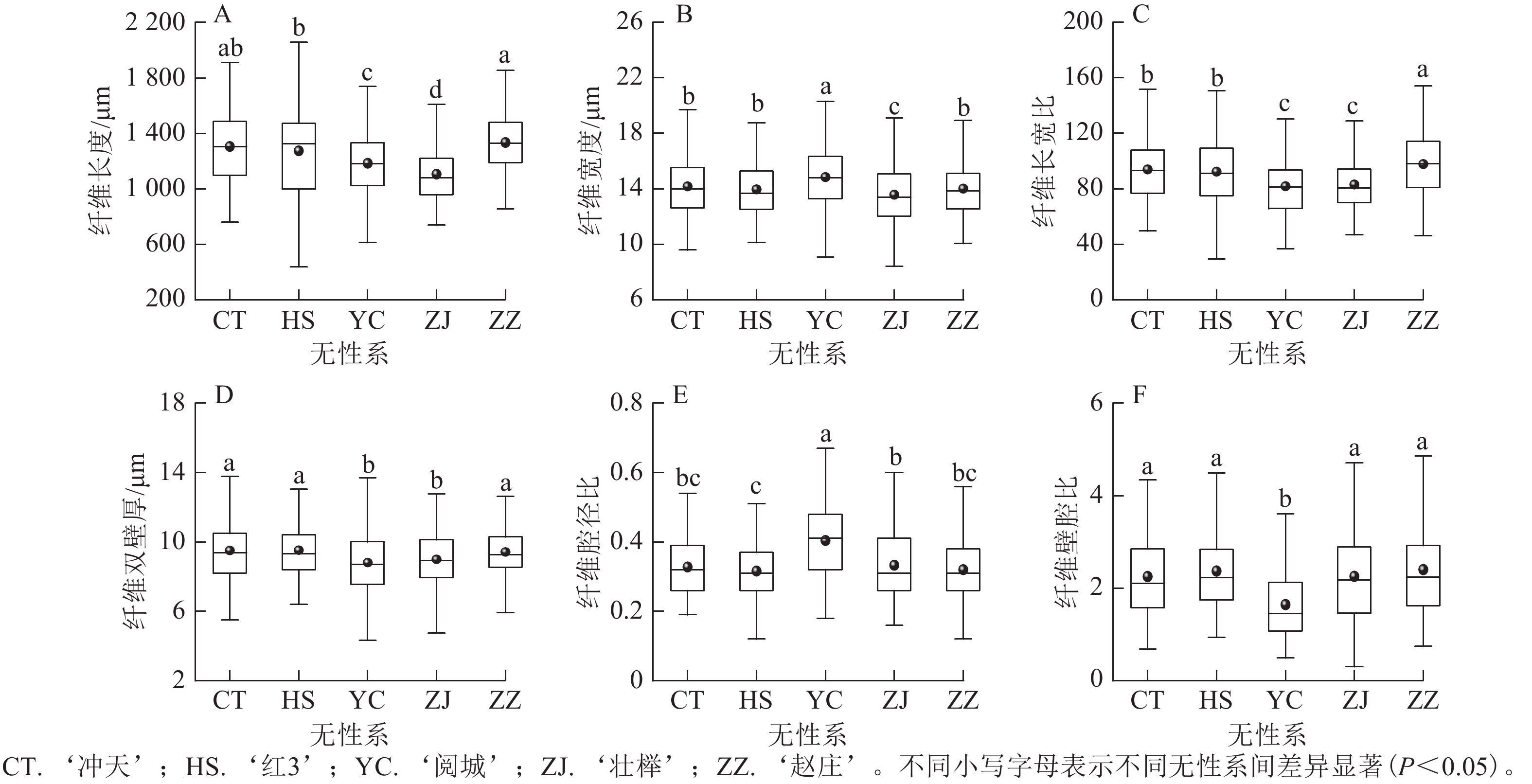
    • 图1可知:5个榉树无性系幼龄材的平均纤维长度为1 240.32 μm±250.50 μm,属于国际木材解剖协会(IAWA)分级中的中等级别(900~1 600 μm);平均纤维宽度为14.12 μm±2.20 μm,长宽比为89.84±22.39,双壁厚为9.25 μm±1.66 μm,腔径比为0.34±0.10,壁腔比为2.19±0.94。其中,无性系‘赵庄’的纤维长度、长宽比、壁腔比最大,而‘阅城’的纤维宽度、腔径比最大,‘红3’的纤维双壁厚最大。‘阅城’在纤维长度、宽度、腔径比和壁腔比上均与其他无性系差异显著(P<0.05),而‘赵庄’在长宽比上差异显著(P<0.05)。方差分析结果(表1)表明:各无性系在所有纤维形态指标上均存在极显著差异(P<0.001)。
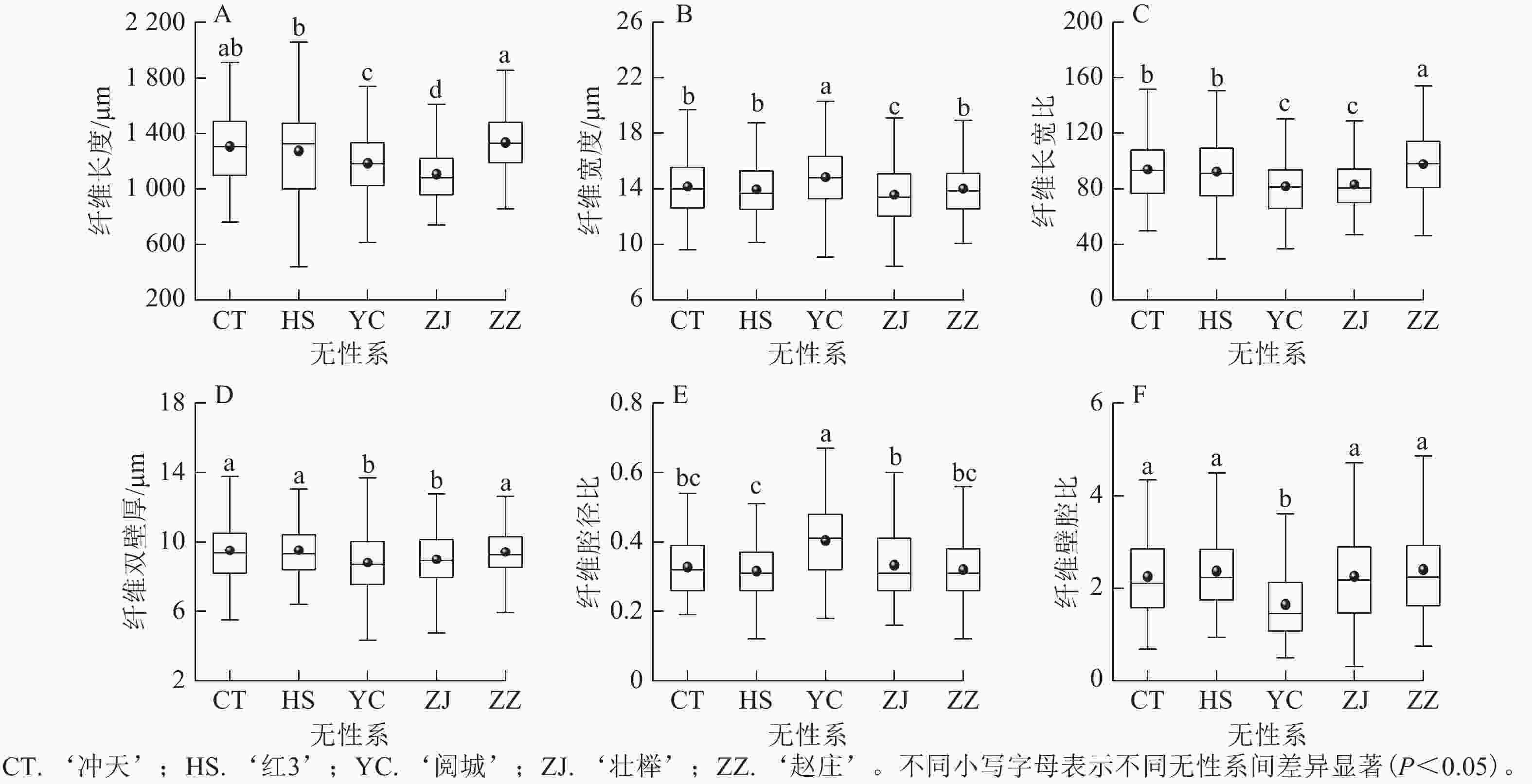
      Figure 1.  Morphological characteristics of wood fibers of 5 Z. schneideriana clones

      指标 平方和 自由度 均方 F 显著性
      纤维长度 9 485 930.512 4 2 371 482.628 42.435 ***
      纤维宽度 231.620 4 57.905 12.422 ***
      纤维长宽比 52 783.620 4 13 195.905 28.477 ***
      纤维双壁厚 113.690 4 28.423 10.574 ***
      纤维腔径比 1.420 4 0.355 43.450 ***
      纤维壁腔比 103.167 4 25.792 32.186 ***
        说明:***表示差异极显著(P<0.001)。

      Table 1.  One-way ANOVA of fiber characteristics for 5 Z. schneideriana clones

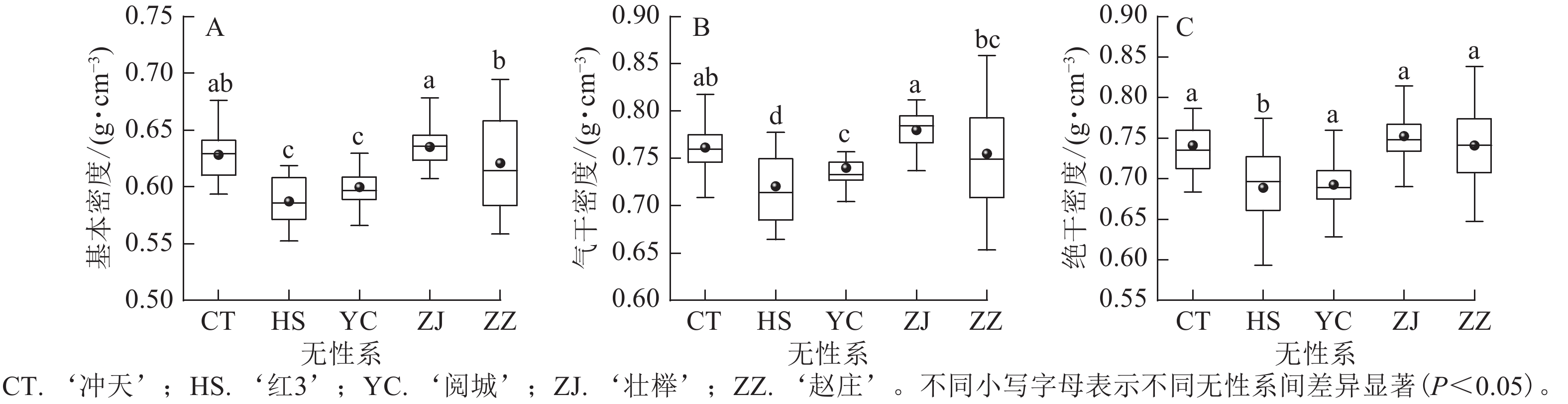
    • 图2可知:5个榉树无性系的基本密度、气干密度和绝干密度均呈一致趋势,即‘壮榉’>‘冲天’>‘赵庄’>‘阅城’>‘红3’,平均分别为(0.614±0.031)、(0.751±0.042)和(0.713±0.040) g·cm−3。根据木材材性分级,‘壮榉’‘冲天’和‘赵庄’的基本密度和气干密度属重级(Ⅳ级),‘阅城’和‘红3’属中级(Ⅲ级)。‘红3’的气干密度和绝干密度与其他无性系差异显著(P<0.05)。结合表2可知:不同无性系木材密度存在极显著差异(P<0.001)。
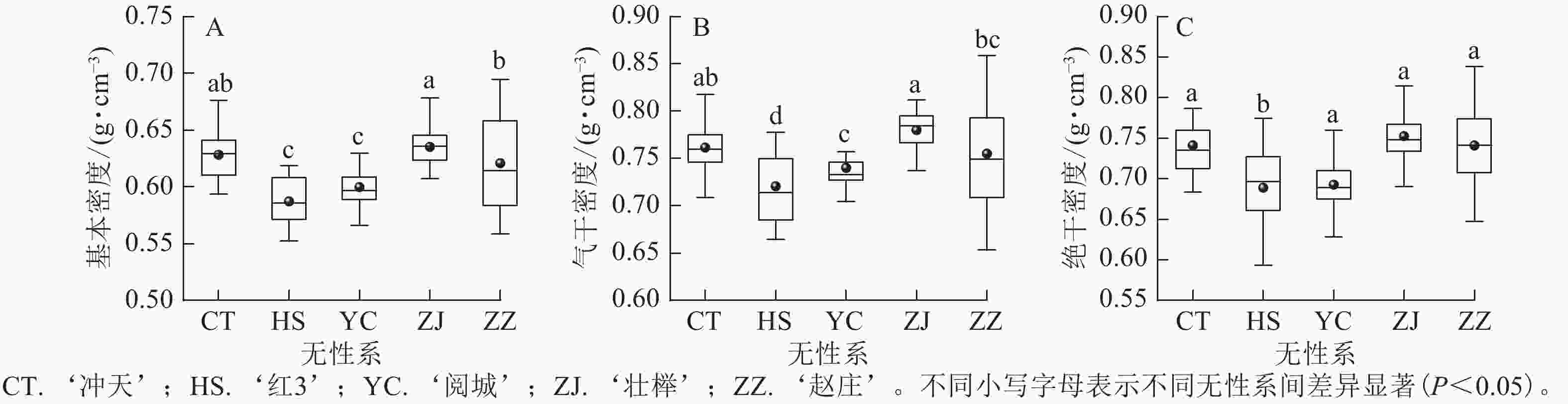
      Figure 2.  Wood density of 5 Z. schneideriana clones

      指标 平方和 自由度 均方 F 显著性
      基本密度 0.050 4 0.012 19.791 ***
      气干密度 0.061 4 0.015 11.021 ***
      绝干密度 0.076 4 0.019 10.918 ***
      气干干缩 径向干缩率 0.002 4 0.001 4.655 **
      弦向干缩率 0.006 4 0.002 5.081 ***
      体积干缩率 0.014 4 0.004 6.509 ***
      差异干缩 11.39 4 2.848 1.842 0.124
      全干干缩 径向干缩率 0.003 4 0.001 4.372 **
      弦向干缩率 0.001 4 0.000 0.823 0.513
      体积干缩率 0.002 4 0.000 1.257 0.290
      差异干缩 3.256 4 0.814 4.087 **
      最大吸水率 2 856.174 4 714.044 11.239 ***
      弯曲强度 12 029.906 4 3 007.476 23.363 ***
      弯曲模量 71.687 4 17.922 18.824 ***
      顺纹抗压强度 784.126 4 196.032 13.099 ***
        说明:**表示差异显著(P<0.01);***表示差异极显著(P<0.001)。

      Table 2.  One-way ANOVA of physical-mechanical properties for 5 Z. schneideriana clones

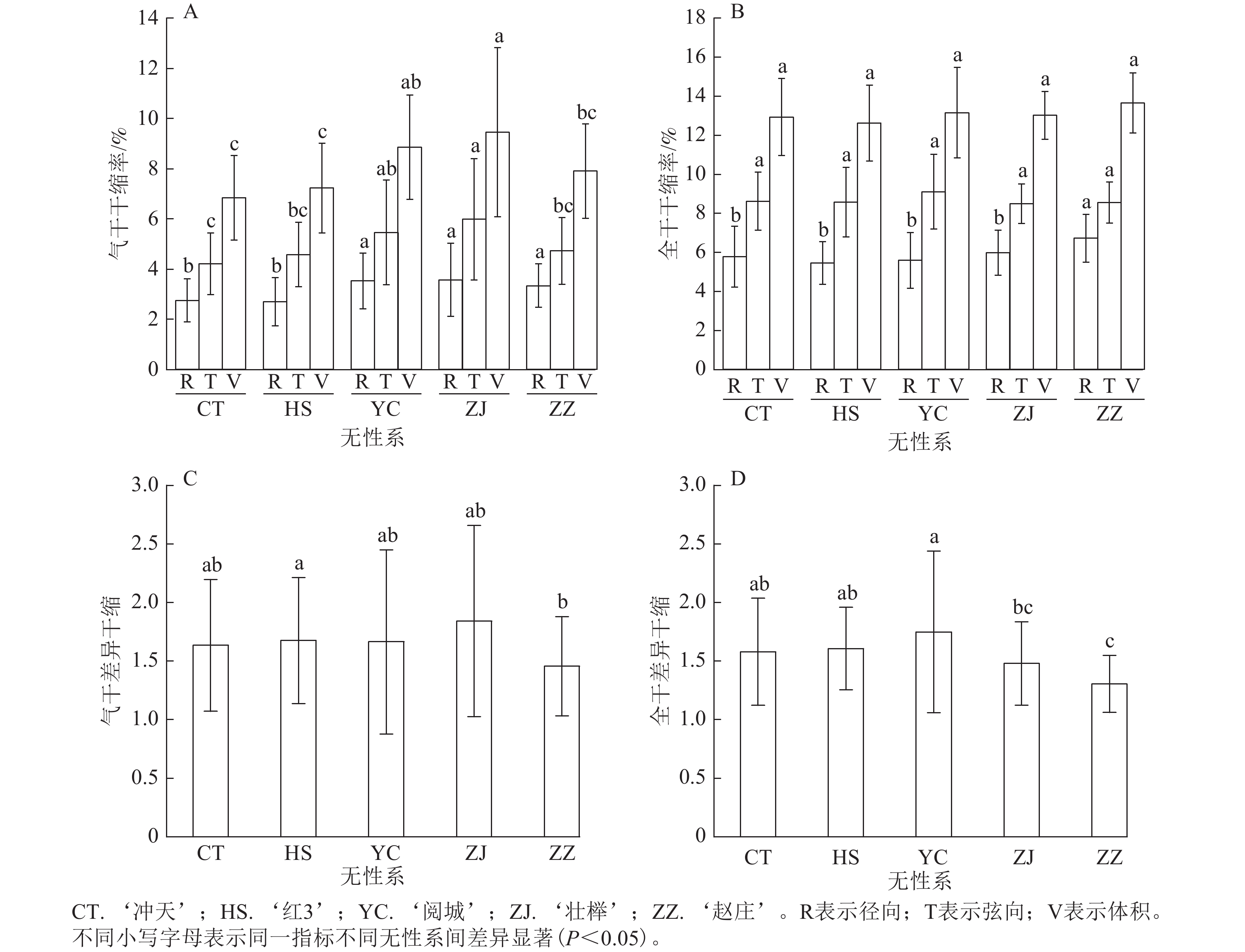
    • 图3可知:5个榉树无性系幼龄材从饱水至气干状态,径向、弦向、体积干缩率和差异干缩均值分别为3.18%、4.99%、8.06%和1.65;从饱水至全干状态,相应值分别为5.91%、8.67%、13.08%和1.54。气干状态下的各干缩指标值均低于全干状态,但差异干缩较全干状态高0.11,表明其干燥过程中更易发生不均匀收缩。
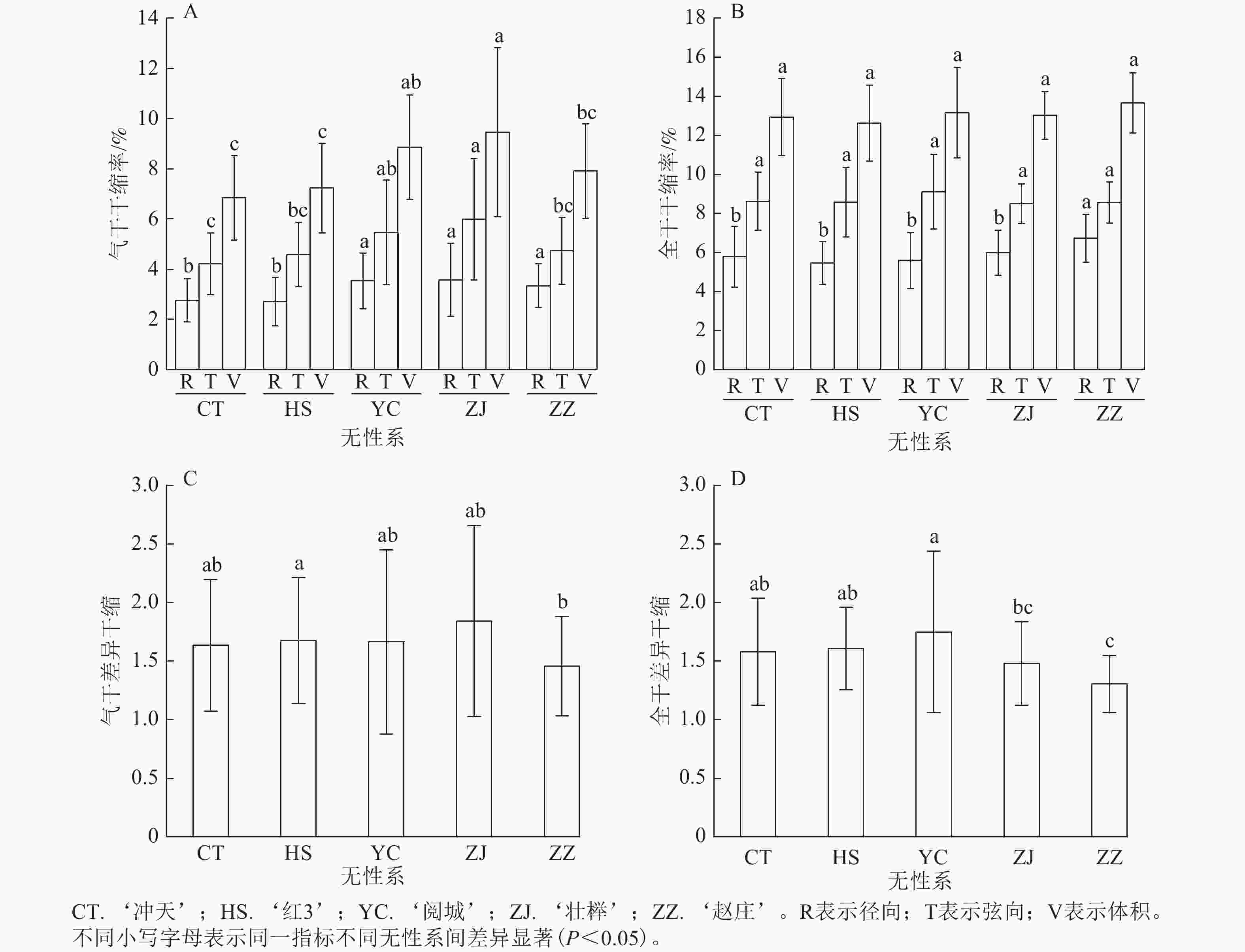
      Figure 3.  Wood shrinkage rate of 5 Z. schneideriana clones

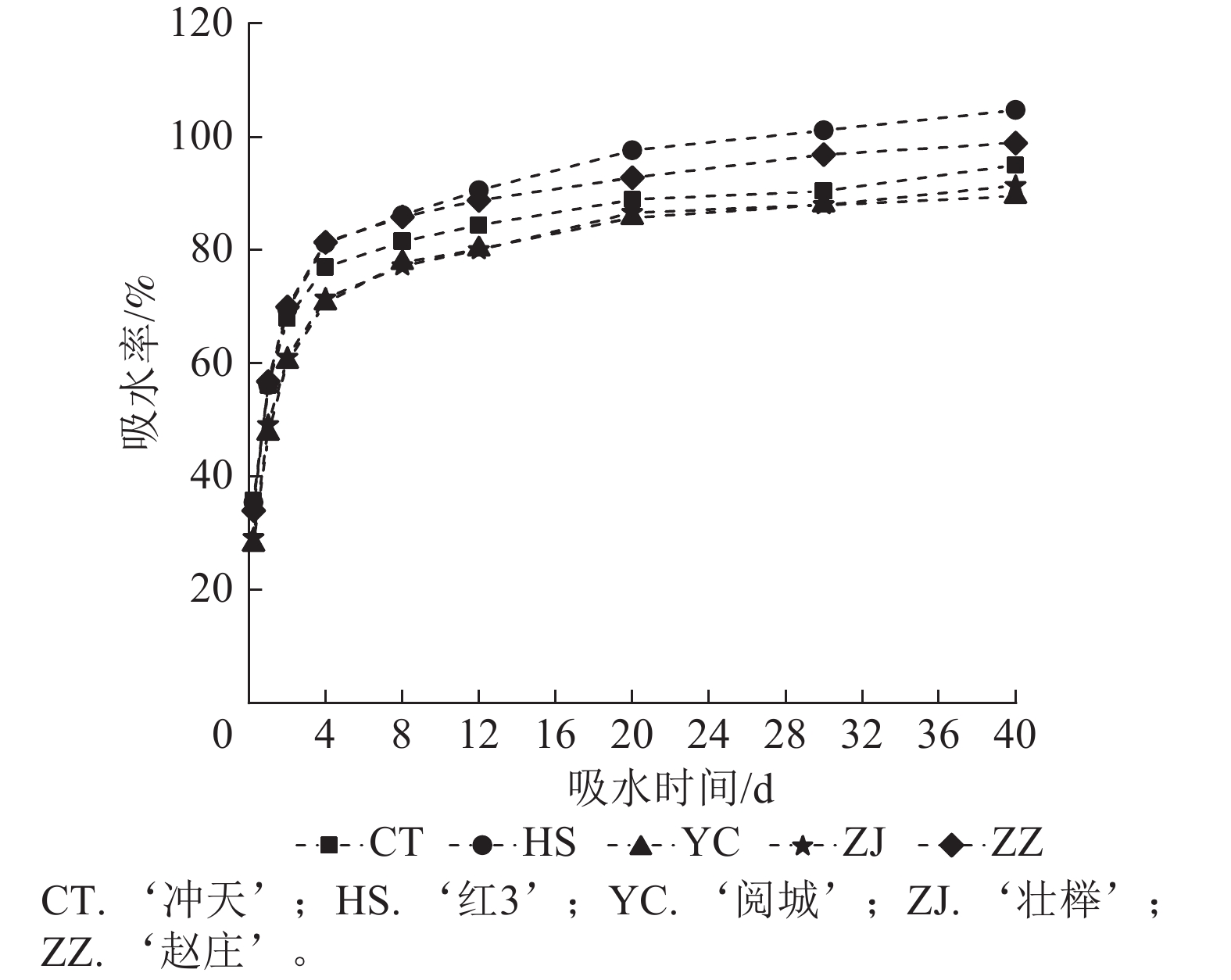
    • 图4可知:吸水过程可分为3个阶段。其中0~8 d为初始吸水阶段,吸水速率较大,木材的吸水率曲线迅速上升,但吸水速率随时间快速降低;8~20 d吸水速率明显放缓,第8天吸水率大部分大于80%,吸水率曲线呈现缓慢上升趋势,第20天均达到最大吸水率,5个榉树无性系的最大吸水率均值为90.30%±9.00%,其中‘红3’的最大吸水率最高,为97.56%,‘阅城’最低,为85.72%;20~40 d吸水率趋向饱和,吸水速率进一步降低,吸水曲线趋向于水平。由表2可知:不同无性系间最大吸水率差异极显著(P<0.001)。
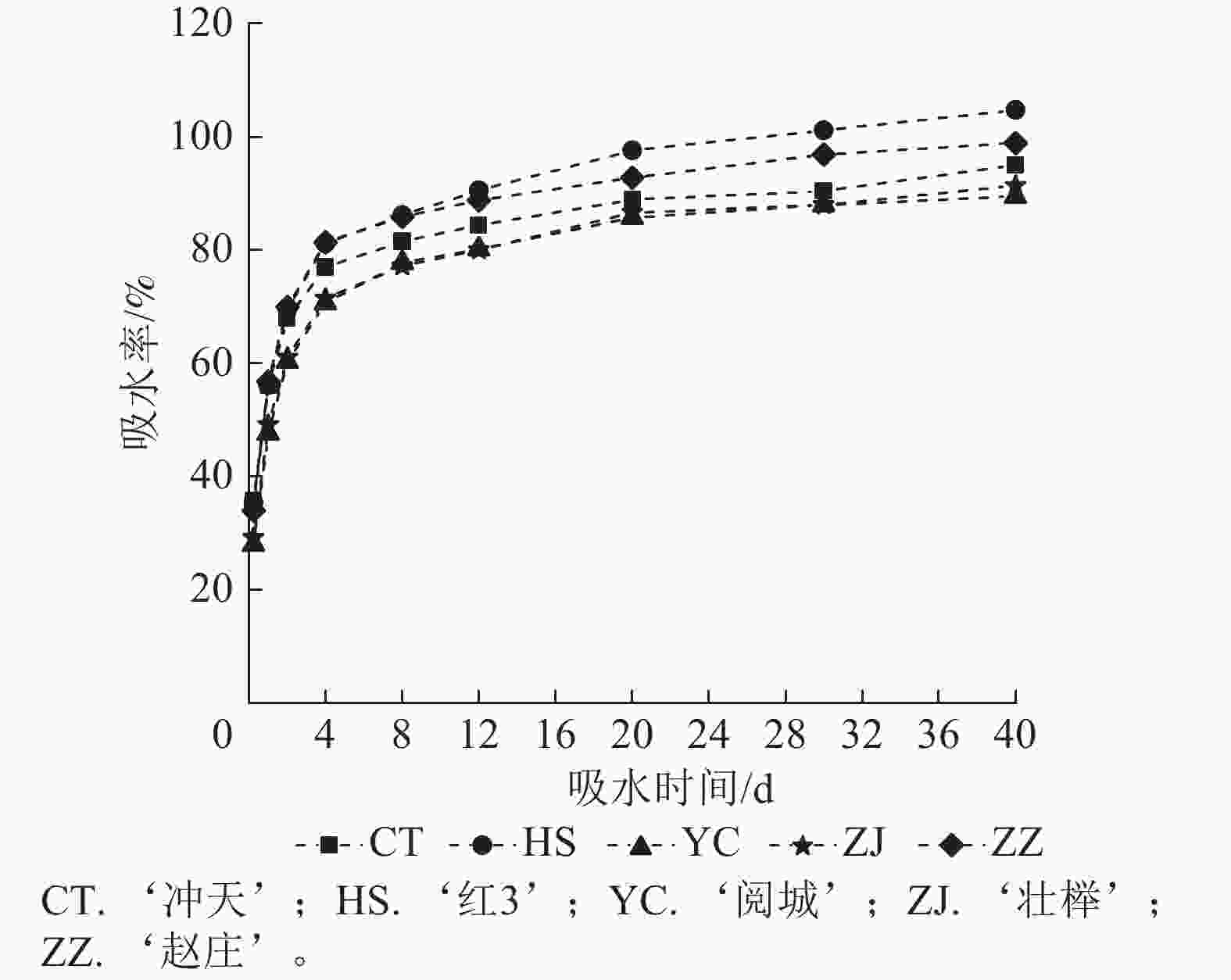
      Figure 4.  Curve of wood water absorption rate of 5 Z. schneideriana clones over time

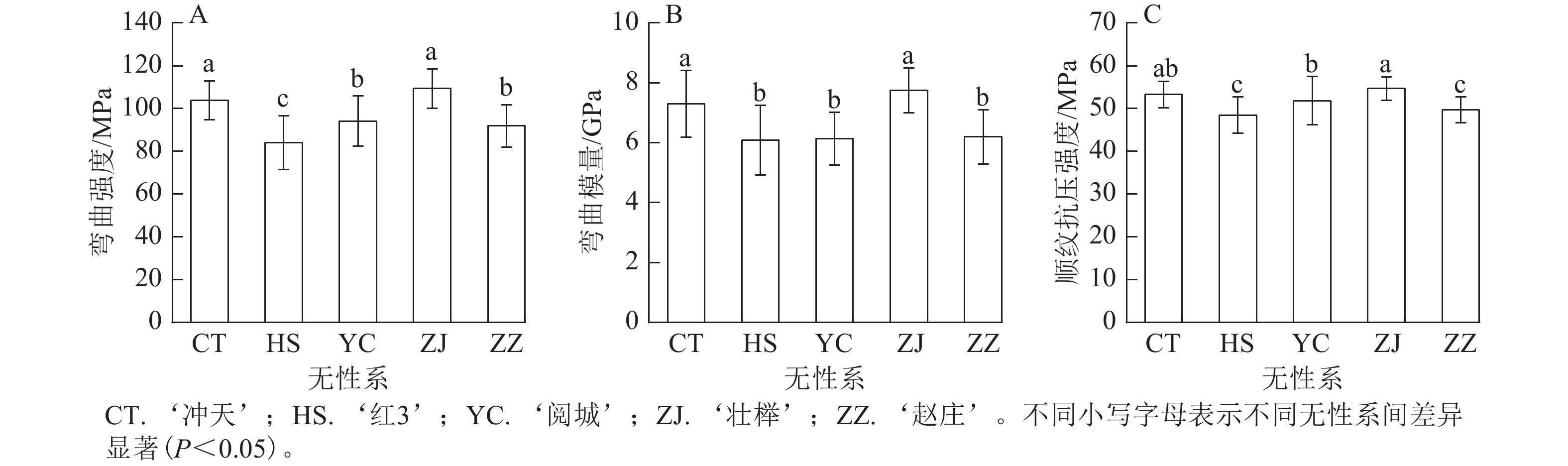
    • 图5可知:5个榉树无性系幼龄材弯曲强度、弯曲模量和顺纹抗压强度的均值分别为96.62 MPa、6.69 GPa和51.59 MPa。弯曲强度排序为‘壮榉’>‘冲天’>‘阅城’>‘赵庄’>‘红3’,除‘红3’为Ⅱ级外,其余为Ⅲ级。弯曲模量排序与密度一致,‘壮榉’为Ⅱ级,其余为Ⅰ级。顺纹抗压强度排序为‘壮榉’>‘冲天’>‘阅城’>‘赵庄’>‘红3’,均为Ⅲ级。由表2可知:主要力学性质在无性系间差异极显著(P<0.001)。
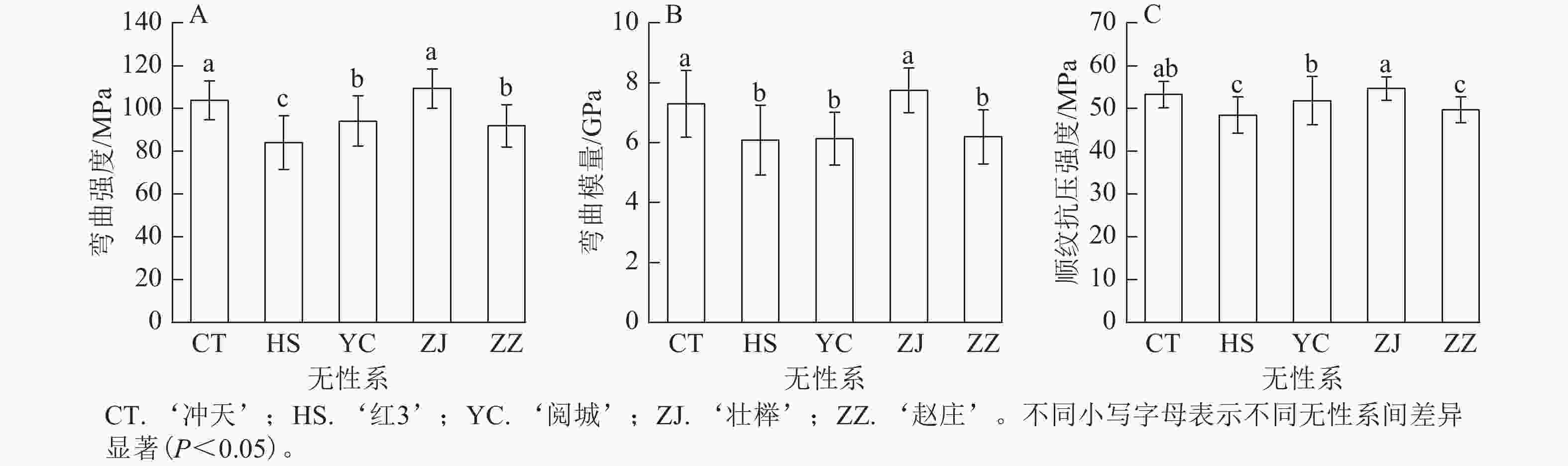
      Figure 5.  Mechanical properties of 5 Z. schneideriana clones

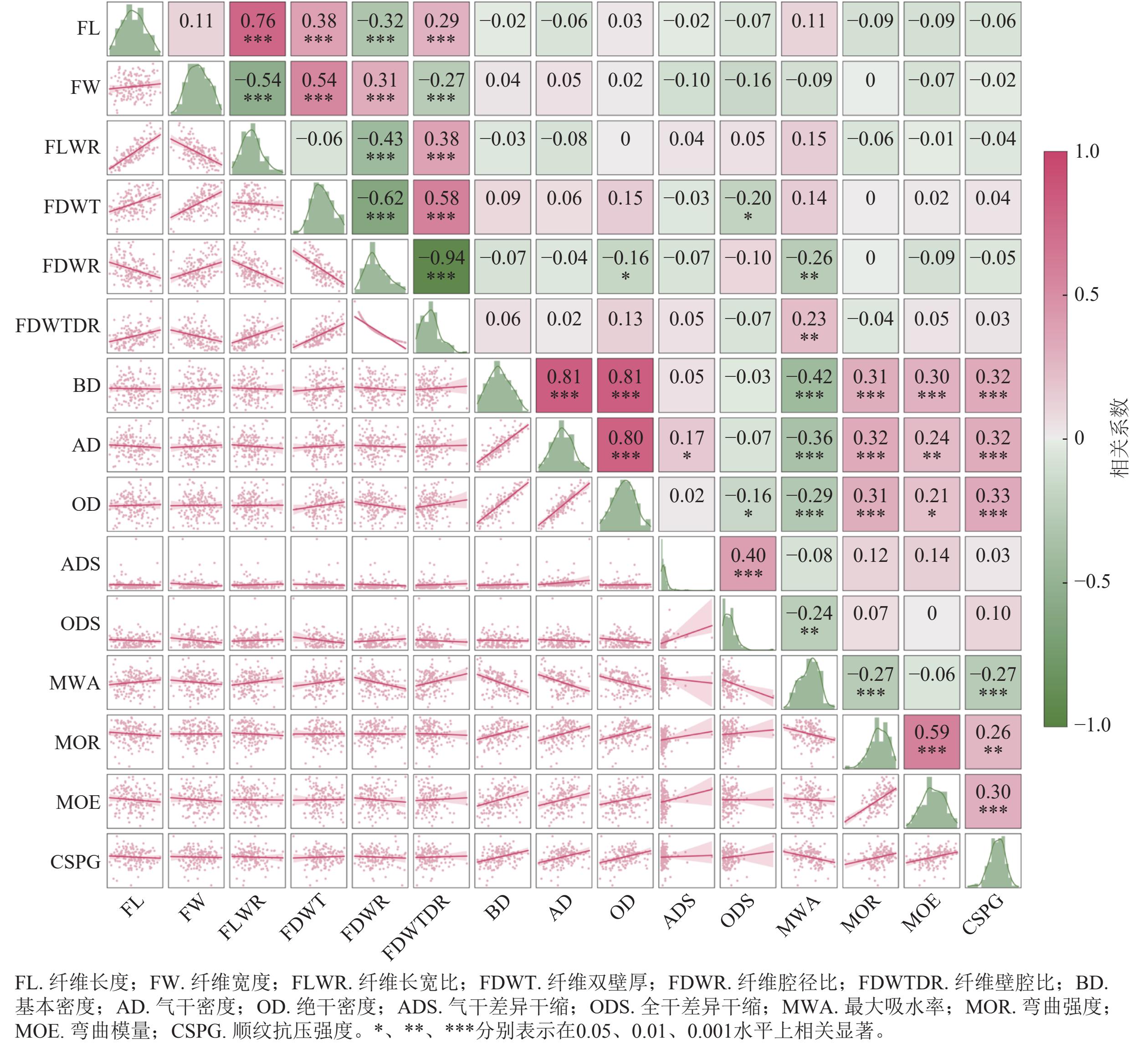
    • 图6可知:纤维形态指标间多数存在显著相关性。密度指标间呈极显著正相关(P<0.001)。最大吸水率与密度、绝干差异干缩呈极显著负相关(P<0.01)。力学指标间呈极显著正相关(P<0.01)。纤维双壁厚与全干差异干缩呈负相关,腔径比与绝干密度和最大吸水率呈负相关,壁腔比与最大吸水率呈正相关。密度与力学性能呈显著正相关(P<0.05),最大吸水率与弯曲强度、顺纹抗压强度呈极显著负相关(P<0.001)。
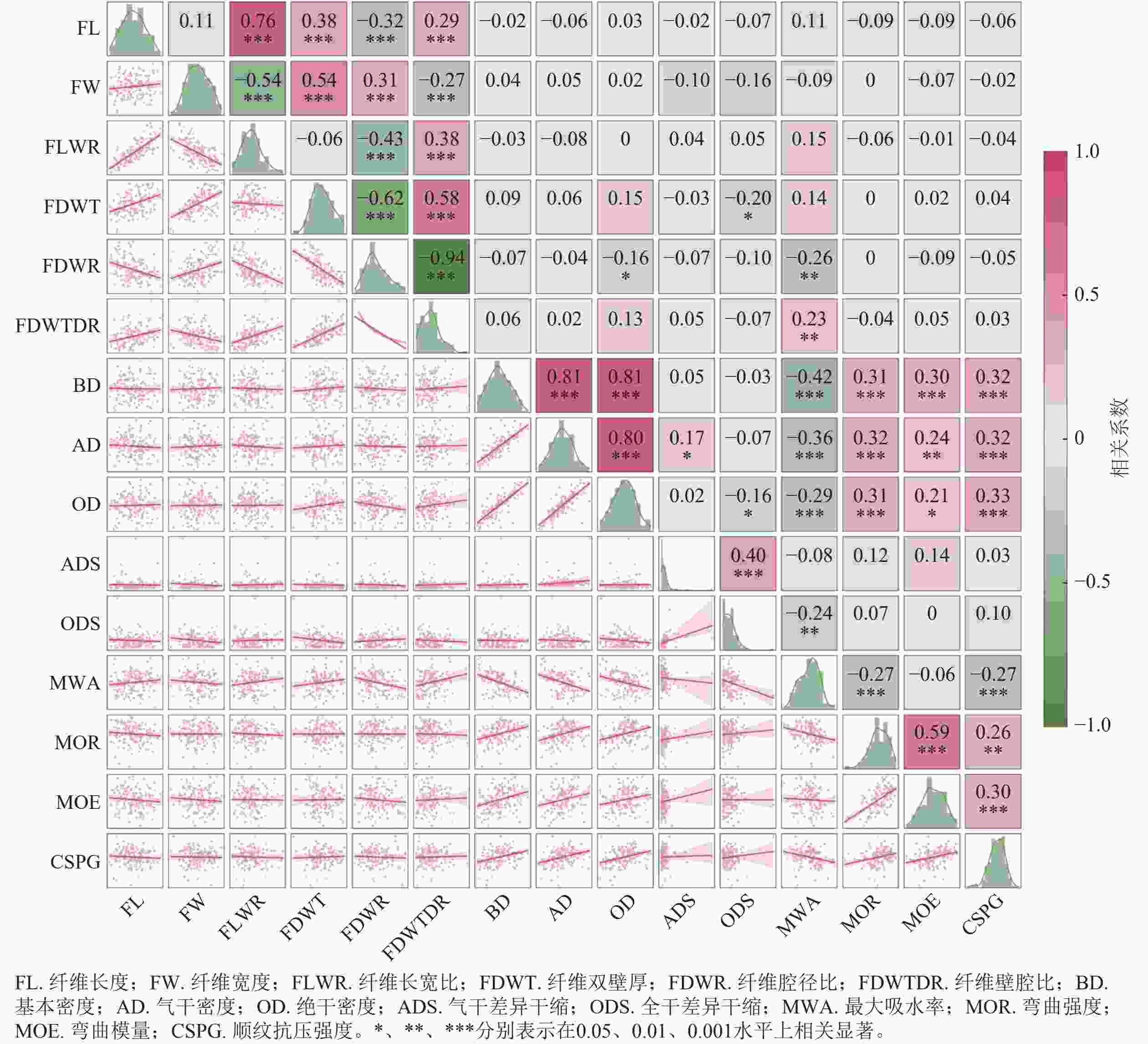
      Figure 6.  Heat map of correlation analysis of fiber, physical and mechanical properties for 5 Z. schneideriana clones

    • 本研究对15个特征指标进行主成分分析,从中提取了6个主成分进行综合评估。通过计算各指标在主成分中的权重贡献(表3),确定相应的特征向量,根据所选主成分的贡献率对主成分得分进行加权平均,得到综合评价得分(表4)。从表4可见:无性系‘壮榉’与‘冲天’综合评价得分整体排名位居前列,综合评价最优。

      指标 主成分1 主成分2 主成分3 主成分4 主成分5 主成分6
      纤维长度 −0.059 0.363 −0.012 −0.178 0.444 0.496
      纤维宽度 0.049 −0.131 −0.596 0.179 0.357 0.159
      纤维长宽比 −0.077 0.370 0.384 −0.274 0.143 0.348
      纤维双壁厚 0.062 0.352 −0.468 0.292 0.179 −0.044
      纤维腔径比 0.018 0.505 0.009 0.168 −0.131 −0.248
      纤维壁腔比 −0.030 −0.525 −0.019 −0.158 0.145 0.210
      基本密度 0.465 0.042 −0.013 −0.231 0.072 −0.117
      气干密度 0.459 0.020 −0.016 −0.208 0.068 −0.178
      绝干密度 0.440 0.103 −0.061 −0.300 0.011 −0.159
      气干差异干缩 0.083 0.009 0.298 0.405 0.338 −0.248
      全干差异干缩 0.001 −0.099 0.393 0.343 0.435 −0.164
      最大吸水率 −0.284 0.189 −0.100 0.037 −0.331 −0.050
      弯曲强度 0.333 −0.030 0.064 0.337 −0.190 0.421
      弯曲模量 0.291 −0.010 0.101 0.357 −0.352 0.394
      顺纹抗压强度 0.283 0.004 0.080 0.104 −0.039 0.070
      特征值 3.506 3.073 1.937 1.384 1.248 1.129
      贡献率/% 23.370 20.484 12.916 9.230 8.319 7.528
      累计贡献率/% 23.370 43.854 56.770 66.000 74.318 81.846

      Table 3.  Eigenvectors of main indicators based on Principal Component Analysis (PCA)

      无性系 主成
      分1
      主成
      分2
      主成
      分3
      主成
      分4
      主成
      分5
      主成
      分6
      综合
      得分
      排序
      ‘冲天’ 0.116 0.086 −0.021 0.024 0.045 0.051 0.300 2
      ‘红3’ −0.488 −0.057 0.020 −0.008 −0.003 −0.019 −0.554 5
      ‘阅城’ −0.033 0.048 0.059 0.048 0.001 −0.065 0.059 3
      ‘壮榉’ 0.509 −0.160 −0.022 0.014 −0.032 −0.000 0.310 1
      ‘赵庄’ −0.170 0.085 −0.052 −0.087 −0.008 0.014 −0.218 4

      Table 4.  Comprehensive evaluation score of each clone

    • 木材材性是评价林木经济价值与利用潜力的重要依据,对于榉树这类珍贵用材树种,建立高效的早期选择方法对于缩短漫长的育种周期具有重要意义。传统林木选育策略多依托单一性状进行筛选,且需等待林木生长至木材成熟阶段方可测定评价,存在选育周期长、效率偏低等缺点。本研究通过对5个榉树无性系7年生幼龄材的纤维形态和物理力学性能进行测定与综合评价,为榉树早期选育提供了理论依据。

      纤维形态是早期选育的重要指标之一,具有一定的选择基础和改良潜力。尹焕焕等[22]研究发现:马尾松Pinus massoniana不同无性系的纤维形态存在一定的遗传变异,且幼龄与成熟期性状关联性较强,说明纤维形态性状受遗传主导,具备早期选择可行性。本研究中,5个榉树无性系的纤维长度、纤维宽度、纤维长宽比等指标差异极显著,其中‘赵庄’无性系纤维长度、纤维长宽比和壁腔比最高,‘阅城’无性系纤维宽度和腔径比最大,说明榉树无性系的纤维形态同样具有稳定的遗传分化基础,可作为早期评价的关键依据。除纤维形态外,物理力学性能也是评价木材品质的核心。‘壮榉’‘冲天’和‘赵庄’无性系的基本密度已达Ⅳ级重级标准,所有无性系的差异干缩系数均小于2.0,表明其属于干燥稳定性好、不易翘曲开裂的树种[23]。‘壮榉’无性系在弯曲强度、弯曲模量和顺纹抗压强度方面均表现最优,其弯曲模量甚至达到Ⅱ级标准。其中,无性系‘赵庄’密度虽低于‘阅城’,但其力学性能明显更优,这可能是因为‘赵庄’具有更规整的纤维排列以及更厚的纤维细胞壁,从而在承受弯曲和压缩载荷时表现出更强的抗力。该现象表明木材力学性能不仅取决于密度,还与其内部组织结构特征密切相关,这与SU等[24]对杂交杨树的研究结果一致,因此在榉树早期选育及材性改良过程中,需综合考虑密度和组织结构特征的协同作用。本研究榉树幼龄材弯曲模量数值较低,反映该材料在受外力作用时表现出较强的弯曲变形倾向[25]。有研究表明:幼龄材的弯曲模量与成熟材有显著差异,是成熟材的55%~90%[26]。因此,本研究中榉树样本弯曲模量偏低的现象与幼龄材固有的力学性能特征相符。本研究相关性分析与主成分分析进一步表明:密度与力学性能间呈显著正相关,而最大吸水率与弯曲强度、顺纹抗压强度呈极显著负相关。主成分分析累计贡献率达81.846%,综合得分表明‘壮榉’和‘冲天’无性系整体性能表现最优,适于作为早期选育的优良品种。同时卜军[27]研究指出:榉树幼龄材与成熟材界定于第7年,此后材性趋于稳定,印证了以7年生作为早期选择年龄的可行性。

      综上,榉树在幼龄期已表现出显著的材性变异,纤维形态特征和物理力学性质具有较高的遗传可控性和早期预测价值。通过无性系选择,可在幼龄期筛选出优质材料,显著缩短育种周期,提高良种选育效率。今后应进一步开展无性系多年份、多地点试验,深化幼龄材、成熟材相关规律研究,建立更精确的早期选择模型,推动榉树遗传改良与高效利用。

    • 5个榉树无性系幼龄材在纤维长度、纤维宽度、纤维长宽比、密度、吸水性及力学性能等方面差异均达极显著水平。‘壮榉’和‘冲天’无性系密度高、力学性能优,具备早期选育潜力;‘赵庄’无性系虽密度较低,但因纤维排列规整、细胞壁较厚,仍表现出较优的力学强度,证实幼龄材力学性能由密度与纤维结构共同决定。基于多性状综合评价,可确定‘壮榉’和‘冲天’为早期优选无性系。

Reference (27)

Catalog

    /

    DownLoad:  Full-Size Img  PowerPoint
    Return
    Return