Turn off MathJax
Article Contents

WANG Yajun, ZHANG Jianjun, HU Yawei, et al. Effects of afforestation measures on growth of Quercus liaotungensis seedlings in transformation of Pinus tabulaeformis stands in the loess region of western Shanxi Province[J]. Journal of Zhejiang A&F University, 2026, 43(X): 1−11 doi:  10.11833/j.issn.2095-0756.20250514
Citation: WANG Yajun, ZHANG Jianjun, HU Yawei, et al. Effects of afforestation measures on growth of Quercus liaotungensis seedlings in transformation of Pinus tabulaeformis stands in the loess region of western Shanxi Province[J]. Journal of Zhejiang A&F University, 2026, 43(X): 1−11 doi:  10.11833/j.issn.2095-0756.20250514

OnlineFirst articles are published online before they appear in a regular issue of the journal. Please find and download the full texts via CNKI.

Effects of afforestation measures on growth of Quercus liaotungensis seedlings in transformation of Pinus tabulaeformis stands in the loess region of western Shanxi Province

DOI: 10.11833/j.issn.2095-0756.20250514
  • Received Date: 2025-09-24
  • Accepted Date: 2026-03-23
  • Rev Recd Date: 2026-03-20
  •   Objective  Quercus liaotungensis is the preferred mixed tree species for Pinus tabulaeformis plantation reconstruction in North China. This study aims to clarify the effects of afforestation measures on growth of Q. liaotungensis seedlings under P. tabulaeformis plantation, so as to provide the basis for transformation of low-efficiency P. tabulaeformis forest and construction of pine-oak mixed forest.   Method  Taking P. tabulaeformis plantation in Caijiachuan watershed of Jixian County, Shanxi Province as the research object, sample plots were set up outside the forest, at the edge of forest, and inside the forest to conduct planting experiments of Q. liaotungensis. A total of 15 treatment methods were set up in the experiment, including no treatment (ck), watering treatments (500, 1 000, 1 500, 2 000 mL·plant−1), covering treatments (covering with plastic film, covering with litter of 45, 90, 135, 180 g·plant−1), and water retaining agent treatments (10, 20, 30, 40, 50 g·plant−1). Regularly monitor growth indexes such as survival rate, seedling height, ground diameter, crown width, leaf quantity and leaf area to explore the effectiveness of different afforestation measures.  Result  (1) The optimal amount of water needed outside the forest, at the edge of forest and inside the forest decreased in turn, which were 2 000, 1 500 and 1 000 mL·plant−1, respectively. (2) The optimal coverage required outside the forest, at the edge of forest and inside the forest decreased gradually, which were 135, 90 and 45 g·plant−1, respectively. (3) When Q. liaotungensis was planted outside the forest, at the edge of forest, and in the forest, the optimal amount of water retaining agent gradually decreased, which were 40, 20 and 10 g·plant−1, respectively. (4) Survival rate and growth status of Q. liaotungensis planted at the edge of forest were the best, followed by that inside the forest, and the worst outside the forest. (5) The comprehensive evaluation of entropy weight TOPSIS method showed that 40 g·plant−1 of water retaining agent was used outside the forest, 20 g·plant−1 of water retaining agent was used at the edge of forest, and 45 g·plant−1 of litter was covered inside the forest, which had the best promoting effect on growth of Q. liaotungensis seedlings.   Conclusion  When using Q. liaotungensis to renew and transform P. tabulaeformis plantations, adaptive measures should be selected according to the characteristics of habitat. When creating block mixed forests, water retaining agents should be prioritized, and when intercropping between plants or rows, it is advisable to strengthen the coverage of planting holes to improve the survival rate and growth quality of seedlings. [Ch, 3 fig. 8 tab. 38 ref.]
  • [1] WU Xiujuan, AO Xiaoping.  Point pattern analysis of dominant populations in Quercus mongolica natural forest on the west side of Lüliang Mountain . Journal of Zhejiang A&F University, doi: 10.11833/j.issn.2095-0756.20240535
    [2] GUO Hongyang, SHI Mingchang, YANG Jianying, CHEN Chunyang.  Precise spatial distribution of suitability of Pinus tabulaeformis in Daqing River Basin, Baiyangdian . Journal of Zhejiang A&F University, doi: 10.11833/j.issn.2095-0756.20200599
    [3] ZHANG Zhonghui, GUO Jianbin, WANG Yanhui, WANG Xiao.  Population structure and spatial distribution pattern of Quercus wutaishanica in Liupan Mountains . Journal of Zhejiang A&F University, doi: 10.11833/j.issn.2095-0756.20200707
    [4] LI Chao, PEI Shunxiang, ZHANG Lianjin, GUO Jia, XIN Xuebing.  Applicability evaluation of competition indexes for Pinus tabuliformis plantations in Beijing . Journal of Zhejiang A&F University, doi: 10.11833/j.issn.2095-0756.2019.06.008
    [5] LIU Wei, WEI Tianxing, ZHU Qingke.  Growing season sap flow of Populus hopeiensis and Pinus tabulaeformis in the semi-arid Loess Plateau, China . Journal of Zhejiang A&F University, doi: 10.11833/j.issn.2095-0756.2018.06.007
    [6] WANG Jinchi, RAN Qixiang, DENG Huafeng, HUANG Guosheng, WANG Xuejun.  Stand growth model for Pinus tabulaeformis using measurement error method . Journal of Zhejiang A&F University, doi: 10.11833/j.issn.2095-0756.2018.01.009
    [7] TENG Fei, LIU Yong, WANG Yan, HU Jiawei, SUN Qiaoyu, WAN Fangfang, ZHANG Jin.  Sub-irrigation with different container types and sizes for containerized root growth of Pinus tabuliformis seedlings . Journal of Zhejiang A&F University, doi: 10.11833/j.issn.2095-0756.2017.03.010
    [8] WANG Qiao, NIE Xin, SUN Dehao, WANG Huatian, MENG Xianpeng, CAO Guiping, LI Jian, HUANG Changbao.  Vigor of old Pinus tabuliformis using the AHP-fuzzy comprehensive evaluation model . Journal of Zhejiang A&F University, doi: 10.11833/j.issn.2095-0756.2016.01.019
    [9] WU Yajing, BI Jun, LI Qiuyan, GAO Hongzhen.  Selection of shiitake residue substrate size formula screening for Pinus tabuliformis container seedlings . Journal of Zhejiang A&F University, doi: 10.11833/j.issn.2095-0756.2015.03.023
    [10] Yilita, Haoshuqi, HAN Hai-rong, FAN Xiao-hua, KANG Feng-feng.  Niche characteristics of a Quercus liaotungensis forest in the Lingkong Mountains . Journal of Zhejiang A&F University, doi: 10.11833/j.issn.2095-0756.2012.01.009
    [11] SHI Feng-hou, ZHU Can-can, SHEN Yong-bao, SHI Ji-sen.  Effects of ultrasonic wave and osmotic treatments on germination of Pinus tabulaeformis seed . Journal of Zhejiang A&F University, doi: 10.11833/j.issn.2095-0756.2011.04.004
    [12] SHAO Dong-hua, REN Qin, Ning Xin-zhe, BAI Shu-lan.  Root exudate constituents and allelopathic effects from forests of Pinus tabulaeformisOstryopsis davidiana,and a mixed forest . Journal of Zhejiang A&F University, doi: 10.11833/j.issn.2095-0756.2011.02.026
    [13] LI Xiao-hong, GAO Jia-rong, ZHANG Jin-rui, YANG Qi-lin.  Determining stand density from growth indicators for young Pinus tabulaeformis in the Miyun Reservoir,Beijing . Journal of Zhejiang A&F University, doi: 10.11833/j.issn.2095-0756.2010.06.003
    [14] MA Feng-feng, JIA Li-ming.  Outside and inside bark diameter at breast height for Platycladus orientalis and Pinus tabulaeformis in the Beijing area . Journal of Zhejiang A&F University,
    [15] LIU Yong-hong, YANG Pei-hua, HAN Chuang-ju, FAN Jun-feng, LI Xin-hui, LI An-ping, YANG Shi-rong.  Phenotypic variation in seed cones and seeds of species and families in different provenances of Pinus tabulaeformis . Journal of Zhejiang A&F University,
    [16] JING Li, ZHU Zhi-hong, WANG Xiao-an, GUO Hua.  Community characteristics of a Pinus tabulaeformis secondary forest and a planted forest in the Xunyangba Region of the Qinling Mountains . Journal of Zhejiang A&F University,
    [17] LUJun-feng, WANG Hui, CAO Jing, YUANHong-bo.  Water holding capacity and nutrients of litter layers in a Pinus tabulaeformis plantation at different ages in Mount Xiaolong of Gansu . Journal of Zhejiang A&F University,
    [18] YANG Pei-hua, FAN Jun-feng, LIU Yong-hong, HAN Chuang-ju, DUAN Le, L Xiao-feng, XIAO Fei, GUO Hong-jie.  Techniques of constructing the second generation clone-orchards of Pinus tabulaeformis . Journal of Zhejiang A&F University,
    [19] LIU Yong-hong, FAN Jun-feng, YANG Pei-hua, HAN Chuang-ju.  Genetic variation of seedling growth traits of open-pollination families of Pinus tabulaeformis . Journal of Zhejiang A&F University,
    [20] ZHOU Yong-xue, FAN Jun-feng, YANG Pei-hua, GAO Jian-he, LIU Yong-hong.  Comparative studies on growth and biomass of one-year-old seedlings of Pinus nigra var. austriaca and Pinus tabuleaformis . Journal of Zhejiang A&F University,
  • [1]
    SUN Ruoxiu, MA Li, ZHANG Shouhong, et al. Study on landscape patches influencing hillslope erosion processes and flow hydrodynamics in the Loess Plateau of western Shanxi Province, China[J]. Water, 2020, 12(11): 3201. DOI: 10.3390/w12113201.
    [2]
    CUI Yanhong, BI Huaxing, LIU Shuqin, et al. Developing additive systems of biomass equations for Robinia pseudoacacia L. in the region of Loess Plateau of western Shanxi Province, China[J]. Forests, 2020, 11(12): 1332. DOI: 10.3390/f11121332.
    [3]
    MU Xingmin, ZHANG Xiuqin, SHAO Hongbo, et al. Dynamic changes of sediment discharge and the influencing factors in the Yellow River, China, for the recent 90 years[J]. CLEAN−Soil, Air, Water, 2012, 40(3): 303-309. DOI: 10.1002/clen.201000319.
    [4]
    YANG Hang, SONG Yahui, PANG Yue, et al. Driving factors of Chinese pine population distribution in the ridge habitats of the southern slope of the mid-Qinling Mountains, China[J]. Forests, 2023, 14(11): 2252. DOI: 10.3390/f14112252.
    [5]
    JIA Yajie, YANG Jianying, ZHANG Jianjun, et al. Effects of stand density on biomass and soil physico-chemical properties of Pinus tabuliformis forest in the loess area of western Shanxi[J]. Journal of Zhejiang A&F University, 2024, 41(6): 1211−1221. DOI: 10.11833/j.issn.2095-0756.20240571.
    [6]
    MAO Jun, WANG Liping, GAO Yonglong, et al. Evaluating plantation ecosystem services at Beijing Badaling National Forest Farm[J]. Journal of Beijing Normal University (Natural Science), 2024, 60(2): 224−232. DOI: 10.12202/j.0476-0301.2023064.
    [7]
    YU Ming, WANG Zhuomin, XUE Li. Effects of stand improvement and slope position on soil chemical properties in Cunninghamia lanceolata plantations[J]. Journal of Central South University of Forestry & Technology, 2019, 39(6): 38−44. DOI: 10.14067/j.cnki.1673-923x.2019.06.006.
    [8]
    CHEN Tiancheng, LI Xinping, HAO Xiangchun, et al. Growth model of individual Quercus wutaishansea Mary in Shanxi Province[J]. Forestry Construction, 2022, 40(2): 36−43.
    [9]
    ZHU Songlin. Artificial mixed afforestation technology of Pinus tabulaeformis and Quercus liaotungensis in Luliang Mountain[J]. Shanxi Forestry Science and Technology, 2016, 45(3): 44−45. DOI: 10.3969/j.issn.1007-726X.2016.03.015.
    [10]
    SUN Heng, ZHANG Yanping, WU Jiangchong, et al. Effect of drought stress and shading on growth and carbon-nitrogen metabolism of Azadirachta indica seedlings[J]. Acta Botanica Boreali-Occidentalia Sinica, 2020, 40(3): 463−470. DOI: 10.7606/j.issn.1000-4025.2020.03.0463.
    [11]
    CHEN Lixin, ZHANG Zhiqiang, ZHA Tonggang, et al. Soil water affects transpiration response to rainfall and vapor pressure deficit in poplar plantation[J]. New Forests, 2014, 45(2): 235−250. DOI: 10.1007/s11056-014-9405-0.
    [12]
    HAN Zhiping, ZHANG Haixia, ZHANG Xun, et al. Effects of water stress on growth and physiological properties of millet seedlings[J]. Chinese Journal of Agrometeorology, 2019, 40(8): 502−511. DOI: 10.3969/j.issn.1000-6362.2019.08.003.
    [13]
    KONG Kaikai, SHI Geli, HAN Wei, et al. Effects of different land cover on photosynthetic characteristics of Populus euphratica seedlings and evaluation[J]. Journal of Northeast Forestry University, 2020, 48(3): 35−40. DOI: 10.13759/j.cnki.dlxb.2020.03.007.
    [14]
    LI Zishuai, ZHANG Xinian, LIU Wenjie, et al. Effects of water retainer on the growth and physiology of Sophora moorcroftiana[J]. Northern Horticulture, 2023(5): 53−60. DOI: 10.11937/bfyy.20222520.
    [15]
    LI Hui, YANG Hua, XIE Rong. Canopy characteristics in gaps and its relationship with seedlings and saplings in a spruce-fir forest in the Changbai Mountain area of northeastern China[J]. Journal of Beijing Forestry University, 2021, 43(7): 54−62. DOI: 10.12171/j.1000-1522.20200131.
    [16]
    LIU Yadong, WANG Xiaoxia, HE Lulu, et al. Effects of spatial structure on understory vegetation and soil properties in Pinus tabuliformis plantation of different succession types in Beijing[J]. Acta Ecologica Sinica, 2023, 43(5): 1959−1970. DOI: 10.5846/stxb202112143542.
    [17]
    BANBURY MORGAN R, JUCKER T. A unifying framework for understanding how edge effects reshape the structure, composition and function of forests[J]. New Phytologist, 2025, 248(2): 529−541. DOI: 10.1111/nph.70457.
    [18]
    MEEUSSEN C, GOVAERT S, VANNESTE T, et al. Microclimatic edge-to-interior gradients of European deciduous forests[J]. Agricultural and Forest Meteorology, 2021, 311: 108699. DOI: 10.1016/j.agrformet.2021.108699.
    [19]
    HU Yawei, SHI Zhengle, LIU Chang, et al. Effects of stand densities on understory vegetation diversity and soil physicochemical properties of Robinia pseudoacacia forest in loess region of western Shanxi Province[J]. Chinese Journal of Ecology, 2023, 42(9): 2072−2080. DOI: 10.13292/j.1000-4890.202309.014.
    [20]
    LENG Xian, ZENG Yuan, ZHOU Jian, et al. Landscape conservation effectiveness assessment of nature reserves based on entropy weight-TOPSIS in Southwest China[J]. Acta Ecologica Sinica, 2023, 43(3): 1040−1053. DOI: 10.5846/stxb202110112860.
    [21]
    LEI Xunping, QIU Guanghua. Empirical study about the carrying capacity evaluation of regional resources and environment based on entropy-weight TOPSIS model[J]. Acta Scientiae Circumstantiae, 2016, 36(1): 314−323. DOI: 10.13671/j.hjkxxb.2015.0580.
    [22]
    GAO Xianming, DU Xiaojun, WANG Zhonglei. Comparison of seedling recruitment and establishment of Quercus wutaishanica in two habitats in Dongling mountainous area, Beijing[J]. Acta Phytoecologica Sinica, 2003, 27(3): 404−411.
    [23]
    LI Gang, ZHANG Wenhui, YU Shichuan, et al. Architectural analysis of crown geometry of saplings of Quercus liaotungensis forest in different habitats[J]. Acta Botanica Boreali-Occidentalia Sinica, 2016, 36(3): 588−595. DOI: 10.7606/j.issn.1000-4025.2016.03.0588.
    [24]
    YAN Xingfu, DENG Xiaojuan, WANG Jing, et al. Effects of seed size and drought stress on the growth and physiological characteristics of Quercus wutaishanica seedlings[J]. Chinese Journal of Applied Ecology, 2020, 31(10): 3331−3339. DOI: 10.13287/j.1001-9332.202010.006.
    [25]
    BYAMBADORJ S O, PARK B B, HERNANDEZ J O, et al. Optimal irrigation regime for woody species potentially suitable for effective and sustainable afforestation in the desert region of Mongolia[J]. Land, 2021, 10(2): 212. DOI: 10.3390/land10020212.
    [26]
    WANG Xiaorong, HU Xingyi, TANG Wanpeng, et al. Effects of waterlogging stress on ecophysiological characteristics of tree seedlings of three species in flooding land of Yangtze River[J]. Journal of Northeast Forestry University, 2015, 43(1): 45−49. DOI: 10.13759/j.cnki.dlxb.20141226.020.
    [27]
    YAO Jiafeng, GUO Yu, DONG Yuan, et al. Effects of litter thickness on natural regeneration of Larix principis-rupprechtii plantations[J]. Chinese Journal of Applied Ecology, 2024, 35(4): 1025−1032. DOI: 10.13287/j.1001-9332.202404.004.
    [28]
    ÖZTÜRK M, BOLAT İ, ŞENSOY H, et al. Comparison of canopy–vegetation parameters from interior parts to edge of multi-story grove forest patch and meadow field within rural landscape for soil temperature and moisture[J]. Forests, 2025, 16(6): 904. DOI: 10.3390/f16060904.
    [29]
    HAN Zhen, LI Kaifeng, FANG Qian, et al. Rainfall interception by leaf litters: what happens with fallen leaves of different types and mixing degrees under simulated rainfall?[J]. Journal of Hydrology, 2024, 637: 131390. DOI: 10.1016/j.jhydrol.2024.131390.
    [30]
    CUI Yongsheng, PAN Chengzhong. Hydrological responses to litter density on runoff-infiltration patterns and water conservation in Pinus tabuliformis plantation[J]. Journal of Hydrology, 2023, 619: 129293. DOI: 10.1016/j.jhydrol.2023.129293.
    [31]
    YANG Wenhai, YANG Zhilian, WANG Yanhui, et al. Microclimate features of Larix gmelinii var. principis-rupprechtii plantations in the Liupan Mountains of northwestern China[J]. Terrestrial Ecosystem and Conservation, 2024, 4(2): 32−41. DOI: 10.12356/j.2096-8884.2024-0026.
    [32]
    ZHU Jing, LIU Jinfu, XING Cong, et al. Effect of seeds dispersal position on the root morphology and growth characteristics of Castanopsis kawakamii seedlings[J]. Acta Ecologica Sinica, 2022, 42(10): 4065−4075. DOI: 10.5846/stxb202102060385.
    [33]
    WU Linjie, ZHANG Zhiming, ZHAO Yong, et al. Impacts of soil moisture and water-retaining agent on germination and seeding growth of Platycladus orientalis and Quercus variabilis[J]. Journal of West China Forestry Science, 2016, 45(1): 112−116,130. DOI: 10.16473/j.cnki.xblykx1972.2016.01.019.
    [34]
    ZHANG Fucang, LI Jicheng, LEI Yan, et al. Effects of super absorbent polymer on retention properties of soil water and nutrient[J]. Journal of Basic Science and Engineering, 2010, 18(1): 120−128. DOI: 10.3969/j.issn.1005-0930.2010.01.014.
    [35]
    HOU Liyuan, HE Xiang, ZHANG Shengwu, et al. Influences of super absorbent polymers on the water retention characteristics of aeolian sandy soil[J]. Science of Soil and Water Conservation, 2024, 22(5): 133−140. DOI: 10.16843/j.sswc.2024008.
    [36]
    WANG Ronglian, MO Yan, WANG Fugui, et al. Research progress on main characteristics of super absorbent polymers and its effects on soil and crops[J]. Water Saving Irrigation, 2021(12): 75−80. DOI: 10.3969/j.issn.1007-4929.2021.12.013.
    [37]
    HUANG Yixin, CHENG Yanxia. Photosynthetic characteristics and spectral reflectance characteristics of four natural tree saplings under forest light environment[J]. Acta Ecologica Sinica, 2022, 42(22): 9121−9129. DOI: 10.5846/stxb202105171289.
    [38]
    SITU Yanjie, WEI Youming, YANG Junying, et al. Adverse effects of superabsorbent polymers on crop growth and the underlying mechanisms[J]. Journal of Plant Nutrition and Fertilizers, 2022, 28(7): 1318−1328. DOI: 10.11674/zwyf.2021586.
  • 加载中
通讯作者: 陈斌, bchen63@163.com
  • 1. 

    沈阳化工大学材料科学与工程学院 沈阳 110142

  1. 本站搜索
  2. 百度学术搜索
  3. 万方数据库搜索
  4. CNKI搜索

Figures(3)  / Tables(8)

Article views(48) PDF downloads(8) Cited by()

Related
Proportional views

Effects of afforestation measures on growth of Quercus liaotungensis seedlings in transformation of Pinus tabulaeformis stands in the loess region of western Shanxi Province

doi: 10.11833/j.issn.2095-0756.20250514

Abstract:   Objective  Quercus liaotungensis is the preferred mixed tree species for Pinus tabulaeformis plantation reconstruction in North China. This study aims to clarify the effects of afforestation measures on growth of Q. liaotungensis seedlings under P. tabulaeformis plantation, so as to provide the basis for transformation of low-efficiency P. tabulaeformis forest and construction of pine-oak mixed forest.   Method  Taking P. tabulaeformis plantation in Caijiachuan watershed of Jixian County, Shanxi Province as the research object, sample plots were set up outside the forest, at the edge of forest, and inside the forest to conduct planting experiments of Q. liaotungensis. A total of 15 treatment methods were set up in the experiment, including no treatment (ck), watering treatments (500, 1 000, 1 500, 2 000 mL·plant−1), covering treatments (covering with plastic film, covering with litter of 45, 90, 135, 180 g·plant−1), and water retaining agent treatments (10, 20, 30, 40, 50 g·plant−1). Regularly monitor growth indexes such as survival rate, seedling height, ground diameter, crown width, leaf quantity and leaf area to explore the effectiveness of different afforestation measures.  Result  (1) The optimal amount of water needed outside the forest, at the edge of forest and inside the forest decreased in turn, which were 2 000, 1 500 and 1 000 mL·plant−1, respectively. (2) The optimal coverage required outside the forest, at the edge of forest and inside the forest decreased gradually, which were 135, 90 and 45 g·plant−1, respectively. (3) When Q. liaotungensis was planted outside the forest, at the edge of forest, and in the forest, the optimal amount of water retaining agent gradually decreased, which were 40, 20 and 10 g·plant−1, respectively. (4) Survival rate and growth status of Q. liaotungensis planted at the edge of forest were the best, followed by that inside the forest, and the worst outside the forest. (5) The comprehensive evaluation of entropy weight TOPSIS method showed that 40 g·plant−1 of water retaining agent was used outside the forest, 20 g·plant−1 of water retaining agent was used at the edge of forest, and 45 g·plant−1 of litter was covered inside the forest, which had the best promoting effect on growth of Q. liaotungensis seedlings.   Conclusion  When using Q. liaotungensis to renew and transform P. tabulaeformis plantations, adaptive measures should be selected according to the characteristics of habitat. When creating block mixed forests, water retaining agents should be prioritized, and when intercropping between plants or rows, it is advisable to strengthen the coverage of planting holes to improve the survival rate and growth quality of seedlings. [Ch, 3 fig. 8 tab. 38 ref.]

WANG Yajun, ZHANG Jianjun, HU Yawei, et al. Effects of afforestation measures on growth of Quercus liaotungensis seedlings in transformation of Pinus tabulaeformis stands in the loess region of western Shanxi Province[J]. Journal of Zhejiang A&F University, 2026, 43(X): 1−11 doi:  10.11833/j.issn.2095-0756.20250514
Citation: WANG Yajun, ZHANG Jianjun, HU Yawei, et al. Effects of afforestation measures on growth of Quercus liaotungensis seedlings in transformation of Pinus tabulaeformis stands in the loess region of western Shanxi Province[J]. Journal of Zhejiang A&F University, 2026, 43(X): 1−11 doi:  10.11833/j.issn.2095-0756.20250514
  • 黄土高原生态环境脆弱,是中国水土流失最严重的地区之一[13]。油松Pinus tabulaeformis因其良好的水土保持作用,是黄土高原栽植面积最广的树种之一[4],发挥着重要的生态效能。但造林初期为了尽早实现郁闭,发挥防护效益,存在种植密度过大、树种单一、后期管护粗放等问题,导致黄土高原现有油松人工林多为纯林,林下植被稀疏、多样性差,低质低效林普遍存在[5]。种间关系协调的混交林生态系统具有更优的生态与生产优势[67]。辽东栎Quercus liaotungensi耐旱耐瘠薄,生态适应性好,与油松形成的松栎林广泛分布于黄土区,具有较强的生态稳定性和适应能力[8],利用辽东栎对油松人工纯林进行改造符合“适地适树”的原则,是优化林分结构、提高生态服务功能,促进近自然演替的必然途径[9]

    在相对干旱的黄土高原地区,水分亏缺是限制林木存活与生长状态的关键[1011]。造林时常将浇水处理作为缓解水分胁迫、确保苗木存活的重要措施,浇水量对苗木存活与生长的影响已成为研究热点[12]。覆盖措施通过抑制水分蒸发、优化苗木生存环境而备受关注[13]。保水剂作为能有效缓解间歇性水分胁迫的材料,广泛用于干旱地区的植被恢复[14]。但需要明确浇水、覆盖及保水剂用量,才能提高苗木栽植成活率与生长质量,实现油松人工林近自然改造及提质增效。油松人工林内部存在显著的空间异质性,不同林分位置因其林冠郁闭度差异和森林边缘效应,形成了具有典型环境梯度的微生境[15],其光照、水分等主要生态因子会对辽东栎苗木的存活与生长产生重要影响[16]。林外虽光照充足,但面临最严重的风蚀和土壤水分蒸发,水分胁迫风险最高;林缘则受强烈的边缘效应支配,其光照、温湿度、风速及土壤水分呈现短距离剧变,是环境胁迫与干扰的敏感区;相比之下林内光照显著减弱,但水分条件相对较好,林外、林缘和林内代表了从强光-强旱到弱光-弱旱的连续环境梯度[1718]。为此,在油松人工林林外、林缘和林内开展不同造林措施试验,探究其对辽东栎苗木存活与生长的影响,可为低质低效油松人工林改造中优化不同林分位置的造林措施提供科学支撑。

    本研究以山西吉县蔡家川流域的油松人工林为研究对象,在林外、林缘、林内,分别设置浇水、覆盖和保水剂3种典型造林措施的对比试验,探究其对辽东栎苗木存活与生长的影响,明确不同造林措施对辽东栎苗木生长发育的调节作用,确定最优造林措施,为低效油松人工林的近自然改造和功能提升提供参考。

    • 研究区位于山西吉县森林生态系统国家野外科学观测研究站所在地蔡家川流域。蔡家川流域面积为39.33 km2,地理位置为110°39′45″E~110°47′45″E,36°14′27″N~36°18′23″N,海拔为895~1 580 m,黄土母质;属于暖温带大陆性气候,年平均气温为10 ℃,平均无霜期为196 d,年平均降水量为575.9 mm,多年平均蒸发量为1 687 mm。20世纪90年代为改善生态环境和防治水土流失,流域内营造了大面积油松、刺槐Robinia pseudoacacia、侧柏Platycladus orientalis等水土保持林[19]

    • 于2024年4月,在研究区油松人工林林外、林缘、林内分别设置1个20 m×20 m的样地,林缘和林内的林分生长状况如表1所示。每个样地均设置15种处理:无处理(ck)、浇水处理(500、1 000、1 500、2 000 mL·株−1)、覆盖处理(覆盖地膜、覆盖凋落物45、90、135、180 g·株−1)、保水剂处理(10、20、30、40、50 g·株−1)。每种处理均栽植20株(5行×4列)规格相同的1年生容器苗,3个样地共计900株。

      位置 海拔/m 坡度/(°) 坡向 郁闭度 平均树
      高/m
      平均胸
      径/cm
      平均冠
      幅/m
      林缘 1 070 18 东南 0.57 8.24 11.70 3.68
      林内 1 071 25 东南 0.89 8.72 10.39 3.33

      Table 1.  Basic overview of P. tabulaeformis plantation sample plot

    • 在2024年4月栽植前,分别在油松人工林林外、林缘和林内各挖50 cm深的土壤剖面,调查容重、孔隙状况等土壤物理性质(表2)。在2024年9月,调查苗木成活率,并使用钢卷尺和游标卡尺测量各处理下辽东栎苗木的存活株数、苗高、地径、冠幅、叶片数量及单叶面积。

      土层
      深度/cm
      林外林缘林内
      容重/
      (g·cm−3)
      含水率/%最大持
      水量/%
      毛管持
      水量%
      容重/
      (g·cm−3)
      含水率/%最大持
      水量/%
      毛管持
      水量%
      容重/
      (g·cm−3)
      含水率/%最大持
      水量/%
      毛管持
      水量%
      0~101.127.9749.1842.321.048.1754.6447.731.058.2954.1345.31
      10~201.137.9948.1141.741.088.2851.0442.581.018.4054.8849.02
      20~301.167.9946.4242.811.188.3745.2641.471.108.9247.8043.98
      30~401.168.1845.7942.171.148.7046.2743.281.189.6442.7539.97
      40~501.198.2044.8641.631.198.9943.8040.461.209.8541.5439.17

      Table 2.  Soil physical properties of P. tabulaeformis plantations in different stand positions

    • 使用Excel 2016进行处理和计算,数据为平均值±标准误。使用SPSS 26.0进行统计分析,采用单因素方差分析和Duncan法对不同处理措施下辽东栎苗木的各项生长指标进行差异性分析和多重比较,在α=0.05水平上检验差异显著性。使用Origin 2024绘制图像。使用熵权-TOPSIS法对不同措施的施用效果进行综合评价。

    • 不同林分位置的辽东栎苗木各浇水措施下存活率及各生长指标的均值,如表3所示。林缘的辽东栎苗木总体生长状况最佳,林内次之,林外最差。其中存活率、苗高增量、地径增量、叶片数量均在林缘处最大,分别为80.00%、9.90 cm、3.90 mm、43.63片。冠幅在林缘处最大为27.48 cm,在林内处最小为21.49 cm,且3种生境下均差异显著(P<0.05)。单叶面积在林内处最大为22.65 cm2,在林外处最小为16.89 cm2,且与林缘和林内均差异显著(P<0.05)。

      位置 存活率/% 苗高增量/cm 地径增量/mm 冠幅/cm 叶片数量/片 单叶面积/cm2
      林外 65.00% 7.33±0.25 b 1.90±0.06 c 23.18±0.52 b 27.77±0.62 c 16.89±1.37 b
      林缘 80.00% 9.90±0.23 a 3.90±0.08 a 27.48±0.45 a 43.63±0.75 a 21.57±1.53 a
      林内 66.25% 7.96±0.20 b 2.22±0.06 b 21.49±0.46 c 32.94±0.85 b 22.65±1.48 a
        说明:不同小写字母表示同一指标不同生境间差异显著(P<0.05)。

      Table 3.  Effects of watering measures on the growth of Q. liaotungensis seedlings in different stand positions

      对不同浇水用量下辽东栎苗木存活率及生长指标进行统计,结果如图1所示。在林外条件下,辽东栎苗木的存活率、苗高增量、地径增量、叶片数量和单叶面积均随着浇水量的增加而增加,在浇水量为2 000 mL·株−1时达到最大,较ck分别提高了87.5%、37.8%、97.5%、29.9%、52.5%。冠幅则在浇水量为1 500 mL·株−1时达到最大,较ck显著提高了36.0% (P<0.05)。可见在油松人工林林外栽植辽东栎苗木时,浇水量对其存活与生长具有重要影响。
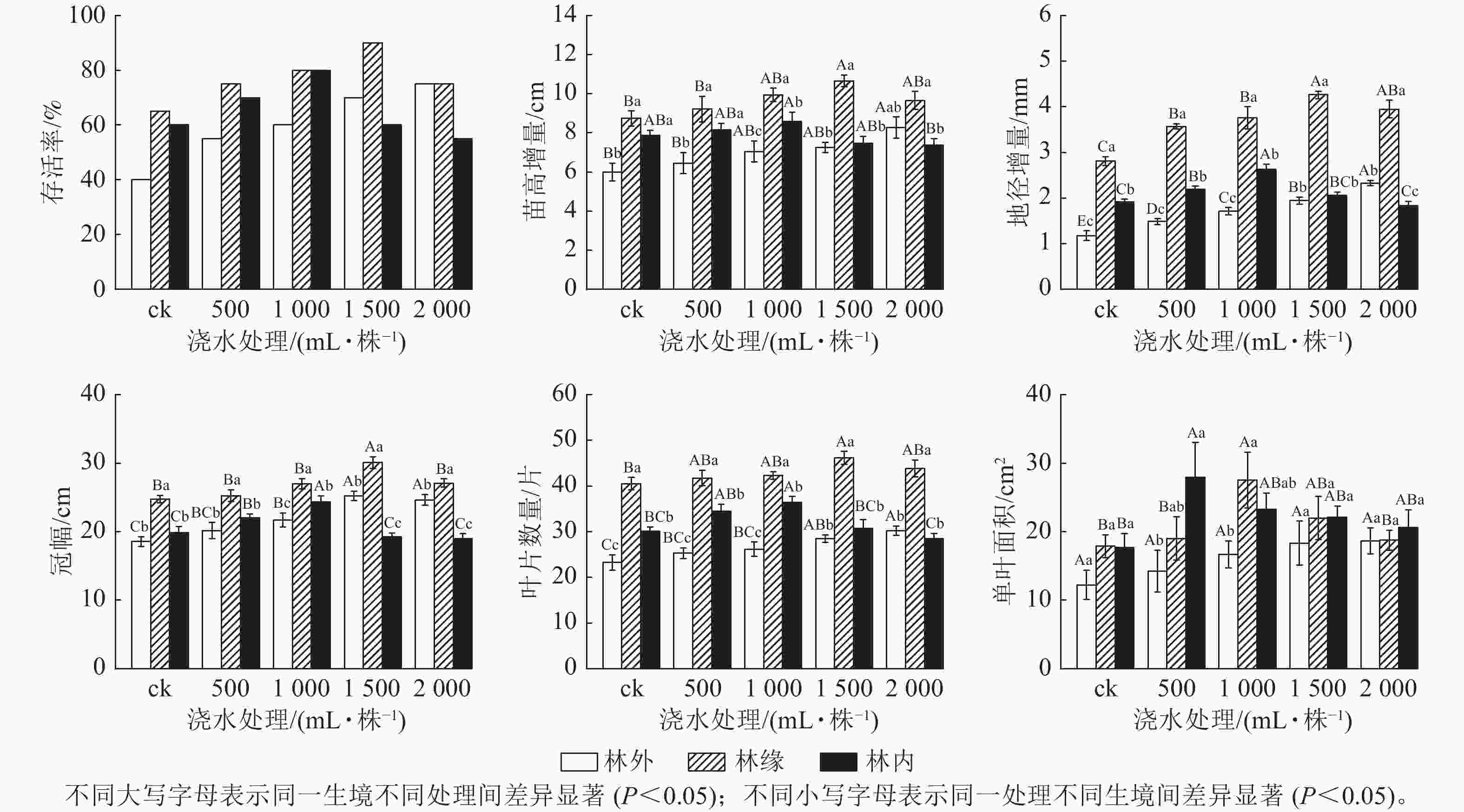
      Figure 1.  Effects of different irrigation rates on the survival rate and growth indexes of Q. liaotungensis seedlings

      在林缘条件下,辽东栎苗木的存活率和各生长指标均随着浇水量的增加呈现先增加后降低的趋势。单叶面积在浇水用量为1 000 mL·株−1时达到最大,较ck显著提高了53.9% (P<0.05)。其余指标均在浇水用量为1 500 mL·株−1时达到最大,较ck分别提高了38.5%、22.0%、51.6%、21.4%、13.9%。在浇水用量为2 000 mL·株−1时,所有指标均出现不同程度的下降,可见在油松人工林林缘栽植辽东栎苗木时,适宜的浇水用量对其存活和生长有促进作用。

      在林内条件下,辽东栎苗木的存活率和各生长指标均随着浇水量的增加呈现先增加后降低的趋势。单叶面积在浇水用量为500 mL·株−1时达到最大,较ck显著提高了58.1% (P<0.05)。其余生长指标均在浇水用量为1 000 mL·株−1时达到最大,较ck分别提高了33.3%、8.9%、37.0%、22.6%、20.6%,且地径增量、冠幅和叶片数量与ck差异显著(P<0.05)。在浇水用量为2 000 mL·株−1时多数指标都低于ck,可见在油松人工林林内栽植辽东栎苗木时,浇水用量过多会限制其存活和生长状况。

    • 不同林分位置的辽东栎苗木各覆盖措施下存活率及各生长指标的均值,如表4所示。林缘的辽东栎苗木总体生长状况最佳,林内次之,林外最差。辽东栎苗木的存活率、苗高增量、地径增量、叶片数量和单叶面积均在林缘处最大,分别为75.00%、9.39 cm、4.05 mm、45.41 cm、24.03 cm2,在林外处最小。冠幅在林缘处最大为31.02 cm,在林内处最小为23.04 cm,且3种生境下均差异显著(P<0.05)。

      位置
      存活率/% 苗高增量/cm 地径增量/mm 冠幅/cm 叶片数量/片 单叶面积/cm2
      林外 61.00% 7.48±0.16 c 2.48±0.05 b 25.47±0.49 b 26.43±0.51 c 15.92±1.05 b
      林缘 75.00% 9.39±0.17 a 4.05±0.07 a 31.02±0.84 a 45.41±0.76 a 24.03±1.21 a
      林内 74.00% 8.66±0.16 b 2.61±0.04 b 23.04±0.51 c 35.41±0.54 b 21.21±1.35 a
        说明:不同小写字母表示同一指标不同生境间差异显著(P<0.05)。

      Table 4.  Effect of covering measures on the growth of Q. liaotungensis seedlings in different stand positions

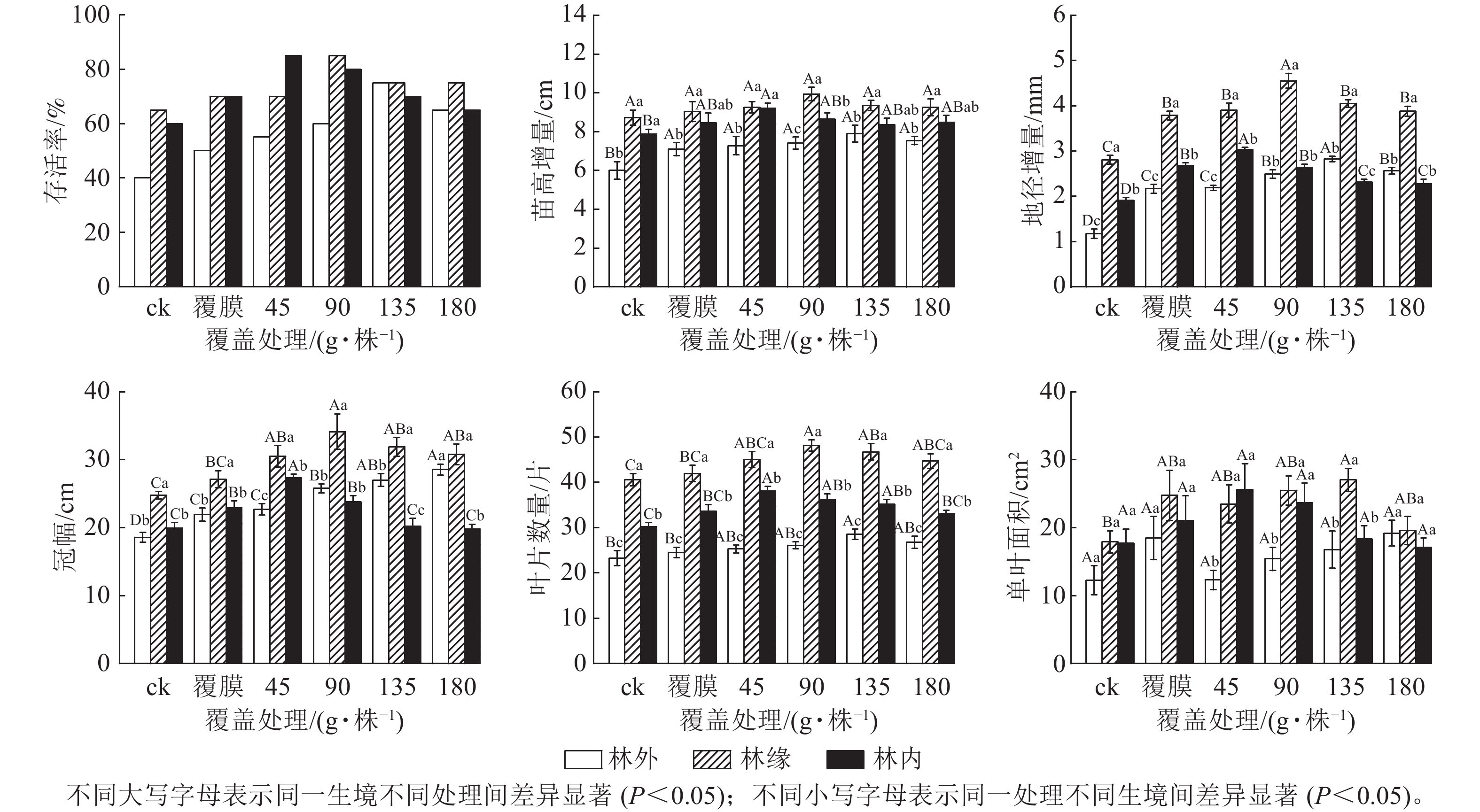
      对不同覆盖措施及用量下辽东栎苗木存活率及生长指标进行统计,发现其存活率、苗高增量、地径增量、冠幅和叶片数量均随着凋落物用量的增加呈现先增后减的趋势(图2)。在林外条件下,辽东栎苗木的存活率、苗高增量、地径增量、冠幅和叶片数量均在覆盖量为135 g·株−1时达到最大,较ck分别提高了87.5%、31.67%、139.8%、45.4%、22.7%。单叶面积则在覆盖量为180 g·株−1时达到最大,较ck提高了56.6%。可见在油松人工林林外栽植辽东栎苗木时,凋落物覆盖量对其存活与生长具有重要影响。
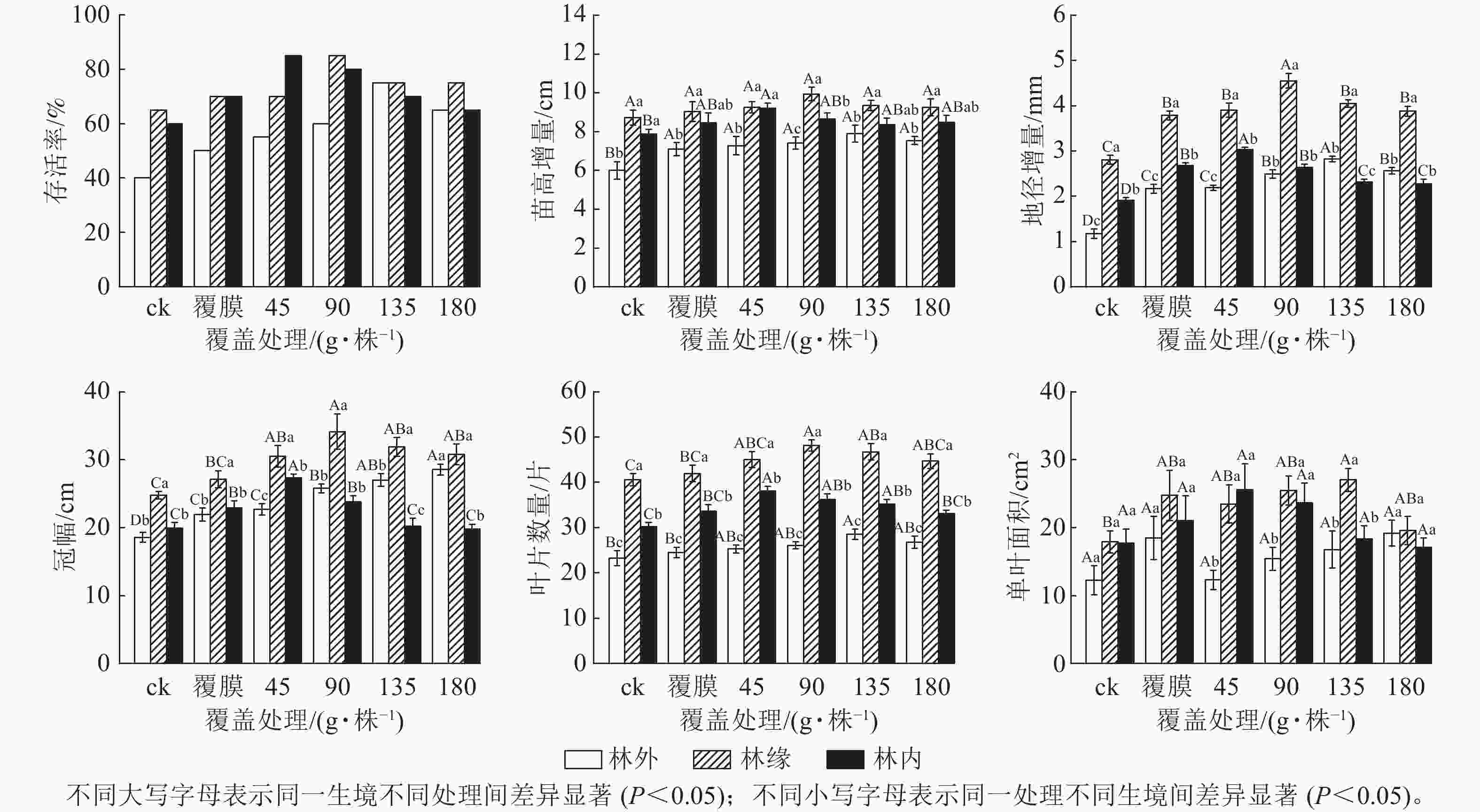
      Figure 2.  Effects of different mulching measures and amounts on the survival rate and growth indexes of Q. liaotungensis

      在林缘条件下,辽东栎苗木的存活率、苗高增量、地径增量、冠幅和叶片数量均在覆盖量为90 g·株−1时达到最大,较ck分别提高了30.8%、13.9%、61.9%、37.7%、18.7%,且地径增量、冠幅和叶片数量与ck间差异显著(P<0.05),但苗高增量在各处理间差异均不显著(P>0.05)。单叶面积则在覆盖量为135 g·株−1时达到最大,较ck显著提高了51.0% (P<0.05)。可见在油松人工林林缘栽植辽东栎苗木时,适宜的凋落物覆盖量对其存活和生长有促进作用。

      在林内条件下,辽东栎苗木的存活率和各生长指标均在覆盖量为45 g·株−1时达到最大,较ck分别提高了41.7%、16.9%、58.3%、37.3%、26.4%、44.6%。当凋落物覆盖量超过45 g·株−1后,各生长指标均开始下降,且冠幅和单叶面积在180 g·株−1时低于ck,可见在油松人工林林内栽植辽东栎苗木时,凋落物覆盖量过多会限制其冠幅和叶面积生长。

    • 不同林分位置的辽东栎苗木各保水剂措施下存活率及各生长指标的均值,如表5所示。林缘的辽东栎苗木总体生长状况最佳,林内次之,林外最差。其中存活率和各生长指标均在林缘处最大,分别为80.00%、9.64 cm、3.88 mm、28.97 cm、48.05片、21.26 cm2。存活率、苗高增量和冠幅均在林内处最小,分别为70.00%、8.06 cm、24.79 cm。地径增量、叶片数量和单叶面积均在林外处最小,分别为2.15 mm、29.84片、16.78 cm2,且均与林缘差异显著(P<0.05)。

      位置 存活率/% 苗高增量/cm 地径增量/mm 冠幅/cm 叶片数量/片 单叶面积/cm2
      林外 73.00% 8.08±0.13 b 2.15±0.04 c 24.84±0.44 b 29.84±0.60 c 16.78±1.04 b
      林缘 80.00% 9.64±0.14 a 3.88±0.05 a 28.97±0.50 a 48.05±0.66 a 21.26±1.05 a
      林内 70.00% 8.06±0.17 b 2.37±0.06 b 24.79±0.54 b 36.13±0.74 b 21.10±1.28 a
        说明:不同小写字母表示同一指标不同生境间差异显著(P<0.05)。

      Table 5.  Effects of water retaining agent on the growth of Q. liaotungensis seedlings in different stand positions

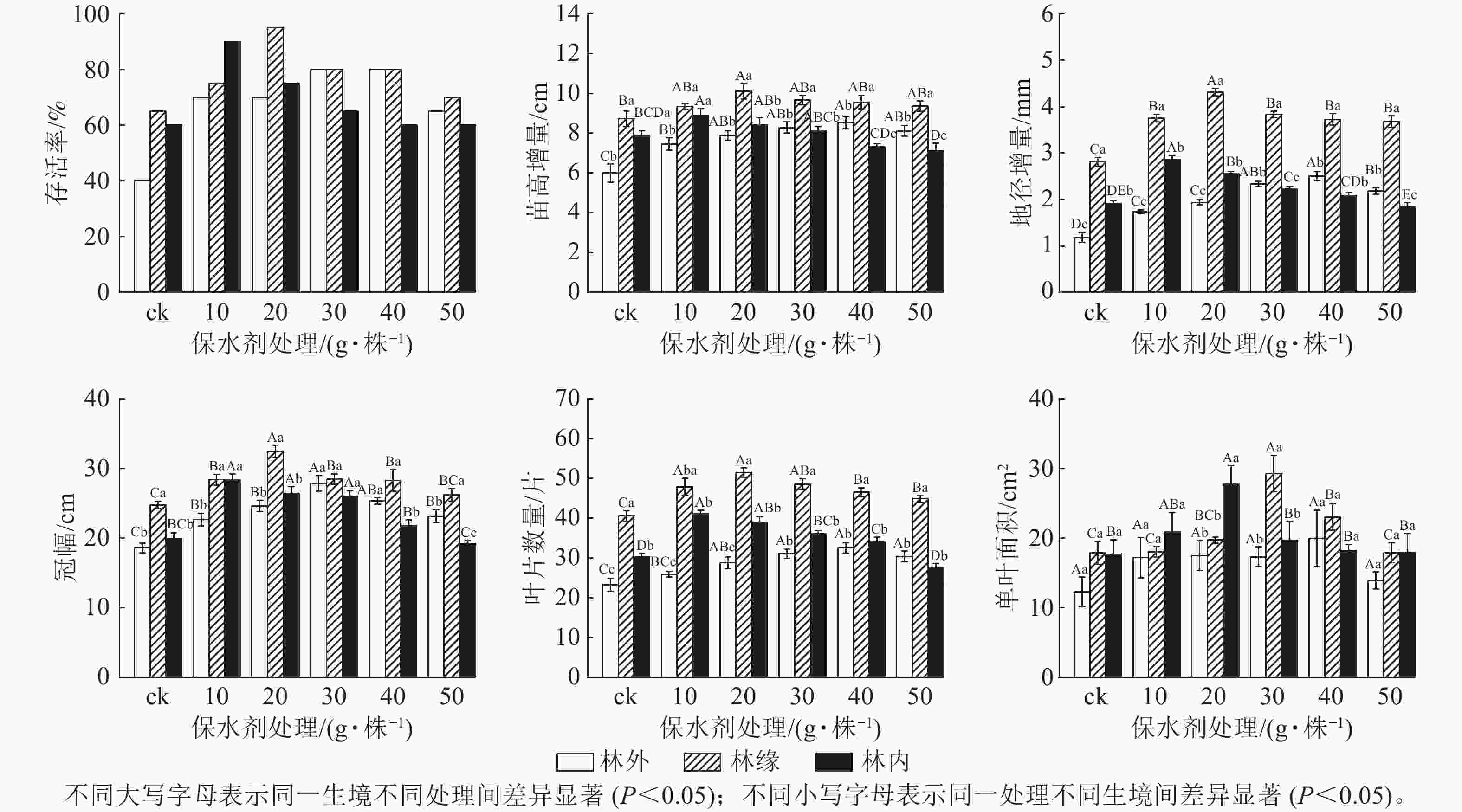
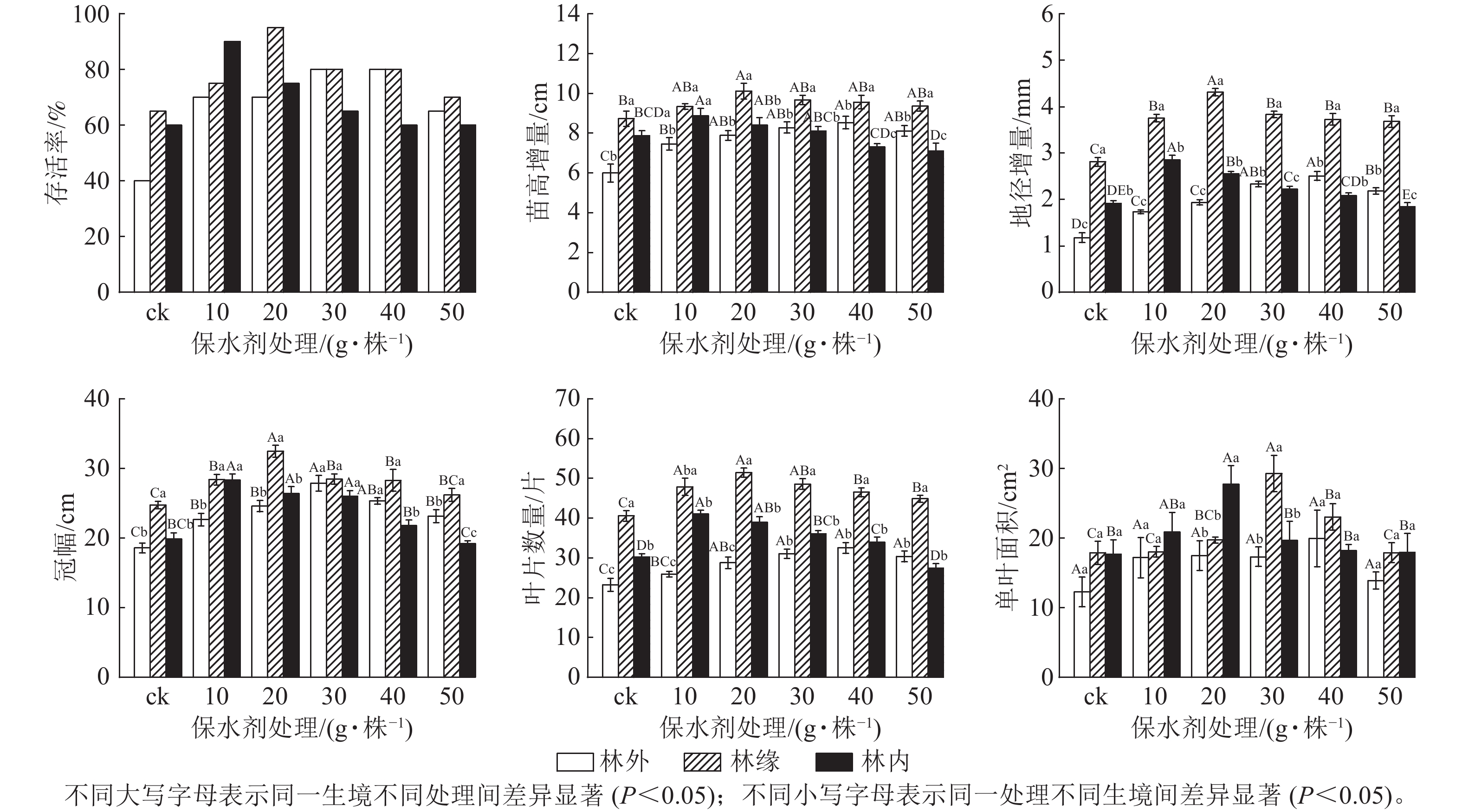
      对不同保水剂用量下辽东栎苗木存活率及生长指标进行统计,发现其存活率和各生长指标均随着保水剂用量的增加呈现先增后减的趋势(图3)。在林外条件下,辽东栎苗木的存活率在保水剂用量为30和40 g·株−1时达到最大,较ck提高了100%;冠幅在保水剂用量为30 g·株−1时达到最大,较ck显著提高了50.2% (P<0.05),其余生长指标则在保水剂用量为40 g·株−1时达到最大,较ck分别提高了42.2%、112.7%、33.9%、63.0%,可见在油松人工林林外栽植辽东栎苗木时,保水剂用量对其存活与生长具有重要影响。

      Figure 3.  Effects of different dosage of water retaining agent on the survival rate and growth indexes of Q. liaotungensis

      在林缘条件下,辽东栎苗木处理组的存活率和各生长指标都优于ck。单叶面积在保水剂用量为30 g·株−1时达到最大,较ck显著提高了63.6% (P<0.05),其余生长指标在保水剂用量为20 g·株−1时达到最大,较ck分别提高了46.2%、15.9%、53.4%、31.1%、26.9%。可见在油松人工林林缘栽植辽东栎苗木时,适宜的保水剂用量对其存活和生长有促进作用。

      在林内条件下,辽东栎苗木的单叶面积在保水剂用量为20 g·株−1时达到最大,较ck显著提高了56.9% (P<0.05),其余生长指标均在保水剂用量为10 g·株−1时达到最大,较ck分别提高了50.0%、12.8%、48.4%、42.5%、36.1%。在保水剂用量为50 g·株−1时,除存活率和单叶面积外其余生长指标均低于ck,可见在油松人工林林内栽植辽东栎苗木时,保水剂用量过多会限制其生长状况。

    • 使用熵权-TOPSIS法对不同措施的施用效果进行综合评价。熵权法赋权是依据不同生境下辽东栎苗木各项指标值的变异程度确定其权重值,变异程度越大,权重值也越大(表6)。TOPSIS法排序是找出评价方案中的最优和最劣方案,从而获得各评价对象与最优方案的相对贴近度C,以此作为评价优劣的依据[2021]。结果显示:林外、林缘、林内所需的最优浇水量依次减少,分别为2 000、1 500和1 000 mL·株−1;凋落物最优覆盖量逐渐递减,分别为135、90和45 g·株−1;保水剂最佳使用量逐渐递减,分别为40、20和10 g·株−1。在15种处理中,林外使用保水剂40 g·株−1、林缘使用保水剂20 g·株−1和林内覆盖凋落物45 g·株−1对辽东栎苗木生长效果的促进作用最佳(表7)。各生境条件下,保水剂和覆盖处理的效果均优于浇水处理和ck (表8)。

      指标 权重
      林外 林缘 林内 综合
      存活率 0.20 0.16 0.17 0.11
      苗高增量 0.19 0.17 0.22 0.07
      地径增量 0.18 0.28 0.14 0.43
      冠幅 0.17 0.16 0.10 0.08
      叶片数量 0.12 0.17 0.23 0.19
      单叶面积 0.15 0.06 0.14 0.12

      Table 6.  Weight values of each index of Q. liaotungensis seedlings

      处理 林外 林缘 林内
      相对贴
      近度C
      排序 相对贴
      近度C
      排序 相对贴
      近度C
      排序
      对照(ck) 0.00 15 0.00 15 0.22 13
      浇水500 mL 0.25 14 0.31 14 0.51 7
      浇水1 000 mL 0.42 12 0.46 11 0.66 5
      浇水1 500 mL 0.61 7 0.73 3 0.23 12
      浇水2 000 mL 0.77 4 0.47 10 0.13 14
      覆膜 0.44 11 0.36 13 0.52 6
      凋落物45 g 0.41 13 0.47 8 0.85 1
      凋落物90 g 0.57 9 0.79 2 0.67 4
      凋落物135 g 0.77 3 0.57 4 0.46 9
      凋落物180 g 0.70 5 0.48 7 0.40 10
      保水剂10 g 0.53 10 0.47 9 0.79 2
      保水剂20 g 0.65 6 0.82 1 0.47 8
      保水剂30 g 0.82 2 0.56 5 0.71 3
      保水剂40 g 0.86 1 0.49 6 0.27 11
      保水剂50 g 0.59 8 0.37 12 0.06 15

      Table 7.  Comprehensive evaluation of 15 treatment measures by TOPSIS method

      环境-造林措施 相对贴近度C 综合排序 环境-造林措施 相对贴近度C 综合排序 环境-造林措施 相对贴近度C 综合排序
      林缘-覆盖 0.97 1 林内-覆盖 0.51 5 林外-保水剂 0.35 9
      林缘-保水剂 0.93 2 林内-保水剂 0.44 6 林内-ck 0.27 10
      林缘-浇水 0.92 3 林外-覆盖 0.43 7 林外-浇水 0.26 11
      林缘-ck 0.58 4 林内-浇水 0.39 8 林外-ck 0 12

      Table 8.  Comprehensive evaluation of 3 afforestation measures by TOPSIS method

    • 在降水量低于潜在蒸发量的晋西黄土区,水分供应强度是决定造林成败的关键。本研究中,在相同浇水措施下,林缘生境的辽东栎幼苗展现出最优的综合生长趋势,其表现显著优于林外和林内。这表明林缘相对均衡的光照与湿度组合,有效平衡了林外开阔地过强的光照胁迫和水分蒸发竞争,又规避了林内可能存在的过度遮荫和光强限制[2223],水分的供应则进一步强化了林缘生境在水分利用效率上的优势。

      通过分析不同浇水用量对辽东栎苗木存活率和生长指标的影响,发现在林外生境中,除冠幅外其余生长指标及存活率均随浇水量增加呈现线性增长趋势。随着浇水用量增加,地径等生长指标均逐渐增大,这表明在林外极端干旱环境下,增加水分供给是直接缓解水分限制、促进苗木生长发育的有效手段[24]。林缘生境在1 500 mL·株−1浇水量时,除单叶面积外其余生长指标均达到最优值,而2 000 mL·株−1时出现不同程度的下降,这表明确定林缘最适浇水用量,既能促进辽东栎苗木地上部分的生长,又可避免水分过量造成的负面影响[25]。林内生境在1 000 mL·株−1浇水量时,各项生长指标均达到最大值,而2 000 mL·株−1时除单叶面积外其余生长指标均低于ck。这表明在此环境下,适宜的浇水量即可满足需求并有效促进苗木生长,水分过多不仅不利于苗木根部吸收,还会造成水资源浪费[26]

    • 在降水量低于潜在蒸发量的晋西黄土区,水分高效利用是造林成功的关键。凋落物由生物组分产生并归还到林地表面,是森林生态系统的重要组成部分,对森林天然更新早期阶段有重要影响[27]。本研究发现:在相同的覆盖措施下林缘生境的辽东栎苗木生长状况最优,且单叶面积在覆盖措施下的优势较浇水措施更为突出。这表明林缘相对均衡的光热和水分环境天然削弱了地表蒸发耗水[28],而凋落物可以阻隔土壤水分蒸发和减缓地温剧烈波动,进一步强化了林缘的水分保存能力[29],从而显著促进了对水分敏感的叶面积扩增。

      在探究不同覆盖措施及用量对辽东栎苗木生长的影响中,发现各生境中多数生长指标随着凋落物用量的增加呈现先增后减的趋势。在林外生境中,当凋落物覆盖量达到135 g·株−1时,除单叶面积外其余生长指标和存活率达到最大值,这一最优覆盖量有效缓解了林外过度蒸发导致的水分亏缺。然而,当覆盖量超过135 g·株−1时,大多数生长指标开始出现不同程度的下降。这可能是因为凋落物自身吸持水分或阻碍降水入渗,反而不利于土壤水分补给,导致苗木生长指标下降[30]。在林缘生境中,当凋落物覆盖量达到90 g·株−1时,除单叶面积外其余生长指标和存活率达到最大值,这种情况的出现可能与林缘的光照条件有关,较林外减弱的光照强度降低了地表蒸发,使得较薄覆盖层即可维持土壤湿度平衡[31]。在林内生境中,当凋落物覆盖量达到45 g·株−1时,所有生长指标均达到最大值,这说明薄层覆盖有助于维持浅层土壤湿度,从而保障辽东栎苗木在林内弱光环境下光合作用的持续进行。但是当覆盖量达到180 g·株−1时,冠幅和单叶面积低于ck,这可能是因为在林内高郁闭环境下,过厚的油松凋落物层严重阻碍了土壤与大气间的气体交换,并显著降低了地表及浅层土壤温度,共同抑制了辽东栎苗木地上部分的冠幅扩张和叶片发育[32]

    • 在降水量低于潜在蒸发量的晋西黄土区,水分亏缺是制约造林成功的关键。保水剂是一种吸水能力特别强的功能高分子材料,且具有反复吸水的功能,可以减少水分的深层渗漏和土壤养分流失,提高水分利用率[33]。本研究中,林缘在相同的保水剂措施下表现最优,说明林缘相对均衡的光热和水分条件,有效缓解了水分快速散失,其本身水分利用效率较高。保水剂则进一步强化了该位置的保水能力,将有限的水资源更高效地转化为苗木可利用的有效水,从而极大促进了辽东栎苗木的生长发育[34]

      在不同保水剂措施下,发现各生境中所有生长指标均随着保水剂用量的增加呈现先增后减的趋势。在林外极端干旱的条件下,保水剂用量达到40 g·株−1时,除冠幅外其余生长指标均达到最大值,表明适量的保水剂能够有效缓解土壤水分的剧烈波动与过度蒸散,为苗木根系提供稳定的水分供应,从而促进苗木生长[3536]。在林缘生境中,保水剂用量为20 g·株−1时,除单叶面积外其余生长指标达到最大值,这可能是因为林缘本身较林外显著降低的蒸发量和相对稳定的水分环境,使得中等剂量的保水剂足以维持苗木根部水分的稳定与充足[37]。在林内生境中,保水剂用量为10 g·株−1时,除单叶面积外其余生长指标达到最大值,当用量为50 g·株−1时,苗高增量、地径增量、冠幅和叶片数量均低于ck。这表明极低的保水剂用量就可以促进辽东栎苗木的生长发育,一旦用量过高其极强的持水性在蒸发微弱的环境下会加剧土壤孔隙水饱和状态,且吸水膨胀的凝胶颗粒会显著降低土壤孔隙度,增加土壤容重,最终抑制辽东栎苗木的生长发育[38]

      综合浇水、覆盖和保水剂3种措施分析,各生境条件下保水剂和覆盖处理的效果均优于浇水处理和ck,其中林缘环境对辽东栎苗木生长表现出显著的促进作用,最大程度地满足了幼苗生长和扩冠的需求。后续研究可进一步探索多措施联合应用在不同环境中的协同效应,为区域生态修复提供更精准的技术方案。

    • 3种环境条件下林缘生长的辽东栎苗木存活率及各项生长指标均表现最优;各生境条件下,保水剂和覆盖处理的效果均优于浇水处理和ck;在干旱胁迫区应优先选用保水剂改善水分胁迫,在过渡带需结合覆盖措施优化土壤微环境,而在郁闭林内则应强化覆盖措施的水分保存功能。因此在黄土区利用辽东栎对油松人工林进行更新改造时,需根据生境特点选择适配性措施,在营造块状混交林时,宜优先选用保水剂,株间混交或行间混交时宜加强栽植穴的覆盖,以提升苗木成活率。

Reference (38)

Catalog

    /

    DownLoad:  Full-Size Img  PowerPoint
    Return
    Return