Turn off MathJax
Article Contents

WANG Chenyang, BI Huaxing, WANG Wu, et al. Differences in composition and diversity of understory shrub and herb layers in Pinus tabuliformis plantations with different stand densities on the Loess Plateau[J]. Journal of Zhejiang A&F University, 2026, 43(X): 1−11 doi:  10.11833/j.issn.2095-0756.20260332
Citation: WANG Chenyang, BI Huaxing, WANG Wu, et al. Differences in composition and diversity of understory shrub and herb layers in Pinus tabuliformis plantations with different stand densities on the Loess Plateau[J]. Journal of Zhejiang A&F University, 2026, 43(X): 1−11 doi:  10.11833/j.issn.2095-0756.20260332

OnlineFirst articles are published online before they appear in a regular issue of the journal. Please find and download the full texts via CNKI.

Differences in composition and diversity of understory shrub and herb layers in Pinus tabuliformis plantations with different stand densities on the Loess Plateau

DOI: 10.11833/j.issn.2095-0756.20260332
  • Received Date: 2026-06-22
  • Accepted Date: 2026-08-30
  • Rev Recd Date: 2026-08-29
  • Available Online: 2026-09-28
  •   Objective  This study aims to clarify the layer-specific effects of stand density on the composition and diversity pattern of the understory shrub and herb communities in Pinus tabuliformis plantations on the Loess Plateau.   Method  Five P. tabuliformis plantations with different stand densities were selected: low density (800 plants·hm−2), medium-low density (1 200 plants·hm−2), medium density (1 600 plants·hm−2), medium-high density (2 000 plants·hm−2), and high density (2 400 plants·hm−2). Species composition of the shrub and herb layers was investigated, and importance values, α diversity indices, and β diversity were calculated. Principal coordinate analysis (PCoA) and permutational multivariate analysis of variance (PERMANOVA) were used to examine differences in the composition of the understory shrub and herb communities under different densities.   Result  With increasing stand density, the dominant species of shrub and herb layers both changed markedly. In the shrub layer, the dominant species gradually changed from Hippophae rhamnoides and Xanthoceras sorbifolium under low density to Caragana korshinskii, Caryopteris mongholica, and Prinsepia uniflora under medium-high and high densities. In the herb layer, the dominant species changed from Potentilla sischanensis and Saussurea japonica to Stipa bungeana, Artemisia sacrorum, and Astragalus melilotoides. The overall α diversity of the shrub layer was generally higher under medium-low density, with Margalef richness, Shannon-Wiener, Simpson, and Pielou evenness indices being 1.34, 1.63, 0.80, and 0.98, respectively, and then decreased with increasing stand density. The α diversity of the herb layer increased first and then decreased with increasing stand density, and reached the highest level under medium density. The Margalef richness index, Shannon-Wiener index, Simpson index and Pielou evenness index were 2.44, 2.51, 0.91, and 0.97, respectively. The community composition of both layers under different densities showed significant differentiation. The β diversity was mainly due to the species turnover component. The species turnover intensity of the shrub layer generally increased with stand density, with the most significant difference observed between medium-high and high density stands, while the species turnover of the herb layer was mainly concentrated in low-density and medium to low density forests. The contribution rate of species to β diversity (SCBD) showed that the compositional differentiation of the shrub layer was mainly associated with changes in the importance values of species such as C. mongholica, C. korshinskii, X. sorbifolium, P. uniflora, and Lespedeza bicolor, while the composition differentiation of the herb layer was mainly related to the changes in the importance values of species such as P. sischanensis, S. bungeana, Picris hieracioides, Glycyrrhiza uralensis, Potentilla chinensis, Dracocephalum moldavica, Poa sphondylodes, and A. melilotoides.   Conclusion  Medium-low density and medium density stands are more conducive to maintaining the diversity of the understory shrub and herb communities in P. tabuliformis plantations. Among them, medium-low density stands were more favorable for shrub-layer diversity, while medium density stands are more favorable for the diversity of the herb layer. [Ch, 3 fig. 4 tab. 32 ref.]
  • [1] ZHAN Zixin, FENG Tianjiao, MEI Bohan, WANG Ping.  Relationship between stoichiometry and ecological factors at various levels of typical vegetation restoration ecosystem in the loess area of western Shanxi Province . Journal of Zhejiang A&F University, doi: 10.11833/j.issn.2095-0756.20230448
    [2] JIA Yajie, YANG Jianying, ZHANG Jianjun, HU Yawei, ZHANG Ben, ZHAO Jiongchang, LI Yang, TANG Peng.  Effects of stand density on biomass and soil physico-chemical properties of Pinus tabuliformis forest in the loess area of western Shanxi . Journal of Zhejiang A&F University, doi: 10.11833/j.issn.2095-0756.20240571
    [3] YUN Huiya, BI Huaxing, JIAO Zhenhuan, WANG Ning, CUI Yanhong, ZHAO Danyang, WANG Shanshan, LAN Daoyun, LIU Zehui.  Composition and diversity of understory plants under different stand types and densities in loess region of western Shanxi Province . Journal of Zhejiang A&F University, doi: 10.11833/j.issn.2095-0756.20220433
    [4] PEI Shunxiang, FA Lei, DU Manyi, XIN Xuebing.  Influence of environmental factors on distribution of undergrowth species of Pinus tabuliformis plantation in Zhongtiao Mountain . Journal of Zhejiang A&F University, doi: 10.11833/j.issn.2095-0756.20210323
    [5] CAO Penghe, XU Xuan, SUN Jiejie, WANG Yuchao, HAN Menghua, GUO Jiahuan, FENG Huili, WANG Weifeng.  Effects of stand density and spacing configuration on the non-structural carbohydrate in different organs of poplar . Journal of Zhejiang A&F University, doi: 10.11833/j.issn.2095-0756.20210223
    [6] WANG Zhengyi, DAI Qilin, BAI Cheng, CHEN Han, KU Weipeng, ZHAO Mingshui, YU Shuquan.  Types and diversity of natural regeneration community after clear cutting of Phyllostachys edulis forests in Mount Tianmu, China . Journal of Zhejiang A&F University, doi: 10.11833/j.issn.2095-0756.20190472
    [7] ZHANG Shuting, WANG Xiaohui, PENG Daoli, JI Ping, LIU Hua, LING Chengxing, HOU Ruixia.  Monitoring of vegetation coverage change in hilly and gully regions on the Loess Plateau . Journal of Zhejiang A&F University, doi: 10.11833/j.issn.2095-0756.20200136
    [8] LI Zhichao, ZHANG Yongqiang, HOU Lingyu, SONG Liguo, SUN Qiwu.  Response of soil microorganism to stand density in Cunninghamia lanceolata plantation . Journal of Zhejiang A&F University, doi: 10.11833/j.issn.2095-0756.2020.01.010
    [9] LIANG Yang, SHAO Sen, MA Bingqian.  Soil quality development in Pinus tabuliformis plantations with different forest ages on Taiyue Mountain . Journal of Zhejiang A&F University, doi: 10.11833/j.issn.2095-0756.2019.03.020
    [10] LI Minmin, WEI Tianxing, LI Xinliang, GE Haichao.  Species diversity in the understory of a Robinia pseudoacacia plantation in the Caijiachuan Watershed of the Loess Plateau . Journal of Zhejiang A&F University, doi: 10.11833/j.issn.2095-0756.2018.02.005
    [11] CHU Xin, PAN Ping, GUO Liling, NING Jinkui, OUYANG Xunzhi, WU Zirong.  Comparing water-holding capacity in forest litter and soils for an aerially seeded Pinus massoniana plantation with different stand densities . Journal of Zhejiang A&F University, doi: 10.11833/j.issn.2095-0756.2017.05.006
    [12] WANG Shuhan, ZHANG Xiaoli, ZHU Chenghao, QU Shuai.  Stand density estimates based on a local maximum spectral filter . Journal of Zhejiang A&F University, doi: 10.11833/j.issn.2095-0756.2017.03.005
    [13] WU Linshi, CAO Fuxiang, PENG Jiqing, CAO Jiwu, XU Yongfu, DONG Xujie, XU Wen.  Plant community and species diversity in rocky desert areas of Southern Hunan . Journal of Zhejiang A&F University, doi: 10.11833/j.issn.2095-0756.2016.02.008
    [14] LI Anding, ZHANG Jianli, XIE Yuangui, LONG Xiuqin.  Analysis of quantity characteristics and α diversity of the Rhododendron communities in Wudang District, Guiyang City . Journal of Zhejiang A&F University, doi: 10.11833/j.issn.2095-0756.2014.02.007
    [15] YANG Aifang, HAN Youzhi, YANG Xiuqing, LIU Zemin, YANG Sha, WANG Guan.  Diversity of understory herbs in Picea forests with different stand densities . Journal of Zhejiang A&F University, doi: 10.11833/j.issn.2095-0756.2014.05.003
    [16] YOU Longhui, YE Gongfu, CHEN Zenghong, BAI Yonghui, ZHU Meiqin.  Species diversity in a Casuarina equisetifolia understory along a highway . Journal of Zhejiang A&F University, doi: 10.11833/j.issn.2095-0756.2013.01.006
    [17] LI Xiao-hong, GAO Jia-rong, ZHANG Jin-rui, YANG Qi-lin.  Determining stand density from growth indicators for young Pinus tabulaeformis in the Miyun Reservoir,Beijing . Journal of Zhejiang A&F University, doi: 10.11833/j.issn.2095-0756.2010.06.003
    [18] FANG Xi, TIAN Da-lun, XIANG Wen-hua, CAI Bao-yu.  On carbon accumulation , distribution of different densities in slash pine plantation . Journal of Zhejiang A&F University,
    [19] HUANG Jia-rong.  Optimal density control model of planted timber forests . Journal of Zhejiang A&F University,
    [20] Hong Wei, Wu Chengzhen.  A New Model for Stand Density ’Effect of Chinese Fir Plantation in Norhtern Fujian. . Journal of Zhejiang A&F University,
  • [1]
    LI Yixuan. Change Characteristics and Influencing Factors of Vegetation Coverage in the Loess Plateau [D]. Beijing: Beijing Forestry University, 2021. DOI:10.26949/d.cnki.gblyu.2021.000513.
    [2]
    GAO Haidong, PANG Guowei, LI Zhanbin, et al. Evaluating the potential of vegetation restoration in the Loess Plateau[J]. Acta Geographica Sinica, 2017, 72(5): 863−874. DOI: 10.11821/dlxb201705008.
    [3]
    FENG Xiaoming, FU Bojie, PIAO Shilong, et al. Revegetation in China’s Loess Plateau is approaching sustainable water resource limits[J]. Nature Climate Change, 2016, 6(11): 1019−1022. DOI: 10.1038/nclimate3092.
    [4]
    SHA Guoliang, YU Huan, CHEN Yuxuan, et al. Understory plant diversity supports the delivery of ecosystem multifunctionality on the Loess Plateau: a comparative of plantations and natural forests[J]. Journal of Environmental Management, 2024, 371: 123191. DOI: 10.1016/j.jenvman.2024.123191.
    [5]
    GUO Yanjie, BI Huaxing, ZHAO Danyang, et al. Soil water and carbon distribution characteristics and their coupling relationship in Pinus tabuliformis plantations with different densities[J]. Chinese Journal of Applied Ecology, 2025, 36(1): 50−58. DOI: 10.13287/j.1001-9332.202501.007.
    [6]
    WEI Xi, LIANG Wenjun. Regulation of stand density alters forest structure and soil moisture during afforestation with Robinia pseudoacacia L. and Pinus tabulaeformis Carr. on the Loess Plateau[J]. Forest Ecology and Management, 2021, 491: 119196. DOI: 10.1016/j.foreco.2021.119196.
    [7]
    ZHANG Yunxiang, LIU Tairui, GUO Jingping, et al. Changes in the understory diversity of secondary Pinus tabulaeformis forests are the result of stand density and soil properties[J]. Global Ecology and Conservation, 2021, 28: e01628. DOI: 10.1016/j.gecco.2021.e01628.
    [8]
    HE Panpan, MA Quanlin, CHEN Zhengni, et al. Effects of density regulation on understory vegetation and soil environment of Pinus tabuliformis plantation on Longxi Loess Plateau[J]. Journal of Central South University of Forestry & Technology, 2024, 44(12): 143−153. DOI: 10.14067/j.cnki.1673-923x.2024.12.014.
    [9]
    TAO Guanhu, BU Yuankun, XUE Weipeng, et al. Relationship between understory diversity and stand spatial structure in air-drilled Pinus tabulaeformis forests of different densities[J]. Journal of Forest and Environment, 2020, 40(2): 171−177. DOI: 10.13324/j.cnki.jfcf.2020.02.009.
    [10]
    CHEN Yunming, CAO Yang. Response of tree regeneration and understory plant species diversity to stand density in mature Pinus tabulaeformis plantations in the hilly area of the Loess Plateau, China[J]. Ecological Engineering, 2014, 73: 238−245. DOI: 10.1016/j.ecoleng.2014.09.055.
    [11]
    DANG Peng, GAO Yang, LIU Jinliang, et al. Effects of thinning intensity on understory vegetation and soil microbial communities of a mature Chinese pine plantation in the Loess Plateau[J]. Science of the Total Environment, 2018, 630: 171−180. DOI: 10.1016/j.scitotenv.2018.02.197.
    [12]
    WANG Jinxin, HUANG Baolong, LUO Weixiang. Compensation and rehabilitation characteristics of soil water deficit at a planted forest site of the drought-prone Loess Plateau[J]. Acta Ecologica Sinica, 2004, 24(11): 2395−2401. DOI: 10.3321/j.issn:1000-0933.2004.11.008.
    [13]
    YANG Lei, WEI Wei, CHEN Liding, et al. Soil desiccation in deep soil layers under different vegetation types in the semi-arid Loess Hilly Region[J]. Geographical Research, 2012, 31(1): 71−81.
    [14]
    DU Sixuan, ZHENG Bo, LEI Hangyu, et al. Response of understory plant diversity to edge effects in plantation forests on the loess plateau[J]. Forests, 2025, 16(1): 87. DOI: 10.3390/f16010087.
    [15]
    GUO Hongting, JI Xiaofang, WANG Cheng, et al. Spatial variability and influencing factors of plant diversity in the shrub layers of artificial forests in China[J]. Journal of Nanjing Forestry University (Natural Sciences Edition), 2022, 46(4): 144−152. DOI: 10.12302/j.issn.1000-2006.202103014.
    [16]
    BASELGA A. Partitioning the turnover and nestedness components of beta diversity[J]. Global Ecology and Biogeography, 2010, 19(1): 134−143. DOI: 10.1111/j.1466-8238.2009.00490.x.
    [17]
    BASELGA A, ORME C D L. Betapart: an R package for the study of beta diversity[J]. Methods in Ecology and Evolution, 2012, 3(5): 808−812. DOI: 10.1111/j.2041-210x.2012.00224.x.
    [18]
    LIN Yang, LI Shixuan, ZHOU Weilong, et al. α and β diversity patterns of woody plant communities along an elevation gradient in Baishanzu National Park[J]. Acta Ecologica Sinica, 2024, 44(17): 7700−7712. DOI: 10.20103/j.stxb.202401090080.
    [19]
    WU Zeyang, AI Ning, HUANG Lou, et al. Variations and niche driving factors of ground-dwelling spiders in Pinus tabuliformis forests of the Loess Plateau in Northern Shaanxi[J]. Chinese Journal of Ecology, 2025, 44(7): 2319−2329. DOI: 10.13292/j.1000-4890.202507.024.
    [20]
    WEI Tianxing, AN Wen, AI Ning, et al. Attribution analysis of radial growth characteristics of Populus hopeiensis and Pinus tabuliformis saplings in the Loess Plateau of Northern Shaanxi[J]. Journal of Northwest Forestry University, 2026, 41(2): 87−94. DOI: 10.3969/j.issn.1001-7461.2026.02.10.
    [21]
    SHEN Wanling, XU Zhanghua, QIN Na, et al. Changing relationship between specific leaf area and leaf matter dry content of moso bamboo Phyllostachys pubescens syn. edulis (Poales: Poaceae) under the stress of Pantana phyllostachysae (Lepidoptera: Lymantriidae)[J]. Forests, 2024, 15(3): 540. DOI: 10.3390/f15030540.
    [22]
    HE Wenqiang, WANG Ruixia, TIAN Ying, et al. Dynamics of understorey herbaceous plant diversity and community stability and its driving factors during succession of lemon strip sand fixation forests at the southern edge of the Mu Us Desert[J]. Acta Ecologica Sinica, 2025, 45(22): 11171−11183. DOI: 10.20103/j.stxb.202503180606.
    [23]
    GUCLU C, LUK C L, ASHTON L A, et al. Beta diversity subcomponents of plant species turnover and nestedness reveal drivers of community assembly in a regenerating subtropical forest[J]. Ecology and Evolution, 2024, 14(9): e70233. DOI: 10.1002/ece3.70233.
    [24]
    DENG Jiaojiao, FANG Shuai, FANG Xiangmin, et al. Forest understory vegetation study: current status and future trends[J]. Forestry Research, 2023, 3: 6. DOI: 10.48130/FR-2023-0006.
    [25]
    WAGNER A S, STUBLE K L. Beta diversity and species turnover in communities of newly recruited seedlings following forest management[J]. Forest Ecology and Management, 2024, 572: 122329. DOI: 10.1016/j.foreco.2024.122329.
    [26]
    LI Junjie, HAN Menghao, ZHAO Jiahao, et al. Temporal effects of thinning on understory plant diversity in Pinus massoniana plantations[J]. Chinese Journal of Ecology, 2023, 42(4): 788−795. DOI: 10.13292/j.1000-4890.202304.013.
    [27]
    LIU Size, YIN Haifeng, SHEN Yi, et al. Effects of thinning intensity on species composition and diversity of undergrowth vegetation community in Pinus massoniana plantation at initial stage of thinning[J]. Chinese Journal of Applied Ecology, 2020, 31(9): 2866−2874. DOI: 10.13287/j.1001-9332.202009.009.
    [28]
    CHEN Han, GUO Hongting, CHEN Rui, et al. Understory plant diversity of Cunninghamia lanceolata plantations and its short-term environmental response to different thinning intensities[J]. Acta Ecologica Sinica, 2023, 43(24): 10274−10284. DOI: 10.20103/j.stxb.202306031177.
    [29]
    FRANCIONI M, BRICCA A, ANDREETTA A, et al. Canopy closure and intensifying climate extremes drive understory species loss over 25 years of forest monitoring[J]. NPJ Biodiversity, 2026, 5: 13. DOI: 10.1038/s44185-026-00126-9.
    [30]
    SOININEN J, HEINO J, WANG Jianjun. A meta-analysis of nestedness and turnover components of beta diversity across organisms and ecosystems[J]. Global Ecology and Biogeography, 2018, 27(1): 96−109. DOI: 10.1111/geb.12660.
    [31]
    YUN Huiya, BI Huaxing, JIAO Zhenhuan, et al. Composition and diversity of understory plants under different stand types and densities in loess region of western Shanxi Province[J]. Journal of Zhejiang A&F University, 2023, 40(3): 569−578. DOI: 10.11833/j.issn.2095-0756.20220433.
    [32]
    LI Dengxing, YANG Zhangqi, YAN Peidong, et al. Effects of stand density on canopy structure and understory herbs of Pinus massoniana plantation community[J]. Journal of Southwest Forestry University, 2024, 44(2): 60−68. DOI: 10.11929/j.swfu.202303070.
  • 加载中
通讯作者: 陈斌, bchen63@163.com
  • 1. 

    沈阳化工大学材料科学与工程学院 沈阳 110142

  1. 本站搜索
  2. 百度学术搜索
  3. 万方数据库搜索
  4. CNKI搜索

Figures(3)  / Tables(4)

Article views(8) PDF downloads(0) Cited by()

Related
Proportional views

Differences in composition and diversity of understory shrub and herb layers in Pinus tabuliformis plantations with different stand densities on the Loess Plateau

doi: 10.11833/j.issn.2095-0756.20260332

Abstract:   Objective  This study aims to clarify the layer-specific effects of stand density on the composition and diversity pattern of the understory shrub and herb communities in Pinus tabuliformis plantations on the Loess Plateau.   Method  Five P. tabuliformis plantations with different stand densities were selected: low density (800 plants·hm−2), medium-low density (1 200 plants·hm−2), medium density (1 600 plants·hm−2), medium-high density (2 000 plants·hm−2), and high density (2 400 plants·hm−2). Species composition of the shrub and herb layers was investigated, and importance values, α diversity indices, and β diversity were calculated. Principal coordinate analysis (PCoA) and permutational multivariate analysis of variance (PERMANOVA) were used to examine differences in the composition of the understory shrub and herb communities under different densities.   Result  With increasing stand density, the dominant species of shrub and herb layers both changed markedly. In the shrub layer, the dominant species gradually changed from Hippophae rhamnoides and Xanthoceras sorbifolium under low density to Caragana korshinskii, Caryopteris mongholica, and Prinsepia uniflora under medium-high and high densities. In the herb layer, the dominant species changed from Potentilla sischanensis and Saussurea japonica to Stipa bungeana, Artemisia sacrorum, and Astragalus melilotoides. The overall α diversity of the shrub layer was generally higher under medium-low density, with Margalef richness, Shannon-Wiener, Simpson, and Pielou evenness indices being 1.34, 1.63, 0.80, and 0.98, respectively, and then decreased with increasing stand density. The α diversity of the herb layer increased first and then decreased with increasing stand density, and reached the highest level under medium density. The Margalef richness index, Shannon-Wiener index, Simpson index and Pielou evenness index were 2.44, 2.51, 0.91, and 0.97, respectively. The community composition of both layers under different densities showed significant differentiation. The β diversity was mainly due to the species turnover component. The species turnover intensity of the shrub layer generally increased with stand density, with the most significant difference observed between medium-high and high density stands, while the species turnover of the herb layer was mainly concentrated in low-density and medium to low density forests. The contribution rate of species to β diversity (SCBD) showed that the compositional differentiation of the shrub layer was mainly associated with changes in the importance values of species such as C. mongholica, C. korshinskii, X. sorbifolium, P. uniflora, and Lespedeza bicolor, while the composition differentiation of the herb layer was mainly related to the changes in the importance values of species such as P. sischanensis, S. bungeana, Picris hieracioides, Glycyrrhiza uralensis, Potentilla chinensis, Dracocephalum moldavica, Poa sphondylodes, and A. melilotoides.   Conclusion  Medium-low density and medium density stands are more conducive to maintaining the diversity of the understory shrub and herb communities in P. tabuliformis plantations. Among them, medium-low density stands were more favorable for shrub-layer diversity, while medium density stands are more favorable for the diversity of the herb layer. [Ch, 3 fig. 4 tab. 32 ref.]

WANG Chenyang, BI Huaxing, WANG Wu, et al. Differences in composition and diversity of understory shrub and herb layers in Pinus tabuliformis plantations with different stand densities on the Loess Plateau[J]. Journal of Zhejiang A&F University, 2026, 43(X): 1−11 doi:  10.11833/j.issn.2095-0756.20260332
Citation: WANG Chenyang, BI Huaxing, WANG Wu, et al. Differences in composition and diversity of understory shrub and herb layers in Pinus tabuliformis plantations with different stand densities on the Loess Plateau[J]. Journal of Zhejiang A&F University, 2026, 43(X): 1−11 doi:  10.11833/j.issn.2095-0756.20260332
  • 随着小流域综合治理、天然林保护、退耕还林(草)等生态工程[1]的持续推进,黄土高原植被覆盖整体显著上升,生态环境明显好转[2]。但随着植被恢复持续推进,人工林经营的核心问题已逐渐从增加植被覆盖转向提高群落质量和维持生态稳定性[3]。林分密度是影响人工林结构、资源分配和林下微环境的重要因子,其变化可通过改变林冠郁闭度、林下光照、凋落物输入和种间竞争强度,进一步影响林下植物的定居、生长和物种共存。林下植被作为森林生态系统的重要组成部分,不仅影响物种共存和群落更新过程,还与养分循环、地表覆盖、土壤保持和生态系统多功能性密切相关[4]。因此,明确林分密度变化对林下灌草群落组成及多样性格局的影响,对于优化人工林密度调控、维持林下植被多样性和提升人工林群落稳定性具有重要意义。

    油松Pinus tabuliformis耐旱性强且根系发达,是黄土高原生态修复与建设中的重要造林树种[5−6]。围绕油松人工林林下植被响应,已有研究表明适度降低林分密度有利于提高林下植物丰富度并改善群落结构[7−9],促进林下植被更新[10−11];高密度造林可能加剧乔木层与林下植被之间的资源竞争[12−13]。现有研究已从林分密度、林下植被多样性等方面为油松人工林经营提供了重要基础,但仍存在2个方面的不足:一是部分研究仍将林下植被作为整体分析,较少将其区分为灌木层和草本层[14];二是已有研究多关注物种丰富度、Shannon-Wiener指数等α多样性指标的变化,而对不同密度下优势种组成如何替换、群落组成是否发生分化及其差异来源关注不足[15]。α多样性可以判断群落内部物种丰富度和均匀度变化,却难以解释不同密度间群落组成差异的来源;β多样性能够反映不同样地或处理间物种组成差异,并可进一步分解为物种周转组分和嵌套组分[16−17]。将α多样性与β多样性相结合,有助于从样地内多样性水平和样地间物种组成分异2个层面识别林下群落对林分密度变化的响应机制[18]。

    因此,本研究聚焦于黄土高原油松人工林,探讨不同林分密度下灌木层和草本层组成及多样性的差异特征,拟探讨以下问题:(1)不同林分密度下,油松人工林灌木层和草本层优势种组成及整体群落组成的差异;(2)不同林分密度下,灌木层和草本层α多样性及β多样性的变化规律,群落组成分异的主要表现,以及对群落组成分异贡献较大的关键物种。本研究可为黄土高原人工造林地密度配置、后续抚育管理和林下植物多样性维持提供参考。

    • 研究区位于陕西省延安市吴起县(36°33′~37°24′N,107°38′~108°32′E),地处黄土高原丘陵沟壑区。吴起县总面积3 791.5 km2,海拔为1 233~1 730 m,年均气温为8.0~10.0 ℃,年均降水量为484.0 mm,6—9月的降水量最大,约占全年的65%。土壤类型以黄绵土为主,土层较厚。2005年,在退耕地基础上栽植乔木。原土地利用均为旱地,主要种植谷物和豆类。林下灌木层和草本层植物未见人工栽植,主要为原有植被保留及自然定居更新。乔木层以油松为主[19],郁闭度约为40%,平均树高为7.84 m,平均胸径为11.33 cm,灌木层盖度为37%,常见种有沙棘Hippophae rhamnoides、拧条锦鸡儿Caragana korshinskii等[20];草本层盖度为43%,主要有风毛菊Saussurea japonica、长芒草Stipa bungeana、西山委陵菜Potentilla sischanensis、草木樨状黄芪Astragalus melilotoides、白莲蒿Artemisia sacrorum等。

    • 于2025年7—8月通过实地踏勘,确定立地条件相近、林分发育状况较一致的不同林分密度油松林为研究对象,设置低密度(800 株·hm−2)、中低密度(1 200 株·hm−2)、中密度(1 600 株·hm−2)、中高密度(2 000 株·hm−2)、高密度(2 400株·hm−2)共5个密度水平,每个密度设置3块20 m×20 m的样地。在每个乔木样方的中心及四角布设5个5 m×5 m的灌木样方,并在每个灌木样方中心各设置1个1 m×1 m的草本样方[21],进行灌草植被群落调查,记录植物的种类、株高、株数、盖度等。使用罗盘和全球定位系统(GPS)测定样地的坡度和坡向,采用投影法测算郁闭度,使用胸径尺和测高仪分别测量乔木胸径与树高。样地基本信息见表1。

      样地编号林分密度/
      (株·hm−2)
      林分密
      度等级
      林龄/a北纬/(°N)东经/(°E)海拔/m坡度/(°)坡向郁闭度/%平均
      树高/m
      平均胸
      径/cm
      1800低密度2036.805 25107.832 401 610.028半阳坡186.179.90
      2800低密度2036.850 75107.852 391 625.029半阳坡166.109.86
      3800低密度2036.770 66107.912 441 617.528半阳坡206.249.33
      41 200中低密度2036.821 15107.874 711 595.025半阳坡228.8511.98
      51 200中低密度2036.795 05107.879 701 565.025半阳坡238.5111.99
      61 200中低密度2036.843 22107.937 731 572.524半阳坡228.5812.51
      71 600中密度2036.849 80107.886 601 557.521半阳坡338.9111.94
      81 600中密度2036.811 10107.907 301 520.021半阳坡308.9812.47
      91 600中密度2036.821 11107.936 001 527.520半阳坡319.0512.43
      102 000中高密度2036.840 08107.756 201 535.023半阳坡327.3712.40
      112 000中高密度2036.813 56107.765 181 542.523半阳坡338.3011.90
      122 000中高密度2036.803 60107.967 251 550.022半阳坡307.4411.81
      132 400高密度2036.803 00107.794 801 580.026半阳坡357.7810.83
      142 400高密度2036.844 10107.972 801 587.526半阳坡367.7110.30
      152 400高密度2036.79009107.946831 602.527半阳坡367.6410.36

      Table 1.  Basic information table of sample plots

    • 植物群落多样性特征选用Margalef丰富度指数(R)、Simpson多样性指数(D)、Shannon-Wiener多样性指数(H)和Pielou均匀度指数(E)[22]。

    • 为分析不同林分密度林下灌木层和草本层群落组成差异,分别构建灌木层和草本层物种重要值矩阵,采用Bray-Curtis距离表征不同样地间灌木层和草本层群落组成差异,并通过主坐标分析(PCoA)对不同林分密度下灌木层和草本层群落组成差异进行排序展示。为进一步分析不同林分密度间群落组成差异来源,基于物种有无矩阵计算Jaccard相异性指数(βJAC),并将其分解为物种周转组分(βJTU)和嵌套组分(βJNE)[23]。

    • 采用SPSS 26进行单因素方差分析或Kruskal-Wallis秩和检验比较不同林分密度下灌草多样性的差异显著性;基于物种重要值矩阵计算Bray-Curtis距离,采用PCoA分析群落组成分异,通过置换多元方差分析(Permutational Multivariate Analysis of Variance,PERMANOVA)检验不同林分密度下灌木层和草本层群落组成差异,并进一步采用置换多元离散度分析(Permutational Analysis of Multivariate Dispersions,PERMDISP)检验不同林分密度组内群落组成离散程度是否存在显著差异,以判断PERMANOVA结果是否受组内离散度差异影响;用物种有无矩阵计算相邻密度间的Jaccard相异性指数;基于灌木层和草本层的物种重要值矩阵计算物种对β多样性的贡献率(SCBD)。采用R 4.3.2完成PCoA、PERMANOVA、PERMDISP、β多样性分解和β多样性的贡献率计算;采用Origin 2022和Python绘图。

    • 不同林分密度油松人工林林下灌木层和草本层优势种组成及重要值均发生变化(表2)。灌木层在低密度林分下以沙棘和文冠果Xanthoceras sorbifolium为主要优势种,重要值分别为40.98%和36.41%。当林分密度升高至中低密度时,拧条锦鸡儿重要值升至26.56%,成为主要优势种,文冠果和沙棘重要值分别降至22.08%和18.84%。中密度林分下,沙棘重要值升至33.50%,拧条锦鸡儿和蕤核Prinsepia uniflora重要值分别为23.48%和22.91%,灌木层优势种以沙棘、拧条锦鸡儿和蕤核为主。中高密度林分下,拧条锦鸡儿重要值升至48.34%,成为该密度下最主要的优势灌木。高密度林分下,蒙古莸Caryopteris mongholica和蕤核重要值分别达到56.93%和34.31%,成为主要优势种。总体来看,灌木层优势种随林分密度升高表现为由低密度下沙棘、文冠果占优变化为中高密度下拧条锦鸡儿、蒙古莸和蕤核占优。

      林分密度
      (株·hm−2)
      林下植
      被类型
      物种组成及重要值
      800 灌木 沙棘(40.98%)、文冠果(36.41%)、胡枝子(17.07%)、蕤核(5.54%)
      草本 西山委陵菜(24.02%)、风毛菊(16.64%)、甘草(11.93%)、星毛委陵菜(10.58%)、华北米蒿(8.80%)、薹草(7.89%)、白莲蒿(6.79%)、硬质早熟禾(6.75%)、野菊(6.61%)
      1 200 灌木 拧条锦鸡儿(26.56%)、文冠果(22.08%)、沙棘(18.84%)、河朔荛花(17.35%)、土庄绣线菊(11.36%)、斜茎黄芪(3.81%)
      草本 西山委陵菜(18.99%)、风毛菊(15.00%)、长芒草(11.16%)、直立点地梅(9.41%)、草木樨状黄芪(8.38%)、委陵菜(7.43%)、北柴胡(7.32%)、白莲蒿(7.00%)、薹草(5.87%)、星毛委陵菜(5.50%)、岩败酱(3.95%)
      1 600 灌木 沙棘(33.50%)、拧条锦鸡儿(23.48%)、蕤核(22.91%)、截叶铁扫帚(15.13%)、土庄绣线菊(4.98%)
      草本 长芒草(14.95%)、毛连菜(12.62%)、风毛菊(9.82%)、鼠尾粟(8.80%)、香青兰(6.95%)、西山委陵菜(6.81%)、草木樨状黄芪(6.74%)、华北米蒿(6.20%)、白莲蒿(5.95%)、薹草(5.03%)、野菊(4.70%)、硬质早熟禾(4.24%)、星毛委陵菜(4.08%)、茜草(3.11%)
      2 000 灌木 拧条锦鸡儿(48.34%)、胡枝子(22.76%)、河朔荛花(14.49%)、沙棘(14.41%)
      草本 长芒草(20.05%)、风毛菊(12.03%)、草木樨状黄芪(10.28%)、白莲蒿(9.21%)、华北米蒿(7.33%)、香青兰(6.89%)、委陵菜(6.87%)、薹草(6.46%)、百里香(5.91%)、茜草(5.67%)、野菊(5.18%)、星毛委陵菜(4.11%)
      2 400 灌木 蒙古莸(56.93%)、蕤核(34.31%)、沙棘(8.76%)
      草本 白莲蒿(17.70%)、长芒草(15.70%)、风毛菊(13.36%)、草木樨状黄芪(11.02%)、华北米蒿(8.82%)、硬质早熟禾(8.80%)、委陵菜(7.17%)、薹草(6.25%)、野菊(5.75%)、百里香(5.43%)
        说明:括号中的百分数为重要值。灌木层:沙棘Hippophae rhamnoides、文冠果Xanthoceras sorbifolium、胡枝子Lespedeza bicolor、蕤核Prinsepia uniflora、拧条锦鸡儿Caragana korshinskii、河朔荛花Wikstroemia chamaedaphne、土庄绣线菊Spiraea pubescens、斜茎黄芪Astragalus adsurgens、截叶铁扫帚Lespedeza cuneata、蒙古莸Caryopteris mongholica。草本层:西山委陵菜Potentilla sischanensis、风毛菊Saussurea japonica、甘草Glycyrrhiza uralensis、星毛委陵菜Potentilla acaulis、华北米蒿Artemisia giraldii、白莲蒿Artemisia sacrorum、硬质早熟禾Poa sphondylodes、野菊Dendranthema indicum、长芒草Stipa bungeana、直立点地梅Androsace erecta、草木樨状黄芪Astragalus melilotoides、委陵菜Potentilla chinensis、北柴胡Bupleurum chinense、岩败酱Patrinia rupestris、毛连菜Picris hieracioides、鼠尾粟Sporobolus fertilis、香青兰Dracocephalum moldavica,茜草Rubia cordifolia、百里香Thymus mongolicus、薹草Carex。

      Table 2.  Species composition and importance values of understory shrub and herb communities under different stand densities in P. tabuliformis plantations

      草本层在低密度林分下以西山委陵菜、风毛菊和甘草Glycyrrhiza uralensis为主要优势种,重要值分别为24.02%、16.64%和11.93%。中低密度林分下,西山委陵菜和风毛菊仍保持较高重要值,分别为18.99%和15.00%,长芒草和直立点地梅Androsace erecta重要值分别升至11.16%和9.41%,进入主要优势种组成。中密度林分下,长芒草重要值升至14.95%,毛连菜Picris hieracioides重要值达到12.62%,成为该密度下主要优势草本。中高密度林分下,长芒草重要值增加至20.05%,草木樨状黄芪和白莲蒿重要值分别为10.28%和9.21%;当林分密度增加到高密度时,白莲蒿和长芒草重要值较高,分别为17.70%和15.70%。总体来看,草本层优势种随林分密度升高表现为由低密度下西山委陵菜、风毛菊和甘草占优,变化为中高密度下长芒草、白莲蒿和草木樨状黄芪占优。

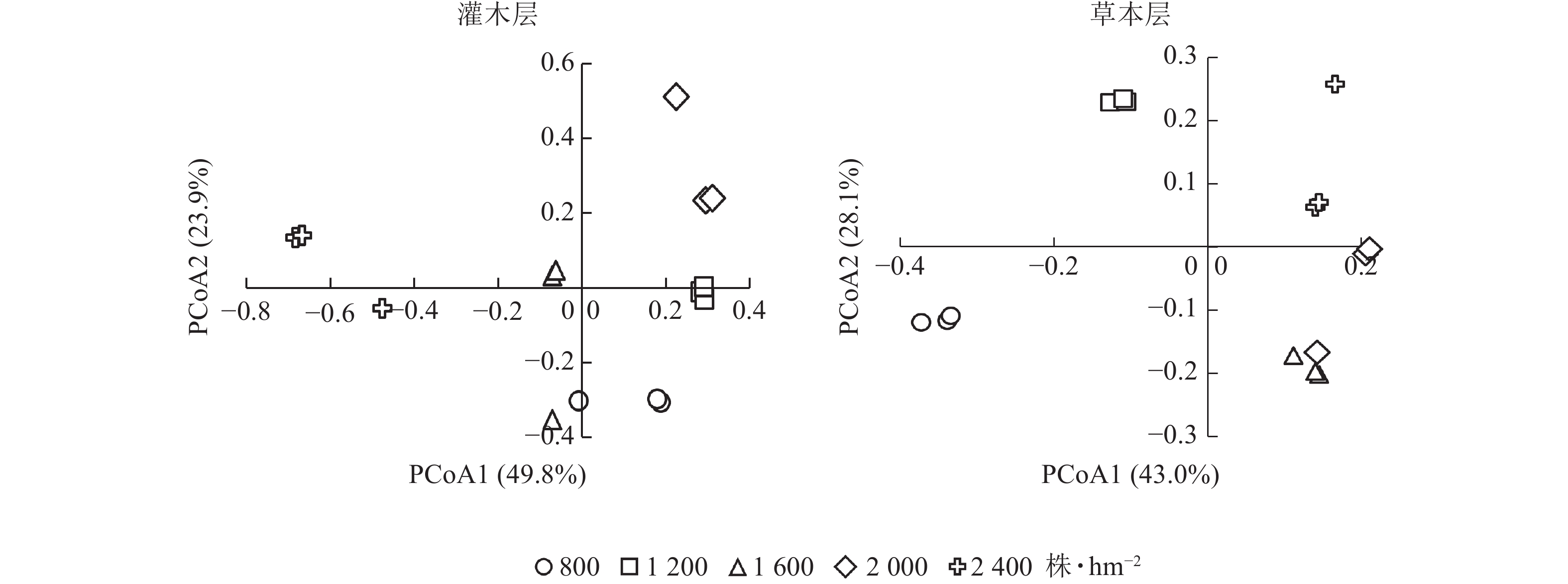
      采用PCoA和PERMANOVA进一步探讨不同密度样地间群落组成是否发生整体分异。PCoA排序结果显示(图1):不同林分密度油松人工林林下灌木层和草本层群落组成均呈现分异特征。灌木层PCoA前2轴累计解释率为73.7%,其中高密度油松林与低、中密度油松林分离较明显,表明灌木层群落组成在不同林分密度间存在差异。草本层PCoA前2轴累计解释率为71.1%,低密度油松林与中高密度油松林沿PCoA1轴分离较明显,其中中高密度和高密度林分下样地距离相对较近,说明高林分密度下草本层群落组成相似性较高。
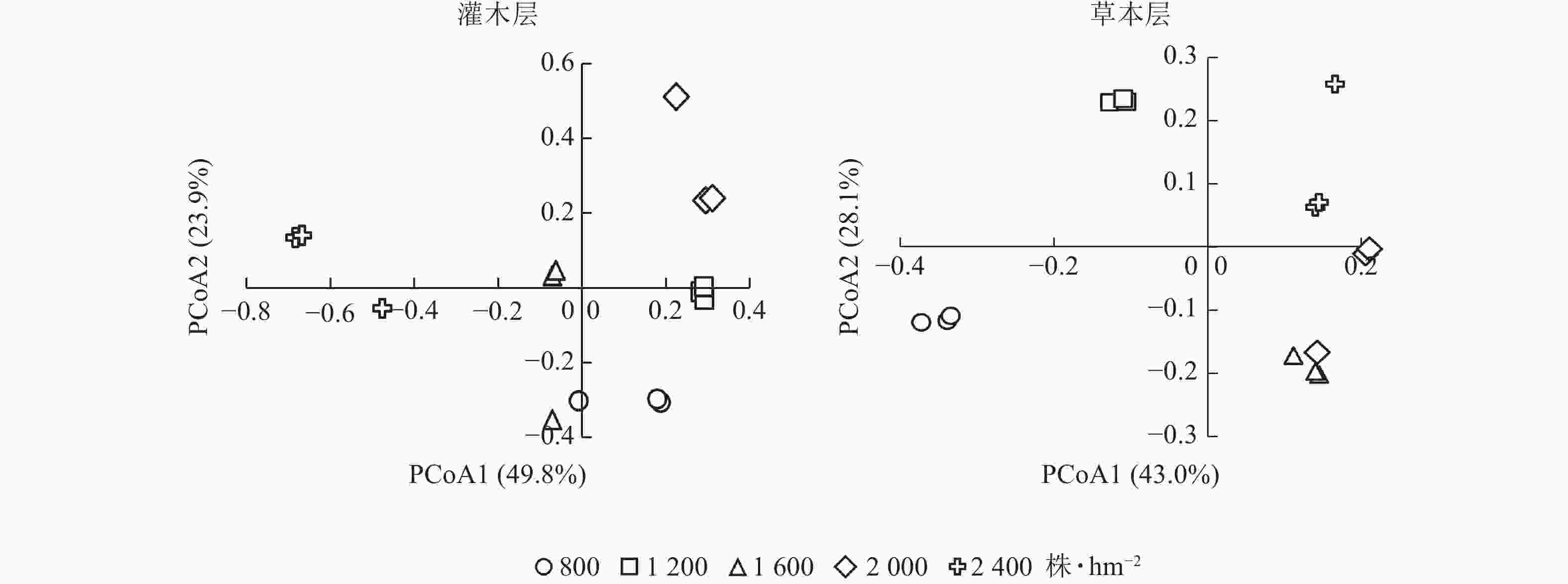
      Figure 1.  PCoA ordination of understory shrub and herb community composition under different stand densities of P. tabuliformis plantations

      PERMANOVA结果表明(表3):不同林分密度样地间灌木层和草本层群落组成均存在显著差异。灌木层群落组成的解释率为87.1% (R2=0.871,P=0.001),草本层群落组成的解释率为95.7% (R2=0.957,P=0.001),灌木层在高密度阶段分离更明显,高密度油松林与低、中密度样地距离较远。草本层则表现为低密度样地与中高密度样地分离明显,而中高密度和高密度油松林组成相对接近,且不同密度组间灌木层和草本层群落组成离散程度差异均不显著(灌木层F4,10=0.254,P=0.906;草本层F4,10=0.211,P=0.927),表明置换多元方差分析结果主要反映不同密度组间群落组成差异,而非组内离散程度差异。

      林下植被类型PERMANOVAPERMDISP
      FR2PFP
      灌木层16.9540.8710.0010.2540.906
      草本层55.2100.9570.0010.2110.927

      Table 3.  Composition difference and intra group dispersion test of understory shrub grass community under different stand densities

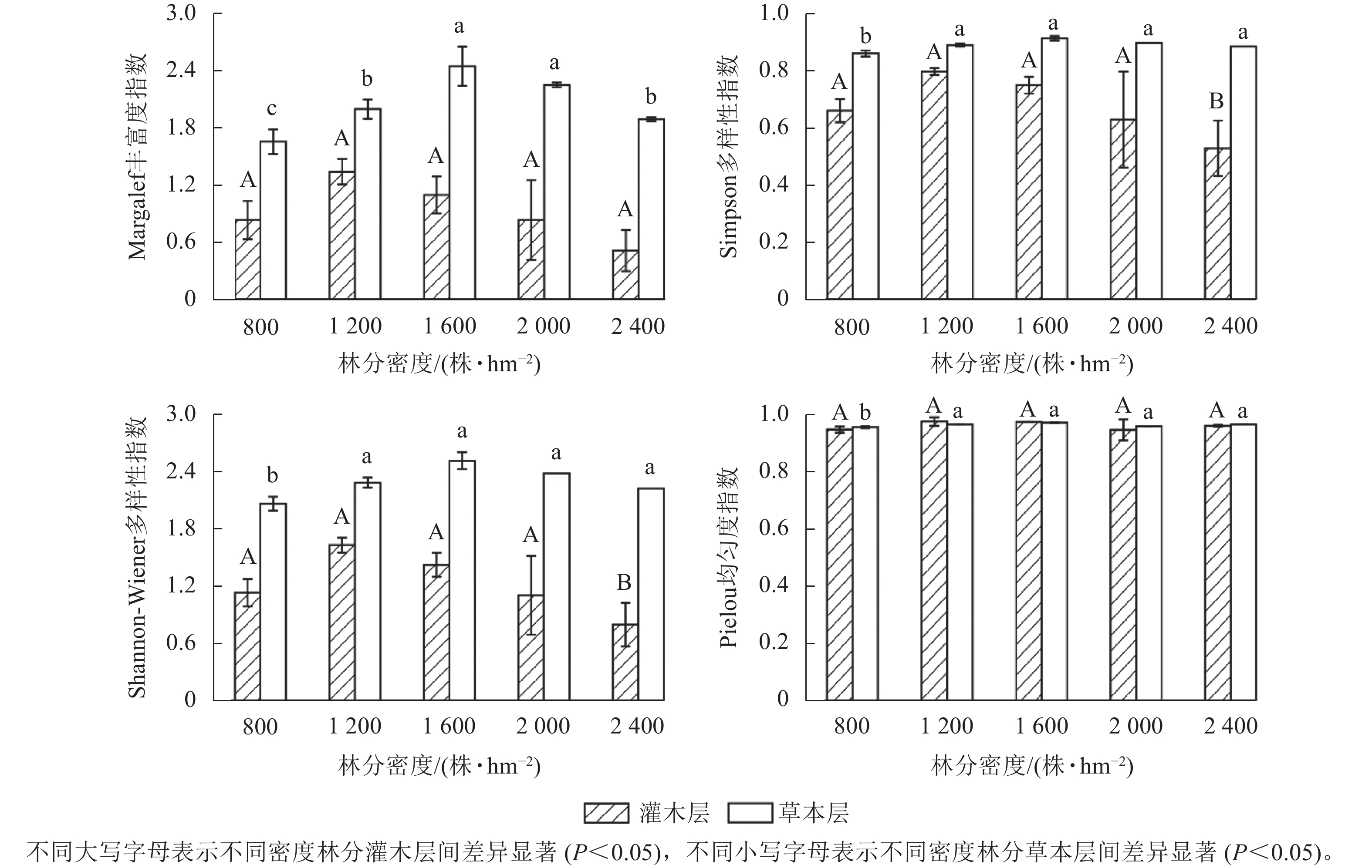
    • 不同林分密度油松人工林林下灌木层和草本层α多样性表现出不同变化特征(图2)。灌木层多样性整体随林分密度增加呈先上升再下降的趋势,显著性检验表明,灌木层Shannon-Wiener多样性指数和Simpson多样性指数在不同林分密度间整体差异达到显著水平(P<0.05)。从数值变化看,Margalef丰富度指数、Shannon-Wiener指数、Simpson指数和Pielou均匀度指数均在中低密度林分下较高,分别为1.34、1.63、0.80和0.98,随后随林分密度升高整体下降,并在高密度林分下降至0.51、0.80、0.53和0.96。
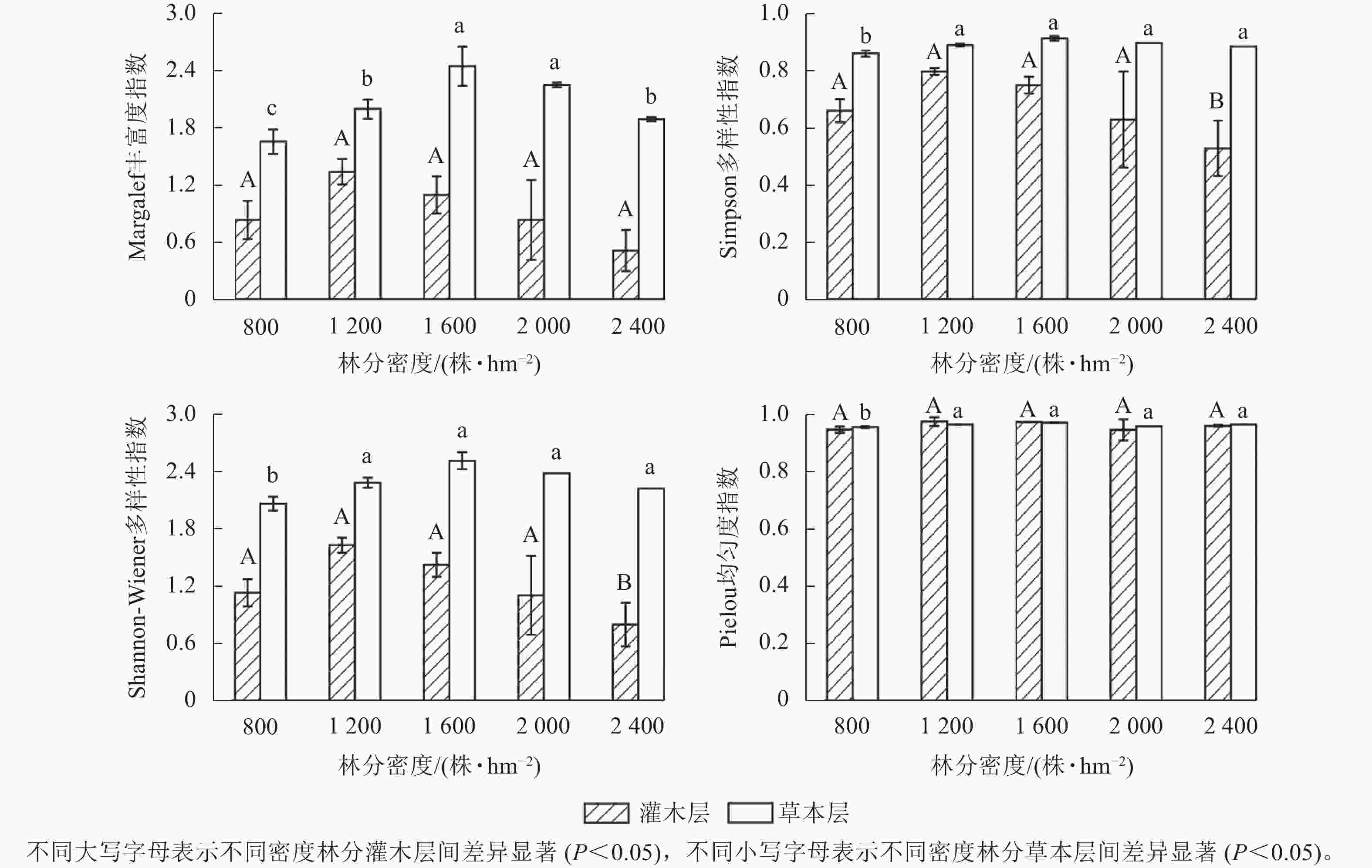
      Figure 2.  Changes in diversity indices of understory shrub and herb layers under different stand densities of P. tabuliformis plantations

      草本层α多样性随林分密度增加总体呈先升高后降低的变化趋势,显著性检验表明,草本层4个α多样性指数在不同林分密度间整体差异均达到显著水平(P<0.05)。从数值变化看,Margalef丰富度指数、Shannon-Wiener指数、Simpson指数和Pielou均匀度指数均在中密度林分下达到较高水平,分别为2.44、2.51、0.91和0.97;在高密度林分下分别下降至1.88、2.22、0.88和0.97。总体来看,灌木层α多样性较高值主要出现在中低密度林分,而草本层α多样性较高值主要出现在中密度林分,说明灌木层和草本层α多样性对林分密度变化的响应区间并不一致。

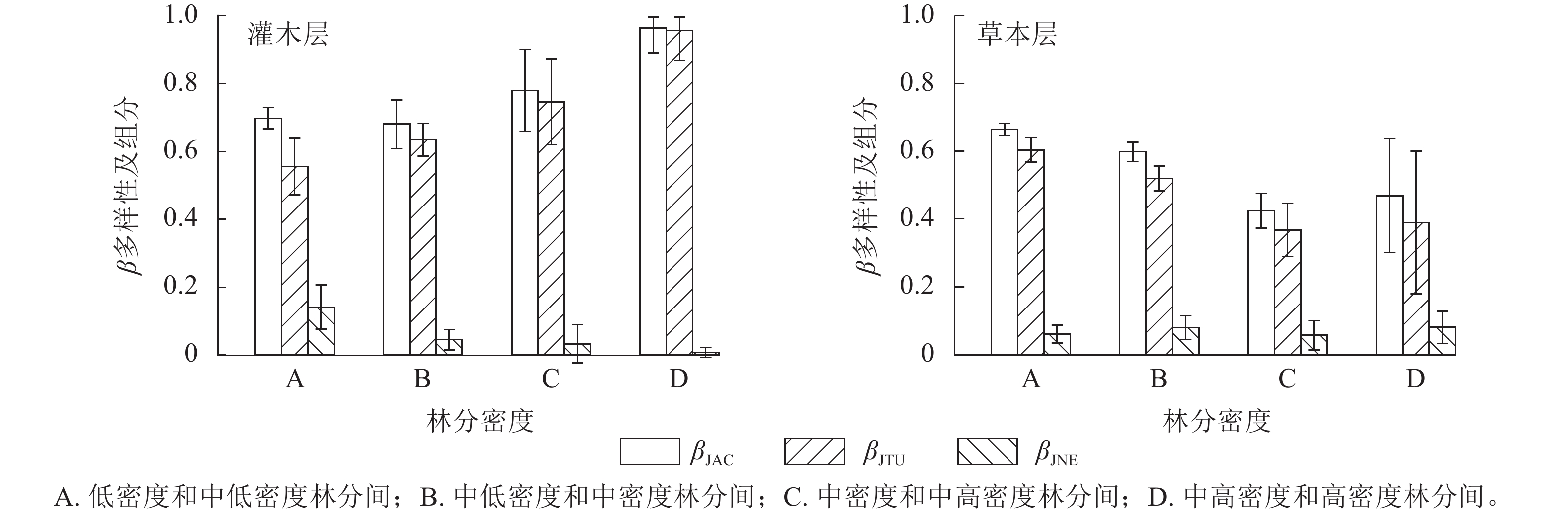
      在群落组成显著分异的基础上,进一步分解β多样性以判断不同密度林分间群落差异主要来源于物种周转还是嵌套。由图3可知:不同林分密度间灌木层和草本层β多样性组分表现出不同变化特征。灌木层相邻林分密度间βJAC和βJTU总体随林分密度升高而增加,并在中高密度和高密度的林分间达到最高,分别为0.963和0.956;βJNE整体较低,且随林分密度升高呈降低趋势,表明在较高林分密度阶段,灌木层群落组成差异主要表现为物种替换增强。
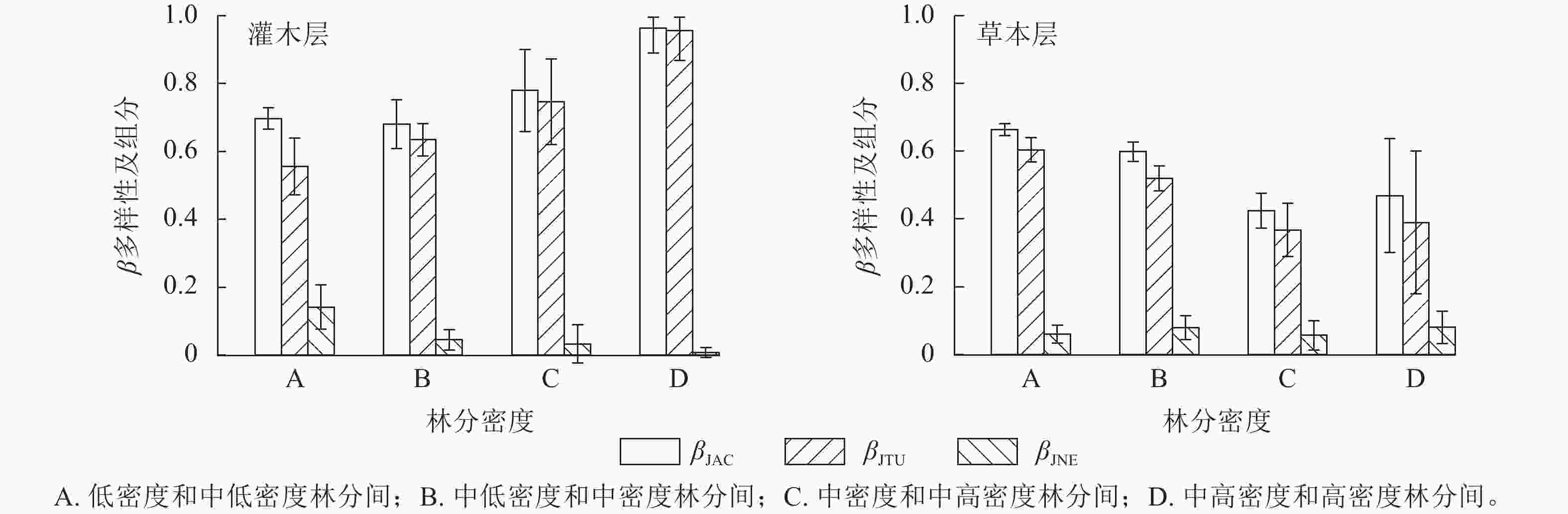
      Figure 3.  Changes in β-diversity components of understory shrub and herb layers among different stand densities

      草本层相邻林分密度间βJAC和βJTU总体随林分密度升高而降低,在低密度和中低密度林分间较高,分别为0.650和0.592,随后逐渐下降;βJNE在不同相邻林分密度间变化幅度较小,表明草本层群落组成差异在低密度油松林至中密度油松林阶段更明显,而高密度油松林间群落组成差异相对减弱。不同林分密度间灌木层和草本层β多样性总体以物种周转组分为主,嵌套组分贡献较低,表明林分密度变化引起的林下灌草群落组成差异主要来源于物种替代。

      为进一步识别不同林分密度间林下灌木层和草本层群落组成分异的主要贡献物种,基于物种重要值矩阵计算β多样性的贡献率(表4)。结果表明:灌木层中蒙古莸、拧条锦鸡儿、文冠果、蕤核和胡枝子对群落组成分异的贡献较高,β多样性的贡献率分别为20.04%、18.00%、15.60%、12.75%和10.55%。蒙古莸和蕤核的重要值峰值出现在高密度的林分下,拧条锦鸡儿和胡枝子的重要值峰值出现在中高密度的林分下,文冠果的重要值峰值出现在低密度的林分下。草本层中,西山委陵菜、长芒草、毛连菜、甘草、委陵菜、香青兰、硬质早熟禾、草木樨状黄芪的β多样性的贡献率较高,分别为15.26%、9.09%、7.12%、6.73%、6.06%、5.86%、5.76%和5.32%,西山委陵菜和甘草的重要值峰值出现在低密度的林分下,长芒草的重要值峰值出现在中高密度的林分下,毛连菜和香青兰的重要值峰值出现在中密度的林分下。

      植被类型 物种 β多样性的
      贡献率/%
      重要值峰值密
      度/ (株·hm−2)
      最大重
      要值/%
      植被类型 物种 β多样性的
      贡献率/%
      重要值峰值密
      度/ (株·hm−2)
      最大重
      要值/%
      灌木层 蒙古莸 20.04 2 400 56.93 草本层 毛连菜 7.12 1 600 12.62
      拧条锦鸡儿 18.00 2 000 48.34 甘草 6.73 800 11.93
      文冠果 15.60 800 36.41 委陵菜 6.06 1 200 7.43
      蕤核 12.75 2 400 34.31 香青兰 5.86 1 600 6.95
      胡枝子 10.55 2 000 22.76 硬质早熟禾 5.76 2 400 8.80
      草本层 西山委陵菜 15.26 800 24.02 草木樨状黄芪 5.32 2 400 11.02
      长芒草 9.09 2 000 20.05

      Table 4.  Main contributing species to compositional differentiation of understory shrub and herb communities under different stand densities

      综合α多样性、PCoA排序、β多样性分解和β多样性贡献率结果可知:灌木层和草本层对林分密度变化的响应并非同步升降,而是在多样性峰值、群落组成分化阶段和物种周转变化趋势上的表现。当处于中低密度林分时,灌木层群落多样性达到较高水平,随后逐渐下降;当油松林林分密度升高至中密度时,草本层群落多样性达到最高,之后随林分密度继续增加而降低;随着油松林林分密度升高,灌木层群落组成分化程度总体增强,物种周转组分逐渐增加,并在中高密度和高密度间最为明显;当油松林林分密度升至高密度时,草本层群落组成分化程度则总体减弱,物种周转组分在林分密度为低密度和中低密度间较高,之后逐渐降低。

    • 林分密度变化通常伴随林冠结构、林下光照、凋落物输入、根系竞争和近地表微环境的改变,从而影响林下植物定居、生长和种间共存[24]。本研究中,低密度林分灌木层主要以沙棘、文冠果等物种占优,草本层主要以西山委陵菜、风毛菊等占优。随着林分密度升高,灌木层中拧条锦鸡儿、蒙古莸和蕤核等物种重要值升高,草本层中长芒草、白莲蒿和草木樨状黄芪等物种逐渐占据较大优势,说明林分密度变化不仅改变了林下植物物种数和多样性水平,也改变了群落优势种组成。这种变化可能与不同物种对林下资源环境变化的适应差异有关。低密度条件下林冠遮光较弱,林下光照相对充足,有利于部分喜光或耐旱物种占据优势;随着林分密度增加,林冠郁闭度提高,林下光照减少,对林下植物形成新的环境筛选。

      PCoA排序和PERMANOVA检验结果表明,林分密度对灌木层和草本层群落组成均具有显著影响,说明密度变化并非只引起少数优势种重要值波动,而是导致不同密度林分间群落组成整体发生分化。高密度林分油松林灌木层群落与低、中密度林分油松林灌木层群落相似性降低;低密度林分油松林草本层群落组成则与中、高密度林分油松林草本层群落之间的群落组成差异增大,说明林分密度变化引起了灌木层和草本层群落组成分化,但两者发生明显分化的密度阶段并不一致。已有研究表明:经营措施可能同时改变物种丰富度、群落组成、α多样性和β多样性格局[25]。本研究进一步说明,不同密度梯度油松人工林林下灌木层和草本层的组成变化存在差异。

    • 本研究中,灌木层和草本层α多样性对林分密度变化表现出不同响应。灌木层Shannon-Wiener指数和Simpson指数在不同密度间差异显著,而Margalef丰富度指数和Pielou均匀度指数差异不显著,说明密度变化主要影响灌木层综合多样性和优势度结构。已有研究认为:林下植被对林冠结构、林下光照和资源竞争变化较为敏感[24],油松人工林林分密度变化也会显著影响林下植物多样性和更新过程[10]。本研究结果与其基本一致。灌木层α多样性整体在中低密度的林分下较高,随林分密度升高而下降,说明过高林分密度可能不利于灌木层植物共存,其原因可能在于高密度林分下林冠遮光作用增强,林下可利用光照减少,乔木层根系竞争加剧,限制了灌木层部分物种的生长和更新[7]。

      草本层各α多样性指数在不同林分密度间均存在显著差异,整体表现为随林分密度增加先升高后降低,并在中密度林分下达到较高水平。这表明草本层对林分密度变化更为敏感。草本植物植株低矮、生活周期较短,对林下光照、凋落物覆盖、表层土壤资源和近地表微环境变化响应较快。适宜的林分密度可能在林冠遮光、地表覆盖和资源竞争之间形成相对平衡,从而有利于草本植物定居和共存;高林分密度条件下,林冠郁闭程度升高,林下光照不足,乔木层与林下植被之间的资源竞争增强,可能导致部分林下植物生长受限,从而使草本层多样性下降[11]。灌木层和草本层对林分密度变化的响应并不一致,说明林下植被并不是作为一个整体同步变化,而是存在明显的层次差异[26]。草本层对林分密度变化响应更敏感,可能与其植株低矮、生活周期较短,对林下光照和表层资源变化更敏感有关[27−28]。

      β多样性能够反映不同样地或不同生境间群落组成差异,是理解群落分化过程的重要指标[29]。已有研究表明:即使物种丰富度变化不明显,群落组成仍可能发生显著重组,因此仅依靠α多样性指数难以全面反映林下植物群落变化[29]。β多样性主要由物种周转组分贡献,说明林分密度梯度下林下群落差异主要表现为物种替换,而不是简单的物种丧失[30]。灌木层相邻林分密度间βJAC和βJTU随林分密度升高而增加,说明高密度阶段灌木层物种替换增强,灌木为多年生木本植物,个体寿命较长,对短期林下环境变化具有一定滞后性;在低密度至中密度阶段,原有灌木个体仍可维持一定优势,因此群落组成变化相对缓和。随着密度进一步升高,林冠遮光、空间竞争和水分消耗压力增强,部分低密度优势灌木的重要值下降,而拧条锦鸡儿、蒙古莸、蕤核等物种在中高密度或高密度下占据较高优势,导致灌木层物种替换增强。β多样性的贡献率结果中,蒙古莸、拧条锦鸡儿、文冠果、蕤核和胡枝子对灌木层组成分异贡献较高,也进一步说明灌木层分化主要由少数优势物种在不同密度阶段的重要值变化驱动。

      草本层βJAC和βJTU则随林分密度升高总体降低。由于草本植物植株低矮、生活周期短,对林下光照、凋落物覆盖和近地表微环境变化更敏感,当林分密度由低密度升高至中密度时,林下光照条件和地表微环境发生明显改变,低密度下占优的西山委陵菜、风毛菊、甘草等物种重要值下降,而长芒草、毛莲菜、草木樨状黄芪等物种重要值升高,从而形成较强的草本层物种替换;在中高密度和高密度林分下,草本层β多样性组分反而降低,说明高密度条件下草本群落组成趋于接近。高密度林分形成较一致的低光照、较强根系竞争和较厚凋落物环境,使草本层受到更强的环境筛选,能够维持较高优势的物种类型减少,群落组成表现出一定趋同。灌木层和草本层的α多样性峰值所对应的林分密度不同,而且在群落组成分化发生的不同林分密度阶段也不同,进一步体现出分层异步响应特征[31]。林分密度变化也会通过改变冠层结构和林下光环境影响林下草本多样性[32],这与本研究中草本层对密度变化响应较明显的结果相吻合。由于缺乏造林初期林下植被组成和土壤种子库资料,尚不能完全排除初始物种库差异对现阶段灌木层和草本层组成及多样性差异的影响,并未开展长期定位连续监测,因此不能分析林下植物群落的演替规律或物种变化速率。本研究结果主要反映相似立地条件下不同密度油松人工林林下植被的现阶段差异。今后需结合长期定位监测和土壤种子库调查进一步验证林分密度对林下植被恢复过程的影响。

    • 不同林分密度下,黄土高原油松人工林灌木层和草本层物种组成及优势种结构均表现出明显差异。随林分密度升高,灌木层优势种由低密度下的沙棘、文冠果等逐渐变化为中高密度下的拧条锦鸡儿、蒙古莸和蕤核等;草本层优势种则由西山委陵菜、风毛菊等逐渐变化为长芒草、白莲蒿和草木樨状黄芪等,表明不同密度油松人工林下植物群落组成发生了明显分化。PCoA、PERMANOVA和PERMDISP结果表明:不同林分密度下灌木层和草本层群落组成均发生显著分异,且这种分异主要反映不同密度组间的群落组成差异。

      灌木层α多样性整体在中低密度的林分下较高,草本层α多样性在中密度林分下达到较高水平,当林分密度升高至高密度时,2层多样性均有所下降,说明过高林分密度不利于林下灌草多样性维持。不同林分密度间灌木层和草本层群落组成均发生显著分化,且β多样性差异主要来源于物种替代。β多样性贡献率分析进一步表明,不同密度间群落组成分异主要由少数重要值变化较大的物种贡献,灌木层主要贡献物种包括蒙古莸、拧条锦鸡儿、文冠果、蕤核和胡枝子,草本层主要贡献物种包括西山委陵菜、长芒草、毛莲菜、甘草、委陵菜、香青兰、硬质早熟禾和草木樨状黄芪等。综合α多样性、β多样性和β多样性贡献率结果,1200~1600 株·hm−2可作为本研究条件下油松人工林兼顾林下灌木层和草本层多样性维持的参考密度范围。

Reference (32)

Catalog

    /

    DownLoad:  Full-Size Img  PowerPoint
    Return
    Return