Volume 42 Issue 4
Aug.  2025
Turn off MathJax
Article Contents

CHEN Sisi, WANG Keyu, YING Liping, et al. Effects of frog density on soil aggregate structure, soil nutrient and rice yield in rice-frog integrated farming model[J]. Journal of Zhejiang A&F University, 2025, 42(4): 765−773 doi:  10.11833/j.issn.2095-0756.20240662
Citation: CHEN Sisi, WANG Keyu, YING Liping, et al. Effects of frog density on soil aggregate structure, soil nutrient and rice yield in rice-frog integrated farming model[J]. Journal of Zhejiang A&F University, 2025, 42(4): 765−773 doi:  10.11833/j.issn.2095-0756.20240662

Effects of frog density on soil aggregate structure, soil nutrient and rice yield in rice-frog integrated farming model

DOI: 10.11833/j.issn.2095-0756.20240662
  • Received Date: 2024-12-24
  • Accepted Date: 2025-03-28
  • Rev Recd Date: 2025-03-26
  • Available Online: 2025-08-01
  • Publish Date: 2025-08-01
  •   Objective  The objective is to analyze the impact of the rice-frog integrated farming model on soil aggregate structure, soil nutrients, and rice (Oryza sativa) yield, and provide a theoretical basis for constructing rice-frog integrated farming model.   Method  Field experiments were conducted in Lin’an District, Hangzhou City of Zhejiang Province from April to September in 2023 to analyze the differences in soil aggregate structure, soil nutrients, and rice yield under different frog density treatments: low density (T1, 0.9×10⁴ individuals·hm−2); medium density (T2, 1.2×10⁴ individuals·hm−2); high density (T3, 1.8×10⁴ individuals·hm−2); and control treatment (ck), rice monoculture.   Result  Compared with ck, rice-frog integrated treatments significantly (P<0.05) reduced soil bulk density and increased the content of soil water-stable macroaggregates which increased with frog density, but had no significant effect on total nitrogen content. Soil ammonium nitrogen content decreased with increasing frog density, while soil nitrate nitrogen content significantly increased. T1 treatment significantly reduced soil total phosphorus and available phosphorus contents, but with the increase of frog density, both soil total phosphorus and available phosphorus contents increased. Medium and high density treatments significantly decreased soil available potassium content. Rice-frog integrated farming model significantly reduced soil organic matter content, especially in T2 and T3 treatments where the decrease was greater. The number of effective panicles, seed setting rate, and rice yield were all significantly lower than those of ck, and the yield decreased by 15.49% in T3 treatment. However, in terms of comprehensive benefits, the comprehensive cultivation model of rice and frog was significantly higher than ck, and the comprehensive benefits increased with increasing frog density.  Conclusion  The rice-frog integrated farming model under high-density treatment has the most significant improvement in soil aggregate structure, and soil nutrients can still maintain at a certain level. The decrease in rice yield is relatively small, and the comprehensive benefits are the most significant. It is recommended as a suitable model for rice-frog integrated cultivation. It is suggested to increase the application rates of nitrogen, potassium and organic fertilizers during non-farming period to maintain nutrient balance, stabilize the number of rice panicles, and promote high yield. [Ch, 4 fig. 1 tab. 37 ref.]
  • [1] GAO Ziying, WANG Haiyan, ZHANG Yifan.  Soil carbon, nitrogen and phosphorus stoichiometric characteristics and driving factors: a review . Journal of Zhejiang A&F University, 2025, 42(3): 645-656. doi: 10.11833/j.issn.2095-0756.20240564
    [2] LI Baogang, NIE Xinjun, KONG Delei, JIANG Peikun, ZHENG Yuting, ZHU Gaodi.  Effects of biochar based fertilizer on soil nutrients and bacterial community structure . Journal of Zhejiang A&F University, 2025, 42(6): 1243-1254. doi: 10.11833/j.issn.2095-0756.20250102
    [3] DU Fangfang, TONG Genping, GUO Rui, JIANG Niwen, YE Zhengqian, FU Weijun.  Spatial heterogeneity of soil nutrients and the influencing factors in Zhejiang subtropical nature reserve . Journal of Zhejiang A&F University, 2023, 40(1): 145-154. doi: 10.11833/j.issn.2095-0756.20220213
    [4] WANG Ning, FU Yajun, SHAO Jing, XUE Yunyun.  Effects of soil nutrient heterogeneity on competition between Aegilops tauschii and Triticum aestivum . Journal of Zhejiang A&F University, 2023, 40(2): 285-292. doi: 10.11833/j.issn.2095-0756.20220370
    [5] SUI Xiran, WU Lifang, WANG Yan, WANG Ziquan, XIAO Yuxin, LIU Yungen, YANG Bo.  Characteristics of nutrient and enzyme activity in soil aggregates of different rocky desertification levels in central Yunnan Plateau . Journal of Zhejiang A&F University, 2022, 39(1): 115-126. doi: 10.11833/j.issn.2095-0756.20210168
    [6] TAN Jin, YANG Jianying, HOU Jian.  Relationship between shrubs and soil nutrients in Wuhai City . Journal of Zhejiang A&F University, 2019, 36(5): 957-964. doi: 10.11833/j.issn.2095-0756.2019.05.015
    [7] GONG Chen, WANG Xudong, NI Xing, LE Tiantian, ZENG Shiyuan, YE Zhengqian.  Effects of long-term application of edible fungus residue and chemical fertilizers on fractions of labile organic carbon and available nutrients in rice field soils . Journal of Zhejiang A&F University, 2018, 35(2): 252-260. doi: 10.11833/j.issn.2095-0756.2018.02.008
    [8] WANG Dan, MA Yuandan, GUO Huiyuan, GAO Yan, ZHANG Rumin, HOU Ping.  Soil nutrients and microorganisms with simulated acid rain stress and Cryptomeria fortunei litter . Journal of Zhejiang A&F University, 2015, 32(2): 195-203. doi: 10.11833/j.issn.2095-0756.2015.02.005
    [9] ZHENG Rong.  Canonical correlation and principal components analysis of different production areas of Dendrocalamopsis oldhami with quality indicators of bamboo shoots and its soil nutrients . Journal of Zhejiang A&F University, 2012, 29(5): 710-714. doi: 10.11833/j.issn.2095-0756.2012.05.012
    [10] LIU Li-na, JIN Ai-wu.  Spatial variability of soil nutrients for an intensively managed Phyllostachys pubescens forest . Journal of Zhejiang A&F University, 2011, 28(5): 828-832. doi: 10.11833/j.issn.2095-0756.2011.05.025
    [11] DU Hua-qiang, TANG Meng-ping, CUI Rui-rui.  Spatial heterogeneity of soil nutrients in an evergreen broadleaved forest of Mount Tianmu,Zhejiang . Journal of Zhejiang A&F University, 2011, 28(4): 562-568. doi: 10.11833/j.issn.2095-0756.2011.04.007
    [12] ZHENG Hong-bo, WU Jian-ping, ZHANG Shan.  Spatial variability of farmland soil organic matter and soil nutrients in Ninghai County,Zhejiang Province . Journal of Zhejiang A&F University, 2010, 27(3): 379-384. doi: 10.11833/j.issn.2095-0756.2010.03.010
    [13] TONG Gen-ping, WANG Wei-guo, ZHANG Yuan-yuan, XU Wen-xin, DOU Chun-ying, SHENG Wei-xing, YU Qing-ping, YE Zheng-qian.  Seasonal changes of soil and leaf nutrient levels in a Carya cathayensis orchard . Journal of Zhejiang A&F University, 2009, 26(4): 516-521.
    [14] JIANG Pei-kun, XUQiu-fang, WUQi-feng, WUJia-sen.  Effects of fertilization on soil properties under Castanea mollissima plantation . Journal of Zhejiang A&F University, 2007, 24(4): 445-449.
    [15] DAI Wen-sheng, LI Zhang-ju, CHENG Xiao-jian, YU Wei-wu, FU Qing-gong.  Mineral elements in Torreya grandis 'Merrillii' seeds and their forest soils . Journal of Zhejiang A&F University, 2006, 23(4): 393-399.
    [16] JIANG Pei-kun, XU Qiu-fang, CHU Jia-miao, WU Li-jun.  Soil nutrients in response to intensive management of Phyllostachys praecox . Journal of Zhejiang A&F University, 2006, 23(3): 242-247.
    [17] DAI Wen-sheng, LI Zhang-ju, CHENG Xiao-jian, YU Wei-wu, FU Qing-gong.  Soil nutrients in Torreya grandis `Merrillii' plantation . Journal of Zhejiang A&F University, 2006, 23(2): 140-144.
    [18] MA Huan-cheng, LUO Zhi-bin, CHEN Yi-qun, LIN Wen-jie.  Hydrogel’s role in retention of nutrients in soil . Journal of Zhejiang A&F University, 2004, 21(4): 404-407.
    [19] YANG Fang, XU Qiu-fang.  Changes in nutrients and heavy metal contents in soils under Phyllostachys praecox stands with different cultivation histories . Journal of Zhejiang A&F University, 2003, 20(2): 111-114.
    [20] JIANG Zhi-biao, YU Qin-min.  Effects of fertilization on some physiological traits of Chinese fir seedling and soil nutrient . Journal of Zhejiang A&F University, 1999, 16(4): 365-368.
  • [1]
    ZHENG Huabin, HE Hui, YAO Lin, et al. Ecological economic effects and its prospects of raising animals in paddy field[J]. Wetland Science, 2015, 13(4): 510−517.
    [2]
    LI Xinghua, TU Junming, CHEN Zhanpeng, et al. Rice-frog planting and raising mode and its sustainable development strategy[J]. Journal of Agriculture, 2020, 10(12): 98−103.
    [3]
    ZHANG Jiaen, WEI Shengbao, LIU Xing, et al. Research progress and prospect of integrated rice-fish coculture[J]. Journal of South China Agricultural University, 2024, 45(6): 812−824.
    [4]
    LI Yifan, WU Tiaoyan, WANG Shaodong, et al. Developing integrated rice-animal farming based on climate and farmers choices[J/OL]. Agricultural Systems, 2023, 204: 103554[2024-11-24]. DOI: 10.1016/j.agsy.2022.103554.
    [5]
    CUI Jinlan, LIU Hongbin, WANG Honyuan, et al. Rice-animal co-culture systems benefit global sustainable intensification[J/OL]. Earths Future, 2023, 11(2): e2022EF002984[2024-11-24]. DOI: 10.1029/2022EF002984.
    [6]
    CLAVERO M, LÓPEZ V, FRANCH N, et al. Use of seasonally flooded rice fields by fish and crayfish in a Mediterranean wetland[J]. Agriculture Ecosystems & Environment, 2015, 213: 39−46.
    [7]
    JI Zijun, ZHAO Lufeng, ZHANG Taojie, et al. Coculturing rice with aquatic animals promotes ecological intensification of paddy ecosystem[J/OL]. Journal of Plant Ecology, 2023, 16(6): rtad014[2024-11-24]. DOI: 10.1093/jpe/rtad014.
    [8]
    LIU Jianfang, ZHANG Qian, WANG Qianyi, et al. Gross ecosystem product accounting of a globally important agricultural heritage system: the Longxian rice-fish symbiotic system[J/OL]. Sustainability, 2023, 15(13): 10407[2024-11-24]. DOI: 10.3390/su151310407.
    [9]
    ZHANG Zhen, DU Linsen, XIAO Zhiyu, et al. Rice-crayfish farming increases soil organic carbon[J/OL]. Agriculture Ecosystems & Environment, 2022, 329: 107857[2024-11-24]. DOI: 10.1016/j.agee.2022.107857.
    [10]
    XU Chao, JIN Lianjuan, HUANG Liguo, et al. Key technologies and benefits analysis of rice-frog ecological symbiosis[J]. Sichuan Agricultural Science and Technology, 2020(5): 58−60.
    [11]
    REN Yi, JIANG Peikun, LU Changgen, et al. Effects of biochar-based fertilizer and organic fertilizer substituting chemical fertilizer partially on soil microbial abundances and enzyme activities[J]. Journal of Zhejiang A&F University, 2022, 39(4): 860−868
    [12]
    YAO Quan, TANG Xu, XIAO Mouliang, et al. Effects of slow release nitrogen fertilizer combined with organic fertilizer on crop growth and soil nutrient content in rice-wheat rotation system[J]. Journal of Zhejiang A&F University, 2025, 42(1): 175−184.
    [13]
    KONG Delei, JIANG Peikun. Approaches and policy recommendations for reducing emissions and increasing carbon sinks in crop industry under the background of carbon peak and carbon neutrality[J]. Journal of Zhejiang A&F University, 2023, 40(6): 1357−1365.
    [14]
    GUO Lijin, LIN Wei, CAO Cougui, et al. Integrated rice-crayfish farming system does not mitigate the global warming potential during rice season[J/OL]. Science of the Total Environment, 2023, 867: 161520[2024-11-24]. DOI: 10.1016/j.scitotenv.2023.161520.
    [15]
    XU Qiang, DAI Linxiu, GAO Pinglei, et al. The environmental, nutritional, and economic benefits of rice-aquaculture animal coculture in China[J/OL]. Energy, 2022, 249: 123723[2024-11-24]. DOI: 10.1016/j.energy.2022.123723.
    [16]
    SUN Xinjia, WANG Haolin, WANG Feijie, et al. Effects of different fertilization patterns on the dietary composition of Procambarus clarkii in a rice-crayfish coculture system[J/OL]. Aquaculture Reports, 2023, 33: 101801[2024-11-24]. DOI: 10.1016/j.aqrep.2023.101801.
    [17]
    DUAN Yuanliang, LI Qiang, ZHANG Lu, et al. Toxic metals in rice-fish co-culture systems and human health[J/OL]. Ecotoxicology and Environmental Safety, 2022, 241: 113797[2024-11-24]. DOI: 10.1016/j.ecoenv.2022.113797.
    [18]
    XU Man, DENG Zhengchun, GU Zhenhua, et al. Green ecological breeding technology and benefit analysis of rice and frog[J]. Crop Research, 2020, 34(4): 384−387.
    [19]
    ZHU Lianfeng, FANG Weiping, ZHUANG Xuehao, et al. Effects of rice-frog co-cultivation on the physicochemical characteristics of the soil and grain yield[J]. China Rice, 2023, 29(5): 23−27.
    [20]
    WANG Huajun, WANG Xinqi, DING Guoping, et al. Effects of nitrogen application on agronomic traits and yield of rice based on eco-planting and breeding of rice and frog model[J]. Acta Agriculturae Shanghai, 2016, 32(6): 82−86.
    [21]
    LIN Haiyan, HUANG Qianxia, SHAO Ziyi, et al. Characterization of soil enzymatic activities and main nutrient contents in paddy field for eco-planting and breeding rice and frog[J]. Journal of Nuclear Agricultural Sciences, 2018, 32(4): 802−808.
    [22]
    ZHOU Xuefang, ZHU Xiaowei, CHEN Zekai, et al. Effect of eco-planting and breeding of rice and frog on soil microorganisms and soluble phosphorus contents[J]. Journal of Nuclear Agricultural Sciences, 2016, 30(5): 971−977.
    [23]
    GUO Wenxiao, ZHAO Qi, ZHU Yuanhong, et al. Effects of eco-planting and breeding patterns of rice and frog on soil microbial characteristics[J]. Jiangsu Agricultural Sciences, 2018, 46(5): 57−60.
    [24]
    MENG Xiangjie, HUANG Huang, CHEN Can, et al. Effect of different cultivation modes on soil fertility in paddy field[J]. Hunan Agricultural Sciences, 2021(2): 45−48.
    [25]
    LI Jinglong, XU Yongfu, WANG Dongwu, et al. Effects of breeding models of Rana nigromaculata on soil fertility and enzyme activity in paddy field and economic benefit analysis[J]. Crop Research, 2019, 33(5): 428−431, 436.
    [26]
    CHEN Can, HUANG Huang, ZHENG Huabin, et al. Effects of different mode of ecological planting and raising on rice quality[J]. China Rice, 2015, 21(2): 17−19.
    [27]
    LI Xinghua, CHEN Zhanpeng, CAI Zhengjun, et al. Effects of different densities of Pelophylax nigromaculatus on rice yields and soil fertility in paddy fields[J]. Hubei Agricultural Sciences, 2023, 62(5): 5−7.
    [28]
    GUO Tianrong, LIU Ruiqi, ZENG Qing, et al. Effects of rice-frog co-cultivation on nutrient contents in rice leaves and brown rice and yield components[J]. Molecular Plant Breeding, 2022, 20(15): 5205−5212.
    [29]
    PENG Xiang, DAI Linxiu, LI Jingyong, et al. Effects of comprehensive planting-breeding in paddy fields on yield and quality of rice in the middle and lower reaches of the yangtze river[J]. China Rice, 2022, 28(4): 55−60.
    [30]
    HU Yiran, DU Linsen, LI Kui, et al. Water quality assessment and economic benefit evaluation of integrated rice-red crayfish cultivation system under different stocking densities[J]. Journal of South China Agricultural University, 2024, 45(6): 918−928.
    [31]
    SI Guohan, PENG Chenglin, XU Xiangyu, et al. Effect of integrated rice-crayfish farming system on soil physico-chemical properties in waterlogged paddy soils[J]. Chinese Journal of Eco-Agriculture, 2017, 25(1): 61−68.
    [32]
    ZHANG Xiaolong, YANG Qiannan, LI Xiangdong, et al. Effects of crop/animal co-cultivations on physiochemical properties and fertility of rice paddy soil[J]. Fujian Journal of Agricultural Sciences, 2023, 38(2): 202−209.
    [33]
    TANG Wei, CHEN Can, HUANG Huang. Effects of different rice cultivation patterns on soil and water physical and chemical properties and rice yield[J]. Crop Research, 2021, 35(5): 490−495.
    [34]
    LIU Yu, CAO Jintao, CHEN Jiaqi, et al. Progress on effects of ecological planting and rearing on soil properties in rice fields[J]. Environmental Ecology, 2021, 3(12): 34−37.
    [35]
    LI Wenbo, LIU Shaojun, YE Xinxin, et al. effects of the co-culture of rice and aquatic animals on soil eco-system: a review[J]. Journal of Ecology and Rural Environment, 2021, 37(10): 1292−1300.
    [36]
    LONG Li, HE Hui, HUANG Huang, et al. Comparative analysis of impact of integrated rice farming systems on soil ecological environment of paddy fields[J/OL]. Journal of Agriculture, 2024-09-20 [2024-11-24]. https://link.cnki.net/urlid/11.6016.S.20240919.1103.002.
    [37]
    DOU Zhi, ZHANG Yaoyuan, GUO Wei, et al. Research progress on the influence of integrated farming of rice and aquatic animal on soil and rice[J]. Journal of South China Agricultural University, 2024, 45(6): 836−845.
  • 加载中
通讯作者: 陈斌, bchen63@163.com
  • 1. 

    沈阳化工大学材料科学与工程学院 沈阳 110142

  1. 本站搜索
  2. 百度学术搜索
  3. 万方数据库搜索
  4. CNKI搜索

Figures(4)  / Tables(1)

Article views(517) PDF downloads(38) Cited by()

Related
Proportional views

Effects of frog density on soil aggregate structure, soil nutrient and rice yield in rice-frog integrated farming model

doi: 10.11833/j.issn.2095-0756.20240662

Abstract:   Objective  The objective is to analyze the impact of the rice-frog integrated farming model on soil aggregate structure, soil nutrients, and rice (Oryza sativa) yield, and provide a theoretical basis for constructing rice-frog integrated farming model.   Method  Field experiments were conducted in Lin’an District, Hangzhou City of Zhejiang Province from April to September in 2023 to analyze the differences in soil aggregate structure, soil nutrients, and rice yield under different frog density treatments: low density (T1, 0.9×10⁴ individuals·hm−2); medium density (T2, 1.2×10⁴ individuals·hm−2); high density (T3, 1.8×10⁴ individuals·hm−2); and control treatment (ck), rice monoculture.   Result  Compared with ck, rice-frog integrated treatments significantly (P<0.05) reduced soil bulk density and increased the content of soil water-stable macroaggregates which increased with frog density, but had no significant effect on total nitrogen content. Soil ammonium nitrogen content decreased with increasing frog density, while soil nitrate nitrogen content significantly increased. T1 treatment significantly reduced soil total phosphorus and available phosphorus contents, but with the increase of frog density, both soil total phosphorus and available phosphorus contents increased. Medium and high density treatments significantly decreased soil available potassium content. Rice-frog integrated farming model significantly reduced soil organic matter content, especially in T2 and T3 treatments where the decrease was greater. The number of effective panicles, seed setting rate, and rice yield were all significantly lower than those of ck, and the yield decreased by 15.49% in T3 treatment. However, in terms of comprehensive benefits, the comprehensive cultivation model of rice and frog was significantly higher than ck, and the comprehensive benefits increased with increasing frog density.  Conclusion  The rice-frog integrated farming model under high-density treatment has the most significant improvement in soil aggregate structure, and soil nutrients can still maintain at a certain level. The decrease in rice yield is relatively small, and the comprehensive benefits are the most significant. It is recommended as a suitable model for rice-frog integrated cultivation. It is suggested to increase the application rates of nitrogen, potassium and organic fertilizers during non-farming period to maintain nutrient balance, stabilize the number of rice panicles, and promote high yield. [Ch, 4 fig. 1 tab. 37 ref.]

CHEN Sisi, WANG Keyu, YING Liping, et al. Effects of frog density on soil aggregate structure, soil nutrient and rice yield in rice-frog integrated farming model[J]. Journal of Zhejiang A&F University, 2025, 42(4): 765−773 doi:  10.11833/j.issn.2095-0756.20240662
Citation: CHEN Sisi, WANG Keyu, YING Liping, et al. Effects of frog density on soil aggregate structure, soil nutrient and rice yield in rice-frog integrated farming model[J]. Journal of Zhejiang A&F University, 2025, 42(4): 765−773 doi:  10.11833/j.issn.2095-0756.20240662
  • 稻田综合种养是利用水稻Oryza sativa与水生动物生态位互补,通过互生互养,实现稻田物质和能量多级循环利用的农业模式,具有较高经济和生态价值[19]。据统计,截至2023年,全国稻田综合种养模式面积已达299.33万hm2,且其规模在不断发展。已有研究表明:合理的稻田综合种养模式能够提高水稻品质,形成物种间互利共生关系,减少化肥、杀虫剂和除草剂使用量,有效降低农业温室气体排放量和面源污染风险[1, 3, 1017],同时显著提升稻田综合收入,实现生态效益和经济效益双赢[2, 10, 1828]。在稻蛙综合种养模式中,蛙类生物活动能够疏松土壤、降低土壤容重、增加土壤孔隙度、促进水稻养分吸收和根系生长[1920]。此外,稻蛙综合种养还显著提升稻田土壤微生物数量和酸性磷酸酶活性[2123],促进稻田土壤中难溶性磷转化与利用,从而提升稻田土壤肥力[2425]。与此同时,蛙类生物活动还能刺激水稻茎干基部生长,促使水稻植株更加健壮[26],改善稻米外观与品质,增加水稻有效分蘖数、穗粒数和结实率[16, 27]。然而,也有研究表明:稻田养蛙会降低水稻有效分蘖数和结实率等,造成水稻产量下降[2829]。这与稻田动物放养密度紧密相关。放养密度过低,可能无法充分发挥动物生态效应,降低种养系统整体效益[27];放养密度过高可能导致动物与水稻之间资源竞争加剧,从而影响水稻正常生长和综合效益[30]。因此,研究稻田综合种养中动物不同投放密度对整个系统的影响规律,有助于优化资源配置、平衡生态效益与经济效益。

    尽管稻蛙综合种养模式发展潜力大,技术较为成熟,但目前关于不同投放密度对稻田土壤物理性质、土壤养分和水稻产量影响的研究报道仍较少。因此,本研究通过大田试验,探究不同放养密度下蛙类对稻田土壤团粒结构特征、土壤养分特征和水稻产量的影响,为稻蛙综合种养模式的优化应用和可持续发展提供理论参考。

    • 试验区位于浙江省杭州市临安区龙岗镇娘娘畈(30°09′38″N,119°07′01″E)。该区属于亚热带季风气候,2023年降水量为1012.1 mm,年平均气温为15.8 ℃。试验地土壤基本性状:土壤pH为5.40,有机质为22.62 g·kg−1,全氮为1.42 g·kg−1,有效磷为25.81 mg·kg−1,速效钾为36.74 mg·kg−1

    • 田间试验采用随机区组设计。试验开始于2023年4月,共设置4种处理方式:常规种植水稻处理(ck),蛙投放低密度处理(0.9万只·hm−2,T1),中密度处理(1.2万只·hm−2,T2)和高密度处理(1.8万只·hm−2,T3),其中,稻蛙综合种养模式处理于5月投放黑斑蛙Pelophylax nigromaculatus,并于2023年9月30日前全部抓获。每种处理设置3个重复试验小区,所有处理的水稻均在相同时间种植和收割。在施肥和农药管理方面,对照处理施肥方式为当地常规模式,使用三元复合肥(氮∶磷∶钾质量比为18∶8∶18),施用量为375 kg·hm−2。稻蛙综合种养模式水稻全生育期不施肥不使用农药,水分管理同当地常规水平保持一致。

    • 在水稻排水收割后,土地较干时采集土壤样品,采集不同处理表层0~20 cm土样。各处理小区按照5点棋盘布局混合取样,每个处理3个重复。采集土样带回实验室后风干,去除植物根系,用于后续土壤团粒结构和土壤养分测定。

      土壤团粒结构数据测定。①土壤容重:采用容积为100 cm3环刀田间采样,带回实验室后105 ℃烘干至恒量,称量后计算土壤容重;②土壤水稳性大团聚体:将2 kg土壤样品装入塑料包装盒,带回实验室后采用湿筛法测定。

      土壤养分测定。①全氮:采用凯氏定氮法,将土壤样品与试剂混合加热消化,经滴定后根据消耗酸量计算其质量分数。②土壤硝态氮:采用紫外分光光度法,将土壤样品提取过滤后测定吸光度,根据标准曲线计算其质量分数。③土壤铵态氮:采用靛酚蓝比色法,用2 mol·L−1氯化钾溶液提取土壤样品,与靛酚蓝试剂反应,测定吸光度并根据标准曲线计算其质量分数。④土壤全磷:采用氢氧化钠熔融-钼锑抗比色法,将土壤样品与氢氧化钠熔融提取后,测定吸光度并根据标准曲线计算其质量分数。⑤土壤速效磷测定:采用Olsen法,用0.5 mol·L−1碳酸氢钠溶液提取土壤样品后,测定吸光度并根据标准曲线计算其质量分数。⑥土壤速效钾:采用醋酸铵浸提-火焰光度法,用1 mol·L−1醋酸铵溶液提取土壤样品后,测定钾发射强度并根据标准曲线计算其质量分数。⑦土壤有机质:采用重络酸钾氧化-外加热法,将土壤样品与重络酸钾溶液和硫酸混合后滴定,根据消耗量计算其质量分数。⑧土壤pH:采用pH计电位法,将土壤样品与水按1.0∶2.5质量比混合,振荡均匀后静置,测定pH。⑨水稻产量与综合效益:在水稻成熟后,随机选取1 m2代表性样方,收割水稻并脱粒。将脱粒后稻谷晒干至恒量后,称量后计算水稻产量。同时,记录结实率、千粒重等数据。综合效益根据当前稻米和稻蛙实际产量经济效益进行统计。

    • 应用SPSS 20.0和Excel 2016进行数据处理与分析。采用多重比较检验法(Duncan’s法)对不同处理中指标差异性进行显著性检验,显著水平为0.05。使用Origin 2023绘图。

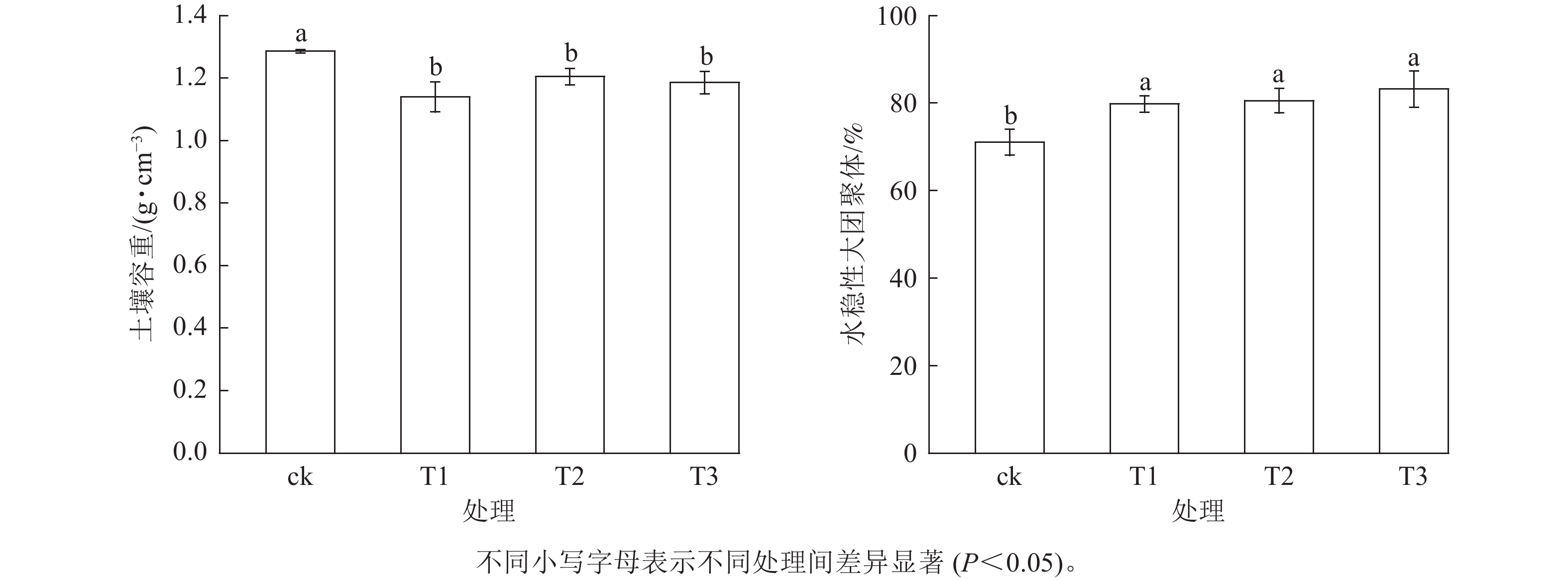
    • 图1可知:相比ck,各蛙投放密度处理均显著降低土壤容重(P<0.05),但3个蛙投放密度处理(T1、T2、T3)之间无显著差异。与ck相比,各蛙投放密度处理均显著提高了土壤水稳性大团聚体质量分数(P<0.05),且随着蛙投放密度的增加,土壤水稳性大团聚体质量分数呈上升趋势(T1为79.83%,T2为80.57%,T3为83.20%),但3个蛙投放密度处理间无显著差异。
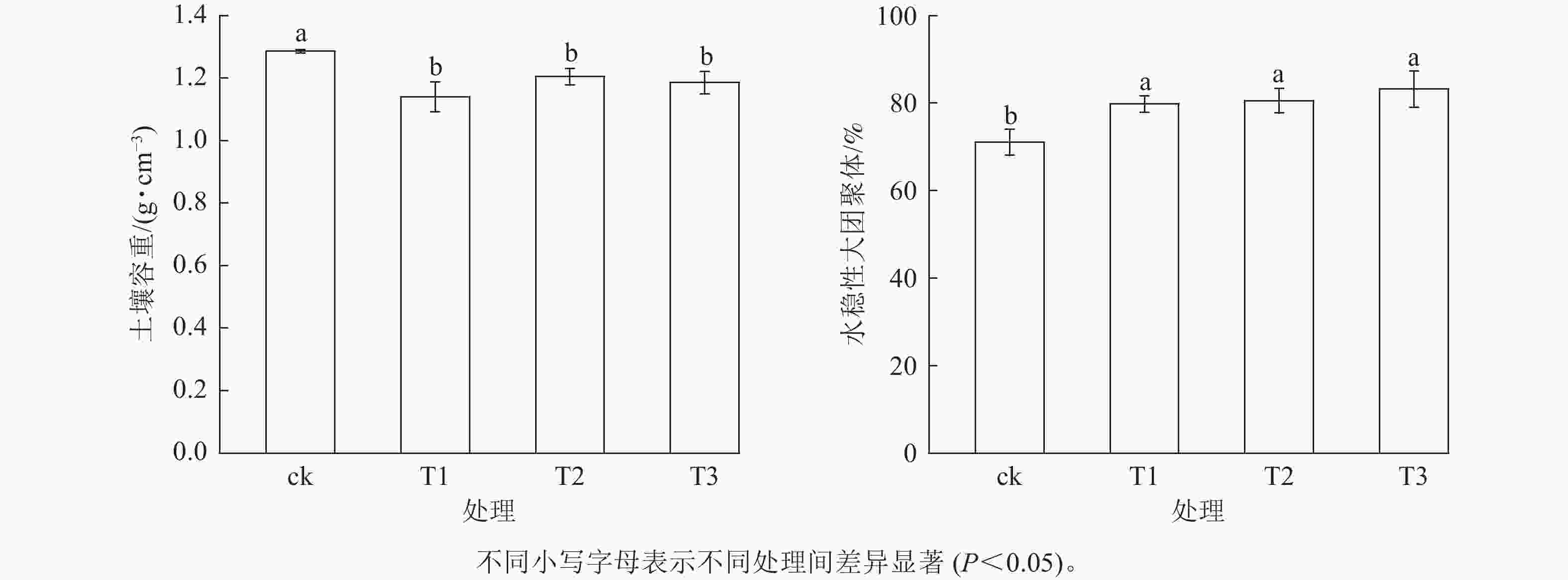
      Figure 1.  Effects of different frog densities on soil bulk density and water stable macroaggregates

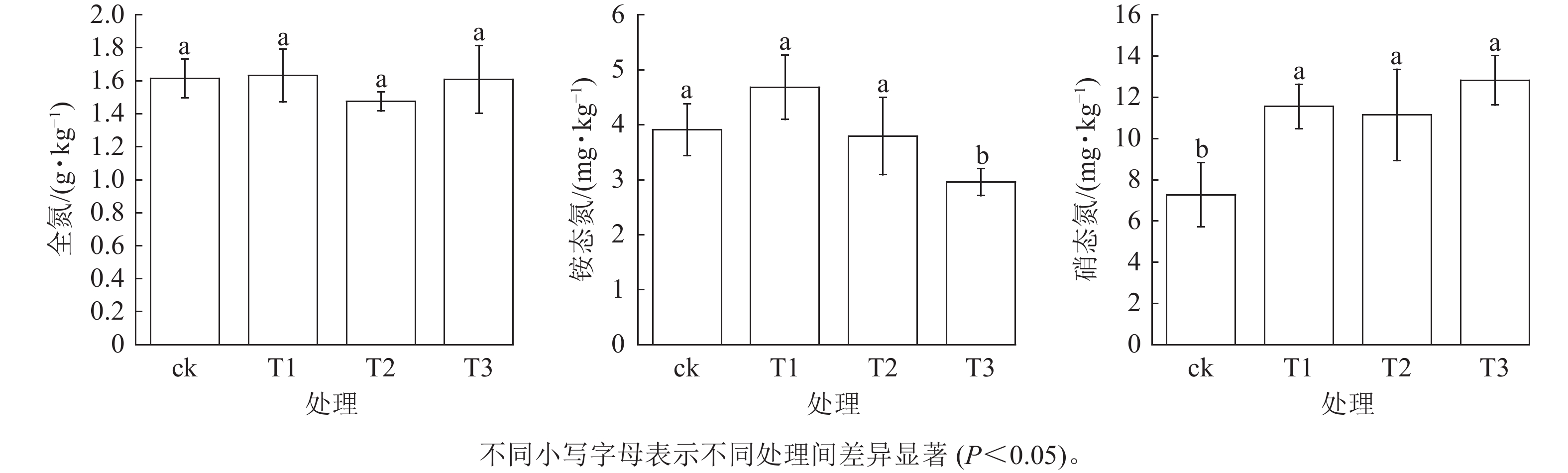
    • 图2可知:相比ck,不同蛙投放密度处理对全氮质量分数无显著差异,虽然T2处理全氮质量分数低于其他蛙投放密度处理和对照,但差异不显著。不同处理下铵态氮质量分数差异较大,T1处理的铵态氮最高,为4.68 mg·kg−1,高于ck处理的3.90 mg·kg−1。T2处理的铵态氮质量分数与ck相近,差异不显著。T3处理的铵态氮最低,显著低于ck、T1、T2处理(P<0.05)。不同蛙投放密度处理显著提高了土壤硝态氮质量分数(P<0.05),其中,T3处理的硝态氮最高,为12.82 mg·kg−1,其次是T1 (11.55 mg·kg−1)和T2处理(11.14 mg·kg−1),3个蛙投放密度处理之间差异不显著。
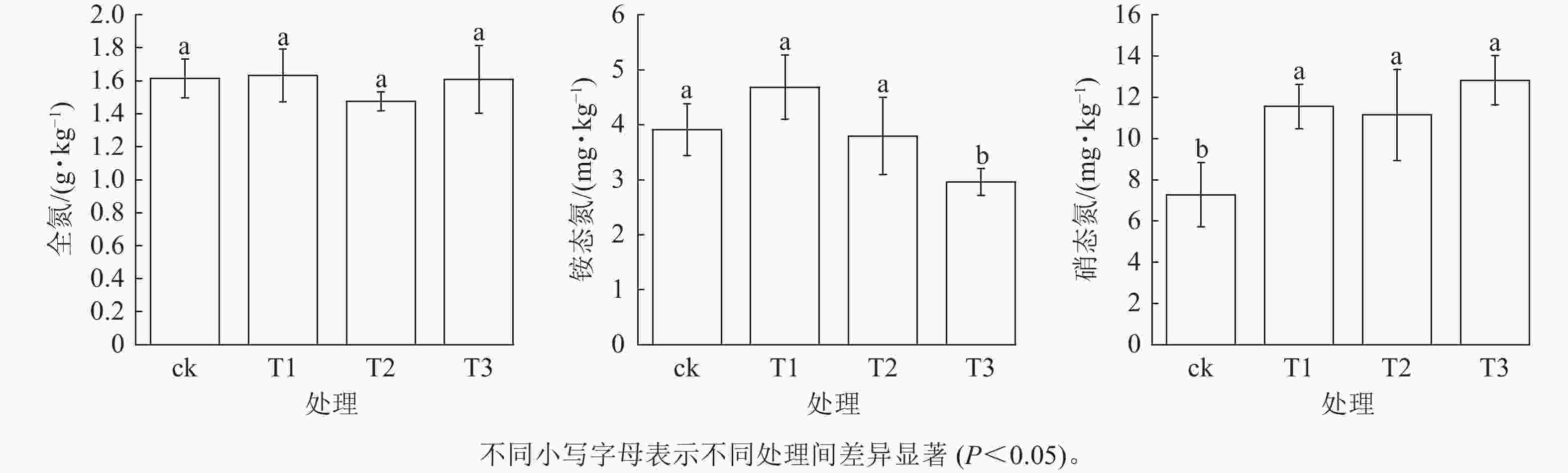
      Figure 2.  Effects of different frog densities on soil total nitrogen, ammonium nitrogen, and nitrate nitrogen

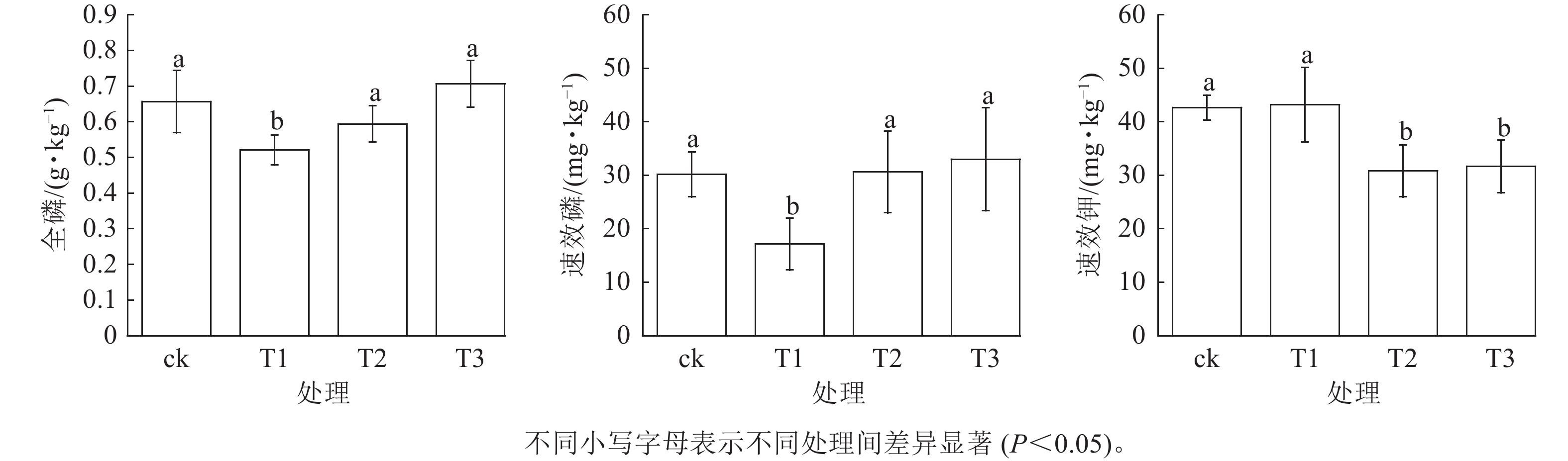
    • 图3可知:T1处理全磷质量分数显著低于ck、T2、T3处理(P<0.05),T2和T3处理全磷质量分数与ck差异不显著。随着蛙投放密度的增加,全磷质量分数呈增加趋势。除T1处理外,各蛙投放密度处理速效磷与ck相比差异不显著,T1处理显著降低了速效磷质量分数(P<0.05),T2和T3处理速效磷质量分数均高于对照组,其中T3处理速效磷最高。与ck相比,T1处理速效钾质量分数略有增加,但差异不显著,T2和T3处理速效钾质量分数均显著低于ck和T1处理(P<0.05)。
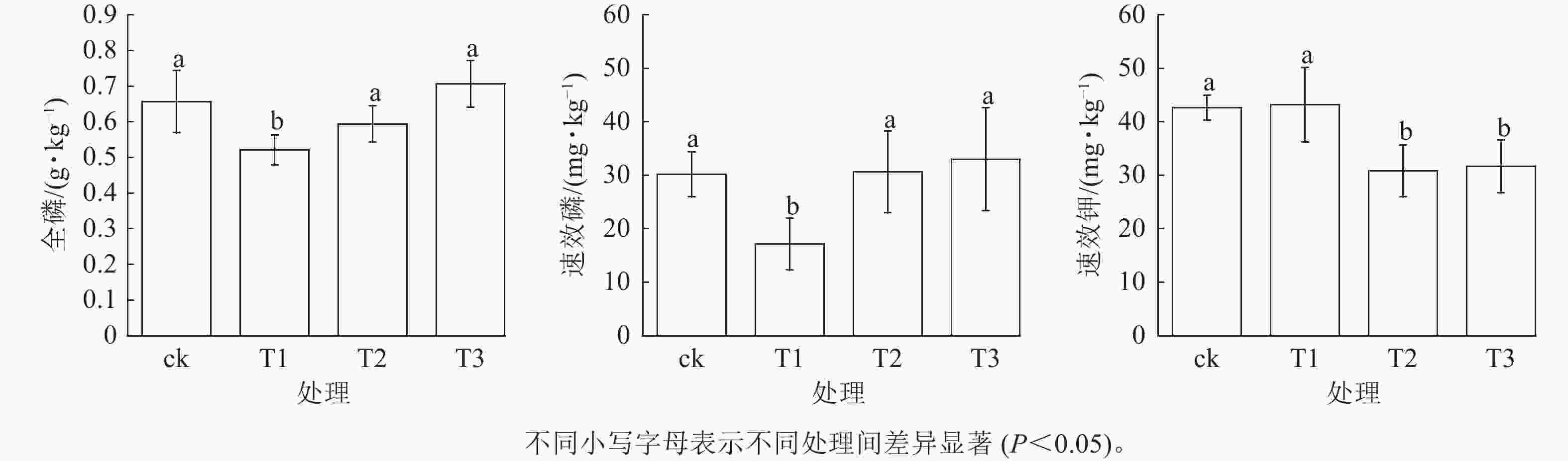
      Figure 3.  Effects of different frog densities on soil total phosphorus, available phosphorus, and available potassium

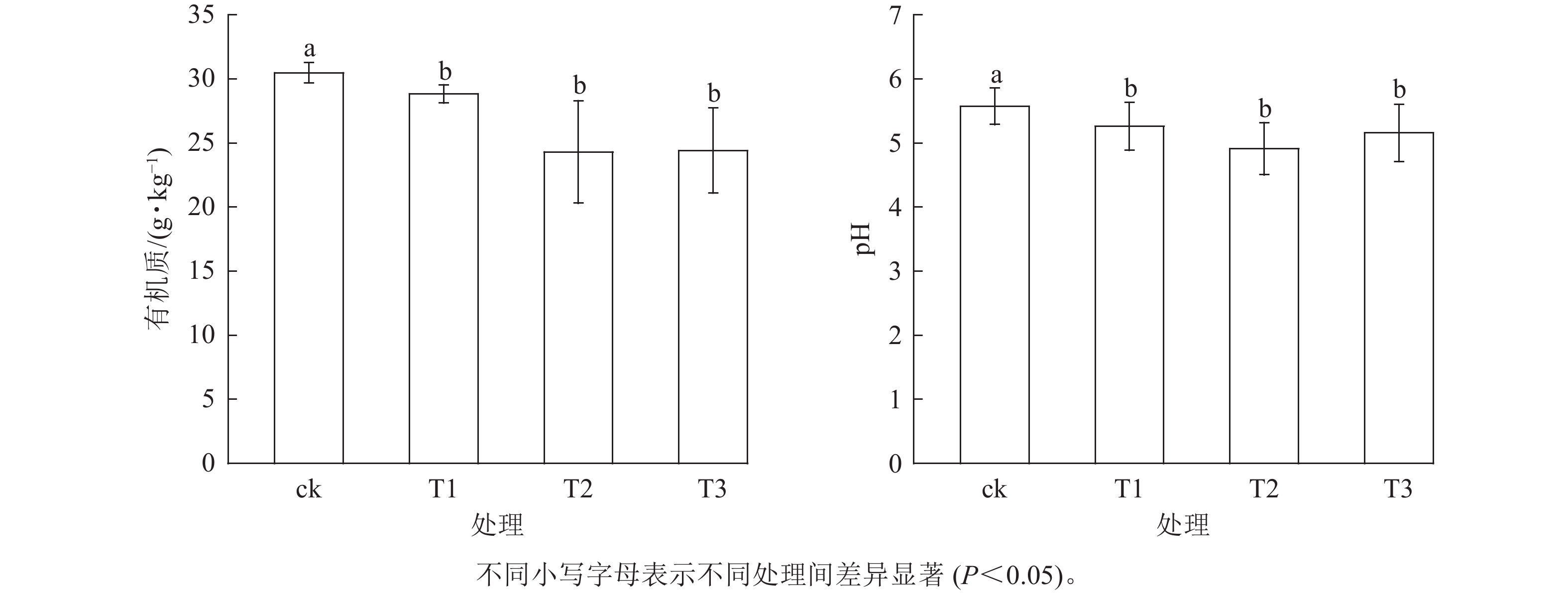
    • 图4可知:与ck相比,各蛙投放密度处理显著降低了土壤有机质质量分数(P<0.05),T2和T3处理土壤有机质降低幅度较大,但各蛙投放密度处理(T1、T2、T3)之间无显著差异,随着蛙投放密度的增加,土壤有机质呈现下降趋势。与ck相比,所有蛙投放密度处理均导致土壤pH显著下降(P<0.05),但不同处理(T1、T2、T3)之间差异不显著。
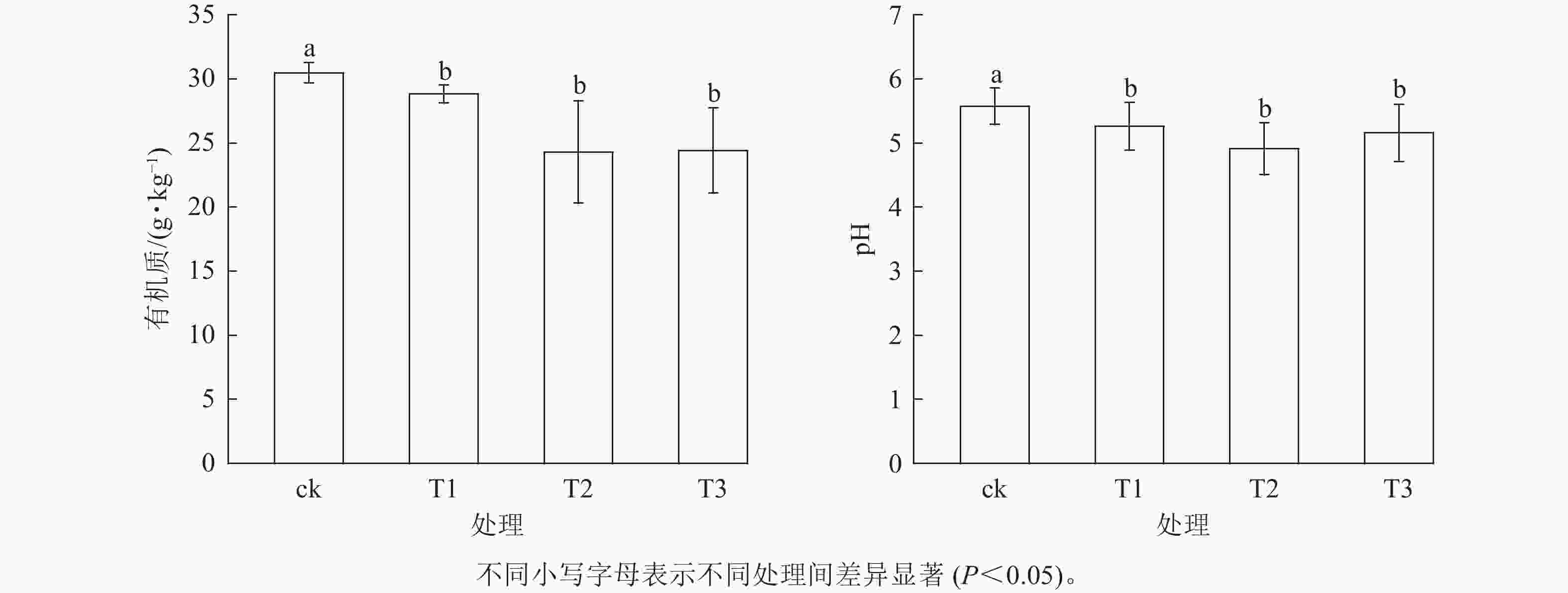
      Figure 4.  Effects of different frog densities on soil organic matter and pH

    • 表1可知:不同蛙投放密度处理有效穗数显著低于ck (P<0.05),各蛙投放密度处理之间有效穗数差异不显著。各蛙投放密度处理每穗粒数与ck间差异不显著,ck结实率显著高于各蛙投放密度处理(P<0.05),各蛙投放密度处理之间千粒重差异不显著。对照组水稻产量最高,显著高于各蛙投放密度处理(P<0.05)。在3个蛙投放处理中,T3处理产量最高,其次为T2和T1,但三者间差异不显著。各蛙投放密度处理综合效益纯利润显著高于ck (P<0.05),且随着投放密度增加,呈显著增加趋势。

      处理 产量构成因子 综合效益
      纯利润/(元·hm−2)
      有效穂数/(×104穗·hm−2) 每穗粒数/(粒·穗−1) 结实率/% 千粒重/g 产量/(kg·hm−2)
      T1 163.76 b 139.86 a 78.42 b 22.59 a 6 086.05 b 52 240.80 c
      T2 161.32 b 137.39 a 79.98 b 23.28 a 6 190.11 b 68 796.05 b
      T3 165.73 b 142.56 a 78.24 b 22.49 a 6 236.02 b 79 235.40 a
      ck 178.47 a 137.38 a 82.30 a 24.38 a 7 379.27 a 7 568.40 d
        说明:不同小写字母表示不同处理间差异显著(P<0.05)。

      Table 1.  Changes in rice yield and its components in different treatments

    • 已有研究发现:稻田动物活动如钻洞、筑穴能有效疏松土壤,增加土壤孔隙度,改善土壤的通气性,改变土壤团聚体分形维数,进而改善土壤物理性质[3133]。本研究结果表明:与ck相比,不同蛙投放密度处理显著改善了土壤团粒结构,低密度处理显著降低了土壤容重和土壤水稳性大团聚体质量分数,土壤水稳性大团聚体质量分数随着蛙投放密度的增加呈现增加趋势。这表明稻蛙综合种养模式系统能有效促进土壤团聚体的形成与稳定[9]。在本研究中,虽然土壤水稳性大团聚体质量分数显著增加,但土壤有机质质量分数显著下降。水稳性团聚体稳定性不仅受土壤有机质影响,还受到土壤矿物质和微生物活性影响,稻蛙活动促进了土壤颗粒之间黏结作用,但并未显著增加土壤有机质积累或转化,可能是蛙类活动有助于土壤团聚体形成,但同时可能加速了有机质分解过程[22],导致土壤有机质降低。

    • 与ck相比,不同蛙投放密度处理对土壤全氮质量分数的影响较小。此结果与已有研究结果一致,即蛙投放密度变化对全氮的影响较为有限,可能是因为全氮受到多种因素综合调控[2022]。然而铵态氮和硝态氮质量分数表现出明显差异,低密度蛙投放处理提高了铵态氮质量分数,表明低密度蛙投放处理蛙类生物活动可能促进了铵态氮释放。研究表明:通过动物活动或土壤微生物活动可增加土壤的氮转化速率,尤其是铵态氮释放[20]。然而,本研究中,随着蛙投放密度增加,土壤铵态氮质量分数呈下降趋势,高密度蛙投放处理铵态氮质量分数降低最为显著,这表明较高密度处理可能对铵态氮积累具有抑制作用,可能是由于高密度蛙投放处理中蛙活动过度,抑制了氮源有效积累。各蛙投放密度处理硝态氮质量分数均显著高于对照组。硝态氮通常是植物易于吸收的氮源,因此,高密度蛙投放处理通过其活动可能促进了氮素转化过程[34],使土壤中硝态氮质量分数显著提高。

      高密度蛙投放处理中全磷和速效磷质量分数均高于低密度处理,这可能是高密度处理中蛙活动通过有效促进土壤微生物繁殖,促进了土壤中难溶性磷转化和利用[22]。然而,在低密度蛙投放处理中,土壤全磷和速效磷质量分数显著低于ck,尤其是速效磷减少了约13%,表明低密度处理对磷素影响有限,可能原因是低密度处理中蛙数量太少,导致粪便累积少,整体活动影响不够,难以有效地促进稻田磷素积累和转化。相比ck,T2和T3处理速效钾质量分数显著降低,可能与稻蛙活动导致土壤结构的变化有关,较高密度蛙投放处理通过其生物扰动作用可能加速了钾流失,或通过改变土壤结构影响了钾吸附和释放过程[32, 3435]。本研究还发现:不同蛙投放密度处理对土壤有机质质量分数具有显著影响,尤其在高密度蛙投放处理下,土壤有机质质量分数显著下降。这与朱练峰等[19]研究结果相似。土壤有机质减少可能与稻蛙活动促进了土壤有机质的矿化过程有关,蛙粪内含有丰富易降解有机质[22],从而加速土壤有机质整体矿化速率。所有蛙投放密度处理土壤pH均显著低于ck,但各蛙投放密度处理间差异不显著。土壤pH轻微下降可能与稻蛙活动中有机物分解过程中酸性物质的释放有关,但这种变化不足以显著影响土壤酸碱度。尽管本研究分析了不同蛙投放密度处理对土壤物理化学性质的短期影响,但其长期效应仍需进一步探讨,如土壤有机质积累与分解、养分循环动态以及土壤结构稳定性需要更长时间观测,从而揭示稻蛙综合种养模式对土壤结构和土壤养分的累积效应和可持续性影响。

    • 稻蛙综合种养模式中的蛙类粪便能够给水稻提供一定养分供给,蛙类活动影响稻田土壤结构、养分积累和转化过程,且蛙类能够捕食稻田中的害虫,从而与常规水稻管理相比,大大减少了水稻生育期内化肥农药的施用量,或者不施用化肥农药,有效提升稻米品质[2629]。但稻蛙综合种养模式需要给蛙类留出一定的饲料投放平台面积(一般不超过总面积的10%),使得水稻种植面积减少,降低水稻总产量。已有研究均表明:相比常规水稻种植模式,稻蛙综合种养模式水稻产量均有所减少,减少幅度为23.45%~28.16%[1920, 28]。本研究结果表明:常规水稻产量要显著高于稻蛙综合种养模式,稻蛙综合种养模式的水稻产量降低幅度为15.49%~17.52%,但随着蛙投放密度的增加,水稻产量呈现上升趋势,这与李兴华等[27]的研究结果一致。从产量构成因子看,稻蛙综合种养模式降低了水稻有效穗数和结实率,从而导致水稻产量降低,这与已有研究结果类似。在不施肥的条件下,仅靠青蛙粪便分解提供养分不能满足水稻生长发育[28]。本研究中高密度蛙投放处理土壤铵态氮、速效钾和有机质显著低于ck。因此可在非稻蛙生育期提高氮肥、钾肥和有机质施用量,或者使用缓释肥和炭基肥等新型肥料[1112],维持养分平衡,保障水稻产量。虽然单作水稻模式生产成本显著低于稻鱼综合种养模式,但是综合效益远不如稻鱼综合种养模式[15, 25, 3637]。本研究结果也得到类似结论,且在高密度蛙投放处理下,综合效益最为显著。

    • 相较于常规施肥及低、中密度蛙投放处理,高密度蛙投放处理稻蛙综合种养模式下土壤团粒结构改善最为明显。虽然该模式下土壤铵态氮、有机质、速效钾等降低,但土壤全氮、全磷、硝态氮、速效磷等土壤养分仍能保持一定水平,且水稻产量下降幅度较低、中密度蛙投放处理小,提升稻田综合经济效益最为显著,同时减少了化肥和农药使用,降低了环境面源污染风险。因此,高密度蛙投放处理是本研究中推荐的最适宜稻蛙综合种养模式。

Reference (37)

Catalog

    /

    DownLoad:  Full-Size Img  PowerPoint
    Return
    Return