Turn off MathJax
Article Contents

WANG Chenyu, LI Shen’ao, ZHAO Yong, et al. Characteristics of carbon fractions and ecological stoichiometry across soil profile levels in Quercus acutissima plantation forests in the hilly areas of Central-South Shandong[J]. Journal of Zhejiang A&F University, 2026, 43(X): 1−9 doi:  10.11833/j.issn.2095-0756.20250339
Citation: WANG Chenyu, LI Shen’ao, ZHAO Yong, et al. Characteristics of carbon fractions and ecological stoichiometry across soil profile levels in Quercus acutissima plantation forests in the hilly areas of Central-South Shandong[J]. Journal of Zhejiang A&F University, 2026, 43(X): 1−9 doi:  10.11833/j.issn.2095-0756.20250339

OnlineFirst articles are published online before they appear in a regular issue of the journal. Please find and download the full texts via CNKI.

Characteristics of carbon fractions and ecological stoichiometry across soil profile levels in Quercus acutissima plantation forests in the hilly areas of Central-South Shandong

DOI: 10.11833/j.issn.2095-0756.20250339
  • Received Date: 2025-06-17
  • Accepted Date: 2026-04-07
  • Rev Recd Date: 2026-02-26
  • Available Online: 2026-04-22
  •   Objective  The carbon components and ecological stoichiometric characteristics of soil profiles can reflect the input processes from forest litter to carbon, nitrogen, and phosphorus in soil. Ecological stoichiometric analysis of carbon, nitrogen and phosphorus in the soil profile development process of Quercus acutissima plantations can provide a theoretical basis for the assessment of soil ecological functions and the maintenance of long-term productivity in Q. acutissima plantations.   Method  The soil profile of Q. acutissima plantation in the warm-temperate zone of state-owned Yaoxiang Forest Farm of Ji’nan City, Shandong Province was selected as the research subject. The soil profile was divided into humus layer, eluvial layer and illuvial layer, and soil samples were collected from each layer. The differences in the total soil organic carbon and its components, as well as the contents of soil nutrients such as nitrogen, phosphorus and potassium in the different layers were analyzed.   Result  (1) The contents of total organic carbon and its components, as well as nitrogen, phosphorus and potassium in the soil profile of the Q. acutissima plantation were all shown as humus layer>eluvial layer>illuvial layer, and the content of humus layer was significantly higher than that of eluvial layer and illuvial layer(P< 0.05). (2) There was a strong coupling between nutrients and carbon components in Q. acutissima plantations. The soil was mainly affected by the synergistic effects of carbon and nitrogen, and the influence of carbon was even higher. (3) The carbon-to-nitrogen ratio (C/N) increased with the increase of soil depth, both the carbon-to-phosphorus ratio (C/P) and the nitrogen-to-phosphorus ratio (N/P) decreased with the increase of soil depth.   Conclusion  There were significant differences in carbon, nitrogen and phosphorus among the layers of the soil profile of Q. acutissima forest, and the strong coupling between carbon and nutrients indicated that the soil nutrient utilization efficiency in the study area was relatively high and the forest soil nutrient cycle was in a healthy state. Therefore, in forest management and operation, attention should be paid to the differences among soil layers, maintaining the litter layer under the forest, and ensuring the sustainable return of nutrients from forest litter. [Ch, 4 fig. 1 tab. 41 ref.]
  • [1] HU Ao, ZHAO Yihui, WU Jilai, WU Yanping, LI Tongxin, YAN Yibo, YE Jianfeng, WANG Yixiang.  Effects of natural vegetation restoration after logging on soil organic carbon and its active components in Pinus massoniana secondary forests . Journal of Zhejiang A&F University, doi: 10.11833/j.issn.2095-0756.20240264
    [2] JIANG Shuzhen, LIAN Yichen, HUA Runxin, ZHANG Yuhan, JIANG Wenting, XIAO Xiangqian, FAN Bo, CAI Yanjiang.  Response of grassland soil CO2 emissions to urine addition under different sterilization methods . Journal of Zhejiang A&F University, doi: 10.11833/j.issn.2095-0756.20230149
    [3] LIU Pan, LU Mei, LI Cong, LÜ Jinghua, YANG Zhidong, ZHAO Xuyan, CHEN Zhiming.  Changes of soil organic carbon storage and carbon components in typical meadow communities in Napahai . Journal of Zhejiang A&F University, doi: 10.11833/j.issn.2095-0756.20220377
    [4] ZHU Wankuan, XU Yuxing, WANG Zhichao, DU Apeng.  Soil-microbial stoichiometry of Eucalyptus urophylla × E. grandis plantation at different growth stages . Journal of Zhejiang A&F University, doi: 10.11833/j.issn.2095-0756.20200536
    [5] CHENG Haotian, KONG Tao, LÜ Gang, WANG Dongli, ZHANG Lili.  Ecological stoichiometric characteristics of rhizosphere and non-rhizosphere soil of Pinus sylvestris var. mongolica plantations at different ages . Journal of Zhejiang A&F University, doi: 10.11833/j.issn.2095-0756.20210211
    [6] ZHAO Jing, HAO Mengjie, WANG Qingyu, LIU Meiying.  Distribution characteristics of soil organic carbon storage in photovoltaic power station under different vegetation restoration modes . Journal of Zhejiang A&F University, doi: 10.11833/j.issn.2095-0756.20210500
    [7] ZHANG Zeng, SONG Chengfang, SHAN Shengdao, ZHENG Huabao, ZHANG Cheng.  Effects of swine manure hydrochar on soil organic carbon mineralization and soil properties . Journal of Zhejiang A&F University, doi: 10.11833/j.issn.2095-0756.20200651
    [8] WANG Yue, LUAN Yaning, WANG Dan, DAI Wei.  Changes of soil organic carbon storage in Pinus tabulaeformis forest and its influencing factors . Journal of Zhejiang A&F University, doi: 10.11833/j.issn.2095-0756.20210390
    [9] ZHU Danmiao, CHEN Junhui, JIANG Peikun.  Research progress on soil organic carbon and microbial characteristics of Cunninghamia lanceolata plantation and their influencing factors . Journal of Zhejiang A&F University, doi: 10.11833/j.issn.2095-0756.20200598
    [10] ZHANG Qingqing, ZHANG Guilian, WU Haibing, ZHONG Qicheng, HE Xiaoli, CHEN Ping, ZHU Qing, XU Bing, LIANG Jing.  Soil organic carbon distribution and its relationship with soil physicochemical properties in different forest types of Shanghai City . Journal of Zhejiang A&F University, doi: 10.11833/j.issn.2095-0756.2019.06.005
    [11] ZHU Rongwei, GE Zhiwei, RUAN Honghua, XU Jin, PENG Sili.  Fractal dimension of soil organic carbon and microbial biomass carbon with nitrogen additions . Journal of Zhejiang A&F University, doi: 10.11833/j.issn.2095-0756.2019.04.004
    [12] LIU Heling, RAO Liangyi, TU Ersun, TANG Lingpei.  Effect of water erosion and soil conservation measures on soil organic carbon content in rocky mountainous areas of northern China . Journal of Zhejiang A&F University, doi: 10.11833/j.issn.2095-0756.2019.04.003
    [13] HE Shan, LIU Juan, JIANG Peikun, ZHOU Guomo, WANG Huilai, LI Yongfu, WU Jiasen.  Effects of forest management on soil organic carbon pool: a review . Journal of Zhejiang A&F University, doi: 10.11833/j.issn.2095-0756.2019.04.023
    [14] GONG Chen, WANG Xudong, NI Xing, LE Tiantian, ZENG Shiyuan, YE Zhengqian.  Effects of long-term application of edible fungus residue and chemical fertilizers on fractions of labile organic carbon and available nutrients in rice field soils . Journal of Zhejiang A&F University, doi: 10.11833/j.issn.2095-0756.2018.02.008
    [15] DAI Aona, LIU Xiaoxiao, WANG Bing, DAI Wei.  Annual spatial and temporal variations of soil organic carbon and its components in Castanopsis fargesii forest . Journal of Zhejiang A&F University, doi: 10.11833/j.issn.2095-0756.2018.03.003
    [16] ZHENG Hong-bo, WU Jian-ping, ZHANG Shan.  Spatial variability of farmland soil organic matter and soil nutrients in Ninghai County,Zhejiang Province . Journal of Zhejiang A&F University, doi: 10.11833/j.issn.2095-0756.2010.03.010
    [17] HAO Rui-jun, FANG Hai-lan, SHEN Lie-ying, CHE Yu-ping.  Soil organic carbon mineralization with urban plant communities in Shanghai . Journal of Zhejiang A&F University, doi: 10.11833/j.issn.2095-0756.2010.05.005
    [18] XU Gui-lin, FANG Xi, TIAN Da-lun, TANG Zhi-juan, ZHANG Zhu-san.  Soil organic carbon:distribution and storage with five regeneration patterns in Cunninghamia lanceolata forests . Journal of Zhejiang A&F University,
    [19] LI Zheng-cai, FUMao-yi, YANG Xiao-sheng.  Review on effects of management disturbance on forest soil organic carbon . Journal of Zhejiang A&F University,
    [20] FANGXi, TIAN Da-lun, XIANG Wen-hua, LEI Pi-feng.  Vertical distribution of soil organic carbon in Cunninghamia lanceolata plantation . Journal of Zhejiang A&F University,
  • [1]
    LI Juan, DING Jinzhi, YANG Shanshan, et al. Depth-dependent driver of global soil carbon turnover times[J]. Soil Biology and Biochemistry, 2023, 185: 109149. DOI: 10.1016/j.soilbio.2023.109149.
    [2]
    XIAO Shengsheng, ZHANG Jie, DUAN Jian, et al. Soil organic carbon sequestration and active carbon component changes following different vegetation restoration ages on severely eroded red soils in subtropical China[J]. Forests, 2020, 11(12): 1304. DOI: 10.3390/f11121304.
    [3]
    LIU Pan, LU Mei, LI Cong, et al. Changes of soil organic carbon storage and carbon components in typical meadow communities in Napahai[J]. Journal of Zhejiang A&F University, 2023, 40(2): 274−284. DOI: 10.11833/j.issn.2095-0756.20220377.
    [4]
    TANG Lili, WANG Shengqiang. Dynamics of soil aggregate-related C-N-P stoichiometric characteristics with stand age and soil depth in Chinese fir plantations[J]. Land Degradation & Development, 2022, 33(8): 1290−1306. DOI: 10.1002/ldr.4217.
    [5]
    WANG Ziwei, WANG Jiao, HUANG Laiming, et al. Patterns and driving factors of soil nutrient stoichiometry under three land use types in the Alpine region of Tibet, China[J]. Journal of Soils and Sediments, 2024, 24(2): 901−913. DOI: 10.1007/s11368-023-03692-8.
    [6]
    TAO Ye, ZHOU Xiaobing, ZHANG Shihang, et al. Soil nutrient stoichiometry on linear sand dunes from a temperate desert in Central Asia[J]. Catena, 2020, 195: 104847. DOI: 10.1016/j.catena.2020.104847.
    [7]
    MIN Xue, WU Yeli, ZHANG Ying, et al. Soil carbon, nitrogen and phosphorus stoichiometric characteristics of typical artificial vegetation in Qingshuihe County, Inner Mongolia[J]. Arid Land Geography, 2025, 48(8): 1492−1501. DOI: 10.12118/j.issn.1000-6060.2024.700.
    [8]
    QIAO Yi’na, LIU Yongxiang, CAO Shuangcheng, et al. The soil nutrient changes and stoichiometric characteristics of Pinus sylvestris under different habitats[J]. Journal of Northeast Forestry University, 2025, 53(3): 71−77. DOI: 10.13759/j.cnki.dlxb.2025.03.012.
    [9]
    MA Yali, GAO Rong, LIU Xidong, et al. Spatial distribution and stoichiometric characteristics of soil carbon, nitrogen and phosphorus in different plant communities in Baiyu mountain areas[J]. Journal of Central South University of Forestry & Technology, 2023, 43(9): 116−125. DOI: 10.14067/j.cnki.1673-923x.2023.09.012.
    [10]
    TUDI M, LI Hongying, LI Hairong, et al. Evaluation of soil nutrient characteristics in Tianshan Mountains, North-western China[J]. Ecological Indicators, 2022, 143: 109431. DOI: 10.1016/j.ecolind.2022.109431.
    [12]
    MA Jian, LIU Xiande, JIN Ming, et al. Soil ecological stoichiometry of five typical shrubs in Qilian Mountain[J]. Acta Botanica Boreali-Occidentalia Sinica, 2021, 41(8): 1391−1400.
    [13]
    ZECHMEISTER-BOLTENSTERN S, KEIBLINGER K M, MOOSHAMMER M, et al. The application of ecological stoichiometry to plant-microbial-soil organic matter transformations[J]. Ecological Monographs, 2015, 85(2): 133−155. DOI: 10.1890/14-0777.1.
    [14]
    SHAO Guodong, AI Juanjuan, SUN Qiwu, et al. Soil quality status and assessment of different forest types in Kunyushan Mountains[J]. Forest Research, 2018, 31(6): 175−184. DOI: 10.13275/j.cnki.lykxyj.2018.06.024.
    [15]
    WU Miaolan, GU Xiaojuan, LIU Yue, et al. Vertical distribution characteristics of soil carbon, nitrogen and phosphorus nutrients in four typical plantations in western Guangdong[J]. Journal of Central South University of Forestry & Technology, 2024, 44(10): 116−125. DOI: 10.14067/j.cnki.1673-923x.2024.10.012.
    [16]
    LIU Chengjie, LI Jianhua, LIAN Xiangru, et al. The carbon storage of forests and its spatial distribution pattern in Yaoxiang forest farm[J]. Journal of Shandong Agricultural University (Natural Science Edition), 2014, 45(2): 181−186. DOI: 10.3969/j.issn.1000-2324.2014.02.05.
    [17]
    LU Rukun. Methods of Soil Agrochemical Analysis[M]. Beijing: China Agricultural Science and Technology Press, 2000.
    [18]
    WU Jinshui. Determination Method of Soil Microbial Biomass and Its Application[M]. Beijing: China Meteorological Press, 2006: 57−59.
    [19]
    BLAIR G J, LEFROY R, LISLE L. Soil carbon fractions based on their degree of oxidation, and the development of a carbon management index for agricultural systems[J]. Australian Journal of Agricultural Research, 1995, 46(7): 1459−1466. DOI: 10.1071/ar9951459.
    [20]
    LI Qichao, LI Xinju. The spatial distribution of organic carbon components in reclaimed soil under different utilization modes[J]. Journal of Soil and Water Conservation, 2018, 32(2): 204−209. DOI: 10.13870/j.cnki.stbcxb.2018.02.030.
    [21]
    LIN Dandan, BI Huaxing, ZHAO Danyang, et al. Soil organic carbon fractions and carbon pool characteristics of Robinia pseudoacacia forests with different densities in the loess region of western Shanxi Province[J]. Ecology and Environmental Sciences, 2024, 33(3): 379−388. DOI: 10.16258/j.cnki.1674-5906.2024.03.006.
    [22]
    JOZEDAEMI E, GOLCHIN A. Changes in aggregate-associated carbon and microbial respiration affected by aggregate size, soil depth, and altitude in a forest soil[J]. Catena, 2024, 234: 107567. DOI: 10.1016/j.catena.2023.107567.
    [23]
    ZHAO Linlin, WU Zhixiang, SUN Rui, et al. Soil organic carbon composition and its influencing factors in rubber plantation of different ages[J]. Journal of Southern Agriculture, 2021, 52(6): 1595−1603. DOI: 10.3969/j.issn.2095-1191.2021.06.019.
    [24]
    YANG Ning, ZOU Dongsheng, YANG Manyuan, et al. The change of soil microbial biomass carbon and the relationship between it and soil physio-chemical factors in different restoration stages on sloping-land with purple soils in Hengyang[J]. Ecology and Environmental Sciences, 2013, 22(1): 25−30. DOI: 10.16258/j.cnki.1674-5906.2013.01.014.
    [25]
    HU Ao, ZHAO Yihui, WU Jilai, et al. Effects of natural vegetation restoration after logging on soil organic carbon and its active components in Pinus massoniana secondary forests[J]. Journal of Zhejiang A&F University, 2024, 41(6): 1189−1200. DOI: 10.11833/j.issn.2095-0756.20240264.
    [26]
    CLEVELAND C C, LIPTZIN D. C∶N∶P stoichiometry in soil: is there a “Redfield ratio” for the microbial biomass?[J]. Biogeochemistry, 2007, 85(3): 235−252. DOI: 10.1007/s10533-007-9132-0.
    [27]
    LI Chenhua, YAN Kai, TANG Lisong, et al. Change in deep soil microbial communities due to long-term fertilization[J]. Soil Biology and Biochemistry, 2014, 75: 264−272. DOI: 10.1016/j.soilbio.2014.04.023.
    [28]
    XIAO Ye, HUANG Zhigang, XIAO Hanxi, et al. Changes of soil microbial biomass carbon, nitrogen, and enzyme activities in East Dongting Lake wetlands at different water levels[J]. Chinese Journal of Applied Ecology, 2021, 32(8): 2958−2966. DOI: 10.13287/j.1001-9332.202108.036.
    [29]
    WANG Yansong, MA Baoming, GAO Haiping, et al. Response of soil nutrients and their stoichiometric ratios to stand density in Pinus tabuliformis and Robinia pseudoacacia plantations in the loess region of western Shanxi Province, Northern China[J]. Journal of Beijing Forestry University, 2020, 42(8): 81−93. DOI: 10.12171/j.1000−1522.20190287.
    [30]
    ZHANG Bo, LI Gangtie, ZHANG Hongwu, et al. Spatial distribution characteristics of soil nutrients in artificially planted Pennisetum giganteum[J]. Northern Horticulture, 2022(5): 91−96. DOI: 10.11937/bfyy.20214016.
    [31]
    ZHAO Ying, HAN Zhen, ZHANG Guangqi, et al. Variability of soil enzyme activities and nutrients with forest gap renewal interacting with soil depths in degraded karst forests[J]. Ecological Indicators, 2024, 166: 112332. DOI: 10.1016/j.ecolind.2024.112332.
    [32]
    LÜ Jinlin, YAN Meijie, SONG Bianlan, et al. Ecological stoichiometry characteristics of soil carbon, nitrogen, and phosphorus in an oak forest and a black locust plantation in the loess hilly region[J]. Acta Ecologica Sinica, 2017, 37(10): 3385−3393. DOI:10.5846 / stxb201603120437. DOI: 10.5846/stxb201603120437.
    [33]
    BANKOLE G O, AGHORUNSE A C, AZEEZ J O. Impact of biochar and fertilizer application on soil nitrate, phosphate, and sulphate leaching patterns, release kinetics, and maize growth[J]. Communications in Soil Science and Plant Analysis, 2025, 56(19): 2812−2830. DOI: 10.1080/00103624.2025.2528890.
    [34]
    XIAO Siying, FU Fangwei, LI Jiangrong, et al. Soil ecological stoichiometry characteristics of six typical forest types in the Sejila mountain[J]. Journal of Central South University of Forestry & Technology, 2023, 43(11): 120−130,172. DOI: 10.14067/j.cnki.1673-923x.2023.11.013.
    [35]
    WANG Bo, ZHOU Zhiyong, ZHANG Huan, et al. Effect of Larix gmelinii proportion on soil chemical properties and enzymatic stoichiometry in mixed coniferous and broad-leaved forest[J]. Journal of Zhejiang A&F University, 2020, 37(4): 611−622. DOI: 10.11833/j.issn.2095-0756.20190525.
    [36]
    NIU Ziru, ZHANG Yang, HAN Jichang, et al. The soil ecological stoichiometry characteristics of the highest latitude areas in the main tea-producing regions of China[J]. Agronomy, 2024, 14(7): 1359. DOI: 10.3390/agronomy14071359.
    [37]
    LIU Mengyun, HUANG Fangfang, HUANG Yuhui, et al. Soil nutrient availability regulates microbial community composition and enzymatic activities at different soil depths along an elevation gradient in the Nanling Nature Reserve, China[J]. Forests, 2023, 14(8): 1514. DOI: 10.3390/f14081514.
    [38]
    QIAO Yang, WANG Jing, LIU Heming, et al. Depth-dependent soil C-N-P stoichiometry in a mature subtropical broadleaf forest[J]. Geoderma, 2020, 370: 114357. DOI: 10.1016/j.geoderma.2020.114357.
    [39]
    WU Yanhao, WU Zijun, JIANG Simin, et al. Elemental stoichiometry (C, N, P) of soil in the wetland critical zone of Dongting Lake, China: understanding soil C, N and P status at greater depth[J]. Sustainability, 2022, 14(14): 8337. DOI: 10.3390/su14148337.
    [40]
    HUANG Yongrong, GAO Wei, HUANG Shide, et al. Ecostoichiometric characteristics of carbon, nitrogen and phosphorus in Fujian evergreen broad-leaved forest[J]. Acta Ecologica Sinica, 2021, 41(5): 1991−2000. DOI: 10.5846/stxb202004180924.
    [41]
    DU Enzai, TERRER C, PELLEGRINI A F A, et al. Global patterns of terrestrial nitrogen and phosphorus limitation[J]. Nature Geoscience, 2020, 13(3): 221−226. DOI: 10.1038/s41561-019-0530-4.
  • 加载中
通讯作者: 陈斌, bchen63@163.com
  • 1. 

    沈阳化工大学材料科学与工程学院 沈阳 110142

  1. 本站搜索
  2. 百度学术搜索
  3. 万方数据库搜索
  4. CNKI搜索

Figures(4)  / Tables(1)

Article views(70) PDF downloads(12) Cited by()

Related
Proportional views

Characteristics of carbon fractions and ecological stoichiometry across soil profile levels in Quercus acutissima plantation forests in the hilly areas of Central-South Shandong

doi: 10.11833/j.issn.2095-0756.20250339

Abstract:   Objective  The carbon components and ecological stoichiometric characteristics of soil profiles can reflect the input processes from forest litter to carbon, nitrogen, and phosphorus in soil. Ecological stoichiometric analysis of carbon, nitrogen and phosphorus in the soil profile development process of Quercus acutissima plantations can provide a theoretical basis for the assessment of soil ecological functions and the maintenance of long-term productivity in Q. acutissima plantations.   Method  The soil profile of Q. acutissima plantation in the warm-temperate zone of state-owned Yaoxiang Forest Farm of Ji’nan City, Shandong Province was selected as the research subject. The soil profile was divided into humus layer, eluvial layer and illuvial layer, and soil samples were collected from each layer. The differences in the total soil organic carbon and its components, as well as the contents of soil nutrients such as nitrogen, phosphorus and potassium in the different layers were analyzed.   Result  (1) The contents of total organic carbon and its components, as well as nitrogen, phosphorus and potassium in the soil profile of the Q. acutissima plantation were all shown as humus layer>eluvial layer>illuvial layer, and the content of humus layer was significantly higher than that of eluvial layer and illuvial layer(P< 0.05). (2) There was a strong coupling between nutrients and carbon components in Q. acutissima plantations. The soil was mainly affected by the synergistic effects of carbon and nitrogen, and the influence of carbon was even higher. (3) The carbon-to-nitrogen ratio (C/N) increased with the increase of soil depth, both the carbon-to-phosphorus ratio (C/P) and the nitrogen-to-phosphorus ratio (N/P) decreased with the increase of soil depth.   Conclusion  There were significant differences in carbon, nitrogen and phosphorus among the layers of the soil profile of Q. acutissima forest, and the strong coupling between carbon and nutrients indicated that the soil nutrient utilization efficiency in the study area was relatively high and the forest soil nutrient cycle was in a healthy state. Therefore, in forest management and operation, attention should be paid to the differences among soil layers, maintaining the litter layer under the forest, and ensuring the sustainable return of nutrients from forest litter. [Ch, 4 fig. 1 tab. 41 ref.]

WANG Chenyu, LI Shen’ao, ZHAO Yong, et al. Characteristics of carbon fractions and ecological stoichiometry across soil profile levels in Quercus acutissima plantation forests in the hilly areas of Central-South Shandong[J]. Journal of Zhejiang A&F University, 2026, 43(X): 1−9 doi:  10.11833/j.issn.2095-0756.20250339
Citation: WANG Chenyu, LI Shen’ao, ZHAO Yong, et al. Characteristics of carbon fractions and ecological stoichiometry across soil profile levels in Quercus acutissima plantation forests in the hilly areas of Central-South Shandong[J]. Journal of Zhejiang A&F University, 2026, 43(X): 1−9 doi:  10.11833/j.issn.2095-0756.20250339
  • 森林是陆地生态系统的核心碳汇,其土壤中储存的碳量,远超陆地生物圈的任何其他单一组分[1]。据估计,森林生态系统中55%~70%的碳汇以有机碳的形式储存于土壤中[2],且这些有机碳可以直接影响土壤结构及肥力,并显著影响大气中二氧化碳(CO2)含量,减缓全球温室效应[3]。在森林生态系统碳储量评估中,土壤有机碳的含量及垂直分布特征常作为关键性指标。碳氮磷是植物生命周期中的重要元素,对植物生长发挥着关键调控作用[4]。土壤中碳氮磷等在土壤剖面中循环迁移,其储量以及化学计量特征影响着土壤质量和生态系统服务功能[5],是森林生态系统养分供给情况的重要评估指标。

    土壤碳氮的输入主要依赖生物过程,变化幅度较大[6];磷的形成主要依赖机械风化作用,在土壤中较为稳定[7]。乔一娜等[8]研究发现:不同生境下樟子松Pinussylvestris var mongolica生长与土壤碳氮磷质量分数及化学计量比显著相关。在不同森林类型间土壤有机碳及养分存在巨大差异,即使在同一森林内,土壤碳组分及氮磷等养分分布也呈现出较显著的垂直格局。例如,在不同的植物群落内,土壤氮磷养分均呈现一致的垂直分布模式,即随土层加深而养分逐渐递减,形成典型的表层富集格局[910]。生态计量特征在揭示林木生长限制因素、土壤养分循环及元素分配方面具有重要意义。师歌等[11]研究发现:水杉Metasequoia glyptostroboides人工林林下土壤碳氮比(C/N)、碳磷比(C/P)、氮磷比(N/P)均低于全国土壤平均水平,说明水杉林土壤具有较高的氮活性,且碳氮磷生态化学计量比受氮限制。马剑等[12]研究发现:祁连山不同植物群落土壤各养分计量比随着土壤深度呈现规律性变化。

    在森林生态系统中,土壤碳氮磷作为影响树木生长的重要因素,也是研究树木生长规律与土壤生境相关性的重要指标[13],因此,研究碳氮磷在土层间的循环特征,有助于揭示土壤生境变化对树木生长的影响与及其内在规律。当前大多数研究主要按照土壤深度进行分层取样,进而阐明碳氮磷等元素在土壤中的垂直梯度格局。然而,不同类型森林因立地条件[14]、树种组成[15]等存在较大差别,导致其林下土壤剖面特征也表现出较大不同。基于土壤深度取样是按照固定深度区间进行的机械性划分,单纯地按照深度进行的取样方法无法体现森林土壤发育过程中土壤碳氮磷在土层间的循环特征。而基于土壤剖面层次取样则是按照自然发生层进行的功能划分,在阐明土壤剖面发育过程中碳氮磷循环特征具有较强的优越性,但当前针对土壤剖面层次的碳氮磷化学计量特征分析较少。

    麻栎Quercus acutissima根系发达,适应性强,在中国分布广泛,并形成暖温带地区的重要建群树种。本研究对麻栎人工林不同土壤剖面中有机碳组分及氮磷钾养分质量分数及生态化学计量比进行了分析,阐明碳氮磷元素在土壤剖面层次间的动态迁移与固持特征,以期深入揭示栎类人工林土壤剖面发育过程中碳氮磷等元素的循环规律,为栎类人工林土壤生态功能评估和长期生产力维持提供理论依据。

    • 研究地点为山东省济南市药乡林场(36°17N,117°10E),该区地处泰山山脉,土壤类型为山地棕壤[16]。2021年在该林场42林班1小班内建立面积为1 hm2的固定样地,共划分出20 m×20 m样方25个。本次调查按坡位选择其中6个样方,各挖1个土壤剖面,直至母岩层,各土壤剖面深度为50~80 cm。按照土壤剖面层次从表层向下依次确定腐殖质层、淋溶层和淀积层。

      采取自下而上的方式,在土壤剖面上采集各层次的土壤样品,挑出植物残根、石砾、土块等,再过2 mm筛以均质化处理。最后将土壤样本分为2个部分,风干样过筛储存,鲜样直接储存于4 ℃冰箱。

    • 总有机碳采用水合热重铬酸钾氧化-比色法测定分析[17];微生物生物量碳采用氯仿熏蒸法测定[18];颗粒有机碳和矿质结合态有机碳采用六偏磷酸钠分散法测定[16];可溶性有机碳采用重铬酸钾-硫酸外加热容量法测定[17];易氧化有机碳采用高锰酸钾氧化比色法测定[19]。微生物熵碳计算公式为:微生物生物量碳/土壤总有机碳。

      全氮采用凯氏蒸馏法;全磷采用氢氧化钠熔融-钼锑抗比色法;速效磷采用碳酸氢钠浸提-钼锑抗比色法;全钾采用碱熔-火焰光度法或原子吸收分光光度法;速效钾采用乙酸铵浸提-火焰光度法测定分析。测定方法详见文献[20]。

    • 利用SPSS 24进行单因素方差分析(one-way ANOVA),并利用最小显著性差异法(LSD)和Duncan法进行多重比较以检验碳组分及养分的差异显著性,使用R 4.4.1、Origin 2020、GraphPad Prism 8软件绘图。

    • 麻栎人工林土壤有机碳各组分质量分数在垂直剖面上呈现出明显的梯度递减特征(表1)。总有机碳、易氧化有机碳、矿质结合态有机碳质量分数在3个土层中均具有显著差异(P<0.05),微生物生物量碳、颗粒有机碳及可溶性有机碳则只有腐殖质层与其他2个土层差异显著(P<0.05),淋溶层与淀积层间无显著差异。其中,腐殖质层的总有机碳、可溶性有机碳、矿质结合态有机碳及颗粒有机碳均比淀积层高约3~4倍,微生物生物量碳高约6倍,而腐殖质层的易氧化有机碳则比淀积层高约12倍。随着土层深度的增加,微生物熵碳呈现出先升高后降低的趋势,腐殖质层与其他2个土层具有显著差异(P<0.05)。

      土层 总有机碳/
      (g·kg−1)
      易氧化有机碳/
      (g·kg−1)
      微生物生物量碳/
      (g·kg−1)
      可溶性有机碳/
      (g·kg−1)
      矿质结合态有机碳/
      (g·kg−1)
      颗粒有机碳/
      (g·kg−1)
      微生物熵碳/%
      腐殖质层 26.28±4.29 a 28.61±3.46 a 0.26±0.02 a 1.61±0.30 a 18.33±3.27 a 7.95±1.73 a 0.98±0.14 a
      淋溶层 16.01±2.14 b 9.59±1.89 b 0.06±0.03 b 0.92±0.37 b 12.88±1.49 b 3.24±1.61 b 0.50±0.14 b
      淀积层 9.00±1.13 c 2.27±1.01 c 0.04±0.03 b 0.56±0.15 b 7.01±0.41 c 1.98±1.06 b 0.65±0.19 b
        说明:数值为平均值±标准差。不同小写字母表示不同土层间差异显著(P<0.05)。

      Table 1.  Soil organic carbon components content and soil microbial biomass carbon values of different soil layers in Q. acutissima plantation forests

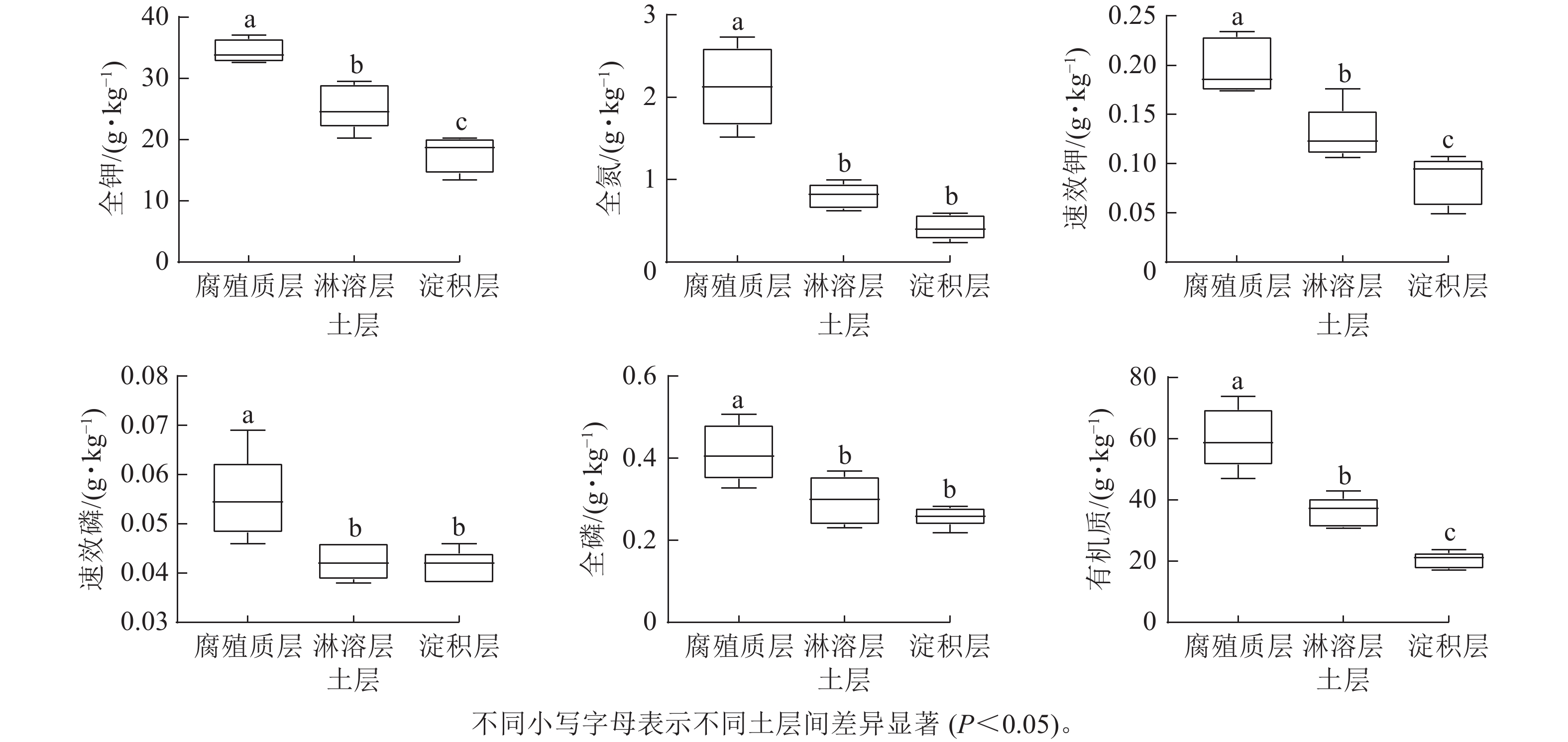
    • 麻栎人工林土壤养分质量分数在垂直剖面上呈逐渐减少的趋势(图1)。各土层间养分质量分数均值各不相同,氮和磷元素较少,有机质与钾元素较多。有机质质量分数在3个土层间均差异显著(P<0.05)。在土壤全量养分中,仅全钾的质量分数在3个土层间差异显著(P<0.05),其中,腐殖质层分别比淋溶层、淀积层高36.89%、93.29%;与其他2个土层相比,全氮与全磷质量分数仅在腐殖质层显著增加(P<0.05)。速效养分中,速效钾质量分数变化规律与全钾相同,在3个土层间均差异显著(P<0.05),速效磷质量分数在腐殖质层显著高于其他2个土层(P<0.05)。
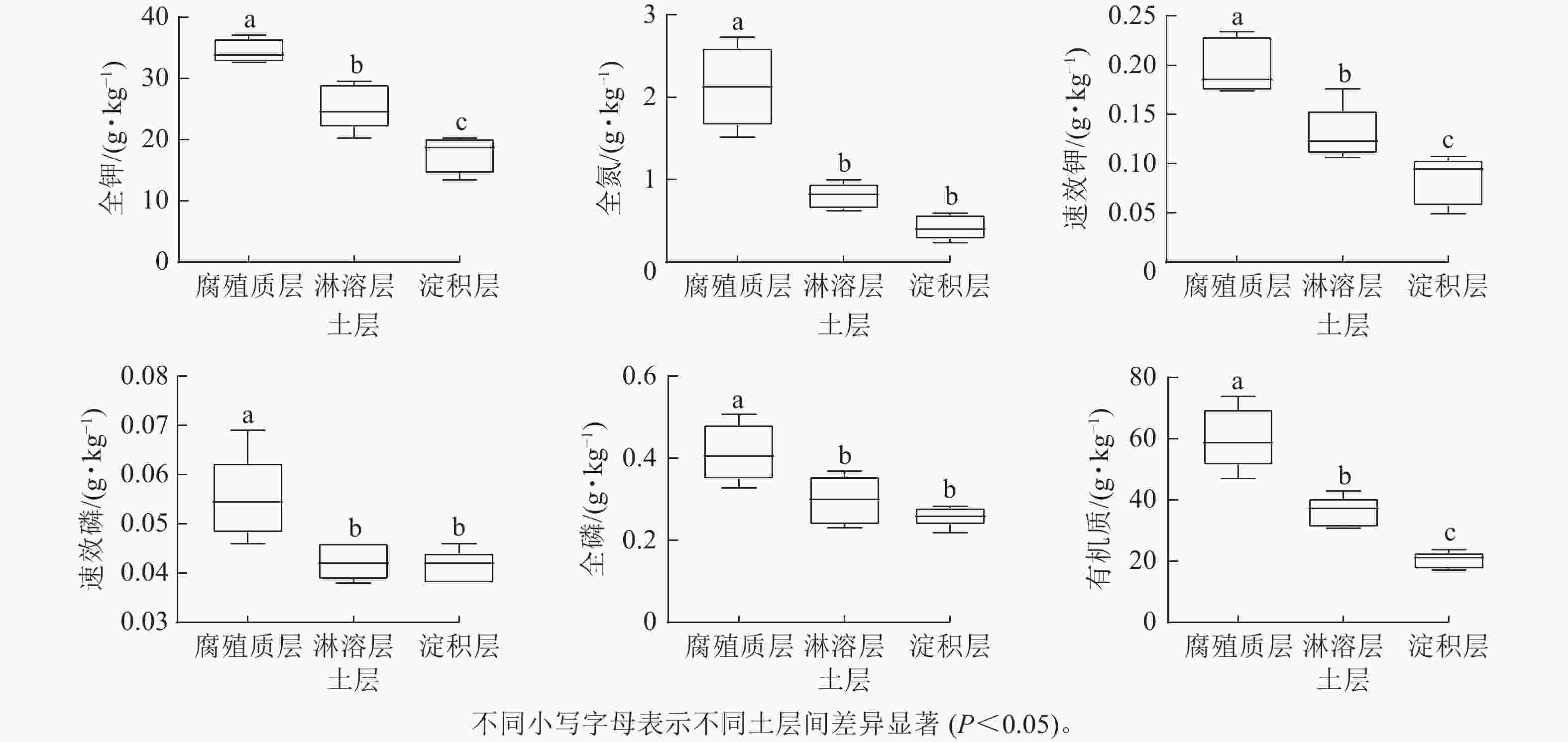
      Figure 1.  Distribution of soil nutrient content across different soil profile levels in Q. acutissima plantation forests

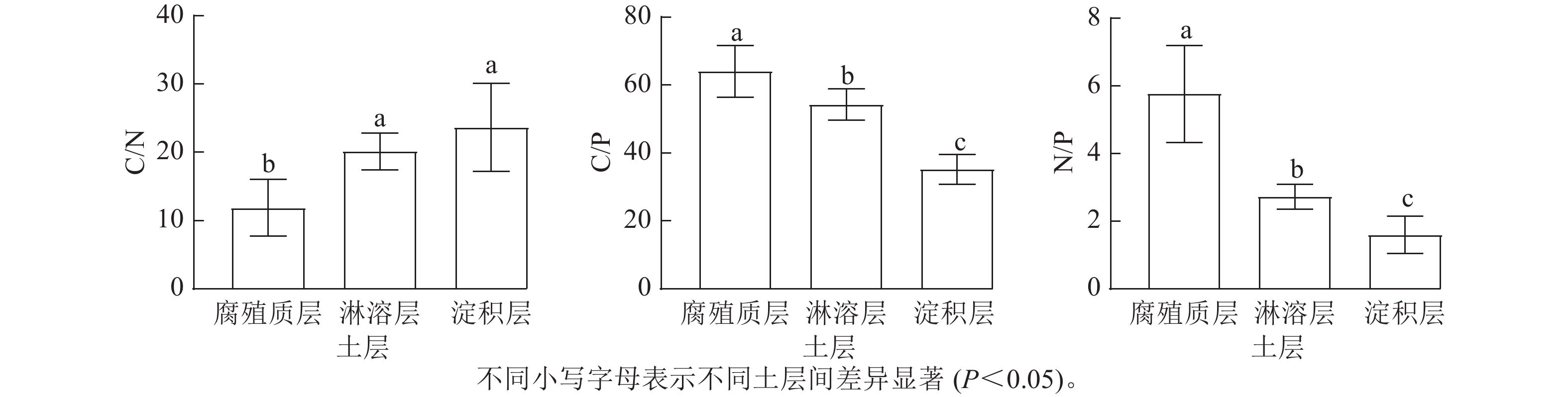
    • 图2所示:麻栎人工林土壤剖面上的C/N随着土层深度的增加逐渐增大,腐殖质层的C/N与其他2个土层间差异显著(P<0.05),分别比淋溶层、淀积层低45.52%、53.68%,淋溶层与淀积层无显著差异。C/P与N/P从大到小依次为腐殖质层、淋溶层、淀积层,且3个土层间差异显著(P<0.05)。随土层深度的增加,C/P和N/P均呈下降趋势。其中,C/P在腐殖质层比淋溶层高15.34%,淋溶层比淀积层高35.08%;N/P在腐殖质层比淋溶层高54.73%,淋溶层比淀积层高41.31%。
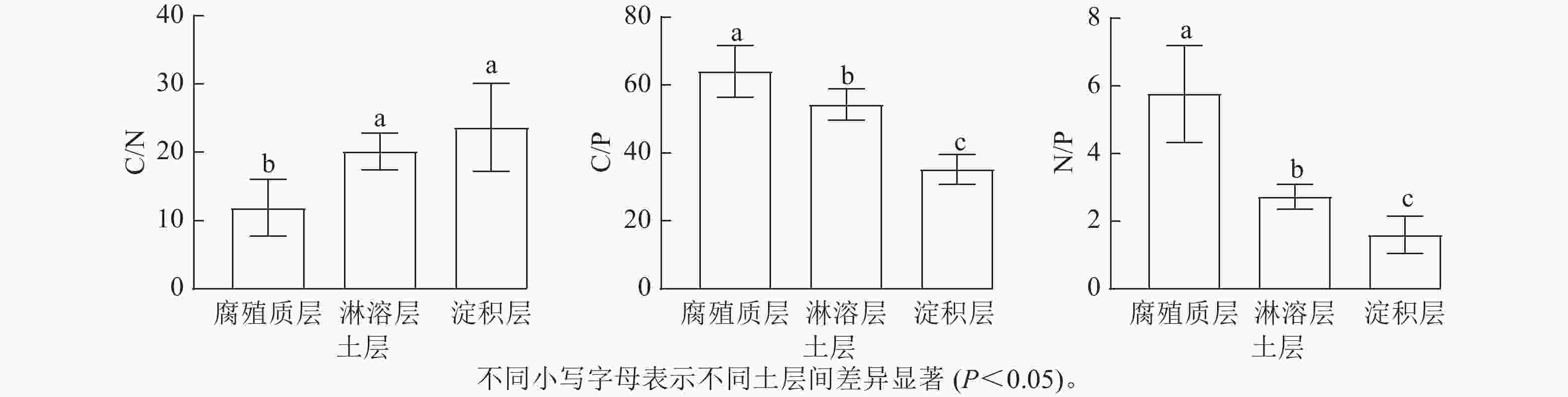
      Figure 2.  Stoichiometric characteristics across different soil profile levels in Q. acutissima plantation forests

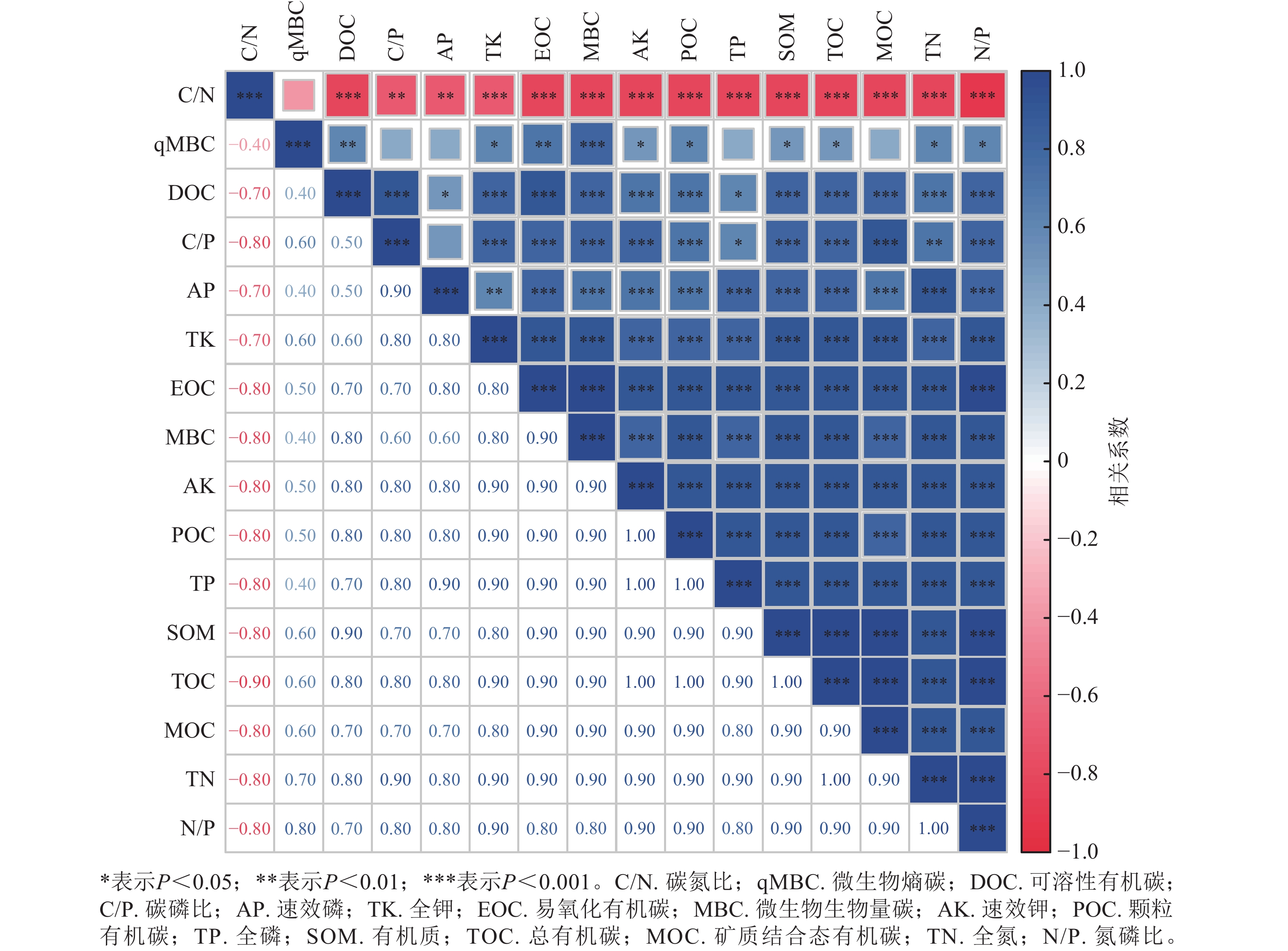
    • 图3所示:不同土层土壤氮、磷、钾与土壤有机碳及其各组分之间呈极显著正相关(P<0.001);微生物熵碳与微生物生物量碳、易氧化有机碳呈极显著正相关(P<0.001),与其余指标呈显著正相关(P<0.05);C/N与C/P、速效磷呈显著负相关(P<0.01),与其余指标呈极显著负相关(P<0.001);C/P与全磷、速效磷呈显著正相关(P<0.05),与其余指标呈极显著正相关(P<0.001);N/P与各指标呈极显著正相关(P<0.001)。
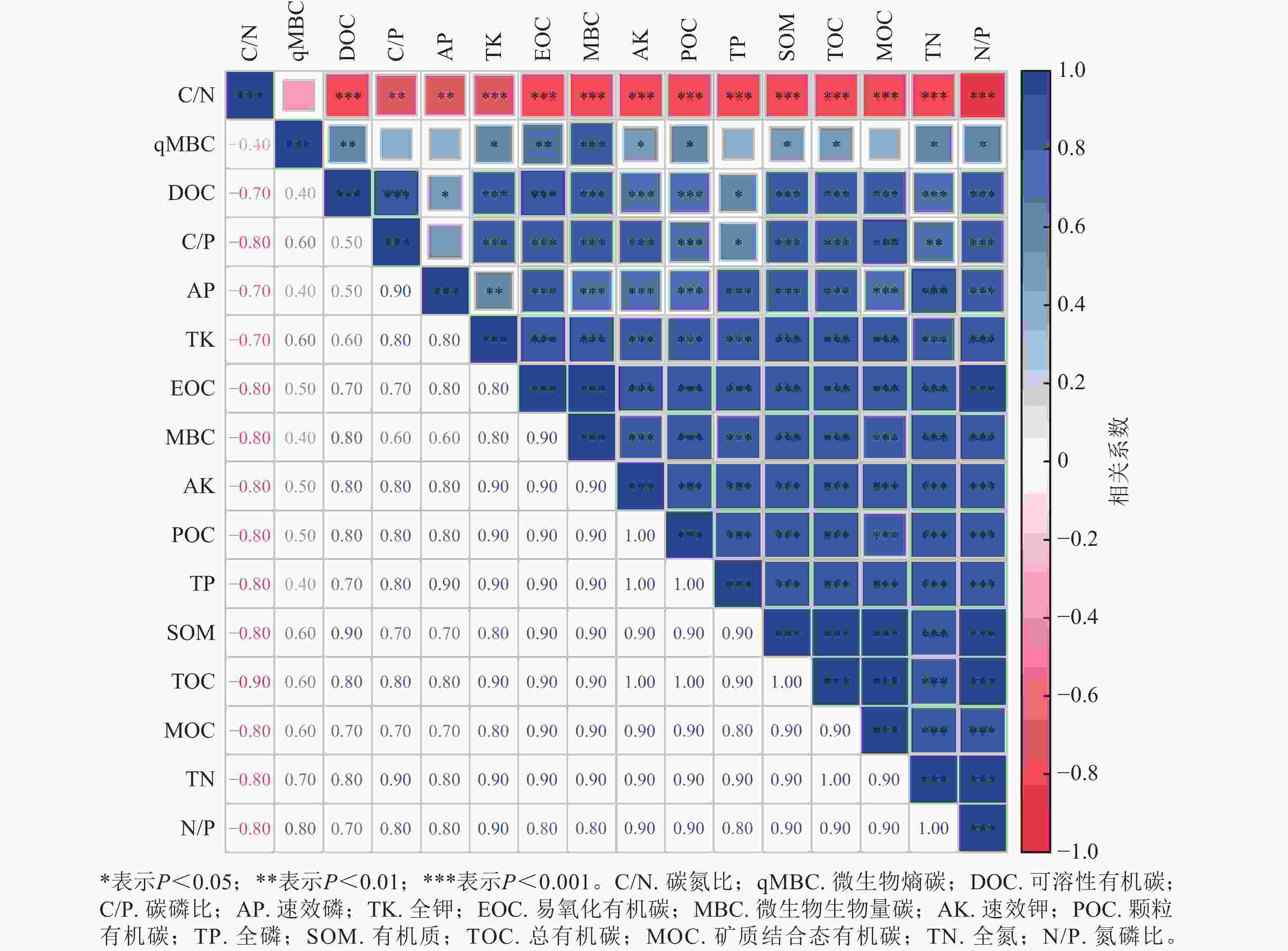
      Figure 3.  Correlations between soil organic carbon, nutrients and stoichiometric ratios

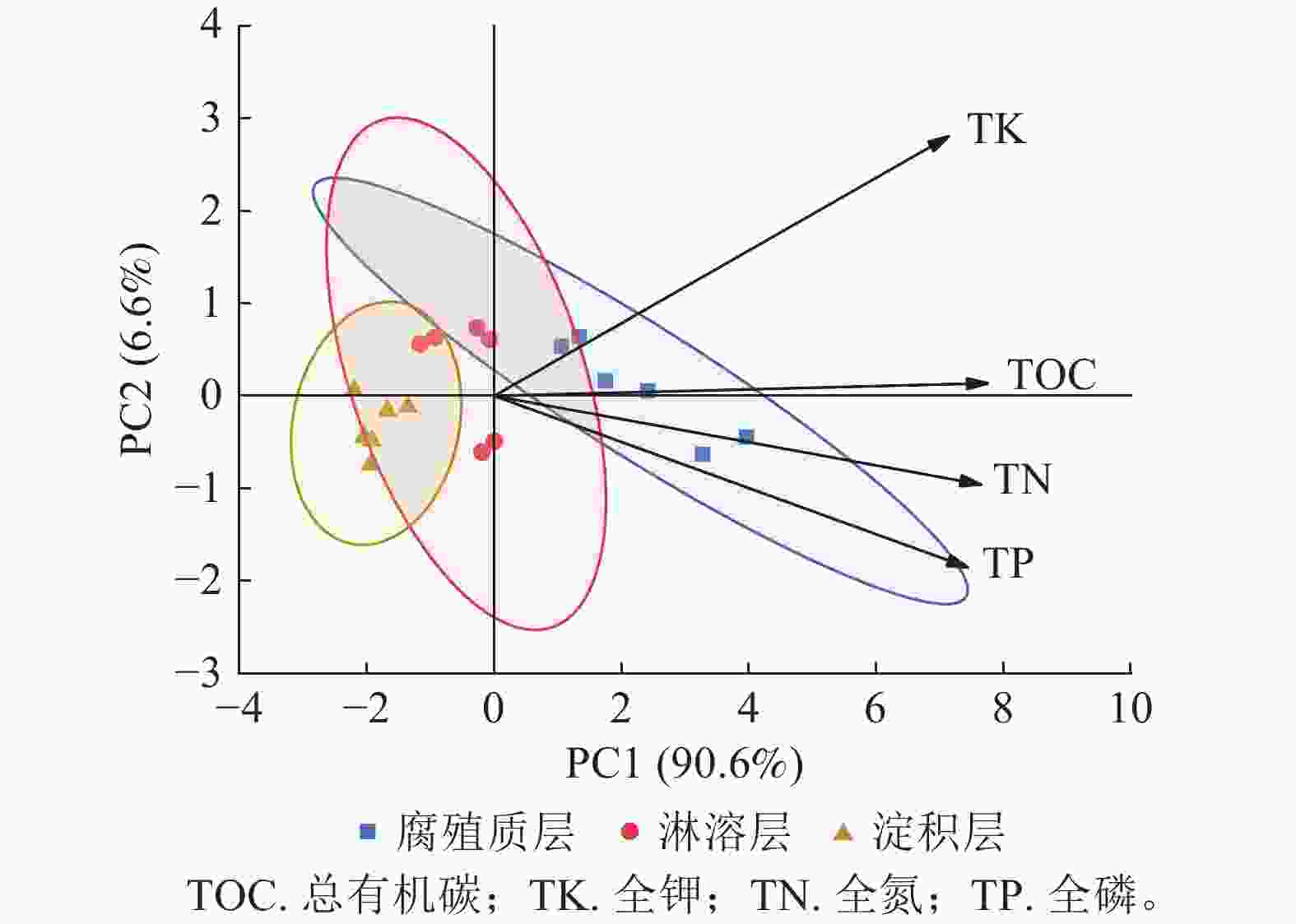
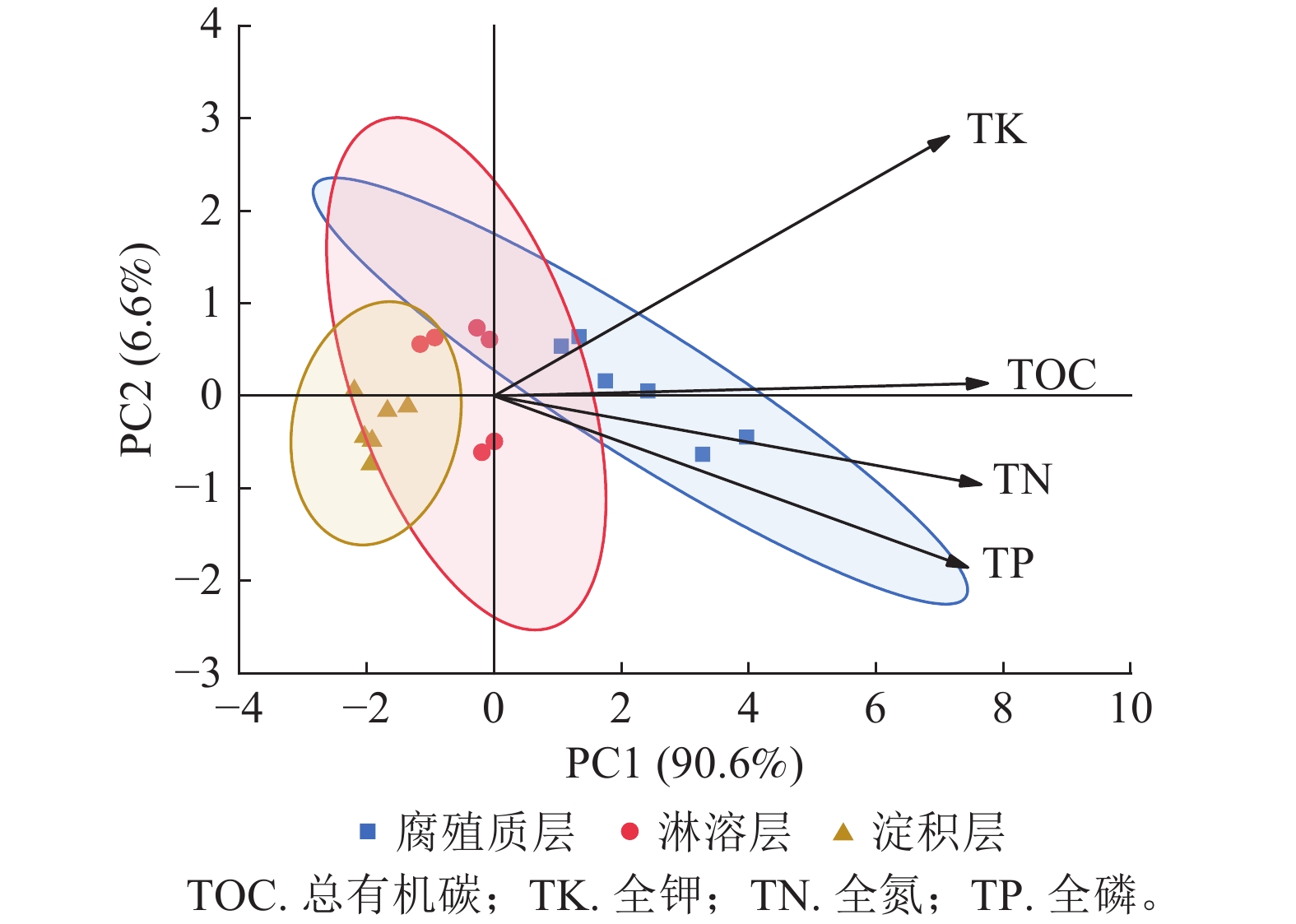
    • 采用主成分分析(PCA)对土壤总有机碳、全氮、全钾、全磷进行进一步分析。提取的第1主成分(PC1)、第2主成分(PC2)的方差贡献率分别为90.6%、6.6%,累计方差贡献率为97.2%,3个土层数据均呈正向分布。图4显示:腐殖质层的土壤元素与其他2个土层均具有显著差异(P<0.05),而淋溶层与其他2个土层置信区间均有部分重合,反映其与腐殖质层、淀积层土壤因子各自具有一定的相似性;总有机碳、全氮、全钾、全磷之间均呈线性正相关。根据各变量在PC1轴上的投影得出:有机碳对PC1的影响最大,全氮次之。

      Figure 4.  Principal component analysis of soil carbon, nitrogen, phosphorus and potassium accumulation across different soil profile levels in Q. acutissima plantation forests

    • 土壤碳组分作为衡量林地固碳能力高低的重要指标,既能够反映森林生态系统碳循环过程,也能为气候变化适应性评估以及生态系统的科学管理提供依据[21]。本研究区土壤有机碳各组分质量分数表现出极强的表聚性,这是由于地表凋落物和植物根系分解而成的有机质在表层土壤中经过分解转化后,通过生物扰动和淋溶作用逐渐向深层迁移所致[22]。淀积层土壤较稳定且封闭,与外界的物质交换少,导致有机碳主要富集于腐殖质层。同时,由于研究区气温较低,土壤微生物活性和土壤动物活动强度受到抑制,地表凋落物的分解转化过程显著减缓,致使有机碳在垂直方向上的迁移效率降低,其可达到的土层深度也相应受限。

      本研究显示:各碳组分中变化幅度最大的为总有机碳、易氧化有机碳,因为总有机碳直接受林地碳输入及输出的影响,而易氧化有机碳作为总有机碳中最活跃的组分,有效性及运转速率均很高,对环境扰动也极为敏感,两者协同凸显研究区土壤碳库的动态变化。热图结果也表明:总有机碳和易氧化有机碳呈现出相同的变化规律。这是由于土壤易氧化有机碳是植物和微生物可利用性较高的活性组分,易受总有机碳和土壤环境变化的影响,能指示土壤碳库的变化与环境影响程度[23]。此外,表层土壤侵蚀的大小是影响易氧化有机碳的决定性因素[24],研究区腐殖质层土壤易氧化有机碳质量分数显著高于其他土层,说明麻栎人工林水土保持能力良好,土壤受侵蚀影响较小。

      在土壤碳库中,微生物生物量碳等对土壤管理、森林经营措施的响应更为敏感[25]。本研究中土壤微生物生物量碳表现为自上而下显著递减,与CLEVELAND等[26]的研究结果相一致,这是由于研究区深层土壤长期受到上层土壤的压实作用而通气性变差,难以满足大多数微生物生长繁殖的基本要求。作为土壤活性有机碳的衡量标准,土壤微生物熵碳既能推断土壤总碳库的可利用状况[27],又能监测有机碳-微生物碳的转化效率,进而评估土壤有机碳的固存或损失趋势[28],微生物熵碳的上升标志着土壤碳库的持续积累,反映了微生物对碳源的高效利用。本研究中微生物熵碳随着土层深度的增加呈先降低后增加的趋势,表明腐殖质层微生物对碳源的利用效率最高,淋溶层最低。这是由于腐殖质层中凋落物提供大量有机物质,而淋溶层淋溶作用强烈,从而加速了碳的大量淋失。

    • 本研究中各养分质量分数均随土层加深而递减,且腐殖质层显著高于其他土层,与王岩松等[29]的研究结果相符。这是由于林地表层土壤质地相对疏松,具有较好的通气透水性能,促进了有机质的分解转化过程。已有研究表明:表层凋落物因较高的分解矿化速率显著促进了养分周转过程,这种效应通过根际过程直接或间接地提升了根系微域养分有效性,导致土壤养分的增幅表现为表层远高于底层[30],本研究区林分亦有效印证了这一点。受根系分布的影响,更深土层养分保留的量会减少[31],麻栎人工林发达的根系和周期性的凋落物输入为表层土壤提供了持续的有机物质来源。

      本研究中养分和碳组分很强的耦合性主要源于植物凋落物和细根残体,其在转化为腐殖质等有机物质的过程中同步释放氮磷钾等养分[32]。由于有机碳为有机质的核心物质,故养分与有机碳变化同步。研究区麻栎林土壤呈弱酸性,也是造成碳-养分耦合性高的因素之一。因为酸性土壤中的真菌占主导地位,分解速率慢,使得碳与养分得以同步释放。而在碱性土壤中细菌占主导地位,碳被分解的同时,氮会因较强的硝化作用而易被淋失,磷易被钙快速固定,从而导致碳-养分的不同步变化。碳-养分的强耦合性能够表征土壤养分利用效率较高[33],该结果有效说明研究区森林生态系统处于良性循环状态,有利于麻栎生长。水分动态、物理迁移和根系活动共同塑造了碳组分与养分在土壤剖面中的分布格局,但其作用相对较小,亦印证了不同土层对养分元素的影响近乎同步[34]

    • 土壤化学计量比可以反映土壤元素调节机制[35]。C/N是衡量土壤有机碳矿化能力的指标之一,较低的C/N有利于微生物对有机碳的矿化[36]。研究区淋溶层和淀积层的C/N均高于全国土壤平均值(11.9),而腐殖质层则低于该水平。表明林场麻栎人工林淋溶层与淀积层相较于腐殖质层土壤矿化速率较弱,腐殖质层土壤矿化速率最强。本研究中,随着剖面深度的增加,C/N呈增加趋势。这与LIU等[37]的研究规律相同,但与QIAO等[38]的结果不一致,主要原因可能是研究区深层土壤氧气不足,微生物活性降低,微生物先利用易分解碳,导致难降解碳积累,从而提高C/N。主成分分析显示:研究区土壤主要受碳氮的协同影响,其中碳元素的影响强度高于氮元素(C>N)。表明尽管氮元素在土壤氮磷调控中具有重要作用,但碳元素对氮磷含量及其化学计量特征的影响更为突出。

      土壤中的磷主要来源于母岩风化,以固定态形式储存且迁移速率缓慢,空间变异性较小[39],故有机碳质量分数的梯度变化是调控土壤C/P垂直分异的主要原因。随着土层深度的增加,有机碳呈现显著递减趋势,这种垂直分布特征直接导致C/P的系统性降低,也是导致本研究中3个土层C/P差异显著的原因。土壤C/P还能够反映磷的有效性,比值升高表明磷元素的释放过程受到抑制,土壤有效磷的供给不足,不利于麻栎生长,反之则说明土壤固磷潜力较好[40]。本研究C/P为35.209~64.058,均低于全国平均值(67),表明研究区林场土壤磷净矿化率及有效性较高,有利于麻栎的生长。

      本研究区N/P随土层深度的增加而减小,这与QIAO等[38]的研究规律一致。主要原因为麻栎人工林土壤随土层深度的增加,土壤磷净矿化率及有效性提高,而氮元素缺乏,故形成N/P随垂直梯度减小的变化趋势。同时,土壤N/P能反映氮素饱和状态,并可作为判断氮磷养分限制的临界指标。N/P<10受氮限制,N/P>20则受磷限制,10<N/P<20受氮磷共同限制[41]。各土层N/P均小于10,说明研究区土壤氮素流失速度比磷淋溶速度的强度更大,导致N/P较低,麻栎生长受氮素供应限制。

    • 本研究表明:麻栎人工林土壤养分质量分数呈明显表聚性,随着土层深度的增加呈现近似“倒三角”的分布模式;养分与碳组分之间存在较强的耦合关系,反映研究区土壤具有较高的养分利用效率。此外,氮素的流失速度大于磷的淋溶强度,表明麻栎生长受氮素供应限制。因此,经营管理策略需充分考虑土壤剖面的垂直变化,针对不同土层采取差异化的调控措施。

Reference (41)

Catalog

    /

    DownLoad:  Full-Size Img  PowerPoint
    Return
    Return