Volume 43 Issue 4
Jul.  2026
Turn off MathJax
Article Contents

ZHANG Tianyi, WANG Zhichao, XU Yuxing, et al. Active components of soil organic carbon and influencing factors in 4 types of plantations on Leizhou Peninsula[J]. Journal of Zhejiang A&F University, 2026, 43(4): 681−694 doi:  10.11833/j.issn.2095-0756.20260125
Citation: ZHANG Tianyi, WANG Zhichao, XU Yuxing, et al. Active components of soil organic carbon and influencing factors in 4 types of plantations on Leizhou Peninsula[J]. Journal of Zhejiang A&F University, 2026, 43(4): 681−694 doi:  10.11833/j.issn.2095-0756.20260125

Active components of soil organic carbon and influencing factors in 4 types of plantations on Leizhou Peninsula

DOI: 10.11833/j.issn.2095-0756.20260125
  • Received Date: 2026-01-02
  • Accepted Date: 2026-06-19
  • Rev Recd Date: 2026-06-12
  • Available Online: 2026-07-21
  • Publish Date: 2026-08-20
  •   Objective  This study aims to explore the effects of different types of plantations on the active components of soil organic carbon and carbon pool management index, so as to provide a scientific basis for improving the quality of soil carbon pools and enhancing overall benefits.   Method  The 4 types of plantations on Leizhou Peninsula were taken as research objects, including Eucalyptus urophylla, E. urophylla-Manglietia glauca, E. urophylla-Castanopsis hystrix and Pinus elliottii-C. hystrix. The distribution of soil organic carbon storage and organic carbon (SOC) active components, namely easily oxidizable organic carbon (EOC), particulate organic carbon (POC), light fraction organic carbon (LFOC), dissolved organic carbon (DOC), and microbial biomass carbon (MBC) in the 0−20 cm soil layer under different planting patterns was analyzed. The relationship between the active components of soil organic carbon and soil physicochemical properties was clarified. The carbon pool activity index (LI), carbon pool index (CPI), carbon pool management index (CPMI), and oxidation stability coefficient (Kos) were calculated to elucidate the carbon pool changes under different planting patterns.   Result  (1) The mass fractions of soil organic carbon storage, organic carbon, and its active carbon components all decreased as the soil layer deepened. Compared to the other three planting patterns, the mixed plantation of E. urophylla and C. hystrix could significantly enhance soil organic carbon storage. The E. urophylla pure plantation showed higher accumulation in POC and LFOC. The mixed plantation of E. urophylla and C. hystrix showed higher accumulation in SOC, EOC, and DOC. The E. urophylla pure plantation and the P. elliottii-C. hystrix mixed plantation showed higher accumulation in MBC (P< 0.05). (2) The ratios of POC/SOC and LFOC/SOC in the E. urophylla pure plantation were significantly higher than those in other stands (P<0.05). (3) In different soil layers, the soil carbon pool index of the E. urophylla-C. hystrix mixed plantation was significantly higher than that of the E. urophylla pure plantation. The Kos of the P. elliottii-C. hystrix mixed plantation was lower in different stands (P< 0.05). (4) Redundancy analysis showed that total nitrogen content was the main factor affecting soil organic carbon fractions under different planting patterns and soil depths.   Conclusion  Different planting patterns significantly alter the surface soil organic carbon storage and the distribution of active organic carbon. The stability of the soil organic carbon pool is relatively low in the E. urophylla pure plantation and the P. elliottii-C. hystrix mixed plantation. The E. urophylla-C. hystrix mixed plantation could substantially increase soil organic carbon storage while enhancing soil carbon pool stability. For plantation construction in the region, appropriate management measures should be taken based on soil properties, basic carbon pool conditions, and the effectiveness of nutrients such as nitrogen and phosphorus to enhance carbon sequestration efficiency and carbon sink level. [Ch, 4 fig. 5 tab. 63 ref.]
  • [1] LI Fuqi, ZHANG Jianben, HAN Junxue, ZHU Xinyu, CHI Ting, LI Mengli, MENG Fengqun.  A comparative study of soil nutrients and microbial community diversity between artificial and natural forests in Yachang, Guangxi . Journal of Zhejiang A&F University, 2026, 43(3): 562-572. doi: 10.11833/j.issn.2095-0756.20250305
    [2] RAN Jiaxuan, QI Yujiao.  Height-diameter model of Pinus massoniana and Schima superba mixed forest in central Guizhou Province . Journal of Zhejiang A&F University, 2024, 41(2): 343-352. doi: 10.11833/j.issn.2095-0756.20230363
    [3] HUANG Jinghan, BI Huaxing, ZHAO Danyang, WANG Ning, LIU Zehui, ZHANG Rong.  Vertical distribution of soil moisture in typical plantation in the loess region of western Shanxi Province . Journal of Zhejiang A&F University, 2024, 41(2): 387-395. doi: 10.11833/j.issn.2095-0756.20230228
    [4] TIAN Xiaoqingfan, XIAO Xiangqian, QIU Yufeng, BU Aiai, LEI Gang, CHEN Youchao, CAI Chunju, TANG Ronggui, CAI Yanjiang.  Responses of CO2 emissions and labile organic carbon to earthworm activities in Phyllostachys edulis forest soil . Journal of Zhejiang A&F University, 2024, 41(3): 486-495. doi: 10.11833/j.issn.2095-0756.20230369
    [5] ZUO Qilin, YU Yang, ZHA Tonggang, ZHANG Hengshuo, LIANG Yipeng, OUYANG Jiahuan.  Soil quality assessment of different land use types in Qingshui River Basin of western Shanxi Province . Journal of Zhejiang A&F University, 2023, 40(4): 801-810. doi: 10.11833/j.issn.2095-0756.20220498
    [6] ZHANG Dongyan, WANG Dongzhi, LI Xiao, GAO Yushan, LI Tianyu, CHEN Jing.  Relationship between height and diameter at breast height(DBH) in mixed coniferous and broadleaved forest based on quantile regression . Journal of Zhejiang A&F University, 2020, 37(3): 424-431. doi: 10.11833/j.issn.2095-0756.20190461
    [7] WANG Zhichao, XU Yuxing, ZHU Wankuan, DU Apeng.  Characteristics and driving factors of nocturnal water consumption of Eucalyptus urophylla plantations in Leizhou Peninsula . Journal of Zhejiang A&F University, 2020, 37(4): 646-653. doi: 10.11833/j.issn.2095-0756.20190531
    [8] LIANG Yang, SHAO Sen, MA Bingqian.  Soil quality development in Pinus tabuliformis plantations with different forest ages on Taiyue Mountain . Journal of Zhejiang A&F University, 2019, 36(3): 581-589. doi: 10.11833/j.issn.2095-0756.2019.03.020
    [9] LI Hai-fang, DUAN Wen-jun.  Soil CO2 and N2O fluxes from four typical plantations in southern China . Journal of Zhejiang A&F University, 2011, 28(1): 26-32. doi: 10.11833/j.issn.2095-0756.2011.01.005
    [10] CAO Yong-hui, XIAO Jiang-hua, CHEN Shuang-lin, WU Bo-lin, WU Ming, ZHANG De-ming.  Effect of everygreen brood-leaved trees on Phyllostachys pubescens growth and their competition in the mixed forest . Journal of Zhejiang A&F University, 2006, 23(1): 35-40.
    [11] HUANG Yong-lai.  Soil fertility improvement in mixed forests of Liquidambar formosana with other tree species . Journal of Zhejiang A&F University, 2006, 23(5): 497-500.
    [12] LIU Fang.  Growth and biomass of pure stands of Betula luminifera and Cunninghamia lanceolata and their mixed forest . Journal of Zhejiang A&F University, 2002, 19(2): 143-147.
    [13] YAN Yi-lun, YAN Qi-peng, HU Li-zhong.  Physiological characteristics of Cunninghamia lanceolata and Sassafras tsumu roots in mixed forests and pure forests . Journal of Zhejiang A&F University, 2000, 17(1): 20-23.
    [14] QIAN Guo-qin.  Productivity and ecological characteristics of mixed forest of Chinese sweet gum and Chinese fir . Journal of Zhejiang A&F University, 2000, 17(3): 289-293.
    [15] XU Feng-lan, WEI Tan, LIU Ai-qing.  Studies on physical characters of soil in mixed forest of Chinese fir and paulownia . Journal of Zhejiang A&F University, 2000, 17(3): 285-288.
    [16] ZHANG  Ren-hao.  Growth characteristics of Chinese fir in pure and mixed forests . Journal of Zhejiang A&F University, 1999, 16(2): 141-144.
    [17] Zheng Yushan, Guan Dayao, Li Renchang.  Water-holding Capacity of Mixed Forest in Cunninghamia lanceolata and Phyllostachys pubescens. . Journal of Zhejiang A&F University, 1998, 15(1): 63-98.
    [18] Liu Aiqin, Ma Xiangqing, Yu Lixuan, Luo Xuemei.  Effects of different mixed model son soil fertility in plantations of Pinus massoniana . Journal of Zhejiang A&F University, 1998, 15(3): 250-255.
    [19] Yu Meilin, Wang Zhiming, Liu Zhi, Tong Xiuyao, Lin Zhi, Wu Jiasheng, Chen Youquan, Jin Yuandong, Wang Baonü, Ding Yifei..  Forestation Techniques on Mixed Forest Taking Liquidambar formosana as Leading Species. . Journal of Zhejiang A&F University, 1995, 12(2): 139-143.
    [20] Du Guojian, Huang Tianping, Zhang Qingrong, Zhang Pushan, Cheng Rongliang..  Studies on Soil Microoganisms and Biochemlcal Properties in Mixed Forests of Chinese Fir. . Journal of Zhejiang A&F University, 1995, 12(4): 347-352.
  • [1]
    LIU Shirong, WANG Hui, LI Haikui, et al. Projections of China’s forest carbon storage and sequestration and ways of their potential capacity enhancement[J]. Scientia Silvae Sinicae, 2024, 60(4): 157−172. DOI: 10.11707/j.1001-7488.LYKX20230206.
    [2]
    MAYER M, PRESCOTT C E, ABAKER W E A, et al. Tamm Review: influence of forest management activities on soil organic carbon stocks: a knowledge synthesis[J]. Forest Ecology and Management, 2020, 466: 118127. DOI: 10.1016/j.foreco.2020.118127.
    [3]
    HAO Zhiguo, ZHAO Yunfei, WANG Xia, et al. Thresholds in aridity and soil carbon-to-nitrogen ratio govern the accumulation of soil microbial residues[J]. Communications Earth & Environment, 2021, 2: 236. DOI: 10.1038/s43247-021-00306-4.
    [4]
    FU Daihan, MING An’gang, WANG Ya’nan, et al. Effects of introducing native species into Eucalyptus monocultures on soil aggregate organic carbon fractions and carbon sequestration[J/OL]. Chinese Journal of Applied and Environmental Biology, 2025-12-31. https://doi.org/10.19675/j.cnki.1006-687x.2025.11009.
    [5]
    ZARAFSHAR M, VINCENT G, KORBOULEWSKY N, et al. The impact of stand composition and tree density on topsoil characteristics and soil microbial activities[J]. CATENA, 2024, 234: 107541. DOI: 10.1016/j.catena.2023.107541.
    [6]
    HU Ao, ZHAO Yihui, WU Jilai, et al. Effects of natural vegetation restoration after logging on soil organic carbon and its active components in Pinus massoniana secondary forests[J]. Journal of Zhejiang A&F University, 2024, 41(6): 1189−1200. DOI: 10.11833/j.issn.2095-0756.20240264.
    [7]
    ZHOU Ziyu, WANG Mengjia, FENG Xiangqian, et al. Effects of crop rotation patterns and nitrogen fertilizer levels on storage and structure of soil organic carbon in paddy fields[J]. Chinese Journal of Rice Science, 2024, 38(5): 577−590. DOI: 10.16819/j.1001-7216.2024.230912.
    [8]
    YANG Xu, WANG Di, LAN Yu, et al. Labile organic carbon fractions and carbon pool management index in a 3-year field study with biochar amendment[J]. Journal of Soils and Sediments, 2018, 18(4): 1569−1578. DOI: 10.1007/s11368-017-1874-2.
    [9]
    CHEN Ruirui, SENBAYRAM M, BLAGODATSKY S, et al. Soil C and N availability determine the priming effect: microbial N mining and stoichiometric decomposition theories[J]. Global Change Biology, 2014, 20(7): 2356−2367. DOI: 10.1111/gcb.12475.
    [10]
    ZHAO Han, ZUO Tian, DIAO Jingwen, et al. Effects of different nitrogen addition on soil labile organic carbon and environmental factors in temperate forests and their interactions[J]. Environmental Science, 2026, 47(1): 573−580. DOI: 10.13227/j.hjkx.202411292.
    [11]
    WU Sizheng, LI Xiaoying, WANG Yiwen, et al. Distribution pattern of labile organic carbon in soil of four representative public welfare forests in Central Yunnan[J]. Journal of Central South University of Forestry & Technology, 2025, 45(2): 185−193, 215. DOI: 10.14067/j.cnki.1673-923x.2025.02.018.
    [12]
    ZHAO Zhi, TAN Jingxing, LUO Xiao, et al. Successive planting of Eucalyptus grandis plantations reduce soil organic carbon and its labile fractions[J]. Forests, 2025, 16(11): 1621. DOI: 10.3390/f16111621.
    [13]
    LI Zhiyong, GUO Baojiang, ZHOU Yechen, et al. Forest management practices can increase the soil organic carbon sequestration potential of Robinia pseudoacacia plantations in the Loess Plateau[J]. Soil Science Society of America Journal, 2025, 89(3): e70082. DOI: 10.1002/saj2.70082.
    [14]
    ZHAO Junyu, LU Zhenxian, WANG Jiayan, et al. Impact of multi-generation continuous planting on soil organic carbon fractions and carbon pool management index in different soil layers of Eucalyptus plantations[J]. Research of Soil and Water Conservation, 2026, 33(2): 255−263. DOI: 10.13869/j.cnki.rswc.2026.02.014.
    [15]
    GU Xiaojuan, WU Miaolan, ZHANG Zhenyuan, et al. Effects of seasonal changes on soil organic carbon fractions and enzyme activities of Eucalyptus urophylla[J]. Journal of Central South University of Forestry & Technology, 2025, 45(1): 140−151. DOI: 10.14067/j.cnki.1673-923x.2025.01.015.
    [16]
    ZHANG Zhenyuan, GU Xiaojuan, WU Miaolan, et al. Characteristics of soil carbon, nitrogen, phosphorus and easily oxidized organic carbon in Eucalyptus plantations with different ages in Leizhou Peninsula[J]. Forestry and Environmental Science, 2024, 40(3): 87−94. DOI: 10.3969/j.issn.1006-4427.2024.03.012.
    [17]
    XU Yuxing, DU Apeng, WANG Zhichao, et al. Effects of different rotation periods of Eucalyptus plantations on soil physiochemical properties, enzyme activities, microbial biomass and microbial community structure and diversity[J]. Forest Ecology and Management, 2020, 456: 117683. DOI: 10.1016/j.foreco.2019.117683.
    [18]
    PU Zhongyu, HUANG Yuchen, TIAN Shasha, et al. Effects of precipitation change on soil microbial biomass and their stoichiometric ratios in an alpine meadow[J/OL]. Acta Pedologica Sinica, 2026-01-07. https://link.cnki.net/urlid/32.1119.p.20260106.1509.004.
    [19]
    LIANG Xiaoling, ZHANG Long, WANG Keqin, et al. Soil microbial carbon use efficiency in Pinus armandii forests in Central Yunnan responds to nitrogen deposition in different seasons[J]. Journal of Soil and Water Conservation, 2026, 40(2): 242−252. DOI: 10.13870/j.cnki.stbcxb.2026.02.015.
    [20]
    BLAIR G J, LEFROY R, LISLE L. Soil carbon fractions based on their degree of oxidation, and the development of a carbon management index for agricultural systems[J]. Australian Journal of Agricultural Research, 1995, 46(7): 1459−1466. DOI: 10.1071/ar9951459.
    [21]
    LING Lei, REN Zengcao, ZONG Wenzhen, et al. Effects of stand age and density on carbon storage of Picea asperata plantations in the Taohe River[J]. Guihaia, 2026-02-13. https://link.cnki.net/urlid/45.1134.Q.20260212.1755.008.
    [22]
    WANG Miao, QU Laiye, MA Keming, et al. Soil microbial properties under different vegetation types on Mountain Han[J]. Science China Life Sciences, 2013, 56(6): 561−570. DOI: 10.1007/s11427-013-4486-0.
    [23]
    LU Mingzhu, HE Gang, FAN Lei, et al. Temperature sensitivity of aerobic and anaerobic organic carbon mineralization varies with climate and soil depth in riparian zones[J]. Soil Biology and Biochemistry, 2024, 195: 109455. DOI: 10.1016/j.soilbio.2024.109455.
    [24]
    YUAN Ye, LI Juan, YAO Liang. Soil microbial community and physicochemical properties together drive soil organic carbon in Cunninghamia lanceolata plantations of different stand ages[J]. PeerJ, 2022, 10: e13873. DOI: 10.7717/peerj.13873.
    [25]
    HUANG Huanqiang, QIU Zhanpeng, GU Luowei, et al. Relationship between stand spatial structure and soil organic carbon in two artificial mixed forests[J]. Journal of Sichuan Agricultural University, 2025, 43(4): 915−921. DOI: 10.16036/j.issn.1000-2650.202402586.
    [26]
    WANG Bingyi, ZHANG Yong, WU Cuirong, et al. Characteristics and influencing factors of carbon density structure in Pinus massoniana forests with different afforestation years[J]. Journal of Zhejiang A&F University, 2025, 42(2): 291−301. DOI: 10.11833/j.issn.2095-0756.20240401.
    [27]
    BLACKBURN K W, LIBOHOVA Z, ADHIKARI K, et al. Influence of land use and topographic factors on soil organic carbon stocks and their spatial and vertical distribution[J]. Remote Sensing, 2022, 14(12): 2846. DOI: 10.3390/rs14122846.
    [28]
    YANG Ting, ZHOU Xiaoguo, WEN Yuanguang, et al. Effects of eco-silviculture on soil organic carbon fractions and enzyme activities in Eucalyptus spp. plantations[J]. Guangxi Sciences, 2025, 32(3): 426−438. DOI: 10.13656/j.cnki.gxkx.20250310.003.
    [29]
    XU Yunhao, LIU Tingting, LIU Guimei, et al. Absorption and utilization of nitrogen and phosphorus nutrients by tree root systems in mixed forests and their competition strategies[J]. World Forestry Research, 2025, 38(1): 38−44. DOI: 10.13348/j.cnki.sjlyyj.2025.0021.y.
    [30]
    LUO Dun, LIN Jing, LIANG Chen, et al. Organic carbon storage and distribution characteristics of different stand types soil in Southeastern Guangxi[J]. Journal of Southern Agriculture, 2024, 55(5): 1416−1423. DOI: 10.3969/j.issn.2095-1191.2024.05.017.
    [31]
    WU Panpan, ZHANG Yan, JIANG Lingxin, et al. Effects of stand type and decomposition position on leaf litter nutrient dynamics in subtropical plantations of China[J]. Chinese Journal of Ecology, 2024, 43(9): 2632−2640. DOI: 10.13292/j.1000-4890.202409.032.
    [32]
    CHENG Man. Effect of Litter Decomposition on Soil Carbon, Nitrogen, and Soil Microbial Community Structure on the Loess Plateau, China[D]. Yangling: Northwest A&F University, 2015.
    [33]
    ZHU Wankuan, WANG Zhichao, DU Apeng, et al. Seasonal patterns of carbon and water fluxes and their environmental biological control in the Eucalyptus plantation in Zhanjiang of Guangdong Province[J]. Scientia Silvae Sinicae, 2024, 60(9): 18−32. DOI: 10.11707/j.1001-7488.LYKX20230482.
    [34]
    ZENG Chenyang, MAN Xiuling, CAI Tijiu. Characterization of soil labile organic carbon fractions in Larix gmelinii forests with different understory vegetation types[J]. Journal of Soil and Water Conservation, 2026, 40(1): 242−252, 266. DOI: 10.13870/j.cnki.stbcxb.2026.01.033.
    [35]
    KOUTIKA L S, TABA K, NDONGO M, et al. Nitrogen-fixing trees increase organic carbon sequestration in forest and agroforestry ecosystems in the Congo basin[J]. Regional Environmental Change, 2021, 21(4): 109. DOI: 10.1007/s10113-021-01816-9.
    [36]
    CHRISTENSEN B T. Physical fractionation of soil and structural and functional complexity in organic matter turnover[J]. European Journal of Soil Science, 2001, 52(3): 345−353. DOI: 10.1046/j.1365-2389.2001.00417.x.
    [37]
    POST W M, KWON K C. Soil carbon sequestration and land-use change: processes and potential[J]. Global Change Biology, 2000, 6(3): 317−327. DOI: 10.1046/j.1365-2486.2000.00308.x.
    [38]
    HU Yunlong, AO G, FENG Jiguang, et al. The patterns of forest soil particulate and mineral associated organic carbon characteristics with latitude and soil depth across Eastern China[J]. Forest Ecosystems, 2025, 12: 100291. DOI: 10.1016/j.fecs.2024.100291.
    [39]
    KANG Tingting, ZHONG Quanlin, LIANG Fengna, et al. Decomposition characteristics of bark litter in subtropical Eucalyptus plantations[J]. Chinese Journal of Applied Ecology, 2025, 36(8): 2325−2334. DOI: 10.13287/j.1001-9332.202508.008.
    [40]
    MA Xingcong, JIN Wenhao, TU Jiaying, et al. Impact of shifts among mycorrhizal types on soil aggregate composition and characteristics[J]. Journal of Zhejiang A&F University, 2023, 40(6): 1149−1157. DOI: 10.11833/j.issn.2095-0756.20230376.
    [41]
    LI Ling, QIU Shaojun, LIU Jingtao, et al. Roles of soil dissolved organic carbon in carbon cycling of terrestrial ecosystems: a review[J]. Chinese Journal of Applied Ecology, 2012, 23(5): 1407−1414. DOI: 10.13287/j.1001-9332.2012.0193.
    [42]
    HANSSON K, KLEJA D B, KALBITZ K, et al. Amounts of carbon mineralised and leached as DOC during decomposition of Norway spruce needles and fine roots[J]. Soil Biology and Biochemistry, 2010, 42(2): 178−185. DOI: 10.1016/j.soilbio.2009.10.013.
    [43]
    SCHWENDENMANN L, VELDKAMP E. The role of dissolved organic carbon, dissolved organic nitrogen, and dissolved inorganic nitrogen in a tropical wet forest ecosystem[J]. Ecosystems, 2005, 8(4): 339−351. DOI: 10.1007/s10021-003-0088-1.
    [44]
    LARSEN K S, JONASSON S, MICHELSEN A. Repeated freeze-thaw cycles and their effects on biological processes in two Arctic ecosystem types[J]. Applied Soil Ecology, 2002, 21(3): 187−195. DOI: 10.1016/S0929-1393(02)00093-8.
    [45]
    ZHOU Sha, MA Huanfei, WANG Jieying, et al. Latitudinal distribution of forest soil microbial biomass carbon and its affecting factors in China[J]. Scientia Silvae Sinicae, 2022, 58(2): 49−57. DOI: 10.11707/j.1001-7488.20220206.
    [46]
    WANG Yufeng, XI Shouhong, TAN Ling, et al. Effects of the monocultures and Pinus massoniana × Castanopsis hystrix plantations on soil microbial biomass carbon and nitrogen in southern subtropical China[J]. Journal of West China Forestry Science, 2022, 51(2): 93−99, 105. DOI: 10.16473/j.cnki.xblykx1972.2022.02.014.
    [47]
    YANG Wen, AN Shuqing, ZHAO Hui, et al. Impacts of Spartina alterniflora invasion on soil organic carbon and nitrogen pools sizes, stability, and turnover in a coastal salt marsh of Eastern China[J]. Ecological Engineering, 2016, 86: 174−182. DOI: 10.1016/j.ecoleng.2015.11.010.
    [48]
    WANG Wei, CHENG Zhengguo, LI Mengying, et al. Increasing periods after seeding under twice-annually harvested alfalfa reduces soil carbon and nitrogen stocks in a semiarid environment[J]. Land Degradation & Development, 2020, 31(18): 2872−2882. DOI: 10.1002/ldr.3592.
    [49]
    JIANG Yongmeng, SU Haohao, LU Yuming, et al. Effect of coniferous and broadleaf mixture measures on soil organic carbon stability of Pinus massoniana plantation in red soil erosion area[J]. Journal of Soil and Water Conservation, 2024, 38(5): 323−331. DOI: 10.13870/j.cnki.stbcxb.2024.05.031.
    [50]
    LAI Jiaming, LI Kaizhi, HUANG Congde, et al. Effect of improvement measures on soil labile organic carbon of low-efficiency Pinus massoniana forest[J]. Forest Research, 2013, 26(2): 167−173. DOI: 10.13275/j.cnki.lykxyj.2013.02.003.
    [51]
    LEHMANN J, RILLIG M C, THIES J, et al. Biochar effects on soil biota: a review[J]. Soil Biology and Biochemistry, 2011, 43(9): 1812−1836. DOI: 10.1016/j.soilbio.2011.04.022.
    [52]
    DAI Quanhou, LIU Guobin, XUE Re, et al. Effect of soil labile organic matter and carbon management index under the closure in eroded hilly Loess Plateau[J]. Journal of Northwest Forestry University, 2008, 23(4): 18−22.
    [53]
    XU Yiliang, CHEN Baoliang. Investigation of thermodynamic parameters in the pyrolysis conversion of biomass and manure to biochars using thermogravimetric analysis[J]. Bioresource Technology, 2013, 146: 485−493. DOI: 10.1016/j.biortech.2013.07.086.
    [54]
    VIEIRA F C B, BAYER C, ZANATTA J A, et al. Carbon management index based on physical fractionation of soil organic matter in an Acrisol under long-term no-till cropping systems[J]. Soil and Tillage Research, 2007, 96(1/2): 195−204. DOI: 10.1016/j.still.2007.06.007.
    [55]
    XU Yunyan, GONG Yuanbo, FU Wanquan, et al. Effect of different reform measures on soil carbon and nitrogen characteristics and carbon stability in low efficiency forest of Pinus massoniana in southern Sichuan Province[J]. Journal of Soil and Water Conservation, 2016, 30(1): 225−230. DOI: 10.13870/j.cnki.stbcxb.2016.01.041.
    [56]
    LUO Hualong, LIU Wenxiang, YANG Mei, et al. Differences of soil physicochemical property, phenolic acid and enzyme activities in different Eucalyptus mixed plantations[J]. Journal of Northwest A&F University (Natural Science Edition), 2022, 50(12): 54−63, 76. DOI: 10.13207/j.cnki.jnwafu.2022.12.007.
    [57]
    MOOSHAMMER M, WANEK W, ZECHMEISTER-BOLTENSTERN S, et al. Stoichiometric imbalances between terrestrial decomposer communities and their resources: mechanisms and implications of microbial adaptations to their resources[J]. Frontiers in Microbiology, 2014, 5: 22. DOI: 10.3389/fmicb.2014.00022.
    [58]
    JUNK W J, AN Shuqing, FINLAYSON C M, et al. Current state of knowledge regarding the world’s wetlands and their future under global climate change: a synthesis[J]. Aquatic Sciences, 2013, 75(1): 151−167. DOI: 10.1007/s00027-012-0278-z.
    [59]
    TAN Yu, YANG Kaijun, QIN Jiashuang, et al. Soil hydrology characteristics among forest type, stand age and successive rotation in Eucalyptus plantations in Southern China[J]. Forests, 2024, 15(3): 423. DOI: 10.3390/f15030423.
    [60]
    XU Chen, RUAN Honghua, WU Xiaoqiao, et al. Progresses in drought stress on the accumulation and turnover of soil organic carbon in forests[J]. Journal of Nanjing Forestry University (Natural Sciences Edition), 2022, 46(6): 195−206. DOI: 10.12302/j.issn.1000-2006.202209015.
    [61]
    ZHANG Qian, WANG Yini, LIU Xin, et al. The contribution of roots to soil organic carbon in different rocky desertifi-cation grasslands[J]. Ecological Science, 2022, 41(6): 26−32. DOI: 10.14108/j.cnki.1008-8873.2022.06.004.
    [62]
    JANDL R, LINDNER M, VESTERDAL L, et al. How strongly can forest management influence soil carbon sequestration?[J]. Geoderma, 2007, 137(3/4): 253−268. DOI: 10.1016/j.geoderma.2006.09.003.
    [63]
    ZHOU Guoyi, XU Shan, CIAIS P, et al. Climate and litter C/N ratio constrain soil organic carbon accumulation[J]. National Science Review, 2019, 6(4): 746−757. DOI: 10.1093/nsr/nwz045.
  • 加载中
通讯作者: 陈斌, bchen63@163.com
  • 1. 

    沈阳化工大学材料科学与工程学院 沈阳 110142

  1. 本站搜索
  2. 百度学术搜索
  3. 万方数据库搜索
  4. CNKI搜索

Figures(4)  / Tables(5)

Article views(69) PDF downloads(16) Cited by()

Related
Proportional views

Active components of soil organic carbon and influencing factors in 4 types of plantations on Leizhou Peninsula

doi: 10.11833/j.issn.2095-0756.20260125

Abstract:   Objective  This study aims to explore the effects of different types of plantations on the active components of soil organic carbon and carbon pool management index, so as to provide a scientific basis for improving the quality of soil carbon pools and enhancing overall benefits.   Method  The 4 types of plantations on Leizhou Peninsula were taken as research objects, including Eucalyptus urophylla, E. urophylla-Manglietia glauca, E. urophylla-Castanopsis hystrix and Pinus elliottii-C. hystrix. The distribution of soil organic carbon storage and organic carbon (SOC) active components, namely easily oxidizable organic carbon (EOC), particulate organic carbon (POC), light fraction organic carbon (LFOC), dissolved organic carbon (DOC), and microbial biomass carbon (MBC) in the 0−20 cm soil layer under different planting patterns was analyzed. The relationship between the active components of soil organic carbon and soil physicochemical properties was clarified. The carbon pool activity index (LI), carbon pool index (CPI), carbon pool management index (CPMI), and oxidation stability coefficient (Kos) were calculated to elucidate the carbon pool changes under different planting patterns.   Result  (1) The mass fractions of soil organic carbon storage, organic carbon, and its active carbon components all decreased as the soil layer deepened. Compared to the other three planting patterns, the mixed plantation of E. urophylla and C. hystrix could significantly enhance soil organic carbon storage. The E. urophylla pure plantation showed higher accumulation in POC and LFOC. The mixed plantation of E. urophylla and C. hystrix showed higher accumulation in SOC, EOC, and DOC. The E. urophylla pure plantation and the P. elliottii-C. hystrix mixed plantation showed higher accumulation in MBC (P< 0.05). (2) The ratios of POC/SOC and LFOC/SOC in the E. urophylla pure plantation were significantly higher than those in other stands (P<0.05). (3) In different soil layers, the soil carbon pool index of the E. urophylla-C. hystrix mixed plantation was significantly higher than that of the E. urophylla pure plantation. The Kos of the P. elliottii-C. hystrix mixed plantation was lower in different stands (P< 0.05). (4) Redundancy analysis showed that total nitrogen content was the main factor affecting soil organic carbon fractions under different planting patterns and soil depths.   Conclusion  Different planting patterns significantly alter the surface soil organic carbon storage and the distribution of active organic carbon. The stability of the soil organic carbon pool is relatively low in the E. urophylla pure plantation and the P. elliottii-C. hystrix mixed plantation. The E. urophylla-C. hystrix mixed plantation could substantially increase soil organic carbon storage while enhancing soil carbon pool stability. For plantation construction in the region, appropriate management measures should be taken based on soil properties, basic carbon pool conditions, and the effectiveness of nutrients such as nitrogen and phosphorus to enhance carbon sequestration efficiency and carbon sink level. [Ch, 4 fig. 5 tab. 63 ref.]

ZHANG Tianyi, WANG Zhichao, XU Yuxing, et al. Active components of soil organic carbon and influencing factors in 4 types of plantations on Leizhou Peninsula[J]. Journal of Zhejiang A&F University, 2026, 43(4): 681−694 doi:  10.11833/j.issn.2095-0756.20260125
Citation: ZHANG Tianyi, WANG Zhichao, XU Yuxing, et al. Active components of soil organic carbon and influencing factors in 4 types of plantations on Leizhou Peninsula[J]. Journal of Zhejiang A&F University, 2026, 43(4): 681−694 doi:  10.11833/j.issn.2095-0756.20260125
  • 气候变化显著改变了全球生态系统格局,减少温室气体排放和增强森林生态系统碳汇功能是应对全球气候变化的2条主要途径[1]。森林生态系统作为陆地碳汇的主要载体,储存了约50%的土壤有机碳(SOC)[2]。土壤有机碳其微小变化会显著影响全球碳平衡[3],其中,人工林土壤碳固存潜力可通过树种选择、结构优化等经营措施进行有效调控[4]。因此,制定科学有效的人工林管理策略以提升森林土壤碳储量尤为重要。

    已有研究表明:土壤有机碳利于形成良好的土壤结构,提高生态系统生物多样性[5],其稳定性与动态变化直接关系到生态系统的长期固碳潜力[6],常被用作评价地区土壤质量和土地生产力[78]。然而,土壤有机碳仅能反映有机质的静态储量而非质量,难以敏感响应短期人为干扰或环境变化[89]。大量研究表明:活性有机碳组分,包括易氧化有机碳(EOC)、颗粒有机碳(POC)、可溶性有机碳(DOC)、微生物生物量碳(MBC)和轻组有机碳(LFOC),具有较高的周转速率和对环境变化的敏感性[1011]。综合评价活性有机碳组分能更全面地反映林型变化对土壤有机碳的影响。为量化碳库质量变化,基于土壤有机碳和氧化有机碳建立的碳库活度指数(LI)和碳库管理指数(CPMI)被广泛用于评估不同管理措施下碳库的质量变化和稳定性[1213]

    雷州半岛地处北热带湿润大区北缘。人工林种植规模大,是该区域实现增强森林生态系统碳汇功能目标,发挥关键生态服务功能的重要载体。研究发现:林龄增长、多代连栽及季节变化对桉树Eucalyptus人工林土壤有机碳及部分活性组分有显著影响[1416],但目前研究多集中于土壤有机碳和少数碳组分,缺乏对多种活性有机碳分布特征的整合分析。同时,研究多局限于桉树单一树种,未能系统比较不同树种组成的人工林的碳库质量差异,也少引入碳库管理指数等综合指标来量化评价不同林分经营模式的碳库质量。因此,有必要从土壤有机碳储量、活性有机碳组分及碳库质量等方面,综合评估不同种植模式对人工林土壤碳库的影响。

    本研究以雷州半岛4种典型人工林(尾叶桉Eucalyptus urophylla纯林、尾叶桉-灰木莲Manglietia glauca混交林、尾叶桉-红锥Castanopsis hystrix混交林、湿地松Pinus elliottii-红锥混交林)为研究对象,系统测定0~20 cm土层中土壤有机碳及5类活性有机碳组分,包括易氧化有机碳、颗粒有机碳、可溶性有机碳、微生物生物量碳和轻组有机碳,并结合土壤容重、土壤体积含水量和土壤全氮等理化性质,分析不同林分土壤碳库质量及其主要影响因素。研究内容主要包括:①比较不同林分土壤有机碳储量、活性有机碳组分质量分数及其占土壤有机碳的比例;②分析活性有机碳组分与主要土壤理化性质之间的关系;③基于碳库活度指数和碳库管理指数评价不同种植模式下土壤碳库质量和固碳稳定性潜力。研究结果可为雷州半岛人工林树种配置优化、林地质量评价和森林碳汇功能提升提供理论依据与管理参考。

    • 研究区位于广东湛江桉树林生态系统定位观测研究站内(21°15′53.5″N,110°05′39.2″E),平均海拔为150.4 m。该区地处北热带湿润大区雷琼区北缘,为海洋性季风气候。据遂溪县气象台1981—2010年观测数据统计,该地年平均气温为23.2 ℃,年平均降水量为1 723.1 mm,集中在5—10月,年平均空气相对湿度为82%,年平均日照时数为1 937.0 h。试验地土壤类型为玄武岩发育的砖红壤[17],土层厚度≥84 cm。

    • 按照气候条件和立地条件相似性原则,本研究分别选取尾叶桉纯林(EU)、尾叶桉-灰木莲混交林(EUM)、尾叶桉-红锥混交林(EUC)、湿地松-红锥混交林(PC)等4种人工林为研究对象。尾叶桉和湿地松纯林均为2007年种植,造林密度为1 665株·hm−2。经台风危害及间伐后,保留相同密度,于2017年补植混交树种。补种时施用复合肥500 g·株−1,后无施肥和管理措施,所有混交林样地均严格包含2种树种,并保持1∶1的混交比例。林分概况见表1。2024年1月,分别在每个林分内随机布设9个20 m×20 m样方,间距≥30 m。同时,对样方内乔木物种进行每木检尺,记录物种名称、胸径、树高、郁闭度等林分特征;在每个20 m×20 m样方内随机布设3个1 m×1 m草本小样方,记录其种名、盖度等。

      林分 海拔/m 坡度/(°) 林分密度/(株·hm−2) 平均树高/m 平均胸径/cm 郁闭度 草本盖度/%
      尾叶桉 混交树种 尾叶桉 混交树种
      EU 110 <5 800 21.25±0.54 20.0±0.4 0.65±0.05 98
      EUM 131 <5 775 20.76±0.56 13.76±0.16 21.0±0.1 13.0±0.1 0.78±0.07 83
      EUC 128 <5 825 21.46±0.85 12.15±0.23 21.0±0.1 10.0±0.2 0.76±0.03 85
      PC 115 <5 825 12.25±0.74 11.89±0.14 20.0±0.0 10.0±0.1 0.67±0.02 88
        说明:EU. 尾叶桉纯林;EUM. 尾叶桉-灰木莲混交林;EUC. 尾叶桉-红锥混交林;PC. 湿地松-红锥混交林。

      Table 1.  Basic characteristics of different forest stand plots

    • 为确保样品的代表性,在每个样方的4个角及中心共计5个取样点,用土钻钻取0~10和10~20 cm土层土样,随后将同一样方内同一土层的土壤样本混合均匀,装入无菌塑料自封袋,在4 ℃冰箱保存,并运至实验室。

      土壤含水量采用烘干法测定;土壤容重、毛管孔隙度采用环刀法测定;土壤全氮采用凯氏定氮法测定;土壤全磷采用钼锑抗比色法测定[18];土壤有机碳采用重铬酸钾氧化-外加热法测定;易氧化有机碳采用高锰酸钾氧化-紫外分光光度法测定;可溶性有机碳采用去离子水浸提-TOC分析仪法测定;轻组有机碳采用相对密度分组法提取测定;颗粒有机碳采用六偏磷酸钠分散、过筛,重铬酸钾外加热法测定;微生物生物量碳氮磷采用氯仿熏蒸浸提法测定[19]

    • 采用土壤碳库管理指数(CPMI)定量评价不同种植模式对土壤有机碳库质量的影响[20]。本研究以同一土层尾叶桉纯林作为对照处理,依据土壤有机碳和易氧化有机碳划分土壤碳库活性特征,其中,碳库活度表示活性碳库与非活性碳库的相对比例。本研究以易氧化有机碳表征活性碳库,以土壤有机碳与易氧化有机碳相减后的部分表征非活性碳库。碳库活度指数表示各林分碳库活度相对于对照处理的变化程度。碳库指数表示各林分土壤有机碳质量分数相对于对照处理的变化程度。碳库管理指数综合反映土壤有机碳数量和活性变化,可用于评价不同种植模式下土壤碳库质量及管理效果。氧化稳定系数表示非活性碳库与活性碳库的相对大小,数值越高,说明土壤有机碳氧化稳定性越强。

      土壤有机碳密度和单位面积土壤有机碳储量参照文献[21]方法计算。土壤有机碳密度表示一定土层内单位面积土壤有机碳的累积量,计算时综合考虑土壤有机碳质量分数、土层厚度、土壤容重和直径≥2 mm石砾体积分数等参数。单位面积土壤有机碳储量由土壤有机碳密度换算得到,单位为t·hm−2。本研究分别计算0~10和10~20 cm土层的土壤有机碳储量,并累加得到0~20 cm土层的土壤有机碳储量。

      使用Excel 2019处理数据。采用SPSS 24软件的单因素方差分析(LSD)探究土壤有机碳活性组分在不同林分类型的差异特征。双因素方差分析(two-way ANOVA)探究林分类型、土层与土壤有机碳活性组分间的交互效应。采用Pearson相关分析探究土壤有机碳活性组分与土壤其他环境因子的相关性。基于前人研究[11],选取与土壤有机碳活性组分可能相关的环境因子为环境变量,以土壤有机碳活性组分及物理组分为响应变量,利用Canoco 5.0软件进行冗余分析(RDA)。采用Origin 2025软件制图。

    • 表2可知:尾叶桉-红锥、尾叶桉-灰木莲混交林的0~10 cm土层土壤含水量显著高于桉树纯林(P<0.05),湿地松-红锥、尾叶桉-灰木莲混交林的0~10 cm土层土壤总孔隙度显著高于尾叶桉纯林(P<0.05),湿地松-红锥混交林、尾叶桉纯林的0~10 cm土层土壤全磷质量分数显著高于尾叶桉-灰木莲混交林(P<0.05);尾叶桉-灰木莲混交林的0~10 cm土层土壤微生物生物量氮显著低于其他3种林分;4种林分的0~10 cm土层土壤容重、毛管孔隙度以及全氮、微生物生物量磷质量分数无显著差异。尾叶桉纯林的10~20 cm土层土壤含水量显著低于其他林分(P<0.05),尾叶桉-红锥混交林的10~20 cm土层土壤全氮质量分数显著高于湿地松-红锥、尾叶桉-灰木莲混交林(P<0.05),湿地松-红锥的10~20 cm土层土壤全磷质量分数显著高于尾叶桉-红锥、尾叶桉-灰木莲混交林(P<0.05);4种林分的10~20 cm土层土壤容重、总孔隙度、毛管孔隙度、微生物生物量氮、微生物生物量磷无显著性差异。

      土层/
      cm
      林分 土壤容重/
      (g·cm−3)
      体积含
      水量/%
      土壤总
      孔隙度
      土壤毛管
      孔隙度
      全氮/
      (g·kg−1)
      全磷/
      (g·kg−1)
      微生物生物
      量氮/(g·kg−1)
      微生物生物
      量磷/(g·kg−1)
      0~10 EU 0.96±0.06 a 0.29±0.01 b 0.59±0.02 b 0.57±0.02 a 1.66±0.14 a 0.62±0.02 ab 0.026±0.005 a 0.005±0.002 a
      EUM 0.95±0.02 a 0.33±0.01 a 0.64±0.01 a 0.60±0.01 a 1.79±0.09 a 0.50±0.04 c 0.016±0.001 b 0.002±0.001 a
      EUC 0.91±0.02 a 0.33±0.01 a 0.63±0.01 ab 0.59±0.01 a 1.92±0.05 a 0.56±0.05 bc 0.023±0.002 ab 0.004±0.001 a
      PC 0.88±0.02 a 0.31±0.01 ab 0.65±0.01 a 0.61±0.01 a 1.80±0.05 a 0.69±0.02 a 0.026±0.003 a 0.002±0.001 a
      10~20 EU 0.91±0.03 a 0.30±0.01 b 0.60±0.03 a 0.56±0.03 a 1.39±0.08 ab 0.59±0.01 ab 0.018±0.003 a 0.002±0.000 a
      EUM 0.92±0.04 a 0.33±0.01 a 0.63±0.02 a 0.58±0.02 a 1.26±0.07 b 0.51±0.03 b 0.017±0.002 a 0.002±0.001 a
      EUC 0.94±0.05 a 0.33±0.01 a 0.59±0.02 a 0.56±0.02 a 1.54±0.06 a 0.56±0.03 b 0.016±0.002 a 0.001±0.000 a
      PC 0.93±0.05 a 0.34±0.01 a 0.61±0.02 a 0.57±0.02 a 1.33±0.06 b 0.66±0.03 a 0.014±0.002 a 0.001±0.000 a
        说明:EU. 尾叶桉纯林;EUM. 尾叶桉-灰木莲混交林;EUC. 尾叶桉-红锥混交林;PC. 湿地松-红锥混交林。不同小写字母表示不同林分在同一土层间差异显著(P<0.05)。

      Table 2.  Differences in soil physicochemical properties among different forest stands

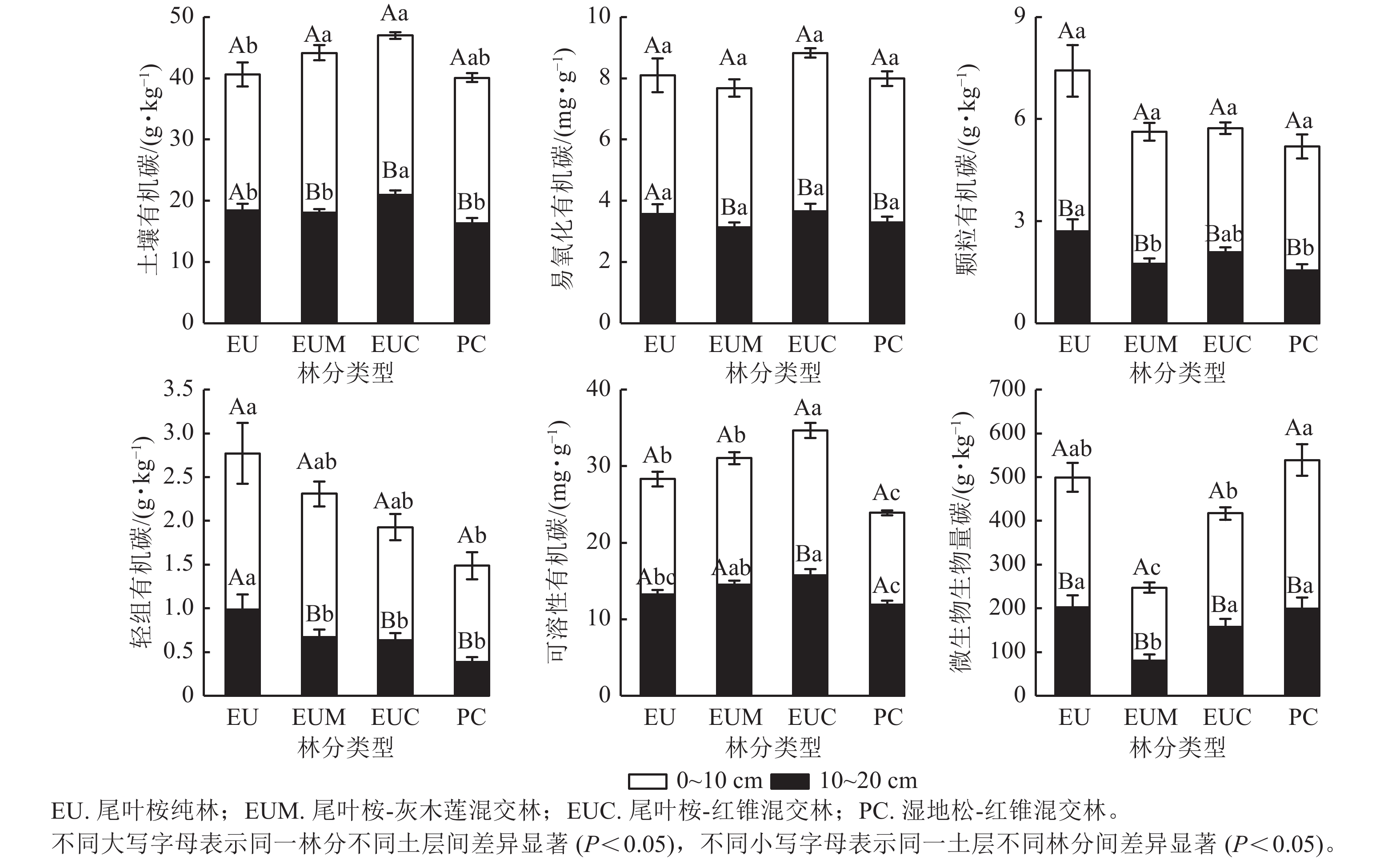
      图1所示:4种林分0~10 cm土层土壤有机碳及其活性组分质量分数普遍显著高于10~20 cm土层(P<0.05),符合土壤养分的垂直分异特征。0~10 cm土层对比来看,尾叶桉纯林土壤有机碳显著低于尾叶桉-红锥和尾叶桉-灰木莲混交林(P<0.05);易氧化有机碳、颗粒有机碳在不同林分间无显著差异,尾叶桉纯林轻组有机碳显著高于湿地松-红锥混交林(P<0.05),尾叶桉-红锥混交林可溶性有机碳显著高于其他林分(P<0.05),湿地松-红锥混交林微生物生物量碳显著高于除尾叶桉纯林外的其他林分(P<0.05)。10~20 cm土层,尾叶桉-红锥混交林土壤有机碳显著高于其他林分(P<0.05),易氧化有机碳在不同林分间无显著性差异,尾叶桉纯林颗粒有机碳、轻组有机碳显著高于其他林分(P<0.05),尾叶桉-红锥混交林可溶性有机碳显著高于除尾叶桉-灰木莲混交林外的其他林分 (P<0.05),尾叶桉-灰木莲混交林微生物生物量碳显著低于其他林分(P<0.05)。
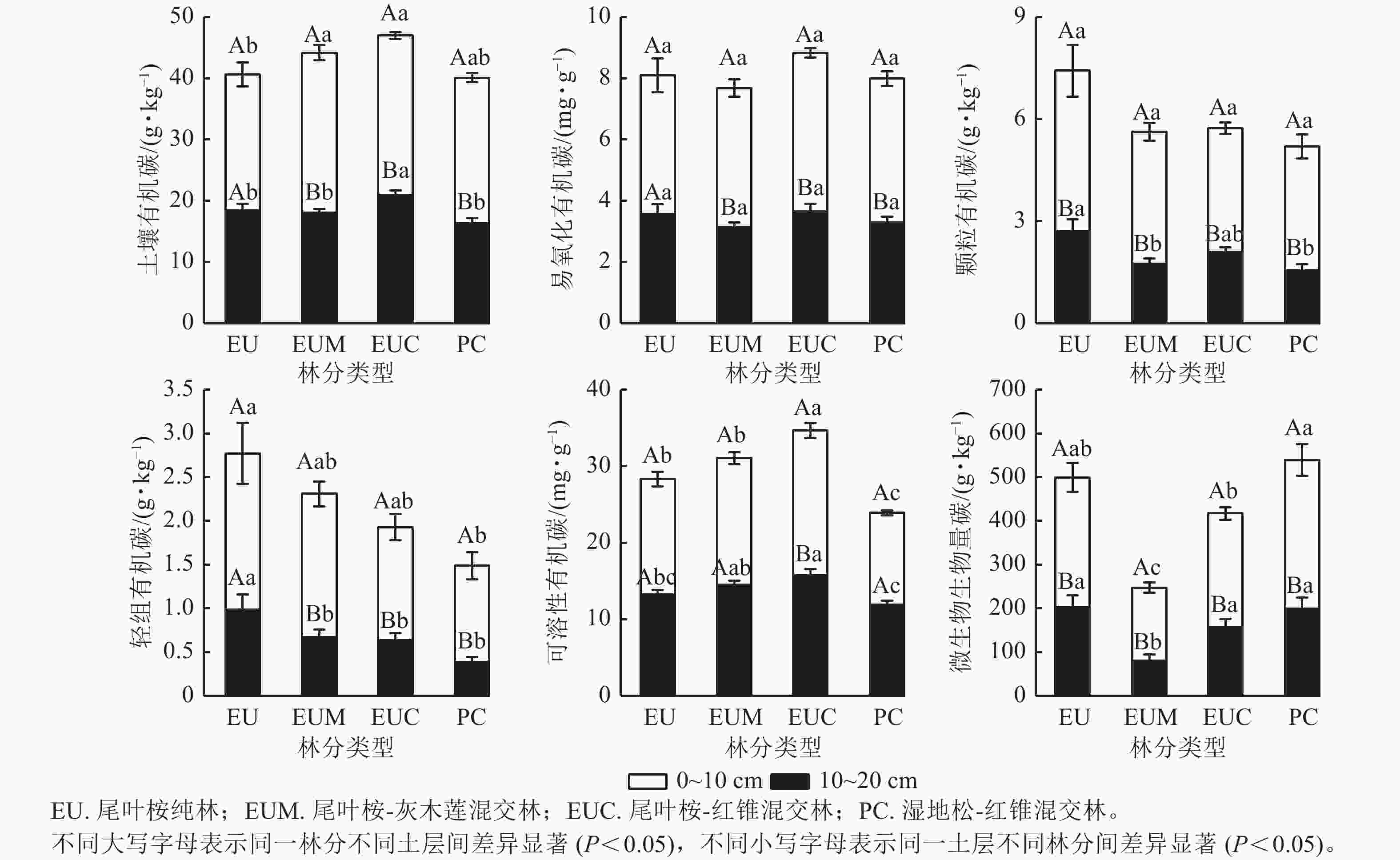
      Figure 1.  Differences in soil organic carbon and its labile components among different forest stands

      表3双因素方差分析结果表明:林分类型和土层深度对土壤有机碳及其活性组分质量分数均具有显著的主效应(P<0.05),但两者的交互作用不显著。

      因变量 变异来源 自由度 F P 因变量 变异来源 自由度 F P
      土壤有机碳 林分类型 3 4.598 0.006 轻组有机碳 林分类型 3 5.072 0.003
      土层深度 1 62.725 0.000 土层深度 1 42.033 0.000
      林分类型×土层深度 3 1.609 0.196 林分类型×土层深度 3 0.307 0.820
      易氧化有机碳 林分类型 3 1.418 0.246 可溶性有机碳 林分类型 3 18.855 0.000
      土层深度 1 40.856 0.000 土层深度 1 11.814 0.001
      林分类型×土层深度 3 0.378 0.769 林分类型×土层深度 3 1.368 0.260
      颗粒有机碳 林分类型 3 3.792 0.014 微生物生物量碳 林分类型 3 14.048 0.000
      土层深度 1 59.778 0.000 土层深度 1 38.386 0.000
      林分类型×土层深度 3 0.272 0.845 林分类型×土层深度 3 0.502 0.682

      Table 3.  Two-way ANOVA results of the effects of stand type and soil depth on soil organic carbon and its labile components

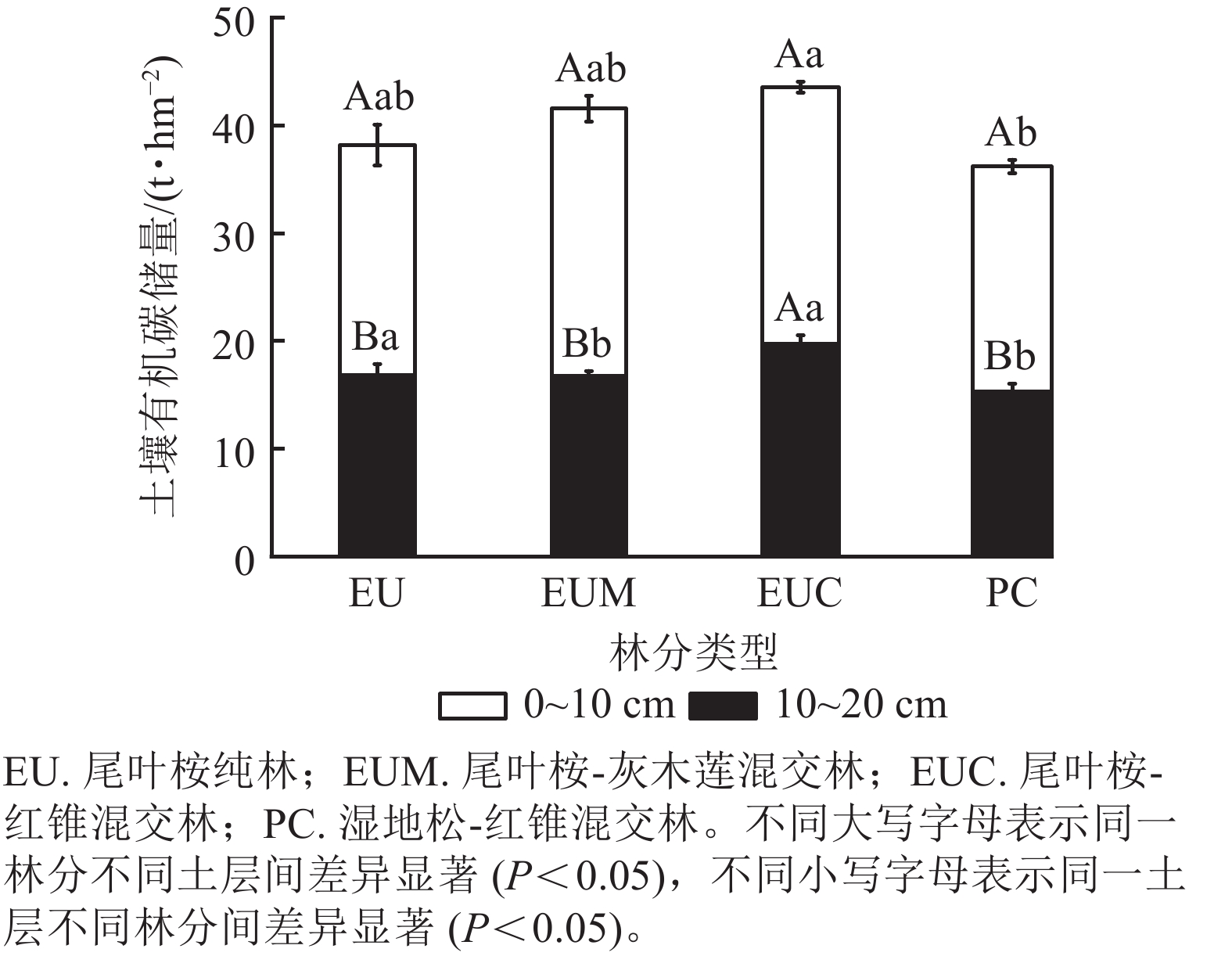
      图2可知:尾叶桉纯林、尾叶桉-灰木莲混交林、湿地松-红锥混交林0~10 cm土层土壤有机碳储量显著高于10~20 cm土层(P<0.05)。在10~20 cm土层中,尾叶桉-红锥混交林土壤有机碳储量显著高于尾叶桉-灰木莲混交林和湿地松-红锥混交林(P<0.05)。
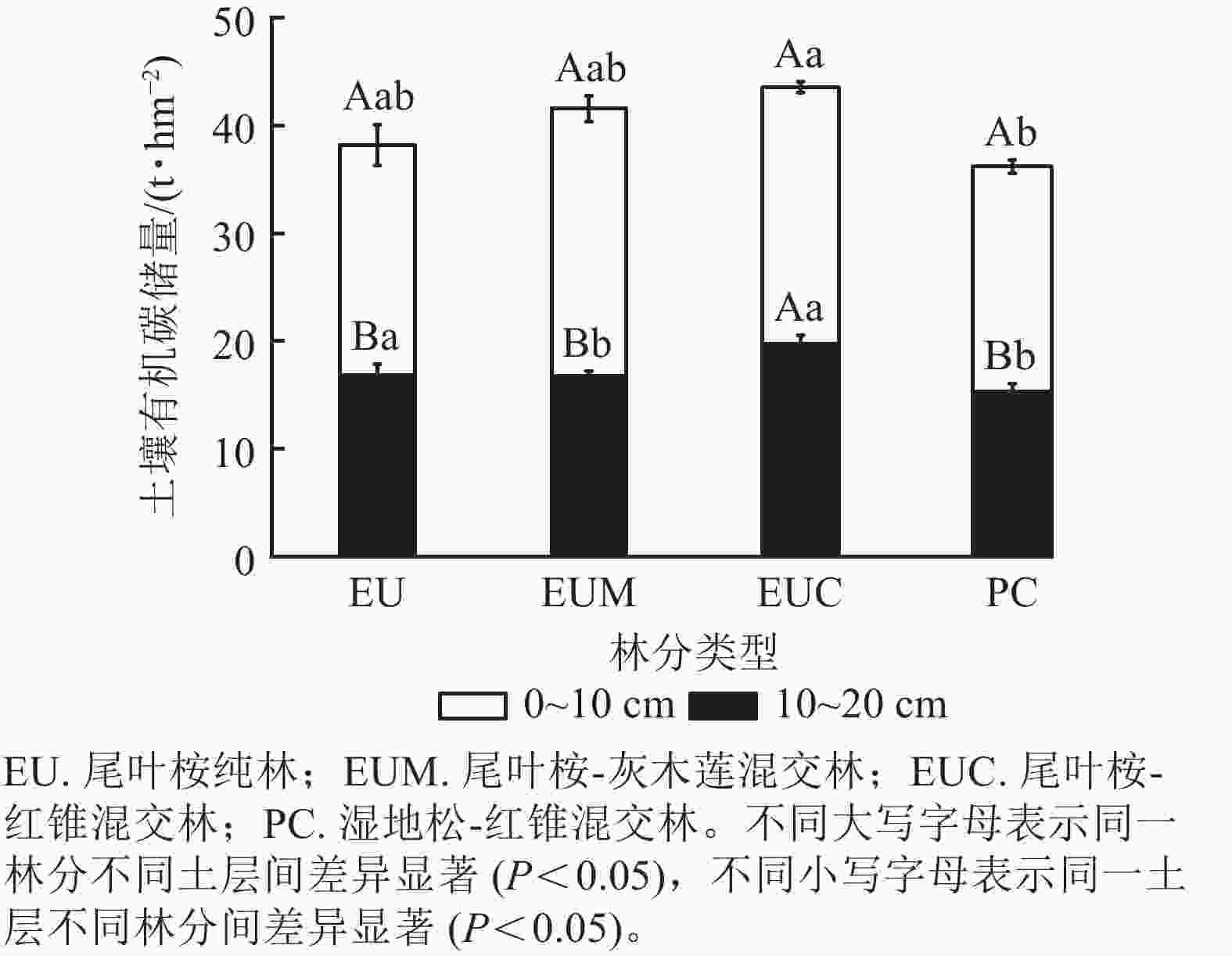
      Figure 2.  Soil organic carbon storage among different forest stands

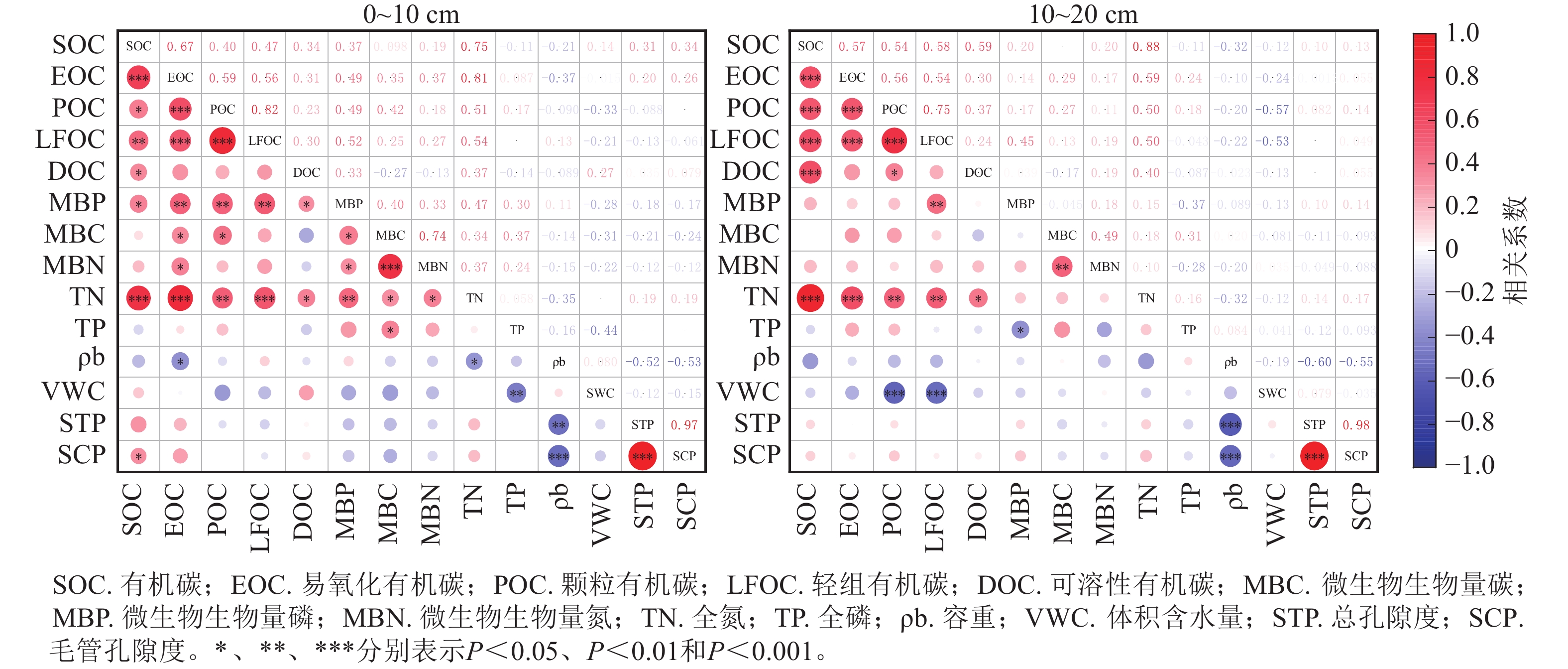
    • 在0~10 cm土层,土壤有机碳活性组分间呈现广泛且显著的正相关(图3):土壤有机碳与易氧化有机碳、颗粒有机碳、轻组有机碳、可溶性有机碳均呈显著正相关(P<0.05),易氧化有机碳与颗粒有机碳、轻组有机碳、微生物生物量碳呈显著正相关(P<0.05),颗粒有机碳与轻组有机碳、微生物生物量碳呈显著正相关性(P<0.05)。土壤有机碳及其活性组分均与微生物生物量磷(MBP)呈显著正相关(P<0.05),其中易氧化有机碳、颗粒有机碳、轻组有机碳与微生物生物量磷达极显著正相关水平(P<0.01)。土壤有机碳及其活性组分均与土壤全氮呈显著正相关(P<0.05),而且除可溶性有机碳外,其他组分与土壤全氮均达极显著水平(P<0.01)。
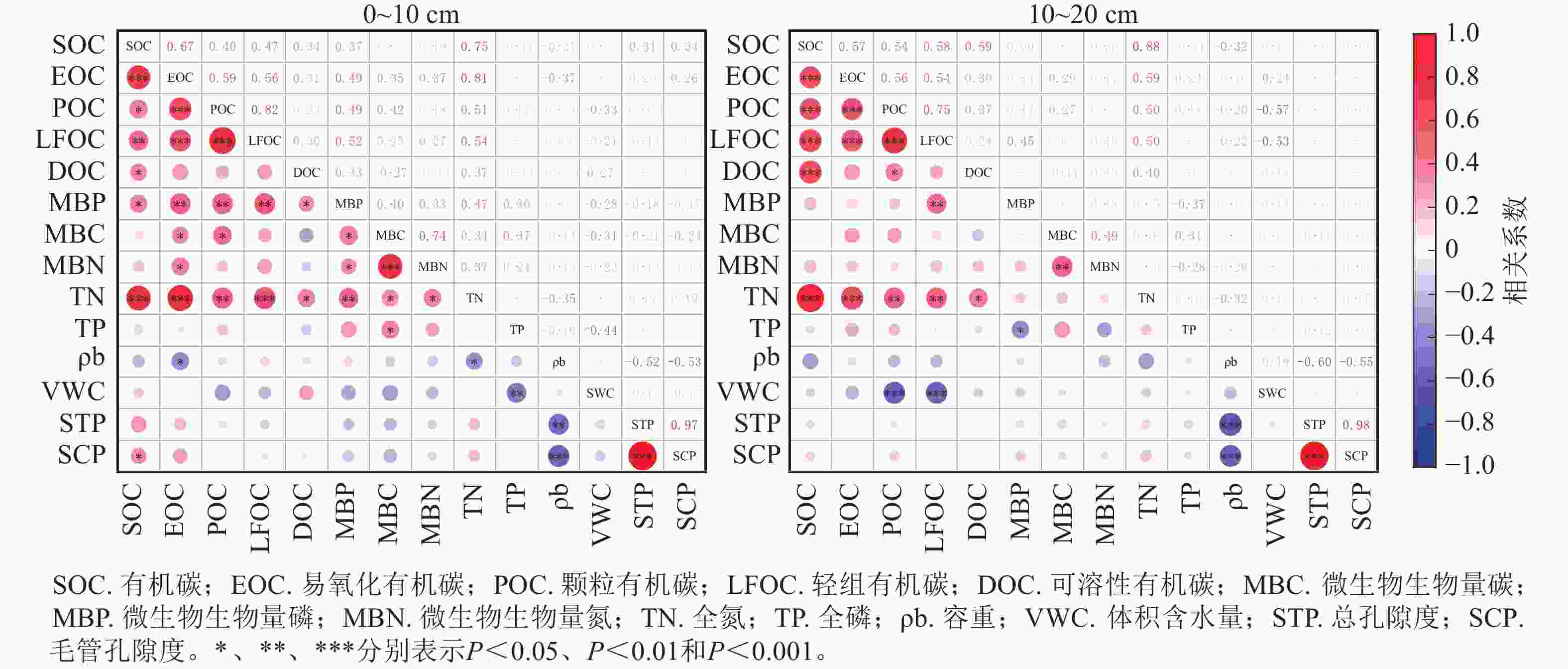
      Figure 3.  Correlation between labile components of soil organic carbon and soil physicochemical properties

      在10~20 cm土层,土壤有机碳及其活性组分间的相关性表现与0~10 cm土层基本一致。微生物生物量磷仅与轻组有机碳存在极显著正相关(P<0.01),这与0~10 cm土层差异较大。土壤全氮与土壤有机碳及其活性组分间的相关性均达显著水平(P<0.05),与0~10 cm土层表现一致。

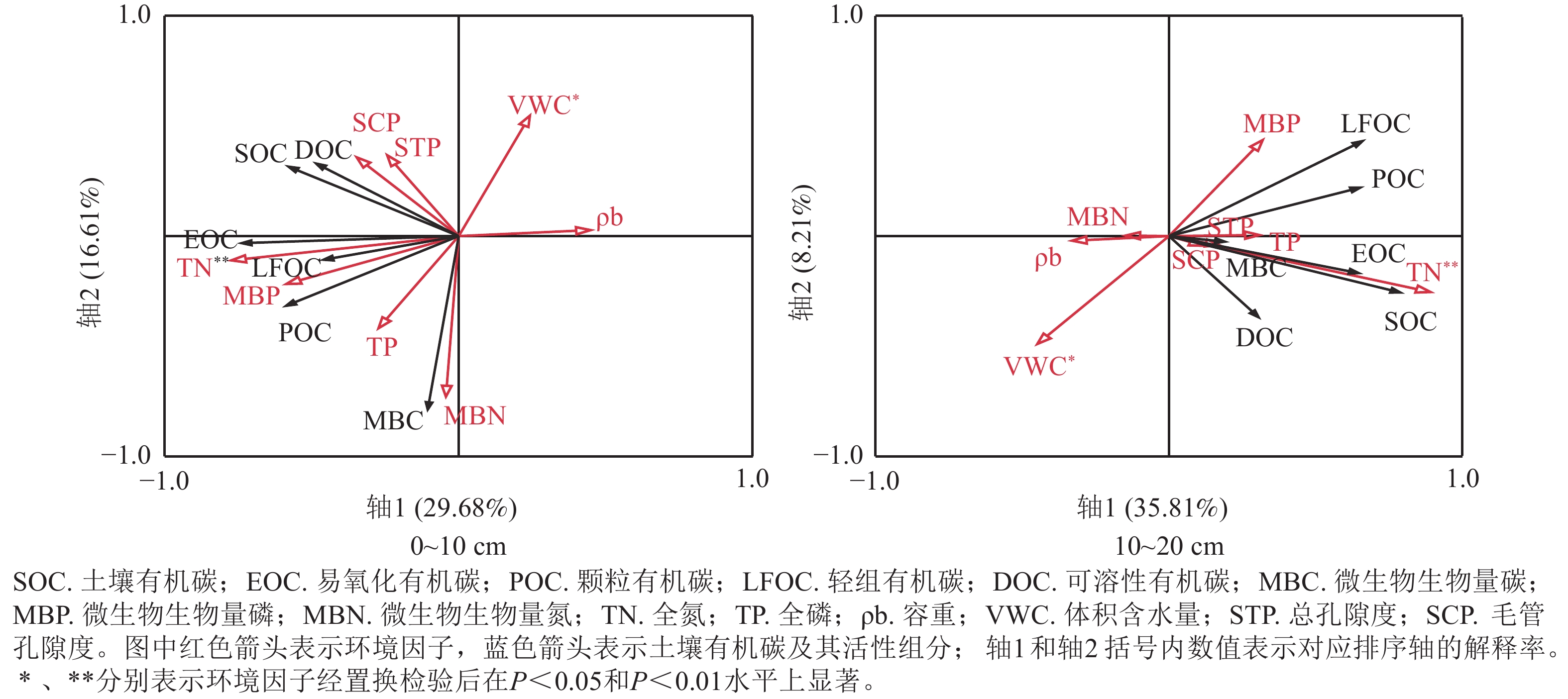
      图4的冗余分析结果可知:在0~10 cm土层中,全氮是解释土壤有机碳及其活性组分变异的最主要因子,贡献率为35.6% (P=0.004),主导了约36.0%的总变异。此外,土壤体积含水量(贡献率为13.1%,P=0.038)也显著贡献于第1轴,进一步提升了模型的解释力(前2轴累计解释46.29%)。相比之下,10~20 cm土层中,全氮仍居主导(贡献率为30.9 %,P=0.002),与土壤体积含水量(贡献率为7.8 %,P=0.038)累计解释约38.7%的变异,前2轴累计解释了总变异的44.02%。表明全氮是土壤有机碳及其活性组分的核心驱动因子。
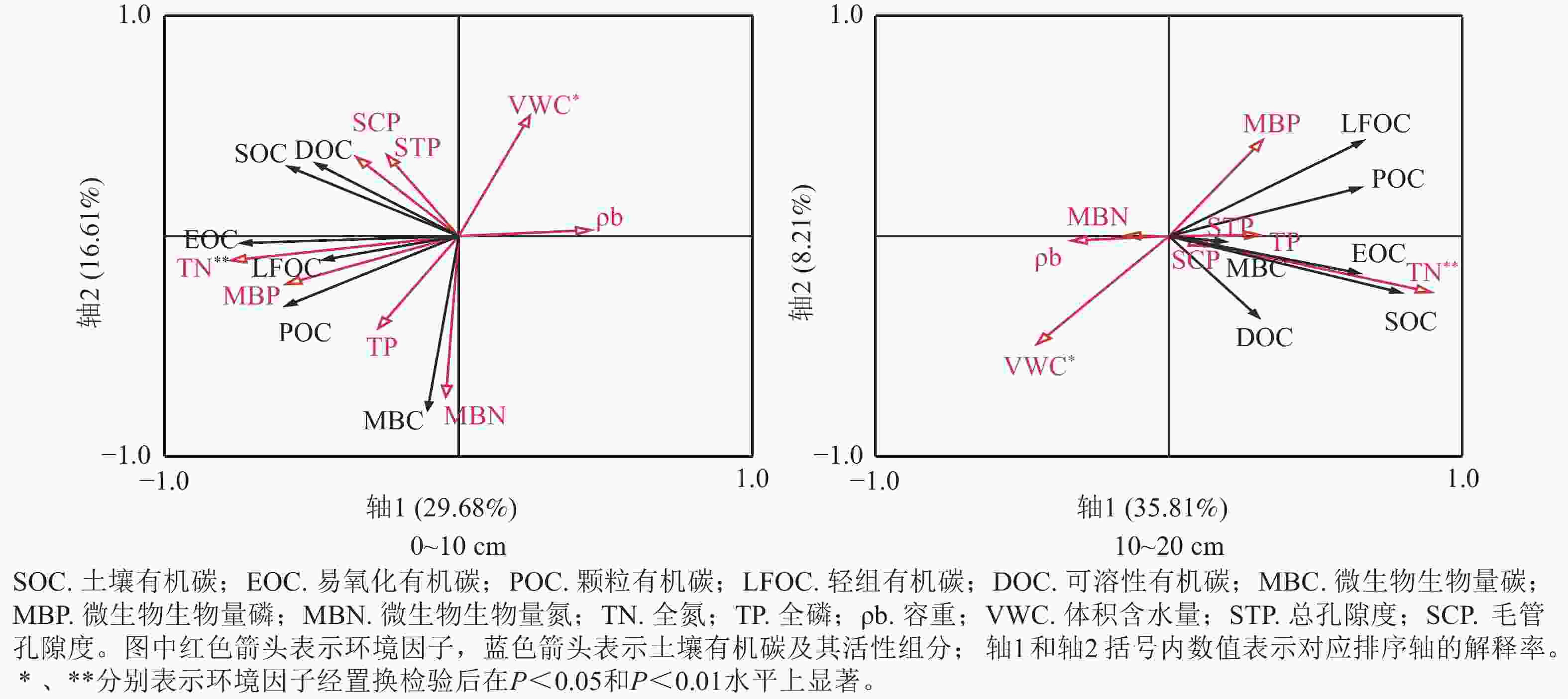
      Figure 4.  Redundancy analysis of soil organic carbon chemical compositions and environmental variables

    • 表4单因素方差分析结果可知:在0~10  cm土层,碳库活度、碳库活度指数、碳库管理指数和氧化稳定系数在不同林分间差异均不显著;尾叶桉-红锥、尾叶桉-灰木莲混交林的碳库指数显著高于尾叶桉纯林(P<0.05)。在10~20 cm土层,碳库活度、碳库活度指数和碳库管理指数在不同林分间差异均不显著,碳库指数表现为尾叶桉-红锥混交林显著高于其他林分(P<0.05)。可见,林分类型仅对碳库指数产生了一定影响。

      土层/cm 林分 碳库活度 碳库活度指数 碳库指数 碳库管理指数 氧化稳定系数
      0~10 EU 0.25±0.02 a 1.00±0.08 a 1.00±0.09 b 102.07±13.66 a 4.12±0.28 a
      EUM 0.22±0.02 a 0.85±0.06 a 1.17±0.06 a 98.78±7.01 a 4.89±0.45 a
      EUC 0.25±0.01 a 0.98±0.03 a 1.18±0.02 a 114.79±3.98 a 4.07±0.13 a
      PC 0.25±0.01 a 0.98±0.05 a 1.07±0.03 ab 104.49±6.23 a 4.13±0.22 a
      10~20 EU 0.24±0.01 a 1.00±0.06 a 1.00±0.06 b 100.79±9.51 a 4.27±0.26 ab
      EUM 0.21±0.02 a 0.88±0.07 a 0.98±0.03 b 85.99±5.91 a 4.91±0.30 a
      EUC 0.21±0.01 a 0.88±0.05 a 1.14±0.04 a 100.71±7.45 a 4.86±0.33 ab
      PC 0.26±0.02 a 1.09±0.10 a 0.89±0.04 b 94.51±6.82 a 4.04±0.30 b
        说明:EU. 尾叶桉纯林;EUM. 尾叶桉-灰木莲混交林;EUC. 尾叶桉-红锥混交林;PC. 湿地松-红锥混交林。不同小写字母表示同一土层不同林分间差异显著(P<0.05)。

      Table 4.  Soil carbon pool management index and oxidative stability among different forest stands

      表5可知:0~10 cm土层,尾叶桉纯林的颗粒有机碳/土壤有机碳和轻组有机碳/土壤有机碳显著高于其他林分(P<0.05),尾叶桉纯林的微生物生物量碳/土壤有机碳和湿地松-红锥混交林的微生物生物量碳/土壤有机碳间无显著差异,但均显著高于其他林分(P<0.05),说明尾叶桉纯林处理显著提升了颗粒有机碳和轻组有机碳占比,尾叶桉纯林和湿地松-红锥混交林处理提升了微生物生物量碳占比。10~20 cm土层有机碳活性组分占比与0~10 cm土层表现基本一致。总体而言,表层有机碳活性组分占比高于深层,尾叶桉纯林的颗粒有机碳和轻组有机碳占比更高,而湿地松-红锥混交林在微生物生物量碳占比上与尾叶桉纯林相当,显示不同处理对不同深度土壤有机碳活性组分的影响存在显著差异。

      土层/cm 林分 易氧化有机碳/
      土壤有机碳/%
      颗粒有机碳/
      土壤有机碳/%
      可溶性有机碳/
      土壤有机碳/%
      微生物生物量碳/
      土壤有机碳/%
      轻组有机碳/
      土壤有机碳/%
      0~10 EU 20.06±1.27 a 20.65±2.31 a 0.07±0.01 a 1.35±0.15 a 7.56±1.05 a
      EUM 17.63±1.08 a 15.21±1.15 b 0.06±0.00 ab 0.65±0.05 c 6.42±0.60 ab
      EUC 19.84±0.52 a 13.95±0.53 b 0.07±0.00 a 1.00±0.07 b 4.92±0.51 b
      PC 19.89±0.84 a 15.14±1.11 b 0.05±0.00 b 1.42±0.13 a 4.53±0.52 b
      10~20 EU 19.32±0.90 a 14.53±1.70 a 0.07±0.00 a 1.08±0.50 ab 5.14±0.61 a
      EUM 17.37±1.13 a 9.65±0.66 b 0.08±0.00 a 0.45±0.44 c 3.65±0.46 b
      EUC 17.46±0.89 a 9.97±0.51 b 0.08±0.00 a 0.76±0.50 bc 2.95±0.36 bc
      PC 20.52±1.43 a 9.50±0.78 b 0.07±0.00 a 1.24±0.50 a 2.32±0.28 c
        说明:EU. 尾叶桉纯林;EUM. 尾叶桉-灰木莲混交林;EUC. 尾叶桉-红锥混交林;PC. 湿地松-红锥混交林。不同小写字母表示同一土层不同林分间差异显著(P<0.05)。

      Table 5.  Proportions of soil organic carbon labile components to total soil organic carbon among different forest stands

    • 本研究中,不同林分类型及植被凋落物输入显著改变了土壤理化性质与微生物特性,进而影响土壤有机碳的固持与转化过程[2223]。总体而言,各林分0~10 cm土层土壤有机碳储量、土壤有机碳及其活性组分质量分数均表现出明显的表层富集特征,这与多数研究结果一致[2425]。植物凋落物集中在土壤表层,为有机质形成提供了充足的底物。表层土壤通透性好、微生物多样性高,有利于凋落物的快速分解[26];随着土层加深,凋落物分解作用强度减弱,导致深层土壤碳固存能力下降[27]

      在0~10 cm土层,尾叶桉-红锥和尾叶桉-灰木莲混交林土壤有机碳显著高于尾叶桉纯林。混交林通过改善凋落物的数量和质量,促进土壤结构变化和养分积累,并提高了微生物活性,从而加速了凋落物分解和根际资源周转,最终促进土壤有机碳积累[2829]。相比之下,湿地松-红锥混交林土壤有机碳储量和土壤有机碳质量分数与尾叶桉纯林差异不显著。这可能是因为红锥属于阔叶树种,凋落物多且易分解,而湿地松作为针叶树种,其革质叶片透水性差,凋落物难分解,从而抵消了混交林对土壤有机碳积累的正效应[3031]。此外,试验地湿地松于2007年种植,红锥于2017年引入种植,混交林建立时间较短。土壤碳库响应的滞后性,也是导致土壤有机碳质量分数未显著提升的原因之一[3233]

      在10~20 cm土层,尾叶桉-红锥混交林土壤有机碳储量与土壤有机碳质量分数高于其他3种林分。这可能是该混交模式能够显著提高该土层全氮质量分数,进而改变土壤微生物组成和结构,减缓了木质素等难降解组分的矿化速率,降低土壤呼吸作用,从而促进了深层土壤碳的稳定积累[3435]

      关于活性碳组分,颗粒有机碳由未完全分解或半分解的植物残体以及栖息的小型动物残体和微生物群落组成[36],轻组有机碳主要由周转速率快且密度较低的新鲜的植物残体、部分分解的有机碎屑以及一些微生物细胞组成,其质量分数主要由有机残留物的输入和分解速率决定[37]。在本研究中,颗粒有机碳和轻组有机碳呈极显著正相关,并且在尾叶桉纯林中质量分数最大,与多数研究结论不一致[8, 38]。这可能是因为尾叶桉纯林虽然凋落物输入量较大,但叶片和树皮等富含单宁、萜烯类次生代谢物[39],这些化学物质抑制了微生物活性并干扰酶表达,导致有机物质分解不彻底,残留了大量颗粒有机碳和轻组有机碳。同时,也可能是尾叶桉纯林土壤团聚体有机质较少,总有机碳趋于活化,易被微生物和细根利用[40]

      本研究中,尾叶桉-红锥混交林2个土层中的可溶性有机碳,除10~20 cm土层尾叶桉-灰木莲混交林外,显著高于其他林分。这可能是由于红锥根系分泌了更多小分子有机酸和糖类,增强了根际碳淀积过程[41];或其根系结构和孔隙分布改善了土壤团聚体结构和水分涵养能力,利于可溶性有机碳在土壤剖面内的滞留,使其被矿物颗粒吸附或由微生物同化转化为稳定有机碳,而非被迅速淋溶出土体[4243]

      微生物生物量碳是评估土壤微生物活性和有机质动态的重要指标[44]。在0~10 cm土层,湿地松-红锥混交林微生物生物量碳显著高于尾叶桉-灰木莲混交林和尾叶桉-红锥混交林,表明该混交模式可能通过互补的凋落物质量与数量提升了养分有效性和微生境异质性[45],从而加速了微生物群落生长与固碳。然而,在10~20 cm土层,尾叶桉-灰木莲混交林微生物生物量碳却显著低于其他林分,可能是该树种组合在此土层中有较强的养分竞争,或根系分泌物产生了抑制效应,限制了微生物的活性与生物量积累[46]

    • 森林土壤碳库的循环和周转速率通常用土壤活性有机碳组分与总有机碳比值(如颗粒有机碳/土壤有机碳、轻组有机碳/土壤有机碳)来表示[47]。WANG等[48]认为:比值越高代表土壤有机碳的生物可利用度越大也越不稳定[49]。本研究中,尾叶桉纯林的颗粒有机碳/土壤有机碳和轻组有机碳/土壤有机碳显著高于其他林分,表明该种植模式可能促进土壤有机碳矿化,使土壤碳库稳定性较低,增加碳排放风险。尽管湿地松-红锥混交林的微生物生物量碳/土壤有机碳较高,暗示其土壤生物肥力较高[50],但这可能与不稳定有机碳作为微生物基质被快速吸收利用有关[51]。相反,尾叶桉-红锥混交林在2个土层中的碳库指数均显著高于尾叶桉纯林。这表明该混交模式能够显著提升碳汇能力,其机制可能在于提高了土壤氮、磷质量分数,缓解了对微生物生长的限制,从而加快了活性碳的转化并提升了碳库稳定性。

      本研究中4种林分的碳库活度和碳库活度指数无显著差异,表明4种林分均未能显著改变表层土壤有机碳的活性组分比例。这可能是因为活性碳组分积累到一定值达到饱和,多余的活性有机碳向未定态碳转化[52],从而导致尽管不同林分的土壤有机碳和活性碳组分质量分数不同,但碳库活度和活度指数无显著差异。

      碳库管理指数是土壤碳库指标和土壤碳库活度指标的综合参数,能反映土地管理的科学性,指示土壤碳库是否稳定和土壤性能是否向良性发展[53]。碳库管理指数通常由易氧化有机碳转化计算得出,但VIEIRA等[54]指出:该指标在部分热带地区土壤中的响应并不敏感,与本研究结果一致。这揭示在特定区域或特定条件下,碳库管理指数对森林管理措施的响应可能不够敏感。相关分析显示:2个土层的轻组有机碳和土壤有机碳呈极显著正相关,相关系数分别为0.47和0.58,与易氧化有机碳和土壤有机碳的相关系数(分别为0.67和0.57)相近。该结果表明:轻组有机碳能较好地反映土壤有机质动态变化,但能否将其用于计算碳库管理指数仍有待进一步验证。

      土壤碳的氧化稳定性与腐殖质抗分解能力直接相关[55]。本研究中,湿地松-红锥混交林土壤碳的氧化稳定性系数较低,反映该地土壤有机质活性增强和土壤肥力释放潜力得到提升,可能与该特定树种组合有更稳定的氮素养分循环机制有关[56]

    • 相关分析表明:土壤全氮和体积含水量与有机碳组分具有强相关性。冗余分析表明:土壤有机碳及其组分在不同林分之间具有较好的分异性,说明全氮是影响不同林分以及土层深度土壤有机碳及其组分的最主要环境因子。氮是土壤中重要的营养元素,会通过影响养分利用性缓解土壤微生物的氮限制,改变土壤微生物群落结构,促进酶的生产,加速有机质的分解和转换,最终影响土壤有机碳及其活性组分的质量和分布[57]。本研究中,尾叶桉-红锥混交林的全氮质量分数显著高于尾叶桉-灰木莲混交林和湿地松-红锥混交林,这不仅加快了土壤有机碳的分解速率,还导致其可溶性有机碳高于其他林分。

      不同林分在不同程度上改善土壤孔隙度和持水能力,使林分间土壤体积含水率不同。土壤水分通过影响土壤氧化还原电位和微生物活性,促进或抑制有机物矿化,改变土壤碳积累[58]。在10~20 cm土层,尾叶桉纯林的颗粒有机碳和轻组有机碳显著高于尾叶桉-灰木莲混交林和湿地松-红锥混交林,且体积含水量与颗粒有机碳和轻组有机碳呈极显著负相关。这可能是因为取样时间正值旱季,尾叶桉纯林较其他林分有较强的吸水能力及水分利用效率,导致其土壤含水量偏低[59],迫使植物将更多碳分配给地下部分,增加细根生物量和周转率,短期内刺激了颗粒有机碳和轻组有机碳的形成和积累[60]

      根系的动态变化和分解过程对土壤碳循环有重要意义[61]。全年中植物根系死亡和更替持续发生,不断向土壤输入有机质。有研究认为:较高的根系凋落物输入通过影响土壤有机碳矿化速率,改变土壤有机碳固存量[62],并且丰富的根系生物量能为土壤微生物提供充足的代谢底物,促进微生物更多的分泌酶参与有机质分解代谢,最终影响土壤碳周转[63]。后续研究中有必要量化土壤根系生物量对土壤有机碳及其活性碳组分的影响特征,以找到土壤碳库变化的控制因素。

    • 本研究表明:不同种植模式可显著改变雷州半岛人工林表层土壤有机碳储量和活性有机碳组分的分布。尾叶桉-红锥混交林土壤有机碳储量在2个土层中积累量均高于其他3个林分;尾叶桉纯林在颗粒有机碳和轻组有机碳上呈现更高的积累量;尾叶桉-红锥混交林在土壤有机碳、易氧化有机碳和可溶性有机碳上呈现更高的积累量;尾叶桉纯林和湿地松-红锥混交林的在微生物生物量碳上呈现更高的积累量。

      在本研究条件下,尾叶桉-红锥混交林在2个土层中碳库指数均显著高于尾叶桉纯林,表明相较于尾叶桉纯林,该混交模式能够提高土壤碳库稳定性;湿地松-红锥混交林土壤氧化稳定系数在不同林分中最低,表明该种植模式下土壤有机碳的化学氧化稳定性最低,土壤碳库稳定性较差。

      土壤全氮质量分数是影响土壤有机碳及其活性组分的质量和分布的重要因子。在该地区营林时,建议采用尾叶桉-红锥种植模式,以增加地区土壤有机碳储量和碳库稳定性。同时,经营过程中需及时监测土壤全氮,避免全氮质量分数较低,维持土壤碳库的稳定性与固碳潜力。

Reference (63)

Catalog

    /

    DownLoad:  Full-Size Img  PowerPoint
    Return
    Return