






-
土壤呼吸(Rs)是陆地生态系统中仅次于总初级生产力的第二大碳通量,其任何微小变动都将显著影响碳循环[1]。城市是人类活动高度集中的地表区域[2],预计到2030年,城市土地面积将增加120万km2,将是2000年城市土地面积的3倍[3−4]。随着城市化进程的加速,城市生态系统在碳循环中的作用日益凸显。一方面,大部分人为产生的二氧化碳(CO2)排放源自城市地区[5];另一方面,城市地区的碳储存能力正在增强[6−7],这有助于减缓大气中CO2浓度的上升,进而缓解温室效应。当前,城市生态系统碳循环研究已经成为气候变化应对策略的热点之一[8],其中城市森林作为城市生态系统的重要组成部分,为城市生态系统贡献了最大的初级生产力,是城市地区的重要碳汇,对缓解气候变化有至关重要的作用[9−10]。因此,探究城市森林土壤呼吸的时空动态及其环境调控机制,对于城市扩张背景下绿地碳汇功能的准确评估至关重要。
土壤呼吸具有很强的时空异质性[11]。已有大量研究证实:土壤呼吸季节变化主要受土壤温度和湿度的调控[10, 12]。然而,不同植被类型因其地表覆盖特征、土壤环境及养分含量的差异,对环境因子的响应机制可能存在显著分异[13]。例如,乔木群落与灌木群落的土壤呼吸对温度的敏感性可能存在显著差异[14]。土壤呼吸的空间变异受环境因素和生物因素的共同调控[15−16],但其具体机制仍存在争议。一些研究表明:土壤呼吸空间变异与土壤温度呈极显著正相关,而与土壤水分无显著相关性[17];另一些研究则发现:土壤呼吸空间变异与土壤温度呈极显著负相关,与土壤水分呈显著正相关[18]。此外,冠层结构(如叶面积指数、归一化植被指数)以及样地内树种的平均胸径和根系生物量也被证实是土壤呼吸空间变异的关键调控因素[10, 19−21]。这些研究结果的差异反映了土壤呼吸空间变异驱动机制的复杂性。尽管已有研究对土壤呼吸的季节响应和空间变异进行了初步探讨,但针对城市森林生态系统的研究仍较为有限。特别是不同植被类型土壤呼吸对环境因子的季节响应机制,以及环境因素与生物因素如何共同驱动土壤呼吸的空间变异,仍是当前研究的热点与难点[22−23]。因此,仍需对城市森林土壤呼吸展开进一步的研究分析。
北京奥林匹克森林公园作为北京中轴线北端的“城市绿肺”,其植被群落在2008年建成后历经15 a演替形成稳定结构,呈现半自然-人工复合生态系统的典型特征,为研究城市环境下的植被-土壤系统耦合作用提供了理想对象。区别于传统城市绿地,该公园采用“近自然林”营建技术(乡土树种占比较高、分层混交种植),其土壤呼吸动态更精准反映了人工干预下生态系统的碳循环特征。此外,其特殊水文设计(南园人工湖群与北园自然溪流系统)形成了梯度化的土壤水分条件,更为探究水分-温度双因子对土壤呼吸的交互影响提供了天然实验场域。基于此,本研究于2023年4—10月在北京奥林匹克森林公园随机布设26个测量点(包括乔木群落和乔灌混交群落各13个),并每月进行土壤呼吸观测。通过连续记录的土壤温度、土壤含水量及高分辨率植被指数数据,定量分析环境与生物因素对土壤呼吸时空变化的贡献,以期为气候变化背景下区域碳循环的可持续发展提供理论依据和决策参考。
-
研究区位于北京市朝阳区奥林匹克森林公园(40°01′N,116°23′E)。该公园建于2008年,占地680 hm2,植被覆盖率为95.6%,是亚洲最大的城市森林公园。研究区限制游客进入,以尽量减少人为干扰的影响。该地区地处暖温带,属典型的半湿润大陆型季风气候。年平均气温为14.0 ℃,最冷月1月的平均气温为−7.0 ℃,最热月7月的平均气温为26.0 ℃。年平均降水量为600.0 mm,80%降水集中在6—8月。土壤以潮土型为主,土壤容重为1.62 g·cm−3,孔隙度为40.3%,pH为7.8。
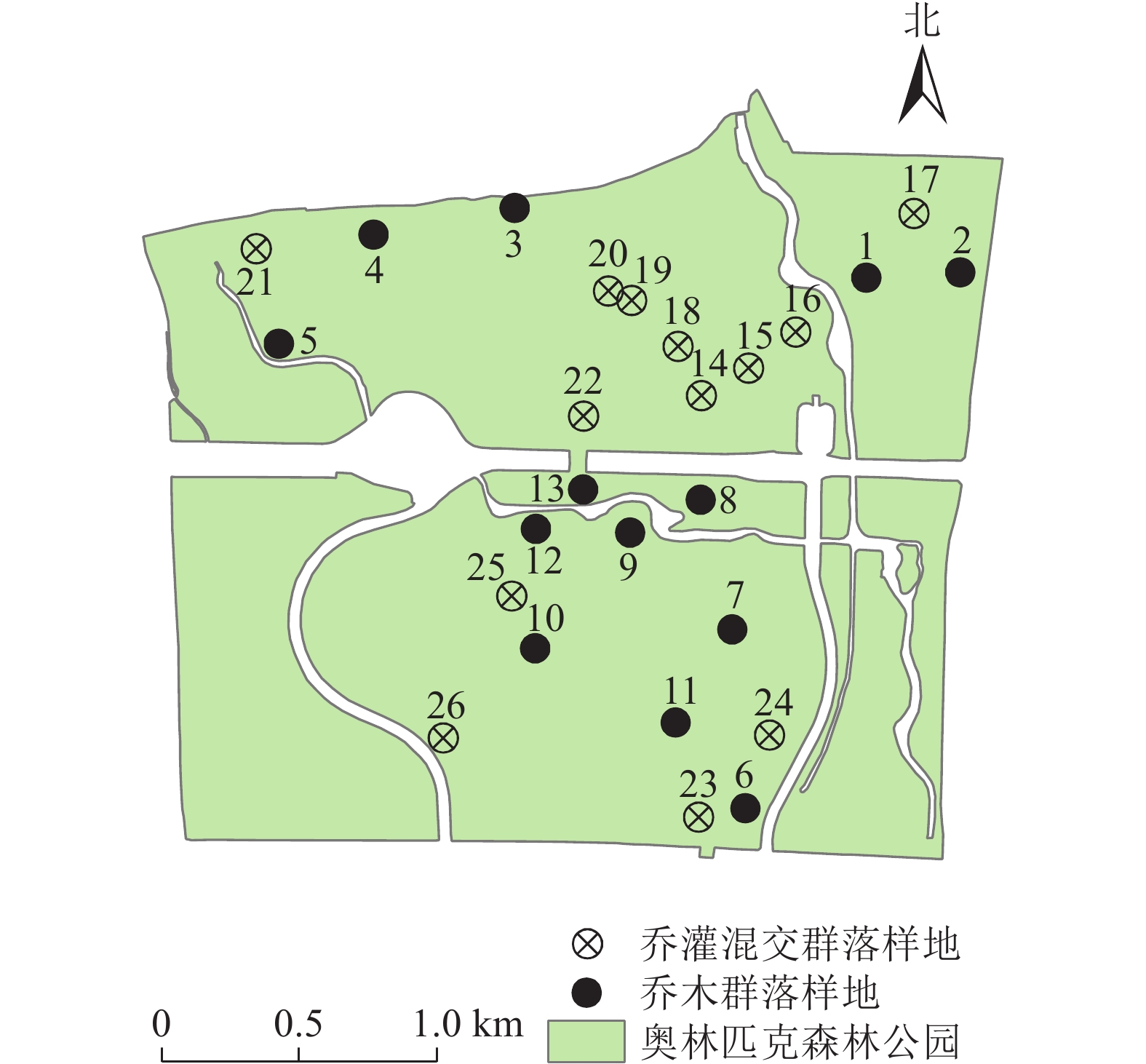
在园内乔木群落和乔灌混交群落分别随机布设13个20 m × 20 m的样地,共布设26个样地(图1)。乔木群落主要树种包括油松Pinus tabuliformis、元宝枫Acer truncatum、毛白杨Populus tomentosa、侧柏Platycladus orientalis等。乔灌混交群落主要树种包括银杏Ginkgo biloba、白榆Ulmus pumila、山杏Prunus sibirica、大叶早樱Cerasus subhirtella、三叶海棠Malus sieboldii等。
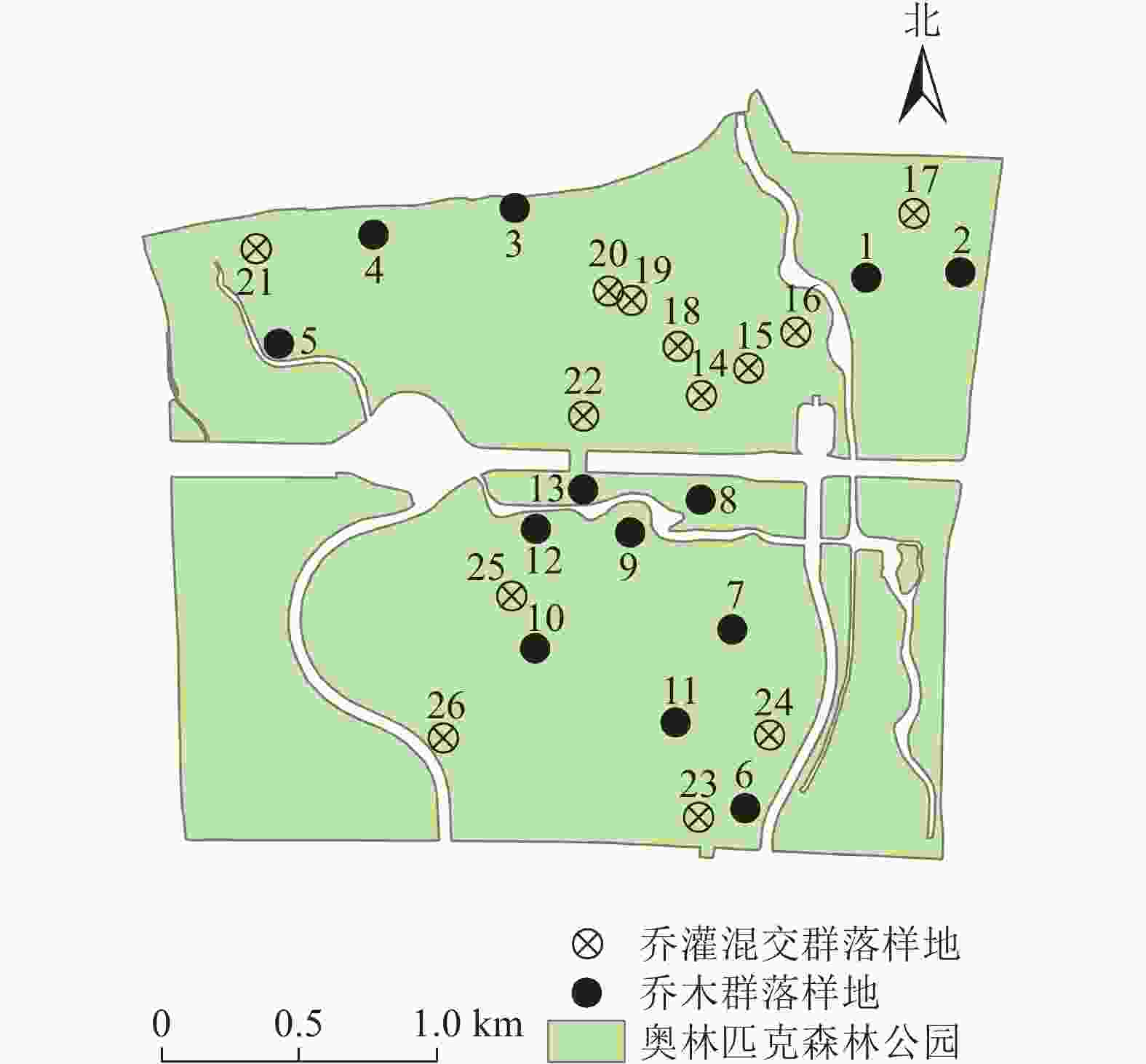
图 1 研究区地理位置示意图
Figure 1. Geographic locations of the study area
-
2023年3月,使用五点法在每个样地中选取5个样点。将一端削尖、直径20 cm、高约10 cm的聚氯乙烯环插入每个样点的土壤中,深度为6 cm。在安放聚氯乙烯环时,清除环内的地表植物和杂物,并定期修剪再生植物,以防止环内存在地上CO2通量。在2023年4—10月的每月中下旬选择7个晴朗的观测日,使用Li-7810便携式土壤呼吸测量仪对土壤呼吸进行测量,所有样点的测量均在8:30—11:00完成。测量时,将Li-7810自带的气室扣在聚氯乙烯环上,轻微转动气室直至稳定,形成密闭气室。每个聚氯乙烯环重复测量3次,每次测量时长为120 s。气路吹扫时长为30 s。每个样地测量15组数据,取其均值作为该样地的土壤呼吸值。
测定土壤呼吸的同时,将Li-7810便携式土壤呼吸测量仪自身携带的土壤温湿度探头插入土壤约10 cm深处同步进行测量,获取10 cm土层深度的土壤温度(Ts)和土壤含水量(CSW)。
研究时段内的归一化植被指数(INDV)遥感数据源于地理空间数据云平台提供的Landsat系列卫星影像。根据研究目的,选取2023年春季和秋季的Landsat 8陆地成像仪(OLI)卫星遥感影像,空间分辨率为30 m。使用ArcMap 10.8.1提取研究区各样点的归一化植被指数数据。
-
用线性函数拟合土壤呼吸与土壤温度、土壤含水量及归一化植被指数的关系[24−25]。计算公式如下:
$$ {R}_{{\mathrm{s}}}=a{T}_{{\mathrm{s}}}+b\text{;} $$ (1) $$ {R}_{{\mathrm{s}}}=c{C}_{{\mathrm{SW}}}+d\text{;}$$ (2) $$ {R}_{{\mathrm{s}}}={\mathrm{e}}{I}_{{\mathrm{NDV}}}+f。 $$ (3) 式(1)~(3)中:$ {R}_{{\mathrm{s}}} $为土壤呼吸(μmol·m−2·s−1);$ {T}_{{\mathrm{s}}} $为土壤温度(℃);CSW为土壤含水量(%);INDV为归一化植被指数;$ a\mathrm{、}b\mathrm{、}c\mathrm{、}d、e、f $均为系数。
用一元二次函数拟合乔木群落土壤呼吸与土壤温度的空间关系。计算公式如下:
$$ {R}_{{\mathrm{s}}}=a_1{T}_{{\mathrm{s}}}^{2}+b_1{T}_{{\mathrm{s}}}+c_1。 $$ (4) 式(4)中:$ a_1\mathrm{、}b_1\mathrm{、}c_1 $均为系数。
土壤呼吸季节变化和空间变化与土壤温度、土壤含水量的双因子模型均为线性函数[16]。计算公式如下:
$$ {R}_{{\mathrm{s}}}=a_2{T}_{{\mathrm{s}}}+b_2{C}_{{\mathrm{SW}}}+c_2。 $$ (5) 式(5)中:$ a_2\mathrm{、}b_2\mathrm{、}c_2 $均为系数。
运用Pearson相关分析方法分析各月土壤呼吸与土壤温度、土壤含水量、INDV之间的相关关系。以上分析和作图均使用SPSS 26.0、R 4.3.1以及Origin 2024软件进行。
-
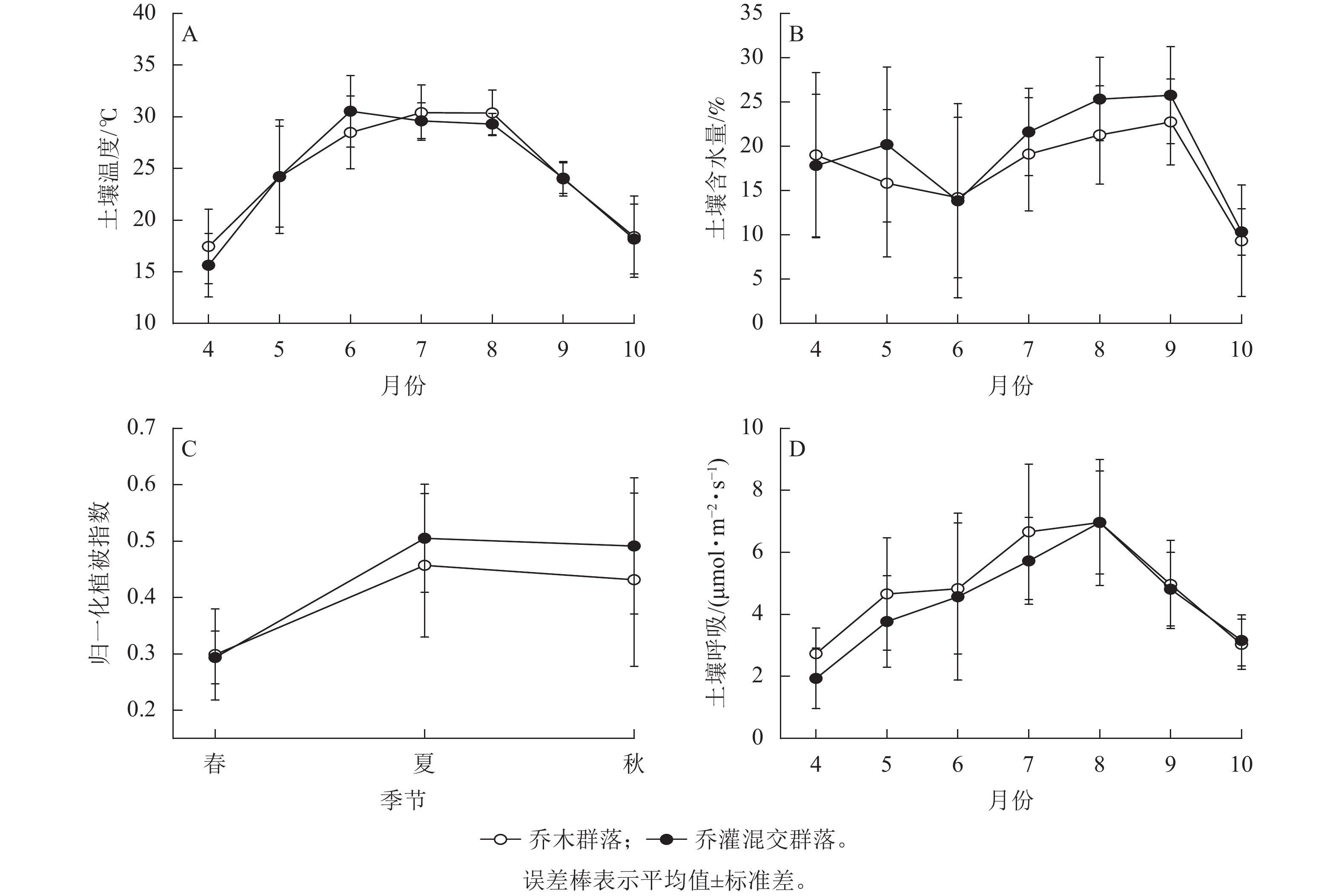
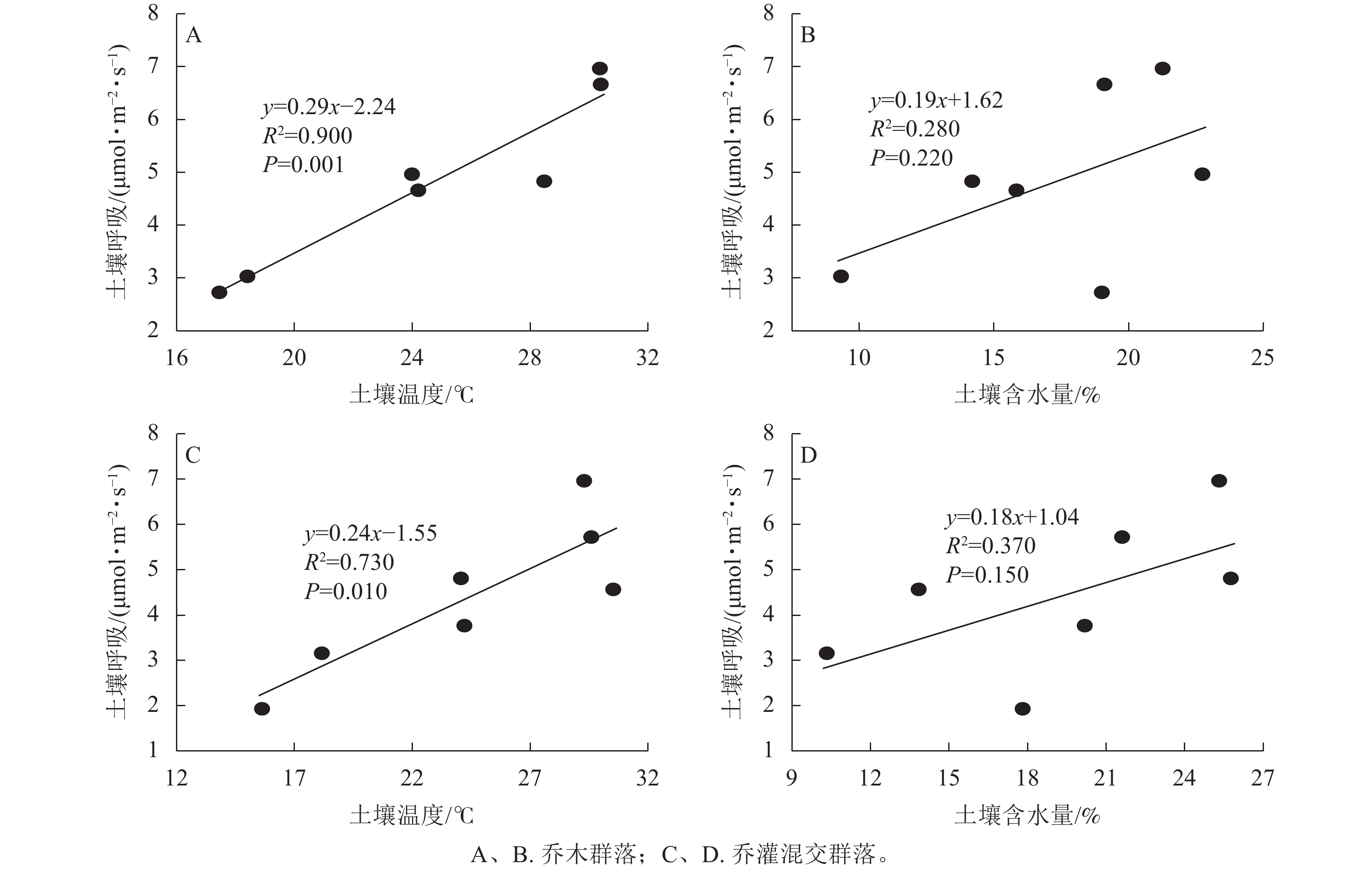
土壤温度、土壤含水量和土壤呼吸存在明显的季节性变化。土壤温度从4月开始上升,在6—8月达到峰值,随后逐渐降低(图2A),不同植被类型间没有显著差异。土壤含水量在10月最低(10%),9月最高(24%),乔灌混交群落土壤含水量比乔木群落高11.3% (图2B)。2种植被型归一化植被指数从大到小均依次为夏季、秋季、春季(图2C)。乔木群落和乔灌混交群落土壤呼吸生长季均值分别为4.83和4.42 μmol·m−2·s−1,其季节变化与土壤温度相似,在8月达到最大值(6.96 μmol·m−2·s−1) (图2D)。由图3可见:在季节变化上,乔木群落和乔灌混交群落土壤呼吸均与土壤温度呈极显著正相关[决定系数(R2)分别为0.90和0.73,P<0.01],而与土壤含水量相关不显著。土壤温度与土壤含水量的双因子模型提高了对乔木群落和乔灌混交群落土壤呼吸的拟合度,R2分别为0.93和0.82 (表1)。
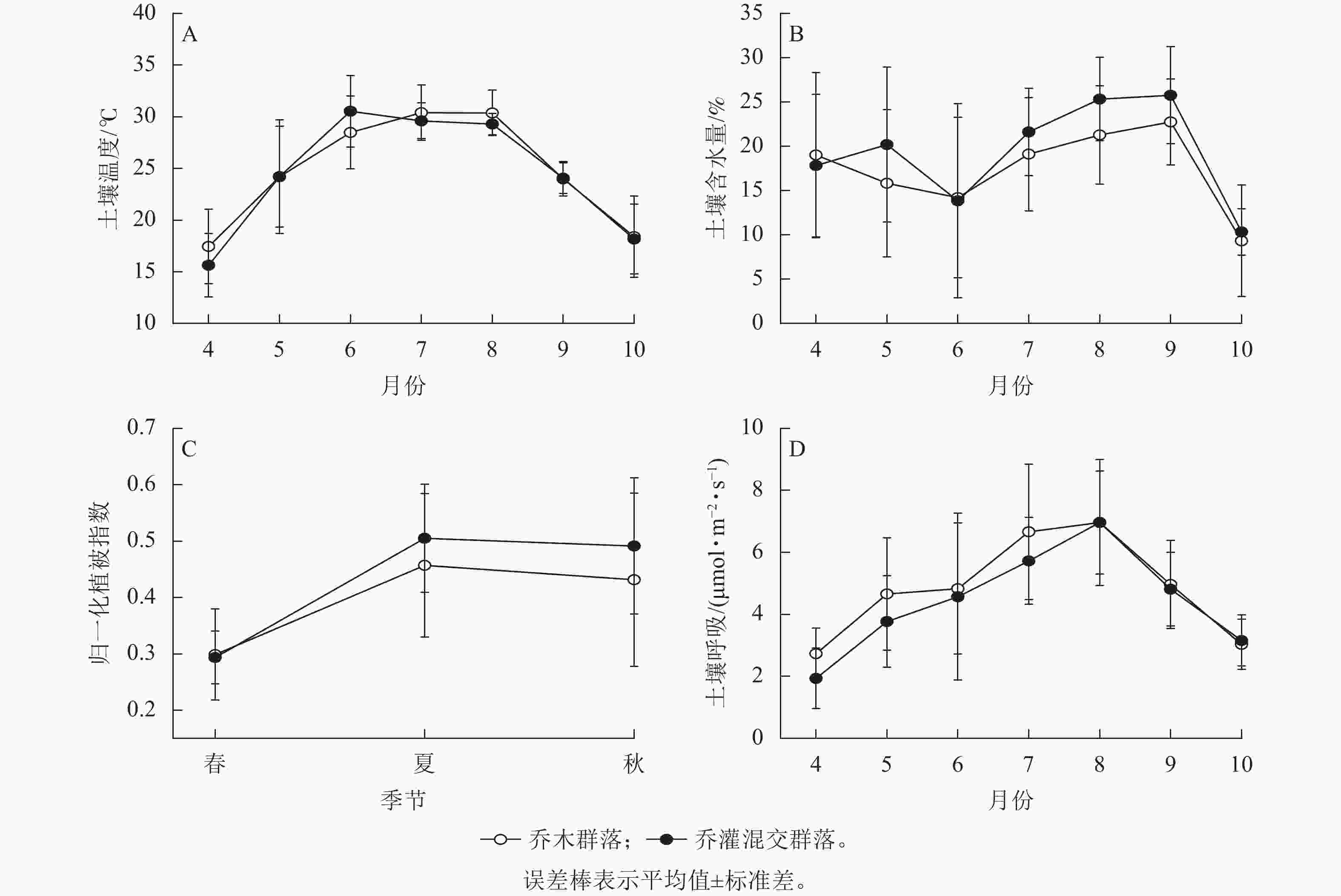
图 2 不同植被类型土壤温度(A)、土壤含水量(B)、归一化植被指数(C)和土壤呼吸(D)的季节变化
Figure 2. Seasonal variation of soil temperature (A), soil water content (B), normalized difference vegetation index (C) and soil respiration (D) across different vegetation types
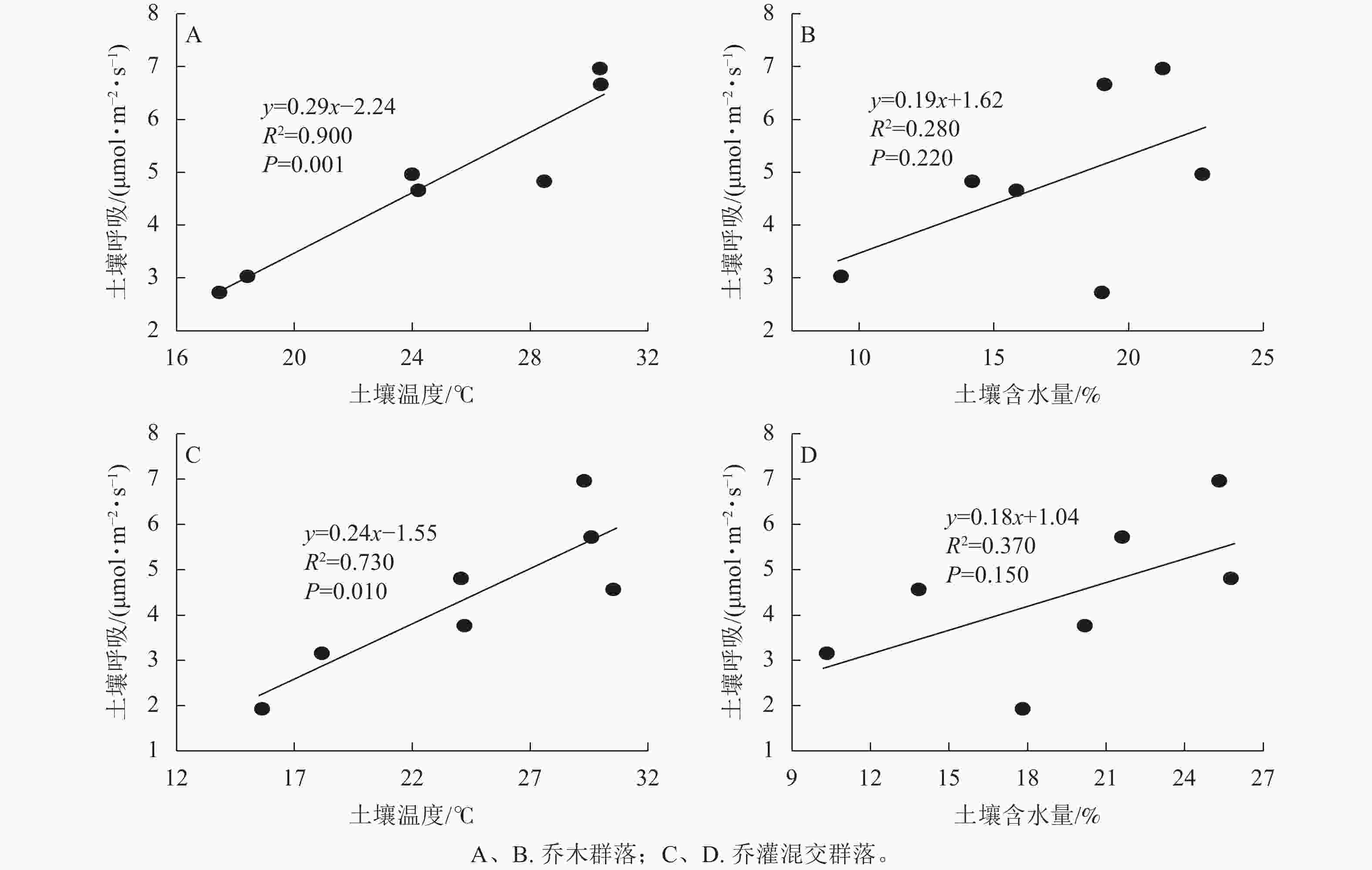
图 3 不同植被类型土壤呼吸与土壤温度和土壤含水量的时间关系
Figure 3. Relationship between soil respiration and soil temperature and soil water content across different vegetation types
表 1 不同植被类型土壤呼吸与土壤温度和土壤含水量的双因子模型
Table 1. Dual-factor models of soil respiration with soil temperature and soil water content across different vegetation types
植被类型 回归方程 决定系数(R2) 显著性水平 乔木群落 $ {R}_{\mathrm{s}}=0.26{T}_{\mathrm{s}}+0.07{C}_{\mathrm{S}\mathrm{W}}-2.89 $ 0.93 P<0.01 乔灌混交群落 $ {R}_{{\mathrm{s}}}=0.21{T}_{\mathrm{s}}+0.1{0C}_{\mathrm{S}\mathrm{W}}-2.54 $ 0.82 P<0.05 说明:Rs. 土壤呼吸;Ts. 土壤温度;CSW. 土壤含水量。 -
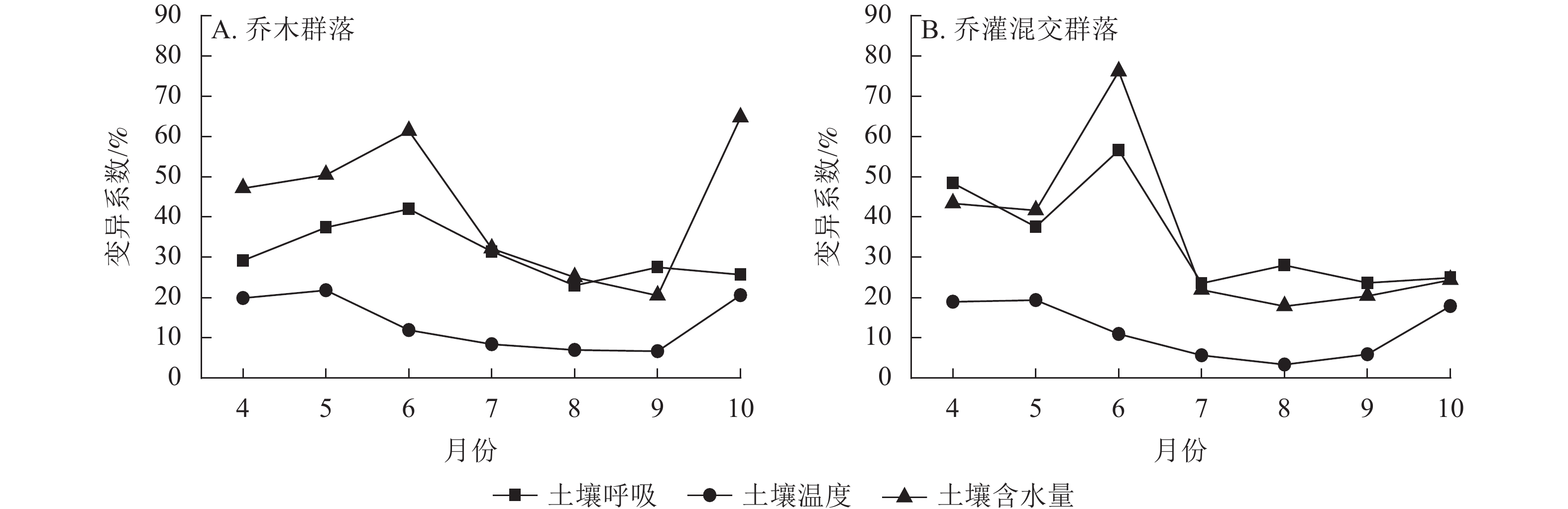
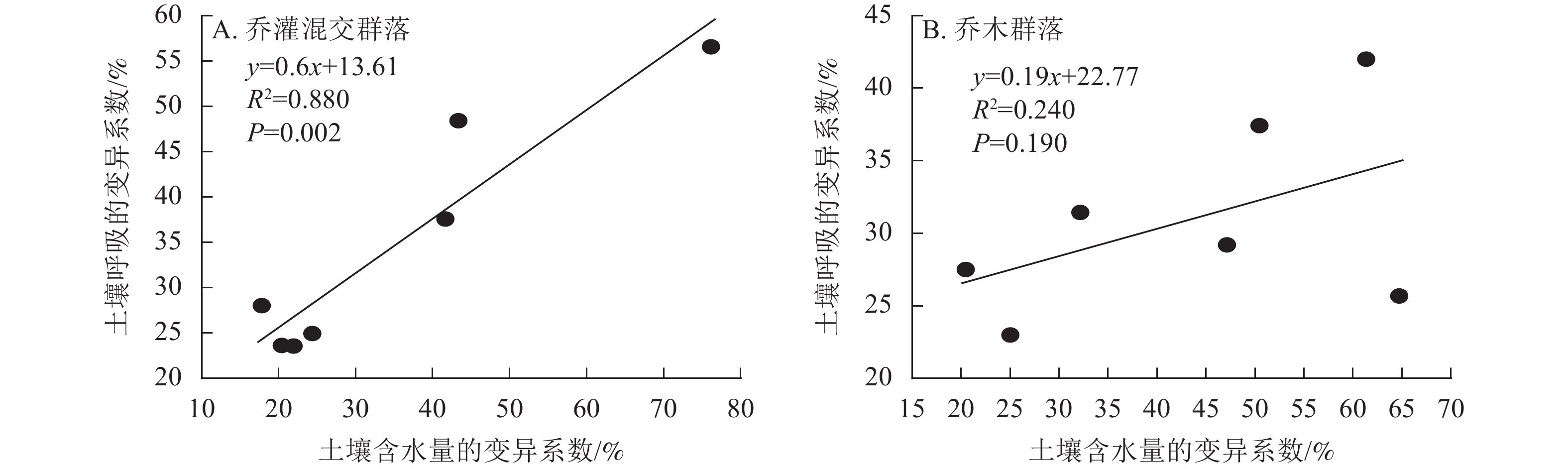
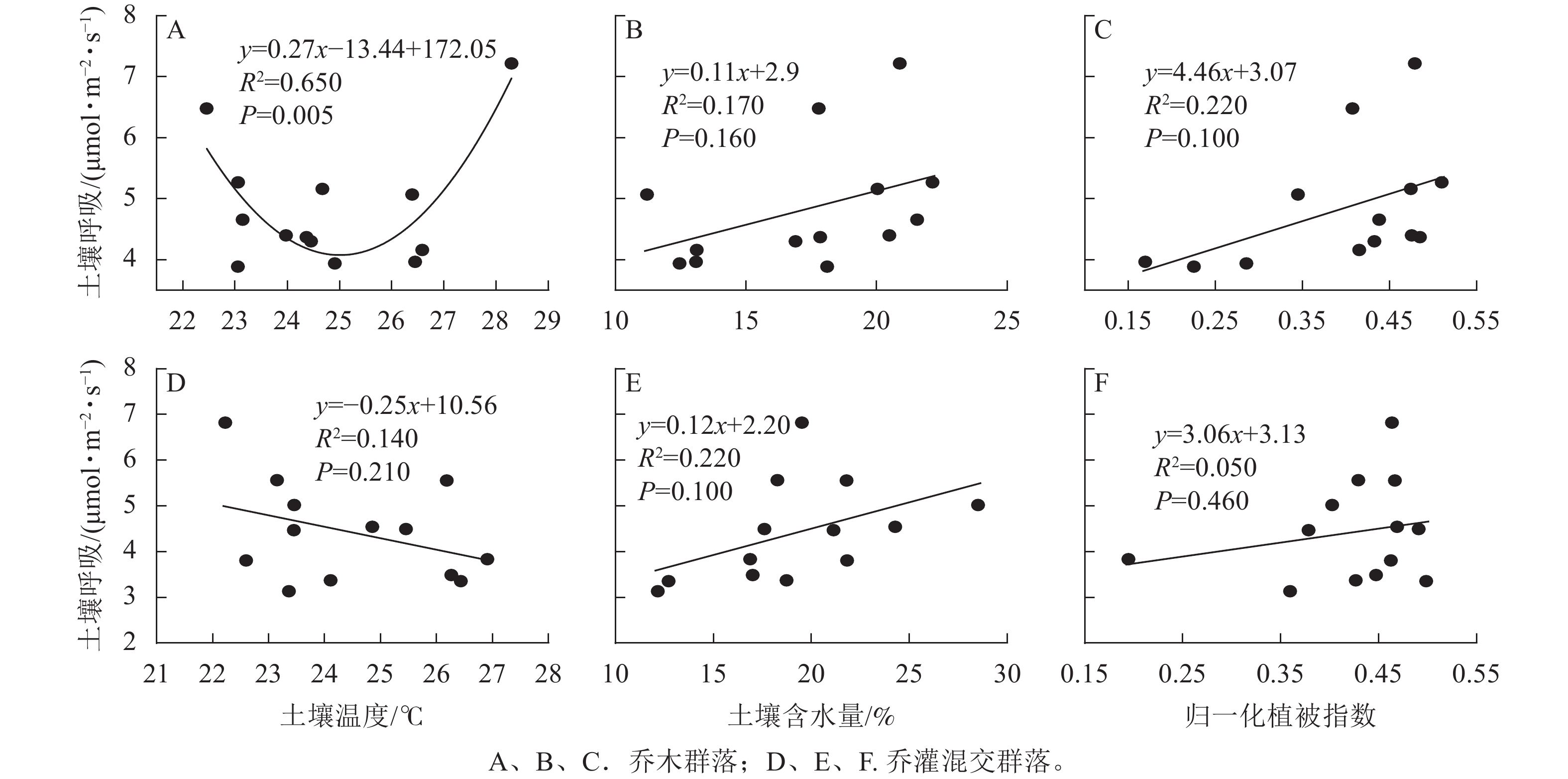
土壤呼吸空间变异存在季节性趋势,变异系数(VC)为22.6%~56.6%。乔木群落最高变异系数出现在6月,此时土壤温度较高,土壤含水量较低(图4A)。乔灌混交群落土壤呼吸与土壤含水量空间变化的变异系数表现出相似的变化趋势(图4B),且呈极显著的正相关(图5A,P<0.01)。乔木群落土壤呼吸空间变化变异系数与土壤含水量的关系不显著(图5B)。进一步的分析发现:乔木群落土壤呼吸的空间变化与土壤温度呈二次多项式关系(R2=0.65),与土壤含水量和归一化植被指数关系不显著(图6)。
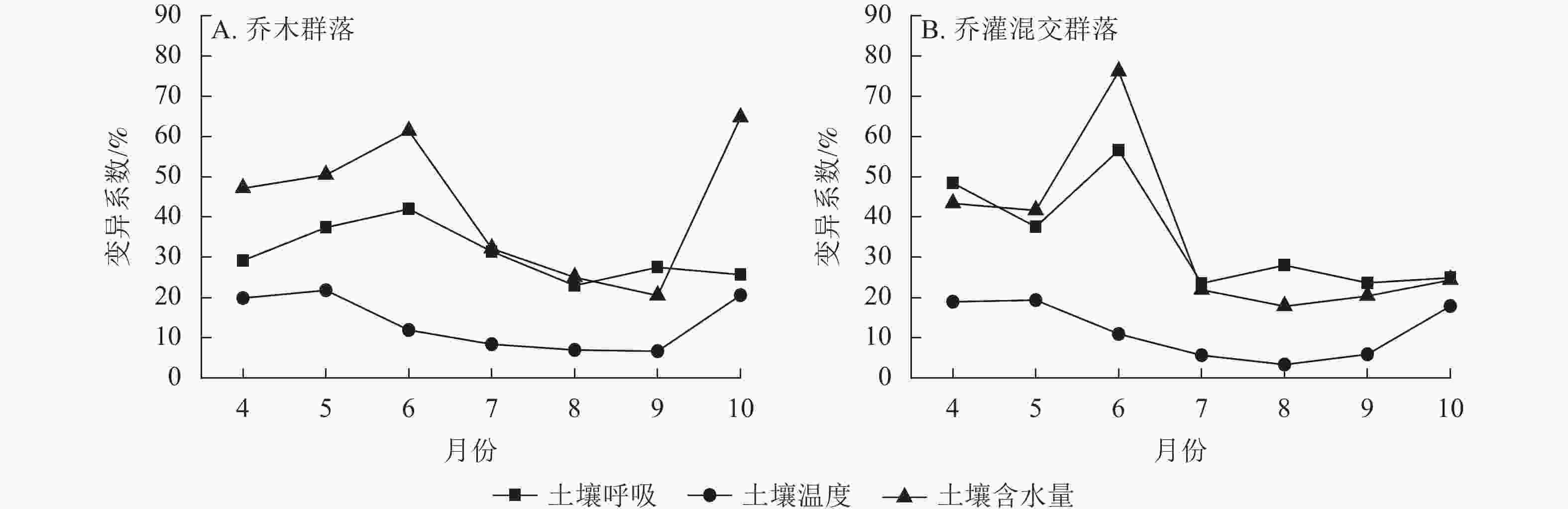
图 4 不同植被类型土壤呼吸及环境因子变异系数的季节变化
Figure 4. Seasonal variations in the coefficient of variation of soil respiration and environmental factors across different vegetation types
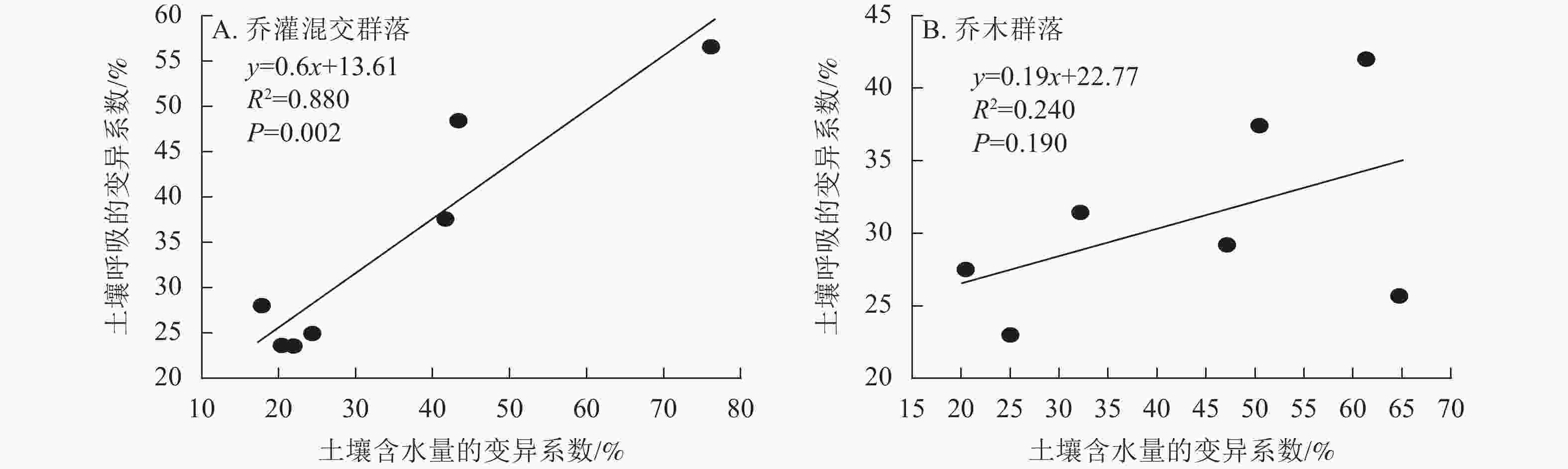
图 5 不同植被类型土壤呼吸变异系数与土壤含水量变异系数的关系
Figure 5. Relationship between the coefficient of variation of soil respiration and the coefficient of variation of soil water content across different vegetation types
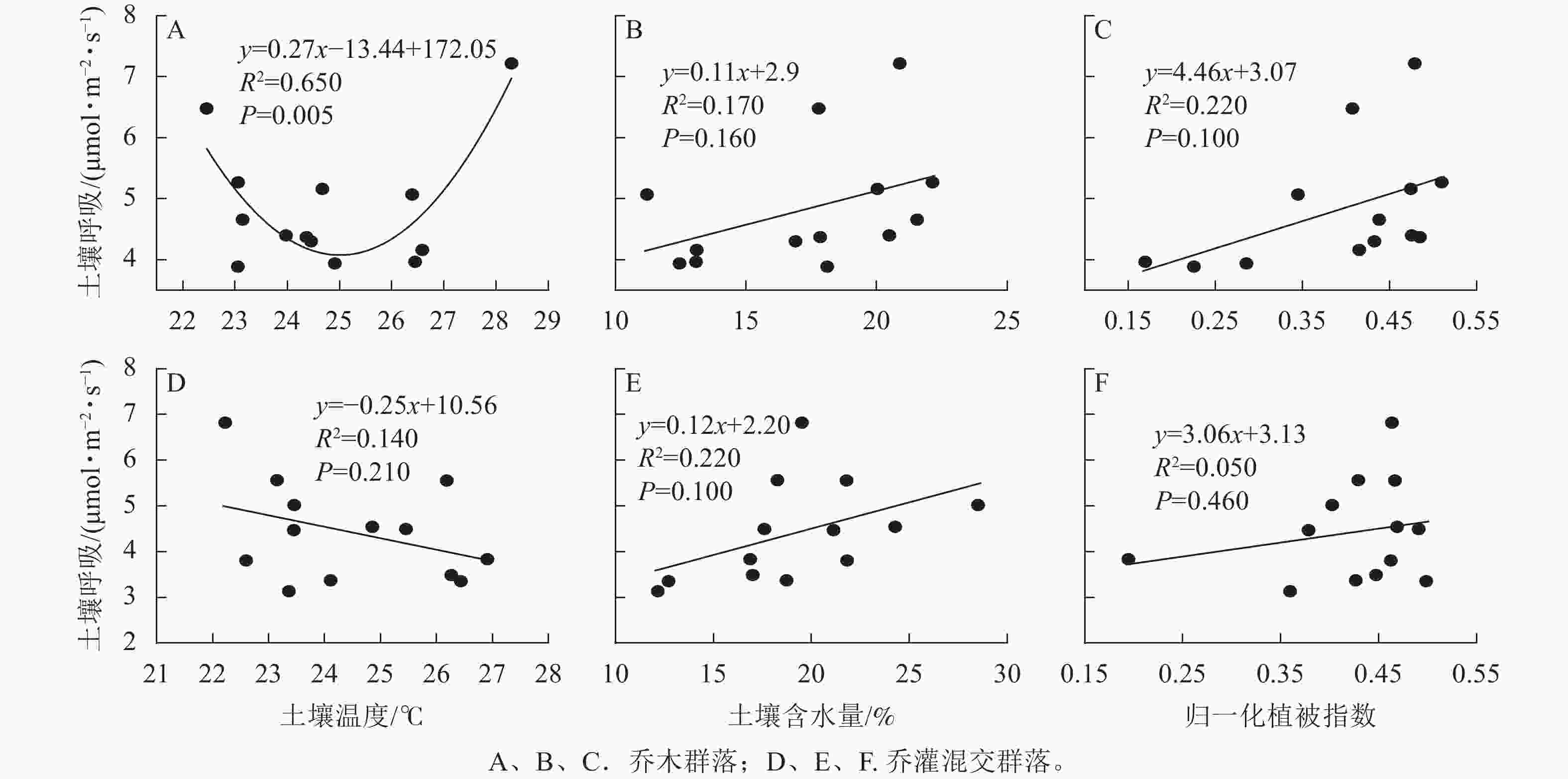
图 6 不同植被类型平均土壤呼吸与平均土壤温度、土壤含水量及归一化植被指数的空间关系
Figure 6. Spatial relationship between the average soil respiration and average soil temperature, soil water content, and normalized difference vegetation index across different vegetation types
此外,不同植被类型土壤呼吸空间变化的主要调控因素随季节变化(表2)。4月乔木群落土壤呼吸与土壤温度呈显著正相关(P<0.05),乔灌混交群落土壤呼吸与土壤含水量呈显著正相关(P<0.05)。6月乔木群落土壤呼吸与土壤含水量呈显著正相关(P<0.05),乔灌混交群落土壤呼吸与土壤含水量呈极显著正相关(P<0.01)。10月乔木群落土壤呼吸与土壤含水量呈极显著负相关(P<0.01),乔灌混交群落土壤呼吸与土壤温度呈显著负相关(P<0.05)。各季节土壤呼吸的空间变化与归一化植被指数相关不显著。
表 2 土壤呼吸及其影响因子之间的相关系数
Table 2. Correlation coefficients between soil respiration and its influencing factors
植被类型 季节 月份 相关系数 植被类型 季节 月份 相关系数 Rs-Ts Rs-CSW Rs-INDV Rs-Ts Rs-CSW Rs-INDV 乔木群落 春 4 0.577* 0.132 0.435 乔灌混
交群落春 4 0.088 0.602* 0.023 5 −0.013 0.136 5 −0.304 0.122 夏 6 0.226 0.562* 0.285 夏 6 −0.431 0.836** 0.306 7 0.368 0.216 7 −0.039 0.287 8 0.109 −0.577* 8 0.413 −0.241 秋 9 0.546* 0.152 0.218 秋 9 −0.226 −0.257 −0.322 10 0.360 −0.886** 10 −0.569* −0.225 说明:*P<0.05;**P<0.01。Rs. 土壤呼吸;Ts. 土壤温度;CSW. 土壤含水量;INDV. 归一化植被指数。 -
前人研究发现:土壤呼吸时间动态主要受土壤温度和土壤水分调控[11, 26]。本研究中, 土壤呼吸变化范围为1.93~6.96 μmol·m−2·s−1,2种植被类型土壤呼吸均与土壤温度的变化趋势一致,乔木群落生长季平均土壤呼吸高于乔灌混交群落。与乔木群落相比,具有复层植被配置的乔灌混交群落地表植物覆盖度更高,不利于太阳辐射直接到达土壤表面,进而抑制了土壤微生物活性和有机质分解速度,导致乔灌混交群落土壤呼吸相对较低[27]。此外,本研究中基于土壤温度和土壤含水量的双因子模型,在对土壤呼吸季节变化的拟合中表现出较高的拟合度(R2为0.82~0.93),远高于郑鹏飞等[13]在北京山区所得模型的拟合结果(R2为0.48~0.57)。这可能是由于城市独特的热岛效应,导致土壤温度和土壤水分呈现出幅度大、频率高但变化模式相对规律的特征,这种具有一定规律性的微气候波动,使得城市森林土壤呼吸对土壤温度和土壤水分的响应更为明显和直接。相比之下,山区森林受地形、海拔和植被类型的影响,土壤呼吸的调控机制更为复杂,从而降低了水热因子与土壤呼吸的拟合度[28]。土壤温度和土壤含水量的双因子模型在2种植被类型群落中的拟合度均高于单因子模型,表明土壤温度和土壤含水量的交互作用超过其单独作用,更能够解释土壤呼吸的季节变异。无论是温度单因子模型还是双因子模型,对乔木群落土壤呼吸季节变化的拟合效果均高于乔灌混交群落,说明乔木群落土壤呼吸对土壤温度的响应更为敏感。这可能是由于乔灌混交群落的有机物质输入更为多样化,导致土壤微生物群落结构和功能更加复杂,从而减弱了土壤温度对土壤呼吸的影响。
-
土壤呼吸空间变化通常可通过变异系数量化。严俊霞等[18]研究发现:庞泉沟天然次生针阔混交林土壤呼吸空间变异系数为16.0%~22.0%;CAI等[29]研究发现:日本长野县北部天然落叶阔叶林土壤呼吸空间变异系数为25.0%~28.0%;SONG等[30]研究发现:热带雨林在雨季和旱季土壤呼吸空间变异系数分别为42.0%和38.0%。本研究中,乔木群落土壤呼吸空间变异系数为22.6%~42.2%,乔灌混交群落土壤呼吸空间变异系数为23.5%~56.6%。上述结果表明:尽管城市人工林的结构相比于天然林更具匀质性,但其土壤呼吸的空间异质性仍可能强于天然林,这可能与经营方式和树种的组成存在一定关系。此外,土壤呼吸的空间变异程度随着土壤含水量变异程度的增大而增强,特别是在乔灌混交群落中。这与前人的研究结果一致[10, 31]。
土壤水分可以通过调控根系和微生物的生理过程直接影响土壤呼吸,也可以通过减轻微生物的水分胁迫间接影响土壤呼吸[32]。本研究中,2种植被类型土壤呼吸在6月的空间变异与土壤含水量显著相关,这是因为较高的土壤温度导致干旱胁迫,致使作为限制因子的土壤水分对土壤呼吸空间变化解释度大幅提高[33]。土壤温度在4和9月对乔木群落土壤呼吸有显著影响,在10月对乔灌混交群落土壤呼吸有显著影响。然而,在夏季(6—8月),土壤温度与土壤呼吸的空间变异无显著相关性,这与前人研究结果一致[31, 34−35]。这可能是由于夏季土壤温度的空间变异较小(变异系数小于12.0%)。本研究中,土壤呼吸的空间主导因子随季节分异,本质上是自然生态响应机制与城市人为干预共同作用的结果。土壤温度和土壤含水量仍为关键驱动因子,符合生态系统呼吸的基本规律,但热岛效应、灌溉管理、土壤压实等人为干扰改变了驱动因子的作用强度、时空范围及群落间分异模式,导致其与自然植被相比呈现“提前主导、异常相关、剧烈切换”的特征。后续在城市森林研究中,需构建融合自然生态模型与城市胁迫因子的综合分析框架,以更精准解析其碳循环机制。
归一化植被指数常用于评估植被冠层光合作用潜力,可通过调控底物供应,进而影响土壤呼吸[36]。在自然生态系统中,归一化植被指数往往是控制土壤呼吸空间变异的主导生物因子[20, 37]。然而,本研究中归一化植被指数在空间上与土壤呼吸的拟合度较低(乔木群落R2=0.22,乔灌混交群落R2=0.05)。这可能是因为城市森林受到人为经营管理(灌溉、修剪、施肥)的影响,植被绿度较高,土壤有机质较为丰富,土壤呼吸受底物限制的情况并不明显,因此归一化植被指数未能有效揭示城市森林生态系统土壤呼吸的空间变异。
空间替代时间方法是一种通过空间差异推断时间动态变化的方法,通常用于预测生物地球化学循环对气候变化的响应[38]。本研究中,土壤呼吸对土壤温度的响应在时间和空间上存在差异,甚至表现出相反的趋势。尽管土壤呼吸对土壤水分的响应在时间和空间上均呈正向关系,但其时空变化斜率存在差异。乔木群落时间变化斜率为0.19,空间变化斜率为0.10;乔灌混交群落时间变化斜率为0.18,空间变化斜率为0.12。因此,空间替代时间的方法可能并不适用于城市森林土壤呼吸的估算,未来的研究工作仍然需要对城市森林进行更长时序的土壤呼吸原位监测。
-
北京奥林匹克森林公园乔木群落生长季土壤呼吸均值(4.83 μmol·m−2·s−1)比乔灌混交群落(4.42 μmol·m−2·s−1)高9.3%。土壤呼吸季节变异由土壤温度主导(R2为0.73~0.90),引入土壤含水量构建双因子模型后决定系数提升至0.82~0.93,且乔木群落表现出更高的温度敏感性。研究区土壤呼吸空间变异系数为22.6%~56.6%,乔灌混交群落土壤呼吸的空间变异系数与土壤含水量呈极显著正相关,乔木群落土壤呼吸空间变化与土壤温度之间呈极显著的非线性关系。土壤呼吸空间变化主控因子呈现时序动态,乔木群落在4、9月受土壤温度主导,6、8、10月转为受土壤含水量主导;乔灌混交群落在10月受土壤呼吸控制,4、6月由土壤含水量主导。土壤呼吸对土壤温度和土壤含水量的时空响应异质性表明:空间替代时间方法在城林生态系统碳通量估算中适用性受限。本研究仅对不同植被类型进行了1个生长季的野外监测,结果仅反映了短期内城市森林土壤呼吸的时空变异特征,未能涵盖整个年度或多年动态过程。未来研究可侧重于对比不同气候年份(如干旱年和湿润年)下土壤温度-土壤含水率主导的土壤呼吸响应阈值变化,或结合长期遥感数据分析归一化植被指数与土壤呼吸关系的年际稳定性。
Spatiotemporal dynamics of soil respiration across different vegetation types in Beijing Olympic Forest Park
-
摘要:
目的 探究城市森林不同植被类型土壤呼吸的时空动态特征及其影响因素,以期为区域碳预估提供理论参考。 方法 以北京奥林匹克森林公园为研究对象,采用便携式土壤呼吸测量仪,于2023年4—10月每月测定该公园26个样地(乔木群落与乔灌混交群落各13个)的土壤呼吸、土壤温度和土壤含水量,并结合高分辨率归一化植被指数,对土壤呼吸的季节与空间变化及其影响因素进行拟合分析。 结果 ①土壤呼吸和土壤温度的季节动态一致,均呈现先上升后下降单峰变化。乔木群落土壤呼吸均值为4.83 μmol·m−2·s−1,大于乔灌混交群落的4.42 μmol·m−2·s−1。②土壤温度可以分别解释乔木群落和乔灌混交群落土壤呼吸季节变化的90.0%和73.0%, 土壤含水量可以分别解释28.0%和37.0%,综合考虑温度−水分的双因子模型可以分别解释93.0%和82.0%。③乔灌混交群落土壤呼吸的空间变异系数与土壤含水量变化趋势相似,两者极显著正相关[决定系数(R2)为0.88,P<0.01],乔木群落土壤呼吸空间变化与土壤温度之间呈现极显著的非线性关系(R2=0.65,P<0.01)。④土壤呼吸对土壤温度的响应存在时空差异,时间上为近似直线增加,空间上为非线性响应,而土壤呼吸虽然时间和空间上都随土壤含水量的增加而增加,但其增加速率存在差异。 结论 城市森林土壤呼吸对环境因素的响应存在时空差异:土壤温度是主导城市森林土壤呼吸季节变化的主要因素,城市森林土壤呼吸空间变化主要影响因素在不同植被类型间存在差异。图6表2参38 Abstract:Objective This study aims to investigate the spatiotemporal dynamics, as well as the driving factors of soil respiration across different vegetation types of urban forests, so as to provide theoretical references for regional carbon estimation. Method Taking Beijing Olympic Forest Park as the research object, a portable soil respiration measurement system was used to measure soil respiration (Rs), soil temperature (Ts), and soil water content (CSW) of 26 sample plots (13 in the arbor community and 13 in the arbor-shrub mixed community) monthly from April to October in 2023. And combined with high-resolution normalized difference vegetation index (INDV), a fitting analysis was conducted on the seasonal and spatial variations of Rs and the influencing factors. Result (1) The seasonal dynamics of Rs and Ts were consistent, showing a unimodal pattern of first increasing and then decreasing. The average Rs in the arbor community (4.83 μmol·m−2·s−1) was higher than that in the arbor-shrub mixed community (4.42 μmol·m−2·s−1). (2) Ts accounted for 90.0% and 73.0% of the seasonal variation in Rs in the arbor and arbor-shrub mixed community, respectively, while CSW explained 28.0% and 37.0%. A dual-factor model incorporating both temperature and moisture could explain 93.0% and 82.0% of the variation, respectively. (3) The spatial coefficient of variation of Rs in the arbor-shrub mixed community was similar to the variation trend of CSW, with a significant positive correlation between the two (R2=0.88, P< 0.01). In contrast, there was a highly significant nonlinear relationship between the spatial variation of Rs and Ts (R2=0.65, P<0.01) in the arbor community. (4) The response of Rs to Ts varied in time and space, with an approximately linear increase in time and a nonlinear response in space. Although Rs increased with the increase of CSW in both time and space, the rate of increase varied. Conclusion The response of Rs to environmental factors in urban forests exhibits spatiotemporal variations. Ts is the driving factor of seasonal variations in Rs, while the dominant factors of spatial variation of urban forest Rs vary among different vegetation types. [Ch, 6 fig. 2 tab. 38 ref.] -
Key words:
- urban forest /
- soil respiration /
- seasonal variation /
- spatial variation /
- Beijing
-
图 2 不同植被类型土壤温度(A)、土壤含水量(B)、归一化植被指数(C)和土壤呼吸(D)的季节变化
Figure 2 Seasonal variation of soil temperature (A), soil water content (B), normalized difference vegetation index (C) and soil respiration (D) across different vegetation types
图 3 不同植被类型土壤呼吸与土壤温度和土壤含水量的时间关系
Figure 3 Relationship between soil respiration and soil temperature and soil water content across different vegetation types
图 4 不同植被类型土壤呼吸及环境因子变异系数的季节变化
Figure 4 Seasonal variations in the coefficient of variation of soil respiration and environmental factors across different vegetation types
图 5 不同植被类型土壤呼吸变异系数与土壤含水量变异系数的关系
Figure 5 Relationship between the coefficient of variation of soil respiration and the coefficient of variation of soil water content across different vegetation types
图 6 不同植被类型平均土壤呼吸与平均土壤温度、土壤含水量及归一化植被指数的空间关系
Figure 6 Spatial relationship between the average soil respiration and average soil temperature, soil water content, and normalized difference vegetation index across different vegetation types
表 1 不同植被类型土壤呼吸与土壤温度和土壤含水量的双因子模型
Table 1. Dual-factor models of soil respiration with soil temperature and soil water content across different vegetation types
植被类型 回归方程 决定系数(R2) 显著性水平 乔木群落 $ {R}_{\mathrm{s}}=0.26{T}_{\mathrm{s}}+0.07{C}_{\mathrm{S}\mathrm{W}}-2.89 $ 0.93 P<0.01 乔灌混交群落 $ {R}_{{\mathrm{s}}}=0.21{T}_{\mathrm{s}}+0.1{0C}_{\mathrm{S}\mathrm{W}}-2.54 $ 0.82 P<0.05 说明:Rs. 土壤呼吸;Ts. 土壤温度;CSW. 土壤含水量。  下载: 导出CSV
表 2 土壤呼吸及其影响因子之间的相关系数
Table 2. Correlation coefficients between soil respiration and its influencing factors
植被类型 季节 月份 相关系数 植被类型 季节 月份 相关系数 Rs-Ts Rs-CSW Rs-INDV Rs-Ts Rs-CSW Rs-INDV 乔木群落 春 4 0.577* 0.132 0.435 乔灌混
交群落春 4 0.088 0.602* 0.023 5 −0.013 0.136 5 −0.304 0.122 夏 6 0.226 0.562* 0.285 夏 6 −0.431 0.836** 0.306 7 0.368 0.216 7 −0.039 0.287 8 0.109 −0.577* 8 0.413 −0.241 秋 9 0.546* 0.152 0.218 秋 9 −0.226 −0.257 −0.322 10 0.360 −0.886** 10 −0.569* −0.225 说明:*P<0.05;**P<0.01。Rs. 土壤呼吸;Ts. 土壤温度;CSW. 土壤含水量;INDV. 归一化植被指数。
下载: 导出CSV
-
[1] LI Wei, QIN Tianling, LIU Shanshan, et al. Driving factors analysis of soil respiration in China ecosystems[J]. Plant and Soil, 2024. DOI: 10.1007/s11104-024-06962-7. [2] ZHANG Yihan, LIU Xiaoping, CHEN Guangliang, et al. Simulation of urban expansion based on cellular automata and maximum entropy model[J]. Science China Earth Sciences, 2020, 63(5): 701−712. DOI: 10.1007/s11430-019-9530-8. [3] SETO K C, GÜNERALP B, HUTYRA L R. Global forecasts of urban expansion to 2030 and direct impacts on biodiversity and carbon pools[J]. Proceedings of the National Academy of Sciences of the United States of America, 2012, 109(40): 16083−16088. DOI: 10.1073/pnas.1211658109. [4] LIU Xiaoping, PEI Fengsong, WEN Youyue, et al. Global urban expansion offsets climate-driven increases in terrestrial net primary productivity[J]. Nature Communications, 2019, 10(1): 5558. DOI: 10.1038/s41467-019-13462-1. [5] GONCHAROVA O, MATYSHAK G, UDOVENKO M, et al. Temporal dynamics, drivers, and components of soil respiration in urban forest ecosystems[J]. CATENA, 2020, 185: 104299. DOI: 10.1016/j.catena.2019.104299. [6] ZHANG Zhenrui, GAO Xiaoxia, ZHANG Sibo, et al. Urban development enhances soil organic carbon storage through increasing urban vegetation[J]. Journal of Environmental Management, 2022, 312: 114922. DOI: 10.1016/j.jenvman.2022.114922. [7] GUO Yang, HAN Jiatong, BAO Haijun, et al. A systematic analysis and review of soil organic carbon stocks in urban greenspaces[J]. Science of the Total Environment, 2024, 948: 174788. DOI: 10.1016/j.scitotenv.2024.174788. [8] 杨元合, 石岳, 孙文娟, 等. 中国及全球陆地生态系统碳源汇特征及其对碳中和的贡献[J]. 中国科学: 生命科学, 2022, 52(4): 534−574. YANG Yuanhe, SHI Yue, SUN Wenjuan, et al. Terrestrial carbon sinks in China and around the world and their contribution to carbon neutrality[J]. Scientia Sinica (Vitae), 2022, 52(4): 534−574. DOI: 10.1360/SSV-2021-0362. [9] MENCONI M E, BONCIARELLI L, GROHMANN D. Assessment of the potential contribution of the urban green system to the carbon balance of cities[J]. Environments, 2024, 11(5): 98. DOI: 10.3390/environments11050098. [10] WU Xiaogang, YUAN Jiajia, MA Shengli, et al. Seasonal spatial pattern of soil respiration in a temperate urban forest in Beijing[J]. Urban Forestry & Urban Greening, 2015, 14(4): 1122−1130. DOI: 10.1016/j.ufug.2015.10.009. [11] ARCHMILLER A A, SAMUELSON L J, LI Yingru. Spatial variability of soil respiration in a 64-year-old longleaf pine forest[J]. Plant and Soil, 2016, 403(1): 419−435. DOI: 10.1007/s11104-016-2817-1. [12] QIN Shuqi, PENG Qin, DONG Yunshe, et al. Role of ambient climate in the response of soil respiration to different grassland management measures[J]. Agricultural and Forest Meteorology, 2023, 334: 109439. DOI: 10.1016/j.agrformet.2023.109439. [13] 郑鹏飞, 余新晓, 贾国栋, 等. 北京山区不同植被类型的土壤呼吸特征及其温度敏感性[J]. 应用生态学报, 2019, 30(5): 1726−1734. ZHENG Pengfei, YU Xinxiao, JIA Guodong, et al. Soil respiration and its temperature sensitivity among different vegetation types in Beijing mountain area, China[J]. Chinese Journal of Applied Ecology, 2019, 30(5): 1726−1734. DOI: 10.13287/j.1001-9332.201905.038. [14] YU Shiqin, CHEN Yuanqi, ZHAO Jie, et al. Temperature sensitivity of total soil respiration and its heterotrophic and autotrophic components in six vegetation types of subtropical China[J]. Science of the Total Environment, 2017, 607: 160−167. DOI: 10.1016/j.scitotenv.2017.06.194. [15] 竹万宽, 陈少雄, ARNOLD R, 等. 不同种桉树人工林土壤呼吸速率时空动态及其影响要素[J]. 浙江农林大学学报, 2018, 35(3): 412−421. ZHU Wankuan, CHEN Shaoxiong, ARNOLD R, et al. Temporal and spatial dynamics of soil respiration and influencing factors in Eucalyptus plantations[J]. Journal of Zhejiang A&F University, 2018, 35(3): 412−421. DOI: 10.11833/j.issn.2095-0756.2018.03.004. [16] 李键, 刘鑫铭, 姚成硕, 等. 武夷山国家公园不同林地土壤呼吸动态变化及其影响因素[J]. 生态学报, 2021, 41(9): 3588−3602. LI Jian, LIU Xinming, YAO Chengshuo, et al. Dynamic change of soil respiration and its effecting factors in different forest lands of Wuyishan National Park[J]. Acta Ecologica Sinica, 2021, 41(9): 3588−3602. DOI: 10.5846/stxb201905130981. [17] 姚雄, 余坤勇, 曾琪, 等. 福建西部山地水土流失区土壤呼吸的空间异质性[J]. 环境科学, 2016, 37(12): 4789−4799. YAO Xiong, YU Kunyong, ZENG Qi, et al. Spatial heterogeneity of soil respiration in the soil erosion area of west mountains in Fujian Province, China[J]. Environmental Science, 2016, 37(12): 4789−4799. DOI: 10.13227/j.hjkx.201605005. [18] 严俊霞, 李洪建, 李君剑. 庞泉沟自然保护区针阔混交林土壤呼吸的空间异质性[J]. 生态学报, 2015, 35(24): 8184−8193. YAN Junxia, LI Hongjian, LI Junjian. Spatial heterogeneity of soil respiration in a conifer-broadleaf mixed forest in the Pangquangou Nature Reserve Area[J]. Acta Ecologica Sinica, 2015, 35(24): 8184−8193. DOI: 10.5846/stxb201406131228. [19] HUANG Ni, WANG Li, GUO Yiqiang, et al. Modeling spatial patterns of soil respiration in maize fields from vegetation and soil property factors with the use of remote sensing and geographical information system[J]. PLoS One, 2014, 9(8): e105150. DOI: 10.1371/journal.pone.0105150. [20] 李晓敏, 严俊霞, 杜自强, 等. 庞泉沟自然保护区土壤呼吸空间分异性影响因素探测[J]. 环境科学, 2022, 43(9): 4858−4866. LI Xiaomin, YAN Junxia, DU Ziqiang, et al. Detection of influencing factors of spatial variability of soil respiration in Pangquangou Nature Reserve[J]. Environmental Science, 2022, 43(9): 4858−4866. DOI: 10.13227/j.hjkx.202110154. [21] 张金文, 王文龙, 倪荣雨, 等. 基于梯度提升机的中国陆地生态系统土壤异养呼吸预测[J]. 浙江农林大学学报, 2025, 42(4): 774−783. ZHANG Jinwen, WANG Wenlong, NI Rongyu, et al. Prediction of soil heterotrophic respiration in China’s terrestrial ecosystems based on gradient boosting machine[J]. Journal of Zhejiang A& F University, 2025, 42(4): 774−783. DOI: 10.11833/j.issn.2095-0756.20240667. [22] WARNER D L, BOND-LAMBERTY B, JIAN J, et al. Spatial predictions and associated uncertainty of annual soil respiration at the global scale[J]. Global Biogeochemical Cycles, 2019, 33(12): 1733−1745. DOI: 10.1029/2019GB006264. [23] TIAN Mi, ZHOU Jian, WANG Xueqiu, et al. Temporal-spatial variations of soil respiration and the controlling factors on global scale (1991–2015)[J]. Journal of Geochemical Exploration, 2024, 266: 107562. DOI: 10.1016/j.gexplo.2024.107562. [24] CECCON C, PANZACCHI P, SCANDELLARI F, et al. Spatial and temporal effects of soil temperature and moisture and the relation to fine root density on root and soil respiration in a mature apple orchard[J]. Plant and Soil, 2011, 342(1): 195−206. DOI: 10.1007/s11104-010-0684-8. [25] 田宁, 黄雪梅, 陈龙池, 等. 施石灰对杉木人工林土壤呼吸及其温度敏感性的影响[J]. 应用生态学报, 2023, 34(5): 1194−1202. TIAN Ning, HUANG Xuemei, CHEN Longchi, et al. Effects of liming on soil respiration and its sensitivity to temperature in Cunninghamia lanceolata plantations[J]. Chinese Journal of Applied Ecology, 2023, 34(5): 1194−1202. DOI: 10.13287/j.1001-9332.202305.011. [26] LI Jiaxuan, ZHANG Jingui, MA Tao, et al. Responses of soil respiration to the interactive effects of warming and drought in alfalfa grassland on the Loess Plateau[J]. Agronomy, 2023, 13(12): 2992. DOI: 10.3390/agronomy13122992. [27] 白洁, 范志平, 林力涛, 等. 沈阳城市绿地土壤呼吸时空变化特征[J]. 气象与环境学报, 2020, 36(5): 105−112. BAI Jie, FAN Zhiping, LIN Litao, et al. Temporal and spatial pattern of soil respiration pattern in urban green spaces of Shenyang[J]. Journal of Meteorology and Environment, 2020, 36(5): 105−112. DOI: 10.3969/j.issn.1673-503X.2020.05.014. [28] YANG Huai, HUANG Ting, LI Yide, et al. Spatial heterogeneity and influence mechanisms on soil respiration in an old-growth tropical montane rainforest with complex terrain[J]. Frontiers in Ecology and Evolution, 2023, 10: 1107421. DOI: 10.3389/fevo.2022.1107421. [29] CAI Yihan, NISHIMURA T, IDA H, et al. Spatial variation in soil respiration is determined by forest canopy structure through soil water content in a mature beech forest[J]. Forest Ecology and Management, 2021, 501: 119673. DOI: 10.1016/j.foreco.2021.119673. [30] SONG Q H, TAN Z H, ZHANG Y P, et al. Spatial heterogeneity of soil respiration in a seasonal rainforest with complex terrain[J]. Iforest-Biogeosciences and Forestry, 2013, 6(2): 65−72. DOI: 10.3832/ifor0681-006. [31] SAIZ G, GREEN C, BUTTERBACH-BAHL K, et al. Seasonal and spatial variability of soil respiration in four Sitka spruce stands[J]. Plant and Soil, 2006, 287(1): 161−176. DOI: 10.1007/S11104-006-9052-0. [32] LUO Yiqi, ZHOU Xuhui. Soil Respiration and the Environment[M]. Amsterdam: Elsevier, 2006. [33] WANG Xuexia, CHEN Yali, YAN Yulong, et al. Ecological responses of Stipa steppe in Inner Mongolia to experimentally increased temperature and precipitation. 3. Soil respiration[J]. The Rangeland Journal, 2018, 40(2): 153. DOI: 10.1071/rj16083. [34] XU Ming, QI Ye. Spatial and seasonal variations of Q10 determined by soil respiration measurements at a Sierra Nevadan Forest[J]. Global Biogeochemical Cycles, 2001, 15(3): 687−696. DOI: 10.1029/2000GB001365. [35] SOE A R B, BUCHMANN N. Spatial and temporal variations in soil respiration in relation to stand structure and soil parameters in an unmanaged beech forest[J]. Tree Physiology, 2005, 25(11): 1427−1436. DOI: 10.1093/treephys/25.11.1427. [36] YAO Xuewen, CHEN Shutao, DING Sicheng, et al. Temperature, moisture, hyperspectral vegetation indexes, and leaf traits regulated soil respiration in different crop planting fields[J]. Journal of Soil Science and Plant Nutrition, 2021, 21(4): 3203−3220. DOI: 10.1007/s42729-021-00600-2. [37] HAMMER R L, SEILER J R, PETERSON J A, et al. Soil respiration and related abiotic and remotely sensed variables in different overstories and understories in a high-elevation southern Appalachian forest[J]. Forests, 2023, 14(8): 1645. DOI: 10.3390/f14081645. [38] KHAROUBA H M, WILLIAMS J L. Forecasting species’ responses to climate change using space-for-time substitution[J]. Trends in Ecology & Evolution, 2024, 39(8): 716−725. DOI: 10.1016/j.tree.2024.03.009. -

-
链接本文:
https://zlxb.zafu.edu.cn/article/doi/10.11833/j.issn.2095-0756.20250206
 点击查看大图
计量
- 文章访问数: 1402
- HTML全文浏览量: 515
- PDF下载量: 165
- 被引次数: 0
