






-
近年来,随着经济全球化的深入推进,生态环境问题愈发突出。中国森林面临着植物入侵带来的严重威胁,引发了学术界的广泛关注[1]。外来植物入侵是指某一物种离开其原本的生物群落,进入到新的群落中不断繁衍并迅速提升种群数量,对被入侵地的生物多样性造成负面影响的现象[2]。植物入侵是复杂的生态过程,多种生态要素相互作用,共同促成外来物种成功定植与扩散[3−4]。
毛竹Phyllostachys edulis是一种生长迅速的禾本科Poaceae植物,作为中国亚热带地区的本土物种,因其经济和文化价值而被广泛种植。根据中国第九次森林资源清查数据,毛竹林占据了全国竹林总面积的70%。然而,毛竹的化感作用可抑制部分常绿阔叶林树种的种子萌发[5],使其具备较强的入侵能力。近年来,浙江天目山国家级自然保护区内毛竹林面积逐年扩张,不断侵占周边阔叶林生境[6]。该入侵过程与外来植物入侵本地生态系统的特征相似。毛竹虽为本土物种,但其扩张行为仍对天目山国家级自然保护区的生物多样性构成严重威胁。有研究表明:毛竹入侵会对森林植物多样性和凋落物输入造成不利影响[7−8],最终干扰土壤理化性状及土壤群落的结构与功能。
植物入侵引发的土壤动物群落变化不容忽视,其会深刻影响森林生态系统的演化过程[9]。土壤动物即主要生活在凋落物层和土壤层的动物,因其高密度、高多样性与广泛分布,在生态学研究中占据不可或缺的地位。它们食性复杂,共同构建起多样的土壤食物网,并作为关键驱动因子,持续维持并调控着土壤生态系统的功能与动态[10]。在植物入侵领域中,多数研究集中在土壤微生物方面[11−12]。而土壤中型动物群落(体宽为0.1~2.0 mm)也间接影响着森林凋落物的分解,关于它们的相关性研究较为匮乏[13]。双翅目Diptera昆虫环境适应能力极强,且在土壤群落中占比优势明显,是理想的土壤昆虫指示类群[14−16]。从生态功能的角度来看,土壤双翅目昆虫通过取食、掘穴加快凋落物的分解,间接促进了生态系统中的养分循环,在生态系统中发挥了关键作用[17−18]。探究森林生境中双翅目昆虫对植物入侵的响应特征,对明晰土壤动物、植物与土壤间的反馈机制具有重要意义。鉴于此,本研究以土壤双翅目昆虫为指示类群,通过高通量测序技术[19]进行物种鉴定,研究毛竹入侵对土壤动物多样性的影响,为亚热带森林生态系统管理提供科学依据。
-
研究区位于浙江天目山国家级自然保护区内(30°18′~30°25′N,119°23′~119°29′E,海拔为500~650 m)。该区为典型的季节性季风气候,年均降水量为1 829 mm,平均气温为15 ℃。土壤类型为红壤,植被于20世纪50~60年代人为采伐后,经自然恢复形成阔叶林,20世纪70年代开始受到毛竹林的入侵。
根据生态学领域中广泛应用的时空替换概念[20−23],结合天目山毛竹入侵的情况,本研究利用空间代替时间的方法,将试验样地划分为3种不同的林分类型,代表毛竹入侵的3个阶段,分别为阔叶林(SBF,毛竹未入侵)、竹阔混交林(MBF,毛竹侵入阔叶林后形成)和毛竹林(PEF,阔叶林完全被毛竹入侵形成)。①阔叶林中,乔木层主要包括短柄枹栎Quercus serrata var. brevipetiolata、化香树Platycarya strobilacea、马银花Rhododendron ovatum、檵木Loropetalum chinense等。灌木层主要包括中国绣球Hydrangea chinensis、牛鼻栓Fortunearia sinensis、窄基红褐柃Eurya rubiginosa var. attenuata、杉木Cunninghamia lanceolata等。草本主要有金星蕨Parathelypteris glanduligera、栗褐薹草Carex brunnea、淡竹叶Lophatherum gracile、粗壮小鸢尾Iris proantha var. valida等。②竹阔混交林中,毛竹与阔叶树种的植株比例接近1∶1。除毛竹外,短柄枹栎、化香树等树种仍占林冠层一定比重。灌木层主要包括中国绣球、牛鼻栓、微毛柃Eurya hebeclados等。草本主要有金星蕨、黑足鳞毛蕨Dryopteris fuscipes、三穗薹草Carex tristachya、栗褐薹草等。③毛竹林中,单株毛竹的年龄为1~4 a。灌木层主要包括中国绣球、微毛柃、牛鼻栓、山橿Lindera reflexa、苦槠Castanopsis sclerophylla等。草本层主要包括麦冬Ophiopogon japonicus、金星蕨、栗褐薹草等。
-
在3种林分中分别设置4个5 m × 5 m的样方,共计12个,样方之间相距30 m。在每个样方采取五点取样法,采集25 cm × 25 cm的地表凋落物,及其下方直径为10 cm、深度为20 cm的土壤样本,用于分离获取凋落物层及土壤层的双翅目昆虫样本。
分别在2021年5月、8月、11月和2022年2月(代表春、夏、秋、冬4个季节)进行样本采集,共计480份(3种林分 × 4个样方 × 5个取样点 × 2个层次 × 4次取样)。当日将采集的土壤和凋落物样本利用改良后的Tullgren漏斗(2 mm孔径)进行土壤动物的分离。随后在体视显微镜下挑取各样本中的双翅目昆虫进行研究。同一批次同一小样方内(5个点)的所有凋落物和土壤样品分别混合为一个完整样品,用于减少环境异质性所导致的误差,最终得到96个完整样品(凋落物层和土壤层各有48个)。
-
根据DNeasy® Blood and Tissue试剂盒(QIAGEN,Hilden,Germany)说明书,对上述96个双翅目昆虫样本的总DNA进行提取。利用NanoDrop2000设备,对提取的DNA进行纯度和浓度检测,然后进行高通量测序。选取引物为Ill_B_F (5′-CCIGAYATRGCITTYCCICG-3 ′)[24]和Fol_degen_rev (5′ -TANACYTCNGGRTGNCCRAARAAYCA-3′)[25−26],扩增长度为418 bp的细胞色素氧化酶亚基I (COI)基因(条形码片段)。原始序列由Trimmomatic软件进行质量控制并在FLASH软件上进行序列拼接[27],仅保留长度为418 bp的重叠群。
利用UPARSE软件,根据97%的相似度对所获得的序列进行操作分类单元(OTU)聚类,并在聚类过程中去掉单序列和嵌合体[28]。利用RDP classifier对每条序列进行物种分类注释,比对美国国家生物技术信息中心核苷酸数据库(NCBI-nt),本研究设置的比对阈值为70%[29]。
-
在Excel 2022中汇总上述聚类所得的OTU,并绘制成丰度表。使用R (v4.3.2)软件绘图,展示凋落物层和土壤层中不同林分所特有或共有的土壤双翅目昆虫的OTU;计算土壤双翅目昆虫在不同林分、季节、层次的α多样性,包括相对丰度、物种丰富度、Simpson优势度指数和Shannon-Wiener指数;采用非参数检验方法Kruskal-Wallis和Dunn检验进行多重比较,比较3种效应的差异,并利用GraphPad Prism 10对分析结果进行可视化;基于Bray-Curtis距离的置换多元方差分析反映林分类型、季节及层次对土壤双翅目昆虫群落组成的影响。
-
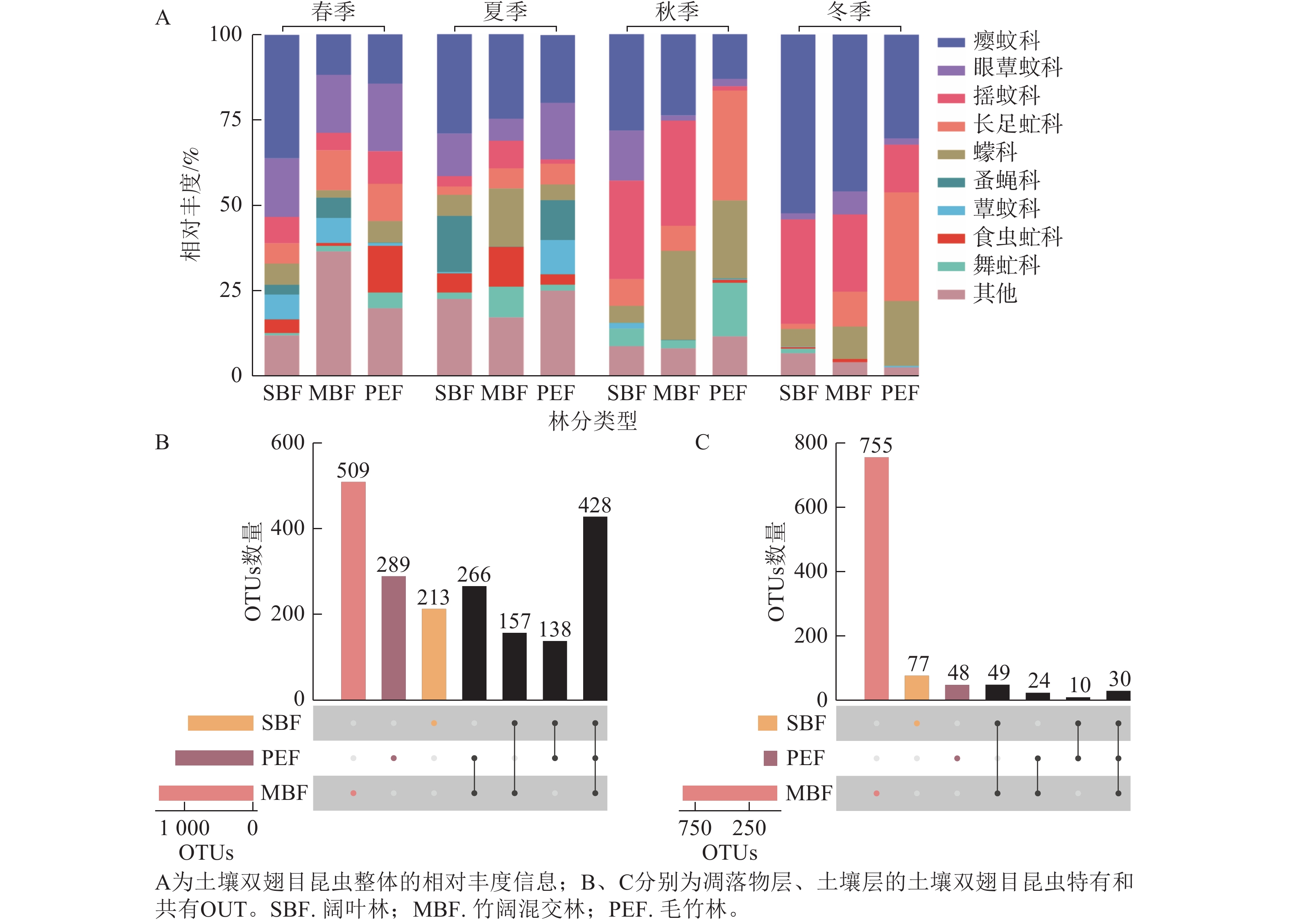
本研究从96个样本共得到2 217个OTUs,隶属于双翅目的63个科,其中丰度最高的科主要是瘿蚊科Cecidomyiidae (23.76%)、眼蕈蚊科Sciaridae (12.08%)、摇蚊科Chironomidae (11.08%)、长足虻科Dolichopodidae (10.39%)、蠓科Ceratopogonidae (9.07%)、蚤蝇科Phoridae (4.02%)、菌蚊科Mycetophilidae (3.65%)、食虫虻科Asilidae (3.57%)和舞虻科Empididae (3.54%)等。双翅目昆虫群落中优势类群的相对丰度存在季节性变化,而同一季节内,不同林分类型会对双翅目昆虫各科的种群丰度产生调控作用(图1A)。
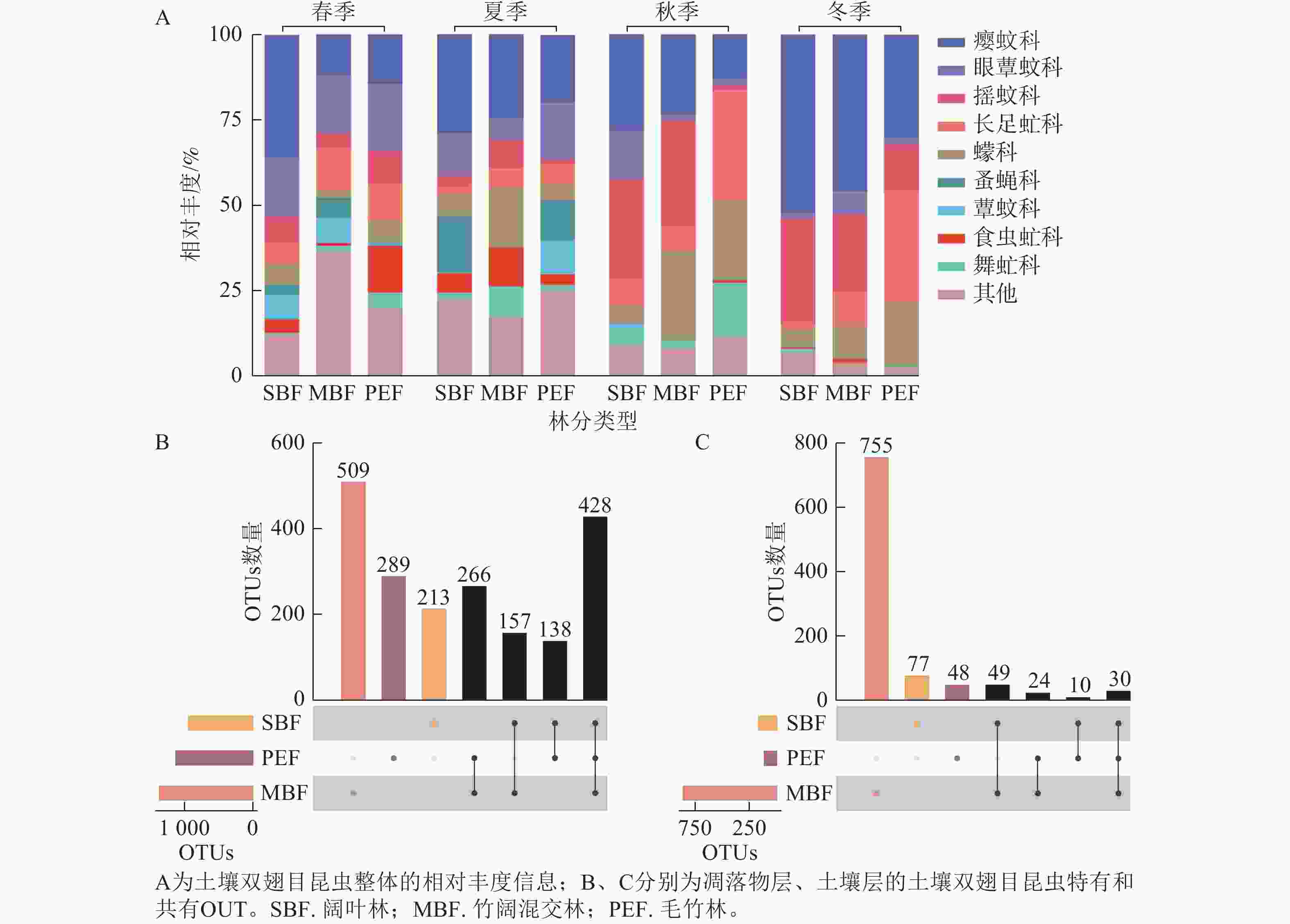
图 1 不同林分中土壤双翅目昆虫群落组成
Figure 1. Community composition of soil Diptera in different forest stands
-
不同林分的土壤双翅目昆虫群落中,无论凋落物层还是土壤层,竹阔混交林特有OTUs均远高于其他2种林分。凋落物层共计有2 000个OTUs,其中,竹阔混交林中特有OTUs为509个,毛竹林特有OTUs为289个,阔叶林特有OTUs为213个(图1B);土壤层共计有993个OTUs,其中竹阔混交林中特有OTUs为755个,毛竹林特有OTUs为48个,阔叶林特有OTUs为77个(图1C)。
-
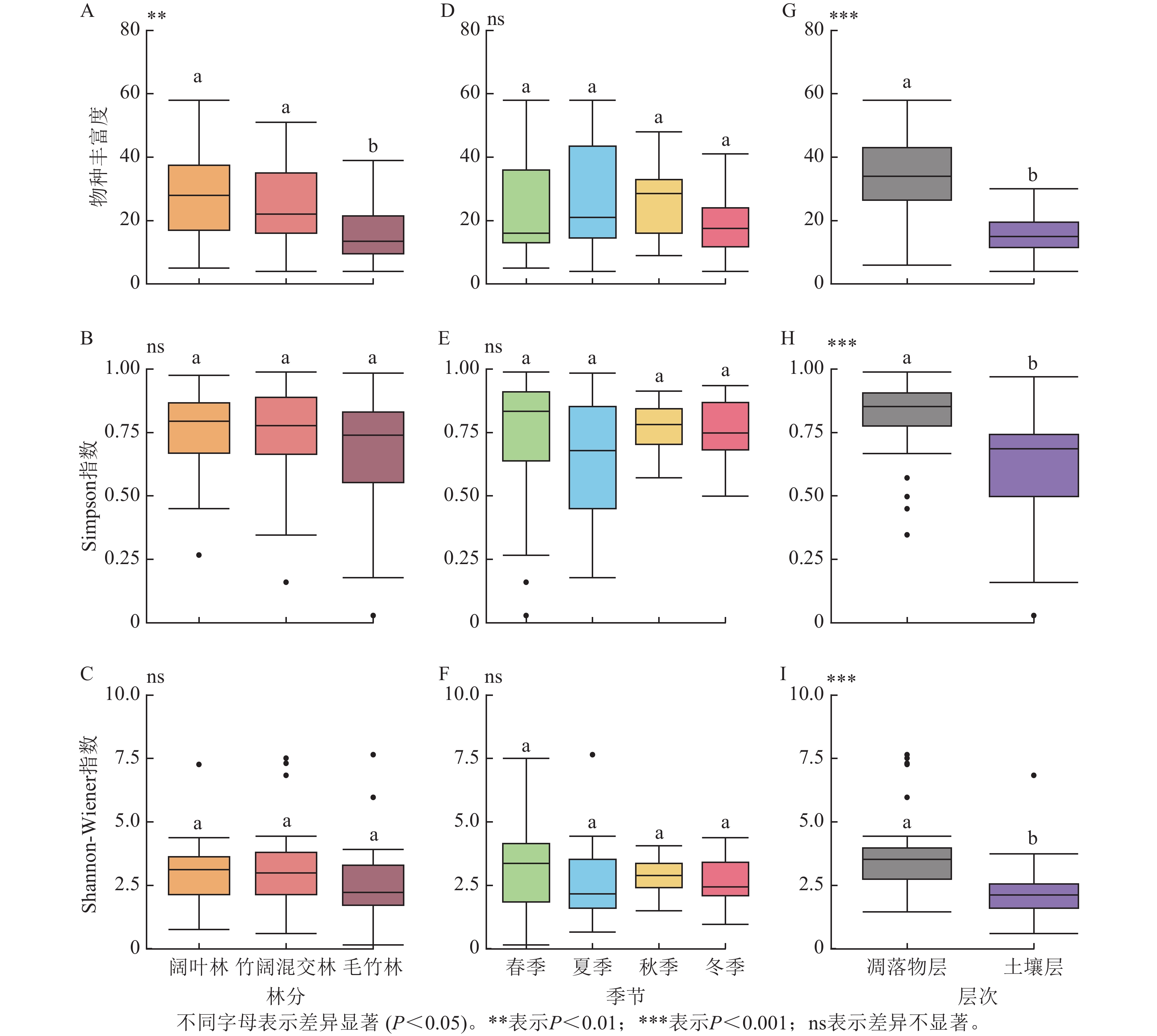
从图2A~C可见:毛竹入侵所形成的林分效应,对土壤双翅目昆虫群落的物种丰富度存在极显著影响(P<0.01),但对Simpson指数与Shannon-Wiener指数均未产生显著作用。毛竹林中的双翅目昆虫丰富度明显低于其他林分,说明毛竹入侵显著降低了双翅目昆虫的物种丰富度(P<0.05)。从图2D~F可见:季节对土壤双翅目昆虫的3种多样性指数影响不显著。从图2G~I可见:层次效应显著影响了土壤双翅目昆虫的多样性(P<0.001),其中凋落物层多样性高于土壤层(P<0.05)。
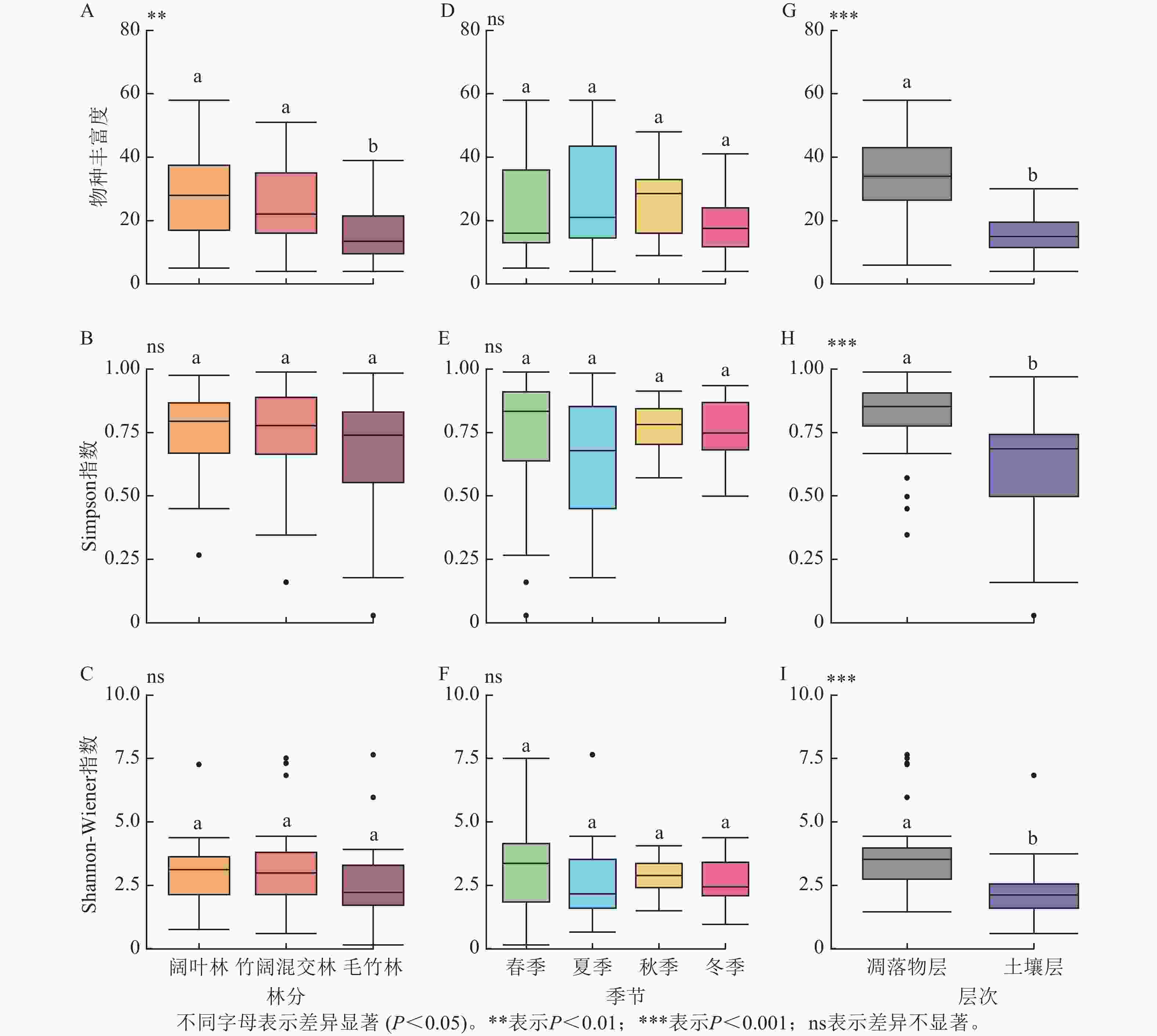
图 2 不同林分、季节、层次对土壤双翅目昆虫多样性的影响
Figure 2. Impacts of different forest stands, seasons, and layers on diversity of soil Diptera
-
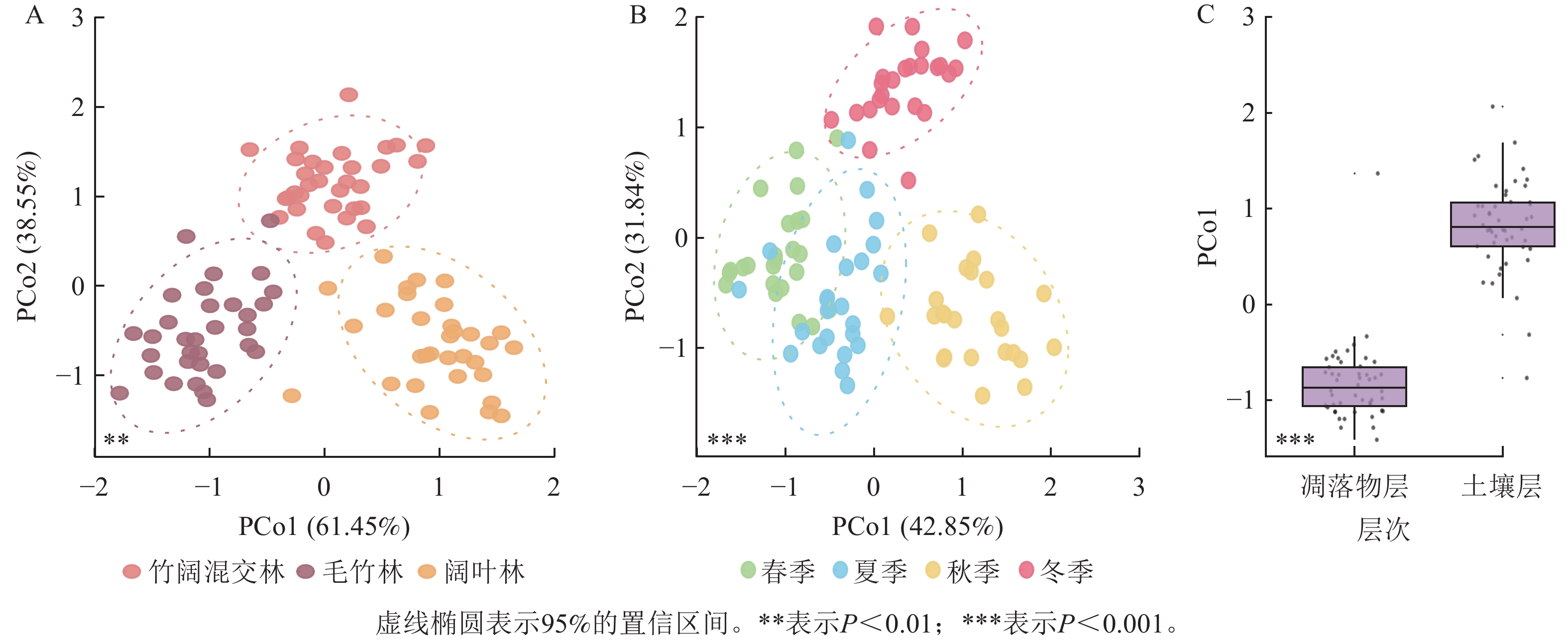
毛竹入侵生境下,林分效应、层次效应、季节效应均对土壤双翅目昆虫群落组成有显著影响(表1和图3)。主坐标分析(PCoA)显示:阔叶林、竹阔混交林、毛竹林的土壤双翅目昆虫群落之间有显著差异(P<0.05)。从林分类型来看,双翅目昆虫群落样本随着林分的改变而分散,第1坐标轴解释了61.45%的方差,第2坐标轴解释了38.55%的方差(图3A)。从不同季节来看,土壤双翅目昆虫群落样本沿着4个不同的季节分开,第1坐标轴解释了42.85%的方差,第2坐标轴解释了31.84%的方差(图3B)。从不同层次来看,层次仅仅解释了3.71%的土壤双翅目昆虫群落变异(图3C)。综合而言,林分效应对土壤双翅目昆虫群落的解释度高于季节效应。
表 1 林分、季节、层次对土壤双翅目昆虫置换多元方差分析
Table 1. Permutational multivariate analysis of variance of soil Diptera in relation to forest stand, season and layer
效应 自由度 F值 R值 林分 2 1.46 0.03** 阔叶林 vs 混交林 1 1.26 0.02* 混交林 vs 毛竹林 1 1.32 0.02* 阔叶林 vs 毛竹林 1 1.78 0.03** 季节 3 1.80 0.06*** 春季 vs 夏季 1 1.42 0.02** 春季 vs 秋季 1 2.24 0.05** 春季 vs 冬季 1 1.82 0.04** 夏季 vs 秋季 1 1.82 0.05** 夏季 vs 冬季 1 1.69 0.04** 秋季 vs 冬季 1 1.79 0.03* 层次 1 3.68 0.04*** 说明:*表示P<0.05;**表示P<0.01;***表示P<0.001。 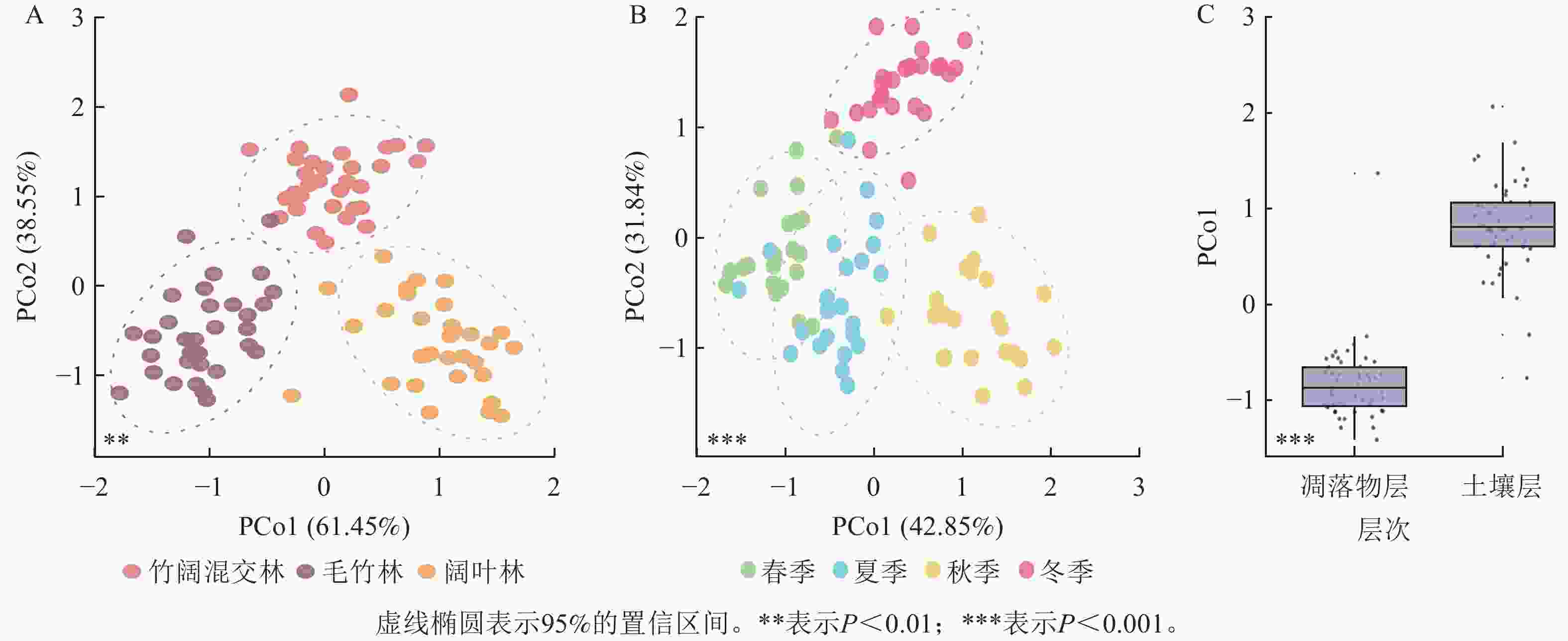
图 3 不同林分、季节、层次对土壤双翅目昆虫群落组成的影响
Figure 3. Impact of different forest stands, seasons and layers on the community composition of soil Diptera
-
近年来,高通量测序与宏条形码技术因其高效、精准的优势,在生物多样性研究中得到越来越广泛的应用。研究显示:相关论文从2005年的不足50篇迅速增长到2022年的2 500篇,其中超过1/2的研究聚焦于生物多样性,近1/4的内容主题为昆虫[30]。REMMEL等[31]研究也表明:在对蜜蜂、蝴蝶等昆虫类群进行鉴定时,基于宏条形码与传统形态学方法所获得的生物多样性结果具有较高一致性,进一步印证了该技术的可靠性。
双翅目昆虫生活史复杂,在土壤样本中包含了同一物种的不同发育阶段,形态差异显著;同时,土壤双翅目昆虫个体较小,物种间相似度高,传统形态学鉴定方法难以实现快速、准确的物种鉴定[32]。本研究通过高通量测序结合宏条形码技术,成功从土壤样本中鉴定出双翅目昆虫2 217个OTUs,归属于63科,进一步印证了该方法在处理复杂类群和不同发育阶段样本中的有效性与适用性。因此,采用高通量测序与宏条形码技术进行物种鉴定,获取土壤双翅目昆虫相对丰度等生物多样性信息,为深入解析毛竹入侵对地下生物群落的生态学影响提供了可靠依据。
-
竹阔混交林土壤双翅目昆虫的OTU数量明显高于阔叶林与毛竹林,这可能是因为适度植物入侵所带来的边缘效应。边缘区环境类型丰富,栖息地与生态位资源更多,能够承载更多物种,双翅目昆虫这类对环境波动敏感的生物对此响应尤为突出[33]。然而,当毛竹完成入侵后,毛竹林中单一的植被结构会大幅度限制该区域的生态多样性,本研究的土壤双翅目昆虫物种丰富度也出现显著降低。该结果与以往研究结论相符,表明植物入侵往往会造成土壤动物多样性下降[34−35]。此外,LAZZARO等[36]研究发现:刺槐Robinia pseudoacacia入侵会显著改变土壤理化性质和植被组成,致使土壤微节肢动物的物种多样性降低。进一步证明了入侵植物能够通过多种途径影响土壤动物群落的结构和功能,类似的作用机制在遭受毛竹入侵的森林生态系统中同样存在。毛竹入侵不仅会减少本土植物的多样性,简化森林的植物群落结构,还会影响森林凋落物的类型和质量[37]。毛竹的化感作用及其自身生长特性可能降低土壤有机物质含量,减少土壤真菌丰度[38],继而间接抑制以真菌为主要食物的双翅目昆虫群落。
-
林分效应、层次效应和季节效应均对土壤双翅目昆虫群落结构产生了显著影响。毛竹向常绿阔叶林入侵时会降低凋落物的产量和质量[39],从而对土壤中以碎屑为食的动物产生不利影响[40−41]。本研究发现:土壤双翅目昆虫受不同层次和季节的调控,这与早期的研究结果一致[42],即温带地区土壤中栖息的双翅目昆虫群落会随着季节发生动态变化,且从垂直分布来看,双翅目昆虫的数量会随着土壤深度的增加而减少。这种现象的产生原因是土壤双翅目昆虫对环境变化比较敏感,它们不同的食性和生态位造成土壤层次上的丰度差异。凋落物层富含有机物质,为食碎屑者提供了丰富的食物来源和栖息空间,因此这一层次的双翅目昆虫个体通常较为密集。相反,捕食者通常需要更多的庇护空间和隐蔽性,土壤层就为它们提供了理想的生存环境。不同土壤层次为双翅目昆虫群落提供了多样的生态位,进一步促进了其多样性和功能的分化[43]。此外,双翅目昆虫的分布还与凋落物的输入和土壤水分呈正相关,且幼虫在化蛹期间需要寻找相对干燥的土壤区域,以确保其生长发育的顺利进行[16]。
-
毛竹入侵过程中形成的混交林区域会容纳更多种类的土壤双翅目昆虫,但是完全入侵后的毛竹林会显著降低土壤双翅目昆虫的物种丰富度。毛竹入侵通过改变林分类型显著重塑了土壤双翅目昆虫的多样性及其群落结构。完全入侵导致双翅目物种丰富度显著下降,而中度入侵的混交林因边缘效应暂时提升了OTU数量;层次效应和季节效应均显著影响群落组成,其中凋落物层多样性高于土壤层,且林分类型的影响程度高于季节变化。
Impact of Moso bamboo invasion on soil Diptera diversity
-
摘要:
目的 研究亚热带森林中毛竹Phyllostachys edulis入侵对土壤双翅目Diptera昆虫多样性的影响,为揭示入侵植物影响生态系统的复杂机制提供理论依据。 方法 以浙江天目山国家级自然保护区内的毛竹入侵区域为试验样地,探究土壤双翅目昆虫对毛竹入侵的响应。选择毛竹入侵过程中经历的3个阶段对应的林分类型,分别为阔叶林(未入侵)、竹阔混交林(入侵过程中)和毛竹林(完全被入侵)。采集2021—2022年4个季节凋落物层和土壤层的双翅目昆虫样本,利用高通量测序与宏条形码技术完成物种聚类与鉴定,获取生物多样性信息。基于96个样本数据,分析双翅目昆虫种群在不同的林分、季节、层次中的动态变化。 结果 96个样本共获取2 217个操作分类单元(OTUs),隶属于63科。无论在凋落物层还是土壤层,竹阔混交林中的特有OTUs远高于其他林分。不同的林分类型仅对土壤双翅目昆虫的物种丰富度有显著影响(P<0.01),毛竹林中的双翅目昆虫物种丰富度显著低于阔叶林和竹阔混交林;土壤层次效应显著影响双翅目昆虫的物种丰富度、相对丰度以及多样性(P<0.001);季节变化对双翅目昆虫的α多样性没有显著影响。而不同的林分、层次、季节的土壤双翅目昆虫群落组成差异显著(P<0.01),且林分效应对土壤双翅目昆虫群落的解释度高于季节效应。 结论 毛竹完全入侵可降低土壤双翅目昆虫的物种丰富度;凋落物层昆虫多样性高于土壤层;相较于季节效应,林分效应对昆虫群落组成的影响更为突出。图3表1参43 Abstract:Objective This study examines the impacts of Moso bamboo (Phyllostachys edulis) invasion on Diptera diversity in subtropical forests, and provides a theoretical basis for elucidating the complex mechanisms underlying the effects of invasive plants on ecosystems. Method The experiment was conducted in the Moso bamboo invasion area of the Tianmu Mountain National Nature Reserve in Zhejiang Province. The study area included 3 stages of Moso bamboo invasion: broadleaf forest (uninvaded), mixed Moso bamboo-broadleaf forest (moderately invaded), and Moso bamboo forest (completely invaded). Samples of dipteran insects in the litter layer and soil layer were collected across 4 seasons in 2021 and 2022. Species clustering and identification were performed using high-throughput sequencing and metabarcoding techniques to obtain biodiversity information. The dynamics of dipteran insect populations in different forest types, seasons, and layers were analyzed based on the data of 96 samples. Result A total of 2 217 operational taxonomic units (OTUs) were obtained, belonging to 63 families. Whether in the litter layer or soil layer, the number of unique OTUs in the mixed Moso bamboo-broadleaf forest was much higher than in the other forest types. Different forest types significantly affected the species richness of soil Diptera (P<0.01), with species richness in Moso bamboo forest being significantly lower than in broadleaved forest and mixed Moso bamboo-broadleaf forest. The soil layer effect significantly impacted the species richness, relative abundance, and diversity of soil Diptera (P<0.001). In addition, seasonal changes did not significantly affect the α diversity of dipteran insects. However, the community composition of soil Diptera differed significantly among different forest types, layers, and seasons (P<0.01), with the forest type effect explaining more variation than the seasonal effect. Conclusion Complete invasion of Moso bamboo reduced the species richness of soil dipteran insects; insect diversity was higher in the litter layer than in the soil layer; compared with seasonal effects, forest stand effects exerted a more prominent influence on insect community composition. [Ch, 3 fig. 1 tab. 43 ref.] -
Key words:
- plant invasion /
- soil arthropods /
- community structure /
- ecosystem function
-
图 1 不同林分中土壤双翅目昆虫群落组成
Figure 1 Community composition of soil Diptera in different forest stands
图 2 不同林分、季节、层次对土壤双翅目昆虫多样性的影响
Figure 2 Impacts of different forest stands, seasons, and layers on diversity of soil Diptera
图 3 不同林分、季节、层次对土壤双翅目昆虫群落组成的影响
Figure 3 Impact of different forest stands, seasons and layers on the community composition of soil Diptera
表 1 林分、季节、层次对土壤双翅目昆虫置换多元方差分析
Table 1. Permutational multivariate analysis of variance of soil Diptera in relation to forest stand, season and layer
效应 自由度 F值 R值 林分 2 1.46 0.03** 阔叶林 vs 混交林 1 1.26 0.02* 混交林 vs 毛竹林 1 1.32 0.02* 阔叶林 vs 毛竹林 1 1.78 0.03** 季节 3 1.80 0.06*** 春季 vs 夏季 1 1.42 0.02** 春季 vs 秋季 1 2.24 0.05** 春季 vs 冬季 1 1.82 0.04** 夏季 vs 秋季 1 1.82 0.05** 夏季 vs 冬季 1 1.69 0.04** 秋季 vs 冬季 1 1.79 0.03* 层次 1 3.68 0.04*** 说明:*表示P<0.05;**表示P<0.01;***表示P<0.001。  下载: 导出CSV
-
[1] 吕金林, 岳明, 毛祝新, 等. 秦岭中段外来植物入侵现状及风险评价研究[J]. 生态环境学报, 2023, 32(9): 1585−1594. LÜ Jinlin, YUE Ming, MAO Zhuxin, et al. Study on invasion status and risk assessment of alien plants in Qinling Mountains[J]. Ecology and Environment Sciences, 2023, 32(9): 1585−1594. DOI: 10.16258/j.cnki.1674-5906.2023.09.005. [2] 刘艳杰, 黄伟, 杨强, 等. 近十年植物入侵生态学重要研究进展[J]. 生物多样性, 2022, 30(10): 276−292. LIU Yanjie, HUANG Wei, YANG Qiang, et al. Research advances of plant invasion ecology over the past 10 years[J]. Biodiversity Science, 2022, 30(10): 276−292. DOI: 10.17520/biods.2022438. [3] 侯清晨, 冯燕楼, 周玉洁, 等. 植物入侵机制的主要假说[J]. 应用生态学报, 2022, 33(11): 3105−3115. HOU Qingchen, FENG Yanlou, ZHOU Yujie, et al. Main hypotheses on mechanisms underlying plant invasion: a review[J]. Chinese Journal of Applied Ecology, 2022, 33(11): 3105−3115. DOI: 10.13287/j.1001-9332.202211.005. [4] GUO Kun, PYŠEK P, van KLEUNEN M, et al. Plant invasion and naturalization are influenced by genome size, ecology and economic use globally[J]. Nature Communications, 2024, 15: 1330. DOI: 10.1038/s41467-024-45667-4. [5] 白尚斌, 周国模, 王懿祥, 等. 毛竹入侵对常绿阔叶林主要树种的化感作用研究[J]. 环境科学, 2013, 34(10): 4066−4072. BAI Shangbin, ZHOU Guomo, WANG Yixiang, et al. Allelopathic potential of Phyllostachys edulis on two dominant tree species of evergreen broad-leaved forest in its invasive process[J]. Environmental Science, 2013, 34(10): 4066−4072. DOI: 10.13227/j.hjkx.2013.10.055. [6] 陈旭, 刘宗悦, 徐钧杰, 等. 天目山毛竹林皆伐后群落的恢复特征[J]. 浙江农林大学学报, 2022, 39(4): 705−716. CHEN Xu, LIU Zongyue, XU Junjie, et al. Restoration characteristics of community after clear-cutting of Phyllostachys edulis stands in Mount Tianmu[J]. Journal of Zhejiang A&F University, 2022, 39(4): 705−716. DOI: 10.11833/j.issn.2095-0756.20210595. [7] LIU Xishuai, SIEMANN E, CUI Cheng, et al. Moso bamboo (Phyllostachys edulis) invasion effects on litter, soil and microbial PLFA characteristics depend on sites and invaded forests[J]. Plant and Soil, 2019, 438(1/2): 85−99. DOI: 10.1007/s11104-019-04010-3. [8] XU Qiufang, JIANG Peikun, WU Jiasen, et al. Bamboo invasion of native broadleaf forest modified soil microbial communities and diversity[J]. Biological Invasions, 2015, 17(1): 433−444. DOI: 10.1007/s10530-014-0741-y. [9] 尹文英. 土壤动物学研究的回顾与展望[J]. 生物学通报, 2001, 36(8): 1−3. YIN Wenying. Review and prospect of soil zoology research[J]. Bulletin of Biology, 2001, 36(8): 1−3. DOI: 10.3969/j.issn.0006-3193.2001.08.001. [10] SCHEU S. The soil food web: structure and perspectives[J]. European Journal of Soil Biology, 2002, 38(1): 11−20. DOI: 10.1016/S1164-5563(01)01117-7. [11] 汪亚芳, 刘宗悦, 张宝刚, 等. 入侵毛竹皆伐对亚热带森林土壤微生物生物量和酶活性的影响[J]. 应用生态学报, 2022, 33(5): 1233−1239. WANG Yafang, LIU Zongyue, ZHANG Baogang, et al. Effects of the removal of invasive Moso bamboo on soil microbial biomass and enzyme activities in subtropical forests[J]. Chinese Journal of Applied Ecology, 2022, 33(5): 1233−1239. DOI: 10.13287/j.1001-9332.202205.015. [12] 李伟成, 盛海燕, 陈伟杰, 等. 毛竹入侵马尾松林的土壤菌群多样性变化[J]. 应用生态学报, 2018, 29(12): 3969−3976. LI Weicheng, SHENG Haiyan, CHEN Weijie, et al. Variation of soil bacterial diversity after the invasion of Phyllostachys edulis into Pinus massoniana forest[J]. Chinese Journal of Applied Ecology, 2018, 29(12): 3969−3976. DOI: 10.13287/j.1001-9332.201812.002. [13] LITT A R, CORD E E, FULBRIGHT T E, et al. Effects of invasive plants on arthropods[J]. Conservation Biology, 2014, 28(6): 1532−1549. DOI: 10.1111/cobi.12350. [14] QIN Jiafeng, LIU Changhai, AI Ning, et al. Community characteristics and niche analysis of soil animals in returning farmland to forest areas on the Loess Plateau[J]. Land, 2022, 11(11): 1958. DOI: 10.3390/land11111958. [15] WEI Xue, WU Pengfei. Responses of soil insect communities to alpine wetland degradation on the eastern Qinghai-Tibetan Plateau, China[J]. European Journal of Soil Biology, 2021, 103: 103276. DOI: 10.1016/j.ejsobi.2020.103276. [16] FROUZ J. Influence of soil water regime on the larval development of terrestrial chironomid Smittia nudipennis (Diptera: Chironomidae)[J]. Biológia (Bratislava), 1994, 49(2): 229−234. DOI: 10.5555/19950501479. [17] HERNÁNDEZ-ORTIZ V, DZUL-CAUICH J F, MADORA M, et al. Local climate conditions shape the seasonal patterns of the Diptera community in a tropical rainforest of the Americas[J]. Neotropical Entomology, 2022, 51(4): 499−513. DOI: 10.1007/s13744-022-00965-8. [18] HUANG Junhao, MIAO Xiaoqian, WANG Qingyun, et al. Metabarcoding reveals massive species diversity of Diptera in a subtropical ecosystem[J]. Ecology and Evolution, 2022, 12: e8535. DOI: 10.1002/ece3.8535. [19] WEI Qiaoyu, YIN Rui, HUANG Junhao, et al. The diversity of soil mesofauna declines after bamboo invasion in subtropical China[J]. Science of the Total Environment, 2021, 789: 147982. DOI: 10.1016/j.scitotenv.2021.147982. [20] BUYANTUYEV A, XU Pengyan, WU Jianguo, et al. A space-for-time (SFT) substitution approach to studying historical phenological changes in urban environment[J]. PLoS One, 2012, 7(12): e51260. DOI: 10.1371/journal.pone.0051260. [21] WOGAN G O U, WANG I J. The value of space-for-time substitution for studying fine-scale microevolutionary processes[J]. Ecography, 2018, 41(9): 1456−1468. DOI: 10.1111/ecog.03235. [22] 李萍, 谢文霞, 王志强, 等. 互花米草入侵对胶州湾潮滩湿地硫素时空分布的影响[J]. 环境科学学报, 2019, 39(3): 870−879. LI Ping, XIE Wenxia, WANG Zhiqiang, et al. Effects of Spartina alterniflora invasion on sulfur content temporal and spatial variation in tidal flat wetland of Jiaozhou Bay[J]. Acta Scientiae Circumstantiae, 2019, 39(3): 870−879. DOI: 10.13671/j.hjkxxb.2018.0416. [23] WU Huihui, SUN Zhigao, WANG Hua, et al. Impacts of spatial expansion by Phragmites australis on spatiotemporal variation of sulfur fractions in marsh soils of the Min River estuary, Southeast China[J]. Science of the Total Environment, 2024, 912: 168910. DOI: 10.1016/j.scitotenv.2023.168910. [24] SHOKRALLA S, PORTER T M, GIBSON J F, et al. Massively parallel multiplex DNA sequencing for specimen identification using an Illumina MiSeq platform[J]. Scientific Reports, 2015, 5: 9687. DOI: 10.1038/srep09687. [25] YU D W, JI Yinqiu, EMERSON B C, et al. Biodiversity soup: metabarcoding of arthropods for rapid biodiversity assessment and biomonitoring[J]. Methods in Ecology and Evolution, 2012, 3(4): 613−623. DOI: 10.1111/j.2041-210x.2012.00198.x. [26] MAGOČ T, SALZBERG S L. FLASH: fast length adjustment of short reads to improve genome assemblies[J]. Bioinformatics, 2011, 27(21): 2957−2963. DOI: 10.1093/bioinformatics/btr507. [27] BOLGER A M, LOHSE M, USADEL B. Trimmomatic: a flexible trimmer for Illumina sequence data[J]. Bioinformatics, 2014, 30(15): 2114−2120. DOI: 10.1093/bioinformatics/btu170. [28] EDGAR R C. UPARSE: highly accurate OTU sequences from microbial amplicon reads[J]. Nature Methods, 2013, 10(10): 996−998. DOI: 10.1038/nmeth.2604. [29] WANG Qiong, GARRITY G M, TIEDJE J M, et al. Naïve Bayesian classifier for rapid assignment of rRNA sequences into the new bacterial taxonomy[J]. Applied and Environmental Microbiology, 2007, 73(16): 5261−5267. DOI: 10.1128/aem.00062-07. [30] SALIS R, SUNDE J, GUBONIN N, et al. Performance of DNA metabarcoding, standard barcoding and morphological approaches in the identification of insect biodiversity[J]. Molecular Ecology Resources, 2024, 24(8): e14018. DOI: 10.1111/1755-0998.14018. [31] REMMEL N, BUCHNER D, ENSS J, et al. DNA metabarcoding and morphological identification reveal similar richness, taxonomic composition and body size patterns among flying insect communities[J]. Insect Conservation and Diversity, 2024, 17(3): 449−463. DOI: 10.1111/icad.12710. [32] MROZIŃSKA N, OBOLEWSKI K. Morphological taxonomy and DNA barcoding: should they be integrated to improve the identification of chironomid larvae (Diptera)?[J]. Ecohydrology & Hydrobiology, 2024, 24(1): 1−10. DOI: 10.1016/j.ecohyd.2023.11.007. [33] ESIN M N, RUCHIN A B. Edge effects on Diptera distribution in deciduous forests of the centre of European Russia[J]. Journal of Wildlife and Biodiversity, 2024, 8(2): 16−37. DOI: 10.5281/zenodo.10499077. [34] FERNANDEZ R D, MORENO M L, ARAGÓN R, et al. Ligustrum lucidum invasion decreases abundance and relative contribution of soil fauna to litter decomposition but increases decomposition rate in a subtropical montane forest of northwestern Argentina[J]. Canadian Journal of Forest Research, 2022, 52(2): 261−268. DOI: 10.1139/cjfr-2021-0169. [35] 胡展育, 周建松, 刘伟, 等. 紫茎泽兰入侵对土壤动物群落结构多样性的影响[J]. 湖北农业科学, 2023, 62(7): 57−62. HU Zhanyu, ZHOU Jiansong, LIU Wei, et al. Effects of Eupatorium adenophorum invasion on the diversity of soil animal community structure[J]. Hubei Agricultural Sciences, 2023, 62(7): 57−62. DOI: 10.14088/j.cnki.issn0439-8114.2023.07.010. [36] LAZZARO L, MAZZA G, D’ERRICO G, et al. How ecosystems change following invasion by Robinia pseudoacacia: insights from soil chemical properties and soil microbial, nematode, microarthropod and plant communities[J]. Science of the Total Environment, 2018, 622: 1509−1518. DOI: 10.1016/j.scitotenv.2017.10.017. [37] CHEN Xi, CHEN Xin, HUANG Shiqi, et al. Impacts of Moso bamboo (Phyllostachys pubescens) invasion on species diversity and aboveground biomass of secondary coniferous and broad-leaved mixed forest[J]. Frontiers in Plant Science, 2022, 13: 1001785. DOI: 10.3389/fpls.2022.1001785. [38] LI Yongchun, LI Yongfu, CHANG S X, et al. Bamboo invasion of broadleaf forests altered soil fungal community closely linked to changes in soil organic C chemical composition and mineral N production[J]. Plant and Soil, 2017, 418(1/2): 507−521. DOI: 10.1007/s11104-017-3313-y. [39] SONG Qingni, OUYANG Ming, YANG Qingpei, et al. Degradation of litter quality and decline of soil nitrogen mineralization after Moso bamboo (Phyllostachys pubscens) expansion to neighboring broadleaved forest in subtropical China[J]. Plant and Soil, 2016, 404(1/2): 113−124. DOI: 10.1007/s11104-016-2835-z. [40] KAPPES H, LAY R, TOPP W. Changes in different trophic levels of litter-dwelling macrofauna associated with giant knotweed invasion[J]. Ecosystems, 2007, 10(5): 734−744. DOI: 10.1007/s10021-007-9052-9. [41] ROBSON T C, BAKER A C, MURRAY B R. Differences in leaf-litter invertebrate assemblages between radiata pine plantations and neighbouring native eucalypt woodland[J]. Austral Ecology, 2009, 34(4): 368−376. DOI: 10.1111/j.1442-9993.2009.01936.x. [42] HÖVEMEYER K. The dipterous community of a beech wood on limestone: production of imagines, abundance and spatial distribution particularly of larvae[J]. Pedobiologia, 1984, 26(1): 1−15. DOI: 10.5555/19841984673. [43] PAOLETTI M G, BRESSAN M, EDWARDS C A. Soil invertebrates as bioindicators of human disturbance[J]. Critical Reviews in Plant Sciences, 1996, 15(1): 21−62. DOI: 10.1080/07352689609701935. -

-
链接本文:
https://zlxb.zafu.edu.cn/article/doi/10.11833/j.issn.2095-0756.20250620
 点击查看大图
计量
- 文章访问数: 279
- HTML全文浏览量: 125
- PDF下载量: 21
- 被引次数: 0
