Volume 42 Issue 6
Nov.  2025
Turn off MathJax
Article Contents

LI Baogang, NIE Xinjun, KONG Delei, et al. Effects of biochar based fertilizer on soil nutrients and bacterial community structure[J]. Journal of Zhejiang A&F University, 2025, 42(6): 1243−1254 doi:  10.11833/j.issn.2095-0756.20250102
Citation: LI Baogang, NIE Xinjun, KONG Delei, et al. Effects of biochar based fertilizer on soil nutrients and bacterial community structure[J]. Journal of Zhejiang A&F University, 2025, 42(6): 1243−1254 doi:  10.11833/j.issn.2095-0756.20250102

Effects of biochar based fertilizer on soil nutrients and bacterial community structure

DOI: 10.11833/j.issn.2095-0756.20250102
  • Received Date: 2025-01-03
  • Accepted Date: 2025-06-06
  • Rev Recd Date: 2025-06-05
  • Available Online: 2025-11-26
  • Publish Date: 2025-12-20
  •   Objective  The objective is to provide a scientific basis for improving rice paddy soil quality, by investigating the effects of biochar based fertilizer on soil nutrients and bacterial community structure.   Method  A field experiment was conducted in a typical rice paddy located in Hangjiahu Plain. 4 treatments, including no fertilizer control (ck), conventional fertilizer (CF), biochar based fertilizer substitution of 50% chemical fertilizer (OF) and biochar based fertilizer (BF), were laid out with the 3 fertilization treatments with consistent inputs of N, P and K. Plant and soil samples were collected post-harvest to analyze soil physicochemical properties, bacterial community structure, and rice yield under different fertilizer treatments.   Result  Compared with CF, OF and BF treatments significantly increased the contents of organic carbon (SOC), soil dissolvable organic carbon (DOC), and microbial biomass carbon (MBC), respectively (P< 0.05). There was no significant difference in soil bacterial diversity index among the fertilization treatments. However, the application of biochar based fertilizer had a significant impact on the composition and function of soil bacterial community (P<0.05), with increasing the relative abundance of eutrophic bacteria and carbon-, nitrogen-related functional bacteria. Meanwhile, the correlation analysis results revealed that soil pH, SOC, DOC, available phosphorus (AP) and available potassium (AK) were the key environmental factors affecting the composition of soil bacterial communities. Correlation analysis indicated that soil SOC, DOC, and MBC were important for rice yield.   Conclusion  The application of biochar based fertilizer (BF) and substitution of 50% chemical fertilizer (OF) could improve soil nutrient and the relative abundance of eutrophic bacteria compared to conventional fertilizer. These results demonstrate the positive effects of biochar based fertilizer in regulating the paddy soil microbial environment and improving soil quality. [Ch, 5 fig. 3 tab. 53 ref.]
  • [1] GAO Ziying, WANG Haiyan, ZHANG Yifan.  Soil carbon, nitrogen and phosphorus stoichiometric characteristics and driving factors: a review . Journal of Zhejiang A&F University, 2025, 42(3): 645-656. doi: 10.11833/j.issn.2095-0756.20240564
    [2] WANG Ning, FU Yajun, SHAO Jing, XUE Yunyun.  Effects of soil nutrient heterogeneity on competition between Aegilops tauschii and Triticum aestivum . Journal of Zhejiang A&F University, 2023, 40(2): 285-292. doi: 10.11833/j.issn.2095-0756.20220370
    [3] CHEN Jiayin, HUANG Chengpeng, ZHENG Mengqi, LI Zihong, WANG Jiayu, JIANG Peikun.  Effects of substituting organic fertilizer and biochar-based fertilizer instead of chemical fertilizer on nitrogen and phosphorus runoff loss in sweet potato sloping farmland . Journal of Zhejiang A&F University, 2023, 40(3): 540-549. doi: 10.11833/j.issn.2095-0756.20220360
    [4] SUI Xiran, WU Lifang, WANG Yan, WANG Ziquan, XIAO Yuxin, LIU Yungen, YANG Bo.  Characteristics of nutrient and enzyme activity in soil aggregates of different rocky desertification levels in central Yunnan Plateau . Journal of Zhejiang A&F University, 2022, 39(1): 115-126. doi: 10.11833/j.issn.2095-0756.20210168
    [5] REN Yi, JIANG Peikun, LU Changgen, SHAO Jianjun, ZHOU Xue’e, CHEN Junhui.  Effects of biochar-based fertilizer and organic fertilizer substituting chemical fertilizer partially on soil microbial abundances and enzyme activities . Journal of Zhejiang A&F University, 2022, 39(4): 860-868. doi: 10.11833/j.issn.2095-0756.20210619
    [6] ZHANG Zeng, SONG Chengfang, SHAN Shengdao, ZHENG Huabao, ZHANG Cheng.  Effects of swine manure hydrochar on soil organic carbon mineralization and soil properties . Journal of Zhejiang A&F University, 2021, 38(4): 765-773. doi: 10.11833/j.issn.2095-0756.20200651
    [7] TAN Jin, YANG Jianying, HOU Jian.  Relationship between shrubs and soil nutrients in Wuhai City . Journal of Zhejiang A&F University, 2019, 36(5): 957-964. doi: 10.11833/j.issn.2095-0756.2019.05.015
    [8] WANG Dan, MA Yuandan, GUO Huiyuan, GAO Yan, ZHANG Rumin, HOU Ping.  Soil nutrients and microorganisms with simulated acid rain stress and Cryptomeria fortunei litter . Journal of Zhejiang A&F University, 2015, 32(2): 195-203. doi: 10.11833/j.issn.2095-0756.2015.02.005
    [9] ZHENG Rong.  Canonical correlation and principal components analysis of different production areas of Dendrocalamopsis oldhami with quality indicators of bamboo shoots and its soil nutrients . Journal of Zhejiang A&F University, 2012, 29(5): 710-714. doi: 10.11833/j.issn.2095-0756.2012.05.012
    [10] LIU Li-na, JIN Ai-wu.  Spatial variability of soil nutrients for an intensively managed Phyllostachys pubescens forest . Journal of Zhejiang A&F University, 2011, 28(5): 828-832. doi: 10.11833/j.issn.2095-0756.2011.05.025
    [11] DU Hua-qiang, TANG Meng-ping, CUI Rui-rui.  Spatial heterogeneity of soil nutrients in an evergreen broadleaved forest of Mount Tianmu,Zhejiang . Journal of Zhejiang A&F University, 2011, 28(4): 562-568. doi: 10.11833/j.issn.2095-0756.2011.04.007
    [12] ZHENG Hong-bo, WU Jian-ping, ZHANG Shan.  Spatial variability of farmland soil organic matter and soil nutrients in Ninghai County,Zhejiang Province . Journal of Zhejiang A&F University, 2010, 27(3): 379-384. doi: 10.11833/j.issn.2095-0756.2010.03.010
    [13] TONG Gen-ping, WANG Wei-guo, ZHANG Yuan-yuan, XU Wen-xin, DOU Chun-ying, SHENG Wei-xing, YU Qing-ping, YE Zheng-qian.  Seasonal changes of soil and leaf nutrient levels in a Carya cathayensis orchard . Journal of Zhejiang A&F University, 2009, 26(4): 516-521.
    [14] JIANG Pei-kun, XUQiu-fang, WUQi-feng, WUJia-sen.  Effects of fertilization on soil properties under Castanea mollissima plantation . Journal of Zhejiang A&F University, 2007, 24(4): 445-449.
    [15] DAI Wen-sheng, LI Zhang-ju, CHENG Xiao-jian, YU Wei-wu, FU Qing-gong.  Mineral elements in Torreya grandis 'Merrillii' seeds and their forest soils . Journal of Zhejiang A&F University, 2006, 23(4): 393-399.
    [16] JIANG Pei-kun, XU Qiu-fang, CHU Jia-miao, WU Li-jun.  Soil nutrients in response to intensive management of Phyllostachys praecox . Journal of Zhejiang A&F University, 2006, 23(3): 242-247.
    [17] DAI Wen-sheng, LI Zhang-ju, CHENG Xiao-jian, YU Wei-wu, FU Qing-gong.  Soil nutrients in Torreya grandis `Merrillii' plantation . Journal of Zhejiang A&F University, 2006, 23(2): 140-144.
    [18] MA Huan-cheng, LUO Zhi-bin, CHEN Yi-qun, LIN Wen-jie.  Hydrogel’s role in retention of nutrients in soil . Journal of Zhejiang A&F University, 2004, 21(4): 404-407.
    [19] YANG Fang, XU Qiu-fang.  Changes in nutrients and heavy metal contents in soils under Phyllostachys praecox stands with different cultivation histories . Journal of Zhejiang A&F University, 2003, 20(2): 111-114.
    [20] JIANG Zhi-biao, YU Qin-min.  Effects of fertilization on some physiological traits of Chinese fir seedling and soil nutrient . Journal of Zhejiang A&F University, 1999, 16(4): 365-368.
  • [1]
    XU Chunchun, JI Long, CHEN Zhongdu, et al. Analysis of China’s rice industry in 2020 and the outlook for 2021 [J]. China Rice, 2021, 27(2): 1−4.
    [2]
    JIA Rong, ZHOU Jie, CHU Juncong, et al. Insights into the associations between soil quality and ecosystem multifunctionality driven by fertilization management: a case study from the north China Plain[J/OL]. Journal of Cleaner Production, 2022, 362: 132265[2025-01-01]. DOI: 10.1016/j.jclepro.2022.132265.
    [3]
    BI Siwen, BARINELLI V, SOBKOWICZ M J. Degradable controlled release fertilizer composite prepared via extrusion: fabrication, characterization, and release mechanisms[J/OL]. Polymers, 2020, 12(2): 301[2025-01-01]. DOI: 10.3390/polym12020301.
    [4]
    ZHANG Su’e, ZOU Wenhua, LEI Chunsong, et al. Impact of biochar-based fertilizers on soil fertility in tea plantations and their effects on tea yield and quality [J]. Journal of Zhejiang A&F University, 2025, 42(3): 486−494.
    [5]
    ZENG Jun, LIU Xuejun, SONG Ling, et al. Nitrogen fertilization directly affects soil bacterial diversity and indirectly affects bacterial community composition [J]. Soil Biology and Biochemistry, 2016, 92: 41−49.
    [6]
    HUA Bin, LI Zhouwen, GAO Weikai, et al. Soil amendment in plastic greenhouse using modified biochar: soil bacterial diversity responses and microbial biomass carbon and nitrogen [J]. Biotechnology Letters, 2021, 43(3): 655−666.
    [7]
    REN Yi, JIANG Peikun, LU Changgen, et al. Effects of biochar-based fertilizer and organic fertilizer substituting chemical fertilizer partially on soil microbial abundances and enzyme activities [J]. Journal of Zhejiang A&F University, 2022, 39(4): 860−868.
    [8]
    LUO Xiaosheng, KOU Changlin, ZHANG Jishi, et al. Effect of biochar-based fertilizer application on soil enzyme activity, fungal community, and crop yield in winer wheat-summer maize rotation farmland[J]. Environmental Science, 2025, 46(6): 3965−3974.
    [9]
    BAI Xiongxiong, HUANG Yawen, REN Wei, et al. Responses of soil carbon sequestration to climate-smart agriculture practices: a meta-analysis [J]. Global Change Biology, 2019, 25(8): 2591−2606.
    [10]
    HU Kun, ZHANG Hongxue, GUO Liming, et al. Effects of tobacco stalk biochar-based fertilizer on the organic carbon fractions and microbial community structure of adlay soil [J]. Chinese Journal of Eco-Agriculture, 2021, 29(9): 1592−1603.
    [11]
    IBRAHIM M M, TONG Chenxiao, HU Kun, et al. Biochar-fertilizer interaction modifies N-sorption, enzyme activities and microbial functional abundance regulating nitrogen retention in rhizosphere soil[J/OL]. Science of the Total Environment, 2020, 739: 140065[2025-01-01]. DOI: 10.1016/j.scitotenv.2020.140065.
    [12]
    GAO Wenhui, GUO Zonghao, GAO Ke, et al. Effects of biochar and biochar compound fertilizer on the soil bacterial and fungal community in the soybean rhizosphere [J]. Ecology and Environmental Sciences, 2021, 30(1): 205−212.
    [13]
    PENG Jiahao, LIN Shaoying, WANG Weiqi, et al. Effects of straw and biochar amendments on characteristics of soil fungal community and organic carbon pool in Jasminum sambac garden [J]. Environmental Science, 2024, 45(7): 4228−4240.
    [14]
    LU Rukun. Methods of Soil Agrochemical Analysis[M]. Beijing: China Agricultural Science and Technology Press, 2000.
    [15]
    IBRAHIM M M, ZHANG Hongxue, GUO Liming, et al. Biochar interaction with chemical fertilizer regulates soil organic carbon mineralization and the abundance of key C-cycling-related bacteria in rhizosphere soil[J/OL]. European Journal of Soil Biology, 2021, 106: 103350[2025-01-01]. DOI: 10.1016/j.ejsobi.2021.103350.
    [16]
    ZHANG Qianqian, SONG Yanfeng, WU Zhen, et al. Effects of six-year biochar amendment on soil aggregation, crop growth, and nitrogen and phosphorus use efficiencies in a rice-wheat rotation[J/OL]. Journal of Cleaner Production, 2020, 242: 118435[2025-01-01]. DOI: 10.1016/j.jclepro.2019.118435.
    [17]
    KAVITHA B, REDDY P V L, KIM B, et al. Benefits and limitations of biochar amendment in agricultural soils: a review [J]. Journal of Environmental Management, 2018, 227: 146−154.
    [18]
    LIU Yuan, KHAN M J, JIN Haiyang, et al. Effects of successive application of crop-straw biochar on crop yield and soil properties in cambosols [J]. Acta Pedologica Sinica, 2015, 52(4): 849−858.
    [19]
    GUL S, WHALEN J K, THOMAS B W, et al. Physico-chemical properties and microbial responses in biochar-amended soils: mechanisms and future directions[J]. Agriculture, Ecosystems & Environment, 2015, 206: 46−59.
    [20]
    LIU Weifan, WANG Xiaogang, LIU Jili, et al. Effects of carbon-based fertilizer on soil physical and chemical properties, enzyme activities and microbial communities in maize fields in arid regions [J]. Environmental Science, 2025, 46(3): 1905−1914.
    [21]
    CHEN Feijie, XIA Huijuan, LIU Fude, et al. Characteristics of biochar and its effects and mechanism on soil properties [J]. Journal of Environmental Engineering Technology, 2022, 12(1): 161−172.
    [22]
    IBRAHIM M M, HU Kun, TONG Chenxiao, et al. De-ashed biochar enhances nitrogen retention in manured soil and changes soil microbial dynamics[J/OL]. Geoderma, 2020, 378: 114589[2025-01-01]. DOI: 10.1016/j.geoderma.2020.114589.
    [23]
    XIONG Jiahuan, ZHANG Yikai, XIANG Jing, et al. Effect of biochar-based fertilizer application on rice yield and nitrogen utilization in film-mulched paddy fields [J]. Chinese Journal of Rice Science, 2024, 38(5): 567−576.
    [24]
    XIE Zhijian, WU Jia, DUAN Jingui, et al. Effects of combining biochar-based fertilizer and milk vetch on dry matter accumulation and N use efficiencies of early rice in reddish paddy field of South China [J]. Journal of Plant Nutrition and Fertilizers, 2020, 26(9): 1732−1739.
    [25]
    KRONZUCKER H J, KIRK G J D, YAEESH S M, et al. Effects of hypoxia on 13 \begin{document}${\mathrm{NH}}_4^+ $\end{document} fluxes in rice roots. kinetics and compartmental analysis kinetics and compartmental analysis [J]. Plant Physiology, 1998, 116(2): 581−587
    [26]
    MANDAL S, THANGARAJAN R, BOLAN N S, et al. Biochar-induced concomitant decrease in ammonia volatilization and increase in nitrogen use efficiency by wheat [J]. Chemosphere, 2016, 142: 120−127.
    [27]
    SPOKAS K A, NOVAK J M, VENTEREA R T. Biochar’s role as an alternative N-fertilizer: ammonia capture [J]. Plant and Soil, 2012, 350(1): 35−42.
    [28]
    CHU Lei, ZHANG Yu, QIAN Long, et al. Influence of biochar on nitrogen use efficiency and root morphology of rice-seedling in two contrasting paddy soils [J]. Phyton, 2020, 89(4): 1035−1042.
    [29]
    CHEW J, JOSEPH S, CHEN Guanhong, et al. Biochar-based fertiliser enhances nutrient uptake and transport in rice seedlings[J/OL]. Science of the Total Environment, 2022, 826: 154174[2025-01-01]. DOI: 10.1016/j.scitotenv.2022.154174.
    [30]
    BENGOUGH A G, MCKENZIE B M, HALLETT P D, et al. Root elongation, water stress, and mechanical impedance: a review of limiting stresses and beneficial root tip traits [J]. Journal of Experimental Botany, 2011, 62(1): 59−68.
    [31]
    HAEFELE S M, KONBOON Y, WONGBOON W, et al. Effects and fate of biochar from rice residues in rice-based systems [J]. Field Crops Research, 2011, 121(3): 430−440.
    [32]
    CHEN Junhui, LIU Xiaoyu, ZHENG Jinwei, et al. Biochar soil amendment increased bacterial but decreased fungal gene abundance with shifts in community structure in a slightly acid rice paddy from Southwest China [J]. Applied Soil Ecology, 2013, 71: 33−44.
    [33]
    FARRELL M, KUHN T K, MACDONALD L M, et al. Microbial utilisation of biochar-derived carbon [J]. Science of the Total Environment, 2013, 465: 288−297.
    [34]
    CHEN Yi, WU Chun, LI Caibin, et al. Effect of biochar-based fertilizer on bacterial and fungal community composition, diversity in tobacco-planting yellow soil [J]. Acta Microbiologica Sinica, 2020, 60(4): 653−666.
    [35]
    NIELSEN S, MINCHIN T, KIMBER S, et al. Comparative analysis of the microbial communities in agricultural soil amended with enhanced biochars or traditional fertilisers[J]. Agriculture, Ecosystems & Environment, 2014, 191: 73−82.
    [36]
    WU Dong, LI Maosen, LI Shuaibing, et al. Effects of biochar based fertilizer on soil nutrients and bacterial community structure under nitrogen reduction [J]. Journal of Henan Agricultural University, 2023, 57(4): 657−666.
    [37]
    MICHAUD L, GIUDICE A L, TROUSSELLIER M, et al. Phylogenetic characterization of the heterotrophic bacterial communities inhabiting a marine recirculating aquaculture system [J]. Journal of Applied Microbiology, 2009, 107(6): 1935−1946.
    [38]
    LI Hui, YANG Shan, SEMENOV M V, et al. Temperature sensitivity of SOM decomposition is linked with a K-selected microbial community [J]. Global Change Biology, 2021, 27(12): 2763−2779.
    [39]
    MA Xiaoying, MA Kun, ZHOU Yan, et al. Response of soil bacteria community structure to application of inorganic and organic fertilizer [J]. Acta Agriculturae Boreali-occidentalis Sinica, 2019, 28(10): 1698−1707.
    [40]
    XU Minmin, HUANG Ying, LI Bo, et al. Effect of biochar on wheat root-associated microbial community structures [J]. Acta Agriculturae Zhejiangensis, 2021, 33(3): 516−525.
    [41]
    BARBERÁN A, BATES S T, CASAMAYOR E O, et al. Using network analysis to explore co-occurrence patterns in soil microbial communities [J]. The ISME Journal, 2012, 6(2): 343−351.
    [42]
    DAVIS K E R, SANGWAN P, JANSSEN P H. Acidobacteria, Rubrobacteridae and Chloroflexi are abundant among very slow-growing and mini-colony-forming soil bacteria [J]. Environmental Microbiology, 2011, 13(3): 798−805.
    [43]
    FIERER N, LAUBER C L, RAMIREZ K S, et al. Comparative metagenomic, phylogenetic and physiological analyses of soil microbial communities across nitrogen gradients [J]. The ISME Journal, 2012, 6(5): 1007−1017.
    [44]
    ZHONG Juxin, TANG Hongqin, LI Zhongyi, et al. Effects of combining green manure with chemical fertilizer on the bacterial community structure in karst paddy soil [J]. Journal of Plant Nutrition and Fertilizers, 2021, 27(10): 1746−1756.
    [45]
    BUTTERFIELD N J. Proterozoic photosynthesis: a critical review [J]. Palaeontology, 2015, 58(6): 953−972.
    [46]
    ZHAO Wenhui, MA Lei, XU Jisheng, et al. Effect of application of straw and wood peat for a short period on soil organic matter and microbial community in composition and function in fluvo-aquic soil [J]. Acta Pedologica Sinica, 2020, 57(1): 153−164.
    [47]
    HE Lili, BI Yucui, ZHAO Jin, et al. Population and community structure shifts of ammonia oxidizers after four-year successive biochar application to agricultural acidic and alkaline soils [J]. Science of the Total Environment, 2018, 619: 1105−1115.
    [48]
    WANG Xianfang, REN Tianzhi, ZHI Yancai, et al. Biochar application improves ammonia oxidation microbial community and increases net nitrification in vegetable soils [J]. Journal of Plant Nutrition and Fertilizers, 2020, 26(3): 502−510.
    [49]
    SUN Ping, ZHAO Ziting, FAN Pingshan, et al. Ammonia- and nitrite-oxidizing bacteria are dominant in nitrification of maize rhizosphere soil following combined application of biochar and chemical fertilizer[J/OL]. Frontiers in Microbiology, 2021, 12: 715070[2025-01-01]. DOI: 10.3389/fmicb.2021.715070.
    [50]
    WANG Chao, ZHENG Manman, HU Anyong, et al. Diazotroph abundance and community composition in an acidic soil in response to aluminum-tolerant and aluminum-sensitive maize (Zea mays L. ) cultivars under two nitrogen fertilizer forms [J]. Plant and Soil, 2018, 424(1): 463−478.
    [51]
    CHEN Juan, WANG Peifang, WANG Chao, et al. Dam construction alters function and community composition of diazotrophs in riparian soils across an environmental gradient [J]. Soil Biology and Biochemistry, 2019, 132: 14−23.
    [52]
    ABUJABHAH I S, DOYLE R B, BOUND S A, et al. Assessment of bacterial community composition, methanotrophic and nitrogen-cycling bacteria in three soils with different biochar application rates [J]. Journal of Soils and Sediments, 2018, 18(1): 148−158.
    [53]
    LIU Xiaoyu, LIU Cheng, GAO Wenhui, et al. Impact of biochar amendment on the abundance and structure of diazotrophic community in an alkaline soil [J]. Science of the Total Environment, 2019, 688: 944−951.
  • 加载中
通讯作者: 陈斌, bchen63@163.com
  • 1. 

    沈阳化工大学材料科学与工程学院 沈阳 110142

  1. 本站搜索
  2. 百度学术搜索
  3. 万方数据库搜索
  4. CNKI搜索

Figures(5)  / Tables(3)

Article views(290) PDF downloads(26) Cited by()

Related
Proportional views

Effects of biochar based fertilizer on soil nutrients and bacterial community structure

doi: 10.11833/j.issn.2095-0756.20250102

Abstract:   Objective  The objective is to provide a scientific basis for improving rice paddy soil quality, by investigating the effects of biochar based fertilizer on soil nutrients and bacterial community structure.   Method  A field experiment was conducted in a typical rice paddy located in Hangjiahu Plain. 4 treatments, including no fertilizer control (ck), conventional fertilizer (CF), biochar based fertilizer substitution of 50% chemical fertilizer (OF) and biochar based fertilizer (BF), were laid out with the 3 fertilization treatments with consistent inputs of N, P and K. Plant and soil samples were collected post-harvest to analyze soil physicochemical properties, bacterial community structure, and rice yield under different fertilizer treatments.   Result  Compared with CF, OF and BF treatments significantly increased the contents of organic carbon (SOC), soil dissolvable organic carbon (DOC), and microbial biomass carbon (MBC), respectively (P< 0.05). There was no significant difference in soil bacterial diversity index among the fertilization treatments. However, the application of biochar based fertilizer had a significant impact on the composition and function of soil bacterial community (P<0.05), with increasing the relative abundance of eutrophic bacteria and carbon-, nitrogen-related functional bacteria. Meanwhile, the correlation analysis results revealed that soil pH, SOC, DOC, available phosphorus (AP) and available potassium (AK) were the key environmental factors affecting the composition of soil bacterial communities. Correlation analysis indicated that soil SOC, DOC, and MBC were important for rice yield.   Conclusion  The application of biochar based fertilizer (BF) and substitution of 50% chemical fertilizer (OF) could improve soil nutrient and the relative abundance of eutrophic bacteria compared to conventional fertilizer. These results demonstrate the positive effects of biochar based fertilizer in regulating the paddy soil microbial environment and improving soil quality. [Ch, 5 fig. 3 tab. 53 ref.]

LI Baogang, NIE Xinjun, KONG Delei, et al. Effects of biochar based fertilizer on soil nutrients and bacterial community structure[J]. Journal of Zhejiang A&F University, 2025, 42(6): 1243−1254 doi:  10.11833/j.issn.2095-0756.20250102
Citation: LI Baogang, NIE Xinjun, KONG Delei, et al. Effects of biochar based fertilizer on soil nutrients and bacterial community structure[J]. Journal of Zhejiang A&F University, 2025, 42(6): 1243−1254 doi:  10.11833/j.issn.2095-0756.20250102
  • 稻作农业是国家粮食安全保障的重要支撑[1]。稻田微生物是有机质分解和养分循环的主要驱动力,是评价土壤质量和肥力的重要指标。施肥可改变土壤微生物群落结构和作物养分需求,影响微生物介导的土壤生化反应和生态系统功能[2],是提高稻田土壤质量、保障稻米产量的主要方式。但由于常规肥料的易溶性,单位时间内各养分的释放速率远大于作物的吸收速率,氮素当季利用率仅30%,磷肥利用率仅25%[3],不仅影响水稻Oryza sativa的增产效果,恶化土壤微环境,还会引发土壤退化和面源污染等问题[45]。因此,肥料“转方式、调结构”的需求迫在眉睫。

    炭基肥是化肥提质增效的重要发展方向,是以生物质炭为基质,与氮(N)、磷(P)、钾(K)等养分合理配比,采用物理或(和)化学方法复混造粒而成。多项研究证实:炭基肥能够改善土壤理化性质、增加有机碳含量、调整微生物群落结构[67]。骆晓声等[8]研究发现:施用炭基肥可显著提高小麦Triticum aestivum-玉米Zea mays轮作土壤的养分含量,其中全氮和有机碳含量较单施化肥处理分别显著提高8%和11%。炭基肥的高比例惰性碳含量和高抗腐稳定性可抑制土壤有机质周转,刺激碳储存,增加土壤有机碳含量[9]。胡坤等[10]研究了烟杆炭基肥对薏苡Coix lacryma-jobi种植土壤有机碳组分的影响,发现炭基肥能显著提高土壤总有机碳及各组分含量,且提升效果显著优于常规化肥。IBRAHIM等[11]研究发现:炭基肥可显著增加土壤氮循环酶活性和土壤细菌分类群(变形菌、放线菌等)丰度。然而,高文慧等[12]对大豆Glycine max田的研究表明:炭基肥对细菌的相对丰度无显著影响,但明显改变了土壤真菌群落结构。可见,炭基肥施用对土壤微生物群落的影响仍存在不确定性。土壤理化性质等环境因子是导致土壤微生物群落变化的重要因素[13],但大部分研究并未将土壤微生物群落与土壤理化性质及炭基肥施用效果建立联系,使得炭基肥对土壤微生物的影响存在诸多争议。基于此,本研究在杭嘉湖平原稻田种植区设置田间试验,探究炭基肥施用对土壤理化性质、细菌群落变化及水稻产量的影响及其相互关系,以期为稻田炭基肥的合理利用和土壤改良提供科学依据。

    • 研究区位于浙江省桐乡市屠甸镇(30°28′N,120°17′E),该区属典型亚热带季风气候,年均气温为15.8 ℃,年均降水量为1 193.0 mm,年均日照时数为1 702.0 h,无霜期为225.0 d。研究区土壤为青紫泥水稻土,质地为壤质黏土,耕作层(0~20 cm土层)土壤基本性质为:pH 6.40,总有机碳(TOC) 12.18 g·kg−1,全氮(TN) 1.06 g·kg−1,铵态氮(${\mathrm{NH}}^+_4 $-N) 3.61 mg·kg−1,硝态氮(${\mathrm{NO}}_3^- $-N) 12.38 mg·kg−1,有效磷(AP) 3.71 mg·kg−1,速效钾(AK) 106.00 mg·kg−1

    • 采用单因素随机区组试验设计,共设4个处理:不施肥对照(ck)、常规施肥(CF)、炭基肥替代50%化肥(OF)、炭基肥(BF)。每个处理设置3个重复,共12个试验小区,各个小区面积为32 m2 (4 m×8 m)。为防止发生侧渗和串灌,各小区间均用水泥浇灌田埂(宽15 cm,深60 cm)。常规施肥(CF)处理中的化肥为尿素、钙镁磷肥和硫酸钾配施,所有处理施入等量氮,即氮肥为270 kg·hm−2(以氮计),磷肥为75 kg·hm−2[以五氧化二磷(P2O5)计],钾肥为150 kg·hm−2[以氧化钾(K2O)计],各处理具体施用量详见表1。炭基肥替代50%化肥处理供试肥料由尿素、磷酸二氢铵(NH4H2PO4)、硫酸钾(K2SO4)、生物质炭和有机肥按照质量比29∶16∶38∶15∶2,经平磨式挤压造粒机混合制成,直径大小为2~4 mm,各养分质量比为N∶P2O5∶K2O=18∶5∶8。生物质炭是由‘浙优18’‘Zheyou18’水稻秸秆,经烘干、粉碎后,通过生物质炭化机,在高温无氧环境下裂解1 h制得。试验监测时长为一季,耕作方式为平地平作,水稻种植方式为移栽种植,翻耕深度为15~20 cm,无排水沟,需灌水,灌水方式为漫灌,其他农事操作均参照当地稻田种植管理。炭基肥作为基肥一次性均匀施于土壤表层,翻耕将肥料和土壤混合均匀,常规化肥则用作追肥。水稻于2023年6月22日施基肥,6月24日移栽,9月9日追肥,11月3日收获。

      处理 基肥/(kg·hm−2) 追肥/(kg·hm−2)
      尿素 钙镁磷肥 硫酸钾 炭基肥 尿素 钙镁磷肥 硫酸钾
      ck 0 0 0 0 0 0 0
      CF 293.5 312.5 144.23 0 293.5 312.5 144.23
      OF 0 0 28.80 750 293.5 312.5 144.23
      BF 0 0 57.70 1 500 0 0 0
        说明:尿素(N质量分数为46%),钙镁磷肥(P2O5质量分数为12%),硫酸钾(K2O质量分数为52%)。炭基肥(N∶P2O5∶K2O=18∶5∶8)(质量比)。

      Table 1.  Fertilizer application rates and nutrient allocation of fertilizers

    • 水稻成熟后,各处理随机选取5穴代表性植株进行考种,自然风干后进行脱离并去除杂质。随机选取1 000粒干种样本称量,3次重复误差控制在0.05 g以内,进而计算千粒重,并按14%含水率折算最终产量。稻米样品被立即送往绿城农科检测技术有限公司进行稻米品质相关指标的测定,包括直链淀粉、全氮、全磷、全钾和蛋白质质量分数。

      水稻收获后,用直径5 cm的土钻在各小区内随机采集0~20 cm土层的5个土样进行混匀,剔除石块、根系及植物残体等杂物后放入冰盒及时运回实验室。所有土壤样品过2 mm筛后,一份保存于4 ℃冰箱中,用于${\mathrm{NH}}_4^+ $-N、${\mathrm{NO}}_3^- $-N和可溶性有机碳(DOC)测定;另一份置于−80 ℃冰箱中保存,用于微生物群落结构和多样性的测定;其余样品自然风干后用于土壤基本理化性质的测定。

    • 参考《土壤农业化学分析方法》[14],其中pH采用电位法测定,水土比为2.5∶1.0 (体积质量比);土壤全氮采用C/N元素分析仪(Europa EA-GSL)测定;土壤有机碳(SOC)采用外加热重铬酸钾氧化-还原容量法测定;${\mathrm{NH}}_4^+ $-N和${\mathrm{NO}}^-_3$-N采用1 mol·L−1氯化钾按照液土比5∶1 (体积质量比)浸提,过滤后采用靛酚蓝和双波长差比色法测定;土壤有效磷采用盐酸-氟化铵浸提(水土体积质量比5∶1),钼锑抗比色法测定;土壤速效钾采用乙酸铵浸提-火焰光度计法测定。DOC按照液土比5∶1 (体积质量比)进行浸提,离心过滤后用TOC分析仪(SHIMADZU)测定;微生物量碳(MBC)采用K2SO4浸提、氯仿熏蒸法测定。

    • 委托美吉生物医药科技有限公司(中国上海)进行PCR扩增及16S高通量测序,分析土壤微生物的多样性及物种组成。使用引物515F (5′-GTGYCAGCMGCCGCGGTAA-3′)和806R (5′-GGACTACHVGGGTWTCTAAT-3′)对16S rRNA的V4~V5区进行扩增并构建文库,通过Illumina MiSeq平台进行测序分析。

    • 运用Excel 2010进行数据预处理,采用SPSS 20对不同施肥处理下的土壤基本理化性质、稻米产量、品质及微生物α多样性指数进行单因素方差分析(one-way ANOVA)和Duncan多重比较,比较不同处理间的显著性差异(显著性水平为0.05)。利用QIIME (Version.7.0)软件计算样品的α多样性,其中选取Chao1指数表示细菌群落的丰富度,Shannon指数表示细菌群落的多样性。采用Bray-Curtis距离进行不同处理间细菌群落的相似性分析,并通过主坐标轴分析(PCoA)进行可视化。细菌群落的功能预测采用FAPROTAX法,选择t检验比较不同施肥处理下的细菌群落组分和预测功能的差异。使用Chiplot对土壤理化性质与微生物特性及水稻产量进行Spearman相关热图分析。利用Origin 2019绘图。

    • 表2可知:不同施肥处理的土壤pH为6.24~6.66,其中CF处理的土壤pH最低,较ck降低3.3% (P<0.05),而OF和BF处理的pH较ck显著增加2.0%和3.3% (P<0.05),但OF和BF处理间无显著差异。施用炭基肥显著提高SOC质量分数(P<0.05),BF处理的SOC质量分数最高,为15.61 g·kg−1。与ck相比,OF和BF处理显著增加了DOC质量分数(P<0.05),分别增加了36.5%和49.4%;与CF相比,OF和BF处理的DOC质量分数分别增加16.6%和27.7% (P<0.05),但OF和BF处理间无显著差异。施用炭基肥后土壤MBC质量分数显著增加(P<0.05),相比ck处理,OF和BF处理分别增加了130.6%和175.0%,相比CF处理分别增加88.0%和124.2%;但ck与CF处理间无显著差异。除土壤全氮外,各施肥处理速效养分质量分数较ck均有不同程度的增加,且呈现明显的梯度变化规律,其中各速效养分质量分数最高值均出现在CF处理。不同施肥处理间土壤全氮质量分数无显著差异。

      处理 pH SOC/(g·kg−1) DOC/(mg·kg−1) TN/(g·kg−1) ${\mathrm{NH}}_4^+ {\text{-}}{\mathrm{N}}/({\mathrm{mg}}\cdot {\mathrm{kg}}^{-1})$ ${\mathrm{NO}}_3^- {\text{-}}{\mathrm{N}}/({\mathrm{mg}}\cdot {\mathrm{kg}}^{-1})$ AP/(mg·kg−1) AK/(mg·kg−1) MBC/(mg·kg−1)
      ck 6.45±0.01 b 12.41±0.01 d 354.96±17.45 c 1.06±0.03 a 3.61±0.14 c 12.38±1.13 c 13.01±0.24 d 106.00±0.58 c 94.7±14.12 b
      CF 6.24±0.01 c 12.18±0.02 c 415.36±30.59 bc 1.10±0.04 a 8.83±0.33 a 34.18±2.51 a 19.57±0.38 a 142.33±0.33 a 116.16±14.91 b
      OF 6.58±0.02 a 14.50±0.02 b 484.51±26.23 ab 1.07±0.03 a 5.03±0.07 b 19.77±0.30 c 14.63±0.27 c 101.67±0.88 d 218.39±31.88 a
      BF 6.66±0.01 a 15.61±0.15 a 530.4±30.13 a 1.08±0.04 a 4.51±0.21 b 14.53±0.33 b 18.31±0.20 b 108.67±0.88 b 260.4±42.35 a
        说明:SOC为土壤有机碳;DOC为可溶性有机碳;TN为全氮;${\mathrm{NH}}_4^+ $-N为铵态氮;${\mathrm{NO}}_3^- $-N为硝态氮;AP为有效磷;AK为速效钾;MBC为微生物量碳。数值为平均值±标准误,同列不同小写字母表示不同处理间差异显著(P<0.05)。

      Table 2.  Characteristics of changes in soil microbial and chemical properties under different fertilization

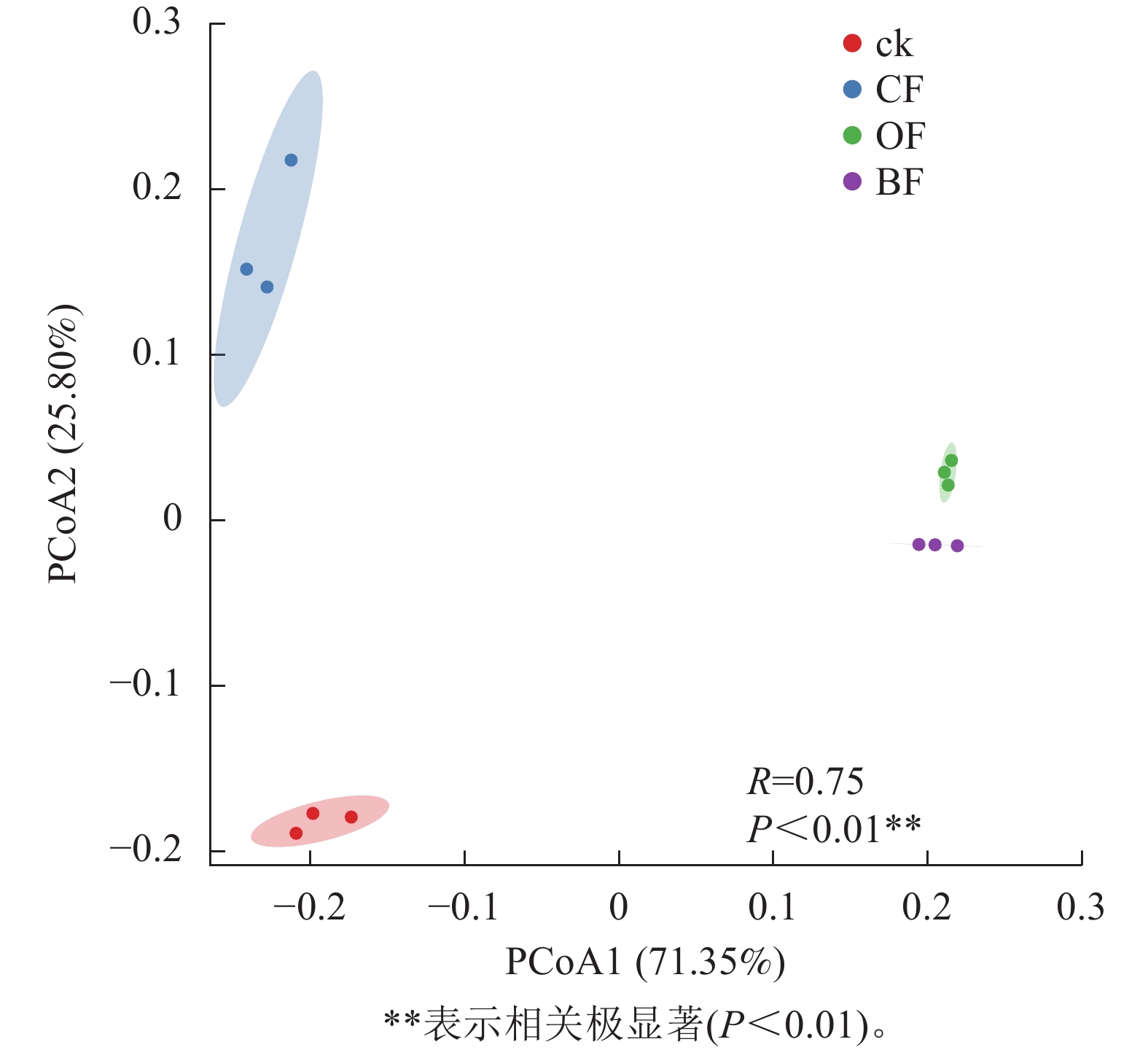
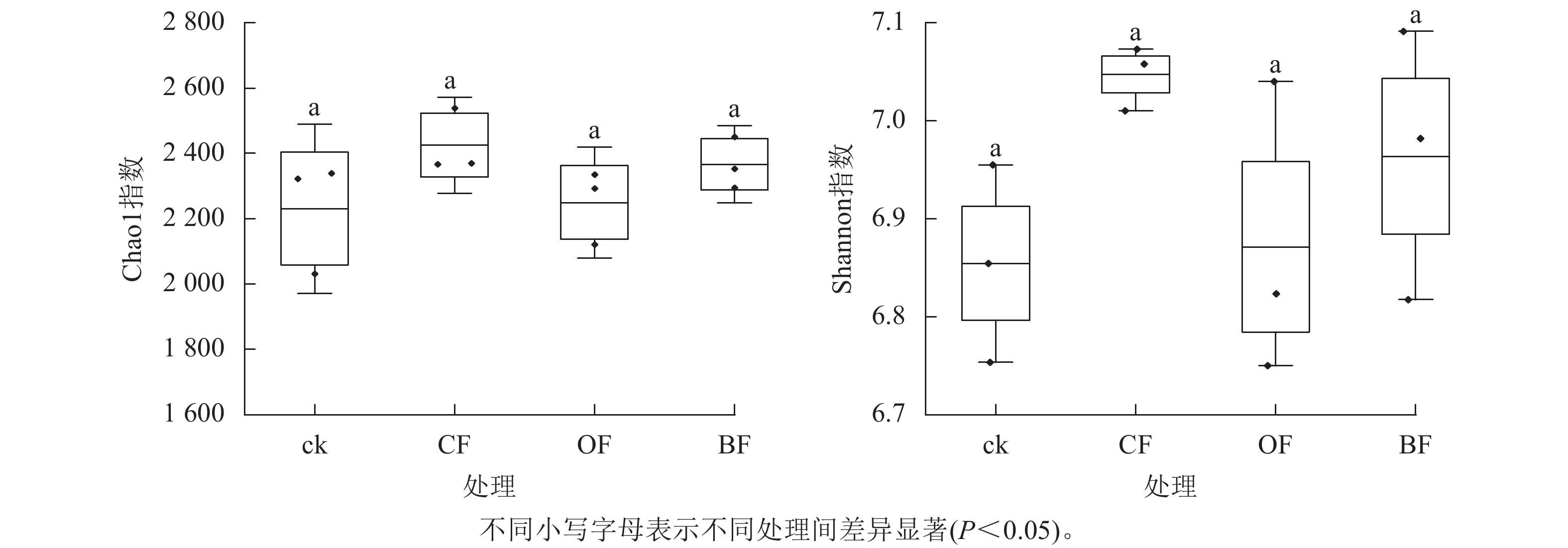
    • 本研究中各样本Coverage指数均大于99%,说明样品中的土壤细菌基本可反映土壤的真实情况。图1表明:不同处理间土壤细菌α多样性无显著差异。施用炭基肥处理(OF和BF)的细菌Chao1指数和Shannon指数较ck有所提高,但较CF处理则有所降低,降低比率为1.18%~10.45%。基于Bray-Curtis距离矩阵的PCoA分析结果(图2)显示:第1、第2主坐标轴分别解释了细菌群落总变异度的71.35%和25.80%。BF和OF处理样品的细菌群落与CF、ck处理沿PCoA1轴明显分开。此外,ck与CF处理样品的细菌群落沿PCoA2轴明显分开。对细菌群落结构进行相似性分析显示:不同施肥处理的土壤样品细菌群落组成具有显著差异(R =0.75,P<0.01)。
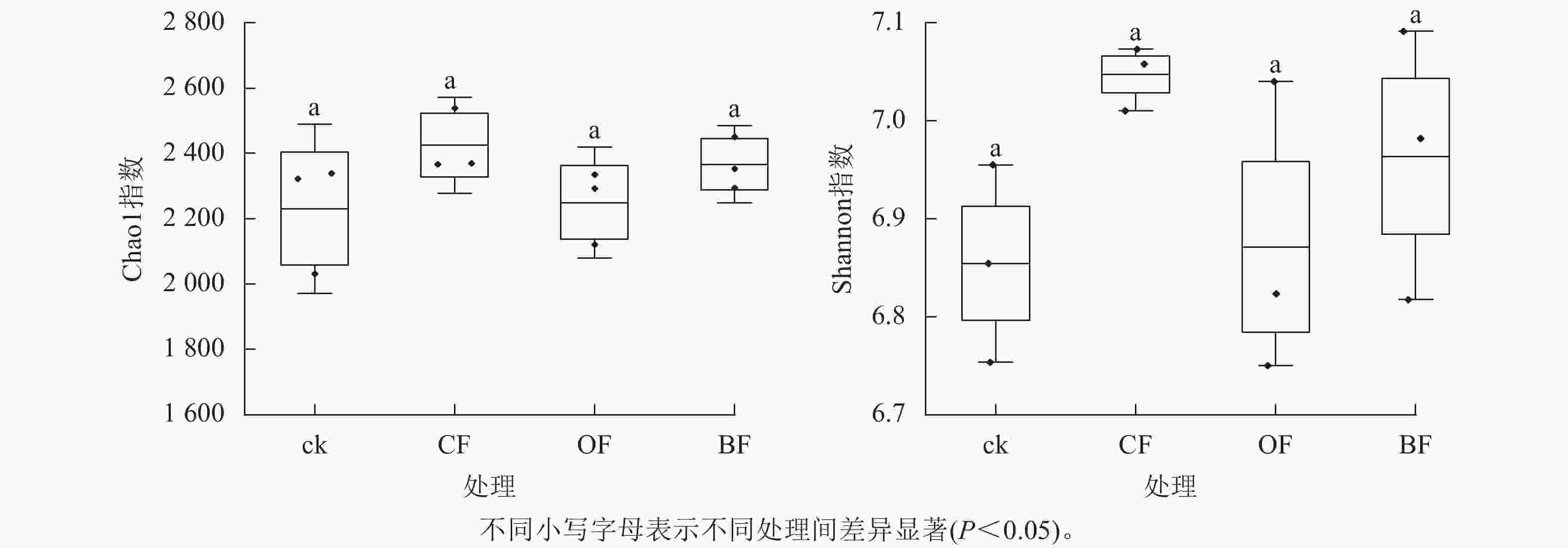
      Figure 1.  Alpha diversity indices of soil bacterial under different fertilization treatments
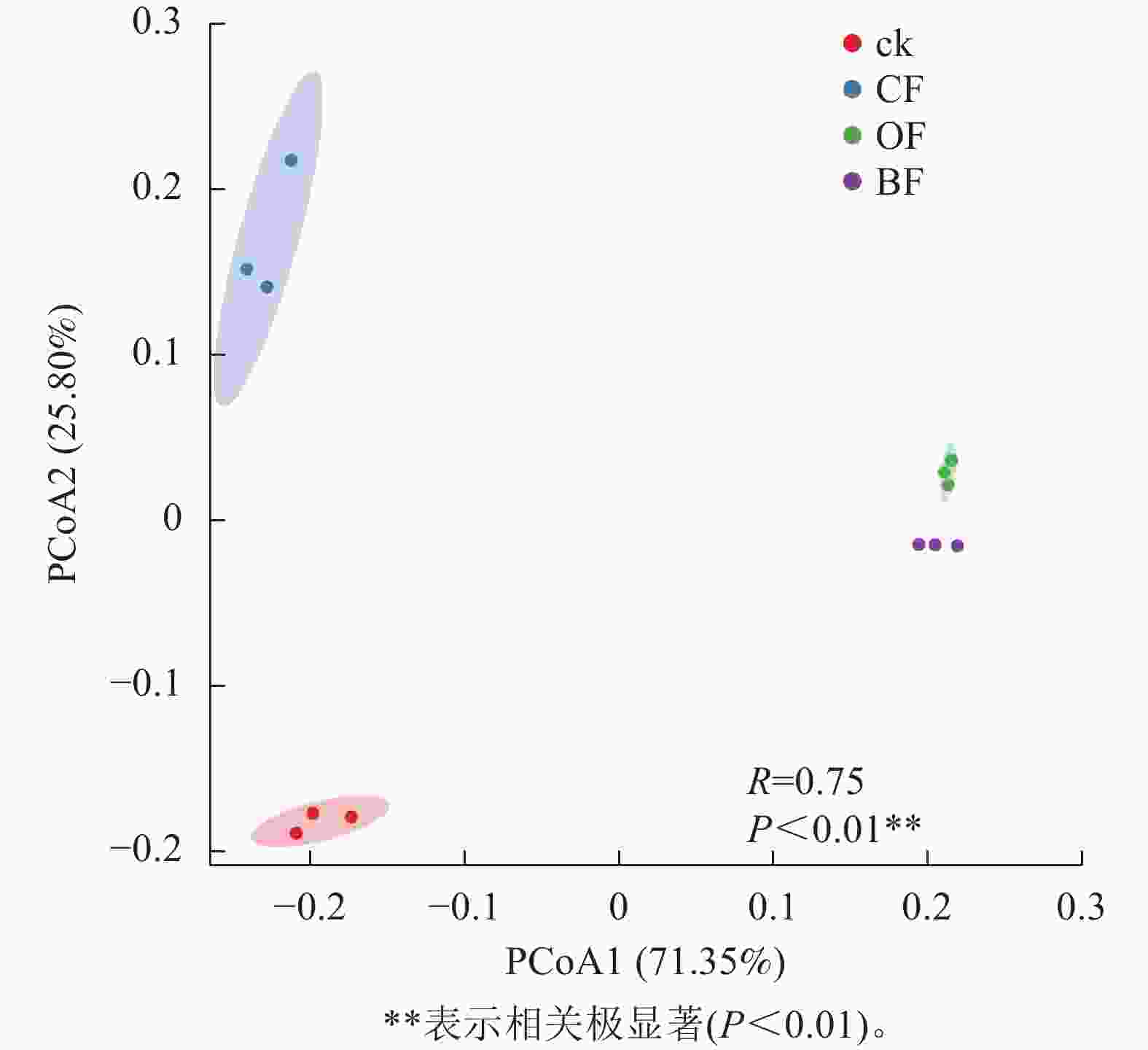
      Figure 2.  PCoA analysis of soil bacterial under different fertilization treatments

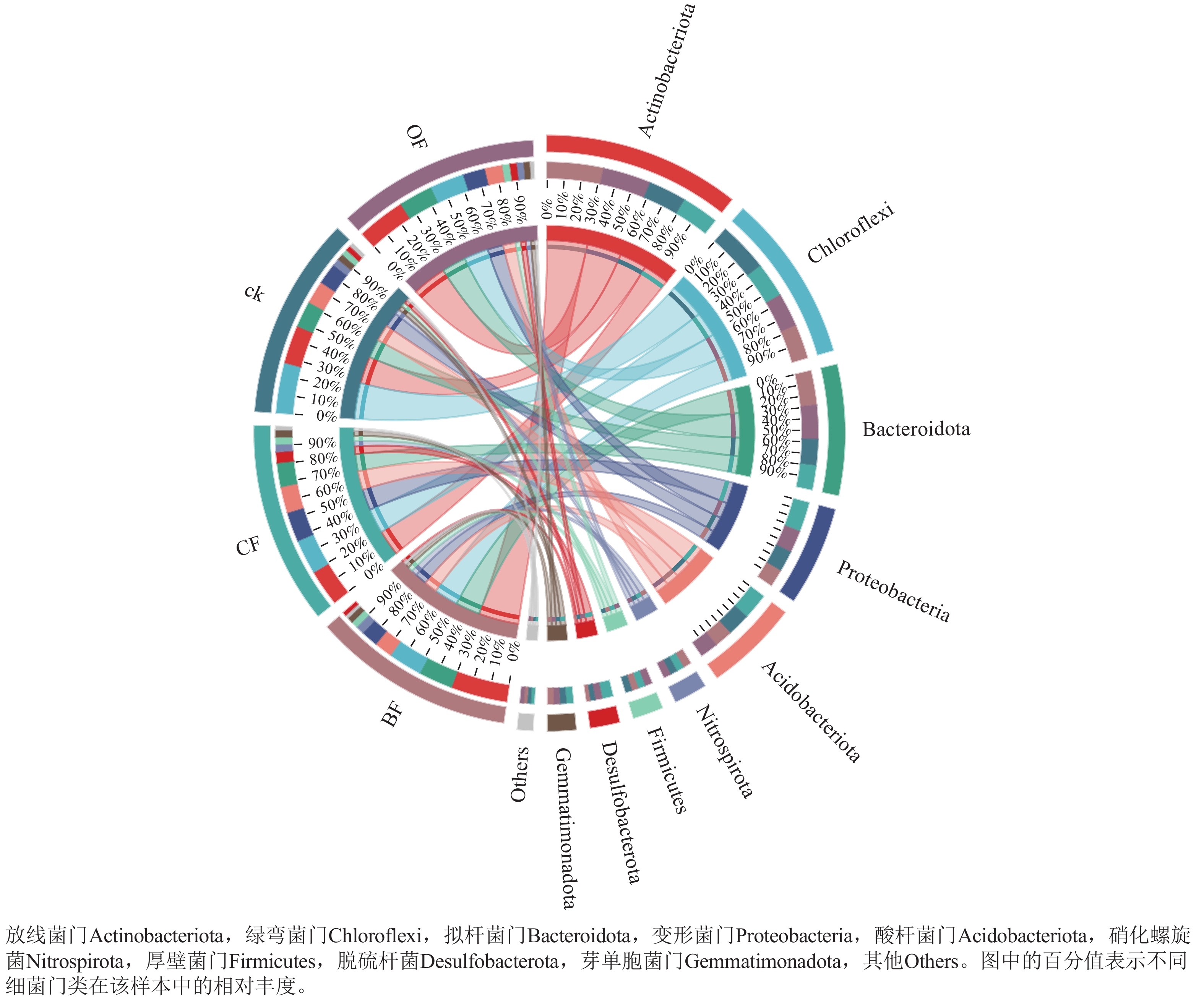
    • 在门水平,不同施肥处理细菌群落主要由绿弯菌门Chloroflexi、变形菌门Proteobacteria、酸杆菌门Acidobacteriota、放线菌门Actinobacteriota、厚壁菌门Firmicutes、硝化螺旋菌门Nitrospirota、芽单胞菌门Gemmatimonadota、拟杆菌门Bacteroidota和脱硫杆菌门Desulfobacterota组成(图3)。其中,绿弯菌门、变形菌门、酸杆菌门和放线菌门的相对丰度为57.30%~75.12%。各施肥处理均能提高放线菌门、拟杆菌门和硝化螺旋菌门的相对丰度,降低绿弯菌门、酸杆菌门和变形菌门的相对丰度,而对厚壁菌门和脱硫杆菌门相对丰度的变化无明显规律。各施肥处理下变形菌门、酸杆菌门、放线菌门和硝化螺旋菌门的相对丰度从大到小依次为BF、CF、OF、ck。
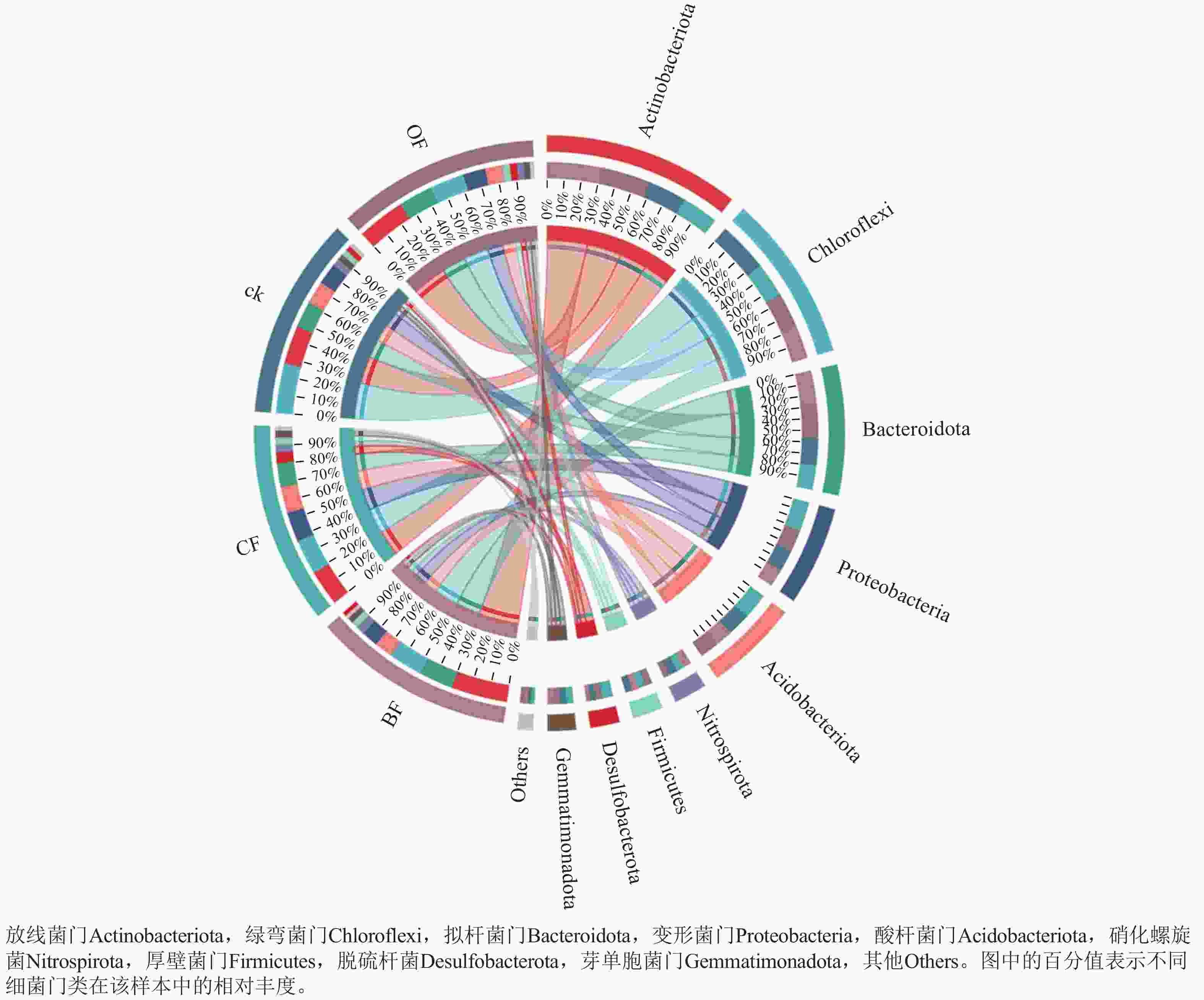
      Figure 3.  Composition of horizontal community structure of bacteria under different fertilization treatments

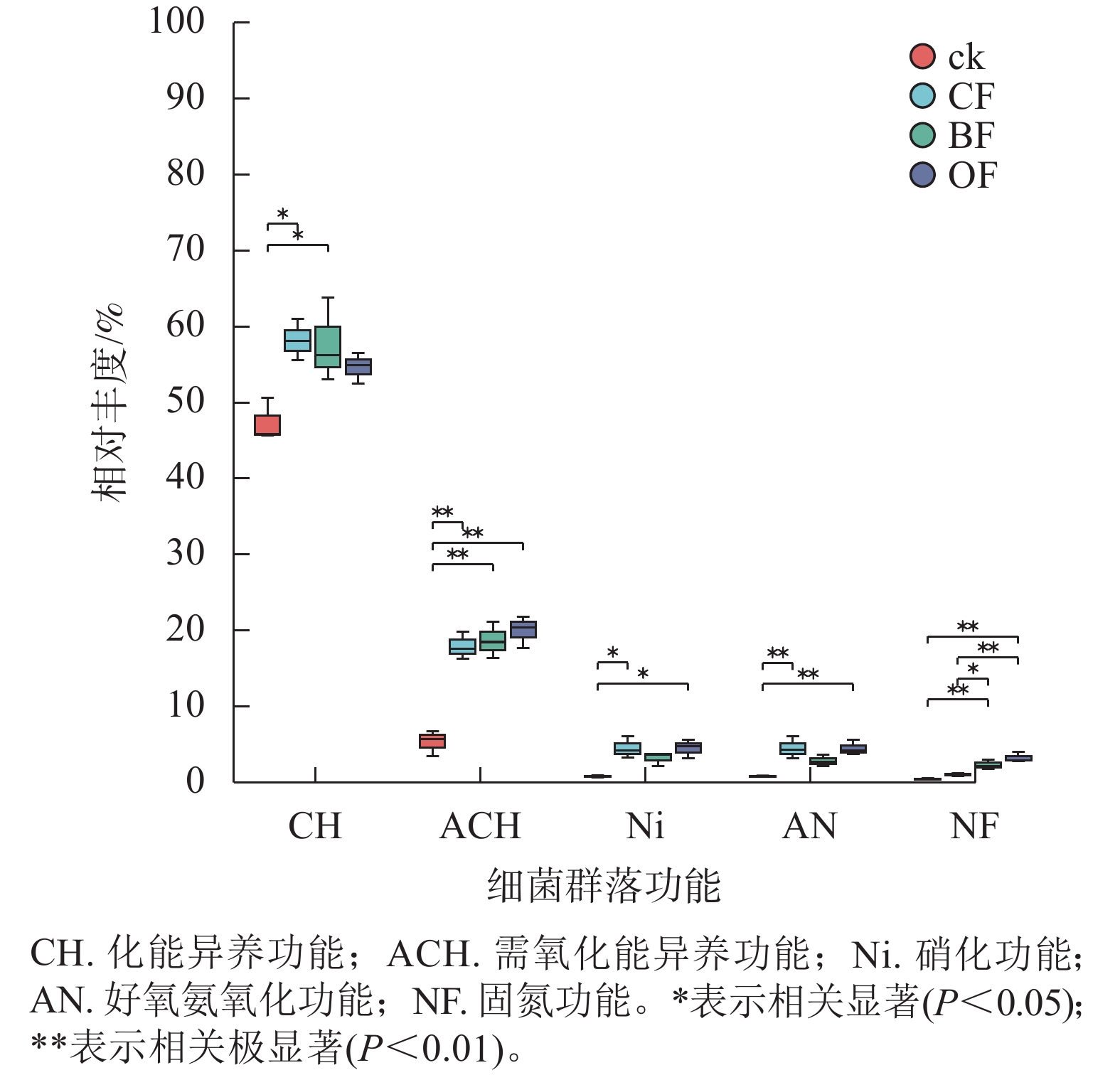
      利用FAPROTAX对16S rRNA测序结果进行功能预测。从图4可见:炭基肥施用后土壤微生物化能异养(chemoheterotrophy)、需氧化能异养(aerobic_chemoheterotrophy)、硝化功能(nitrification)、好氧氨氧化功能(aerobic_ammonia_oxidation)和固氮功能(nitrogen_fixation)等发生了显著变化(P<0.05)。炭基肥施用可改变土壤碳、氮循环相关功能菌群的相对丰度。首先,与ck相比,CF和BF处理的化能异养功能分别显著增加22.97%和21.81% (P<0.05),但与OF处理无显著差异。而CF、BF和OF处理的有氧化能异养功能较ck显著增加242.70%~282.30% (P<0.05),说明BF和CF处理显著提高了土壤碳循环相关功能。对于氮循环相关功能菌群而言,CF和OF处理的土壤细菌群落硝化功能较ck显著提高359.41%和544.44% (P<0.05),好氧氨氧化功能较ck显著提高522.35%和519.15% (P<0.01),但BF与其他处理间无显著差异。BF和OF处理的土壤细菌群落固氮功能显著高于ck和CF处理(P<0.01),但BF与OF处理间无显著差异。
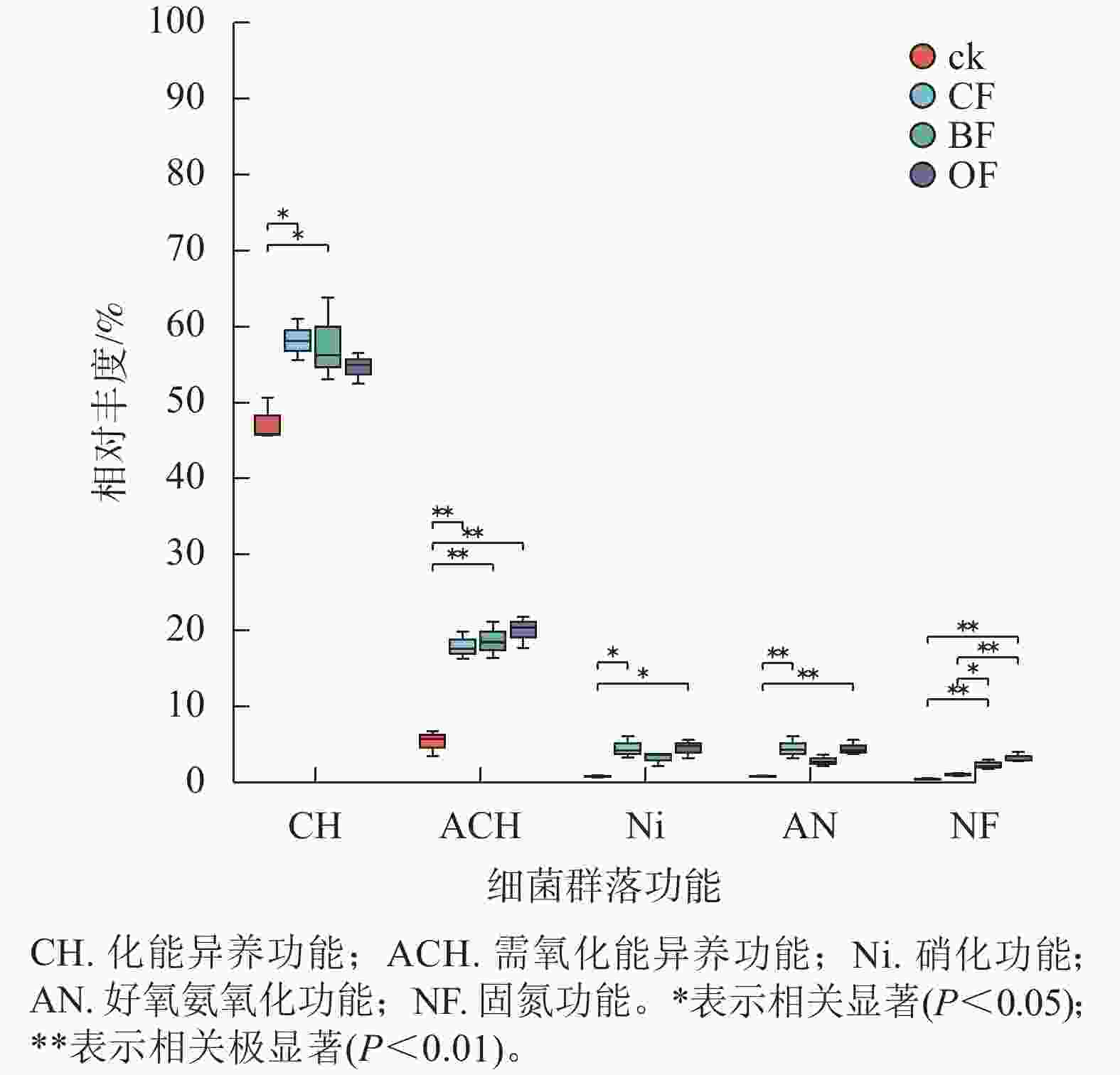
      Figure 4.  Functional prediction of bacterial communities under different fertilization treatments

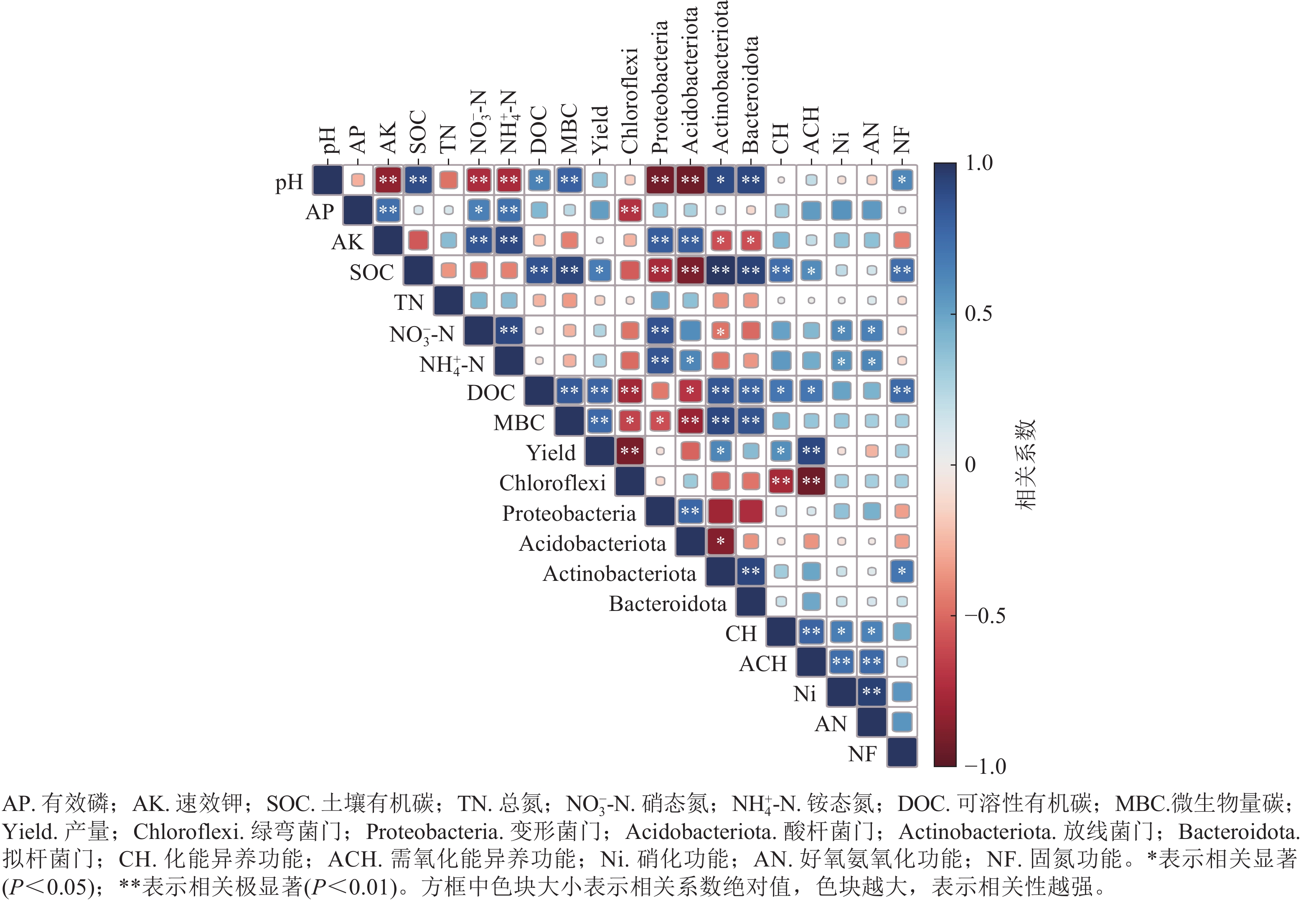
    • 图5可见:绿弯菌门与土壤AP和DOC呈极显著负相关(P<0.01),与MBC呈显著负相关(P<0.05);变形菌门与土壤pH和SOC呈极显著负相关(P<0.01);酸杆菌门与土壤pH、SOC呈极显著负相关 (P<0.01),与AK呈极显著正相关 (P<0.01);放线菌门和拟杆菌门与土壤pH、SOC和DOC呈极显著正相关(P<0.01),与AK呈极显著负相关(P<0.01)。
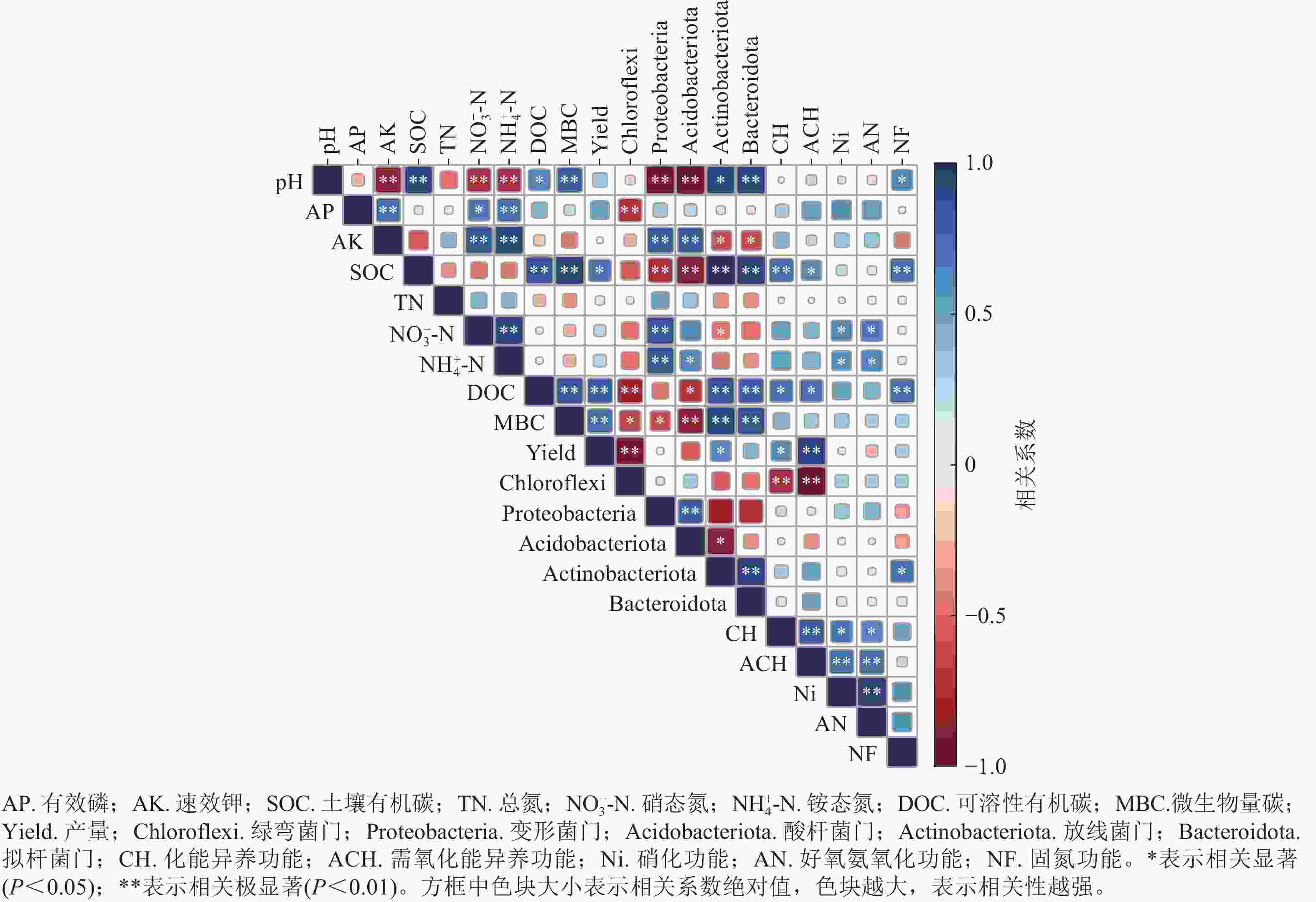
      Figure 5.  Correlation analysis between soil environmental factors and soil microbial characteristics and yield

    • 表3可知:不同处理间稻米品质差异较大,其中OF和BF处理的全钾质量分数显著低于ck和CF处理(P<0.05),BF处理的全磷质量分数显著低于其他处理(P<0.05)。各施肥处理的蛋白质质量分数显著高于ck处理(P<0.05),但其他各处理间无显著差异。各处理的直链淀粉质量分数呈现阶梯式变化规律,其中OF处理的直链淀粉质量分数最高,较ck、CF和BF处理分别显著提高13.22%、8.09%和4.23%(P<0.05)。对于产量而言,与ck相比,各施肥处理均能显著提高稻米产量和地上部生物量。其中,与CF处理相比,OF和BF处理的稻米产量分别提高9.00%和7.90%,地上部生物量分别提高0.43%和2.34%,但未达到显著水平。相关性分析(图5)可知:稻米产量与土壤SOC呈显著正相关(P<0.05),与DOC和MBC呈极显著正相关(P<0.01)。

      处理 总氮/
      (g·kg−1)
      全磷/
      (g·kg−1)
      全钾/
      (g·kg−1)
      蛋白质/
      (g·kg−1)
      直链淀粉/
      (g·kg−1)
      稻米产量/
      (kg·hm−2)
      地上部生物量/
      (kg·hm−2)
      ck 13.94±0.49 ab 2.51±0.01 a 6.10±0.26 a 8.16±0.07 b 6.96±0.06 d 7 864.58±341.53 b 11 145.83±579.98 b
      CF 14.34±0.36 ab 2.53±0.03 a 6.12±0.33 a 8.67±0.04 a 7.29±0.03 c 10 037.50±179.45 a 19 500.00±565.10 a
      OF 14.51±0.72 a 2.61±0.05 a 5.61±0.27 b 8.81±0.11 a 7.88±0.04 a 10 937.50±251.58 a 19 583.33±583.51 a
      BF 14.48±0.80 ab 2.12±0.03 b 6.04±0.56 b 8.75±0.05 a 7.56±0.02 b 10 833.33±321.89 a 19 955.42±686.81 a
        说明:不同小写字母表示不同处理间差异显著(P<0.05)。

      Table 3.  Rice quality parameters and yield under different fertilization treatments

    • 土壤酸化和肥力退化是南方红壤区水稻生产的限制因素,而肥料中的碳、氮、磷、钾等元素是增加土壤碳和养分储量的关键因素[15]。已有研究证实:施用炭基肥可显著提高土壤有机碳含量及速效养分含量,改善土壤酸化,促进作物生长发育,进而提升作物产量[1617]。本研究发现:施用炭基肥后,土壤pH及速效养分(${\mathrm{NH}}_4^+ $-N、${\mathrm{NO}}_3^- $-N、AP和AK)质量分数较ck显著增加,这主要是由于:①生物质炭本身呈碱性,其含有的大量盐基离子进入土壤后,能交换中和土壤中的氢离子(H+)和铝离子(Al3+)[1718],从而降低土壤酸度,提高土壤pH;②生物质炭中的硅酸盐、碳酸盐和碳酸氢盐也可与土壤溶液中的H+结合[19];③生物质炭的巨大比表面积及芳香烃和烷基结构,能有效吸附肥料中的养分,改善土壤肥力[20]。本研究发现:施用炭基肥能显著提高土壤SOC质量分数,增加DOC和MBC质量分数,且随着施用量的增加而增加,这与胡坤等[10]在薏苡土壤施用烟杆炭基肥的研究结果一致。生物质炭作为炭基肥的基质,其本身含碳量高,施用后可直接增加土壤中有机碳含量;其次,丰富的孔隙结构及巨大的比表面积,能够吸附和固定多种无机离子及极性或非极性有机化合物,可在土壤中形成有机-无机复合物和大粒径团聚体[21],改善土壤结构,进而减少有机质淋失;同时较大的孔隙度及比表面积,可为微生物提供有利的生长环境,进而提高MBC含量[22]

      水稻生物产量是决定产量水平的重要因素。本研究中炭基肥及部分替代化肥能够显著提高水稻产量,且相关性分析表明:水稻产量与SOC、DOC和MBC质量分数呈显著正相关,这与熊家欢等[23]和谢志坚等[24]的研究结果类似。水稻是典型的喜铵作物,土壤中铵态氮含量高低是影响水稻植株生长发育的重要因素[25]。炭基肥中的酚羟基等基团,能够提高${\mathrm{NH}}_4^+ $-N在生物质炭表面的静电吸附作用[26],延长其在土壤中的存留时间,与此同时,被吸附的${\mathrm{NH}}_4^+ $-N在水稻生长过程中可缓慢释放[27]。CHU等[28]研究发现:添加生物质炭后土壤${\mathrm{NH}}_4^+ $-N含量提高了105%~116%;其次,炭基肥能够提高植物根膜的离子电势,以此促进养分向植物的迁移[29]。另外,根系是作物与外界环境发生物质、能量与信息交换的重要器官,施用炭基肥可改善土壤物理结构,提高土壤透气性,促进根系生长,为水稻生长提供营养保障[30]。然而,HAEFELE等[31]研究表明:稻壳炭基肥施用并未增加水稻产量,甚至出现减产,过量的生物质炭使得土壤C/N过高,导致大量速效养分被固持,土壤养分有效性降低,阻碍了水稻对养分的吸收利用,最终导致水稻的生长发育和产量受到抑制。综上可见,炭基肥在稻田中的应用目前仍存在不确定性。炭基肥对水稻产量的影响可能因生物质炭种类、施用量及施用方式而异,如不同来源以及不同条件下制备的生物质炭的疏水性、比表面积、孔隙结构及表面官能团组成等性状差异较大,从而影响了炭基肥对养分的固持、释放以及作物对养分的吸收利用,最终影响产量。

    • 常规施肥和炭基肥可通过改变土壤生物化学环境,从而影响土壤微生物群落的组成和多样性[32]。本研究表明:炭基肥可明显提高土壤细菌群落的多样性和丰富度,且效果优于常规施肥。首先,炭基肥富含碳及大量营养元素,可直接为细菌生长提供所需养分[33];其次,生物质炭表面丰富的官能团可通过吸附和持留作用增加土壤有机质和速效养分的含量,促进细菌大量定殖[20, 33];另外,生物质炭的多微孔结构及巨大的比表面积,能够为土壤细菌提供适宜的生存场所[22, 34]。因此,与常规施肥相比,炭基肥能更大程度地提高稻田土壤细菌多样性和丰富度。不同细菌门类对炭基肥的响应不同。本研究表明:与常规施肥相比,炭基肥显著增加了放线菌门和拟杆菌门的相对丰度,显著降低了酸杆菌门和变形菌门的相对丰度,这与胡坤等[10]和NIELSEN等[35]的研究结果一致;进一步分析不同用量炭基肥处理间的差异发现:与施用低量炭基肥处理相比,高量炭基肥处理显著增加了放线菌门的相对丰度,但对拟杆菌门无显著影响。放线菌适宜在碱性环境中生存,炭基肥施用后土壤pH升高,为放线菌的生长繁殖提供了有利条件[36]。拟杆菌门细菌具有纤维素降解能力,能够促进分解和利用脂类、DNA和蛋白质等有机物,炭基肥可直接提供碳源及所需养分,致使其丰度增加[3738]。与拟杆菌门相反,酸杆菌门和变形菌门属于嗜酸性细菌,酸性环境更有利于其生存[10, 39],但炭基肥中生物质炭的有机阴离子脱羧作用会消耗土壤中的质子,进而提高土壤pH,导致酸杆菌门和变形菌门丰度降低。与不施肥处理相比,常规施肥和炭基肥处理显著降低了绿弯菌门的相对丰度,但常规施肥与炭基肥处理间无显著差异。而徐民民等[40]研究发现:施用生物质炭对变形菌门无影响,造成这种差异可能与宿主植物及土壤性质的不同有关。绿弯菌门是一类贫瘠营养性细菌,具有生长缓慢的特性[4142],在营养贫乏的土壤中普遍存在[4344]。炭基肥施用后土壤有机碳及速效养分含量升高,导致绿弯菌门细菌生长受限。

    • 细菌在土壤养分循环中扮演关键角色,其功能特性影响着土壤肥力的高低。然而,细菌群落的功能表现极易受到外界环境因素(如施肥)的影响。本研究发现:与不施肥相比,炭基肥和炭基肥替代50%化肥处理中化能异养和需氧化能异养功能微生物的相对丰度均高于不施肥处理。土壤中异养微生物比例的升高意味着自养微生物比例的降低,本研究中绿弯菌门和芽单胞菌门的相对丰度在炭基肥和常规施肥处理中呈现降低趋势。土壤中异养微生物比例的上升通常伴随着自养微生物比例的下降。有研究表明:绿弯菌门和芽单胞菌门是可进行光合作用或利用光能进行自养代谢的微生物,微生物群落的内部竞争作用会导致某一类微生物增加,抑制另一类微生物生长[4546]。相关性分析也表明:化能异养和需氧化能异养菌均与绿弯菌门相对丰度呈极显著负相关。

      与氮循环相关的硝化、好氧氨氧化和固氮功能在不同处理间的差异均达到显著水平,其中硝化功能和好氧氨氧化功能基因的相对丰度在常规施肥处理最高。大量研究表明:生物质炭可增加氨氧化细菌(AOB)和氨氧化古菌(AOA)的丰度,对土壤硝化菌具有积极影响[4749]。本研究硝化螺旋菌在常规施肥处理中丰度最高,硝化螺旋菌可将亚硝酸盐氧化为硝酸盐,是典型的硝化细菌。固氮功能菌在炭基肥和炭基肥替代50%化肥处理中的相对丰度显著高于不施肥和常规施肥处理,且与SOC和DOC呈显著正相关,这与WANG等[50]的研究结果一致。土壤中碳有效性的高低也是影响生物固氮的关键因素[51]。炭基肥中的不稳定有机碳可被固氮微生物直接利用;同时,还可促进植物生长,并通过根系分泌物进一步降低有机碳稳定性[5253]。本研究炭基肥和炭基肥替代50%化肥处理的水稻产量均显著高于不施肥对照,可能是水稻通过根系分泌物为固氮微生物生长提供了较多的养分供应。

    • 炭基肥施用可显著提高土壤有机碳、可溶性有机碳及速效养分,提升稻米产量及品质。等量氮、磷、钾养分投入下,炭基肥及部分替代化肥对稻田土壤细菌Chao1指数和Shannon指数均无显著影响,但均可提高土壤富营养性细菌及碳氮相关功能菌的相对丰度,且前者提高幅度更大。土壤pH、SOC、DOC和MBC是细菌群落的主要调控因子。炭基肥及部分替代化肥均有助于改善土壤质量,调节土壤细菌群落结构,对提高稻米产量及品质,促进农田生态系统稳定和健康发展具有重要意义。

Reference (53)

Catalog

    /

    DownLoad:  Full-Size Img  PowerPoint
    Return
    Return