Volume 42 Issue 6
Nov.  2025
Turn off MathJax
Article Contents

HAO Jiahang, GUO Xiaoping, OUYANG Qunwen, et al. Effects of different years of spray seeding greening on soil shear strength and anti-erodibility of expressway slope[J]. Journal of Zhejiang A&F University, 2025, 42(6): 1221−1231 doi:  10.11833/j.issn.2095-0756.20250114
Citation: HAO Jiahang, GUO Xiaoping, OUYANG Qunwen, et al. Effects of different years of spray seeding greening on soil shear strength and anti-erodibility of expressway slope[J]. Journal of Zhejiang A&F University, 2025, 42(6): 1221−1231 doi:  10.11833/j.issn.2095-0756.20250114

Effects of different years of spray seeding greening on soil shear strength and anti-erodibility of expressway slope

DOI: 10.11833/j.issn.2095-0756.20250114
  • Received Date: 2025-01-13
  • Accepted Date: 2025-06-10
  • Rev Recd Date: 2025-05-28
  • Available Online: 2025-11-26
  • Publish Date: 2025-12-20
  •   Objective  This study aims to explore the effects of vegetation and soil dynamic characteristics on soil shear strength and anti-erodibility of spray seeding matrix after the construction of high-speed slope spray seeding greening project in Beijing, and to provide reference for the formulation of sustainable road slope vegetation restoration scheme.   Method  A shady slope and a sunny slope sprayed with thick-layer base material, and a natural slope without artificial disturbance (ck) with similar basic parameters were selected from 3 expressways with different restoration years (5, 10, 15 a ). The change law of anti-erodibility and shear strength of vegetation and soil during slope restoration was explored by redundancy analysis and regression equation.   Result  (1) The diversity and coverage of slope vegetation increased significantly with the increase of restoration years (P<0.01), but did not return to the level of natural slope at 15 a. (2) The soil organic carbon content, geometric mean diameter and mean weight diameter increased by 96.10%, 12.17% and 26.23% at 15 a compared with 5 a. The stability of soil aggregates gradually increased and returned to the level of natural slope at 15 a. (3) Vegetation characteristics and soil indexes explained 83.42% of the soil anti-erodibility and shear resistance indexes. The K value of soil anti-erodibility decreased linearly with the geometric mean diameter (R2=0.902) or increased linearly with the aggregate destruction rate (R2=0.776). The soil anti-erodibility increased linearly with the diversity index (R2=0.660) and bulk density (R2=0.750), and the internal friction angle decreased with the saturated water content (R2=0.816).   Conclusion  Bulk density, saturated water content and geometric mean diameter are the direct control factors of soil anti-erodibility and shear strength, which can be used as evaluation indexes. In order to better improve the anti-erodibility and shear strength of shallow soil on the slope, it is recommended to adopt the spray seeding and planting method to plant Robinia pseudocacia in the spray seeding greening construction scheme, and to carry out appropriate topdressing on the slope when it is restored for 10 years. [Ch, 4 fig. 4 tab. 31 ref.]
  • [1] FAN Qinghua, LIU Xiaojun, LI Peng, ZHANG Yi, REN Zhengyan, ZHANG Huwei, TAO Qingrui, XU Shibin.  Characterization and attribution of water-soil-nutrient leaching from red soil under vegetation restoration conditions . Journal of Zhejiang A&F University, 2025, 42(3): 444-456. doi: 10.11833/j.issn.2095-0756.20240473
    [2] LI Peng, LIU Xiaojun, LIU Yuanqiu, TAO Lingjian, FU Xiaobin, MAO Menglei, LI Wenqin, WANG Chen.  Characteristics and influencing factors of soil carbon stocks in different vegetation restoration models in red soil erosion areas . Journal of Zhejiang A&F University, 2024, 41(1): 12-21. doi: 10.11833/j.issn.2095-0756.20230408
    [3] MA Xingcong, JIN Wenhao, TU Jiaying, SHENG Weixing, CHEN Junhui, QIN Hua.  Impact of shifts among mycorrhizal types on soil aggregate composition and characteristics . Journal of Zhejiang A&F University, 2023, 40(6): 1149-1157. doi: 10.11833/j.issn.2095-0756.20230376
    [4] LIANG Chuxin, FAN Tao, CHEN Peiyun.  Stoichiometric characteristics and influencing factors of soil C, N and P in Pinus yunnanensis forests under different restoration modes on rocky desertification slope land in eastern Yunnan . Journal of Zhejiang A&F University, 2023, 40(3): 511-519. doi: 10.11833/j.issn.2095-0756.20220417
    [5] YANG Fuyu, CHEN Qibo, LI Jianqiang, GONG Shunqing, FU Yishan.  Effect of prescribed burning on soil anti-erodibility and anti-scourability of Pinus yunnanensis forest . Journal of Zhejiang A&F University, 2023, 40(1): 188-197. doi: 10.11833/j.issn.2095-0756.20220321
    [6] LI Wenjie, CUI Lulu, MA Yunjiao, LIANG Haiyong.  Insect resistance and metabolome of four willow species . Journal of Zhejiang A&F University, 2022, 39(1): 153-158. doi: 10.11833/j.issn.2095-0756.20210166
    [7] SUI Xiran, WU Lifang, WANG Yan, WANG Ziquan, XIAO Yuxin, LIU Yungen, YANG Bo.  Characteristics of nutrient and enzyme activity in soil aggregates of different rocky desertification levels in central Yunnan Plateau . Journal of Zhejiang A&F University, 2022, 39(1): 115-126. doi: 10.11833/j.issn.2095-0756.20210168
    [8] ZHANG Ge, WANG Qizhi, HE Yuan, ZENG Qianting, HE Jing, WANG Yong, YANG Jie, ZHENG Jiangkun.  Changes of plant community diversity and environmental interpretation in Beichuan landslide site . Journal of Zhejiang A&F University, 2022, 39(1): 50-59. doi: 10.11833/j.issn.2095-0756.20210188
    [9] ZHAO Jing, HAO Mengjie, WANG Qingyu, LIU Meiying.  Distribution characteristics of soil organic carbon storage in photovoltaic power station under different vegetation restoration modes . Journal of Zhejiang A&F University, 2021, 38(5): 1033-1039. doi: 10.11833/j.issn.2095-0756.20210500
    [10] CHEN Tao, ZHOU Lijun, QI Shi, SUN Baoping, NIE Zexu.  Soil aggregate stability and anti-erodibility of typical forest stands in Huaying mountain area . Journal of Zhejiang A&F University, 2021, 38(6): 1161-1169. doi: 10.11833/j.issn.2095-0756.20210142
    [11] SHU Qiaosheng, XIE Liya.  Root system distribution and soil anti-scouring capability with Hippophae rhamnoides degradation . Journal of Zhejiang A&F University, 2014, 31(3): 380-385. doi: 10.11833/j.issn.2095-0756.2014.03.008
    [12] YU Fei, SONG Qi, LIU Meihua.  Several topics on wetland seeds bank research . Journal of Zhejiang A&F University, 2014, 31(1): 145-150. doi: 10.11833/j.issn.2095-0756.2014.01.022
    [13] LI Xiao-jun, ZHANG Ming-ru, ZHANG Li-yang, WU Gang.  Photosynthesis,light-use efficiency and water-use efficiency for woody species in the hilly area of the Taihang Mountains . Journal of Zhejiang A&F University, 2011, 28(2): 180-186. doi: 10.11833/j.issn.2095-0756.2011.02.002
    [14] WEI Yuan, ZHANG Jin-chi, YU Yuan-chun, YU Li-fei.  Ecological characteristics of soil microbial amount during succession of degraded karst vegetation on the Guizhou Plateau . Journal of Zhejiang A&F University, 2009, 26(6): 842-848.
    [15] SONG Wei-feng, CHEN Li-hua, LIU Xiu-ping.  Root reinforcement of soil:a review . Journal of Zhejiang A&F University, 2008, 25(3): 376-381.
    [16] ZHANG Lǜ-qin, ZHANG Ming-kui.  Changes of organic C, N and P pools in red soil in transformation between agricultural land and forestry land . Journal of Zhejiang A&F University, 2006, 23(1): 75-79.
    [17] YU Shu-quan, LI Cui-huan, JIANG Li-yuan, XIE Ji-quan.  Community ecology of secondary vegetation in Qiandao Lake , Zhejiang Province . Journal of Zhejiang A&F University, 2002, 19(2): 138-142.
    [18] LI Cui-huan, YU Shu-quan, ZHOU Guo-mo.  Review of reserches in restoration of subtropical evergreen broad-leaved forests . Journal of Zhejiang A&F University, 2002, 19(3): 325-329.
    [19] XU Qiu-fang, JIANG Pei-kun, YU Yi-wu, SUN Jian-min.  Study on erosion resistance of different land use . Journal of Zhejiang A&F University, 2001, 18(4): 362-365.
    [20] Yang Yunfang, Liu Zhikun.  Phyllostachys pubescens Wood: Tensile Elastic modulus and Tensile Strength . Journal of Zhejiang A&F University, 1996, 13(1): 21-27.
  • [1]
    LANE P N J, HAIRSINE P B, CROKE J C, et al. Quantifying diffuse pathways for overland flow between the roads and streams of the mountain ash forests of central Victoria Australia [J]. Hydrological Processes, 2006, 20(9): 1875−1884.
    [2]
    NYSSEN J, POESEN J, MOEYERSONS J, et al. Impact of road building on gully erosion risk: a case study from the Northern Ethiopian Highlands [J]. Earth Surface Processes and Landforms, 2002, 27(12): 1267−1283.
    [3]
    ZHANG Chongjun. Study on the Selection and Disposition Pattern of Greening Plants on Slope of Beijing Expressway in Mountains Area[D]. Beijing: Beijing Forestry University, 2018.
    [4]
    ZHAO Jiayu. Study on the Reinforcement Effect and Mechanism of Coir Fiber Length on Spray-seeding Substrate[D]. Beijing: Beijing Forestry University, 2022.
    [5]
    ASHWORTH A J, OWENS P R, ALLEN F L. Long-term cropping systems management influences soil strength and nutrient cycling[J/OL]. Geoderma, 2020, 361: 114062[2025-01-02]. DOI: 10.1016/j.geoderma.2019.114062.
    [6]
    FOX D M, DARBOUX F, CARREGA P. Effects of fire-induced water repellency on soil aggregate stability, splash erosion, and saturated hydraulic conductivity for different size fractions [J]. Hydrological Processes, 2007, 21(17): 2377−2384.
    [7]
    WANG Kaichang. Influence of Soil Hydraulic Characteristics on Slope Stability under Vegetation Restoration in Shallow Landslide Area[D]. Lanzhou: Lanzhou University, 2022.
    [8]
    XING Shukun, ZHANG Guanghui, ZHU Pingzong. Effects of vegetation restoration age on shear strength of root-soil system in hilly and gully region of the Loess Plateau [J]. Journal of Soil and Water Conservation, 2021, 35(4): 41−48, 54.
    [9]
    ABD I A, FATTAH M Y, MEKKIYAH H. Relationship between the matric suction and the shear strength in unsaturated soil [J/OL]. Case Studies in Construction Materials, 2020, 13: e00441[2025-01-02]. DOI:10.1016/j.cscm.2020.e00441.
    [10]
    LIU Aixia, GAO Zhaoliang, LI Yonghong, et al. Fractal characteristics research on soil aggregates during highway slope vegetation restoration of different ages in Guanzhong Plain [J]. Journal of Soil and Water Conservation, 2011, 25(1): 219−223, 237.
    [11]
    WANG Xia, HONG Miaomiao, HUANG Zheng, et al. Biomechanical properties of plant root systems and their ability to stabilize slopes in geohazard-prone regions [J]. Soil and Tillage Research, 2019, 189: 148−157.
    [12]
    LI Jia, WANG Xia, JIA Haixia, et al. Effect of herbaceous plant root density on slope stability in a shallow landslide-prone area [J]. Natural Hazards, 2022, 112(3): 2337−2360.
    [13]
    LIU Yang. Research on the Root System Characteristics and Slope Stability of Robinia pseudoacacia L. Forests with Different Stand Ages in the Loess Hilly area of Central Gansu[D]. Lanzhou: Lanzhou University, 2021.
    [14]
    CHEN Xi, WANG Gailing, LIU Huanhuan, et al. Stability and organic carbon distribution of soil aggregates with different fallow years in Lüliang Mountains in Loess Plateau [J]. Soils, 2021, 53(2): 375−382.
    [15]
    CHEN Bozhou, HU Jianhua, WU Wei, et al. Physicochemical properties of soil under restoration of different vegetation types and resulting slope stability in the Bailong River Basin, China [J]. Mountain Research, 2024, 42(2): 260−277.
    [16]
    ZHANG Yue, ZHONG Xiaoyan, LIN Jinshi, et al. Effects of fractal dimension and water content on the shear strength of red soil in the hilly granitic region of Southern China[J/OL]. Geomorphology, 2020, 351: 106956[2025-01-02]. DOI: 10.1016/j.geomorph.2019.106956.
    [17]
    ZHANG Baojun, ZHANG Guanghui, YANG Hanyue, et al. Soil resistance to flowing water erosion of seven typical plant communities on steep gully slopes on the Loess Plateau of China [J]. CATENA, 2019, 173: 375−383.
    [18]
    ZHAO Xiaolong, XIE Yuhong, MA Xujun, et al. Vegetation structure and its relationship with soil physicochemical properties in restoring sandy grassland in Horqin Sandy Land [J]. Journal of Desert Research, 2022, 42(2): 134−141.
    [19]
    HE Qishen, CHEN Daling, LI Shaoyu, et al. Changes of plant community biomass and soil nutrients in abandoned farmland in different restoration years at the northern piedmont of Yinshan Mountain [J]. Chinese Journal of Grassland, 2022, 44(10): 30−37.
    [20]
    ZHANG Xiaoxia, YANG Zongru, ZHA Tonggang, et al. Changes in the physical properties of soil in forestlands after 22 years under the influence of the Conversion of Cropland into Farmland Project in loess region, western Shanxi Province[J/OL]. Acta Ecologica Sinica, 2017, 37(2): 416−424.
    [21]
    ZHANG Qindi, LIU Jianrong, YANG Lei, et al. Effect of vegetation restoration on stability and erosion resistance of soil aggregates in semi-arid loess region [J]. Acta Ecologica Sinica, 2022, 42(22): 9057−9068.
    [22]
    ZHONG Yangquanwei, YAN Weiming, WANG Ruiwu, et al. Differential responses of litter decomposition to nutrient addition and soil water availability with long-term vegetation recovery [J]. Biology and Fertility of Soils, 2017, 53(8): 939−949.
    [23]
    NAN Guowei, WANG Jinghui, QIN Shuying, et al. Diversity characteristics of herbaceous species under Robinia pseudoacacia forest in different years [J]. Journal of Zhejiang A&F University, 2024, 41(5): 978−985.
    [24]
    WANG Bingyi, ZHANG Yong, WU Cuirong, et al. Characteristics and influencing factors of carbon density structure in Pinus massoniana forests with different afforestation years [J]. Journal of Zhejiang A&F University, 2025, 42(2): 291−301.
    [25]
    CHEN Tao, ZHOU Lijun, QI Shi, et al. Soil aggregate stability and anti-erodibility of typical forest stands in Huaying mountain area [J]. Journal of Zhejiang A&F University, 2021, 38(6): 1161−1169.
    [26]
    WEN Hui, NI Shimin, WANG Yitong, et al. A study on silty soil shear strength and its influencing factors in different vegetation types in Benggang erosion area of southern Jiangxi [J]. Acta Pedologica Sinica, 2022, 59(6): 1517−1526.
    [27]
    SHA Xiaowei, WU Yuxin, JIA Guodong, et al. Effects of vegetation restoration on soil erodibility and nutrients at different slope sites in northern Hebei mountains [J]. Journal of Soil and Water Conservation, 2024, 38(4): 11−19, 28.
    [28]
    CHEN Guojing, CAI Jinjun, MA Fan, et al. Effects of typical forest and grass vegetation structure on soil water-stable aggregates in Hilly Loess Plateau of Ningxia Province [J]. Research of Soil and Water Conservation, 2018, 25(5): 49−53, 60.
    [29]
    WANG Yue, DU Feng, ZHOU Min, et al. Research on shear strength of root-soil composite in a forest and grass standing site in northern Shaanxi [J]. Research of Soil and Water Conservation, 2018, 25(2): 213−219.
    [30]
    YILDIZ A, GRAF F, RICKLI C, et al. Determination of the shearing behaviour of root-permeated soils with a large-scale direct shear apparatus [J]. Catena, 2018, 166: 98−113.
    [31]
    TIAN Yuqin, WANG Bing, WANG Jianfang, et al. Influence of typical herbaceous root characteristics on soil shear properties in loess hilly regions [J]. Research of Soil and Water Conservation, 2024, 31(3): 153−159.
  • 加载中
通讯作者: 陈斌, bchen63@163.com
  • 1. 

    沈阳化工大学材料科学与工程学院 沈阳 110142

  1. 本站搜索
  2. 百度学术搜索
  3. 万方数据库搜索
  4. CNKI搜索

Figures(4)  / Tables(4)

Article views(210) PDF downloads(21) Cited by()

Related
Proportional views

Effects of different years of spray seeding greening on soil shear strength and anti-erodibility of expressway slope

doi: 10.11833/j.issn.2095-0756.20250114

Abstract:   Objective  This study aims to explore the effects of vegetation and soil dynamic characteristics on soil shear strength and anti-erodibility of spray seeding matrix after the construction of high-speed slope spray seeding greening project in Beijing, and to provide reference for the formulation of sustainable road slope vegetation restoration scheme.   Method  A shady slope and a sunny slope sprayed with thick-layer base material, and a natural slope without artificial disturbance (ck) with similar basic parameters were selected from 3 expressways with different restoration years (5, 10, 15 a ). The change law of anti-erodibility and shear strength of vegetation and soil during slope restoration was explored by redundancy analysis and regression equation.   Result  (1) The diversity and coverage of slope vegetation increased significantly with the increase of restoration years (P<0.01), but did not return to the level of natural slope at 15 a. (2) The soil organic carbon content, geometric mean diameter and mean weight diameter increased by 96.10%, 12.17% and 26.23% at 15 a compared with 5 a. The stability of soil aggregates gradually increased and returned to the level of natural slope at 15 a. (3) Vegetation characteristics and soil indexes explained 83.42% of the soil anti-erodibility and shear resistance indexes. The K value of soil anti-erodibility decreased linearly with the geometric mean diameter (R2=0.902) or increased linearly with the aggregate destruction rate (R2=0.776). The soil anti-erodibility increased linearly with the diversity index (R2=0.660) and bulk density (R2=0.750), and the internal friction angle decreased with the saturated water content (R2=0.816).   Conclusion  Bulk density, saturated water content and geometric mean diameter are the direct control factors of soil anti-erodibility and shear strength, which can be used as evaluation indexes. In order to better improve the anti-erodibility and shear strength of shallow soil on the slope, it is recommended to adopt the spray seeding and planting method to plant Robinia pseudocacia in the spray seeding greening construction scheme, and to carry out appropriate topdressing on the slope when it is restored for 10 years. [Ch, 4 fig. 4 tab. 31 ref.]

HAO Jiahang, GUO Xiaoping, OUYANG Qunwen, et al. Effects of different years of spray seeding greening on soil shear strength and anti-erodibility of expressway slope[J]. Journal of Zhejiang A&F University, 2025, 42(6): 1221−1231 doi:  10.11833/j.issn.2095-0756.20250114
Citation: HAO Jiahang, GUO Xiaoping, OUYANG Qunwen, et al. Effects of different years of spray seeding greening on soil shear strength and anti-erodibility of expressway slope[J]. Journal of Zhejiang A&F University, 2025, 42(6): 1221−1231 doi:  10.11833/j.issn.2095-0756.20250114
  • 高速公路作为重要的基础设施和跨境运输网络,在山区修建过程中所形成的高、陡边坡不可避免地对沿线生态系统造成一定程度的损毁[1],容易发生滑坡、崩塌、沟蚀等水土流失问题[2],严重威胁生态环境和道路行车安全。喷播绿化作为一种植被修复手段被广泛应用到边坡生态治理工程中[3],是目前针对高陡挖填边坡最普遍、最有效的生态修复方法。其主要作用是在保证基质稳定和抗侵蚀能力的前提下,为植被生长提供相对良好的养分和水分环境[4]

    土壤可蚀性常被用来反映土壤是否易受侵蚀营力破坏,而从土力学角度看,土壤剪切变形本身就是一种常见的土壤侵蚀破坏形式[5],土壤可蚀性K值和抗剪强度是表示土壤剥离过程和径流通过期间土壤抗蚀、抗剪性能较为合适的指标[6],对防治土壤侵蚀和提高浅土层稳定性具有重要意义。有研究表明:在浅层土层中,植物通过根系的力学加固作用以及改变土壤水文的抗蚀效应共同影响边坡浅层土体的稳定性[7]。一方面,植被通过林冠截流、茎秆和凋落物层减缓地表径流,增加入渗[8],同时通过蒸腾作用增加土壤孔隙中的孔隙水压力和基质吸力,增强边坡的水文加固作用[9]。另一方面,植被根系产生分泌物作为胶结剂促进土壤团聚体的形成和转化[10],并与土壤缠绕形成根土复合体[11-12],发挥加筋和锚固作用,通过改变土壤的结构[13]、水稳性团聚体特征[14]和微量元素含量[15]等土壤理化性质,间接影响土壤的结构稳定性和养分含量,从而提高土壤抗剪强度和抗侵蚀能力[16-17]。对于喷播绿化工程来说,植被恢复在一定程度上影响土壤的理化性质,而土壤理化性质也控制着植被生长过程,同时又长期决定着土壤的力学特性,影响坡面浅层土的稳定性,进而影响工程施工质量、后期养护投入和边坡生态恢复效果。因此,厘清较长时序的植被恢复和土壤改良情况,对揭示不同恢复时期坡面喷播土壤抗蚀和抗剪能力意义重大,同时也对边坡喷播绿化工程的施工方案、后期养护具有重要指导意义。

    当前对于北京地区高速公路喷播绿化工程的恢复效果研究,多集中于施工后短期成效或单一恢复年限的公路边坡,缺少较长时序的动态研究,同时对于边坡喷播基质的抗蚀和抗剪性能鲜有研究,尚未清楚高速公路边坡在喷播建植后边坡基质抗蚀和抗剪能力与自然边坡的协调程度,以及植被和土壤性质对指标的影响。本研究选取北京地区采用相同植物、基材配方的厚层基材喷播方式的3种不同恢复年限的高速公路边坡以及对应的自然边坡作为研究对象,探究植被恢复过程中基质层稳定性的变化规律,分析恢复年限、植被特征、土壤理化性质与喷播基质抗蚀、抗剪性能间的关系,明确边坡恢复过程中喷播基质抗蚀和抗剪性能动态变化与影响因素,为北京地区高速公路边坡喷播绿化工程提供参考依据。

    • 北京地区位于华北平原北部,39°26′~41°03′N,115°25′~117°30′E,地处燕山山脉和太行山脉,地势西北高、东南低,属于典型的温带大陆性季风气候,夏季炎热多雨,冬季寒冷干燥,年平均气温为11.4 ℃,1月最低,7月最高,无霜期为191 d。年均降水量为585 mm,集中在夏季。土壤类型自低向高为山地褐土、山地棕壤、山地草甸土。代表植物主要有乔木如侧柏Platycladus orientalis、油松Pinus tabuliformis、刺槐Robinia pseudoacacia、山杨Populus davidiana、蒙古栎Quercus mongolica等;灌木如紫穗槐Amorpha fruticosa、荆条Vitex negundo、胡枝子Lespedeza bicolor、山杏Armeniaca sibirica、酸枣Ziziphus jujuba等;草本以狗尾草Setaria viridis、紫花苜蓿Medicago sativa为主。

    • 采用空间代替时间的方法,分别从京礼高速(恢复建植5 a)、京昆高速(10 a)、京承高速(15 a)等3条不同恢复年限高速公路上选取坡度、坡长等基本参数相似,采用厚层基材喷播的阴坡、阳坡以及未受人工干扰的自然阴、阳坡(ck)各1块,共12块样地。样地气候、水文和基岩条件基本一致,植生基材采用当地山坡表层土,并配备相同植物以及黏合剂、保水剂等材料,喷播厚度均为15 cm。每块样地坡上、中、下布设草本样方(1 m×1 m),灌木样方(5 m×5 m)各3个作为重复,共108个样方。样地基本特征见表1。去除地表凋落物后,采用体积为100 cm3的环刀取土并称量,此外,按五点取样法采集表层0~10 cm的土壤样品,装入塑封袋带回实验室,风干、研磨、过筛以进行后续土壤理化性质测定。同时采集各样方内0~10 cm的原状土,装入铝盒带回实验室,按照土壤自然纹理轻掰为小土块,剔除石块、根系和动植物残体等,以进行后续团聚体筛分。

      恢复方式 恢复
      年限/a
      桩号 植被类型 坡向 坡高/
      m
      坡长/
      m
      坡度/
      (°)
      自然坡面 荆条Vitex negundo var. heterophylla、胡枝子Lespedeza bicolor
      紫花地丁Viola philippica、狗尾草Setaria viridis
      阴坡 36.1 110.1 36.3
      胡枝子、紫花地丁、狗尾草 阳坡 37.5 115.6 38.4
      荆条、胡枝子、侧柏Platycladus orientalis 阴坡 41.7 190.2 33.1
      荆条、狗尾草 阳坡 39.6 205.7 36.2
      荆条、牵牛Ipomoea nil、刺槐Robinia pseudoacacia
      紫穗槐Amorpha fruticosa
      阴坡 33.5 130.1 35.2
      刺槐、紫穗槐、牵牛 阳坡 37.2 150.7 35.8

      厚层基材
      喷播+框格梁
      5 K114+100-K114-230 紫花苜蓿Medicago sativa、紫穗槐、狗尾草 阳坡 44.7 130.4 38.9
      5 K114+100-K114-230 紫穗槐、紫花苜蓿、青蒿Artemisia caruifolia 阴坡 35.3 130.1 33.8
      10 K40+220-K40+435 荆条、紫穗槐、狗尾草、鬼针草Bidens pilosa 半阳坡 43.1 214.6 37.3
      10 K40+212-K40+415 紫穗槐、荆条、牵牛 半阴坡 30.3 213.4 35.2
      15 YK27+400-YK27+540 荆条、牵牛、刺槐 阳坡 32.4 139.5 32.1
      15 ZK26+982-ZK27+102 紫穗槐、牵牛、刺槐 阴坡 30.1 120.1 30.6

      Table 1.  Basic information of sampling sites

    • 利用α多样性指数分析群落的物种多样性特征,Shannon-Wiener多样性指数(H)、Pielow均匀度指数(E)、Simpson优势度指数(D)计算公式如下:

      式(1)~(3)中:$ {P}_{i} $是物种i的数量在样方中所占比例,即$ {P}_{i} $=$ {N}_{i}/N $,其中$ {N}_{i} $是样方内物种i的个体数,N是样方内所有物种的个体数;S是样方内植物种类总数。

      植被覆盖度采用目估法测算。

    • 土壤容重、总孔隙度、田间持水量、饱和含水率用环刀浸水法(100 cm3)测定;pH采用pH计测定(水土体积比2.5∶1.0);全氮采用半微量凯氏法测定;有机碳采用重铬酸钾稀释热法测定。

    • 取风干土过筛后得到大团聚体(>2.000 mm)、中团聚体(>0.250~2.000 mm)、微团聚体(>0.053~0.250 mm)和黏粉粒级团聚体(≤0.053 mm)等4个粒径的团聚体,将各粒级土粒称量,计算各级团聚体所占百分比,按百分比配成50 g土样,供湿筛分析。将供试土壤装入套筛(孔径分别为2.000、0.250、0.053 mm)中沿沉降桶小心加水至筛边缘2/3处,浸湿5 min后开机振荡30 min,振荡频率为30 r·min−1。振荡结束后,将各粒级土壤冲洗进称好质量的铝盒,烘干后称质量,计算各粒级百分比。团聚体稳定性指标,平均质量直径(DMW)、几何平均直径(DGM)、团聚体破坏率(DPA)和土壤可蚀性K值的相关计算公式如下:

      式(4)~(7)中:$ {x}_{i} $为每粒级团聚体的平均直径(mm);$ {w}_{i} $为第$ {x}_{i} $级的团聚体的质量百分比; AWS为粒径>0.250 mm水稳性团聚体的含量;A为粒径>0.250 mm干筛稳定性团聚体的含量。

    • 用直径为61.8 mm、高度为40.0 mm的环刀分别从样方内各取4个含根土块,采样时去除植被茎叶、凋落物、砾石,露出土壤面。采样完成后用保鲜膜密封。修整表面后,用透水石将根土复合体挤入直剪盒。根据GB/T 50123—2019《土工试验方法标准》的规定,试验时的最大剪切位移为6 mm,剪切速率为0.8 mm·min−1,在4种不同的法向应力($ \sigma $=100、200、300、400 kPa)下进行试验。直剪试验采用全自动应变控制式直剪仪,设备自动采集剪应力和位移数据并分析。根据Mohr-Coulomb公式计算土壤内摩擦角[$ \varphi $,(°)]和黏聚力(c,kPa):

      式(8)中:$ {\tau }_{\mathrm{m}\mathrm{a}\mathrm{x}} $为抗剪强度(kPa),取剪切位移为4 mm时的剪应力值;$ \sigma $为轴向荷载(kPa)。

    • 采用Excel 2021对数据进行处理,采用SPSS的多重比较法(LSD)、单因素方差分析(one-way ANOVA)对不同恢复年限植被特征、土壤理化性质、水稳性团聚体稳定性、基质抗蚀性和抗剪能力进行差异显著性分析。采用冗余分析(RDA)确定上述各指标之间的相关性并建立回归方程。利用Origin 2020绘图。

    • 表2所示:3个不同恢复年限边坡植物群落主要物种属豆科Fabaceae、禾本科Gramineae、菊科Asteraceae和唇形科Lamiaceae。在5~15 a的恢复过程中,边坡植被群落经历了以紫穗槐+紫花苜蓿+青蒿→紫穗槐+荆条+狗尾草→紫穗槐+荆条+刺槐为主的多年生草本向灌草,再向乔灌草群落的演替过程。此外,植被群落特征在边坡恢复的过程中不断变化,Shannon-Wiener多样性指数(H)、Pielow均匀度指数(E)、Simpson优势度指数(D)和植物覆盖度的变化范围分别为1.08~2.00、0.90~0.94、0.61~0.83、52.96%~89.39%,均随恢复年限的增加呈现上升趋势。其中,多样性指数、优势度指数以及植被覆盖度均呈现极显著增加趋势(P<0.01),恢复10、15 a与恢复5 a相比,分别增加了14.80%、8.20%、20.77%和44.44%、22.95%、40.45%,与自然边坡的差距逐渐减小,但尚未达到自然边坡水平,均匀度指数没有显著差异。

      恢复
      年限/a
      Shannon-Wiener
      多样性指数(H)
      Pielow均匀度
      指数(E)
      Simpson优势度
      指数(D)
      植被覆
      盖度/%
      植被类型
      ck 2.00±0.29 a 0.91±0.03 ab 0.83±0.07 a 89.39±7.07 a 荆条胡枝子、紫花地丁、狗尾草
      5 1.08±0.29 c 0.90±0.04 b 0.61±0.11 b 52.96±11.68 d 紫穗槐、紫花苜蓿、狗尾草、青蒿
      10 1.24±0.28 c 0.91±0.03 b 0.66±0.10 b 63.96±7.38 c 荆条、紫穗槐、狗尾草、鬼针草
      15 1.56±0.24 b 0.94±0.01 a 0.75±0.06 a 74.38±6.66 b 荆条、紫穗槐、牵牛、刺槐
        说明:数据为平均值±标准差,不同小写字母表示不同恢复年限间差异显著(P<0.05)。3个自然边坡数据取平均值,n=54;不同恢复年限阴、阳坡数据取平均值,n=18。

      Table 2.  Vegetation characteristics of different restoration years

    • 不同恢复年限边坡的土壤理化性质之间有显著差异(表3)。随着恢复年限不断增加,土壤容重和pH均呈现下降趋势,变化范围分别为1.01~1.19 g·cm−3和7.46~7.71,人工边坡的土壤容重始终低于自然边坡,pH整体呈弱碱性,从5 a到10 a的恢复过程中,pH逐渐下降至低于自然边坡。土壤饱和含水率和全氮质量分数均随着恢复年限的增加而呈现极显著增加趋势(P<0.01),在10 a向15 a恢复进程中超过自然边坡水平,在15 a时分别达54.62%和1.53 g·kg−1。土壤总孔隙度和土壤有机碳质量分数变化范围分别为50.11%~54.6%和3.85~7.55 g·kg−1,其中土壤有机碳质量分数大幅度升高,呈现随恢复年限增加而增加的趋势,但研究区段内均未达到自然边坡水平。

      恢复年限/a 容重/(g·cm−3) 总孔隙度/% 饱和含水率/% 土壤pH 土壤全氮/(g·kg−1) 土壤有机碳/(g·kg−1)
      ck 1.21±0.06 a 58.73±2.23 a 49.26±2.27 b 7.67±0.18 ab 1.38±0.14 ab 7.78±1.17 a
      5 1.17±0.04 a 50.11±1.80 d 44.02±2.24 c 7.71±0.17 a 0.82±0.20 c 3.85±1.77 c
      10 1.10±0.07 b 52.50±1.76 c 45.65±2.22 c 7.60±0.13 b 1.26±0.32 b 6.13±1.16 b
      15 1.01±0.08 c 54.62±1.38 b 52.26±3.80 a 7.46±0.11 c 1.53±0.35 a 7.55±1.18 a
        说明:数据为平均值±标准差,不同小写字母表示不同恢复年限间差异显著(P<0.05)。

      Table 3.  Physicochemical properties of soil at different years of restoration

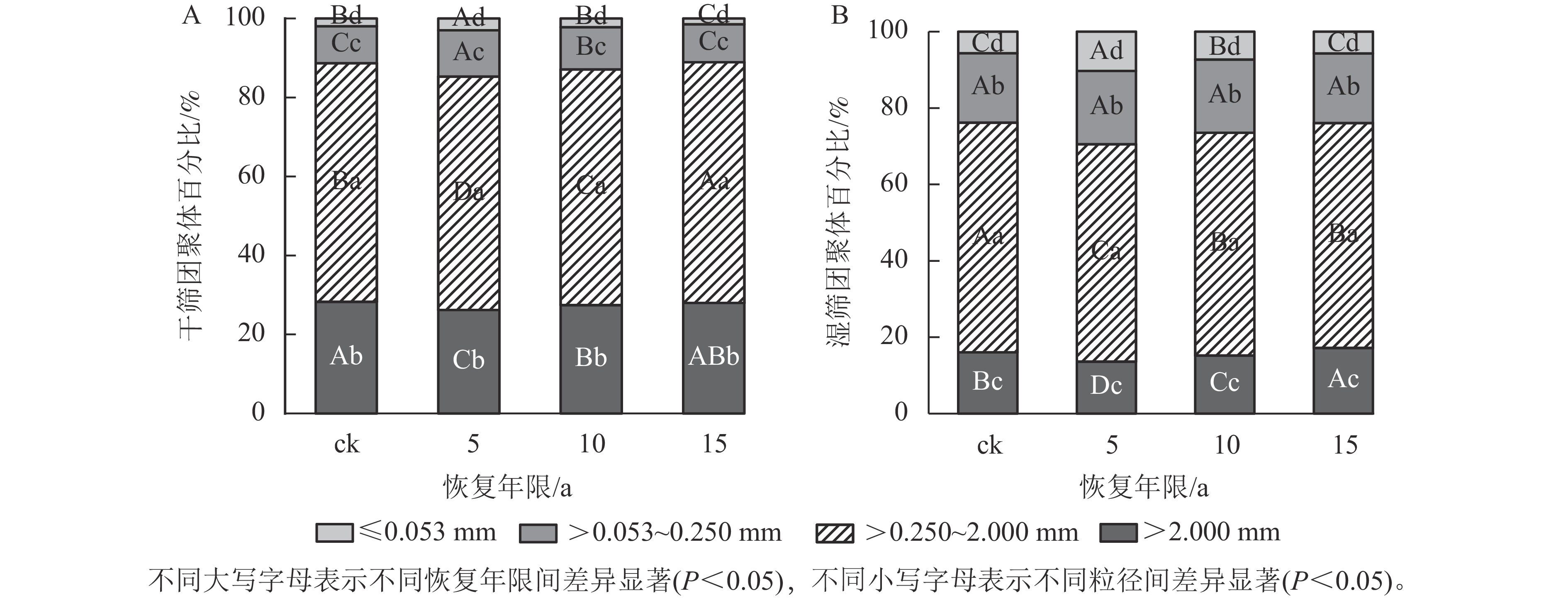
    • 图1可知:3个不同恢复年限边坡的水稳性团聚体主要以>0.250~2.000和>0.053~0.250 mm粒径为主,总体上占比从高到低依次为中团聚体、微团聚体、大团聚体、黏粉粒团聚体。边坡恢复过程中,大团聚体和中团聚体占比呈现极显著上升趋势(P<0.01),边坡恢复15 a中团聚体占主导地位,占比为59%,接近自然边坡水平,大团聚体占比17%,超过自然边坡水平。与之相反,微团聚体和黏粉粒团聚体在边坡恢复过程中比例呈现极显著下降趋势(P<0.01),与边坡恢复5 a相比,15 a下降1%和4%。
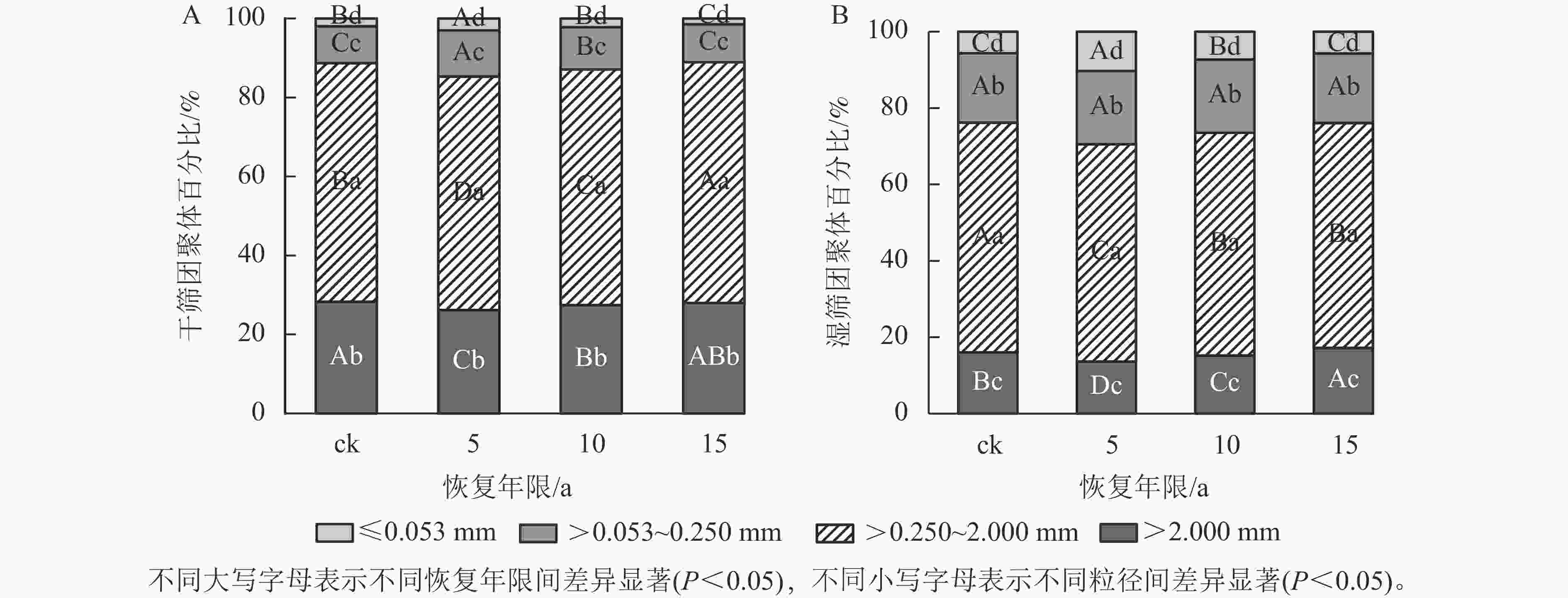
      Figure 1.  Particle size distribution of wet sieve aggregates with different recovery years

      表4可知:土壤团聚体几何平均直径(DGM)、平均质量直径(DMW)以及团聚体破坏率(DPA)随恢复年限的增加与自然边坡差距逐渐减小,DGMDMW分别从低于自然边坡9.34%和19.88%增长至高于自然边坡,DPA从高于自然边坡18.01%降至低于自然边坡。土壤团聚体稳定性从大到小依次为15 a、ck、10 a、5 a。土壤可蚀性K值在边坡恢复过程中,在恢复5 和10 a时分别高于自然边坡24.41%和9.42%,在15 a时恢复至低于自然边坡1.07%,土壤抗蚀性恢复至自然边坡水平。

      恢复年限/a 几何平均直径(DGM)/mm 平均质量直径(DMW)/mm 团聚体破坏率(DPA)/% 土壤可蚀性K
      ck 0.76±0.05 a 1.27±0.05 a 14.67±1.25 c 0.047±0.003 c
      5 0.61±0.04 c 1.15±0.04 c 17.31±0.59 a 0.058±0.004 a
      10 0.69±0.06 b 1.22±0.05 b 15.72±1.21 b 0.051±0.005 b
      15 0.77±0.06 a 1.29±0.05 a 14.46±1.78 c 0.046±0.003 c
        说明:数据为平均值±标准差,不同小写字母表示不同恢复年限间差异显著(P<0.05)。

      Table 4.  Soil aggregate stability indexes of different restoration years

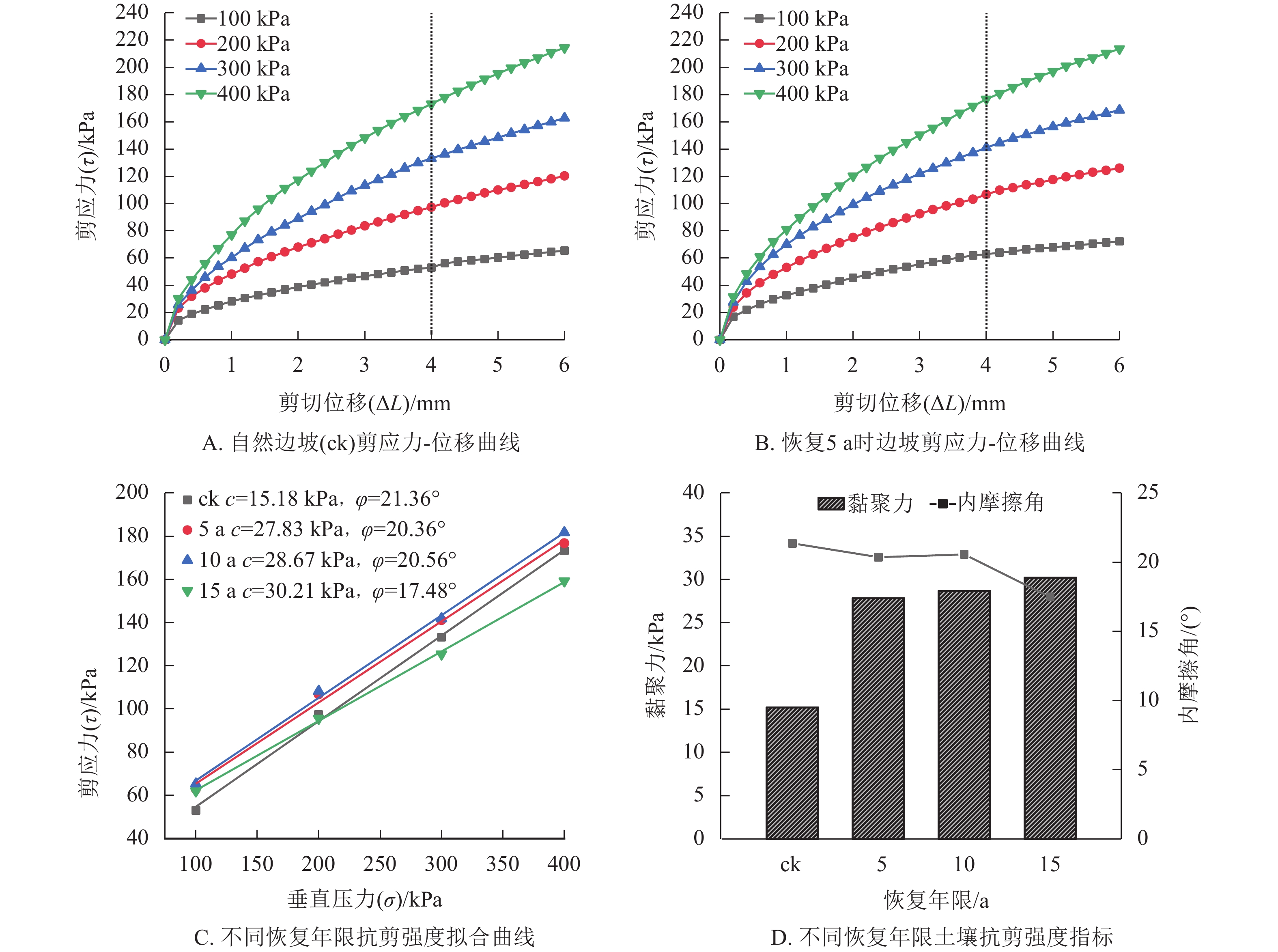
    • 不同恢复年限边坡土壤剪应力-位移曲线如图2A和B所示。取位移4 mm时剪应力,拟合成不同恢复年限边坡表土抗剪强度变化曲线如图2C所示。边坡恢复5和10 a时的抗剪强度拟合曲线位于自然边坡上方,而恢复15 a时的土壤抗剪强度拟合曲线与自然边坡相交,说明边坡恢复5和10 a时土壤抗剪强度高于自然边坡。自然边坡和3个不同恢复年限的土壤平均抗剪强度分别为114.22、121.83、124.31和110.55 kPa,呈现先增加后减小的趋势。
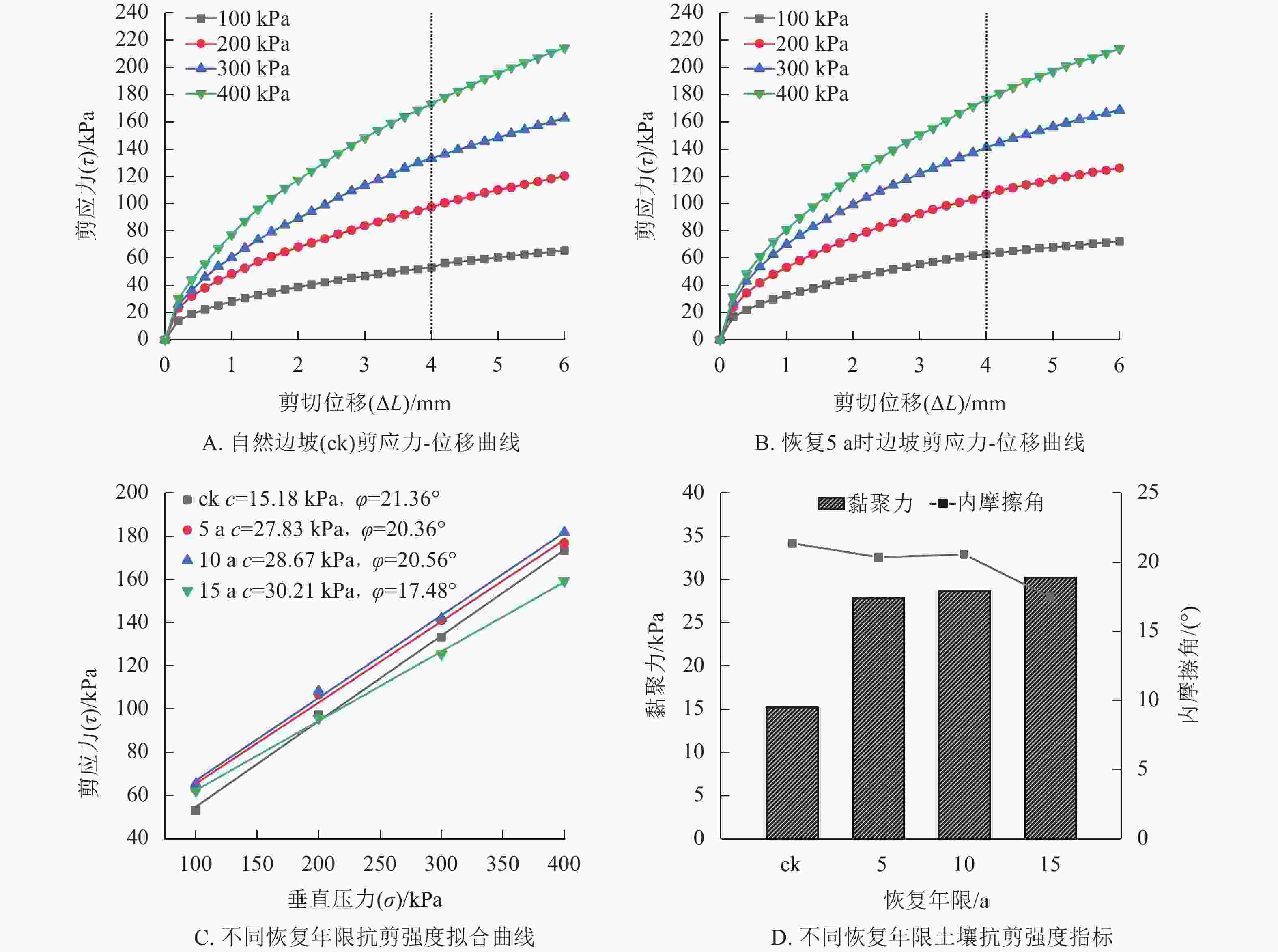
      Figure 2.  Comparison of soil cohesion and internal friction angle of matrix layer under different restoration years

      3种不同恢复年限的土壤抗剪强度指标结果如图2D所示。边坡恢复5、10、15 a和自然边坡的黏聚力分别为27.83、28.67、30.21和15.18 kPa,随着恢复年限的不断增加,人工边坡的内摩擦角比自然边坡分别提高了83.33%、88.87%、99.01%。边坡恢复5和10 a的内摩擦角均低于自然边坡水平,没有显著差别,在恢复15 a时有较大下降,变化幅度为18.16%。

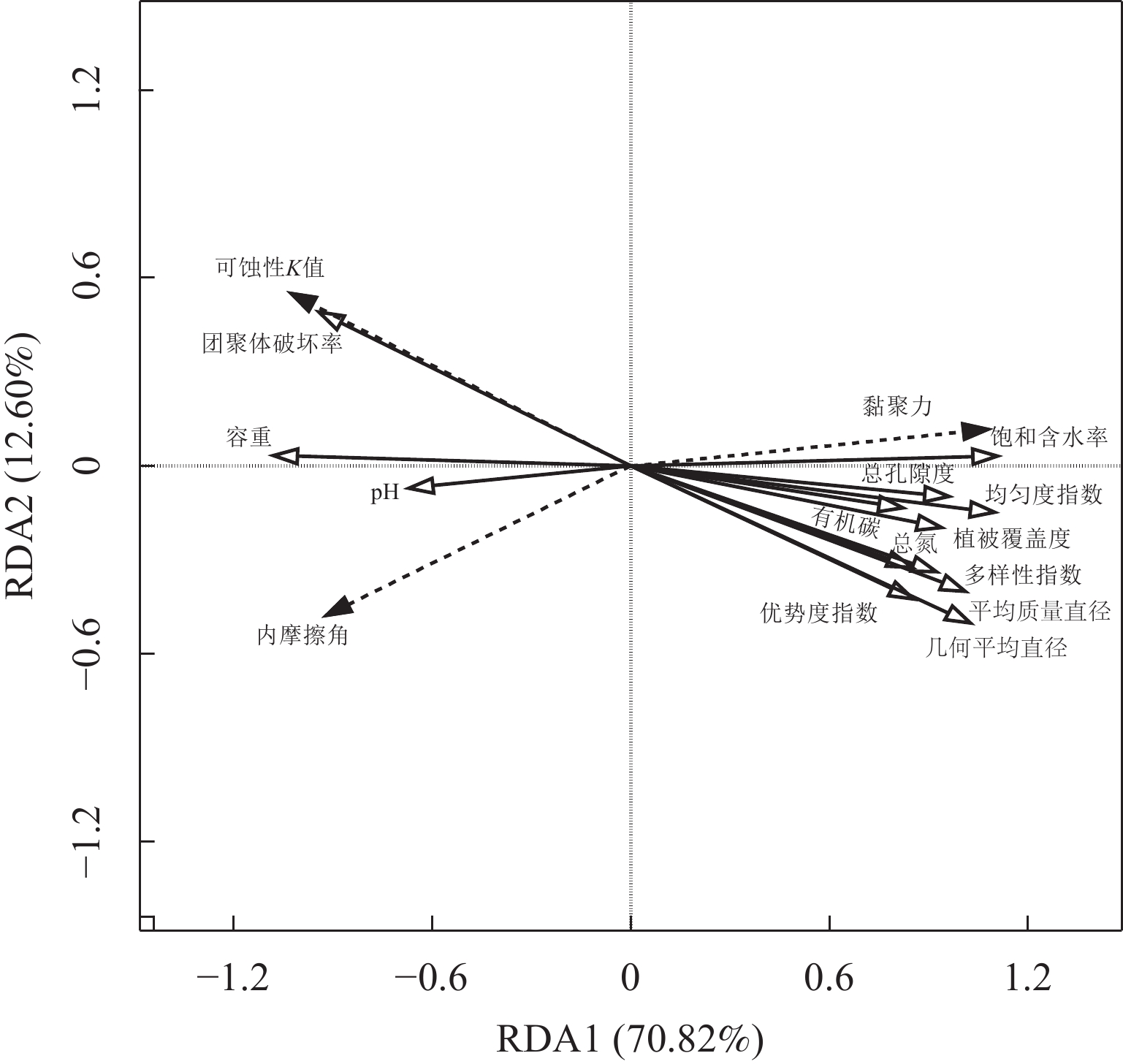
    • 冗余分析(图3)表明:植被特征和土壤指标对表土稳定性在第Ⅰ轴和第Ⅱ轴的解释量分别为70.82%和12.60%。各影响因素中,饱和含水率、几何平均直径、多样性指数和团聚体破坏率显著影响土壤稳定性指标,其贡献率分别为65.7%、11.8%、6.3%和5.0%。其中土壤可蚀性K值与容重、团聚体破坏率显著正相关(P<0.05),与饱和含水率、团聚体几何平均直径、团聚体平均质量直径显著负相关(P<0.05);黏聚力与饱和含水率、多样性指数显著正相关(P<0.05),与容重显著负相关(P<0.05);而内摩擦角则与饱和含水率显著正相关,与容重显著负相关(P<0.05)。
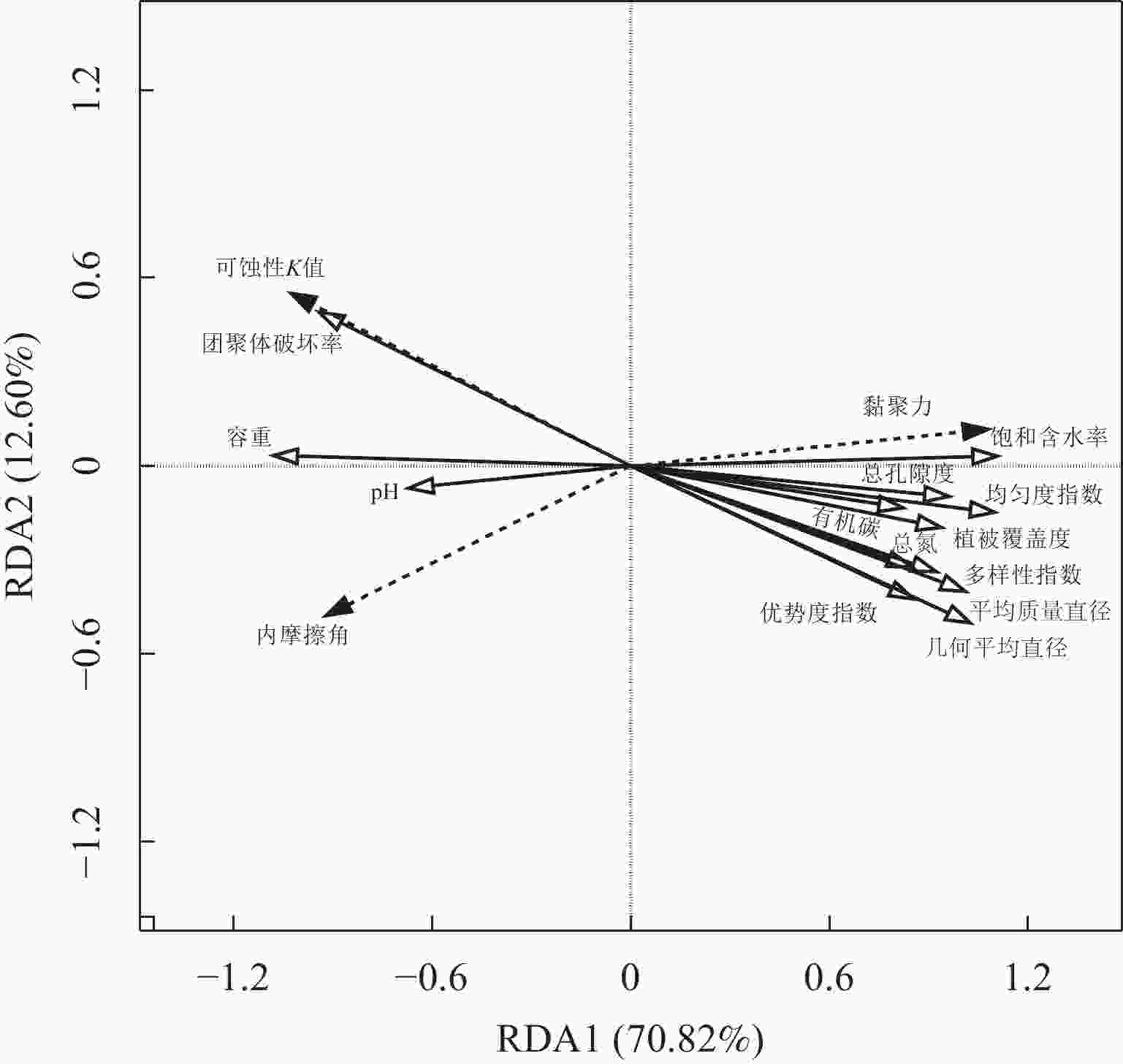
      Figure 3.  Correlation between vegetation characteristics, soil properties and soil anti-erodibility, shear strength indexes

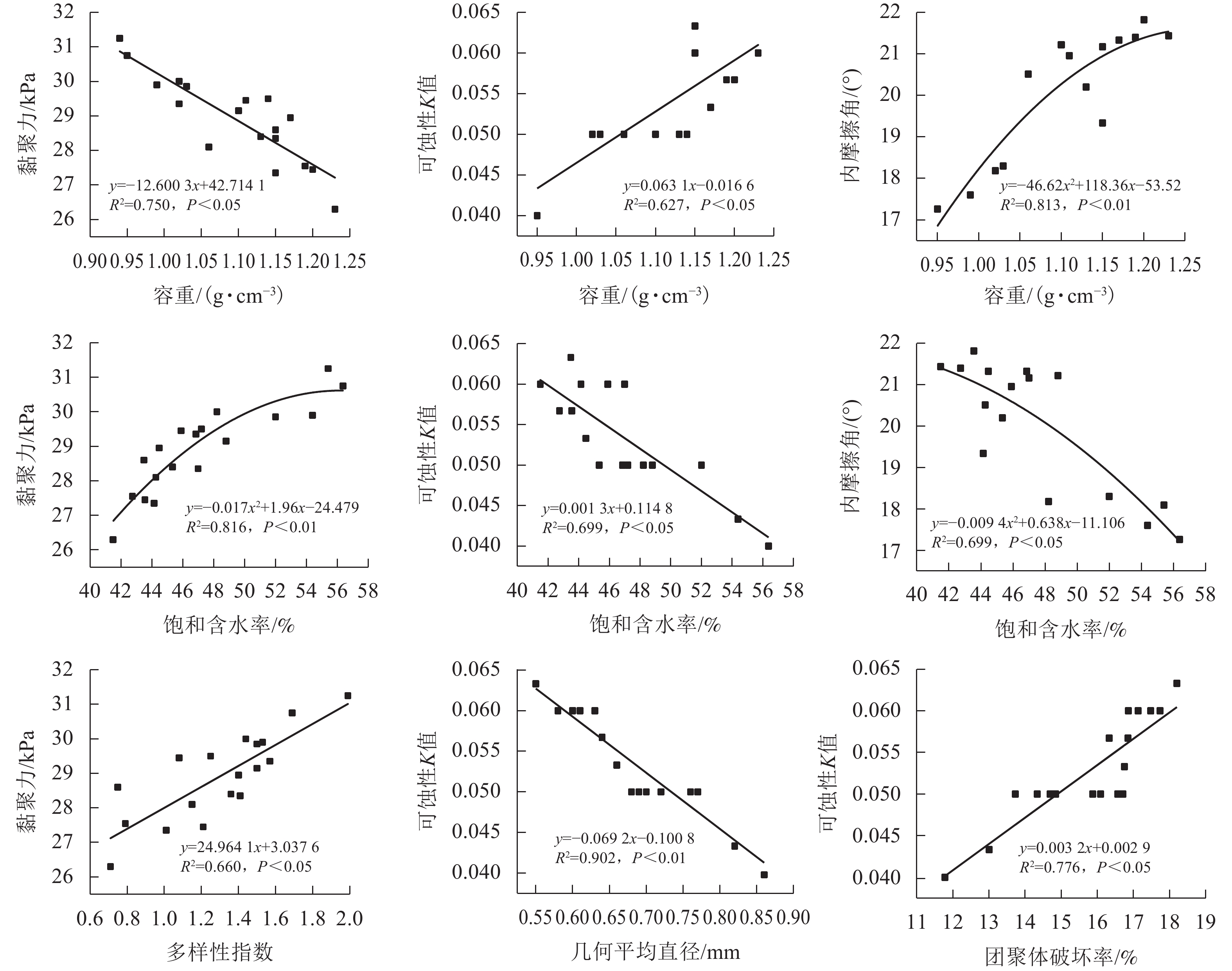
      进一步对植被特征、土壤指标与土壤稳定性指标进行回归分析(图4)发现:土壤可蚀性K值可表征为容重(R2=0.627)、饱和含水率(R2=0.699)、团聚体几何平均直径(R2=0.902)和团聚体破坏率(R2=0.776)的线性函数。黏聚力可以表征为多样性指数(R2=0.660)和容重(R2=0.750)的线性函数,以及饱和含水率(R2=0.816)的幂函数。内摩擦角则可以表征为容重(R2=0.813)和饱和含水率(R2=0.699)的幂函数。
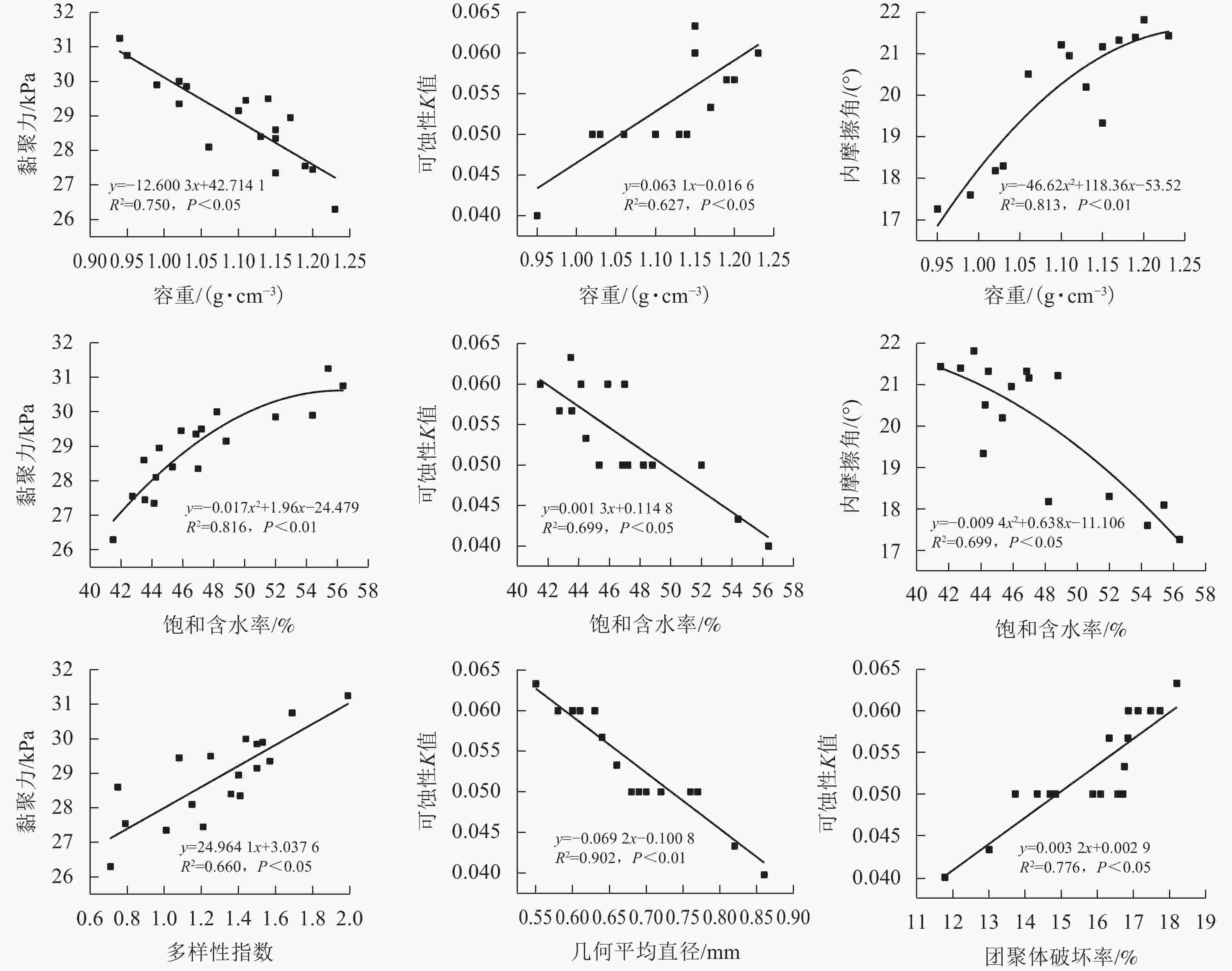
      Figure 4.  Regression analysis of soil physical and chemical properties and soil erosion resistance and shear strength index

    • 在本研究区的植被恢复过程中,豆科、禾本科、菊科和唇形科植物为主要优势种。菊科、禾本科植物通过增加根系生物量来吸收更多水分,同时通过增加根冠比来减少水分散失,豆科植物可以与根瘤菌共生,增加土壤氮含量,改善土壤条件,促进植物生长,植被开始由1年生或2年生物种逐渐向多年生物种演替[18]。随着恢复年限的增加,边坡植被的Shannon-Wiener指数、Simpson指数、植物覆盖度均呈现显著上升趋势,恢复10 a向15 a过程中指标涨幅大于恢复初期,但仍低于自然边坡。这可能是由于在植被演替过程中,灌乔木的生长改善了边坡水热条件,为植被生长提供有利条件,随着植被多样性和覆盖度的增加,减弱了降水对土壤的侵蚀,有利于土壤养分积累,从而进一步促进植被的生长[19]。但指标的快速增长出现在刺槐演替成为优势种的过程中,喷播施工方案中刺槐仅采用种子喷播的方式,刺槐的萌发和生长会受到先锋草本植物的影响,建议在施工时采用喷播+栽植的方式适当提高刺槐数量。

    • 在边坡植被恢复过程中,植被和土壤的协同作用会改变土壤结构和养分[20]。本研究结果显示:随着边坡恢复年限的不断增加,土壤容重不断减小,总孔隙度以及土壤水稳性大团聚体和中团聚体占比上升,在研究区段内指标变化幅度均表现出恢复后期快于前期的特征,并在恢复15 a时超过自然边坡水平,这表明土壤结构在恢复过程中得到改善。这可能是由于紫穗槐、刺槐等灌乔木数量不断增多,土壤中根系发达,在释放分泌物增强胶结作用促进团聚体向大粒级转化的同时,固结、缠绕、挤压土体[21],此外,由于植被覆盖度的变化,减少了土壤水分蒸发和外力对团聚结构的冲击[22],土壤结构得到改善,使得土壤的保水性能得到提升,所以饱和含水率随恢复年限的增加逐渐上升,在恢复10~15 a过程中,饱和含水率的涨幅是恢复5~10 a时的4.06倍,较高的土壤含水量也适宜刺槐等高耗水植物的生长[23]。土壤全氮和有机碳含量随着恢复时间的延长不断增长,恢复15 a比恢复5 a时分别增长了86.59%和96.1%,但恢复后期的增长幅度低于前期,且有机碳含量未达到自然边坡水平。这可能是植物的固氮作用以及碳循环的增强使得土壤全氮和有机碳含量上升,但乔木的快速生长消耗了过多土壤养分[24],使得微量元素增长速率下降,建议在恢复10 a时对边坡进行合理追肥,以提高碳、氮含量。

    • 通常,土壤可蚀性K值用来表征土壤抗蚀能力[25],而黏聚力和内摩擦角用来表征土壤抗剪能力[26]。本研究结果显示:土壤可蚀性K值随恢复年限的增加而减小,这是由于土壤团聚体几何平均直径、平均质量直径上升,团聚体破坏率下降,团聚体稳定性更高,土壤抵抗径流冲刷等外力作用的能力提升,与此同时,全氮、有机碳等养分的增加,以及土壤总孔隙度的增加,为土壤水、肥、气、热提供了良好条件,土壤表层根系发育较好,有效改善土壤孔隙结构[27],使得降雨能够更快渗透,削弱降雨对土壤的侵蚀,提升土壤抗侵蚀能力[28]。另一方面根系长度、直径和细根数量增加,加大了与土壤的接触面积,根系的加筋效应提高,土壤所受剪应力更多转化为根系拉应力[29],同时植被消耗土壤水分,增加了土壤基质的吸力[30],使得土壤黏聚力不断增加,土壤的抗剪强度不断增加,在恢复5 和10 a时均高于自然边坡,而恢复15 a时低于自然边坡,是因为内摩擦角在恢复15 a时下降18.16%,这可能是在一定土壤含水量范围内,土壤黏聚力和内摩擦角会随着土壤含水量的增加而增加,土壤抗剪强度增加,但当土壤含水量超过一定阈值时,颗粒间摩擦性能减弱,内摩擦角减小,削弱了土壤抗剪性能,使得土壤抗剪强度降低[31]。但人工边坡内摩擦角数值在恢复过程中一直低于自然边坡,这与抗剪强度的变化趋势并不一致,所以本研究黏聚力对抗剪强度的影响更为重要。

    • 随植被恢复年限的增加,植被群落发生正向演替,边坡植被多样性和覆盖度显著增加,并在刺槐成为优势种的过程中呈现快速增长。同时,土壤结构和养分不断提升,在15 a时恢复至自然边坡水平,但土壤理化性质指标在恢复后期的增长幅度低于前期。植被恢复和土壤性质的改善可以显著提高土壤抗蚀和抗剪性能,解释率为83.42%。土壤抗蚀能力可表征为平均质量直径、几何平均直径、团聚体破坏率的线性函数,R2为0.77~0.90,而土壤黏聚力随多样性指数和容重线性增加,内摩擦角随饱和含水率减小,虽然一定程度上降低了土壤的抗剪性能,但黏聚力对土壤抗剪能力影响更强,从高到低为15 a、ck、10 a、5 a。因此,建议在喷播绿化施工方案中采取喷播+栽种方式种植刺槐,并且在恢复10 a时对边坡进行适当追肥,同时,可以优先采用上述6个指标对土壤抗蚀和抗剪性能进行分析,这对边坡喷播绿化植物选配和后期养护具有一定的参考意义。但当前研究仅关注了地上植被与土壤性质的关系,后续研究应该结合植物根系相关指标进一步探讨植被对土壤抗蚀抗剪性能的影响。

Reference (31)

Catalog

    /

    DownLoad:  Full-Size Img  PowerPoint
    Return
    Return