Turn off MathJax
Article Contents

CAO Yaochang, WANG Xu, FENG Hanhua, et al. Community characteristics and carbon storage of natural forests in rocky desertification areas of northern Guangdong[J]. Journal of Zhejiang A&F University, 2026, 43(1): 1−13 doi:  10.11833/j.issn.2095-0756.20250170
Citation: CAO Yaochang, WANG Xu, FENG Hanhua, et al. Community characteristics and carbon storage of natural forests in rocky desertification areas of northern Guangdong[J]. Journal of Zhejiang A&F University, 2026, 43(1): 1−13 doi:  10.11833/j.issn.2095-0756.20250170

OnlineFirst articles are published online before they appear in a regular issue of the journal. Please find and download the full texts via CNKI.

Community characteristics and carbon storage of natural forests in rocky desertification areas of northern Guangdong

DOI: 10.11833/j.issn.2095-0756.20250170
  • Received Date: 2025-03-03
  • Accepted Date: 2025-10-19
  • Rev Recd Date: 2025-09-27
  • Available Online: 2025-12-17
  •   Objective  This study aims to explore the relationship between community characteristics and carbon storage in rocky desertification areas of northern Guangdong, and to reveal the key community characteristic indicators that affect carbon storage.   Method  Forest communities with mild, moderate, and severe levels of rocky desertification in northern Guangdong were selected as the research objects. Three 30 m×40 m forest plots were selected by typical sampling, and one-way analysis of variance, Pearson correlation analysis, and random forest model were used to analyze the characteristics of forest communities, carbon storage and their relationship in rocky desertification areas in northern Guangdong.   Result  (1) The dominant tree species of the forest community in rocky desertification areas were Castanopsis jucunda, Pinus massoniana, Quercus acutissima, etc., and the species diversity of moderate rocky desertification communities was the highest. (2) The diameter structure of the forest communities at three desertification levels all showed an inverted “J” shape. Among them, diameter Class Ⅰ was dominant (mild desertification accounting for 53.8%, moderate 67.8%, and severe 77.4%). The vertical structure was mainly composed of Classes Ⅰ-Ⅱ, and the community structure tended to simplify with increasing desertification intensity. The average stand density in descending order was severe, moderate, and mild desertification communities. (3) Carbon storage of the three forest communities, ranking from large to small, was as follows: moderate rocky desertification communities, mild rocky desertification communities, and severe rocky desertification communities, with no significant differences in carbon storage among communities. The carbon storage of dead wood and litter was the least among carbon storage components. (4) There was no significant correlation between species diversity and carbon storage characteristics. DBH and tree height were significantly positively correlated with carbon storage characteristics (P<0.05). There was no significant correlation between forest density and carbon storage characteristics. Bedrock exposure degree was significantly negatively correlated with soil carbon storage (P<0.01), but not significantly correlated with total carbon storage. The relative importance of species dominance index, DBH, and tree height to carbon storage was 21.23%, 19.95%, and 19.55%, respectively.   Conclusion  The species diversity of forest communities in rocky desertification areas of northern Guangdong is the highest in the moderate rocky desertification community, with overall smaller species diameter classes and unclear vertical structural stratification. The carbon storage of dominant species is the main component of the community carbon storage, and the influence of community structure on carbon storage is dominant. [Ch, 6 fig. 5 tab. 40 ref.]
  • [1] ZHOU Zhenyan, LIU Chang, SONG Xiechen.  Distribution of forest carbon stocks in “Three Parallel Rivers” region based on GTWR-GBRT model . Journal of Zhejiang A&F University, doi: 10.11833/j.issn.2095-0756.20250346
    [2] CHEN Qi, ZHANG Chao, TIAN Xiangyun, SHI Xiaorong, ZHANG Yuwei, WANG Yan.  Spatio-temporal evolution process of rocky desertification in Yunnan Province from 2000 to 2020 . Journal of Zhejiang A&F University, doi: 10.11833/j.issn.2095-0756.20210806
    [3] YANG Bo, WANG Shaojun, ZHAO Shuang, ZHANG Lulu, ZHANG Kunfeng, FAN Yuxiang, XIE Lingling, WANG Zhengjun, GUO Zhipeng, XIAO Bo.  Effects of arbuscular mycorrhizal fungi symbiosis on growth and photosynthetic characteristics of Fraxinus malacophylla in rocky desertification habitats . Journal of Zhejiang A&F University, doi: 10.11833/j.issn.2095-0756.20210740
    [4] SHAO Han, WANG Hu, WANG Yan, XU Hongfeng, SU Qian, LIU Yungen.  Effects of different land use modes on soil fertility and heavy metal contents in karst rocky desertification area . Journal of Zhejiang A&F University, doi: 10.11833/j.issn.2095-0756.20210437
    [5] ZHOU Siyi, YIN Xiaojie, TANG Ruiquan, WU Pengfei.  Evaluation of eco-environmental quality in typical rocky desertification areas in the upper reaches of the Yangtze River . Journal of Zhejiang A&F University, doi: 10.11833/j.issn.2095-0756.20210523
    [6] SUI Xiran, WU Lifang, WANG Yan, WANG Ziquan, XIAO Yuxin, LIU Yungen, YANG Bo.  Characteristics of nutrient and enzyme activity in soil aggregates of different rocky desertification levels in central Yunnan Plateau . Journal of Zhejiang A&F University, doi: 10.11833/j.issn.2095-0756.20210168
    [7] HU Shengke, LIU Chang, WEI Pujie, LI Mengxi, HU Die.  Community characteristics of the wild Phoebe and Machilus plants in Yuan’an County, Hubei Province . Journal of Zhejiang A&F University, doi: 10.11833/j.issn.2095-0756.20190428
    [8] NIU Zhengyang, ZHANG Xiaochen, QI Qi, XI Lianlian, CHEN Xin.  Phoebe sheareri community in the Jiangsu Baohuashan Nature Reserve . Journal of Zhejiang A&F University, doi: 10.11833/j.issn.2095-0756.2019.06.010
    [9] XU Qihu, LIN Liping, XUE Chunquan, LUO Yong, LEI Yuancai.  Component specific carbon content and storage of Cinnamomum camphora in Guangdong Province . Journal of Zhejiang A&F University, doi: 10.11833/j.issn.2095-0756.2019.01.010
    [10] LIU Peng, WANG Yan, LIU Zongbin, GUO Yujing, ZHANG Zixia, LI Xiangwang, YANG Bo.  Distribution and division of stony desertification on county scale . Journal of Zhejiang A&F University, doi: 10.11833/j.issn.2095-0756.2019.05.016
    [11] PENG Yang, BAI Yanfeng, JIANG Chunqian, XU Rui, LIU Xiuhong.  Carbon storage differences for farmland with two rehabilitation approaches . Journal of Zhejiang A&F University, doi: 10.11833/j.issn.2095-0756.2018.02.006
    [12] AI Jingwen, LIU Jian, YU Kunyong, ZHANG Jinzhao, ZENG Qi, ZHENG Wenying.  Research on contribution rate of plant community characteristics and stand spatial structure to landscape aesthetics quality of forest parks and its influencing factors . Journal of Zhejiang A&F University, doi: 10.11833/j.issn.2095-0756.2017.06.017
    [13] WU Linshi, CAO Fuxiang, PENG Jiqing, CAO Jiwu, XU Yongfu, DONG Xujie, XU Wen.  Plant community and species diversity in rocky desert areas of Southern Hunan . Journal of Zhejiang A&F University, doi: 10.11833/j.issn.2095-0756.2016.02.008
    [14] BAI Yanfeng, ZHANG Shougong, JIANG Chunqian.  International comparison of carbon flows of harvested wood products . Journal of Zhejiang A&F University, doi: 10.11833/j.issn.2095-0756.2014.01.011
    [15] SUN Chong, LIU Qijing.  Carbon storage changes for major forest types in Beijing . Journal of Zhejiang A&F University, doi: 10.11833/j.issn.2095-0756.2013.01.010
    [16] CUI Rui-rui, DU Hua-qiang, ZHOU Guo-mo, XU Xiao-jun, DONG De-jin, Lü Yu-long.  Remote sensing-based dynamic monitoring of moso bamboo forest and its carbon stock change in Anji County . Journal of Zhejiang A&F University, doi: 10.11833/j.issn.2095-0756.2011.03.012
    [17] ZHOU Yuan-yuan, WANG Xiao-de, FU Xiu-yu, ZHOU Su-qin, LI Dong.  Community features of rock vegetation of Danxia topography in Mount Jianglangshan,Zhejiang Province . Journal of Zhejiang A&F University, doi: 10.11833/j.issn.2095-0756.2010.05.010
    [18] JING Li, ZHU Zhi-hong, WANG Xiao-an, GUO Hua.  Community characteristics of a Pinus tabulaeformis secondary forest and a planted forest in the Xunyangba Region of the Qinling Mountains . Journal of Zhejiang A&F University,
    [19] LI Gui-xiang, MENG Guang-tao, FANG Xiang-jing, LANG Nan-jun, YUAN Chun-ming, WEN Shao-long.  Characteristics of Alnus cremastogyne plantation community and its biomass in central Yunnan Plateau . Journal of Zhejiang A&F University,
    [20] WANG De-lu, ZHU Shou-qian, HUANG Bao-long.  Internal factors influencing Karst rocky desertification . Journal of Zhejiang A&F University,
  • [1]
    FALKOWSKI P, SCHOLES R J, BOYLE E, et al. The global carbon cycle: a test of our knowledge of earth as a system [J]. Science, 2000, 290(5490): 291−296. DOI: 10.1126/science.290.5490.291.
    [2]
    TU Chun, LUO Weiqun, LI Fadong, et al. Spatial and temporal changes of karst rocky desertification and its cause analysis in South China [J]. Geological Bulletin of China, 2025, 44(2): 326−339. DOI: 10.12097/gbc.2021.50.120.
    [3]
    YU Lifei, ZHU Shouqian, ZHU Xiaoke, et al. A study on evaluation of restoration and remedy technology of degraded karst forest [J]. Guizhou Science, 2002, 20(1): 7−13. DOI: 10.3969/j.issn.1003-6563.2002.01.002.
    [4]
    YANG Bairun, WU Jiang, GUAN Kaicheng, et al. Community structure and species composition in Dachen Island [J]. Journal of Zhejiang A&F University, 2025, 42(2): 321−328. DOI: 10.11833/j.issn.2095-0756.20240423.
    [5]
    LOU Yikai, FAN Yi, DAI Qilin, et al. Relationship between vertical structure and overall species diversity in an evergreen deciduous broad-leaved forest community of Tianmu Mountain Natural Reserve [J]. Acta Ecologica Sinica, 2021, 41(21): 8568−8577. DOI: 10.5846/stxb202007301989.
    [6]
    CHEN Bolan, WU Yuru, ZHONG Xinyi, et al. Effects of stand density on understory plant diversity and biomass in a Cupressus funebris plantation in yunding mountain [J]. Journal of Sichuan Agricultural University, 2023, 41(4): 665−672. DOI: 10.16036/j.issn.1000-2650.202305240.
    [7]
    PACH M, PODLASKI R. Tree diameter structural diversity in Central European forests with Abies alba and Fagus sylvatica: managed versus unmanaged forest stands [J]. Ecological Research, 2015, 30(2): 367−384. DOI: 10.1007/s11284-014-1232-4.
    [8]
    ZHAO Yi. Study on the Distribution Pattern of Karst Forest Species Diversity and Aboveground Carbon Storage in the Lijiang River Basin [D]. Guilin: Guilin University of Electronic Technology, 2024. DOI: 10.27049/d.cnki.ggldc.2024.000236.
    [9]
    LAUTENBACH S, JUNGANDREAS A, BLANKE J, et al. Trade-offs between plant species richness and carbon storage in the context of afforestation–Examples from afforestation scenarios in the Mulde Basin, Germany [J]. Ecological Indicators, 2017, 73: 139−155. DOI: 10.1016/j.ecolind.2016.09.035.
    [10]
    ZHU Xiai, SHEN Youxin, HE Beibei, et al. Species diversity and biomass of vascular plant on rocky outcrops in karst area [J]. Mountain Research, 2016, 34(2): 165−172. DOI: 10.16089/j.cnki.1008-2786.000114.
    [11]
    MA Xuewei. Carbon Storage Features of High-efficiency Characteristic Forests and Carbon Sequestration Forestry Cultivation Techniques in the Karst Rocky Desertification Areas[D]. Guiyang: Guizhou Normal University, 2020. DOI: 10.27048/d.cnki.ggzsu.2020.000494.
    [12]
    NOWAK D J, CRANE D E. Carbon storage and sequestration by urban trees in the USA [J]. Environmental Pollution, 2002, 116(3): 381−389. DOI: 10.1016/S0269-7491(01)00214-7.
    [13]
    ZHENG Zheng, FENG Zhili, CAO Min, et al. Forest structure and biomass of a tropical seasonal rain forest in Xishuangbanna, southwest China [J]. Biotropica, 2006, 38(3): 318−327. DOI: 10.1111/j.1744-7429.2006.00148.x.
    [14]
    ZHAO Zhonghua, HUI Gangying. Advances in structural diversity of stand structure [J]. Scientia Silvae Sinicae, 2020, 56(9): 143−152. DOI: 10.11707/j.1001-7488.20200916.
    [15]
    HUANG Jinguo, GUO Zhiyong. Causes and control countermeasures of land rocky desertification in karst mountainous areas of northern Guangdong Province [J]. Modern Agricultural Science and Technology, 2010(15): 349−350. DOI: 10.3969/j.issn.1007-5739.2010.15.232.
    [16]
    XIONG Kangning. A Typical Study of Karst Rocky Desertification Based on Remote Sensing and GIS: A Case Study of Guizhou Province[M]. Beijing: Geological Publishing House, 2002.
    [17]
    FENG Hanhua, WU Bin, WU Guoqing, et al. Characteristics and functions of soil microbial communities under different vegetation types in karst areas [J]. Journal of Forest and Environment, 2024, 44(2): 148−156. DOI: 10.13324/j.cnki.jfcf.2024.02.005.
    [18]
    MA Keping, HUANG Jianhui, YU Shunli, et al. Plant community diversity in Dongling Mountain, Beijing, China (Ⅱ) species richness, evenness, and species diversities [J]. Acta Ecologica Sinica, 1995, 15(3): 286−277. DOI: 10.3321/j.issn:1000-0933.1995.03.006.
    [19]
    HUBBELL S, FOSTER R. Commonness and rarity in a neotropical forest: implications for tropical tree conservation [J]. Plant Ecology, 1986, 8: 205−231.
    [20]
    LIU Canran, MA Keping. Measurement of biotic community diversity (Ⅴ) methods for estimating the number of species in a community [J]. Acta Ecologica Sinica, 1997, 17(6): 39−48.
    [21]
    TAN Shanshan, WANG Renren, GONG Xiaoling, et al. Scale dependent effects of species diversity and structural diversity on aboveground biomass in a tropical forest on Barro Colorado Island, Panama [J]. Biodiversity Science, 2017, 25(10): 1054−1064. DOI: 10.17520/biods.2017155.
    [22]
    LI Qiao, FAN Qingping, TANG Zhansheng, et al. Community composition and structure dynamics of secondary coniferous and broad-leaved mixed forest in Dongbaishan, Zhejiang Province [J]. Guihaia, 2022, 42(6): 1067−1076. DOI: 10.11931/guihaia.gxzw202012022.
    [23]
    ZHOU Guoyi, YIN Guangcai, TANG Xuli, et al. Carbon Storage-Biomass Equation of Forest Ecosystem in China[M]. Beijing: Science Press, 2018.
    [24]
    CHAI Hua, HE Nianpeng. Evaluation of soil bulk density in Chinese terrestrial ecosystems for determination of soil carbon storage on a regional scale [J]. Acta Ecologica Sinica, 2016, 36(13): 3903−3910. DOI: 10.5846/stxb201411222312.
    [25]
    WANG Wantong, TANG Xuli, HUANG Mei, et al. Carbon Storage-Dynamics and Mechanism of Forest Ecosystem in China[M]. Beijing: Science Press, 2018.
    [26]
    ZHOU Wenchang, ZHENG Lanying, CAO Guo, et al. Characteristics of the composition and diversity of plants in the rocky desertification karst land in northern Hubei [J]. Central South Forest Inventory and Planning, 2017, 36(1): 21−25. DOI: 10.16166/j.cnki.cn43-1095.2017.01.006.
    [27]
    CHENG Jing, LIU Jiming, XIONG Hua, et al. Plant communities characteristics of different microhabitats of karst moderate rocky desertification [J]. Journal of Sichuan Agricultural University, 2020, 38(3): 272−279. DOI: 10.16036/j.issn.1000-2650.2020.03.004.
    [28]
    WANG Shixiong, ZHAO Liang, LI Na, et al. The relative contributions of rare and common species to the patterns of species richness in plant communities [J]. Biodiversity Science, 2016, 24(6): 658−664. DOI: 10.17520/biods.2015239.
    [29]
    YAO Xiaolan, HAO Jianfeng, QI Jinqiu, et al. Effects of human disturbance on community structure and species diversity of Schima superba secondary forest in Bifengxia, western Sichuan [J]. Journal of Northwest A&F University (Natural Science Edition), 2017, 45(11): 18−26. DOI: 10.13207/j.cnki.jnwafu.2017.11.003.
    [30]
    WEI Shiguang, YE Wanhui, LIAN Juyu, et al. Species diversity characteristics of lower subtropical evergreen broad-leaved forest community and its satellite plots [J]. Acta Ecologica Sinica, 2022, 42(11): 4515−4523. DOI: 10.5846/stxb202105071190.
    [31]
    BAI Yixin, WANG Linjiao, SHENG Maoyin. A study of the coupling relationship between natural vegetation community and micro-habitat in karst ecosystem of southwest China [J]. World Forestry Research, 2018, 31(5): 58−63. DOI: 10.13348/j.cnki.sjlyyj.2018.0046.y.
    [32]
    LI Chendi, YANG Xiaobo, LI Donghai, et al. Changes of community structure and diversity of natural forests in mountainous areas of central Hainan Island [J]. Chinese Journal of Ecology, 2023, 42(3): 513−523. DOI: 10.13292/j.1000-4890.202303.013.
    [33]
    ZHANG Suili, SHENG Maoyin, WANG Linjiao, et al. Effects of long term vegetation restorations on soil organic carbon fractions in the karst rocky desertification ecosystem, Southwest China [J]. Acta Ecologica Sinica, 2023, 43(20): 8476−8492. DOI: 10.20103/j.stxb.202208152346.
    [34]
    LIU Pan, LU Mei, LI Cong, et al. Changes of soil organic carbon storage and carbon components in typical meadow communities in Napahai [J]. Journal of Zhejiang A&F University, 2023, 40(2): 274−284. DOI: 10.11833/j.issn.2095-0756.20220377.
    [35]
    WEN Linqin, LI Zhongfei, LI Mingyu, et al. Characteristics of vegetation and soil physical properties in evolution processes of rocky desertification in Southwest Guizhou [J]. Journal of Northwest A&F University (Natural Science Edition), 2020, 48(12): 97−106. DOI: 10.13207/j.cnki.jnwafu.2020.12.012.
    [36]
    LI Lin, ZHAO Yi, WEN Zhifeng, et al. Spatial distribution characteristics and influencing factors of carbon storage on a subtropical evergreen broad-leaved forest in South Asia [J]. Acta Ecologica Sinica, 2024, 44(11): 4687−4697. DOI: 10.20103/j.stxb.202311162499.
    [37]
    FENG Hanhua, CAO Yaochang, BAO Ximei, et al. Selection of tree species for vegetation restoration in the rocky desertification areas of northern Guangdong Province [J]. Forestry and Environmental Science, 2024, 40(3): 41−48. DOI: 10.3969/j.issn.1006-4427.2024.03.006.
    [38]
    OUYANG Shuai, XIANG Wenhua, WANG Xiangping, et al. Significant effects of biodiversity on forest biomass during the succession of subtropical forest in South China [J]. Forest Ecology and Management, 2016, 372: 291−302. DOI: 10.1016/j.foreco.2016.04.020.
    [39]
    HAO Minhui, DAI Ying, YUE Qingmin, et al. Relationship between functional diversity of broadleaved Korean pine forest and forest carbon sink function [J]. Journal of Beijing Forestry University, 2022, 44(10): 68−76. DOI: 10.12171/j.1000-1522.20220237.
    [40]
    FANG Guojing, TANG Mengping. Spatial continuity for DBH in dominant populations of an evergreen broadleaved forest in National Nature Reserve of Mount Tianmu, China [J]. Journal of Zhejiang A&F University, 2014, 31(5): 663−667. DOI: 10.11833/j.issn.2095-0756.2014.05.001.
  • 加载中
通讯作者: 陈斌, bchen63@163.com
  • 1. 

    沈阳化工大学材料科学与工程学院 沈阳 110142

  1. 本站搜索
  2. 百度学术搜索
  3. 万方数据库搜索
  4. CNKI搜索

Figures(6)  / Tables(5)

Article views(18) PDF downloads(1) Cited by()

Related
Proportional views

Community characteristics and carbon storage of natural forests in rocky desertification areas of northern Guangdong

doi: 10.11833/j.issn.2095-0756.20250170

Abstract:   Objective  This study aims to explore the relationship between community characteristics and carbon storage in rocky desertification areas of northern Guangdong, and to reveal the key community characteristic indicators that affect carbon storage.   Method  Forest communities with mild, moderate, and severe levels of rocky desertification in northern Guangdong were selected as the research objects. Three 30 m×40 m forest plots were selected by typical sampling, and one-way analysis of variance, Pearson correlation analysis, and random forest model were used to analyze the characteristics of forest communities, carbon storage and their relationship in rocky desertification areas in northern Guangdong.   Result  (1) The dominant tree species of the forest community in rocky desertification areas were Castanopsis jucunda, Pinus massoniana, Quercus acutissima, etc., and the species diversity of moderate rocky desertification communities was the highest. (2) The diameter structure of the forest communities at three desertification levels all showed an inverted “J” shape. Among them, diameter Class Ⅰ was dominant (mild desertification accounting for 53.8%, moderate 67.8%, and severe 77.4%). The vertical structure was mainly composed of Classes Ⅰ-Ⅱ, and the community structure tended to simplify with increasing desertification intensity. The average stand density in descending order was severe, moderate, and mild desertification communities. (3) Carbon storage of the three forest communities, ranking from large to small, was as follows: moderate rocky desertification communities, mild rocky desertification communities, and severe rocky desertification communities, with no significant differences in carbon storage among communities. The carbon storage of dead wood and litter was the least among carbon storage components. (4) There was no significant correlation between species diversity and carbon storage characteristics. DBH and tree height were significantly positively correlated with carbon storage characteristics (P<0.05). There was no significant correlation between forest density and carbon storage characteristics. Bedrock exposure degree was significantly negatively correlated with soil carbon storage (P<0.01), but not significantly correlated with total carbon storage. The relative importance of species dominance index, DBH, and tree height to carbon storage was 21.23%, 19.95%, and 19.55%, respectively.   Conclusion  The species diversity of forest communities in rocky desertification areas of northern Guangdong is the highest in the moderate rocky desertification community, with overall smaller species diameter classes and unclear vertical structural stratification. The carbon storage of dominant species is the main component of the community carbon storage, and the influence of community structure on carbon storage is dominant. [Ch, 6 fig. 5 tab. 40 ref.]

CAO Yaochang, WANG Xu, FENG Hanhua, et al. Community characteristics and carbon storage of natural forests in rocky desertification areas of northern Guangdong[J]. Journal of Zhejiang A&F University, 2026, 43(1): 1−13 doi:  10.11833/j.issn.2095-0756.20250170
Citation: CAO Yaochang, WANG Xu, FENG Hanhua, et al. Community characteristics and carbon storage of natural forests in rocky desertification areas of northern Guangdong[J]. Journal of Zhejiang A&F University, 2026, 43(1): 1−13 doi:  10.11833/j.issn.2095-0756.20250170
  • 岩石圈作为地球最大的碳库,碳储量占全球总碳量的99.55%[1]。岩溶作用驱动碳元素在不同碳库之间的迁移转化,是全球碳循环的重要组成部分。石漠化是中国南方岩溶地区主要生态问题。截至2020年,南方岩溶石漠化面积为8.45万km2,占南方岩溶地区面积14.43%[2]。人地资源矛盾以及极端天气灾害的频发,导致石漠化地区大面积植被遭到破坏,植被碳库和土壤碳库受到了严重的损失。这种退化地带生态恢复工程的首要现实问题是进行植被恢复,且植物群落结构修复先于功能恢复[3]。群落结构特征是影响生物量差异的关键因素,随着群落演替的进行,群落生境、群落结构等也随之发生变化,进而对生态系统的碳循环产生影响。

    在分析群落特征的过程中,群落物种多样性是生物多样性在物种水平上的表现形式,可反映生物群落结构的复杂性,体现群落的结构类型、组织水平、发展阶段、稳定程度和生境差异。水平和垂直方向的结构指标是群落特征研究的重要内容,其中径级分布格局不仅定量表征林木胸径变异特征与干形发育规律,还能有效反映群落更新潜力及种间、物种与环境间的互作关系[4]。垂直分布结构则通过调控光资源梯度分布,在生境空间异质性形成过程中构建多层次生态位分化系统,为物种共存提供了丰富的生态位空间,进而塑造群落生物多样性格局[5]。此外,林分密度是森林生态系统的关键结构特征,是控制林木生长发育和生物量积累的关键因素,与林木平均个体材积或质量也存在一定关系[6]。已有研究表明:植物群落结构能对群落固碳能力产生影响[7]。有学者研究发现:漓江流域喀斯特森林地上碳储量受林分结构多样性的影响大于物种多样性[8]。群落物种丰富度与群落生物量呈正相关[9],但物种多样性和生物量并没有固定的关系,如相较于人工林和次生林,在云南石漠化地区物种多样性指数表现居中的石漠化生态系统却拥有最高的生物量[10]。马学威[11]对贵州石漠化地区高效特色林研究发现:乔木层碳储量与树种平均胸径和树高呈显著正相关,且群落中大径级树木对总生物量影响显著[12]。适度的林分密度有利于提高单位面积的固碳效益,但过高或过低的密度都可能降低固碳效果[13]。物种多样性、结构特征在森林地上碳储量中的主导地位存在争议,物种多样性是物种丰富度和均匀性的组合,而结构特征则反映了森林中树木个体及其属性之间的连接方式[14]。这两者都会对森林地上碳储量造成影响。因此,研究森林碳储量时考虑森林群落的结构特征和物种多样性,对理解森林生态系统在陆地碳循环中的作用以及预测未来碳储量具有重要意义。

    粤北地区是广东石漠化的主要分布区域,其基岩裸露度面积占据广东省石漠化土地面积的84.4%,石漠化问题已受到广泛关注[15]。目前,关于群落结构特征与碳储量关系的研究多集中于草地、山地等,针对石漠化地区,尤其是粤北石漠化地区的相关综合研究较缺乏,而且物种多样性和结构特征对森林群落碳储量的贡献是否会随着石漠化程度的变化而改变仍未知。

    本研究通过对粤北石漠化地区不同石漠化程度的天然林群落特征、碳储量特征以及两者之间的关系分析,拟回答以下问题:①粤北不同石漠化程度的天然林植物群落特征是否存在差异?③不同群落类型的碳储量分配特征如何?②物种多样性和群落结构特征对森林群落碳储量的贡献是否会随着石漠化程度的变化而改变?研究结果可为粤北石漠化地区植被恢复与治理提供理论支撑,也可对石漠化地区碳管理提供决策依据。

    • 粤北地区的石漠化由脆弱的地质基地和人类活动胁迫共同作用形成。其中粤北地区的乐昌市石漠化面积占广东省石漠化总面积的1/3,为全省岩溶地区石漠化程度最严重地区之一。梅花镇是乐昌市石漠化分布最广、程度最高的地区之一,基本涵盖了粤北石漠化全部类型,具有较强的代表性。目前,粤北石漠化的主要治理措施为“退耕还林草+人工造林”“防治水土流失+水利水保设施建设”以及禁止不合理的垦荒及耕作活动。本研究以乐昌市梅花镇为研究区域(25°09′38″~25°15′45″N,113°03′34″~113°08′02″E)。该区地处石灰岩小盆地,基岩裸露程度高,石砾多且质地疏松。属于亚热带季风气候,雨量充足,四季分明,年平均气温为19.6 ℃,年平均降雨量为1 522.0 mm;雨季为4—9月。研究区土壤以红壤和黄壤为主,其他土壤类型包括石灰土和紫色土等。植被类型主要为中亚热带常绿阔叶林,其次为常绿-落叶阔叶林、针阔混交林、竹林、高山草甸和各类人工林。

    • 2023年7月在实地踏查的基础上,根据基岩裸露度、地形、代表性植被等因素,参照熊康宁[16]将研究区域划分为3个石漠化等级:轻度石漠化(10%≤基岩裸露度<40%)、中度石漠化(40%≤基岩裸露度<60%)和重度石漠化(基岩裸露度≥60%),每个等级设置3个重复样地,样地均为天然林,每个样地面积为1 200 m2 (30 m×40 m)。样地基本情况见表1。每个样地内左上、中部、右下3个方位设置3个2 m×2 m的灌木小样方,在每个灌木小样方的左下角设置1个1 m×1 m的草本小样方。

      石漠化
      程度
      样地
      编号
      平均胸
      径/cm
      平均
      高度/m
      密度/
      (株·hm−2)
      基岩裸
      露度/%
      群落类型
      轻度 LCX1 6.7 5.0 4 608 21 常绿阔叶林
      轻度 LCX2 8.6 7.6 3 150 13 常绿阔叶林
      轻度 LCX3 7.7 5.7 4 708 25 常绿阔叶林
      中度 LCX4 7.0 5.3 7 150 40 针阔混交林
      中度 LCX5 6.2 5.2 6 575 40 针阔混交林
      中度 LCX6 8.6 6.7 4 942 42 针阔混交林
      重度 LCX7 2.2 6.2 4 892 75 常绿阔叶林
      重度 LCX8 2.9 1.9 8 558 60 常绿阔叶林
      重度 LCX9 6.6 4.3 8 283 60 常绿阔叶林

      Table 1.  Basic information of the sampled plots

    • 对9个样地内所有胸径≥1 cm的活立木进行每木检尺。乔木层和幼树层的调查内容为树木种名、胸径、树高、枝下高、冠幅等;灌草层的调查内容为物种名、株数、盖度、高度等。

    • 在每个样地,避开灌木小样方,在左上、中部、右下3个方位布设3个5 m × 5 m的土壤采样区,采用对角线法进行土壤取样。研究区土层薄、岩石裸露,多数小生境土层较薄,平均土层厚度为0~28 cm。结合前人研究[17],本研究采用不锈钢土钻对0~10和10~20 cm 土层进行取样,在每个采样区采集5个土壤样品。所有土壤样品均用无菌自封袋密封保存,用冰盒运回实验室,采用烧失量法测定土壤有机质,计算土壤有机碳储量。

    • 重要值(VI)是衡量物种在群落中相对重要性的综合指标,参考马克平等[18]的方法计算。参照HUBBELL等[19]的定义划分稀有种,在本研究中将物种数量为1~2种的物种判定为稀有种。群落物种多样性特征选用Margale指数、Simpson指数、Shannon-Wiener指数和Pielou指数来衡量。计算方法参考文献[20]。

    • 森林调查中胸径、树高是最容易测得的结构指标, 并且胸径与树高、林冠有较好的相关性[21] ,所以选用胸径、树高和林分密度作为群落结构指标。结合样地实际调查所得的数据,并参考有关群落径级的划分方法[22],将树木胸径(DBH)径级划分为5个等级:径级Ⅰ(1 cm≤DBH<5 cm)、径级Ⅱ(5 cm≤DBH<10 cm)、径级Ⅲ(10 cm≤DBH<15 cm)、径级Ⅳ(15 cm≤DBH<20 cm)、径级Ⅴ(DBH≥20 cm),并将1 cm≤DBH<5 cm的径级定义为小径级,5 cm≤DBH<15 cm径级定义为中径级,DBH≥15 cm的径级定义为大径级。将群落内木本植物树高(h)划分为4个等级:高阶Ⅰ(h<5 m)、高阶Ⅱ(5 m≤h<10 m)、高阶Ⅲ(10 m≤h<15 m)、高阶Ⅳ (h≥15 m),将h≤ 5 m定义为下层,5 m≤h<15 m定义中层,h≥15 m定义为上层。林分密度(DS,株·hm−2): DS=N/S,其中:N为样地株数,S为样地面积。

    • 喀斯特石漠化区地下生物量取样十分困难,且本研究中灌木样地平均密度为(6.8±1.0) 株·m−2,草本样地平均密度为(1.4±0.5) 株·m−2,对固碳量影响甚微。为减少对林下植被的破坏,根据实地调查情况,本研究仅计算乔木层(DBH≥5 cm)和幼树层(1 cm≤DBH<5 cm) 的碳储量。植被碳储量计算参照周国逸等[23]对中国森林生态系统生物量研究结果,采用一阶生物量(W)相对生长模型W=aDb(D为胸径,ab为拟合系数),乔木层选取广东省针阔混交林和阔叶林生物量方程,幼树层选取亚热带常绿阔叶林和针阔混交林生物量方程。各器官生物量计算公式见表2,总生物量为各器官生物量之和; W乔/幼=Wt+ Wb+ Wl+ Wr,其中:W乔/幼为乔木层或幼树层生物量(kg),WtWbWl、Wr分别为树干、树枝、树叶和树根生物量(kg)。样地植被生物量为:WB= Wa+Wy;其中:WB 为植被生物量(kg),WaWy分别为乔木层和幼树层生物量(kg)。植被碳储量计算公式为:CB= WB×0.5×0.001/S,其中:CB为植被碳储量(t·hm−2),WB为植被生物量;S为样地面积(hm2)。

      群落层次 林型 树干 树枝 树叶 树根 胸径/cm
      Wt 决定系数 Wb 决定系数 Wl 决定系数 Wr 决定系数
      乔木层 针阔混交林 0.054 2D2.544 9 0.89 0.009 7D2.692 3 0.81 0.030 2D2.021 2 0.62 0.055 1D2.067 1 0.73 5~65
      阔叶林 0.076 3D2.502 2 0.94 0.018 9D2.499 6 0.78 0.008 0D2.652 8 0.89 0.006 7D2.832 7 0.98 5~94
      幼树层 针阔混交林 0.105 0D2.226 0 0.99 0.024 0D2.256 0 0.99 0.039 0D1.814 0 0.99 0.092 0D1.805 0 0.99 <5
      常绿阔叶林 0.050 0D2.566 9 0.88 0.045 3D2.034 1 0.83 0.013 8D2.517 6 0.89 0.052 9D1.582 2 0.48 <5
        说明:Wt为树干生物量;Wb为树枝生物量;Wl为树叶生物量;Wr为树根生物量,各器官生物量单位均为kg。D为调查样地内树种胸径(cm)。

      Table 2.  Mixed species (group) biomass equation

    • 凋落物、枯死木碳储量根据《森林生态系统碳储量计算指南》公式计算,即:Cl=Btg×FDl×FCl×0.001/SCd=Btg×FDd×FCd×0.001/SBtg= Wt+ Wb+ Wl。其中:Cl为凋落物碳储量(t·hm2);Cd为枯死木碳储量(t·hm2);Btg为乔木地上生物量(kg),由树干(Wt)、树枝(Wb)、树叶(Wl)生物量组成;FDl为凋落物生物量分配系数,针阔混交林(亚热带)取7.309%,阔叶混交林取11.414%;FDd为枯死木生物量分配系数,广东地区取2.25%;FClFCd为含碳系数,均取缺省值0.37;S为样地面积(hm2)。

    • SSOC=θ×ρ×(1−σ)×(1−δT×α×0.000 1。其中:SSOC为土壤碳储量(t·hm−2);θ 为土壤有机质质量分数(mg·kg−1);σ为岩石裸露率(%);T 为土壤厚度(cm);ρ为土壤容重(1.35 g·cm−3) [24]δ为土壤中粒径>2 mm砾石体积百分比(%);α为土壤有机碳的转化系数,为0.58。根据王万同等[25]的方法,选取广东省针阔混交林和常绿阔叶林0~10、10~20 cm土层土壤砾石体积百分比(δ)分别为19.79%和15.39%。

    • 采用Excel 2019进行数据的整理, 用SPSS 27.0对不同石漠化程度森林群落的物种多样性、结构特征及碳储量分配特征进行单因素方差分析 (one-way ANOVA),采用Tukey HSD检验进行组间差异性分析(α=0.05),利用Origin 2021绘图。采用R-4.3.1对群落特征及与碳储量特征进行Pearson相关性分析,并用corrplot包进行绘图。运用随机森林模型进一步评估群落特征指标对群落碳储量的重要性贡献程度。利用Origin 2021软件绘图。

    • 9块样地共有植物47科94属139种。从表3可以看出:各群落类型的优势种存在明显差异。轻度石漠化样地中共有植物59种,隶属于29科50属,群落类型为秀丽锥Castanopsis jucunda+鸡仔木Sinoadina racemosa+马尾松Pinus massoniana,优势种为秀丽锥、鸡仔木、马尾松、麻栎Quercus acutissima等;中度石漠化样地中共有植物86种,隶属于36科64属,群落类型为秀丽锥+马尾松+山胡椒Lindera glauca,优势种为秀丽锥、马尾松、山胡椒、桂花Osmanthus fragrans、青冈Cyclobalanopsis glauca等;重度石漠化样地中共有植物88种,隶属于37科66属,群落类型为麻栎+檵木Loropetalum chinense+牡荆Vitex negundo var. cannabifolia,优势种为牡荆、麻栎、檵木、桂花、秀丽锥等。另外对不同群落类型的物种统计发现:各石漠化程度样地的稀有种组成具有明显的特异性,轻度石漠化样地中为卫矛Euonymus alatus和长叶胡颓子 Elaeagnus bockii,中度石漠化样地中为枳椇Hovenia acerba和吴茱萸Tetradium ruticarpum,重度石漠化样地中为印度崖豆Millettia pulchra

      石漠化
      程度
      群落类型 优势种 相对
      频度
      相对
      多度
      相对显
      著度
      重要值
      轻度 秀丽锥+
      鸡仔木+
      马尾松
      秀丽锥 0.27 0.09 0.41 0.26
      鸡仔木 0.07 0.08 0.17 0.10
      马尾松 0.14 0.06 0.05 0.09
      麻栎 0.04 0.05 0.05 0.05
      桂花 0.06 0.05 0.04 0.05
      中度 秀丽锥+
      马尾松+
      山胡椒
      秀丽锥 0.02 0.23 0.30 0.19
      马尾松 0.02 0.03 0.15 0.07
      山胡椒 0.02 0.08 0.06 0.06
      桂花 0.02 0.07 0.02 0.04
      青冈 0.01 0.06 0.04 0.04
      重度 麻栎+
      檵木+
      牡荆
      牡荆 0.02 0.25 0.09 0.12
      麻栎 0.02 0.03 0.20 0.08
      檵木 0.03 0.15 0.06 0.08
      桂花 0.02 0.08 0.13 0.08
      秀丽锥 0.03 0.09 0.11 0.07

      Table 3.  Important values of plants of different community types

    • 表4可知:从数值排序特征来看:乔木层中Margale指数从大到小依次为轻度石漠化群落、中度石漠化群落、重度石漠化群落,Shannon-Wiener指数从大到小依次为轻度石漠化群落、重度石漠化群落、中度石漠化群落,Simpson指数和Pielou指数从大到小依次为轻度石漠化群落、中度石漠化群落、重度石漠化群落。幼树层中Margale指数、Shannon-Wiener指数从大到小依次为中度石漠化群落、轻度石漠化群落、重度石漠化群落,Simpson指数、 Pielou指数从大到小依次为轻度石漠化群落、中度石漠化群落、重度石漠化群落;4个多样指数在灌草层从大到小依次均为中度石漠化群落、轻度石漠化群落、重度石漠化重群落。从排序特征分析,除幼树层中重度石漠化群落与其他2个群落在Simpson指数、Pielou指数中存在显著差异(P<0.05)外,3种不同石漠化程度森林群落其他物种多样性指数差异均不显著,Margale指数、Shannon-Wiener指数、Pielou指数在中度石漠化群落最高,Simpson指数在轻度石漠化群落最高,Margale指数、Simpson指数在重度石漠化群落最低,Shannon-Wiener指数、Pielou指数在轻度石漠化群落最低。综上分析可知:中度石漠化群落的各物种多样性表现最好,重度石漠化群落优势物种最不突出,轻度石漠化群落的空间分布均匀性较差。

      石漠化
      程度
      乔木层 幼树层
      Margale指数 Simpson指数 Shannon-Wiener指数 Pielou指数 Margale指数 Simpson指数 Shannon-Wiener指数 Pielou指数
      轻度 4.5±0.2 a 0.7±0.1 a 2.1±0.1 a 0.6±0.1 a 5.3±0.2 a 0.9±0.0 b 2.7±0.1 a 0.8±0.0 b
      中度 3.9±0.4 a 0.7±0.2 a 1.9±0.5 a 0.6±0.1 a 6.0±1.2 a 0.9 ±0.0 b 2.7 ±0.2 a 0.8 ±0.0 b
      重度 3.2±0.6 a 0.8±0.0 a 2.0±0.2 a 0.8±0.1 a 5.0±0.7 a 0.7±0.1 a 2.0±0.2 a 0.6±0.1 a
      石漠化
      程度
      灌草层 整体
      Margale指数 Simpson指数 Shannon-Wiener指数 Pielou指数 Margale指数 Simpson指数 Shannon-Wiener指数 Pielou指数
      轻度 2.2±0.5 a 0.6±0.0 a 1.4±0.1 a 0.7±0.0 a 5.9±0.2 a 0.9±0.1 a 2.0±0.4 a 0.6±0.1 a
      中度 4.0 ±1.5 a 0.8 ±0.1 a 2.0 ±0.3 a 0.7±0.1 a 6.2±1.2 a 0.8±0.1 a 2.6±0.3 a 0.8±0.1 a
      重度 3.0±1.1 a 0.7±0.1 a 1.7±0.4 a 0.6±0.1 a 5.6±0.6 a 0.8±0.1 a 2.1±0.3 a 0.6±0.1 a
        说明:不同字母表示不同石漠化群落间差异显著(P<0.05)。数据为平均值±标准误。

      Table 4.  Species diversity of communities with different degrees of rocky desertification

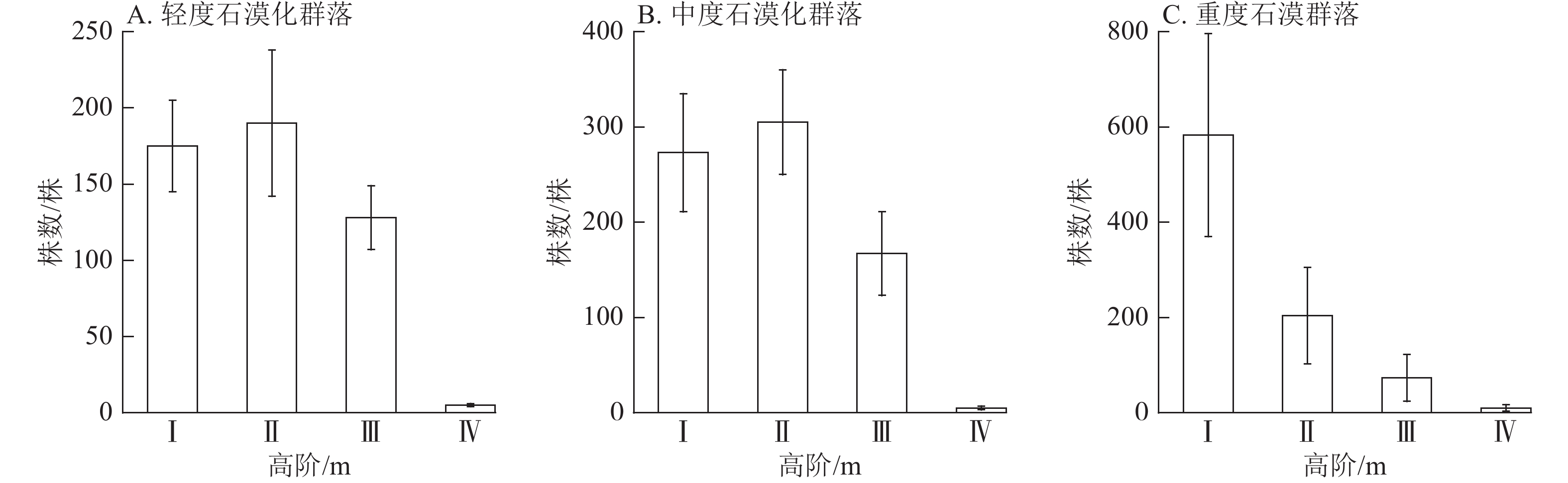
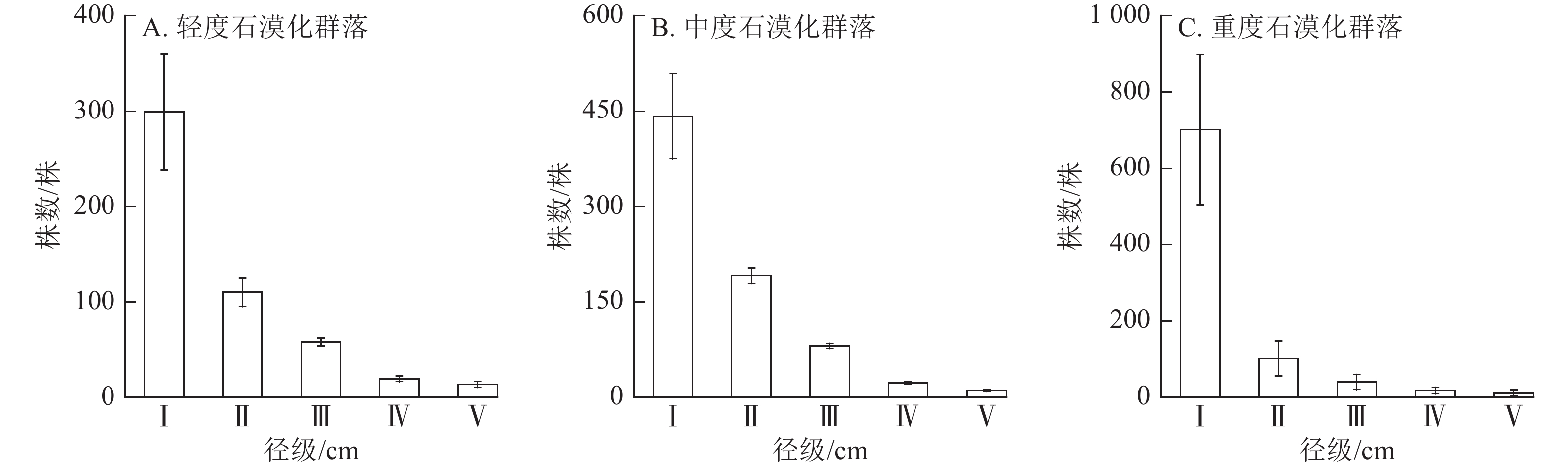
    • 树木的胸径和高度分布特征是表征群落结构的主要指标。轻度石漠化群落平均林分密度为(4 156±504) 株·hm−2,中度石漠化群落平均林分密度为(6 222±661) 株·hm−2,重度石漠化群落平均林分密度为(7 244±1 179) 株·hm−2。由图1可知:3种石漠化程度的森林群落树木胸径分布均呈现倒“J”型径级结构,但分布模式存在明显差异。轻度石漠化群落中,径级Ⅰ个体平均为(299±61) 株,占总株数的53.8%;径级Ⅱ为(110±15) 株,占19.8%;径级Ⅲ为(58±4) 株,占10.4%;径级Ⅳ和径级Ⅴ分别占10.1%和7.0%,径级分布相对均匀。中度石漠化群落小径级个体比例进一步增加,径级Ⅰ达(442±67) 株,占67.8%;径级Ⅱ为(191±12) 株,占 29.3%,大径级个体比例明显减少。重度石漠化群落表现出极端的径级分布特征,径级Ⅰ个体高达(701±197) 株,占总株数的77.4%;径级Ⅱ骤降至(101±46) 株,占11.2%;径级Ⅲ以上大径级树木稀少。由图2可知:石漠化程度对群落垂直结构产生明显影响。轻度石漠化群落垂直分布较为均衡,高阶Ⅰ为(175±30) 株,占31.4%;高阶Ⅱ为(190±48) 株,占34.1%;高阶Ⅲ为(128±21) 株,占23.0%;高阶Ⅳ虽然数量较少但仍有分布,形成相对完整的垂直层次结构。中度石漠化群落呈现向中下层集中的趋势,高阶Ⅰ为(273±62) 株,占42.0%;高阶Ⅱ为(305±55) 株,占46.9%,上层个体比例下降。重度石漠化群落垂直结构极度简化,呈现明显的倒“J”型分布,高阶Ⅰ个体高度集中,达(583±213) 株,占67.0%,高阶Ⅱ急剧减少至(204±191) 株,仅占23.4%,高阶Ⅲ、高阶Ⅳ个体稀缺。
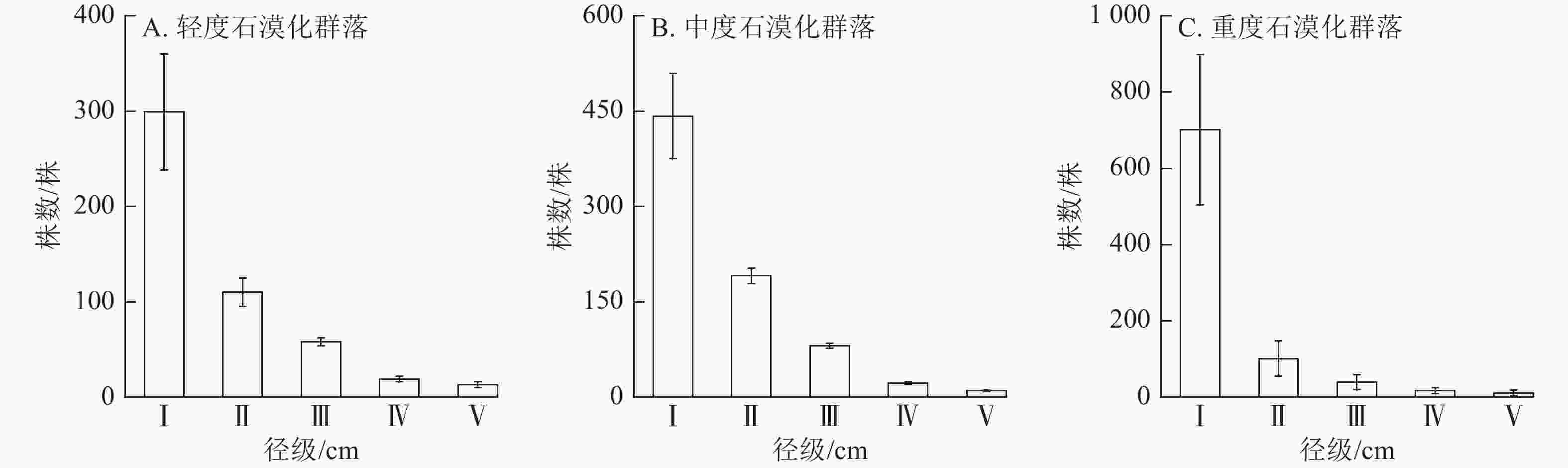
      Figure 1.  Distribution of plant number in different DBH classes in communities with different rocky desertification degrees
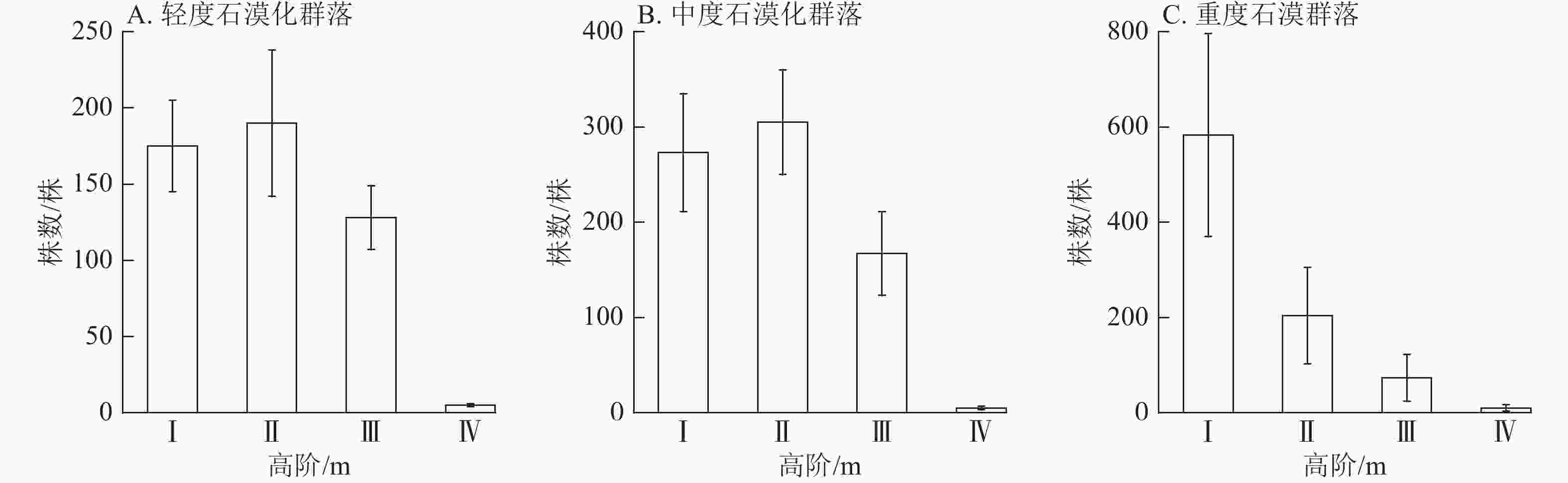
      Figure 2.  Distribution of plant number in high class of communities with different degrees of rocky desertification

      总体上看,轻度石漠化群落保持相对完整的径级和高度级结构,群落稳定性较好;中度石漠化群落结构开始简化,但仍维持基本的层次分异;重度石漠化群落结构高度简化,主要由幼树和低矮个体构成,群落处于受干扰后的恢复初期阶段。植株密度较大,在每个径级和高阶中都存在着特定的个体分布,树木的数量在径级和高阶的划分中呈现出连贯性,并未出现明显的断层情况。

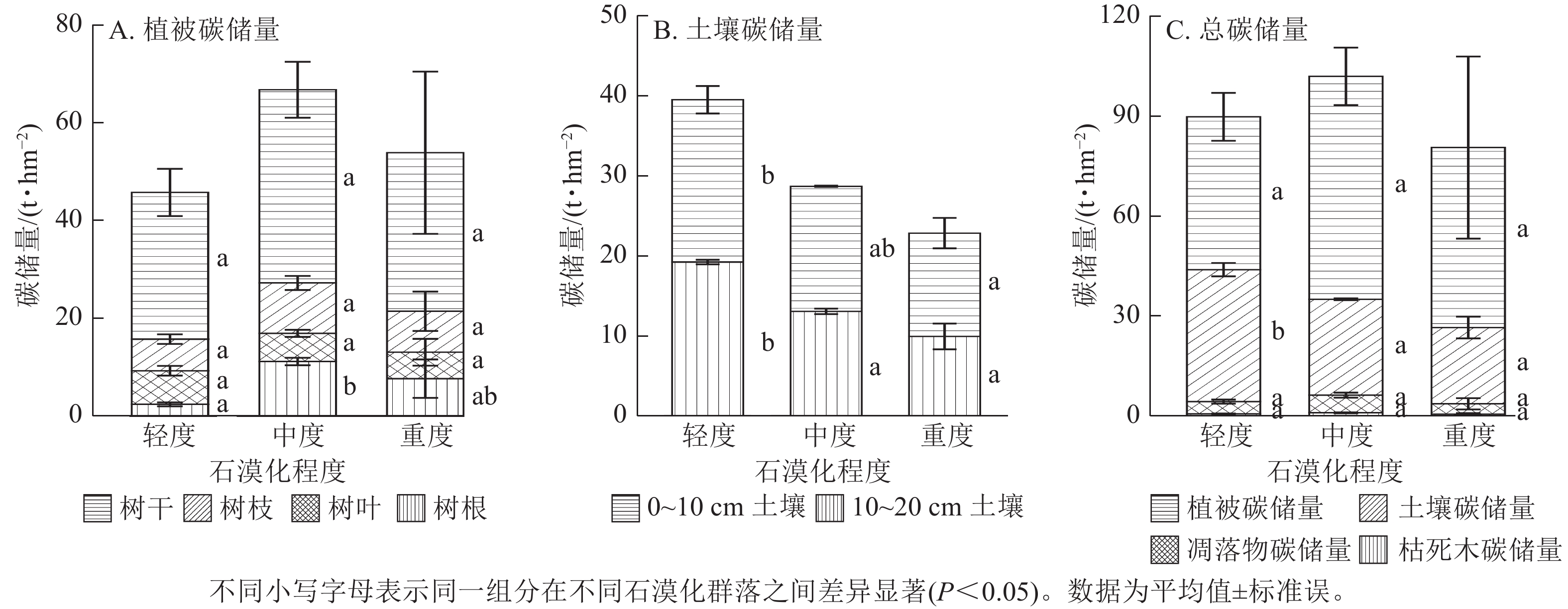
    • 从植被碳储量来看,3种石漠化程度森林群落均以树干为主要碳储量器官。从林木器官组分(图3A)来看,轻度和中度石漠化群落的树根存在显著差异(P<0.05)。不同的石漠化群落植被碳储量从大到小依次为中度石漠化群落[(66.7±8.6) t·hm−2]、重度石漠化群落[(53.9±27.3) t·hm−2]、轻度石漠化群落[(45.7±7.2) t·hm−2],3种群落类型植被碳储量之间差异不显著。从土壤碳储量(图3B)来看,不同程度石漠化群落类型土壤碳储量从大到小依次为轻度石漠化群落[(39.5±2.0) t·hm−2]、中度石漠化群落[(28.67±0.27) t·hm−2]、重度石漠化群落[(22.82±5.64) t·hm−2],3种群落类型0~10 cm土层土壤有机碳储量均大于10~20 cm土层,土壤碳储量轻度石漠化群落与中度石漠化群落、重度石漠化群落存在显著差异(P<0.05)。各群落类型总碳储量从大到小依次为中度石漠化群落(101.7 t·hm−2)、轻度石漠化群落(89.6 t·hm−2)、重度石漠化群落(80.4 t·hm−2),各群落类型之间差异不显著(图3C)。3种石漠化程度森林群落中植被碳储量远超其群落总碳储量的50%,次之为土壤碳储量、凋落物碳储量和枯死木碳储量。
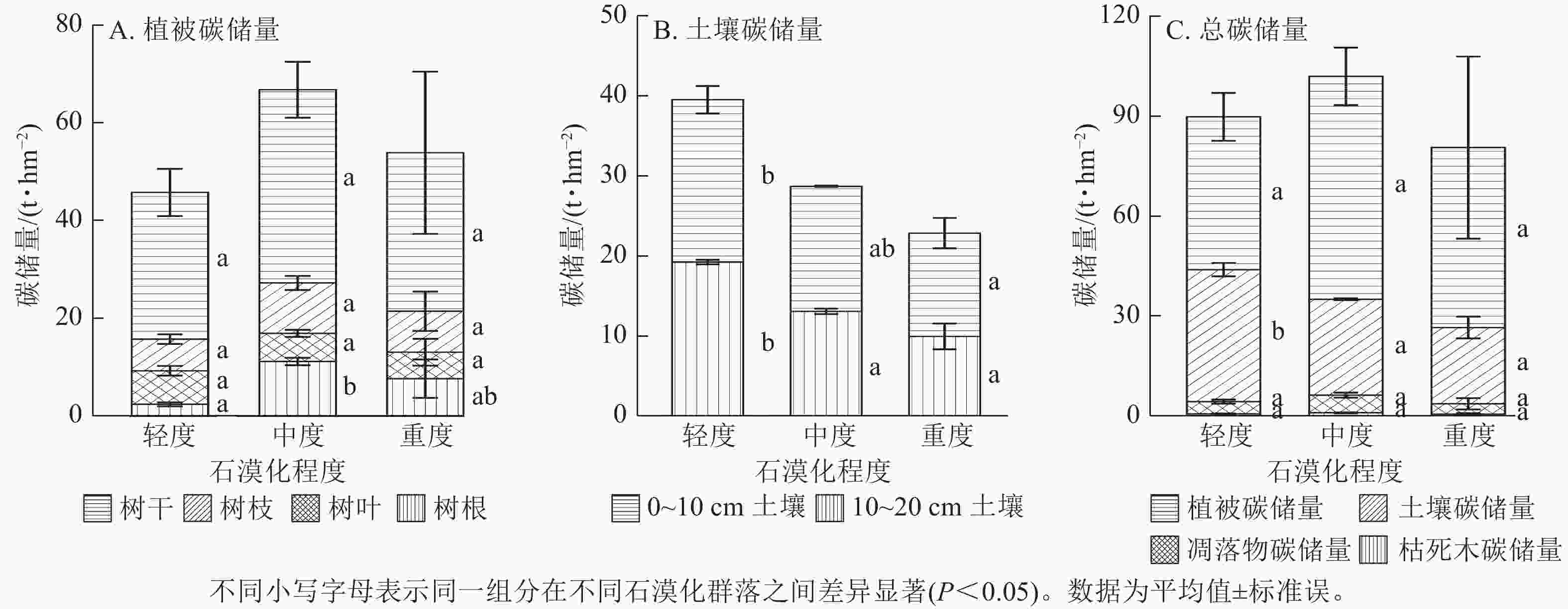
      Figure 3.  Characteristics of communities carbon storage with different rocky desertification degrees

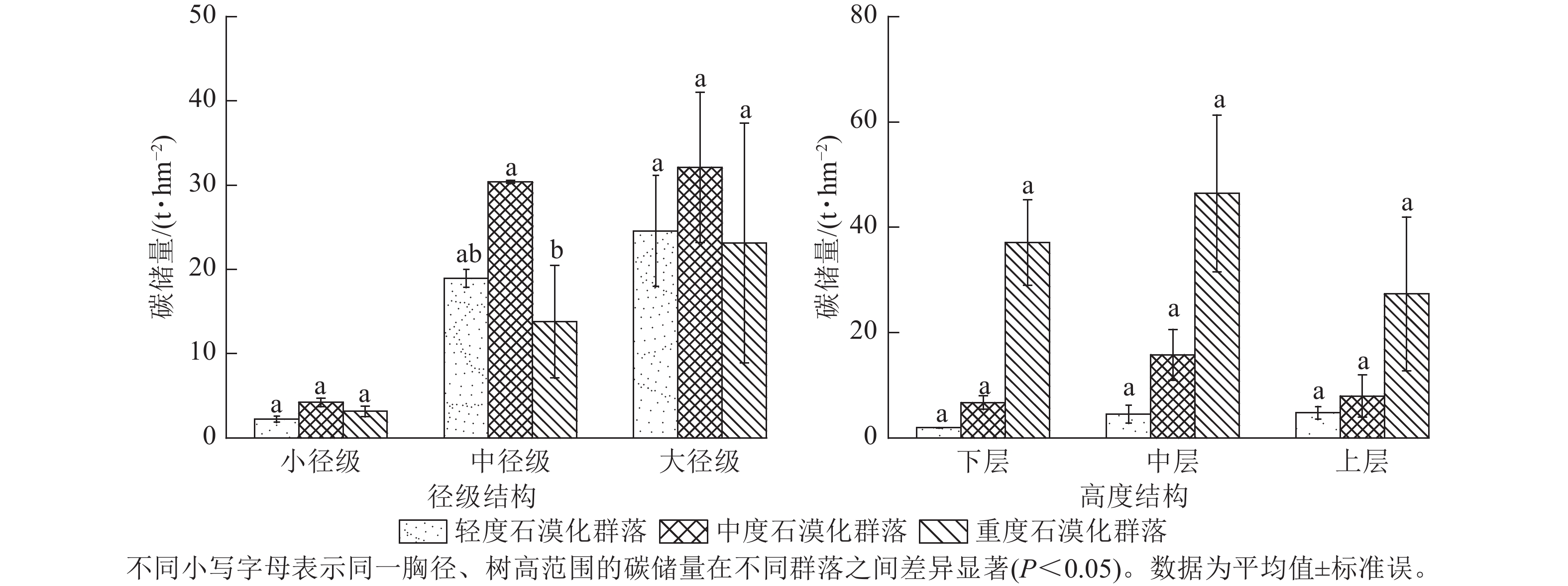
    • 图4表5所示:3种群落中,5 cm≤DBH<20 cm或树高≥10 m的林木碳储量最高,其中轻度石漠化群落的优势种秀丽锥和马尾松,中度石漠化群落的优势种秀丽锥、马尾松,重度石漠化群落的优势种麻栎和秀丽锥的胸径和树高符合上述区间。3种群落类型中 1 cm≤DBH<5 cm或树高<5 m的林木碳储量较低,中度和重度石漠化群落的中径级树种的碳储量存在显著差异(P<0.05)。其次,优势种在轻度石漠化群落、中度石漠化群落占据主导地位,分别占74%和68%,重度石漠化群落以非优势种占据主导地位,占54%。综合来看,3种群落类型中大径阶和上层的树种为其碳储量重要组成部分,优势种秀丽锥、马尾松和麻栎具有较强的碳汇功能。
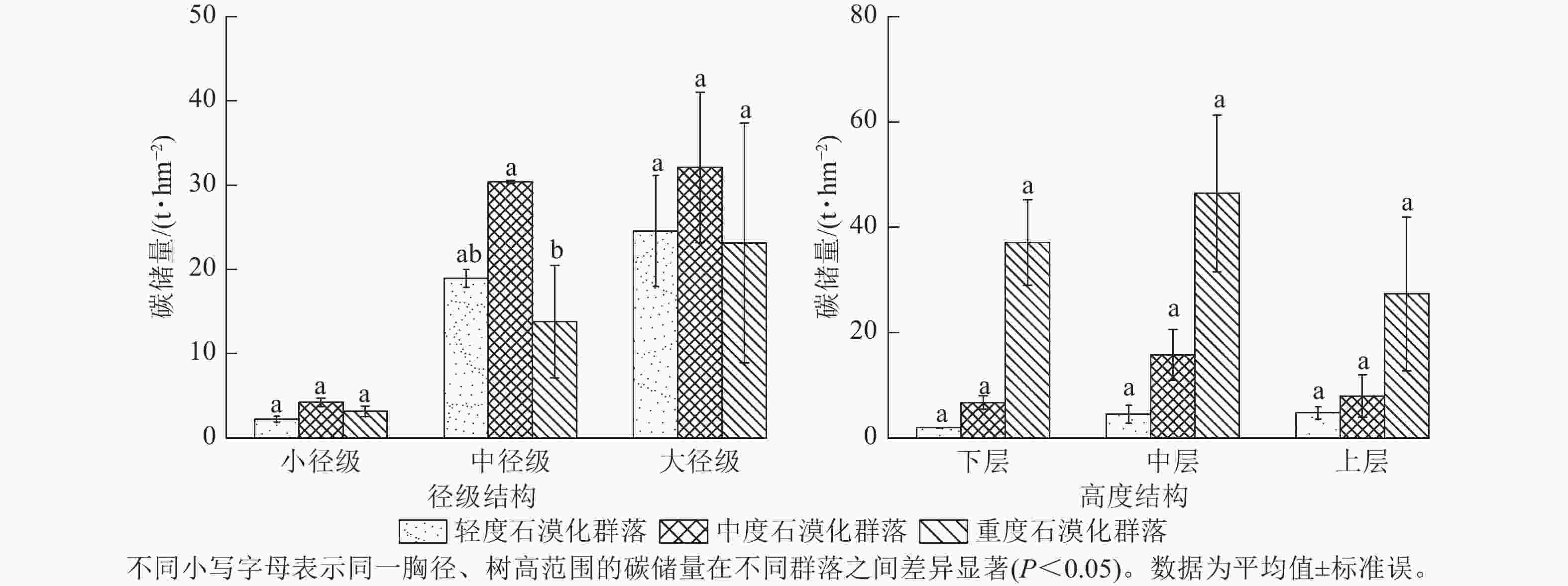
      Figure 4.  Distribution of carbon storage of tree species with different diameters and high-order tree species in each community type

      群落类型 树种 平均胸径/cm 平均高度/m 碳储量/(t·hm−2) 群落类型 树种 平均胸径/cm 平均高度/m 碳储量/(t·hm−2)
      轻度石漠化群落 秀丽锥 8.6±0.5 9.9±0.6 20.3±9.9 中度石漠化群落 桂花 1.5±0.8 2.1±1.1 0.4±0.3
      马尾松 14.8±3.0 11.6±1.2 9.3±4.4 青冈 4.2±0.0 5.2±0.0 4.3±0.0
      鸡仔木 3.7±0.2 6.6±0.2 1.3±0.5
      桂花 3.3±0.5 3.4±0.4 0.5±0.0 重度石漠化群落 牡荆 1.1±0.6 2.0±1.0 0.7±0.7
      麻栎 8.6±1.0 9.4±1.3 2.2±0.6 麻栎 10.6±6.9 8.5±4.6 15.1±13.6
      檵木 2.8±0.9 4.2±0.8 0.9±0.7
      中度石漠化群落 秀丽锥 7.2±0.6 8.6±0.0 24.6±13.8 桂花 2.9±1.4 3.5±1.9 2.8±2.7
      马尾松 15.5±1.8 12.7±0.6 15.3±8.2 秀丽锥 8.9±4.2 8.9±2.6 5.1±4.6
      山胡椒 5.2±0.5 7.4±0.4 3.6±2.8
        说明:数据为平均值±标准误。

      Table 5.  Carbon storage of top 5 tree species with important values of dominant species in different rocky desertification degrees

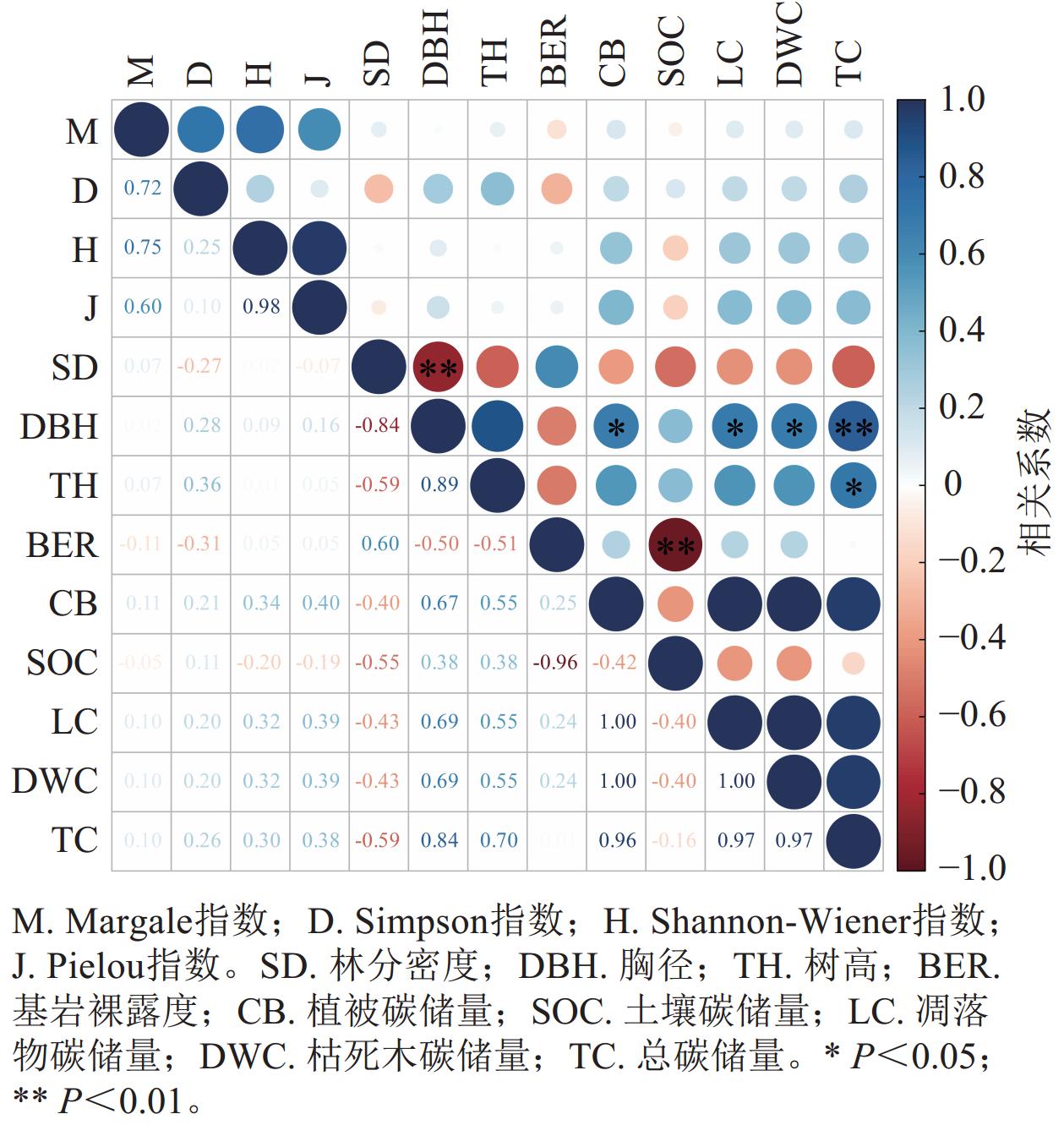
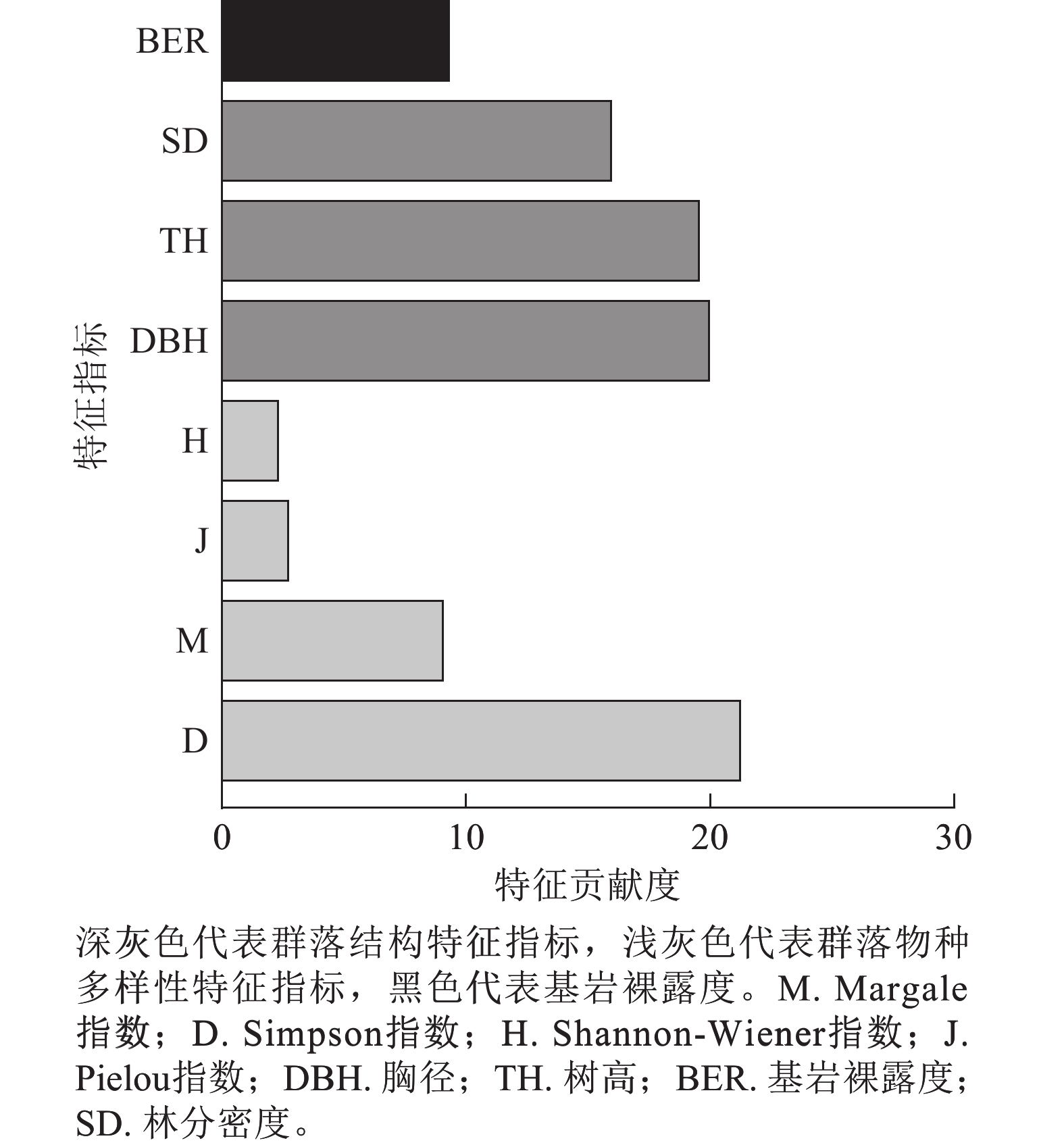
    • 相关性分析(图5)显示:群落结构特征中,胸径与植被碳储量呈显著正相关(P<0.05),与总碳储量呈极显著正相关(P<0.01),与凋落物碳储量和枯死木碳储量呈显著正相关(P<0.05);树高与总碳储量呈显著正相关(P<0.05)。群落物种多样性与碳储量均不存在显著相关,基岩裸露度与总碳储量无显著相关,与土壤碳储量呈极显著负相关(P<0.01);林分密度与群落物种多样性无显著相关,与胸径极显著负相关(P<0.01)。随机森林模型分析(图6)可知:物种优势度指数、胸径和树高是影响群落碳储量的重要因子,其特征贡献度分别为21.23%、19.95%和19.55%,群落结构特征总贡献度为55.43%,群落物种多样性特征总贡献度为35.28%。
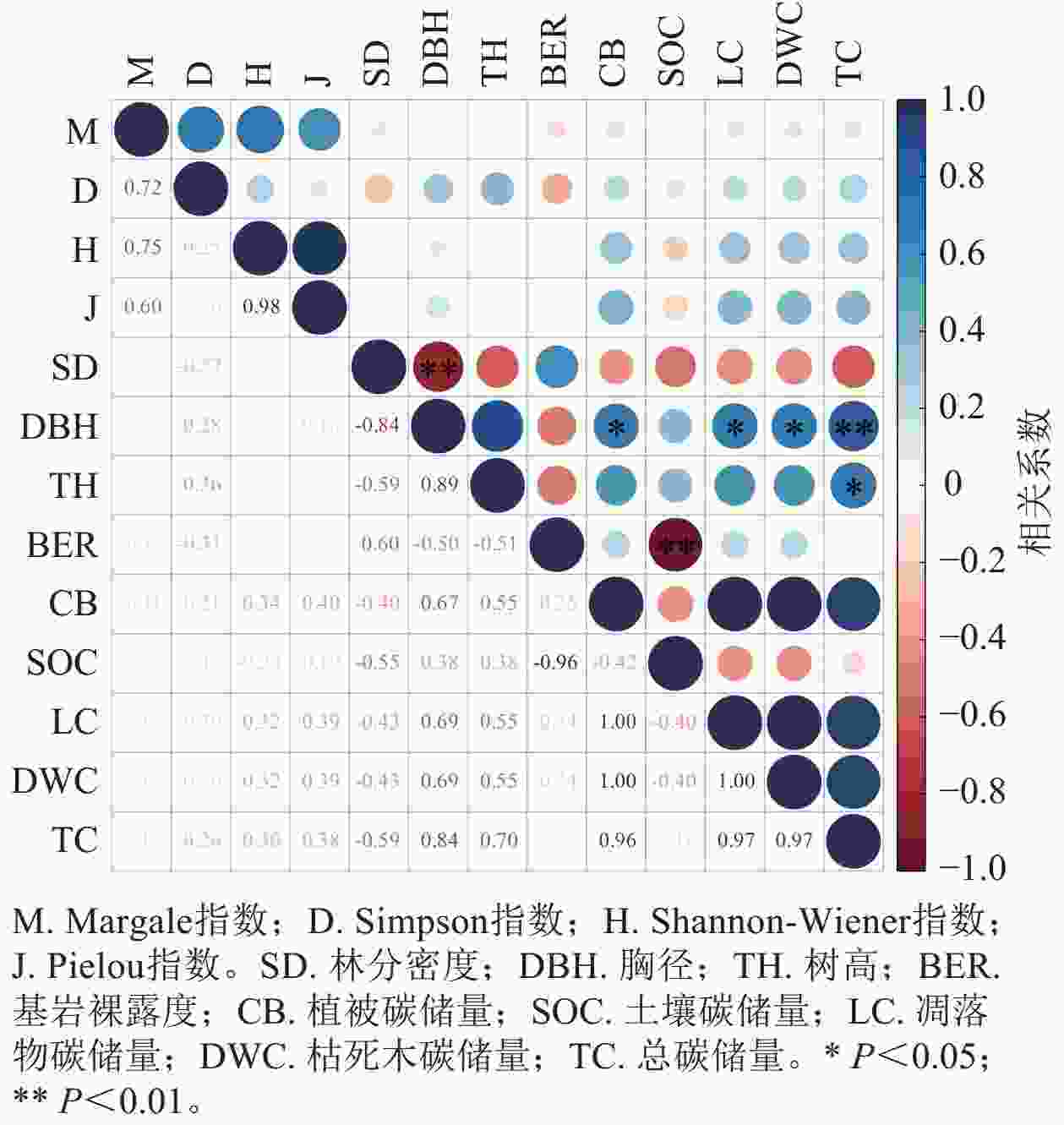
      Figure 5.  Thermodynamic map of correlation coefficient between community characteristics and carbon storage characteristics
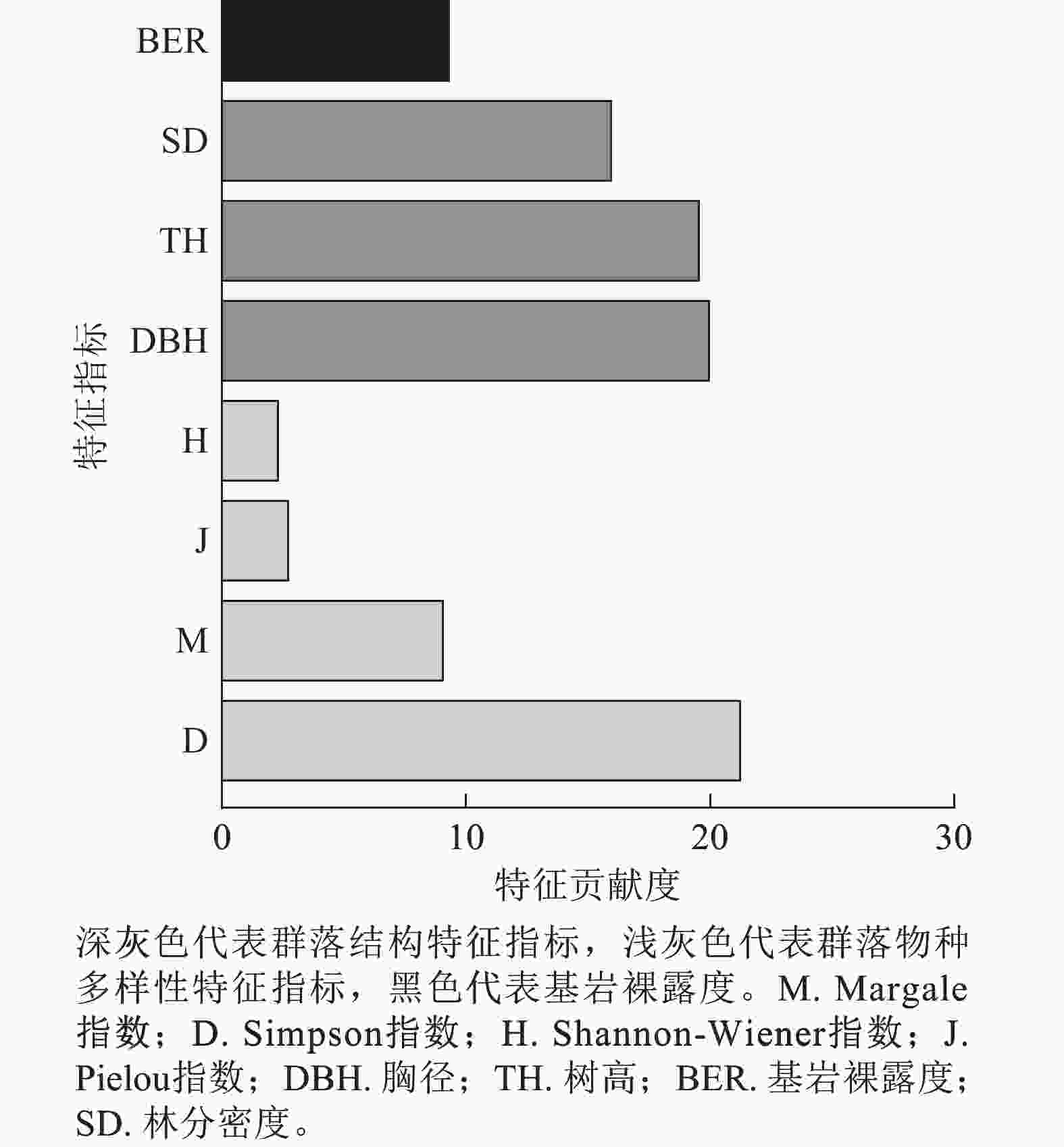
      Figure 6.  Relative importance of community characteristics indicators

    • 物种多样性和群落结构反映了生态系统的稳定性。本研究显示:粤北石漠化地区优势树种为秀丽锥、马尾松、麻栎等。重度石漠化群落植物种类相较最多,林分密度最大,植物种类数量和林木密度并未随石漠化程度的加剧而减少。前人在石漠化地区的相关研究也得出了不一致的结果[26]。这可能是岩石裸露度高,形成多种微生境为不同类型的植物提供了多样资源,生境的异质性为更多物种的共存创造了条件,也促进了物种的适应性进化[27]。本研究发现:物种数量的增加主要体现在稀有种数量的增加,轻度、中度和重度石漠化群落稀有种数量依次为23、35、36,这与“稀有种是维持生物多样性的重要机制之一”的观点一致[28]。但中度石漠化群落物种多样性表现最好,可能与中度石漠化区域受到生态和人为干扰的强度适中有关,结果符合中度干扰假说[29]。中度石漠化群落中多见的桂花、光叶海桐Pittosporum glabratum等树种,是人工促进更新物种。这说明在适度的人工促进更新可以促进林下更新,提升多样性,同时也能够增加森林的碳汇功能。对不同群落类型多样性进行比较发现:粤北石漠化地区物种多样性指数与其他亚热带常绿阔叶林相比均较低[30],且除Simpson指数外,其他物种多样性指数与石漠化等级演替没有明显相关性。产生这种现象的原因:一是石漠化地区自然条件恶劣,适生树种少,适生树种受到竞争压力小,表现出更强的优势地位;二是不同石漠化程度生境的差异,以及不同物种的耐受性、群落繁殖策略等生态习性的不同也可能导致不同石漠化程度下群落呈现不同的物种多样性特征[31];三是研究区为天然次生林,群落的生长受到树种、树龄和环境多种因素影响,导致植物多样性指数的变化。植物多样性与石漠化群落演替之间的规律还与其他生态因子有关。在今后的研究中需综合考虑各种生态因子影响,更加全面解释石漠化地区植物多样性与群落类型之间的关系。

      胸径和树高结构是预测群落结构发展趋势的2个指标[32]。本研究显示:随着石漠化程度加剧,群落结构呈现幼龄化和低矮化趋势,小径级、低高度级个体比例显著增加,大径级、高层个体比例相应减少,径级分布基本形成倒“J”型,这种结构特征反映了恶劣立地条件对树木生长发育的限制作用,说明粤北石漠化地区群落结构龄级为增长型,同时也表明群落具备一定的更新潜力。复杂的垂直群落造成群落郁闭度增加,改变了光照、温度、水分分布,下层环境变得较为阴暗、凉爽和湿润。这种微环境的变化为林下中性或阴性树种的生长提供了良好的生境,增加了群落中间层植物的种类,使中间层植物数量达到最多。因此,应根据具体的立地环境和实际需求,合理调控粤北石漠化地区的林分结构,逐渐形成复层林。

    • 森林生态系统的碳储量主要由植被碳库和土壤碳库组成。本研究中轻度石漠化群落土壤碳储量远高于中度和重度石漠化群落土壤碳储量,这与张穗粒等[33] 对西南喀斯特地区土壤有机碳的研究结果一致。通常,相较于中度和重度石漠化地区,轻度石漠化地区水土流失量小,土壤通气性和保水保肥性好,植物的生存环境较好,更有利于有机质的分解和转化。灌草类植物定居及产生的凋落物,经微生物分解产生新的有机物质进入土壤,增加了表层土壤碳。本研究中, 0~10 cm土层土壤有机碳储量较高,这与其他森林类型的研究结果基本一致[34]。本研究中森林群落中大径级、中层和上层的树种碳储量处于优势地位,植被碳储量不随石漠化程度的增加而减少,呈现中度石漠化群落碳储量高于轻度和重度石漠化群落,这与前人研究结果不一致[35]。轻度石漠化群落离居民点较近,人为干扰严重,重度石漠化森林样地林木生境条件最差,因此中度石漠化群落中位于中径级、大径级和中、上层的树种碳储量远高于其他2种森林群落。森林群落碳储量更多由群落的大径级树种数量和高碳储量物种决定,大径级优势种在碳汇功能的维持中具有重要作用[36],且林分结构处于碳储量优势范围内,树种皆为粤北石漠化地区高效碳汇乡土树种[37],这与本研究结果相符。由此可见,修复粤北石漠化地区植被、发展碳汇林产业、促进植物群落正向演替应该筛选适生高效的碳汇乡土树种进行栽植,重点关注群落中现有的中、大径级和中、上层树种进行管护。

    • 植物群落物种多样性、结构特征和林分密度,都可对地上碳储量产生直接或间接影响。本研究发现:物种多样性与群落碳储量呈现弱正相关,这一点和OUYANG等[38]在中国南方的研究结果一致,但与其他学者研究不一致[39]。产生研究结果差异的主要原因:首先,研究区域群落处于生长演替发展阶段,植被碳主要存在于乔木层,大树可能会通过非对称性竞争抑制所在样方的物种多样性。群落演替过程中,碳储量占优势地位的树种通过竞争逐渐淘汰掉其他树种,使得物种多样性与碳储量相关性较弱[21];其次,碳储量和群落结构特征呈现显著正相关,主要体现在树高和胸径上,且群落中占据高位或优势径级地位的树种更容易获取水分、阳光等,有利于碳储量的积累。第三,本研究中胸径作为植被层、凋落物和枯死木碳储量的计算参数,对植被碳储量结果也有影响。林分密度从资源竞争角度调节碳储量,其影响可能大于胸径和树高。本研究结果显示:林分密度与胸径呈现极显著负相关,与碳储量无显著相关性,说明粤北石漠化地区森林群落的林分密度可能是通过胸径间接作用于群落碳储量。林分密度越大树木间的资源竞争加剧,个体生长受限,胸径显著减小。虽然林分密度的增加会提升单位面积的林木株数,但密度适中的中度石漠化群落优势种胸径较大,林分空间结构更合理,碳储量最高。胸径可能就是影响碳储量的主要因素。考虑到基岩裸露度是影响石漠化地区森林碳汇的最主要因素,因此本研究将基岩裸露度也作为分析因子之一。本研究显示:基岩裸露度只与土壤碳储量呈极显著负相关,与植被碳储量无相关,表明石漠化程度越高的森林群落碳储量不一定低,但土壤碳储量会更低,说明石漠化地区森林群落碳储量可能更多由群落结构特征决定,基岩裸露度则更多是土壤碳储量高低的主要影响因素。物种优势度虽然不如树高、胸径与碳储量的相关性显著,但是重要性高。方国景等[40]指出:物种优势度对群落生物量的贡献主要是通过树高、胸径和环境因素的共同效应发挥作用。高优势度物种往往是群落中的优势种,具有较高的树高和胸径,能更有效利用资源,占据更高生态位,对生态系统的维护和生物多样性具有重要意义。对于一些特殊地区或特殊类型的森林生态系统而言,物种多样性、结构特征和碳储量之间可能会呈现不同的关系。今后可以在更多地区对不同生态系统类型开展相关研究,以期获得更全面、更具有代表性的数据。

    • 本研究发现:粤北石漠化地区物种多样性指数偏低,以中度石漠化群落物种多样性最高,建群种马尾松、秀丽锥等作为粤北石漠化地区高效碳汇林营造树种,群落植物多样性对碳储量影响较小,群落结构对碳储量具有主导作用,基岩裸露度是土壤碳储量高低的主要因素。因此,在粤北地区石漠化治理中,建议以天然林群落的优势种为首选树种,在经营过程中重视林分结构调整,加强中大径级树种的管护,同时改善石漠化立地条件,提升粤北石漠化生态系统恢复能力和碳汇能力。轻度石漠化群落可以通过封山育林或适当地进行人工促进恢复,优先保护秀丽锥、马尾松等优势种的中小径阶个体,促进林下幼树自然更新,补植高效固碳乡土树种;中度石漠化区选择性保留胸径≥15 cm的秀丽锥、马尾松个体,促进上层发育,补植中层伴生树种,增强垂直分层异质性;重度石漠化区加强小生境的管理,以耐旱、耐贫瘠的岩生植物为优选种,先固定薄层土壤,再引入演替中后期树种。

Reference (40)

Catalog

    /

    DownLoad:  Full-Size Img  PowerPoint
    Return
    Return