Volume 42 Issue 6
Nov.  2025
Turn off MathJax
Article Contents

XIE Juan, HOU Ting, WANG Longfei, et al. Decomposition characteristics of Carya illinoensis green husk and its effect on soil properties[J]. Journal of Zhejiang A&F University, 2025, 42(6): 1210−1220 doi:  10.11833/j.issn.2095-0756.20250108
Citation: XIE Juan, HOU Ting, WANG Longfei, et al. Decomposition characteristics of Carya illinoensis green husk and its effect on soil properties[J]. Journal of Zhejiang A&F University, 2025, 42(6): 1210−1220 doi:  10.11833/j.issn.2095-0756.20250108

Decomposition characteristics of Carya illinoensis green husk and its effect on soil properties

DOI: 10.11833/j.issn.2095-0756.20250108
  • Received Date: 2025-01-06
  • Accepted Date: 2025-04-10
  • Rev Recd Date: 2025-03-27
  • Available Online: 2025-11-26
  • Publish Date: 2025-12-20
  •   Objective  The objective is to study the decomposition, nutrient release of Carya illinoensis green husk at different returning depths, and its effects on soil metabolites, so as to provide scientific reference for its full and rational utilization.  Method  A flat test plot was selected in Chunhui Mountain, Central South University of Forestry and Technology. The green husk of C. illinoensis ‘Jinhua’ was used as the test material. 3 treatments were set up: control (no return of green husk to the field), ground cover and buried depth (10 cm). The decomposition characteristics of green husk at different returning depths were studied for 2 years by nylon net bag method. The quality and nutrient quality of the remaining green husk in the decomposition bag, as well as physical and chemical properties of soil and metabolites were measured and analyzed every 3 months.  Result  (1) During the 2-year decomposition period, the decomposition rate of green husk from C. illinoensis under buried depth treatment was faster than that under ground cover. Under both treatments, the total organic carbon and phosphorus exhibited an enrichment and leaching pattern. Nitrogen showed an enrichment mode, while potassium showed a net release mode. (2) During the 2-year decomposition period, soil total nitrogen content under control treatment was higher than that under ground cover and buried depth treatments. The content of alkali-hydrolyzable nitrogen and available potassium in soil under buried depth treatment was higher than that under ground cover. The number of bacteria in soil under ground cover was greater than that under buried depth treatment, while the number of fungi and actinomycetes in soil under ground cover was lower than that under buried depth treatment. (3) The differences in soil metabolites between ground cover and buried depth treatments during the same period were small, while there were significant differences at different decomposition stages. When soil samples from the 12th month of green husk decomposition were compared with those from the 9th month, and soil samples from the 18th month were compared with those from the 12th month, 54 differential metabolites were identified in both comparisons, mainly concentrated in 22 metabolic pathways, including pyrimidine metabolism, ubiquinone and other terpenoid-quinone biosynthesis, steroid hormone biosynthesis, and ABC transporters.  Conclusion  In the 9th month of decomposition, the nutrient loss of C. illinoensis green husk is less, the number of soil microorganisms is the highest, and the soil metabolic substances conducive to plant growth are produced. It is the best period to have a positive impact on soil fertility. [Ch, 8 fig. 3 tab. 28 ref.]
  • [1] ZHOU Jielu, WU Tianhao, JU Yunwei, YANG Xutao, LIANG Tian, ZHU Haijun.  Biological characteristics and toxicity test of the pathogen of Carya illinoinensis leaf spot . Journal of Zhejiang A&F University, 2023, 40(5): 1018-1025. doi: 10.11833/j.issn.2095-0756.20230029
    [2] PAN Langbo, DUAN Wei, HUANG Youjun.  Prediction on the potential planting area of Carya illinoinensis in China based on MaxEnt model . Journal of Zhejiang A&F University, 2022, 39(1): 76-83. doi: 10.11833/j.issn.2095-0756.20210106
    [3] HUANG Yuancheng, GUO Wenlei, WANG Zhengjia.  Genome-wide identification and bioinformatics analysis of LBD family of transcription factors in Carya illinoensis . Journal of Zhejiang A&F University, 2021, 38(3): 464-475. doi: 10.11833/j.issn.2095-0756.20200454
    [4] LAN Ziyu, DING Sihui, FANG Shengzuo.  Impacts of poplar harvesting residue additions on soil nutrients and CO2 emission . Journal of Zhejiang A&F University, 2021, 38(5): 1012-1022. doi: 10.11833/j.issn.2095-0756.20210186
    [5] LUO Manli, DUAN Junhua, YAO Heng, LU Changtai, XIAO Jiujin, ZHANG Jian.  Effects of different rice straw returning quantities on soil fauna community structure . Journal of Zhejiang A&F University, 2020, 37(1): 85-92. doi: 10.11833/j.issn.2095-0756.2020.01.011
    [6] SHANG Yangjuan, TAN Pengpeng, FAN Pinghua, KONG Deyi, PENG Fangren, LI Yongrong.  Evaluation of foliar spraying of zinc in Carya illinoensis . Journal of Zhejiang A&F University, 2020, 37(6): 1071-1079. doi: 10.11833/j.issn.2095-0756.20190687
    [7] YAN Zepu, ZHANG Jiaqi, LIANG Bi, WEI Guangli, ZHANG Qixiang, WANG Zhengjia.  Effects of exogenous gibberellin on growth of Carya illinoensis and its metabolic gene expression . Journal of Zhejiang A&F University, 2020, 37(5): 922-929. doi: 10.11833/j.issn.2095-0756.20190566
    [8] CHEN Meng, LIU Jiming, CHEN Jingzhong, LI Jia, HUANG Luting.  Effects of nitrogen addition on decomposition and nutrient release of Cinnamomum migao litter leaves . Journal of Zhejiang A&F University, 2020, 37(6): 1080-1087. doi: 10.11833/j.issn.2095-0756.20200106
    [9] JIANG Dongyue, LI Yonghong, SHEN Xin.  Components and variations of volatile organic compounds released from leaves and flowers of Ruta graveolens . Journal of Zhejiang A&F University, 2018, 35(3): 572-580. doi: 10.11833/j.issn.2095-0756.2018.03.025
    [10] YANG Biao, LIU Zhuangzhuang, PENG Fangren, CAO Fan, CHEN Tao, DENG Qiuju, CHEN Wenjing.  Growth and photosynthetic characteristics for pecan cultivars during drought stress and recovery . Journal of Zhejiang A&F University, 2017, 34(6): 991-998. doi: 10.11833/j.issn.2095-0756.2017.06.004
    [11] GU Jianqiang, CHEN Donghui, XU Kuiyuan, CHEN Youwu, WU Jiawei, ZHOU Jin, XU Zhihong.  Insect species diversity, functional diversity, and their mutual relationship in a pecan stand . Journal of Zhejiang A&F University, 2015, 32(1): 116-122. doi: 10.11833/j.issn.2095-0756.2015.01.017
    [12] YANG Xianyu, HUANG Jianqin, XU Kuiyuan, XIA Guohua, YUAN Ziqian, LING Hua, WANG Zhengjia.  Flowering characteristics and pollen viability of Carya illinoensis 'Mahan' . Journal of Zhejiang A&F University, 2014, 31(4): 528-533. doi: 10.11833/j.issn.2095-0756.2014.04.006
    [13] LIU Fang, XU Gaiping, WU Xingbo, DING Qianqian, ZHENG Jie, ZHANG Rumin, GAO Yan.  Effect of drought stress and re-watering on emissions of volatile organic compounds from Rosmarinus officinalis . Journal of Zhejiang A&F University, 2014, 31(2): 264-271. doi: 10.11833/j.issn.2095-0756.2014.02.015
    [14] YU Chunlian, WANG Zhengjia, XIA Guohua, HUANG Jianqin, LIU Li.  Fat content and fatty acid composition of ten Carya illinoensis cultivars . Journal of Zhejiang A&F University, 2013, 30(5): 714-718. doi: 10.11833/j.issn.2095-0756.2013.05.012
    [15] CHEN Lisha, ZHANG Jinchi, ZHUANG Jiayao, SI Dengyu.  Inter-ite incubation with leaf decomposition for three forest types . Journal of Zhejiang A&F University, 2013, 30(5): 681-688. doi: 10.11833/j.issn.2095-0756.2013.05.008
    [16] TONG Gen-ping, WANG Wei-guo, ZHANG Yuan-yuan, XU Wen-xin, DOU Chun-ying, SHENG Wei-xing, YU Qing-ping, YE Zheng-qian.  Seasonal changes of soil and leaf nutrient levels in a Carya cathayensis orchard . Journal of Zhejiang A&F University, 2009, 26(4): 516-521.
    [17] ZHENG Zhao-fei.  Decomposition and nutrient dynamics of Schima superba leaf litter . Journal of Zhejiang A&F University, 2009, 26(1): 22-26.
    [18] XIE Hong-en, HUANG You-jun, XUE Xia-ming, XU Chang-shou, LIU Li.  Growth and development of the Carya cathayensis nut . Journal of Zhejiang A&F University, 2008, 25(4): 527-531.
    [19] WANG Min-ying, LIU Qiang, DING Ya-feng, FU Su-zhen, YE Zhao-li, FENG Tai-sheng.  Nutrients and litter decomposition in Vatica mangachapoi forest versus Casuarina equisetifolia plantation . Journal of Zhejiang A&F University, 2008, 25(5): 597-603.
    [20] CHEN Jin-lin, WU Chun-lin, JIANG Zhi-lin, XU Xin-jian.  Litter decomposition and phosphorus release in an oak forest ecosystem . Journal of Zhejiang A&F University, 2002, 19(4): 367-371.
  • [1]
    HUANG Danqing. Study on Adsorption Performance of Pecan Fruit Peel Waste to Simulated Uranium[D]. Hefei: Anhui Agricultural University, 2020.
    [2]
    ZHANG Xiaokai, HE Lizhi, LU Kouping, et al. Use of biochar for remediation of soils contaminated with heavy metals and organic pollutants: a review [J]. Soils, 2013, 45(6): 970−977.
    [3]
    SHCHEMELININA T N, ANCHUGOVA E M. The integrated biotechnology for oil-polluted soil cleanup [J]. Biology Bulletin, 2023, 50(10): 2791−2796.
    [4]
    LI Jingsong, LI Jing, FENG Xiaohui, et al. Straw incorporation: a more effective coastal saline land reclamation approach to boost sunflower yield than straw mulching or burial[J/OL]. Agricultural Water Management, 2024, 305: 109140[2024-12-06]. DOI: 10.1016/j.agwat.2024.109140.
    [5]
    WEN Meijuan, YANG Sicun, WANG Chengbao, et al. Effects of different tillage and straw returning on soil physicochemical properties, enzyme activities in sierozem, and maize yield [J]. Chinese Journal of Ecology, 2025, 44(3): 903−911.
    [6]
    XUE Xinxin, WU Xiaoping, WANG Wenbin, et al. Effects of varying slopes and depths on decomposition and infrared spectrum characteristics of leaf litter in a rubber forest [J]. Acta Ecologica Sinica, 2019, 39(3): 874−883.
    [7]
    WANG Ling, LONG Feiyu, LIU Jiabin, et al. Effects of organic planting on metabolites in maize rhizosphere soil [J]. Journal of Northeast Agricultural University, 2022, 53(3): 30−41.
    [8]
    WU Guoliang, ZHANG Linyun, PAN Qiuhong, et al. Advances in study of pecan and its cultivars’characteristics [J]. Journal of Fruit Science, 2003, 20(5): 404−409.
    [9]
    PAN Langbo, DUAN Wei, HUANG Youjun. Prediction on the potential planting area of Carya illinoinensis in China based on MaxEnt model [J]. Journal of Zhejiang A&F University, 2022, 39(1): 76−83.
    [10]
    LIANG Qiong. Study on Preparation of Walnuts Shell Activated Carbon and its Properties[D]. Hangzhou: Zhejiang A&F University, 2015.
    [11]
    HU Wenyi, DU Wenxian, BAI Shumin, et al. Phenoloxidase, an effective bioactivity target for botanical insecticide screening from green walnut husks [J]. Natural Product Research, 2018, 32(23): 2848−2851.
    [12]
    FENG Simin, WANG Lei, BELWAL T, et al. Phytosterols extraction from hickory (Carya cathayensis Sarg. ) husk with a green direct citric acid hydrolysis extraction method[J/OL]. Food Chemistry, 2020, 315: 126217[2024-12-06]. DOI: 10.1016/j.foodchem.2020.126217.
    [13]
    ZHOU Wenjun. Fruit Growth and Development Regularity and Comprehensive Evaluation of Four Carya illinoensis Varieties in Hunan Province[D]. Changsha: Central South University of Forestry and Technology, 2022.
    [14]
    BAO Shidan. Soil Agrochemical Analysis[M]. 3rd ed. Beijing: China Agriculture Press, 2000: 25−114.
    [15]
    ZHENG Hongyuan, XU Xinghui. Handbook of Soil Microbial Analysis Methods[M]. Beijing: Agricultural Publishing House, 1986: 55−93.
    [16]
    HOU Ting, YUAN Jun, ZHOU Wenjun, et al. Decomposition and nutrient releasing pattern in Carya illinoensis husks [J]. Acta Agriculturae Universitatis Jiangxiensis, 2022, 44(5): 1188−1196.
    [17]
    GARCIA-PAUSAS J, CASALS P, ROMANYA J. Litter decomposition and faunal activity in Mediterranean forest soils: effects of N content and the moss layer [J]. Soil Biology and Biochemistry, 2004, 36(6): 989−997.
    [18]
    QU Xinjing, ZHAO Guanyu, GENG Rui, et al. Decomposition and nutrient releasing pattern in Camellia oleifera seed meal [J]. Non-wood Forest Research, 2019, 37(4): 104−111.
    [19]
    LIU Yulin. Effects of Litter Decomposition on Soil Organic Carbon in Vegetation Restoration of Ziwuling[D]. Yangling: Northwest A&F University, 2020.
    [20]
    JIANG Xiaojin, LIU Wenjie, WU Jinen, et al. Land degradation controlled and mitigated by rubber based agroforestry systems through optimizing soil physical conditions and water supply mechanisms: a case study in Xishuangbanna, China [J]. Land Degradation & Development, 2017, 28(7): 2277−2289.
    [21]
    LUO Jia. Decomposition Rate of the Litter of Artifical Forest of Liquidambar Formosana and Its Effects of Soil Nutrient[D]. Changsha: Central South University of Forestry and Technology, 2009.
    [22]
    WANG Qiuya. Effects of Different Reclamation Patterns on Soil Fertility and Microbial Community Structure[D]. Huainan: Anhui University of Science and Technology, 2022.
    [23]
    TAN Jiehui, FU Shuangjun, NAN Lili, et al. Effects of green manure crop rotation on soil microbial quantity and enzyme activity in semi-arid region of the Loess Plateau [J]. Grassland and Turf, 2020, 40(5): 116−123.
    [24]
    LI Yingzhe, XU Lining, LETUMA P, et al. Metabolite profiling of rhizosphere soil of different allelopathic potential rice accessions[J/OL]. BMC Plant Biology, 2020, 20(1): 265[2024-12-06]. DOI: 10.1186/s12870-020-02465-6.
    [25]
    PATCHETT A, NEWMAN J A. Comparison of plant metabolites in root exudates of Lolium perenne infected with different strains of the fungal endophyte Epichloë festucae var. lolii [J]. Journal of Fungi, 2021, 7(2): 148−148.
    [26]
    LIU Miaomiao, LU Shanva. Plastoquinone and ubiquinone in plants: biosynthesis, physiological function and metabolic engineering[J/OL]. Frontiers in Plant Science, 2016, 7: 1898[2024-12-06]. DOI: 10.3389/fpls.2016.01898.
    [27]
    CHENG Hongyan. Response of Soil Microbial Communities and Metabolites to Phosphorus Fertilizer Management in Dryland Farmland[D]. Yangling: Northwest A&F University, 2022.
    [28]
    ZHU Lingyue, WANG Jiachen, WENG Yilin, et al. Soil characteristics of Eucalyptus urophylla×Eucalyptus grandis plantations under different management measures for harvest residues with soil depth gradient across time[J/OL]. Ecological Indicators, 2020, 117(5): 106530[2024-12-06]. DOI: 10.1016/j.ecolind.2020.106530.
  • 加载中
通讯作者: 陈斌, bchen63@163.com
  • 1. 

    沈阳化工大学材料科学与工程学院 沈阳 110142

  1. 本站搜索
  2. 百度学术搜索
  3. 万方数据库搜索
  4. CNKI搜索

Figures(8)  / Tables(3)

Article views(435) PDF downloads(33) Cited by()

Related
Proportional views

Decomposition characteristics of Carya illinoensis green husk and its effect on soil properties

doi: 10.11833/j.issn.2095-0756.20250108

Abstract:   Objective  The objective is to study the decomposition, nutrient release of Carya illinoensis green husk at different returning depths, and its effects on soil metabolites, so as to provide scientific reference for its full and rational utilization.  Method  A flat test plot was selected in Chunhui Mountain, Central South University of Forestry and Technology. The green husk of C. illinoensis ‘Jinhua’ was used as the test material. 3 treatments were set up: control (no return of green husk to the field), ground cover and buried depth (10 cm). The decomposition characteristics of green husk at different returning depths were studied for 2 years by nylon net bag method. The quality and nutrient quality of the remaining green husk in the decomposition bag, as well as physical and chemical properties of soil and metabolites were measured and analyzed every 3 months.  Result  (1) During the 2-year decomposition period, the decomposition rate of green husk from C. illinoensis under buried depth treatment was faster than that under ground cover. Under both treatments, the total organic carbon and phosphorus exhibited an enrichment and leaching pattern. Nitrogen showed an enrichment mode, while potassium showed a net release mode. (2) During the 2-year decomposition period, soil total nitrogen content under control treatment was higher than that under ground cover and buried depth treatments. The content of alkali-hydrolyzable nitrogen and available potassium in soil under buried depth treatment was higher than that under ground cover. The number of bacteria in soil under ground cover was greater than that under buried depth treatment, while the number of fungi and actinomycetes in soil under ground cover was lower than that under buried depth treatment. (3) The differences in soil metabolites between ground cover and buried depth treatments during the same period were small, while there were significant differences at different decomposition stages. When soil samples from the 12th month of green husk decomposition were compared with those from the 9th month, and soil samples from the 18th month were compared with those from the 12th month, 54 differential metabolites were identified in both comparisons, mainly concentrated in 22 metabolic pathways, including pyrimidine metabolism, ubiquinone and other terpenoid-quinone biosynthesis, steroid hormone biosynthesis, and ABC transporters.  Conclusion  In the 9th month of decomposition, the nutrient loss of C. illinoensis green husk is less, the number of soil microorganisms is the highest, and the soil metabolic substances conducive to plant growth are produced. It is the best period to have a positive impact on soil fertility. [Ch, 8 fig. 3 tab. 28 ref.]

XIE Juan, HOU Ting, WANG Longfei, et al. Decomposition characteristics of Carya illinoensis green husk and its effect on soil properties[J]. Journal of Zhejiang A&F University, 2025, 42(6): 1210−1220 doi:  10.11833/j.issn.2095-0756.20250108
Citation: XIE Juan, HOU Ting, WANG Longfei, et al. Decomposition characteristics of Carya illinoensis green husk and its effect on soil properties[J]. Journal of Zhejiang A&F University, 2025, 42(6): 1210−1220 doi:  10.11833/j.issn.2095-0756.20250108
  • 农林剩余物是指在农林业生产及其产品的加工及利用过程中产生的废弃物与残留物[1]。合理有效地开发利用农林剩余物可以实现资源再利用,缓解日益凸显的能源和环境问题。农林剩余物在缺氧条件下通过高温热解的方式可以制备为生物质炭[2],秸秆、畜禽类粪便等农林剩余物可以应用于修复石油污染的土壤[3],秸秆地表覆盖和掩埋可以直接影响土壤水分运输,显著降低表层土壤含盐量,而秸秆掺入比覆盖或掩埋能更有效地改善沿海盐碱地[4],深松秸秆还田有利于改善灰钙土土壤物理性状,增加土壤肥力,提高土壤微生物量和酶活性[5]。橡胶Hevea brasiliensis树凋落叶埋深处理较地表覆盖加快了物质分解和养分元素释放速率[6],可能是由于不同土壤深度土壤微生物活性、水分、径流强度等差异导致的。此外,代谢组学是对基因组学和蛋白质组学的拓展,可以直观准确地反映生物体的生理过程和现象。王玲等[7]利用代谢组学对玉米Zea mays根际土壤研究表明:根际土壤的差异代谢物质与微生物群落具有显著的相关性。

    薄壳山核桃Carya illinoinensis又名美国山核桃、碧根果和长寿果等,属胡桃科Juglandaceae山核桃属Carya落叶高大乔木[8],是世界上重要的干果树种之一。随着中国市场需求量不断增加,产业规模也日益扩大。潘浪波等[9]利用MaxEnt模型预测:随着未来气温的升高,薄壳山核桃的潜在高适生区将扩张,生产中产生的青皮也将不断增加。薄壳山核桃青皮可以制备山核桃壳基活性炭[10],应用于农作物病虫害防治[11],提取医疗活性成分[12]。然而,生产中绝大部分山核桃青皮仍是通过焚烧进行处理,不仅造成环境的巨大压力,对人体的健康也产生一定程度的威胁。目前,针对薄壳山核桃的研究集中在其生长发育规律的初步解析,对薄壳山核桃青皮分解规律的研究却鲜见报道[13]

    如何有效地实现薄壳山核桃青皮的资源化利用,已经成为当前亟待解决的重要现实问题。本研究设置薄壳山核桃青皮不还田、青皮覆盖地表和青皮埋深3种处理,探讨薄壳山核桃青皮分解过程及养分释放规律,并分析其对土壤肥力及代谢产物的影响,从而探寻薄壳山核桃青皮还田的最佳方式,以期为合理再利用薄壳山核桃青皮提供科学依据。

    • 试验样地位于湖南省长沙市天心区中南林业科技大学春晖山(28°8′N,112°59′E)。所选区域地势平缓,平均海拔为110.0 m。光照充足,降雨丰沛,年平均气温为17.2 ℃,年平均日照时数为1 726.0 h,年平均降水量为1 422.4 mm,无霜期为279.3 d,属于典型的亚热带湿润季风气候。土壤类型为第四纪酸性红壤,自然植被以亚热带常绿阔叶林为主。

      试验材料为薄壳山核桃‘金华’‘Jinhua’青皮。2020年10月下旬于云南省林业科学院漾濞核桃研究院采集果实,采集后对其进行剥壳、晾晒及粉碎处理,然后过20目网筛,每袋称取30.0 g放入11 cm×17 cm,孔径0.178 mm的尼龙网分解袋中。

    • 试验于2020年12月开始。在春晖山选取1块较为平整的试验地,向下挖掘30 cm,将72根内径为20 cm,高度为30 cm的聚氯乙烯管随机放置于试验地,每根聚氯乙烯管之间间隔20 cm,回填原土于管中,将处理过的青皮分装在48个尼龙网袋中。试验设置3个处理。①地表覆盖:将24个网袋置于聚氯乙烯管土柱的上层,用网纱遮盖,橡皮筋固定;②埋深处理:将24个网袋置于聚氯乙烯管中部10 cm;③对照处理:未放置网袋的聚氯乙烯管。

    • 2021年3月开始第1次采样,此后隔3个月采集1次,即试验开始后分别于第3、6、9、12、15、18、21、24个月共8次进行取样。取样时将整个分解管完整取出,对照处理和地表覆盖处理取整个聚氯乙烯分解管内的土壤,埋深处理取分解管内尼龙网袋以下的土壤,每次每处理各取3个重复。所有样品均分为2份,一份用于土壤肥力指标等测定,另一份用于土壤代谢组测定,保存于−80 ℃超低温冰箱。

    • 将取回的分解网袋用去离子水反复清洗,仔细去除网袋内植物根系与土壤等其他物质,将内部的青皮全部分离下来装于纸质信封袋中置于60 ℃烘箱中烘干至恒量,用精度为万分之一的分析天平称量网袋中剩余青皮的质量,计算青皮干物质残留率。

    • 采用土壤农化分析方法[14]测定以下土壤指标:土壤全氮质量分数采用全自动间断分析仪测定;土壤碱解氮质量分数采用碱解扩散法测定;土壤有效磷质量分数采用盐酸-氟化铵浸提-钼锑抗比色法测定;土壤速效钾采用乙酸铵浸提-火焰光度法测定。

      根据稀释平板涂布法[15],使用营养肉汤培养基、高斯氏合成1号琼脂培养基和孟加拉红培养基分别测定土壤中细菌、放线菌和真菌的数量。

    • 准确称取(1 000±5) mg土壤样品于2 mL离心管中,加入1 000 µL的代谢产物提取液(甲醇∶水=4∶1,体积比),使用冷冻组织研磨仪研磨6 min (−10 ℃,50 Hz),低温超声提取30 min (5 ℃,40 kHz),将样品静置于−20 ℃,30 min,离心15 min (13 000 g,4 ℃),移取上清液至带内插管的进样小瓶中上机分析。每个样本分别移取20 µL上清液进行混合,作为质控样本。2 μL样本经HSS T3色谱柱分离后进入质谱检测。所得到的数据利用代谢组学处理软件Progenesis QI (Waters Corporation, Milford)进行处理,同时将MS、MSMS质谱信息与代谢公共数据库HMDB (http://www.hmdb.ca/)和Metlin (https://metlin.scripps.edu/)以及美吉自建库进行鉴定,得到代谢物信息。

    • 采用Excel 2016记录数据,采用SPSS 26进行统计分析。采用one-way ANOVA单因素方差分析法分析不同处理下土壤肥力因子是否存在显著差异。采用多元统计分析,使用美吉生物一站式科研服务平台进行主成分分析(PCA)、正交偏最小二乘法-判别分析(OPLS-DA),根据OPLS-DA模型的变量重要性投影(VIP)和差异倍数值(FC)以及单变量t检验P值筛选差异代谢物,绘制火山图和代谢通路气泡图,采用Pearson相关性热图分析土壤养分与土壤代谢物相对丰度的相关关系。

    • 分解期内青皮干物质残留率随分解时间的增加呈现逐渐下降趋势(表1),且地表覆盖处理的青皮干物质残留率始终大于埋深处理。地表覆盖处理的青皮在第12~15个月时分解速率最快,埋深处理的青皮在第6~9个月时分解速率最快。在分解9和18个月时,2个处理产生显著差异(P<0.05),在分解12个月时,2个处理产生极显著差异(P<0.01)。

      分解
      时间/月
      地表覆盖干物质
      残留率/%
      埋深处理干物质
      残留率/%
      显著性 分解
      时间/月
      地表覆盖干物质
      残留率/%
      埋深处理干物质
      残留率/%
      显著性
      3 98.42±5.14 88.03±4.28 15 69.58±3.57 64.36±3.62
      6 91.64±5.07 82.77±4.31 18 67.36±3.42 55.08±2.95 *
      9 88.61±4.53 71.32±3.57 * 21 54.84±2.89 46.21±2.27
      12 87.09±4.22 66.25±2.88 ** 24 53.78±2.64 45.37±2.51
        说明:*表示处理间存在显著差异(P<0.05),**表示处理存在极显著差异(P<0.01)。

      Table 1.  Changes in dry matter residue rate of C. illinoensis green husk under different soil depth treatments

      利用Olson负指数衰减模型对青皮干物质分解动态进行拟合,决定系数(R2)均达显著水平(P<0.05),可以较好地表示青皮分解速率。由表2可知:埋深处理的青皮分解速率显著高于地表覆盖处理,2个处理到达周转时期所需时间为到达半衰期的4.3倍,体现了薄壳山核桃青皮分解前期快后期慢的特点。

      处 理 回归方程 决定系数(R2) 分解系数(k) 半分解时间/月 分解95%所需时间/月
      地表覆盖 y=e−0.023 9x 0.88 0.023 9 29.00 125.30
      埋深处理 y=e−0.033 2x 0.98 0.033 2 20.85 90.12
        说明:x表示分解时间(月),y表示青皮干物质月残留率(%)。

      Table 2.  Characteristic parameters of C. illinoensis green husk decomposition under different soil depth treatments

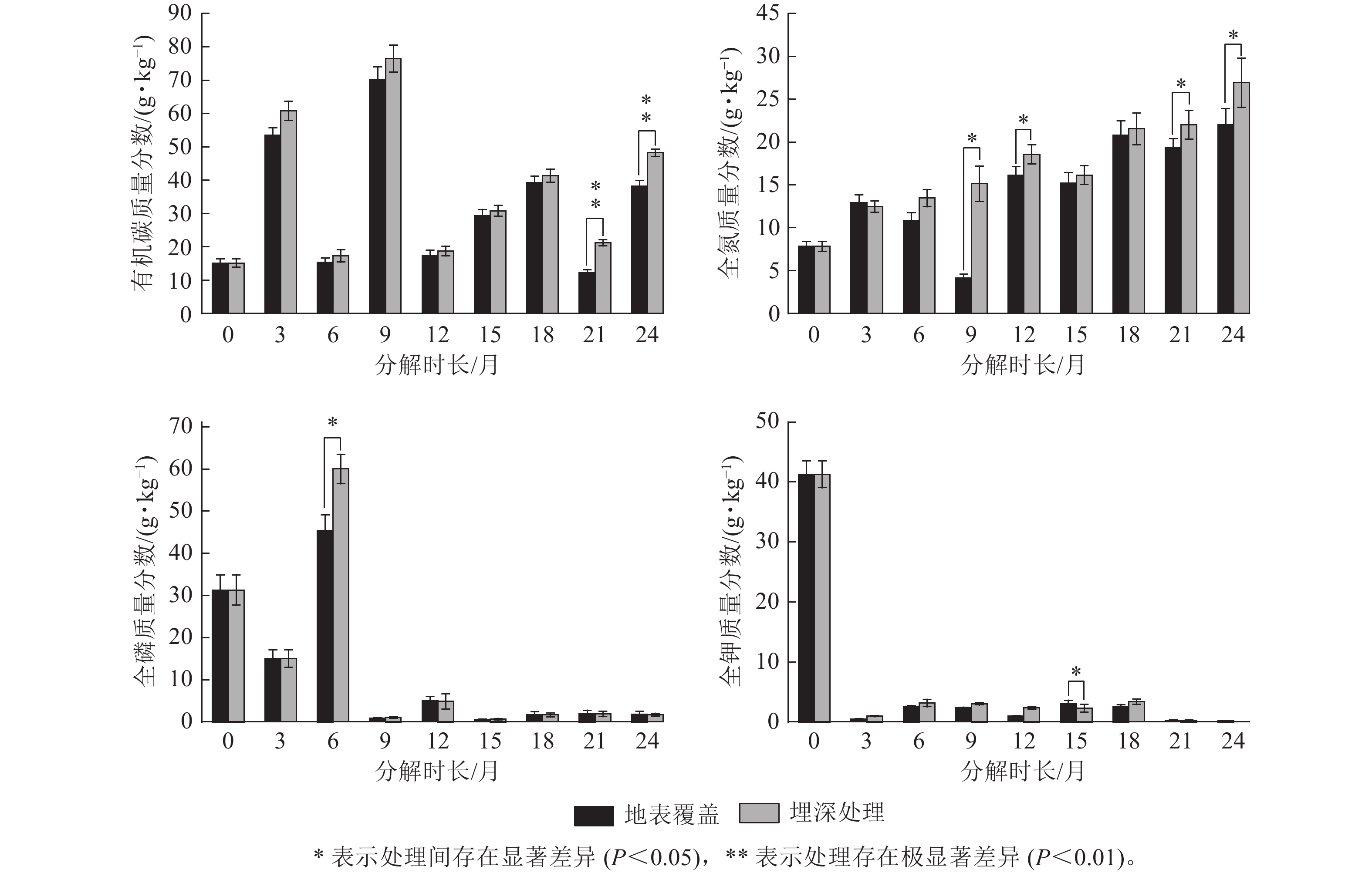
    • 图1可知:在整个分解期内,2个处理青皮的有机碳质量分数整体上均表现为富集-淋溶模式,变化规律较为一致,且整个分解时期埋深处理的青皮有机碳质量分数明显高于地表覆盖。在分解3、9、18、24个月时青皮有机碳质量分数进行富集,在分解9个月时地表覆盖和深埋处理的青皮有机碳质量分数均达到最大值,分别为70.17和76.49 g·kg−1,在分解21和24个月时2个处理青皮的有机碳质量分数产生极显著差异(P<0.01)。
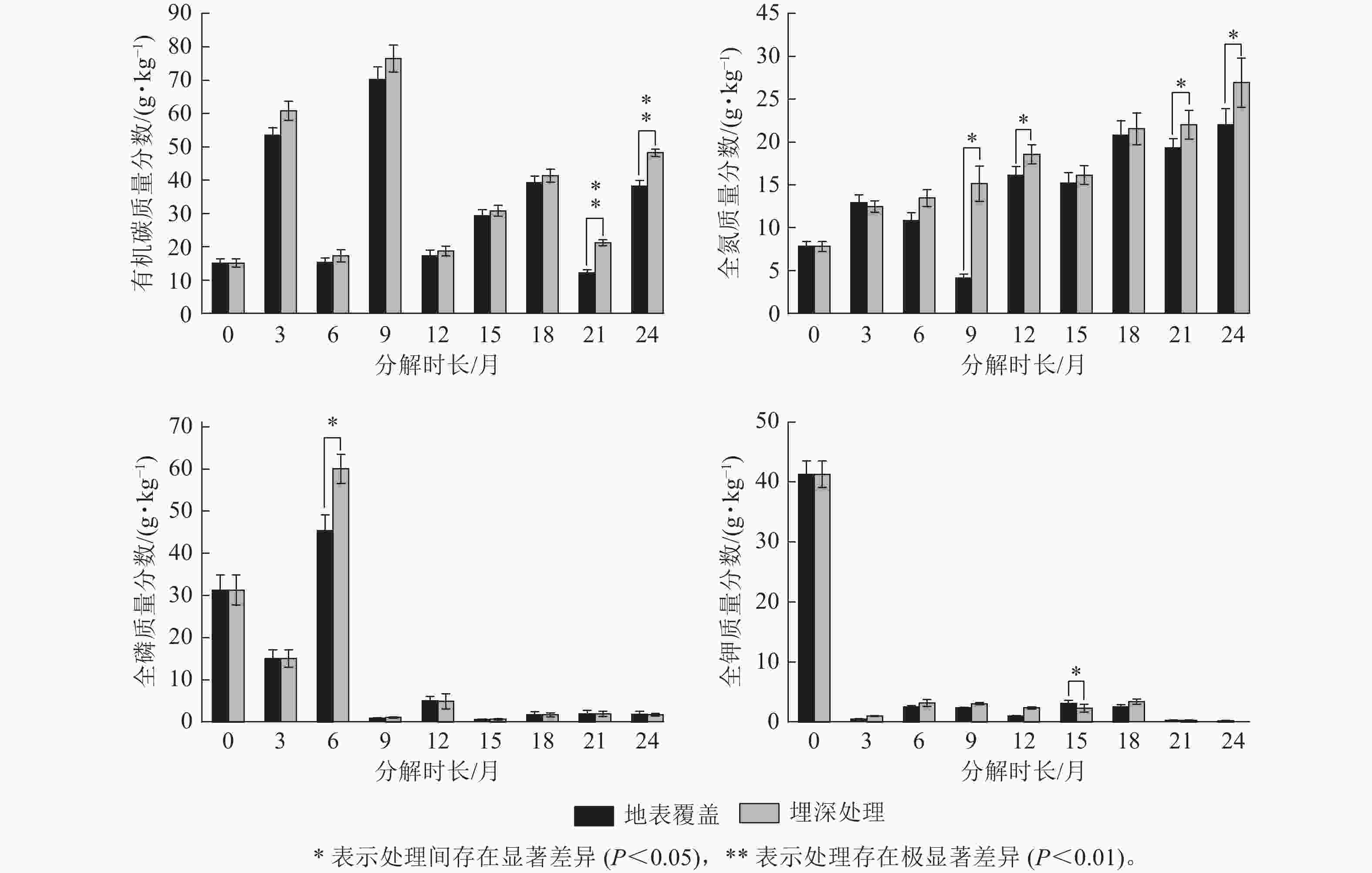
      Figure 1.  Changes of husk nutrient contents during decomposition of C. illinoensis green husk under different soil depth treatments

      青皮的全氮质量分数整体呈上升趋势。2个处理青皮的全氮质量分数在分解9、12、21、24个月时存在显著差异(P<0.05)。分解前3个月,埋深处理青皮的全氮质量分数低于地表覆盖,其他分解时期均表现为埋深处理高于地表覆盖。在分解9个月时差距最大,相差4.16 g·kg−1。分解24个月时地表覆盖和深埋处理青皮的全氮质量分数均达到最高值,分别为22.02和26.93 g·kg−1,分解9个月时达到最低值,地表覆盖的全氮质量分数为4.12 g·kg−1。2个处理青皮的磷质量分数整体变化规律一致,表现为富集-释放模式。在分解6个月时地表覆盖和深埋处理青皮的磷质量分数出现显著差异(P<0.05),相差14.64 g·kg−1,且均达到最高值,分别为45.37和60.01 g·kg−1。2个处理青皮的磷质量分数在3~6个月发生富集,其余时间都表现为释放状态。在整个分解过程中,2个处理青皮的全钾质量分数表现为净释放模式,且明显低于其各自的初始值。2个处理青皮的全钾质量分数变化规律一致且趋于相似水平,在分解前3个月均急剧下降,之后波动幅度较小。在分解15个月时,2个处理青皮的全钾质量分数产生显著差异(P<0.05),在分解24个月时地表覆盖和深埋处理的全钾质量分数分别为0.21和0 g·kg−1

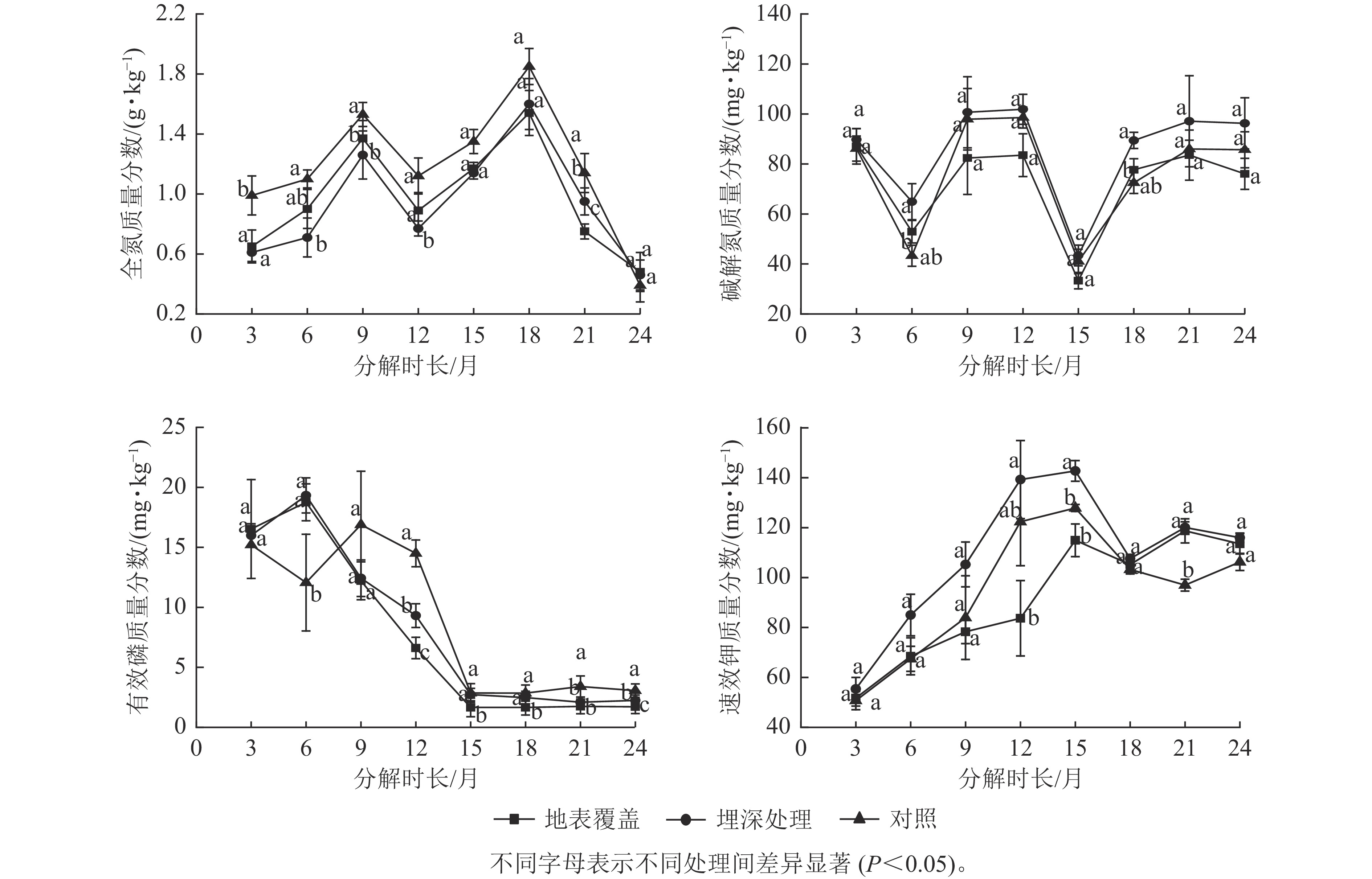
    • 图2可知:在分解第1年和第2年,不同处理的土壤全氮质量分数均表现为先上升后下降的趋势。在青皮分解15个月内,土壤全氮质量分数从大到小始终表现为对照、地表覆盖、埋深处理。在分解第18个月时不同处理下的土壤全氮质量分数均达最大值,分解到第21个月时不同处理土壤全氮质量分数差异显著(P<0.05),分解到第24个月时不同处理土壤全氮质量分数均达分解期最低值。
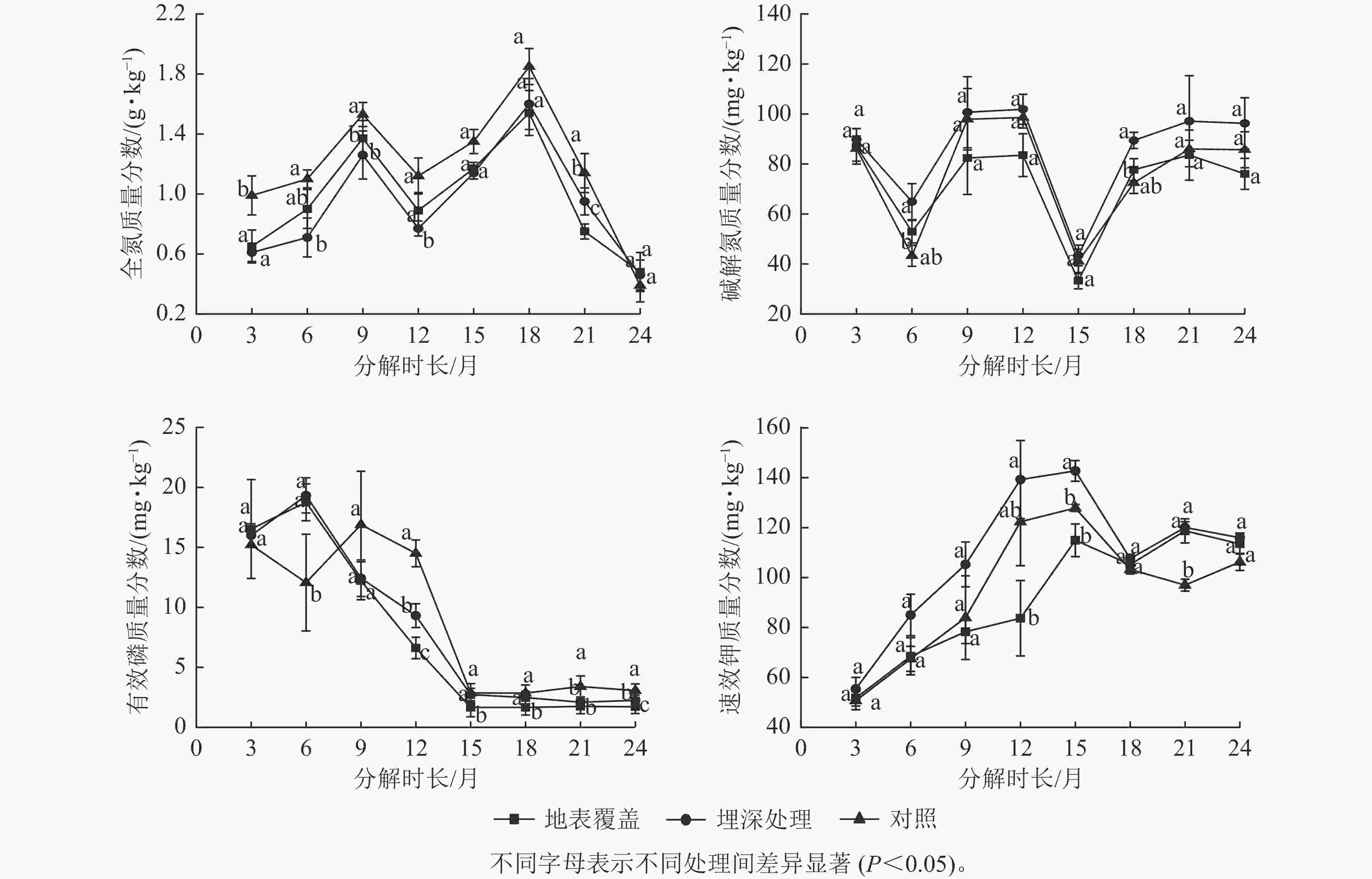
      Figure 2.  Changes of soil nutrient contents during decomposition of C. illinoensis green husk under different soil depth treatments

      在分解同一时期内,3个处理的土壤碱解氮不存在显著差异。埋深处理的土壤碱解氮质量分数在分解第12个月时达到最高值,地表覆盖处理的土壤碱解氮质量分数在分解第3个月时达到最高值,在分解第6个月和第15个月时不同处理的土壤碱解氮质量分数明显低于其他分解时期。在分解第15个月时3个处理的土壤碱解氮质量分数均最低。

      在整个分解期内,各处理分解第2年的土壤有效磷质量分数均显著低于第1年。地表覆盖和埋深处理的土壤有效磷质量分数均在分解第6个月时最高,分别为18.76和19.33 mg·kg−1。在分解9个月之后,土壤有效磷质量分数从大到小依次为对照、埋深处理、地表覆盖。在分解15个月后各个处理的土壤有效磷质量分数均明显降低,在分解第12个月和第24个月时,各处理间存在显著差异(P<0.05)。

      在整个分解期内,不同处理土壤速效钾质量分数始终表现为埋深处理最高。在分解第12个月和15个月时,速效钾质量分数从大到小依次表现为埋深处理、对照、地表覆盖。分解12个月时地表覆盖和埋深处理的土壤速效钾质量分数存在显著差异(P<0.05)。在分解15个月内,各处理的土壤速效钾随分解时间增加不断增多,且在分解到第15个月时达最大值,对照、地表覆盖和埋深处理的土壤速效钾质量分数分别为127.90、114.94和142.76 mg·kg−1

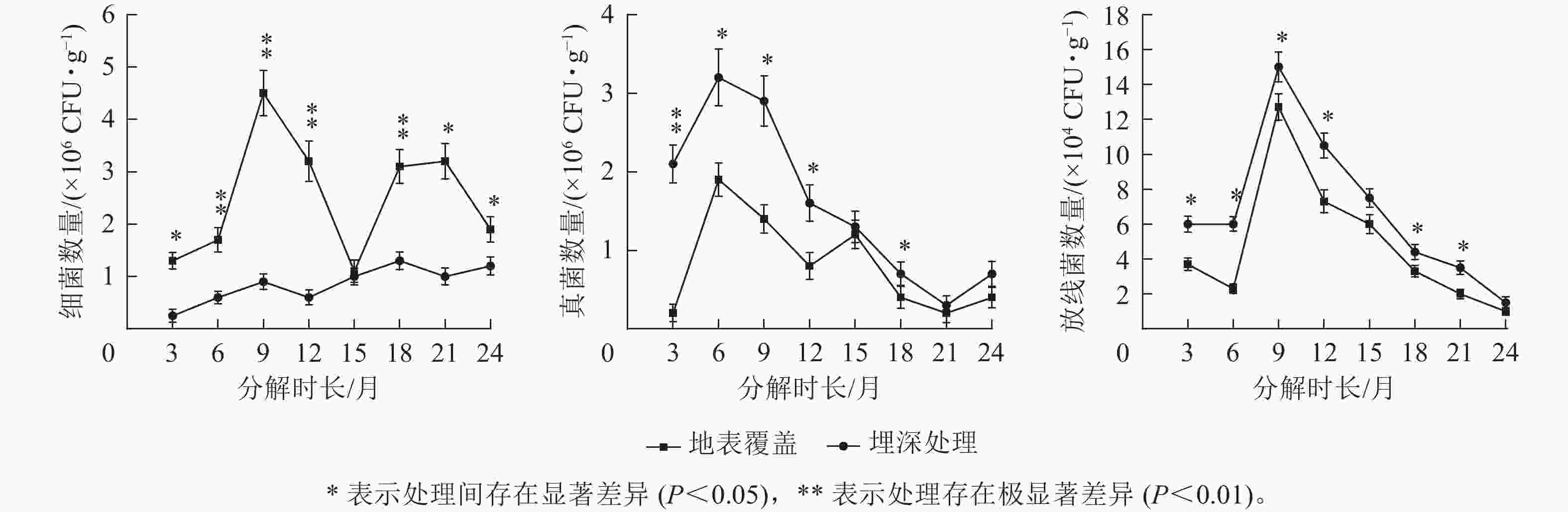
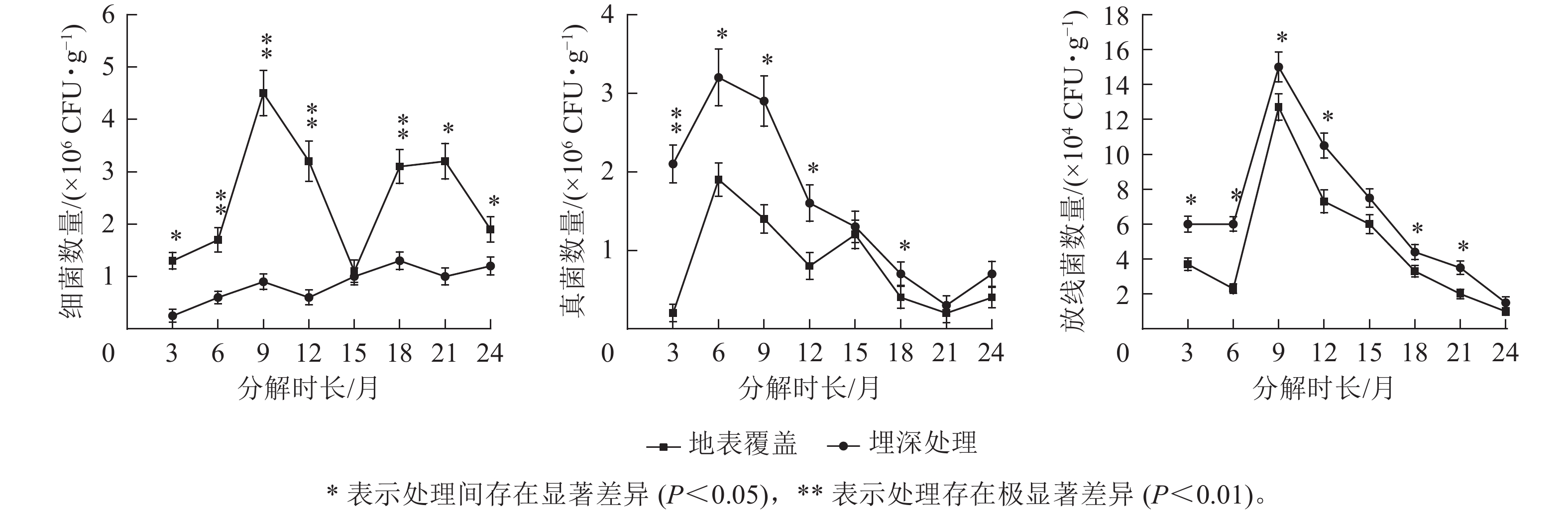
    • 图3可知:在整个分解期内,地表覆盖的土壤细菌数量始终大于埋深处理,且埋深处理下的土壤细菌数量的变化幅度较为平稳。分解第1年与分解第2年不同处理的土壤细菌数均表现为先上升后下降的趋势,在分解6、9、12、18个月时差异极显著(P<0.01)。地表覆盖土壤细菌数量为1.10×10⁶~4.50×10⁶ CFU·g−1,埋深处理土壤细菌数量为0.25×10⁶~1.30×10⁶ CFU·g−1。埋深处理的土壤真菌数量始终大于地表覆盖,其变化趋势也大致相同,分解第1年表现为先上升后下降的趋势,分解第2年表现为先下降后上升的趋势,且土壤真菌数量整体小于第1年。地表覆盖和深埋处理的土壤真菌数量在分解3个月时差异极显著(P<0.01),且均在分解第6个月达到最高值,分别为1.90×10⁶和3.20×10⁶ CFU·g−1

      Figure 3.  Changes in soil microbial during the decomposition of C. illinoensis green husk under different soil depth treatments

      2个处理的土壤放线菌数量变化趋势均表现为先上升后逐渐下降,在分解3、6、9、12、18、21个月时,2个处理土壤放线菌数量差异显著(P<0.05),且埋深处理土壤放线菌数量大于地表覆盖。在分解第9个月时,地表覆盖和深埋处理的土壤放线菌数量最多,分别为12.70×10⁴和15.00×10⁴ CFU·g−1。在分解第24个月时,地表覆盖和深埋处理的土壤放线菌数量均达到最低值,分别为1.00×10⁴和1.50×10⁴ CFU·g−1

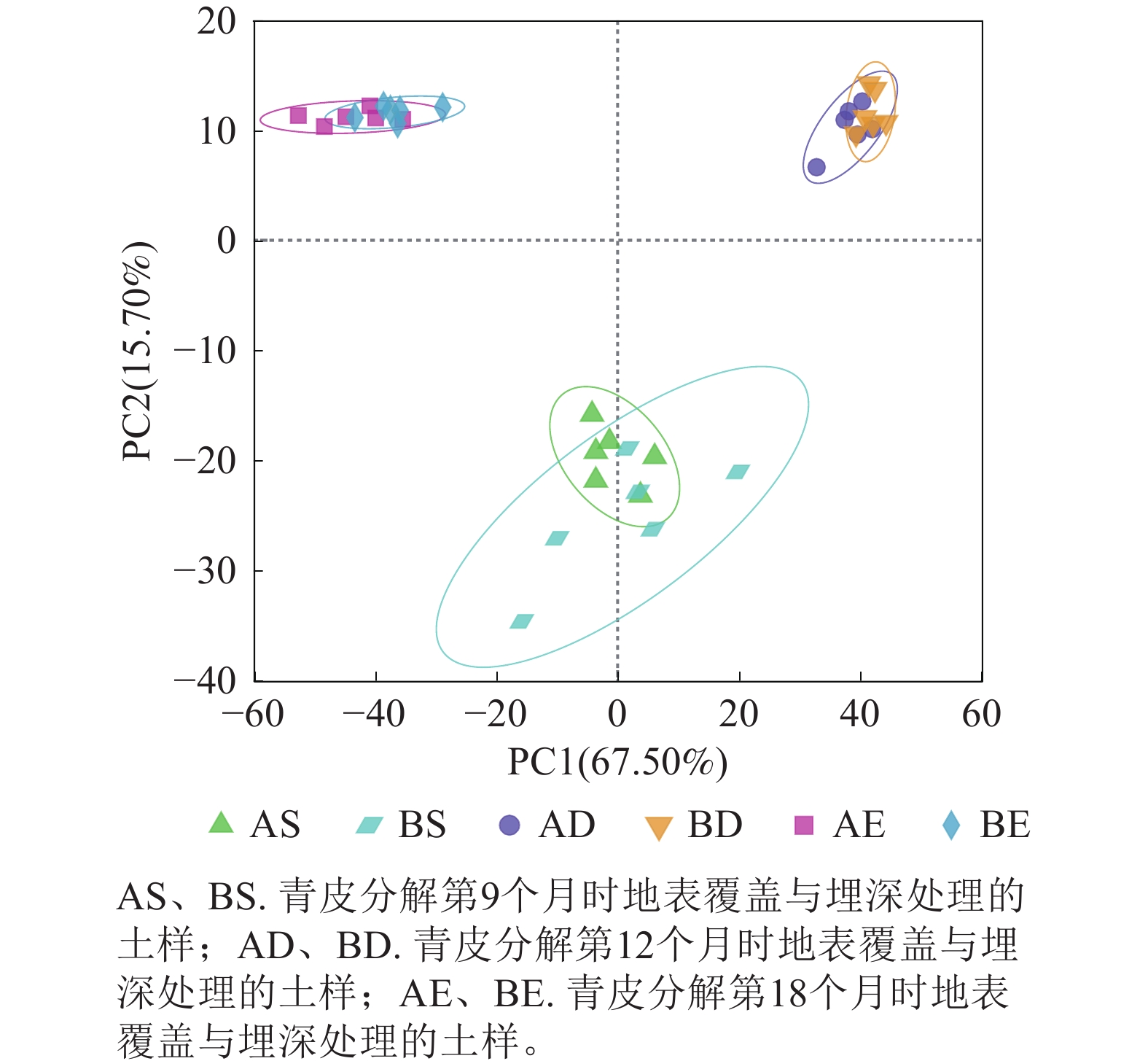
    • 应用LC-MS非靶向代谢组学技术,根据薄壳山核桃青皮干物质残留率的显著程度确定了3个具有代表性的关键分解阶段,即分解第9、12和18个月时,对正离子模式下获得的3个时期的土壤样本进行主成分分析。第1主成分(PC1)的贡献值为67.50%,第2主成分(PC2)的贡献值为15.70%,所有样本均置于95%的置信区间内(图4)。主成分分析结果表明:薄壳山核桃青皮在不同分解时期的代谢物质差异较大,同一时期不同处理之间的代谢物质差异较小。
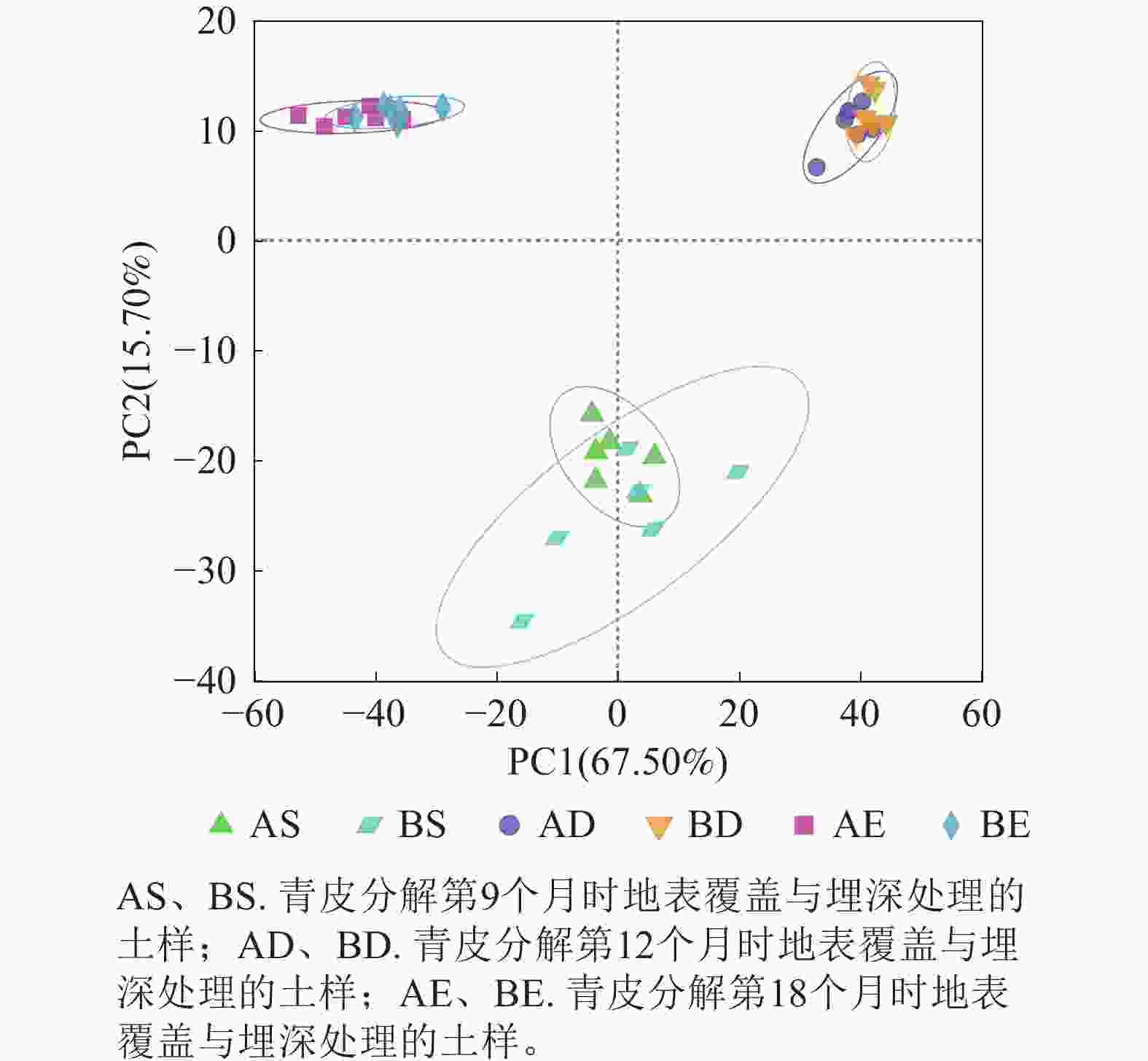
      Figure 4.  Map of PCA scores for different periods of soil

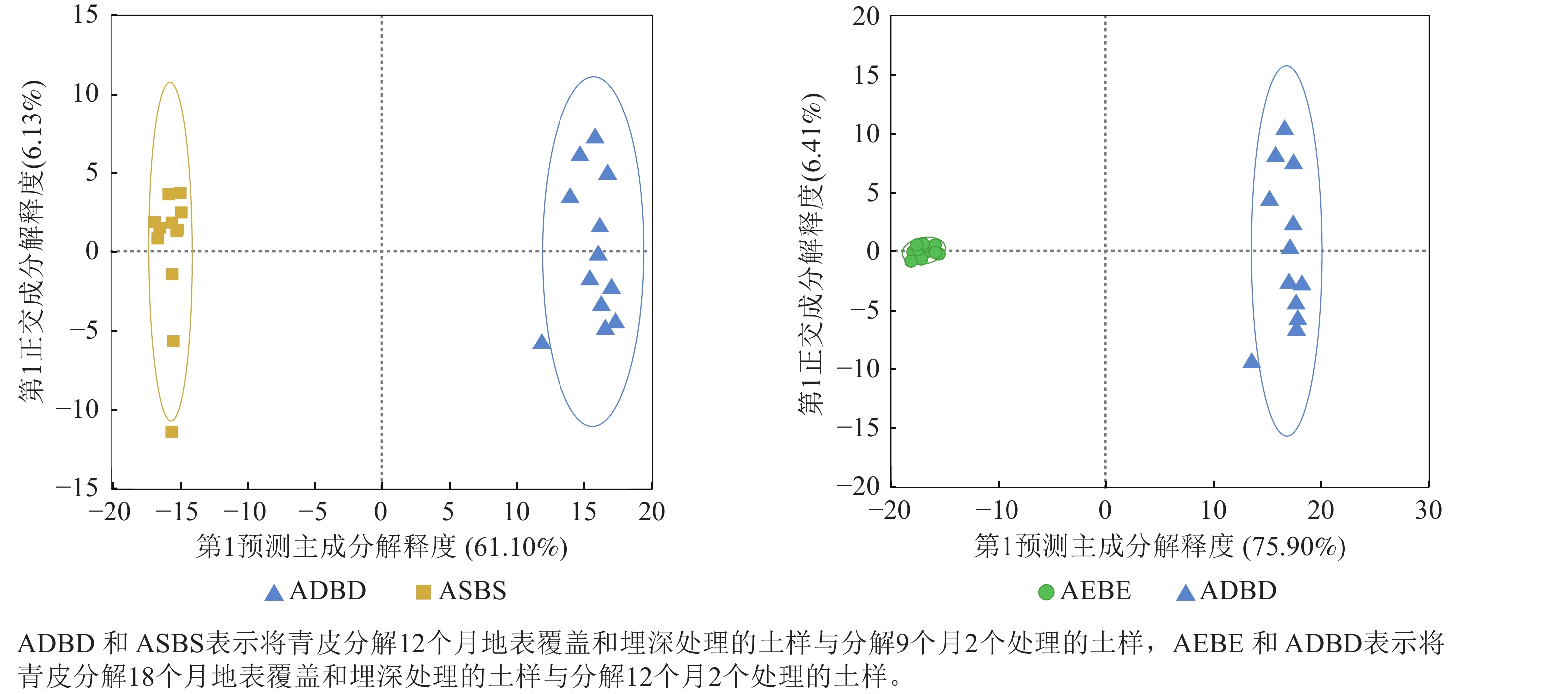
      建立薄壳山核桃青皮分解9、12和18个月3个时期土壤样本分组的OPLS-DA模型。由图5可知:青皮分解12个月和青皮分解9个月、青皮分解18个月和青皮分解12个月之间差异指数分别为61.1%和75.9%,且2组样本中样本间均没有重叠,说明该模型有较好的区分效果。由表3的模型评价参数可知:模型对X矩阵的累积解释率[R2X(cum)]均大于0.5,模型对Y矩阵的累积解释率[R2Y(cum)]和模型的累积预测能力[Q2(cum)]均接近1,说明建立的模型稳定可靠。
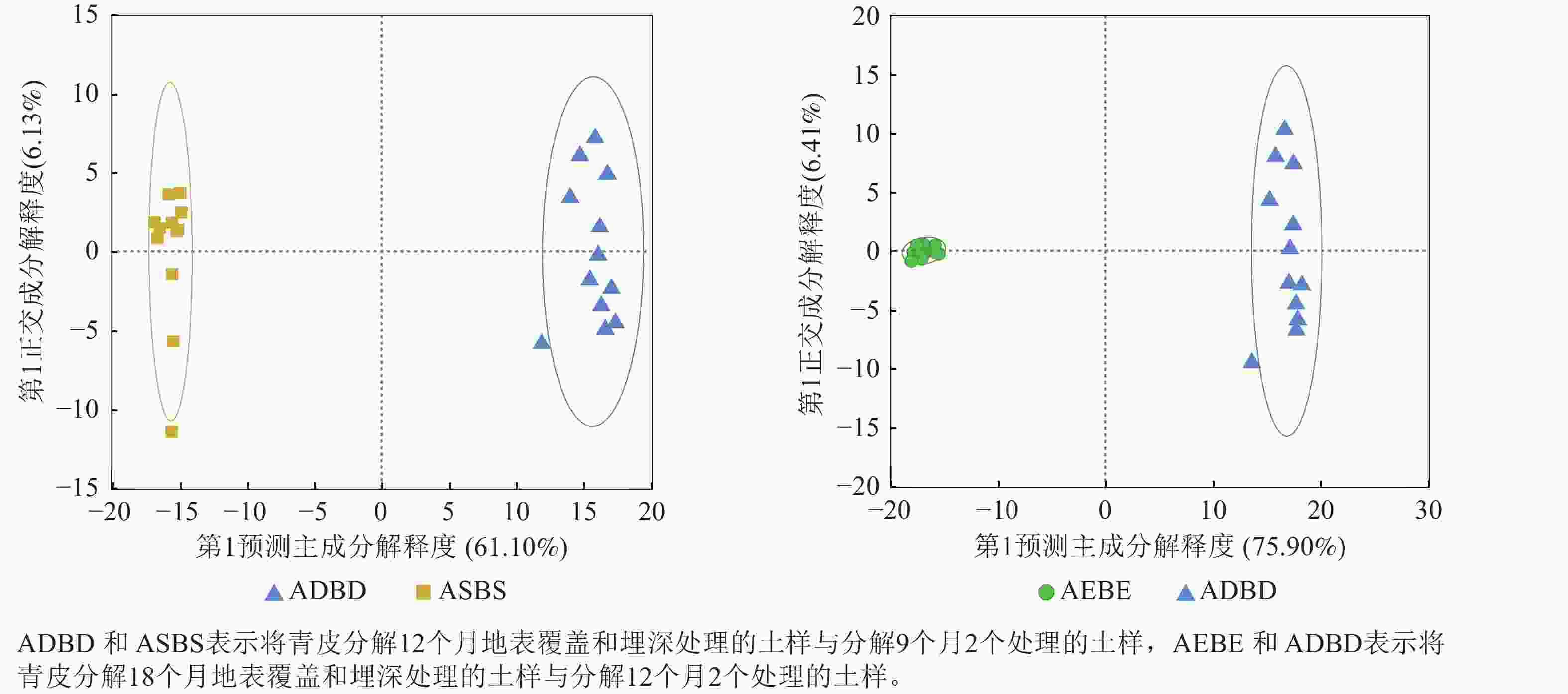
      Figure 5.  OPLS-DA score plot

      样品分组 主成分数 R2X(cum) R2Y(cum) Q2(cum) R2 Q2
      ADBD vs ASBS 1+2 0.685 0.995 0.985 0.623 0.973
      AEBE vs ADBD 1+2 0.782 0.993 0.986 0.979 0.705
        说明:ADBD vs ASBS表示将青皮分解12个月地表覆盖和埋深处理的土样与分解9个月2个处理的土样进行对比,AEBE vs ADBD表示将青皮分解18个月地表覆盖和埋深处理的土样与分解12个月2个处理的土样进行对比。R2X(cum)和R2Y(cum) 分别表示所建模型对XY矩阵的累积解释率,R2表示模型对数据变异性的解释能力,Q2表示模型的预测能力,Q2(cum)表示模型的累积预测能力。

      Table 3.  Evaluation parameters of OPLS-DA model

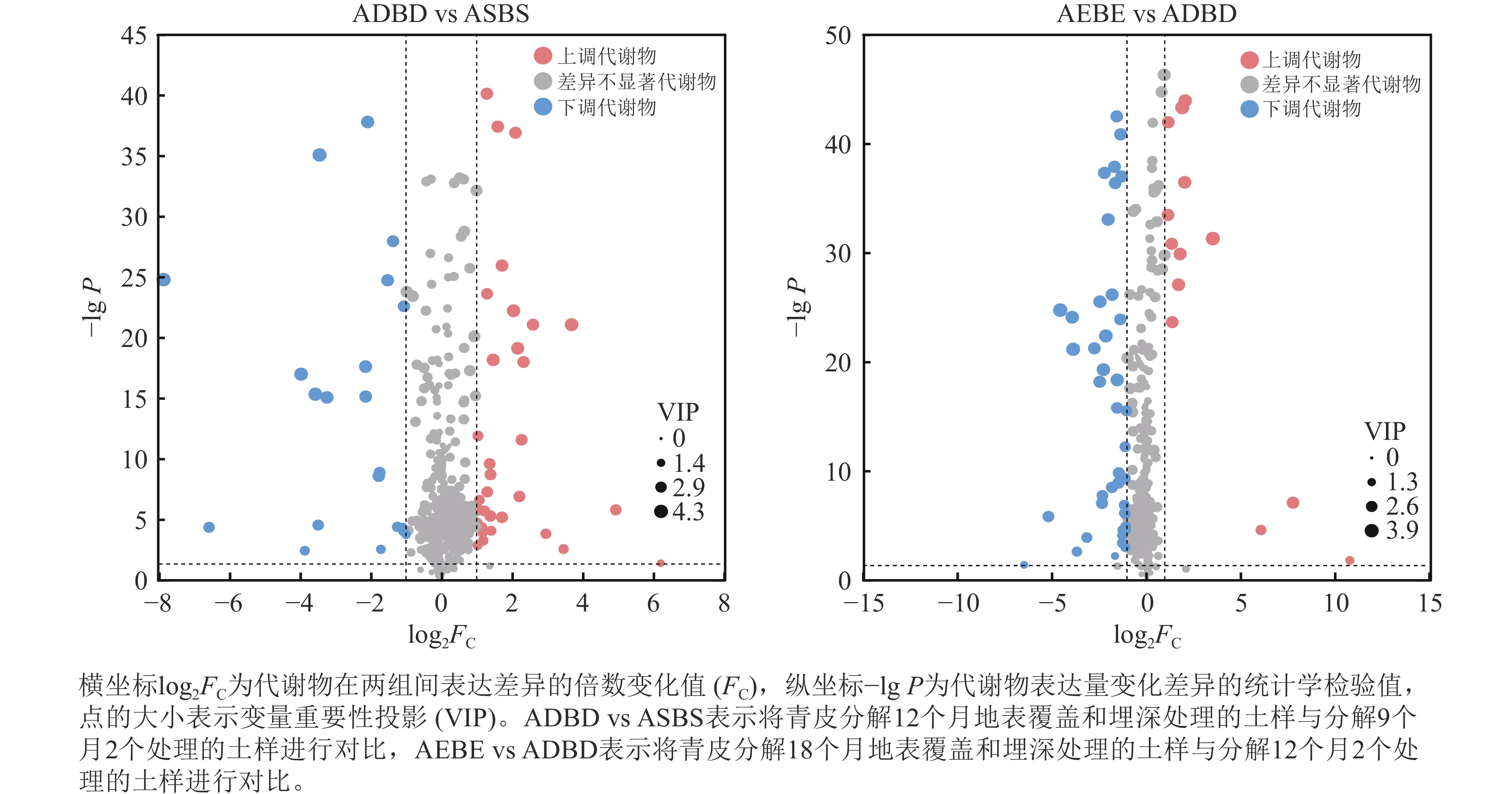
    • 依据OPLS-DA分析后,以差异倍数值(FC)>2或FC<0.5,P<0.05,变量重要性投影值(VIP)>1相结合,筛选出差异显著的代谢物,将数据进行可视化处理绘制火山图(图6)。与青皮分解9个月相比,分解12个月时土壤中筛选出54种差异代谢物,显著上调的差异代谢物为33种,显著下调的差异代谢物为21种。根据京都基因和基因组百科全书(KEGG),共鉴定出命名的代谢物22种;与青皮分解12个月相比,分解18个月时土壤中筛选出54种差异代谢物,显著上调的差异代谢物为13种,显著下调的差异代谢物为41种,共鉴定出命名的代谢物20种。
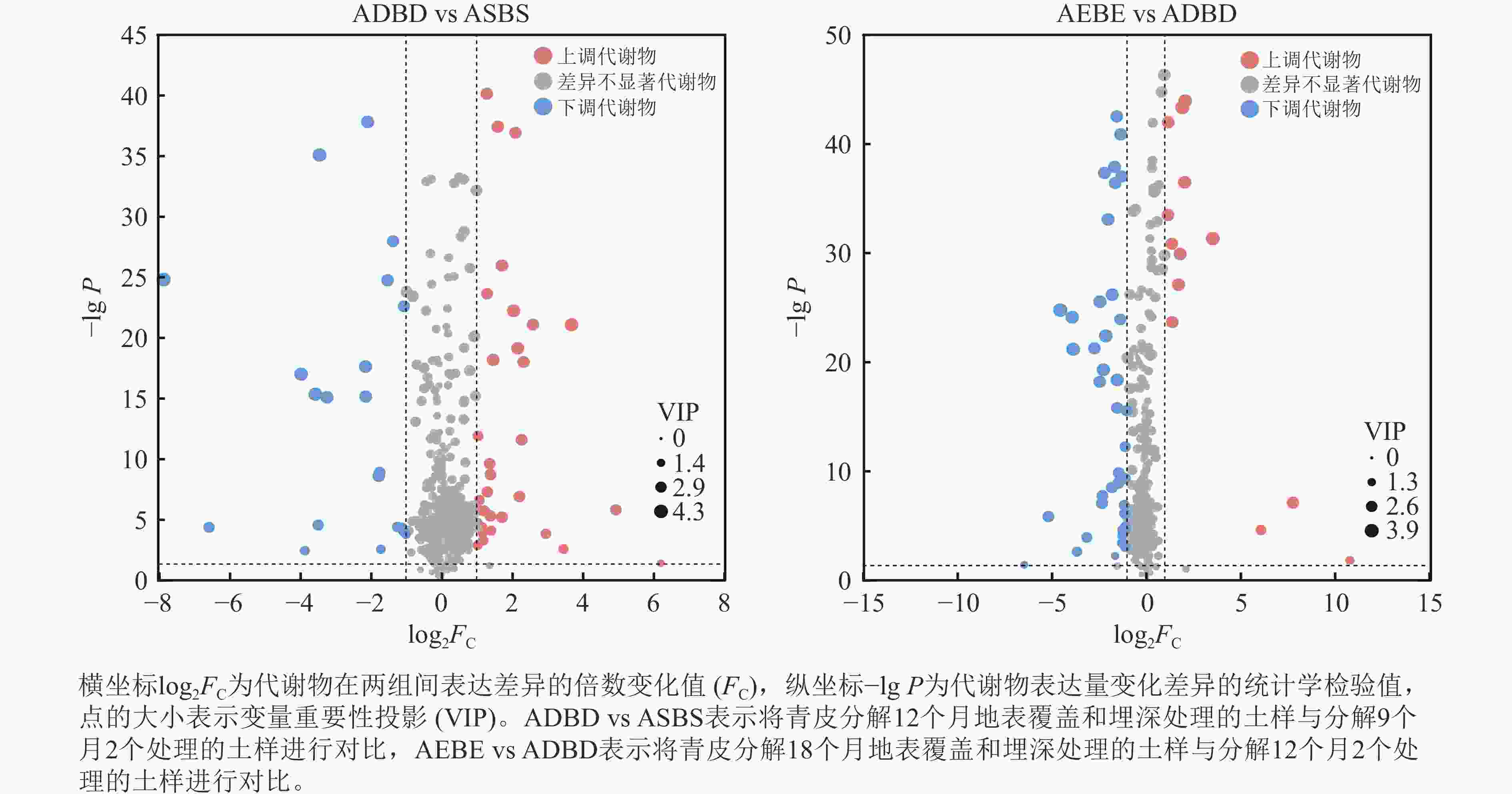
      Figure 6.  Volcano map of differential metabolites

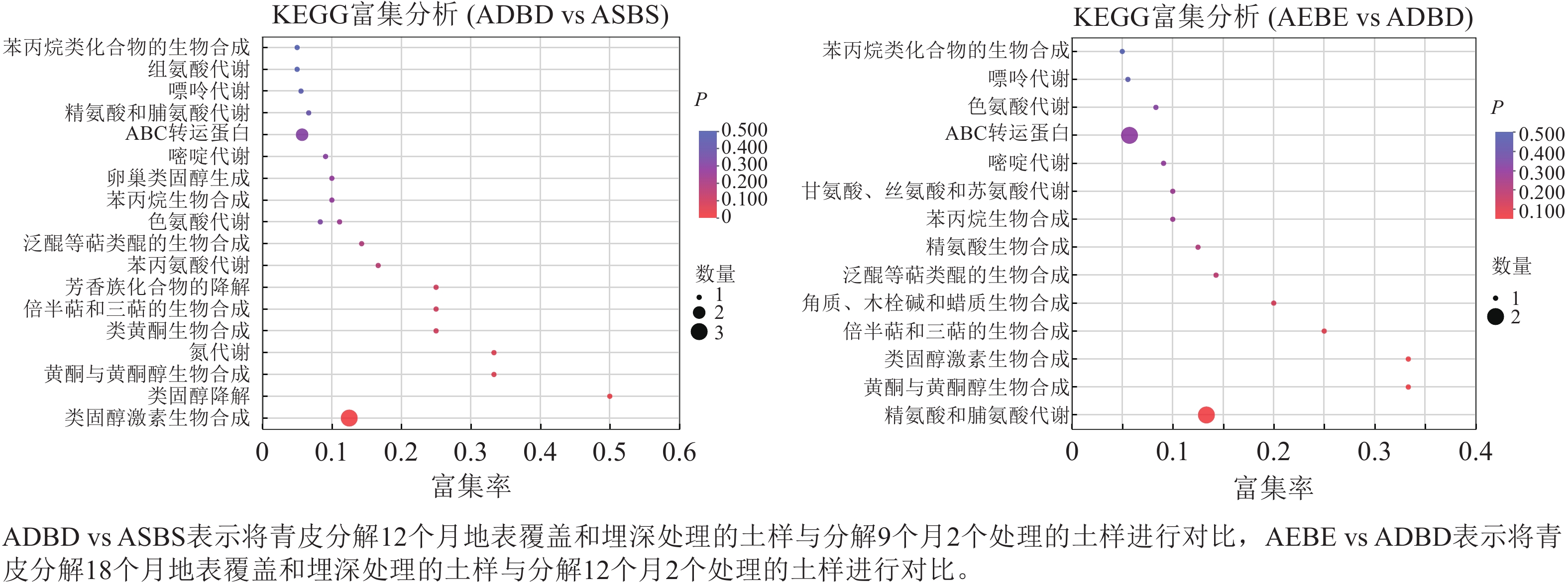
    • 通过KEGG数据库对差异代谢物质进行通路富集分析,其结果以气泡图的形式展现(图7)。由图7可知:这些差异代谢物主要富集在嘧啶代谢、泛醌和其他萜类醌生物合成、类固醇激素生物合成、ABC转运蛋白等22条代谢通路中。青皮分解12个月与分解9个月土壤中的差异代谢物富集到了19条代谢通路中,其中类固醇激素生物合成和类固醇降解代谢途径较为显著,P分别为0.036 1、0.063 7。青皮分解18个月与分解12个月土壤中的差异代谢物富集到了14条代谢通路中,其中精氨酸和脯氨酸代谢、黄酮和黄酮醇生物合成代谢途径较为显著,P分别为0.080 0、0.094 1。有11条代谢通路为2组共有。随着分解时间的延长,青皮分解18个月富集了角质、木栓碱和蜡质生物合成的代谢通路,参与植物抗逆、抵御病虫害等抗逆性生理过程。
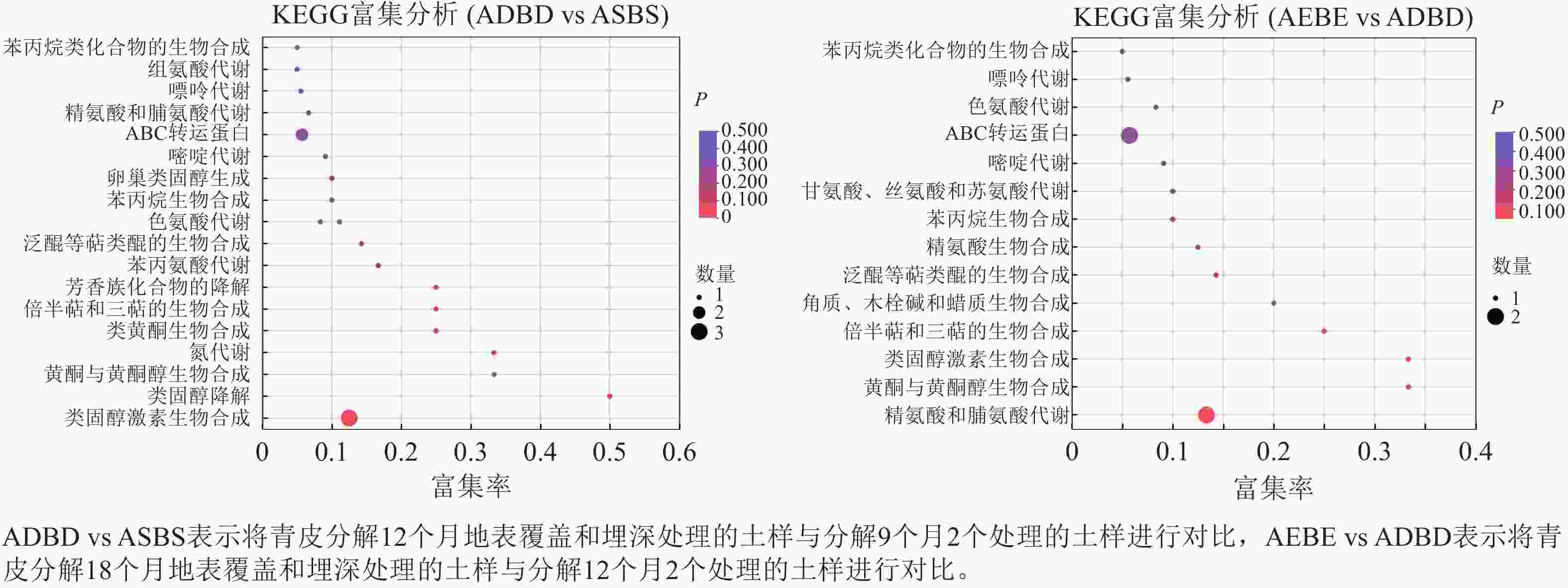
      Figure 7.  Bubble diagram of differential metabolic pathways at different times

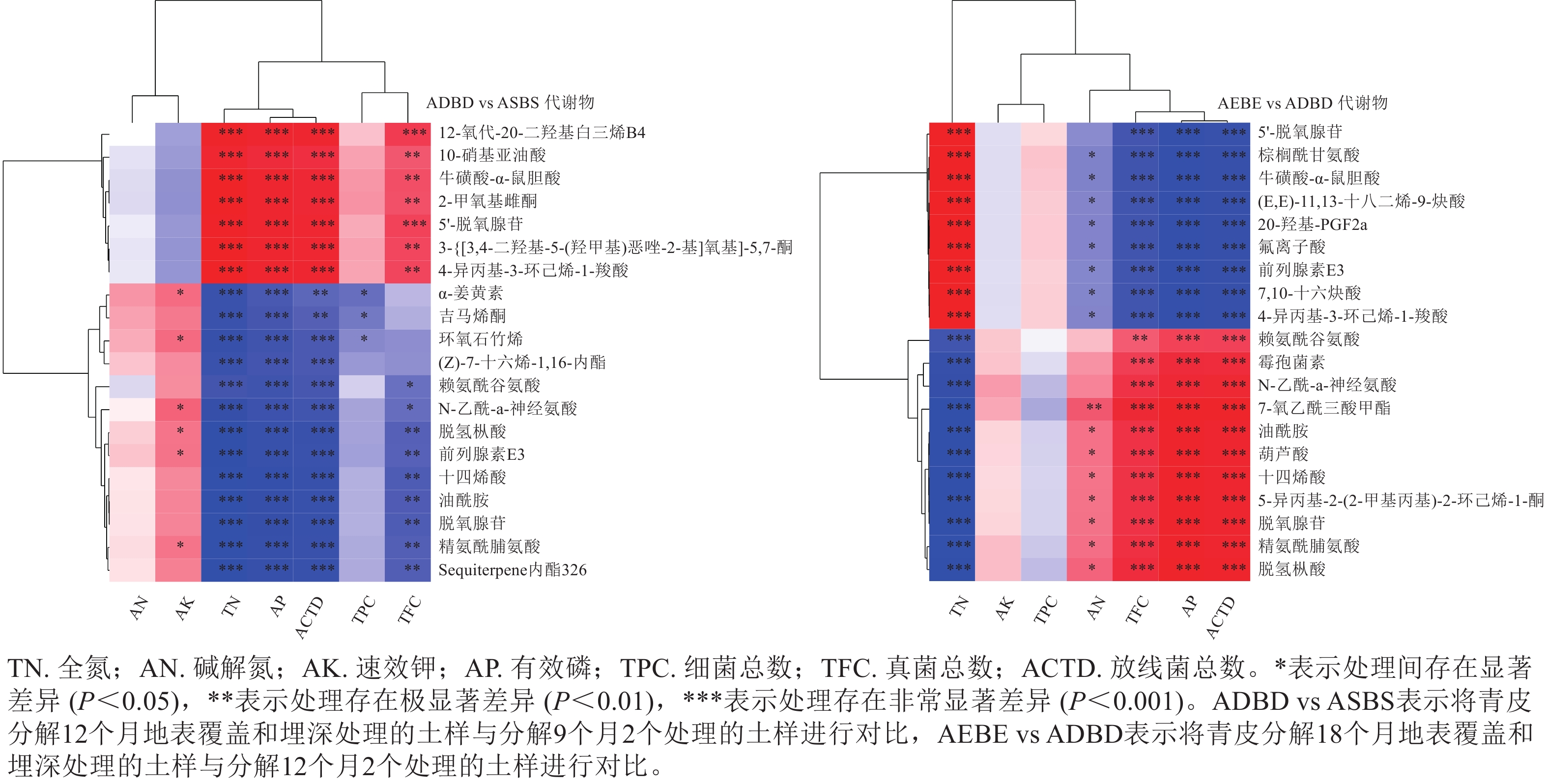
    • 通过对土壤理化指标和不同时期土壤丰度前20位的代谢物进行关联分析,其结果以热图(图8)的形式展现。将青皮分解12个月与分解9个月土壤中的代谢物进行对比,碱解氮与丰度前20位的代谢物没有显著的相关性,速效钾与其中6种代谢物呈显著正相关(P<0.05),细菌总数与其中3种代谢物呈显著负相关(P<0.05)。将青皮分解18个月与分解12个月土壤中的代谢物进行对比,速效钾和细菌总数与代谢物没有显著的相关性。碱解氮与1种代谢物呈极显著正相关(P<0.01),与7种代谢物呈显著正相关(P<0.05),与8种代谢物呈显著负相关(P<0.05)。此外,2个时期的全氮、有效磷和放线菌总数与代谢物的相关性均较为一致,均呈非常显著的正相关或负相关(P<0.001)。
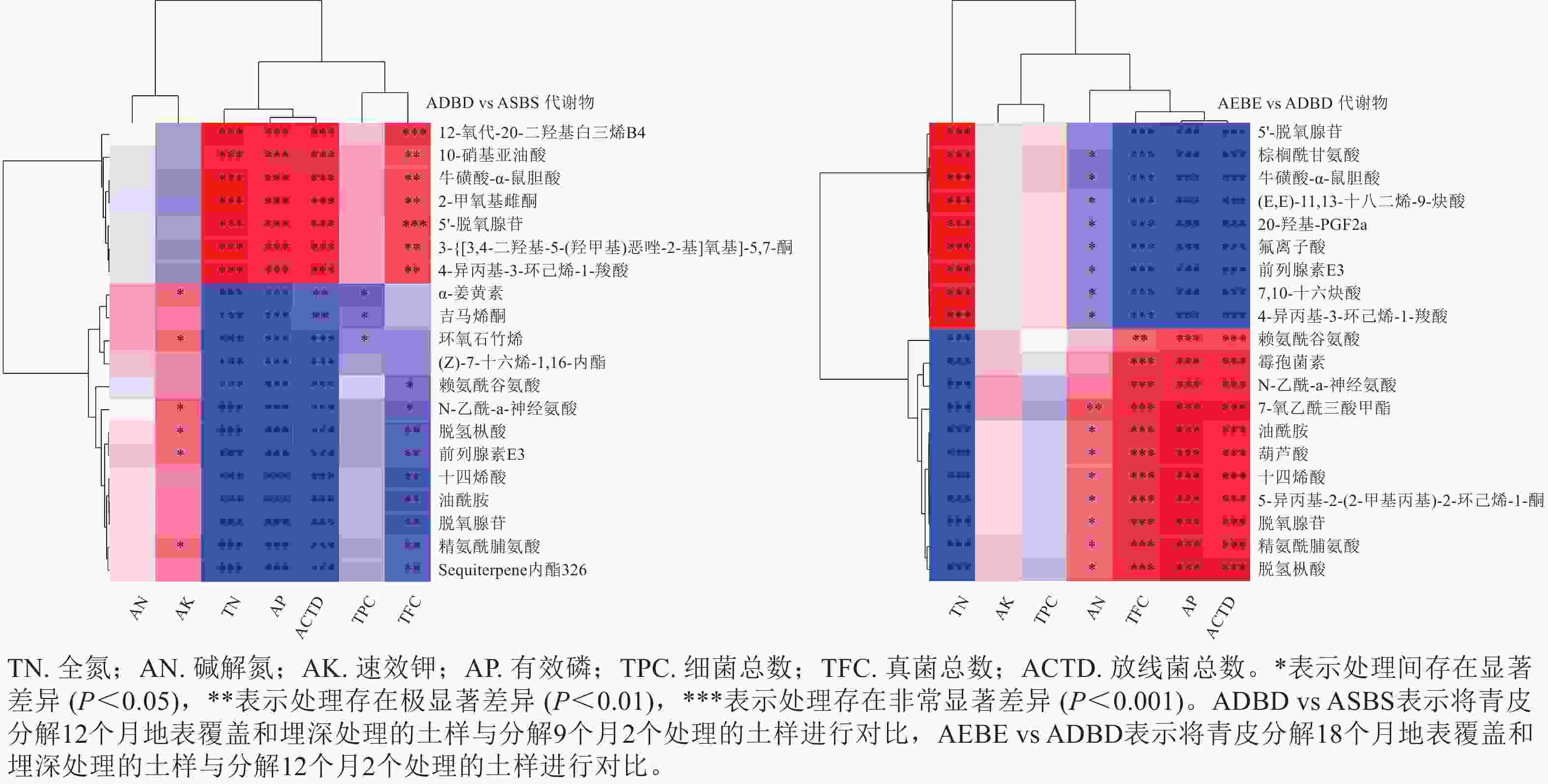
      Figure 8.  Correlation analysis of soil physical and chemical indexes and metabolites

    • 植物残体分解是一个复杂的过程,主要包括粉碎、淋溶和分解代谢3个部分,受到各种因素的影响,如气候条件、分解物类型和土壤微生物等[16]。大量研究表明:植物残体质量损失快慢表现出明显的阶段性,总体上呈先快后慢的趋势。GARCIA-PAUSAS等[17]研究发现:陆生森林凋落物第1年干物质损失率为30%~70%,之后4~5 a损失率为20%~30%。在本研究中,薄壳山核桃青皮分解速率同样表现为前期分解迅速,后期较缓慢,随分解时间的延长干物质残留率逐渐降低。这可能与不同分解时期青皮中的分解物质有关。分解前期青皮中易分解物质较多,青皮分解迅速。随着分解时间的延长,木质素、纤维素等难分解物质的比例增多,青皮的进一步分解受到抑制,因此分解速率降低。本研究发现:不同处理薄壳山核桃青皮的有机碳、全氮、全磷和全钾表现出相似的变化特征,但埋深处理青皮的营养元素质量分数显著高于地表覆盖(P<0.05),而残留率差异不显著。这与渠心静等[18]对油茶Camellia oleifera茶枯分解的研究结果一致。土壤中的养分由于淋溶作用向地下淋失,埋深青皮在分解过程中可能会吸附上层土壤淋溶的养分,导致埋深处理青皮的营养元素质量分数高于地表覆盖。

    • 在整个分解过程中,薄壳山核桃青皮的干物质残留率和养分元素等处于动态变化中。薄壳山核桃青皮分解是青皮养分与土壤养分互相调节的过程,青皮养分及分解速率的变化会影响土壤养分[19],从而导致土壤理化性质和生物学特性等也随之发生变化[20]。由此说明,薄壳山核桃青皮的分解对土壤肥力及化学性质的影响是持续存在的。青皮分解可以为土壤提供养分,但与此同时,在其分解的过程中微生物活动又会与植物竞争营养物质,从而导致土壤养分的差异[21]。薄壳山核桃青皮的分解改变了土壤肥力状况,土壤肥力状况的变化会对土壤微生物的数量和种群组成产生影响,土壤微生物的活性同样也会影响土壤养分的转化[22]。本研究结果显示:土壤微生物数量与土壤肥力之间存在显著正相关,土壤肥力较好的分解阶段土壤中微生物数量较高;地表覆盖细菌数量高于埋深处理,真菌和放线菌数量均低于埋深处理。这与谭杰辉等[23]的研究结论一致。

    • 土壤代谢物主要来自植物根系分泌物、微生物代谢物以及植物、微生物和土壤有机质的分解[2425]。本研究发现:地表覆盖和埋深处理均可以显著影响土壤代谢产物。在分解的3个关键时期,显著上调的差异代谢物为γ-生育三烯酚。γ-生育三烯酚参与泛醌和其他萜类醌的生物合成。泛醌和其他萜类醌是重要的抗氧化剂,参与植物对逆境的反应,影响土壤中的生物合成与代谢[26]。土壤微生物种类和丰度的变化决定了土壤代谢产物种类和丰度的变化[27]。本研究发现:在青皮分解第9、12个月时微生物数量达到顶峰。对青皮分解不同时期土壤代谢物进行两两对比,通过代谢通路富集分析发现:与遗传物质传递有关的嘧啶代谢、嘌呤代谢广泛存在于土壤代谢通路中,且脱氧腺苷、胞苷和胸腺嘧啶核苷等与遗传有关的差异代谢物的质量分数最高,证明薄壳山核桃青皮分解会通过影响微生物的繁殖与代谢,从而诱导土壤代谢物质的变化,增加土壤代谢产物的种类和丰富度。随着薄壳山核桃青皮分解时间的延长,逐渐出现了可以参与土壤碳代谢、氮代谢的代谢通路,精氨酸和脯氨酸代谢通路中的精氨酸、脯氨酸同时参与土壤中的矿物质吸收[28]

    • 埋深处理的青皮分解速率快于地表覆盖处理,2个处理在分解12个月时差异极显著,埋深处理的薄壳山核桃青皮总有机碳、氮、磷、钾质量分数整体显著高于地表覆盖,埋深处理土壤碱解氮和速效钾质量分数较高,地表覆盖土壤中细菌数量大于埋深处理,埋深处理土壤真菌和放线菌数量大于地表覆盖。青皮分解后期出现与碳代谢、氮代谢、蛋白质合成代谢等有关的代谢通路,诱导土壤代谢物质变化,为土壤微生物提供营养物质,土壤的代谢丰度逐渐增强。薄壳山核桃青皮不同还田方式均有利于提高土壤肥力,改善资源浪费的现状,但还需进一步研究效果更好的青皮还田处理方式。

Reference (28)

Catalog

    /

    DownLoad:  Full-Size Img  PowerPoint
    Return
    Return