Turn off MathJax
Article Contents

WANG Ruiqi, ZHENG Guoquan. Spatial distribution pattern and influencing factors of agricultural heritage in Zhejiang Province[J]. Journal of Zhejiang A&F University, 2025, 42(X): 1−11 doi:  10.11833/j.issn.2095-0756.20250146
Citation: WANG Ruiqi, ZHENG Guoquan. Spatial distribution pattern and influencing factors of agricultural heritage in Zhejiang Province[J]. Journal of Zhejiang A&F University, 2025, 42(X): 1−11 doi:  10.11833/j.issn.2095-0756.20250146

OnlineFirst articles are published online before they appear in a regular issue of the journal. Please find and download the full texts via CNKI.

Spatial distribution pattern and influencing factors of agricultural heritage in Zhejiang Province

DOI: 10.11833/j.issn.2095-0756.20250146
  • Received Date: 2025-02-17
  • Accepted Date: 2025-07-23
  • Rev Recd Date: 2025-06-24
  •   Objective   As a province in China to initiate the identification and protection of agricultural heritage, Zhejiang Province leads the country in the number of important agricultural heritage sites both in China and worldwide. The aim of this study is to investigate the spatial distribution pattern and influencing factors of agricultural heritage in Zhejiang, which provides valuable insights for the conservation and sustainable utilization of agricultural heritage across China.   Method  Based on 205 agricultural heritage sites recognized by Department of Agriculture and Rural Affairs of Zhejiang Province in 2024, the spatial pattern, morphology, and concentration degree were analyzed by using ArcGIS 10.2. Combined with the topography of Zhejiang Province, agricultural heritage sites were classified spatially, and influencing factors were examined.   Result  The spatial distribution of agricultural heritage in Zhejiang was characterized by an overall dispersed pattern and small-scale multi-point aggregation. The concentration of agricultural heritage was relatively high at the city level, mainly concentrated in Lishui and Quzhou. At the county level, Longyou County exhibited the highest concentration. Zhejiang’s agricultural heritage zones were spatially divided into high mountain agricultural heritage zone in hilly areas of west Zhejiang, plain and basin agricultural heritage zone in Jinqu Basin of central Zhejiang, water town agricultural heritage zone in plains of north Zhejiang, composite agricultural heritage zone in hilly areas of east Zhejiang, and marine and fishery agricultural heritage zone in southeast coastal plains and islands.   Conclusion  The spatial distribution pattern of agricultural heritage in Zhejiang is mainly influenced by a combination of natural factors, including elevation, climate, and hydrological systems, as well as socio-economic factors such as economic development level, population, urbanization rate, and historical culture. [Ch, 6 fig. 37 ref.]
  • [1] WANG Jianwu, JI Biyong, WANG Zhengyi, ZHU Chenghao.  Impact of subtropical forest landscape pattern on forest carbon density in Lishui City of Zhejiang Province . Journal of Zhejiang A&F University, doi: 10.11833/j.issn.2095-0756.20230205
    [2] ZHANG Yanfei, ZHOU Xiaoguang, WU Yaqi.  Spatiotemporal differences and influencing factors of urban development quality in Zhejiang Province . Journal of Zhejiang A&F University, doi: 10.11833/j.issn.2095-0756.20220623
    [3] JIAO Xinyu, LONG Mei, LIU Zhixiong.  Spatiotemporal distribution and influencing factors of wild Cymbidium faberi from the perspective of historical geographic information system . Journal of Zhejiang A&F University, doi: 10.11833/j.issn.2095-0756.20220766
    [4] XU Hao, LI Wei, LIU Wei, WANG Chengkang.  Spatio-temporal evolution of Nanjing’s urban green space pattern and its influencing factors . Journal of Zhejiang A&F University, doi: 10.11833/j.issn.2095-0756.20220332
    [5] ZHANG Jianguo, XU Xian.  Research on the spatial distribution of forest parks and tourism development in Zhejiang Province . Journal of Zhejiang A&F University, doi: 10.11833/j.issn.2095-0756.20210252
    [6] ZHANG Chenghu, LIU Ju, HU Baoqing, CHEN Xiufen.  Spatial pattern and its influencing factors of water conservation services in Xijiang River Basin, Guangxi . Journal of Zhejiang A&F University, doi: 10.11833/j.issn.2095-0756.20210616
    [7] HE Sixiao, ZHANG Jianguo.  Spatial distribution characteristics and influencing factors of forest health care brand resources in Zhejiang Province . Journal of Zhejiang A&F University, doi: 10.11833/j.issn.2095-0756.20210103
    [8] HUANG Xiaofen, BAI Ou.  Spatial distribution characteristics and influencing factors of forest villages in Zhejiang Province . Journal of Zhejiang A&F University, doi: 10.11833/j.issn.2095-0756.20210558
    [9] ZHAN Xiaohao, WANG Xuhang, YE Nuonan, WU Chuping, YUAN Weigao, YI Lita.  Spatial distribution patterns and interspecific relationship of dominant tree species in the tree layer of typical natural secondary forest communities in Jiande, Zhejiang Province . Journal of Zhejiang A&F University, doi: 10.11833/j.issn.2095-0756.20200586
    [10] YE Peng, YE Changmin, ZHOU Tongyue, LU Yujun, YANG Fan, TANG Mengping.  Spatial structure characteristics of close-to-nature Phyllostachys edulis forests in Zhejiang Province . Journal of Zhejiang A&F University, doi: 10.11833/j.issn.2095-0756.2020.02.005
    [11] GE Yang, ZHANG Jianguo.  Spatial distribution features and influence factors of forest towns in Zhejiang Province . Journal of Zhejiang A&F University, doi: 10.11833/j.issn.2095-0756.2020.02.024
    [12] LI Zhengxin, BAO Yafang, SUN Zhi.  Spatial distribution characteristics and influencing factors of 3A scenic villages in Zhejiang Province . Journal of Zhejiang A&F University, doi: 10.11833/j.issn.2095-0756.2019.06.006
    [13] HU Xiaojun, XU Jingqin, HE Danhua, ZHANG Nianru, ZHENG Yifeng.  Households' willingness to develop under-forest economy and its determinants in collective forest areas of Zhejiang . Journal of Zhejiang A&F University, doi: 10.11833/j.issn.2095-0756.2018.03.020
    [14] JIN Wan, SHEN Yueqin, ZHAO Xingquan, MAO Bitian.  Research on farmers' satisfaction and influence factors of joint-stock reform of rural collective property in Zhejiang . Journal of Zhejiang A&F University, doi: 10.11833/j.issn.2095-0756.2017.01.023
    [15] ZHENG Zerui, SHI Yongjun, ZHOU Guomo, CHEN Ting, YANG Yi, PEI Jingjing.  Planting pattern's influence for characteristics of variation of spatial distribution pattern in the early stages of moso bamboo carbon sink stands . Journal of Zhejiang A&F University, doi: 10.11833/j.issn.2095-0756.2017.03.003
    [16] ZHAO Saisai, TANG Mengping, TANG Sijia, ZHANG Jun, LI Lan, PANG Chunmei, ZHAO Mingshui.  Visualization for a Phyllostachys edulis stands . Journal of Zhejiang A&F University, doi: 10.11833/j.issn.2095-0756.2016.05.014
    [17] WU Houchun, WANG Chengjun, FEI Ximin.  Factor decomposition study of farmland change in Zhejiang Province . Journal of Zhejiang A&F University, doi: 10.11833/j.issn.2095-0756.2015.06.017
    [18] ZHANG Jiajia, FU Weijun, DU Qun, ZHANG Guojiang, JIANG Peikun.  Determinants of spatial distribution of forest litter carbon densities in Zhejiang Province . Journal of Zhejiang A&F University, doi: 10.11833/j.issn.2095-0756.2013.06.003
    [19] YE Ling-yan, FU Wei-jun, JIANG Pei-kun, LI Yong-fu, ZHANG Guo-jiang, DU Qun.  Spatial variation of basic chemical properties and organic carbon storage for forest top-soil in Zhejiang Province . Journal of Zhejiang A&F University, doi: 10.11833/j.issn.2095-0756.2012.06.001
    [20] LI Gen-you, CHEN Zheng-hai, QIU Yao-de, HONG Jing-liang, ZHUGE Gang, FANG Teng, CHEN Sheng-wen.  Quantitative distribution and forestry features of Disantus cercidifolius in Zhejiang . Journal of Zhejiang A&F University,
  • [1]
    MIN Qingwen. Research priorities, problems and countermeasures of Important Agricultural Heritage Systems and their conservation [J]. Chinese Journal of Eco-Agriculture, 2020, 28(9): 1285−1293.
    [2]
    MIN Qingwen, SUN Yehong. The concept, characteristics and conservation requirements of agro-cultural heritage [J]. Resources Science, 2009, 31(6): 914−918.
    [3]
    WEI Zhenying. Present situation and deficiency of agricultural cultural heritage protection in China [J]. The Farmers Consultant, 2022(20): 150−152.
    [4]
    LIU Qiang. Analysis on the current situation of important agricultural heritage systems in China [J]. Science and Technology of Tianjin Agriculture and Forestry, 2022(4): 23−25.
    [5]
    WANG Siming. On the concept and system of agricultural heritage [J]. Agricultural History of China, 2019, 38(6): 113−121.
    [6]
    WANG Caiyan, ZHENG Liangyan, YU Lan, et al. Research on the spatio-temporal characteristics, multiple values and protection development of rice agricultural heritage in Zhejiang Province [J]. China Rice, 2025, 31(1): 112−119.
    [7]
    MIN Qingwen, YANG Xiao, DING Lubin. The concept, connotation and significance of cultural keystone species in agricultural heritage systems [J]. Journal of Resources and Ecology, 2022, 13(1): 51−60.
    [8]
    SUN Yehong, CHENG Jiaxin, WU Qing. Research on spatial characteristics of agricultural cultural heritage protection based on farmers’ perceptions: a case study of Dancong tea culture system in Chaozhou, Guangdong [J]. Journal of Northwestern Ethnic Studies, 2025(1): 116−129.
    [9]
    JIAO Wenjun, ZHAO Guigen, MIN Qingwen, et al. Building a monitoring system for Globally Important Agricultural Heritage Systems (GIAHS) based on the monitoring experience of World Heritage [J]. Chinese Journal of Eco-Agriculture, 2020, 28(9): 1350−1360.
    [10]
    JIAO Wenjun, YU Zhounan, SUN Yehong, et al. An analytical framework for formulating conservation and development measures for important agricultural heritage systems [J/OL]. Sustainability, 2023, 15(5): 4439[2025-01-17]. DOI: 10.3390/su15054439.
    [11]
    MIN Qingwen. Investigation, application and designation of the important agricultural heritage systems in China: retrospect and prospect [J]. Study on Natural and Cultural Heritage, 2020, 5(6): 1−9.
    [12]
    JIAO Wenjun, CUI Wenchao, MIN Qingwen, et al. A review of research on agricultural heritage systems and their conservation [J]. Resources Science, 2021, 43(4): 823−837.
    [13]
    MIN Qingwen, WANG Bojie, SUN Yehong. Progresses and perspectives of the resource evaluation related to agri-cultural heritage tourism [J]. Journal of Resources and Ecology, 2022, 13(4): 708−719.
    [14]
    MIN Qingwen. Agricultural cultural heritage tourism: a brand-new field [J]. Tourism Tribune, 2022, 37(6): 1−3.
    [15]
    SUN Yehong, WANG Jing. Discussion on the development of tourism resources and product design in agricultural cultural heritage sites [J]. Tourism Tribune, 2022, 37(6): 3−5.
    [16]
    WANG Bojie, HE Siyuan, MIN Qingwen, et al. Influence of traditional ecological awareness of rural households on tourism livelihood options in agricultural heritage sites [J]. Tourism Tribune, 2024, 39(7): 98−111.
    [17]
    SUN Yehong, WU Wenjie, SONG Yuxin. Study on the coupling relationship between agricultural cultural heritage tourism and rural revitalization [J]. Journal of Northwestern Ethnic Studies, 2022(2): 133−142.
    [18]
    LIU Moucheng, SU Boru, MIN Qingwen, et al. The mechanism and approach of agricultural heritage promoting rural revitalization [J]. Research of Agricultural Modernization, 2022, 43(4): 551−558.
    [19]
    LI Jingyi, HE Jiaxin, YANG Lun, et al. Does the identification of important agricultural heritage systems promote economic growth? Empirical analysis based on county data from China [J/OL]. Agriculture, 2023, 13(9): 1745[2025-01-17]. DOI: 10.3390/agriculture13091745.
    [20]
    ZHAO Yiqi, ZHENG Ruinan, MA Jia, et al. Landscape characteristics and conservation and utilization mechanisms of composite agricultural heritage systems in Japan [J]. Landscape Architecture, 2024, 31(12): 65−73.
    [21]
    XIN Lin, WANG Yingfei, TONG Jun. Strategies for improving the tourism landscape of agricultural cultural heritage in grain field system [J]. Landscape Architecture, 2024, 31(12): 12−19.
    [22]
    WANG Bojie, HE Siyuan, MIN Qingwen, et al. Framework for evaluating the development suitability of tourism resources in agricultural heritage systems: a case study of Qingyuan County in Zhejiang Province [J]. Chinese Journal of Eco-Agriculture, 2020, 28(9): 1382−1396.
    [23]
    JIAO Wenjun, CUI Wenchao, HE Siyuan. Can agricultural heritage systems keep clean production in the context of modernization? A case study of Qingtian Rice-Fish Culture System of China based on carbon footprint [J]. Sustainability Science, 2023, 18(3): 1397−1414.
    [24]
    ZHANG Menghan, YU Yue, LIU Meizi, et al. Opportunities for China’s agricultural heritage systems under the “digital nomadism” trend—a stakeholder-weighted approach [J/OL]. Sustainability, 2024, 16(7): 2918[2025-01-17]. DOI: 10.3390/su16072918.
    [25]
    NATH T K, INOUE M, WEY Y E, et al. Globally important agricultural heritage systems in Japan: investigating selected agricultural practices and values for farmers[J/OL]. International Journal of Agricultural Sustainability, 2024, 22(1): 2355429[2025-01-17]. DOI: 10.1080/14735903.2024.2355429.
    [26]
    LIU Haitao, LUO Ming, XU Ming, et al. Gini coefficient-based spatial distribution features of Globally Important Agricultural Heritage Systems(GIAHS) and their influence factors [J]. Chinese Journal of Eco-Agriculture, 2020, 28(9): 1465−1474.
    [27]
    HAN Zongwei. Geographical distribution and affecting factors of the important agricultural heritage systems in China [J]. Chinese Journal of Agricultural Resources and Regional Planning, 2017, 38(2): 97−104.
    [28]
    LIU Jin, LENG Zhiming, LIU Jianping, et al. Spatial distribution characteristics and tourism response of important agricultural cultural heritage in China [J]. Economic Geography, 2021, 41(12): 205−212.
    [29]
    WU Rulian, JIANG Pingfa, WEN Rou. Spatial distribution pattern of China’s important agricultural heritage and its formation cause [J]. Resource Development & Market, 2023, 39(8): 957−965.
    [30]
    JU Fei, YANG Rui, YANG Chun. Analysis of spatiotemporal dynamics and driving factors of China’s nationally important agricultural heritage systems[J/OL]. Agriculture, 2025, 15(2): 221[2025-01-17]. DOI: 10.3390/agriculture15020221.
    [31]
    LIU Guilin, DORONZO D M. A novel approach to bridging physical, cultural, and socioeconomic indicators with spatial distributions of agricultural heritage systems (AHS) in China[J/OL]. Sustainability, 2020, 12(17): 6921[2025-01-17]. DOI: 10.3390/su12176921.
    [32]
    GU Xingguo, FANG Qiaokun. Distribution characteristics and value assessment of agricultural heritage systems in Zhejiang Province, China [J]. Acta Agriculturae Zhejiangensis, 2025, 37(2): 493−506.
    [33]
    XU Xian, ZHANG Jianguo. On temporal and spatial distribution and evolution characteristics of agricultural cultural heritage in Zhejiang Province [J]. Journal of Southwest China Normal University (Natural Science Edition), 2021, 46(7): 50−57.
    [34]
    PAN Yuan, ZHANG Xiaoxiao. Spatial distribution and influencing factors of agricultural cultural heritage in Guangxi [J]. Journal of Nanning Normal University (Natural Science Edition), 2023, 40(4): 178−187.
    [35]
    HU Jinlong, TENG Yaobao, FAN Yaming, et al. Spatial distribution and influencing factors of traditional villages in Guangxi Zhuang Autonomous Region [J]. Journal of Guilin University of Technology, 2021, 41(3): 580−588.
    [36]
    GUO Xuan, MIN Qingwen, JIAO Wenjun. Spatial distribution characteristics and differentiated management strategies of China Nationally Important Agricultural Heritage Systems [J]. Journal of Geographical Sciences, 2024, 34(3): 483−498.
    [37]
    MAHARJAN K L, GONZALVO C M, AALA W F. Leveraging Japanese sado island farmers’ GIAHS inclusivity by understanding their perceived involvement[J/OL]. Sustainability, 2021, 13(20): 11312[2025-01-17]. DOI: 10.3390/su132011312.
  • 加载中
通讯作者: 陈斌, bchen63@163.com
  • 1. 

    沈阳化工大学材料科学与工程学院 沈阳 110142

  1. 本站搜索
  2. 百度学术搜索
  3. 万方数据库搜索
  4. CNKI搜索

Figures(6)

Article views(128) PDF downloads(1) Cited by()

Related
Proportional views

Spatial distribution pattern and influencing factors of agricultural heritage in Zhejiang Province

doi: 10.11833/j.issn.2095-0756.20250146

Abstract:   Objective   As a province in China to initiate the identification and protection of agricultural heritage, Zhejiang Province leads the country in the number of important agricultural heritage sites both in China and worldwide. The aim of this study is to investigate the spatial distribution pattern and influencing factors of agricultural heritage in Zhejiang, which provides valuable insights for the conservation and sustainable utilization of agricultural heritage across China.   Method  Based on 205 agricultural heritage sites recognized by Department of Agriculture and Rural Affairs of Zhejiang Province in 2024, the spatial pattern, morphology, and concentration degree were analyzed by using ArcGIS 10.2. Combined with the topography of Zhejiang Province, agricultural heritage sites were classified spatially, and influencing factors were examined.   Result  The spatial distribution of agricultural heritage in Zhejiang was characterized by an overall dispersed pattern and small-scale multi-point aggregation. The concentration of agricultural heritage was relatively high at the city level, mainly concentrated in Lishui and Quzhou. At the county level, Longyou County exhibited the highest concentration. Zhejiang’s agricultural heritage zones were spatially divided into high mountain agricultural heritage zone in hilly areas of west Zhejiang, plain and basin agricultural heritage zone in Jinqu Basin of central Zhejiang, water town agricultural heritage zone in plains of north Zhejiang, composite agricultural heritage zone in hilly areas of east Zhejiang, and marine and fishery agricultural heritage zone in southeast coastal plains and islands.   Conclusion  The spatial distribution pattern of agricultural heritage in Zhejiang is mainly influenced by a combination of natural factors, including elevation, climate, and hydrological systems, as well as socio-economic factors such as economic development level, population, urbanization rate, and historical culture. [Ch, 6 fig. 37 ref.]

WANG Ruiqi, ZHENG Guoquan. Spatial distribution pattern and influencing factors of agricultural heritage in Zhejiang Province[J]. Journal of Zhejiang A&F University, 2025, 42(X): 1−11 doi:  10.11833/j.issn.2095-0756.20250146
Citation: WANG Ruiqi, ZHENG Guoquan. Spatial distribution pattern and influencing factors of agricultural heritage in Zhejiang Province[J]. Journal of Zhejiang A&F University, 2025, 42(X): 1−11 doi:  10.11833/j.issn.2095-0756.20250146
  • 农业文化遗产是农耕文明起源以来,经过人与自然和谐进化[1],在漫长的历史进程中将各异的生态空间、复杂的人文社会相结合而形成的复合活态系统[2]。农业文化遗产概念的形成对于全球农业发展过程中产生的生态平衡、气候稳定、文化知识可延续等多维度、多层次化特征问题的解决有着重要意义[3]。2002年,为保护、稳定和动态发展农业文化遗产系统,联合国粮农组织(FAO)在全球环境基金(GEF)的经济支持下创办全球重要农业文化遗产(GIAHS)。中国在政策与实践上积极响应,目前已初步形成农业文化遗产保护利用工作机制[4]。在浙江省,自青田稻鱼共生系统作为第1批农业遗产入选全球农业文化遗产名录后,至今已有5项全球重要农业文化遗产,16项中国重要农业文化遗产(China-NIAHS)。浙江省的农业文化遗产项目数量和保护重视程度都位居中国前列。

    中国悠久的农业发展历史和丰富的地理环境孕育了大量农业文化遗产,提供了众多研究样本和探索空间。在农业文化遗产的研究内容上,多数研究者聚焦农业文化遗产的基础理论研究和保护开发探索两大方面,从农业文化遗产的基本概念[5]、保护工作[610]、发展进程[1113]、旅游资源开发[1416]、乡村振兴[1718]和经济社会[19]角度进行了深入研究,但少以农业文化遗产分布特征作为切入点。在研究范围上,众多学者从不同研究方向[2025]出发,多致力于研究单个农业文化遗产或微观地区农业文化遗产状况,缺乏从宏观区域视角上统筹研究。在农业文化遗产空间格局研究中,刘海涛等[26]在全球尺度上对全球重要农业文化遗产空间分布特征及其影响因素进行研究,韩宗伟[27]、刘进等[28] 、吴儒练等[29]、JU等[30]、LIU等[31]在全国尺度上对中国重要农业文化遗产进行研究,顾兴国等[32]、徐晛等[33]、盘媛等[34]从省域范围内对重要农业文化遗产进行研究。在研究方法上,采取最邻近指数、地理集中指数、莫兰指数、核密度分析来揭示农业文化遗产的空间分布特征。在研究对象上,多以全球重要农业文化遗产和中国重要农业文化遗产为主要研究对象,缺乏对一般农业文化遗产分布特征的思考。综上所述,不同领域的学者重视农业文化遗产对社会、生态、旅游、农业发展等的影响,农业文化遗产已经成为研究中国农业多维度可持续发展的重要内容。浙江省作为中国农业文化遗产大省,探讨其空间分布特征及其影响因素,对于农业文化遗产可持续利用和保护具有重要价值。

    为此,本研究以浙江省农业文化遗产为研究对象,利用ArcGIS 10.2地理信息分析工具,对其空间形态和集中状态进行分析,并从地理环境和社会经济历史2个方面分析其影响因素,为农业文化遗产可持续利用和保护提供理论依据。

    • 研究样本来源于2024年1月发布的《浙江省重要农业文化遗产资源库名录》,共计205处农业文化遗产。采用谷歌地图获取poi点位后利用ArcGIS地理分析软件进行分析。从地理空间数据云(https://www.gscloud.cn) 获取浙江省30 m分辨率的数字高程(DEM)数据。从国家地球系统科学数据中心(https://www.geodata.cn) 获取2022年浙江省1 km分辨率年降水量数据、1 km分辨率年平均气温数据和浙江省1∶25万基础地理数据。浙江省2023年国内生产总值(GDP)、人口分布、城镇化率等社会经济数据来源于各县(区、市)统计局公开数据整理。

    • 浙江省农业文化遗产可抽象为点要素。最邻近指数用来辨别点要素在空间中的邻近指数,可用ArcGIS 10.2中的平均最邻近工具计算。点要素有随机分布、均匀分布和凝聚分布3种空间分布类型。研究中通常采用最邻近点指数(R)。当R=1时,点状要素趋于随机分布;R>1时,点状要素趋于均匀分布;R<1时,点状要素趋于聚集分布。

    • 核密度分析可以计算出浙江省农业文化遗产点要素周围的点密度,可用来反映点的集聚或离散程度。可用ArcGIS 10.2中的核密度分析工具计算。

    • 地理集中指数的运用是计算农业文化遗产在浙江省内的集中程度[35]G为地理集中指数,假设农业文化遗产在地级市县(区、市)平均分布为GG取值范围为0~100,值越大,表示农业文化遗产空间分布集中指数越高。

    • 利用ArcGIS 10.2工具箱中的创建泰森多边形工具,建立浙江省农业文化遗产的泰森多边形,再利用变异系数(CV)法进行计算。

      其中:CV为泰森多边形面积的变异系数,S为泰森多边形面积的标准差,V为泰森多边形面积的平均值。且当33.00%≤CV≤64.00%时,点为随机分布;当CV>64.00%时,点为聚集分布;当CV<33.00%时,点为均匀分布。

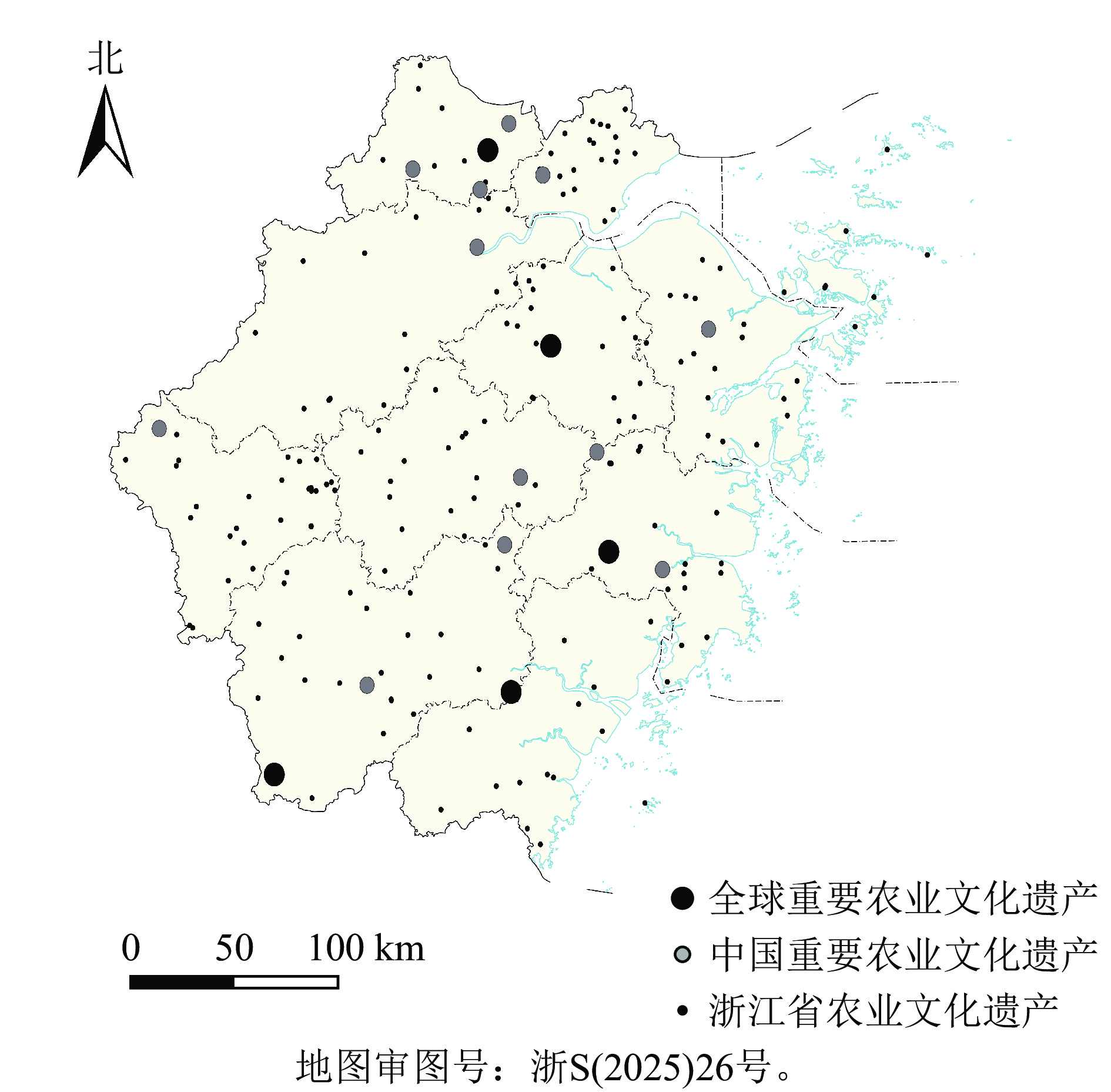
    • 若将农业文化遗产视为重点要素,根据谷歌地图获取poi地理坐标后利用ArcGIS 10.2绘制出浙江省农业文化遗产空间分布图(图1)。通过ArcGIS系统工具箱中平均最邻近工具可计算农业文化遗产分布最邻近指数R为0.827<1,可知农业文化遗产空间分布整体呈现聚集型分布特征,且农业文化遗产在浙江省内的分布特征为整体分散、小范围多点聚集。
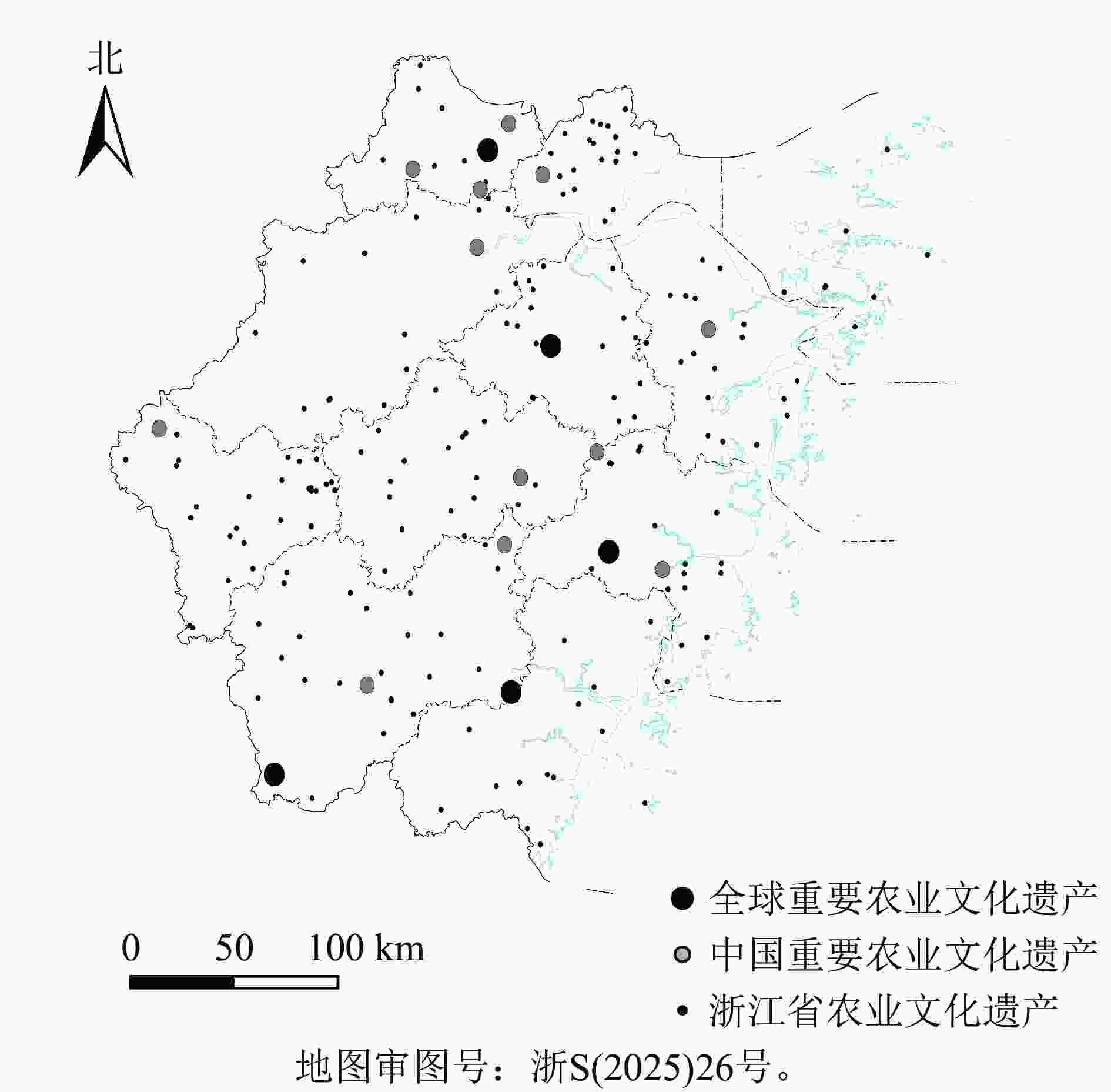
      Figure 1.  GIANS and China-NIAHS distribution in Zhejiang Province

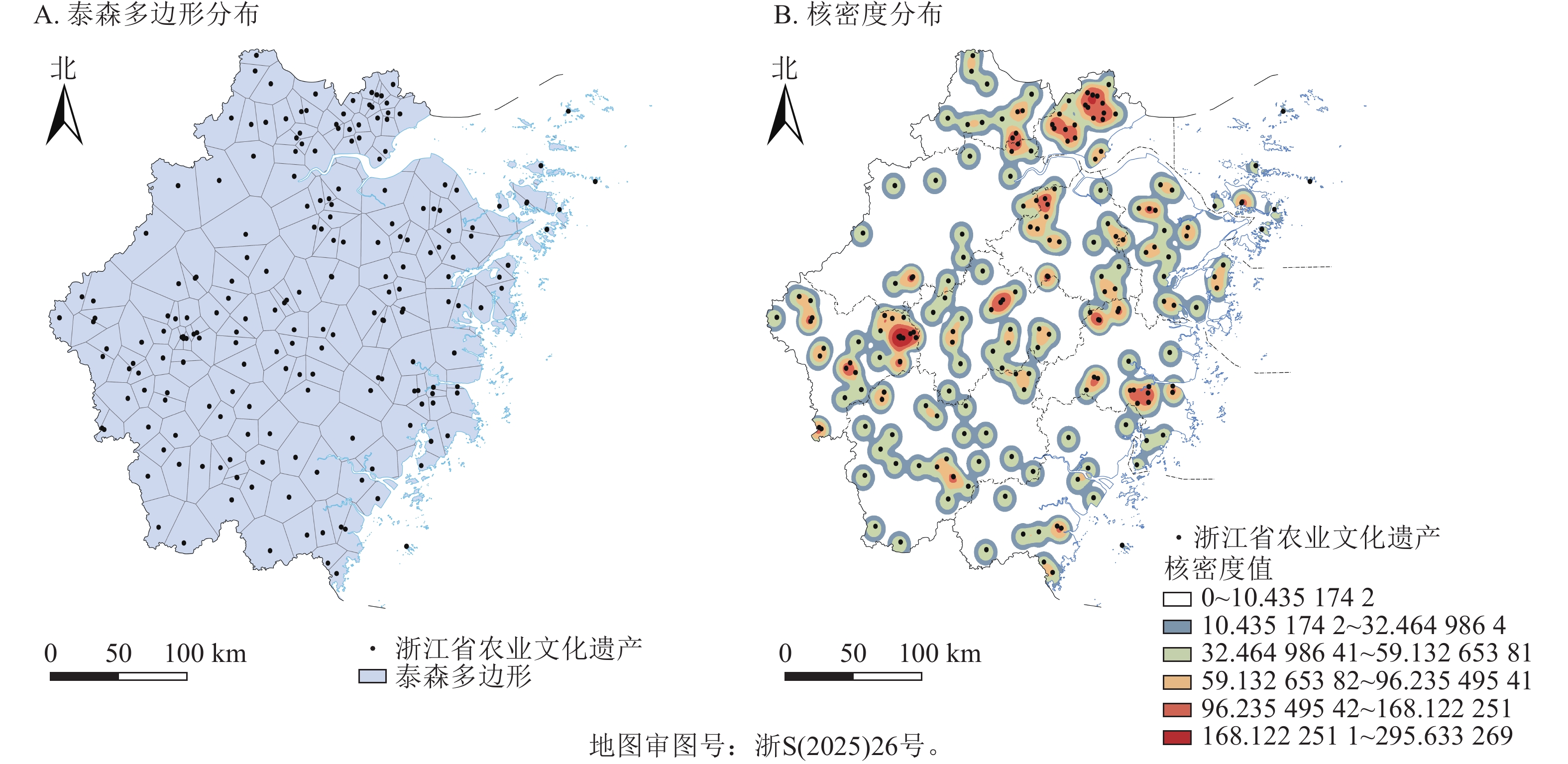
      为验证聚集型空间分布特征的准确性,利用ArcGIS 10.2创建泰森多边形工具,绘制出浙江省农业文化遗产多边形地图(图2A),其变异系数为70.52%>64.00%,表明浙江省文化农业遗产空间分布类型为聚集分布。
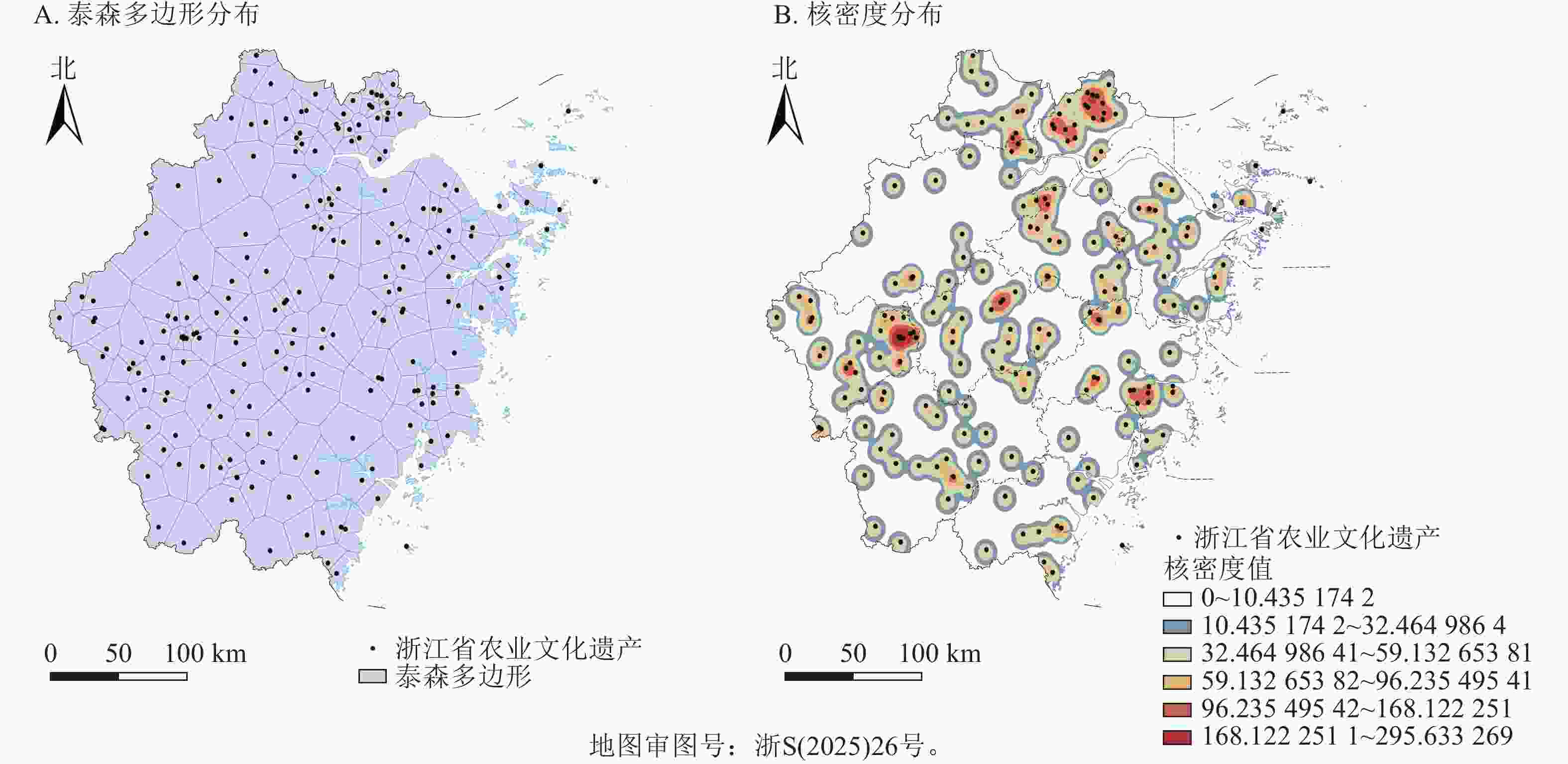
      Figure 2.  Tyson polygonal and nuclear density distribution of agricultural heritage in Zhejiang Province

      利用ArcGIS 10.2的核密度分析工具对浙江省农业文化遗产点要素进行计算分析(图2B)。结果表明:浙江省农业文化遗产有两大主要聚集点和三大次级聚集点。主要聚集点为以龙游县为核心的衢州盆地聚集点和嘉兴西北部平原聚集点;次级聚集点为台州东南部的次级聚集点、绍兴西北部的次级聚集点、杭州与湖州东部交界的次级聚集点。聚集点分布状态呈现类三角形结构。丽水市的农业文化遗产数量(27个)仅次于衢州市(29个),但在核密度分析计算结果中并未呈现聚集分布特征。

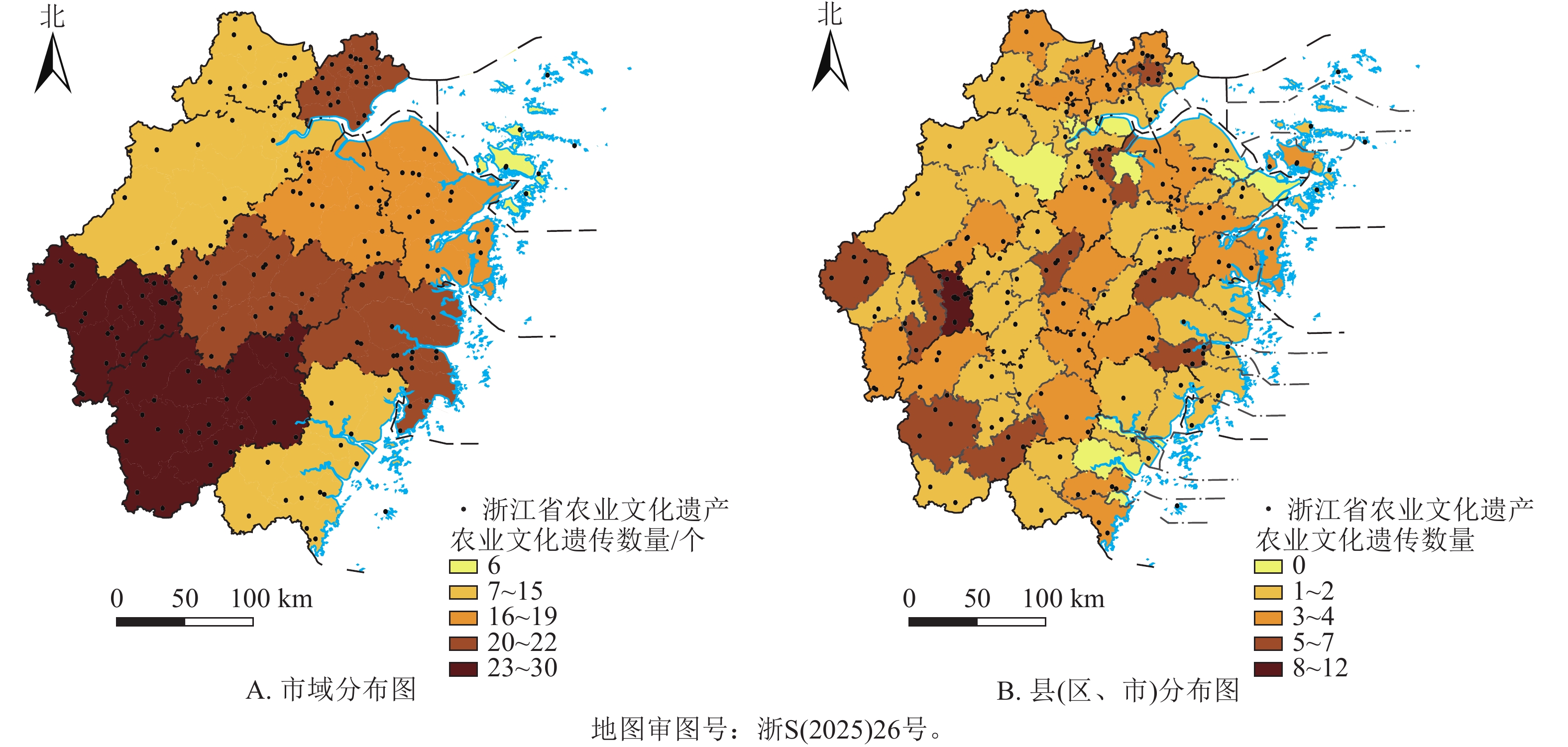
    • 通过ArcGIS 10.2对浙江省农业文化遗产点位坐标进行分析,得出市域范围内浙江省农业文化遗产分布地图(图3A),经计算可知:地理集中指数(G)为31.602,G0为18.636,GG0。可得出在市域尺度上农业文化遗产呈集中分布形态且集中度较高,主要集中在浙江西南部的丽水市(27个)和衢州市(29个),舟山市(8个)、湖州市(12个)和温州市(14个)的农业文化遗产数量较少。
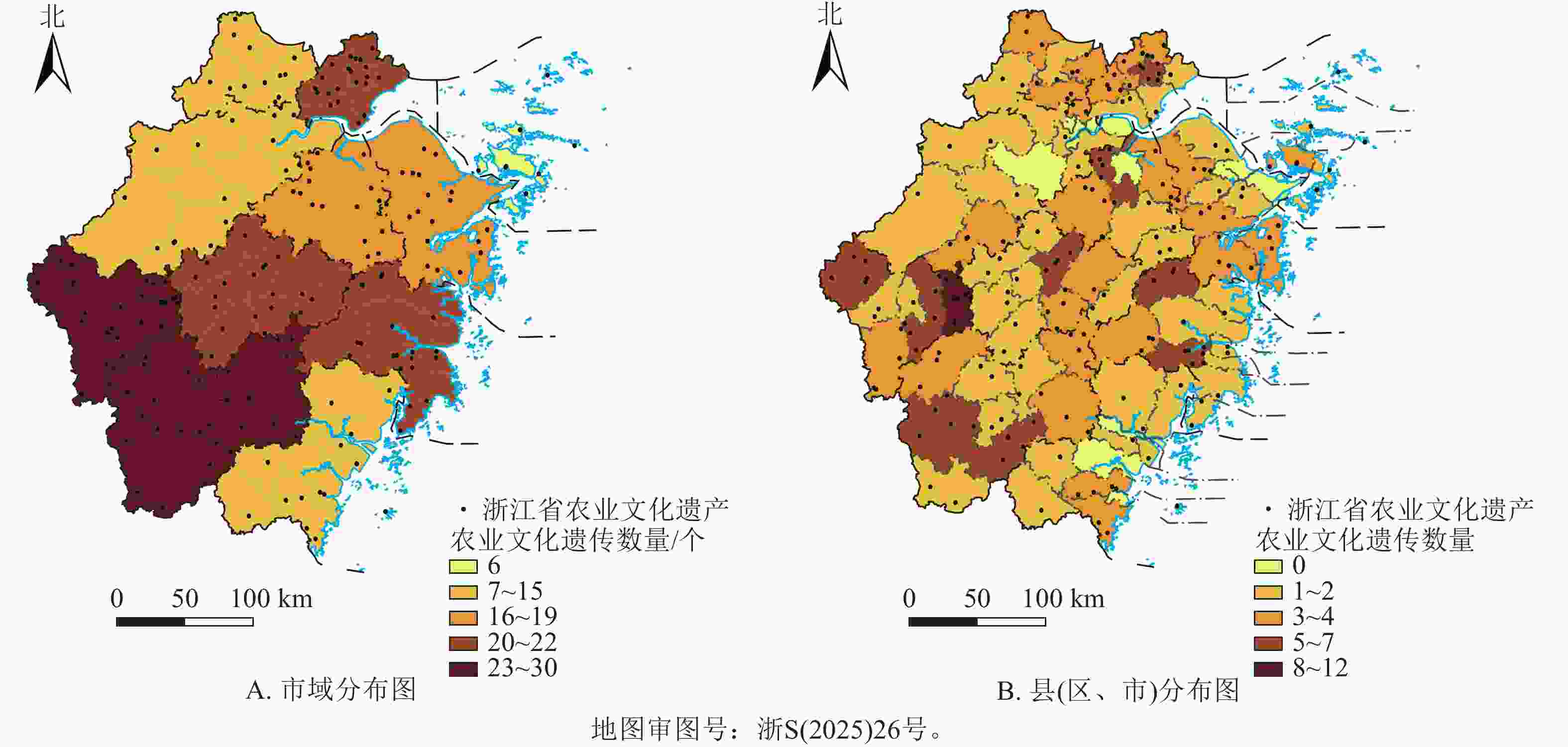
      Figure 3.  Distribution of of agricultural heritage sites at the municipal and county (district, city) levels in Zhejiang Province

      再利用ArcGIS 10.2制作其县(区、市)的分布地图(图3B),计算得出县(区、市)范围的地理集中指数(G)为13.404,G0为2.531,GG0,表明浙江省农业文化遗产在区(县、市)尺度上的集中程度更高,其中龙游县共有12个农业文化遗产,集中程度最高,占衢州市农业文化遗产的41.38%。

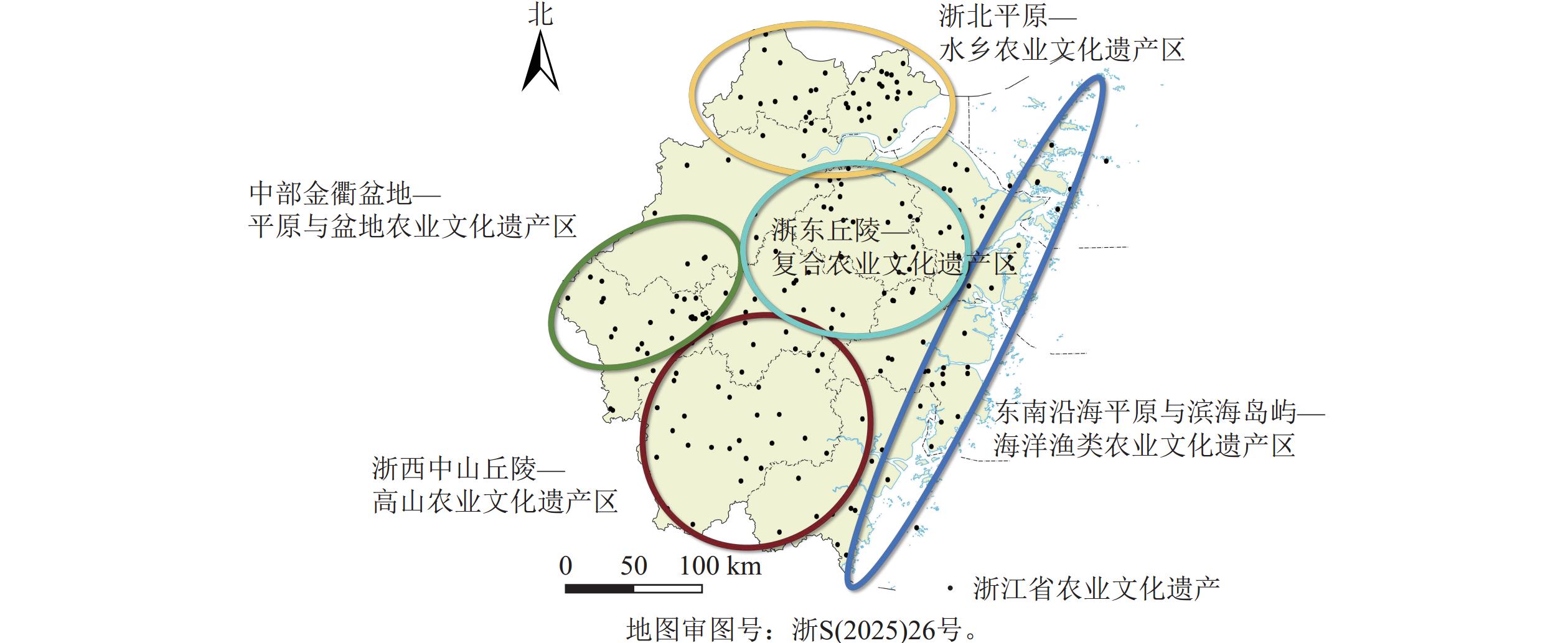
    • 根据农业文化遗产类型分类,浙江省205个重要农业文化遗产中,以特定农业物种为主,共182个,占浙江省重要农业文化遗产的88.78%。复合农业系统14个,水土保持系统2个,农田水利系统7个。然而,仅根据上述类型对浙江省农业文化遗产进行区别分类,难体现浙江省农业文化遗产在空间上的特征,因此根据其空间形态、集聚关系、农业生产特征,并结合浙江省特殊的地形,将农业文化遗产进行空间划分(图4)。
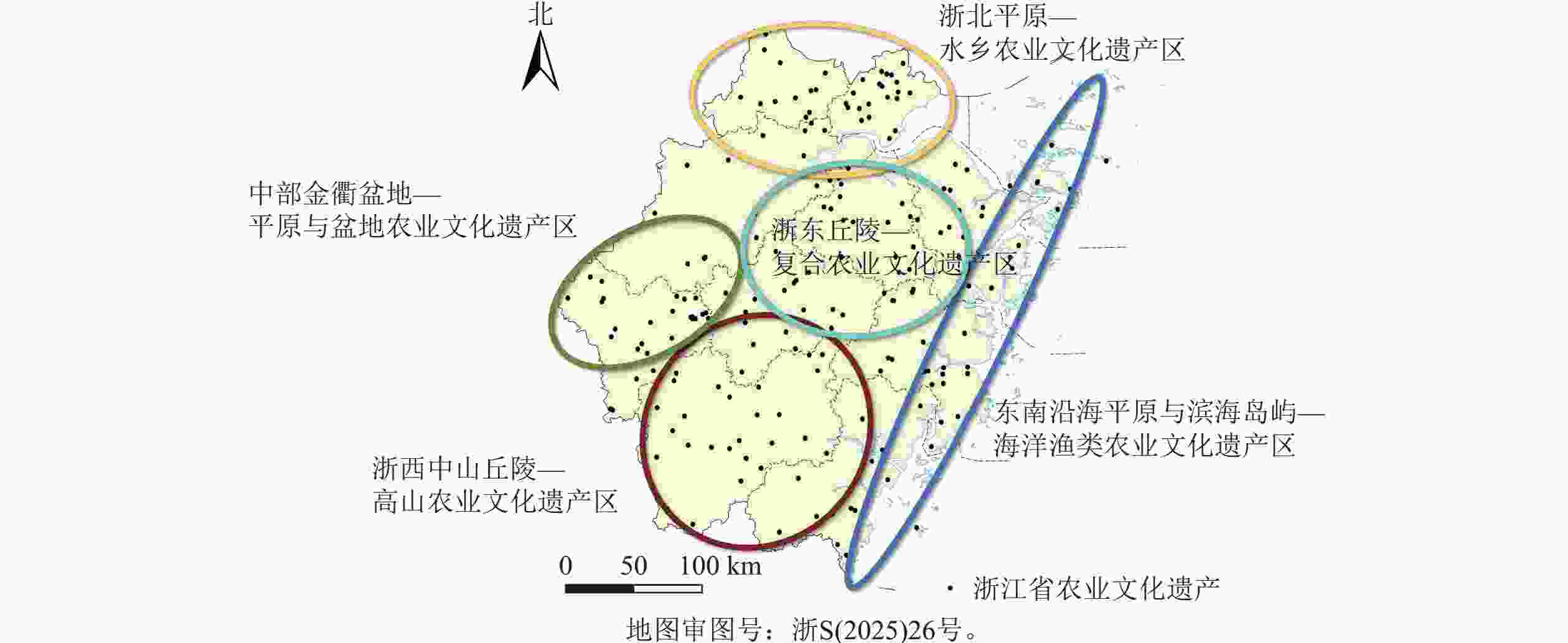
      Figure 4.  Schematic diagram of the spatial classification of agricultural heritage in Zhejiang Province

    • 该区是以丽水市为核心形成的农业遗产主要聚集区,地势较高,以中山、丘陵和山地为主,农业文化遗产分布高度集中。遗产地主要依托山区生态环境,农业文化与自然高度融合。受地形影响,农业文化遗产能较好体现传统山地农业利用方式,如梯田、山地果园、生态茶园等。农业模式依赖立体农业与原始生态环境,如丽水梯田农耕文化、衢州西部特色粮作系统等。该区域农业高度依赖自然生态环境,若开发过度,易引发水土流失与生物多样性下降。城镇化加速导致青壮年外流,农业劳动力不足,农业文化面临传承断层。以浙江青田稻鱼共生系统为例,该系统在评为全球重要农业文化遗产之初也面临生态系统不稳定、技术传承困境,系统濒临衰退。

    • 该区是以龙游县为核心的农业文化遗产聚集区,以盆地为主,地势平坦,土壤肥沃,适宜农作物种植,具有一定的区域集中性。遗产地多分布于河谷盆地及平原地带,孕育出大量复合养殖及多样化农作模式。该地区受史前文化影响,稻作文化突出,兼有果蔬种植、茶叶种植等农业文化传统,如金华火腿酿造技艺、浦江稻田综合种养系统等。然而,城市扩张对农田空间造成挤压,农业用地减少;同时,机械化普及使传统耕作与生态农业模式逐渐弱化,文化传承面临挑战。

    • 该区以杭嘉湖平原和宁绍平原为主,水网密布,适合水乡农耕文化发展,农业文化遗产主要分布于嘉兴西北部。遗产以低海拔平原农业系统为主,分布相对零散,但在局部区域形成聚集点。农业系统依托水系条件,具有典型的区域生态特征。虽遗产点分布较为零散,但在特定区域呈现聚集,如湖州桑基鱼塘系统、太湖湖羊养殖系统等,表现出养殖对象与耕作方式的高度关联。该区域外在农业形态差异大,但内部耕作逻辑一致性强。面临的主要问题包括水体污染风险增高,工业排放和农业污染造成水体富营养化,太湖水质恶化对湖州、嘉兴农业发展造成直接影响。

    • 该区覆盖台州、绍兴与宁波部分丘陵地区,以低山丘陵为主,农业文化遗产分布具有一定的局部集中性,有多个次级聚集点。受地形影响,农业模式多样,梯田、果树、茶园、竹林等生态农业景观较为典型。农业系统呈复合特征,地域性强,如绍兴香榧古树林、宁波鄞州雪菜、台州仙居杨梅体系等。城市扩张和矿山开发削弱农业景观完整性,特色农业产业链发展滞后,市场化程度低。以香榧系统为例,古树衰退与流通不畅导致产量下降、销售受阻,价格波动剧烈,农户利益受损。

    • 该区农业文化遗产主要分布于温州、舟山、宁波、台州等沿海地区,空间上虽分散,但文化特征鲜明。浙江海岸线曲折,滩涂成片,岛屿众多,海洋资源丰富,大陆与海洋的充分交融为众多滨海农业文化遗产的形成提供了自然条件。典型系统包括南麂列岛渔文化、温岭黄鱼、椒江围海养鱼、三门青蟹、宁海蛏子与牡蛎养殖、象山与普陀渔文化、嵊泗贻贝养殖等。当前海洋资源趋紧,滨海渔业系统在生态利用与传统技艺延续方面具有示范意义。然而,该区域同样面临生态退化、产业结构单一及文化传承断裂等问题,亟待系统性保护与创新性利用。

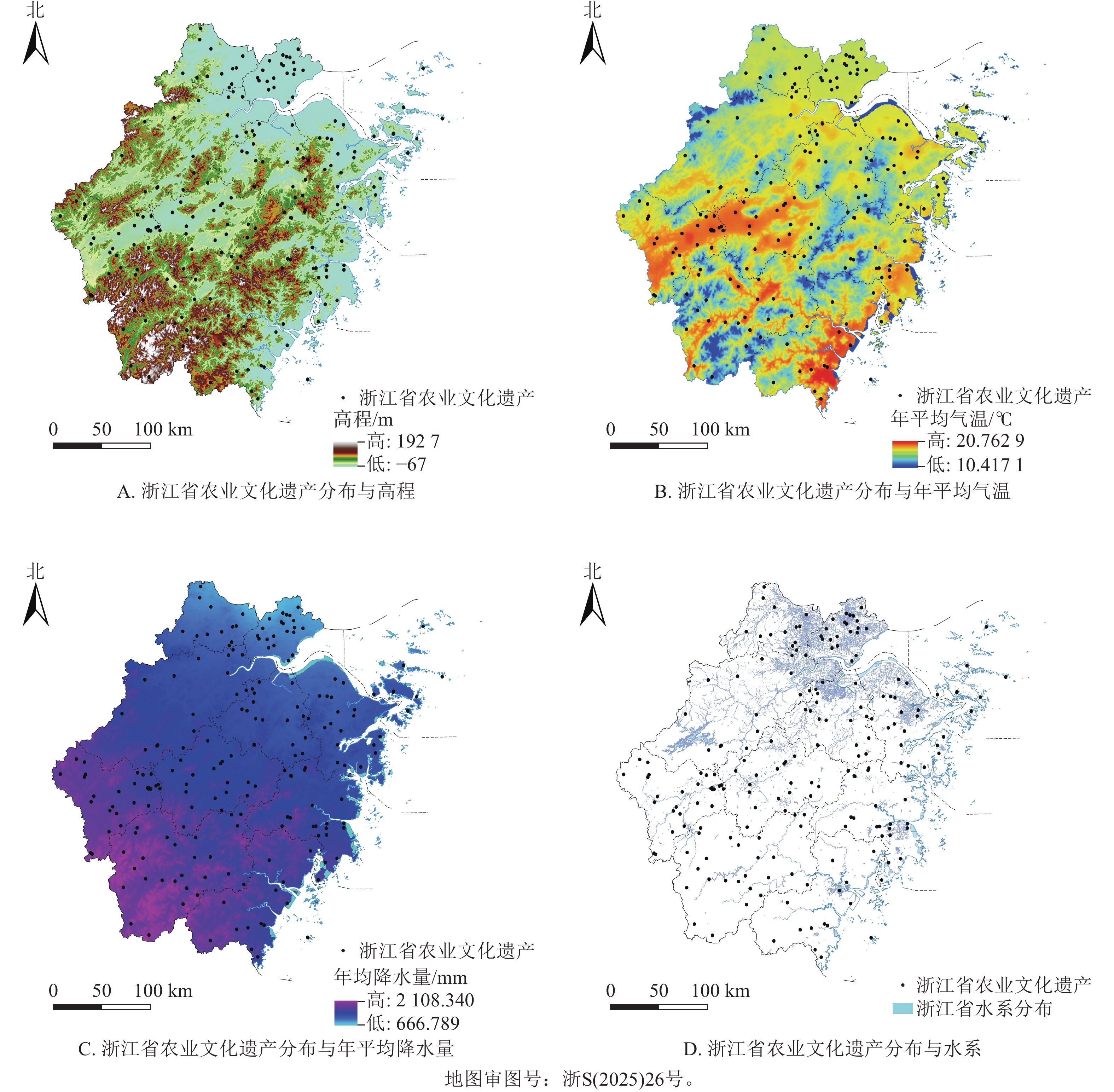
    • 浙江地貌以山地丘陵为主,平原较少,地形结构对农业文化遗产的空间分布具有显著影响。利用ArcGIS 10.2对浙江省DEM高程(图5A)进行分析,通过值提取至点工具将高程数据赋值到遗产点中,结果表明:分布在海拔0~200 m平坦地区的农业文化遗产有151个(占比73.66%),分布在海拔200~1 000 m有50个(占比24.39%),分布在海拔1 000 m以上有4个(占比1.95%)。可见浙江省农业文化遗产主要集中于低海拔平原地区,其次为丘陵地带,高海拔区域较为稀少。核密度计算结果发现:主要和次要农业文化遗产聚集区均位于海拔200 m以下的平原地区。嘉兴市的陆地面积仅占浙江省陆地面积的3.7%,但凭借平原地形优势,农业文化遗产数量位居全省第3位。相较之下,丽水市山地面积占比达 90.5%,农业文化遗产呈分散式分布。由此可见,高程因素对农业文化遗产的空间格局具有重要影响。
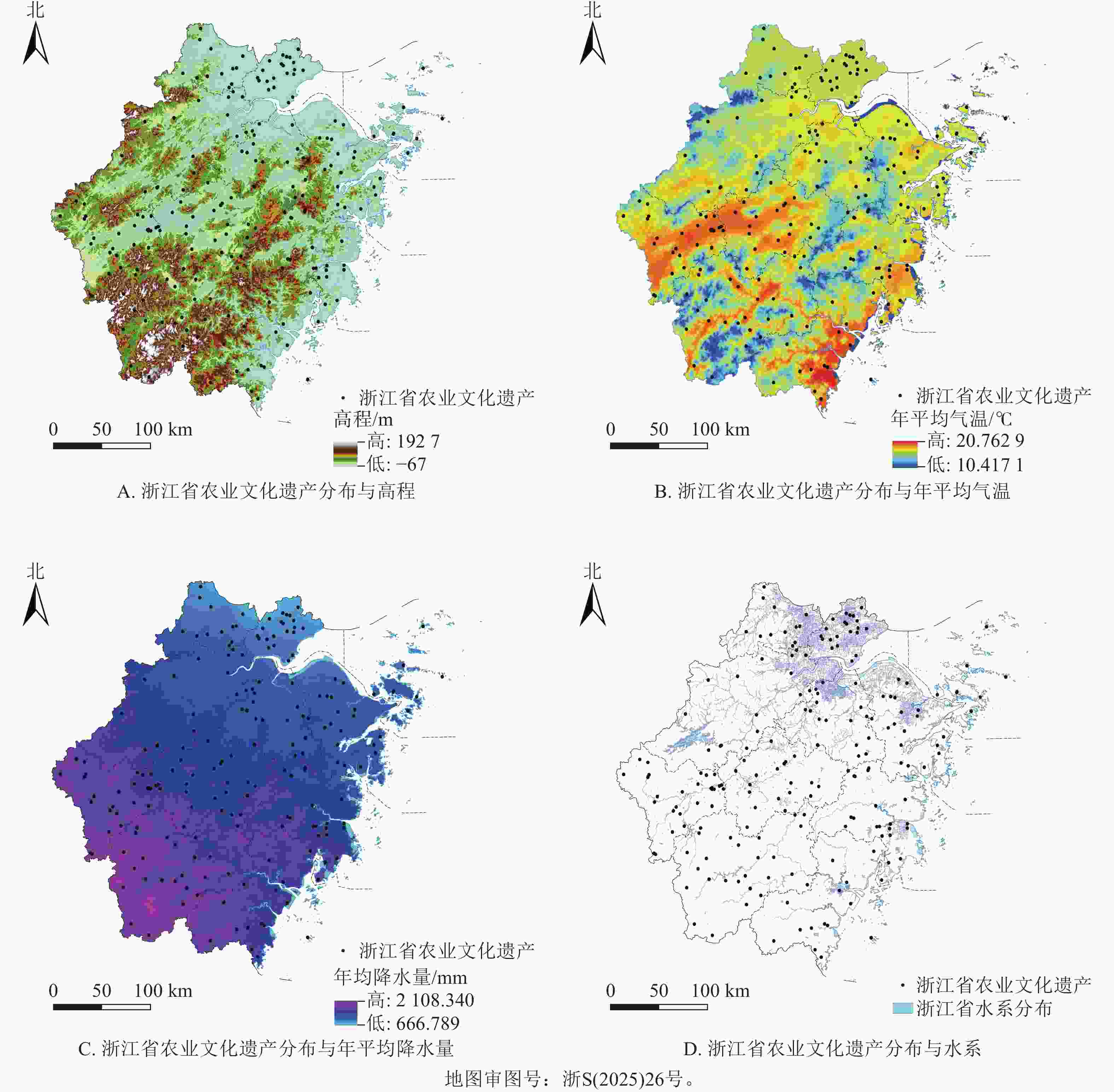
      Figure 5.  Distribution of agricultural heritage and its relationship with elevation, annual mean temperature, precipitation, and water systems in Zhejiang Province

    • 浙江省年平均气温为15.0~18.0 ℃,年平均降水量为1 100.0~1 900.0 mm,气候温暖湿润,具备孕育农耕文化的优异条件。利用ArcGIS 10.2分析浙江省年平均气温(图5B)和年平均降水量(图5C)特征,发现年平均降水量整体呈自东北沿海地带向西南部山地丘陵地带逐渐增高的趋势;年平均气温在浙江中西部、浙江南部沿海地区、浙江西南部盆地谷地地区呈3条较高温带,海拔较高地区以及部分滨海地区气温略低。利用ArcGIS 10.2,使用值提取至点工具提取205个农业文化遗产点的年平均气温和降水量数据。分析发现:处于年平均气温高于19.0 ℃区域的农业文化遗产共计25个,集中在上述3个较高温区域,年平均降水量为1 400.0~1 650.0 mm。处于年平均气温低于16.0 ℃区域的遗产点共计10个,其中茶类占60%,蜜蜂养殖占20%。结合浙江省山地平均气温较低的特征,推测茶类与蜜蜂养殖遗产点更趋于在海拔高的区域,与杭州市茶类农业文化遗产多处于海拔500 m以下的平原丘陵有异。浙江省农业文化遗产所在区域的年平均降水量差异较大,为900~2 000 mm。年平均降水量为1 200 mm区域的遗产点集中在嘉兴和宁波。同样是沿海城市的温州、台州因地形影响降水较少,农业文化遗产聚集程度较低。综上,浙江省农业文化遗产的分布受气候和地形影响显著。

    • 水资源对农业文化遗产起源、发展和可持续性至关重要。浙江省水系发达,河网密布,对农业文化遗产的分布格局产生重要影响。为探究其空间关系,制作浙江省农业文化遗产水系分布图(图5D),并利用ArcGIS 10.2中的缓冲区工具建立浙江省水系的多环缓冲区,再通过空间连接工具计算缓冲区内的农业文化遗产个数。结果显示:距河流5 km范围内有175个遗产点,5~10 km内19个,10~20 km内11个,20 km外无分布。94.63% 的遗产点分布在距水体10 km以内,表明其空间分布高度依赖水系资源。如钱塘江流域水系密集,形成了农业文化遗产的典型聚集带;衢州、丽水虽河网不密,但区域内河流众多,农业文化遗产沿河分布趋势明显。这表明浙江农业文化遗产的空间格局受水系影响显著,是其聚集的重要因素之一。

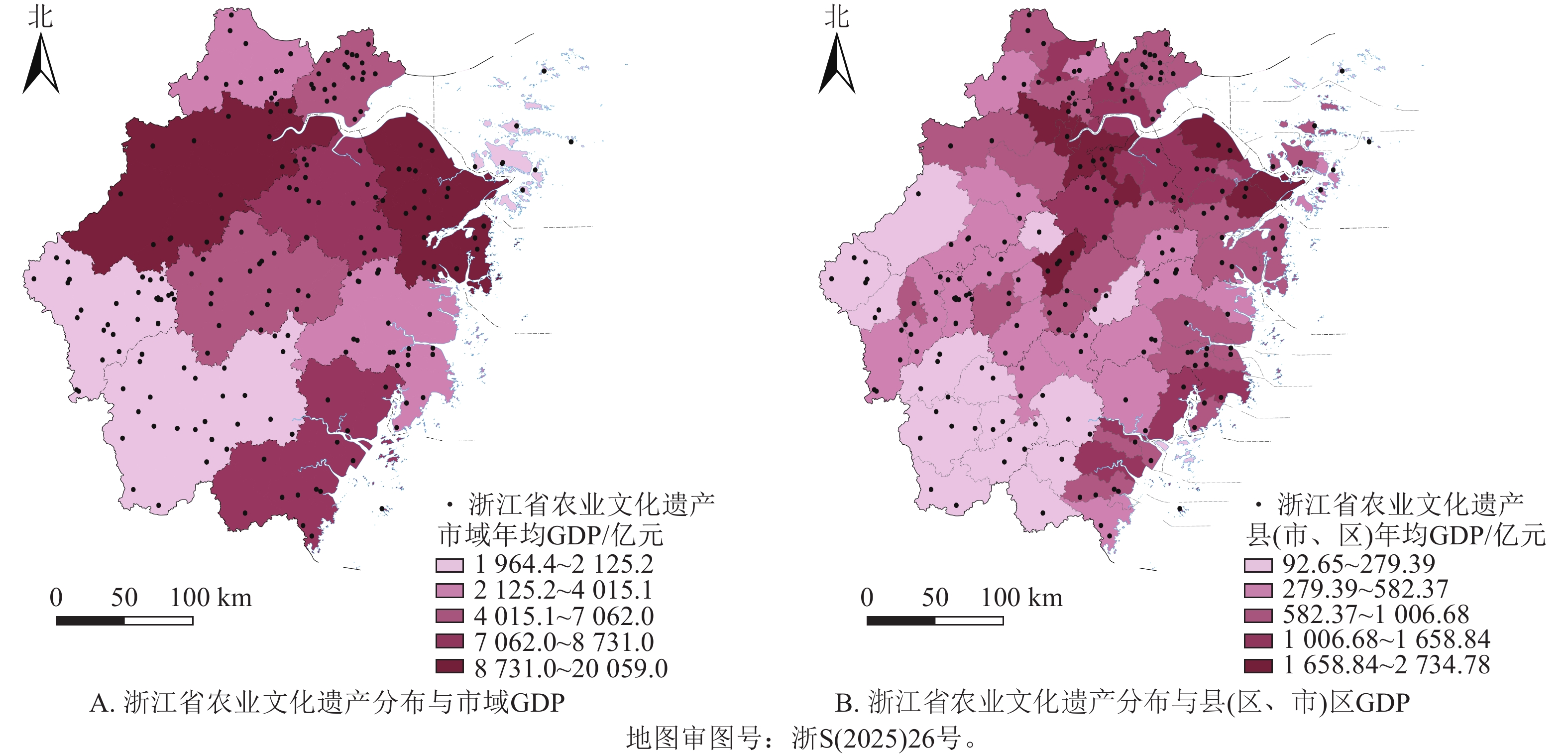
    • 根据2023年市域与各县(区、市)统计局的年GDP数据,并利用ArcGIS 10.2绘制浙江省各市域、县(区、市)GDP地图及农业文化遗产分布(图6)。结果可知:浙江北部GDP水平高于南部,沿海地区优于内陆,衢州、丽水、台州GDP相对较低。GDP可在一定程度上反映区域经济发展与居民生活水平。衢州有农业文化遗产29项,丽水27项,台州21项,且丽水拥有浙江最多的全球和全国农业文化遗产,可见经济水平影响农业文化遗产的分布。经济欠发达、城市化较低的地区,更易保持农业文化遗产的原始形态[36]。此外,浙江北部城市的总体GDP高于南部城市,即使在占地面积小于浙南地区的前提下,但农业文化遗产数量占全省45.86%,包括2项全球农业文化遗产,其数量和质量并不逊于南部,得益于政府在农业研究、博物馆建设、人才培养等方面的资金和政策投入。
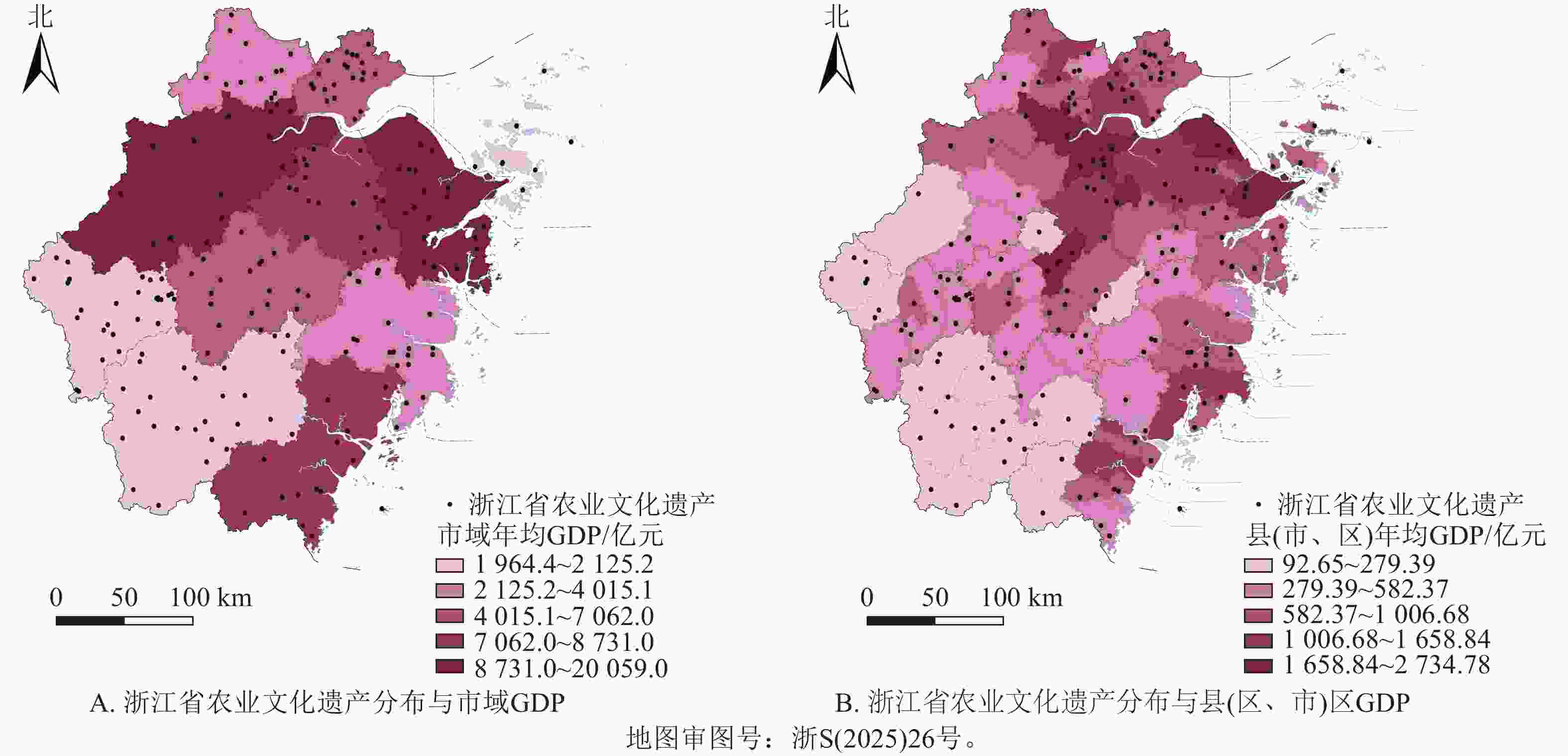
      Figure 6.  Distribution of agricultural heritage in relation to municipal and county (district, city) GDP in Zhejiang Province

    • 2023年城镇化率、常住人口数据显示:衢州、丽水与台州的城市化率分别为60.6%、64.6%、64.8%,是浙江省城镇化率较低的3个城市,亦是农业文化遗产数量较多的3个城市;常住人口分别为229.7万、282.8万、671.2万,其中衢州常住人口列全省倒数第3位,但农业文化遗产数量居全省首位。这表明较低的城镇化率与常驻人口虽在现代社会发展中属劣势,但对农业文化遗产的保留具有积极作用。城镇化水平较低意味着耕地资源与农业空间未被大规模占用,而人口稀疏则减少了对传统农业系统的人为干扰,有利于其完整性保护。

    • 农业文化遗产是地域历史文化的具体体现。浙江农耕文明历史悠久,上山、跨湖桥、河姆渡、崧泽、良渚等史前文化分布广泛,其中距今近1万年的上山文化分布在金衢盆地为中心的钱塘江上游及周边地区,其余主要分布在杭宁嘉湖区域,可见农耕文明悠久的区域与农业文化遗产聚集点在空间上具有一致性。农业文化遗产评定强调其应具有丰富的文化传承价值和人类与自然和谐共生状态。如青田稻鱼共生系统已有1 200年历史,并衍生出田鱼文化与鱼灯舞等艺术形式;湖州桑基鱼塘系统源于春秋战国时期“溇港横塘”水利工程,展现水乡智慧;绍兴会稽山香榧群则保留大量百年乃至千年古香榧树,反映出古代农耕智慧与长期积淀的文化传统。综上,浙江省农业文化遗产的分布特征和形成机制与历史文化因素密不可分。

    • 本研究根据2024年1月发布的《浙江省重要农业文化遗产资源库名录》,利用ArcGIS 10.2分析其地理空间分布形态与集聚格局,根据地形对农业文化遗产点进行空间分类,最后结合地理环境差异和社会经济数据分析影响浙江省农业文化遗产分布差异性的原因。主要结果与结论如下:①浙江省农业文化遗产空间分布不均衡,呈现整体分散、多点聚集的分布格局。②通过地理集中指数计算,在市域尺度上和县(区、市)尺度上集中程度高。③浙江省农业文化遗产点在空间上可分为浙西中山丘陵—高山农业文化遗产区、中部金衢盆地—平原与盆地农业文化遗产区、浙北平原—水乡农业文化遗产区、浙东丘陵—复合农业文化遗产区、东南沿海平原与滨海岛屿—海洋渔类农业文化遗产区。④浙江省农业文化遗产空间分布差异性受高程、气候、水系、GDP水平、人口、城镇化率、历史文化等多方面因素的耦合影响。

    • 自2005年浙江青田稻鱼共生系统被列为全球首批重要农业文化遗产保护试点以来,浙江省持续推进农业文化遗产保护与多维度研究,成为全国农业文化遗产发展的领先省份。因自然地理环境、生产方式和社会经济特征存在差异,本研究提出的浙江省五大农业文化遗产区的保护利用方式、现阶段的困境与未来发展机遇都有所不同。现从生态保护、经济社会、文化传承3个层面提出针对性建议。

    • 构建多尺度生态治理机制,保障遗产地生态系统的稳定性与可持续性。农业文化遗产地是生态多样性的重要组成部分,其生态功能正受环境压力影响。浙江省水系发达,建议建立水网生态监测体系,加强农业面源污染防控。省内海岸线蜿蜒绵长,沿海区域可推行限量作业,维系海洋生态。应制定专门保护政策,划定生态红线,实施分级管控,协调自然资源与人类活动,推动生态系统长期稳定。

    • 推动农业文化遗产与一二三产深度融合,实现资源价值转化与产业化发展。当前,农业文化遗产利用不足,经济效益未充分释放。浙江省经济发达,为农业文化遗产发展利用提供了良好条件。应依托农业文化遗产特色,构建“农—文—旅”融合链,提升附加值。对资源丰富但经济薄弱的浙中、浙西地区,应加强资金与人才支持,避免“有遗产、无发展”困局。农业文化遗产与乡村振兴的内涵具有高度一致性,两者可相结合发展。对于经济相对发达的浙北、浙东南沿海区域,可推动数字化赋能,实现遗产的活态利用与市场转化。

    • 建立以社区为核心的协同传承机制,激发农民主体性与文化内生动力。农业文化遗产承载着深厚的农耕知识与地方文化,当前面临传承主体流失与认知缺位的问题。农业文化遗产的文化传承需要遗产地的农民与其建立深刻的“地缘”关系,农民对农业文化遗产的认知极大影响了农业的参与度和生产力[37]。应推动村民深度参与,通过村民主导、政府支持的模式开展传承工作,并结合教育推广、公益活动提升认同感和参与度。鼓励青年与文化人才返乡创业,增强遗产地人口吸引力,构建城乡文化双向流动体系,确保文化传承持续发展。

      目前,中国农业文化遗产研究尚处起步阶段,体系与机制尚不成熟。与前人研究相比,本研究结果丰富了农业文化遗产空间结构研究的视角,为深入理解农业文化遗产的空间分布机制提供了综合性解释框架,但分析仍侧重宏观层面,且对社会变迁等深层机制探讨不足。后续研究可拓展区域与技术路径,提升研究深度与实践指导价值。

Reference (37)

Catalog

    /

    DownLoad:  Full-Size Img  PowerPoint
    Return
    Return