Turn off MathJax
Article Contents

WU Zhida, CAI Ouqi, LIN Yueyang, et al. Effects of exogenous melatonin and nitrogen application rate on yield and quality of sweet potatoes under natural high-temperature stress[J]. Journal of Zhejiang A&F University, 2026, 43(4): 1−13 doi:  10.11833/j.issn.2095-0756.20250583
Citation: WU Zhida, CAI Ouqi, LIN Yueyang, et al. Effects of exogenous melatonin and nitrogen application rate on yield and quality of sweet potatoes under natural high-temperature stress[J]. Journal of Zhejiang A&F University, 2026, 43(4): 1−13 doi:  10.11833/j.issn.2095-0756.20250583

OnlineFirst articles are published online before they appear in a regular issue of the journal. Please find and download the full texts via CNKI.

Effects of exogenous melatonin and nitrogen application rate on yield and quality of sweet potatoes under natural high-temperature stress

DOI: 10.11833/j.issn.2095-0756.20250583
  • Received Date: 2025-11-17
  • Accepted Date: 2026-05-25
  • Rev Recd Date: 2026-05-15
  •   Objective  Investigate the synergistic regulatory mechanism of exogenous melatonin and nitrogen application rate under high-temperature stress in sweet potatoes (Ipomoea batatas) and enhancing yield and quality formation, thereby providing a theoretical basis for heat-resistant sweet potato cultivation in the hilly and mountainous regions of southern Zhejiang.   Method  From 2023 to 2025, 3 exogenous melatonin concentrations with 0 (M0)、100 (M1)、200 (M2) μmol·L1 and 4 nitrogen application levels with 0 (N0)、75 (N1)、150 (N2)、225 (N3) kg·hm−2 were established to investigate the effects of different treatments on antioxidant enzyme activities, membrane lipid peroxidation, photosynthetic characteristics, carbon and nitrogen metabolism, root morphology and physiology, yield, quality, and economic benefits of sweet potato leaves under high-temperature stress.   Result  Under high-temperature stress, the activities of superoxide dismutase (SOD) and peroxidase (POD), net photosynthetic rate (Pn), maximum photochemical efficiency (Fv/Fm), as well as the activities of nitrate reductase (NR), sucrose phosphate synthase (SPS), and sucrose synthase (SS) in sweet potatoes leaves all exhibited a decreasing trend with the prolongation of stress duration, while the malondialdehyde (MDA) content continuously increased. Taking the 20th day of stress as an example, compared with M0N0, the M1N2 treatment significantly increased SOD and POD activities, thereby enhancing Pn and Fv/Fm, promoting the activities of NR, SPS, and SS, while reducing MDA content. After the cessation of high-temperature stress, compared with M0N0, the M1N2 treatment significantly increased root length and root activity. Ultimately, it significantly improved yield, quality, and economic benefits. Correlation analysis indicated that yield and quality were extremely significantly negatively correlated with MDA, and extremely significantly positively correlated with all other indicators(P<0.01). Membership function analysis identified M1N2 as the optimal treatment.   Conclusion  Foliar spraying of 100 μmol·L−1 melatonin along with 150 kg·hm−2 nitrogen effectively enhances leaf antioxidant capacity, alleviates membrane lipid peroxidation, and sustains photosynthesis of sweet potatoes under high-temperature stress. This synergistic regulation improves carbon-nitrogen metabolic balance, root development, yield, quality, and economic returns, supporting its application in the hilly areas of southern Zhejiang. [Ch, 9 fig. 7 tab. 36 ref.]
  • [1] QI Peiyun, XIE Yuxuan, XU Caini, WANG Qianqian, ZHU Xiangtao, CHEN Xia.  Expression characteristics and functional analysis of PsTRX1 gene inPaeonia suffruticosa in response to high temperature stress . Journal of Zhejiang A&F University, doi: 10.11833/j.issn.2095-0756.20250457
    [2] WANG Liyun, SUN Jian, CHEN Mengying, YAO Hui, ZHOU Shuideng, WANG Haige, WANG Pan, XU Kaijie, WANG Zhian.  Genetic diversity and quality characteristics of Angelica dahurica in different producing areas . Journal of Zhejiang A&F University, doi: 10.11833/j.issn.2095-0756.20220427
    [3] SONG Peng, LI Hui, JIANG Houlong, ZHAO Pengyu, LI Lixiang, ZHAO Biao, ZHANG Jun.  Effect of biochar-based fertilizer on root development, yield and quality of flue-cured tobacco in Chongqing tobacco growing area . Journal of Zhejiang A&F University, doi: 10.11833/j.issn.2095-0756.20230161
    [4] ZHOU Shuideng, SUN Jian, JIANG Jianming, SHAO Jiangwei, DENG Huimin, SHAO Qingsong, WANG Zhi’an.  Effects of fertilization at different growth stages on yield and quality of Fritillaria thunbergii . Journal of Zhejiang A&F University, doi: 10.11833/j.issn.2095-0756.20220613
    [5] HAO Lihui, DONG Bin, ZHU Shaohua, MA Jin.  Transcriptome analysis and PsHSP gene expression of Paeonia suffruticosa in response to high temperature stress . Journal of Zhejiang A&F University, doi: 10.11833/j.issn.2095-0756.20200529
    [6] LIU Zheng, HU Suntian, SHEN Xiaofei, ZHU Pei, CHU Xudong, LI Zhuoya, LUO Ping.  Alleviation of exogenous melatonin on rose seedlings under salt stress . Journal of Zhejiang A&F University, doi: 10.11833/j.issn.2095-0756.20190604
    [7] BAI Rongrong, GAO Yanming, LI Jianshe, WANG Lan, ZHANG Xue, LIU Junli.  Mineral element absorption, distribution, and growth of nutrient film technique cultured tomatoes with varying nutrient solution ratios . Journal of Zhejiang A&F University, doi: 10.11833/j.issn.2095-0756.2019.06.020
    [8] LUO Tongtong, PANG Tianhong, MA Ji, LI Hui, QIU Xiaoting, HUANG Fangfang, DU Changxia.  Melatonin for cut flower preservation with Rosa hybrida 'Corolla' . Journal of Zhejiang A&F University, doi: 10.11833/j.issn.2095-0756.2018.05.025
    [9] YIN Cui, SUN Lixin, DONG Yan, CAO Zhen, ZHANG Yahong.  Growth, development, and quality of red globe grapes using root-zone soil heating in a plastic greenhouse . Journal of Zhejiang A&F University, doi: 10.11833/j.issn.2095-0756.2016.06.024
    [10] JIA Sizhen, YANG Hengwei, YAN Zhiming, WEI Yue.  Physiological and biochemical indexes of exogenous salicylic acid on chrysanthemum seedlings with high temperature stress . Journal of Zhejiang A&F University, doi: 10.11833/j.issn.2095-0756.2016.03.011
    [11] GONG Zhongxing, HE Yong, ZHU Zhujun.  Heat resistance of Salvia splendens with salicylic acid added and high temperature stress . Journal of Zhejiang A&F University, doi: 10.11833/j.issn.2095-0756.2015.05.007
    [12] SUN Ying, WANG Xudong, WANG Ying, PAN Wujie, LU Rongjie, RUAN Zhongqiang, TU Wenwen.  Soil available nutrients and rice yield with silicon and phosphorus fertilization . Journal of Zhejiang A&F University, doi: 10.11833/j.issn.2095-0756.2015.04.009
    [13] CHEN Feng, SU Shuchai, ZHANG Bing, CHEN Zhigang, WANG Wenhao.  Hazelnut yield and fruit quality with foliar N, P, K fertilizer . Journal of Zhejiang A&F University, doi: 10.11833/j.issn.2095-0756.2014.06.016
    [14] WU Genliang, ZHENG Jirong, LI Xuke.  Effect of different LED sources on the quality and yield of overwintering pepper in the greenhouse . Journal of Zhejiang A&F University, doi: 10.11833/j.issn.2095-0756.2014.02.013
    [15] ZHU Lan, LI Xue-qin, JIA Xiao-lin, WANG Bin, JIN Song-heng.  High temperature stress with photosynthesis in Festuca arundinacea . Journal of Zhejiang A&F University,
    [16] ZUO Ji-lin, GONG Chun, WANG Jian-ping, ZHOU Wen-cai, WEN Qiang, XU Lin-chu.  Evaluation on quality of twenty-five clones of Camellia oleifera Group Gan . Journal of Zhejiang A&F University,
    [17] CAO Fu-liang, OU Zu-lan.  Ginkgo biloba seedling tolerance to high-temperature stress using salicylic acid . Journal of Zhejiang A&F University,
    [18] LI Ji-yuan, LI Xin-lei, FAN Miao-hua, TIAN Min, FAN Zheng-qi.  Heat tolerance of 15 Camellia cultivars under heat stress . Journal of Zhejiang A&F University,
    [19] MENG Ci-fu, JIANG Pei-kun, CAO Zhi-hong, XU Qiu-fang, ZHOU Guo-mo.  Boron nutrition and application to Myrica rubra . Journal of Zhejiang A&F University,
    [20] Wang Zhaomin, Zhang Jianzhong, Ni Rong xin, Chen Yiliang, Wu Longgao, Wang Weian, Chen Xilian.  Analysis of the Factors Affecting Output and Quality of Seeds From Chinese Fir Seed Orchard. . Journal of Zhejiang A&F University,
  • [1]
    SHU Sufang, LU Xiang, FAN Yuyue, et al. Analysis of temperature evolution and low-temperature disaster characteristics at flowering stage of Cuiguan pear in Jinhua, Zhejiang Province[J]. South China Fruits, 2024, 53(2): 159−162. DOI: 10.13938/j.issn.1007-1431.20230178.
    [2]
    SHAO Zhengwei. Molecular Mechanism of High Temperature on Tuberous Roots Formation of Sweet Potato [Ipomoea batatas (L.) Lam][D]. Zhanjiang: Guangdong Ocean University, 2022. DOI: 10.27788/d.cnki.ggdhy.2022.000224.
    [3]
    YANG Jun, ZHANG Yizhi, DUAN Licheng, et al. Effects of spraying different exogenous substances on physiological characteristics, and yield of single-season rice under high temperature condition[J]. Chinese Journal of Eco-Agriculture, 2026, 34(4): 864−875. DOI: 10.12357/cjea.20250924.0944.001.
    [4]
    GUO Jia, XIONG Dingwei, YANG Lijuan, et al. Effects of 2, 4-epibrassinolide and arbuscular mycorrhizal fungi on photosynthetic characteristics and hormone metabolism of Rhododendron hybridum under high temperature stress[J]. Journal of Henan Agricultural Sciences, 2025, 54(10): 110−120. DOI: 10.15933/j.cnki.1004-3268.2025.10.012.
    [5]
    LIU Xiaolong, YE Shihe, LIAO Junjie, et al. Effect of heat stress during early filling stage on ROS accumulation and yield formation in rice grain[J]. Journal of Northwest A&F University (Natural Science Edition), 2024, 52(5): 33−47. DOI: 10.13207/j.cnki.jnwafu.2024.05.004.
    [6]
    YANG Keming, LI Haifeng, Huxidan Maimaiti, et al. The effect of prohexadione-calcium on physiological growth, yield and quality of cantaloupe under high temperature stress[J]. Acta Agriculturae Boreali-Sinica, 2025, 40(4): 85−95. DOI: 10.7668/hbnxb.20195650.
    [7]
    ARNAO M B, HERNÁNDEZ-RUIZ J. Melatonin: a new plant hormone and/or a plant master regulator?[J]. Trends in Plant Science, 2019, 24(1): 38−48. DOI: 10.1016/j.tplants.2018.10.010.
    [8]
    LI Guoying, DAI Hongjun. Effects of exogenous hormones on leaf photosynthetic performance and fruit quality of Cabernet Sauvignon grape under high temperature stress[J]. Journal of Southern Agriculture, 2024, 55(8): 2277−2285. DOI: 10.3969/j.issn.2095-1191.2024.08.007.
    [9]
    ZHANG Tingyu, ZHANG Mingru, LI Qingxiang, et al. Effects of light intensity and nitrogen treatments on photosynthetic characteristics of Stewartia sinensis seedlings[J]. Journal of Zhejiang A&F University, 2022, 39(6): 1247−1256. DOI: 10.11833/j.issn.2095-0756.20210771.
    [10]
    AHMAD S, SU Wennan, KAMRAN M, et al. Foliar application of melatonin delay leaf senescence in maize by improving the antioxidant defense system and enhancing photosynthetic capacity under semi-arid regions[J]. Protoplasma, 2020, 257(4): 1079−1092. DOI: 10.1007/s00709-020-01491-3.
    [11]
    LI Zhitao, MA Wenjing, ZHU Jinyong, et al. Effects of different field water capacity on root system characteristics and yield of potato under drip irrigation with plastic mulch[J]. Acta Agriculturae Boreali-Sinica, 2022, 37(suppl 1): 161−171. DOI: 10.7668/hbnxb.20193047.
    [12]
    YANG Xinyue, XIAO Renhao, ZHANG Linxi, et al. Effects of waterlogging at different growth stages on the stress-resistance physiological characteristics and yield formation of sweet potato[J]. Acta Agronomica Sinica, 2025, 51(3): 744−754. DOI: 10.3724/SP.J.1006.2025.44116.
    [13]
    WU Hao, HE Jinping, LIAO Zhaoxia, et al. Effects of drought and re-watering on reactive oxygen species metabolism and endogenous hormones in sweet potato roots during tuberous root differentiation and formation stage[J]. Crops, 2026(1): 111−117. DOI: 10.16035/j.issn.1001-7283.2026.01.014.
    [14]
    LIU Ying, WAN Liqiang, HAI Meirong. Effects of exogenous melatonin on leaf antioxidant and hydrogen peroxide in potato seedlings under UV-B radiation[J]. Jiangsu Agricultural Sciences, 2023, 51(9): 60−67. DOI: 10.15889/j.issn.1002-1302.2023.09.008.
    [15]
    SU Ming, WANG Hua, HONG Ziqiang, et al. Effect of nitrogen fertilizer application on the growth and yield of maize under high temperature stress during flowering period[J]. Journal of Northwest A&F University (Natural Science Edition), 2026, 54(2): 45−55. DOI: 10.13207/j.jnwafu.2026.02.005.
    [16]
    MAACH M, BAGHOUR M, AKODAD M, et al. Overexpression of LeNHX4 improved yield, fruit quality and salt tolerance in tomato plants (Solanum lycopersicum L.)[J]. Molecular Biology Reports, 2020, 47(6): 4145−4153. DOI: 10.1007/s11033-020-05499-z.
    [17]
    GUO Aihua. Influences of exogenous melatonin on seedling growth of Sonchus oleraceus L. under salt stress[J]. Jiangsu Agricultural Sciences, 2022, 50(13): 153−157. DOI: 10.15889/j.issn.1002-1302.2022.13.025.
    [18]
    HIGASHI Y, SAITO K. Lipidomic studies of membrane glycerolipids in plant leaves under heat stress[J]. Progress in Lipid Research, 2019, 75: 100990. DOI: 10.1016/j.plipres.2019.100990.
    [19]
    MI Meiduo, MU Yu, DAI Xiaohua, et al. Effects of different nitrogen application rates on antioxidant characteristics of spring wheat under high temperature stress after anthesis[J]. Jiangsu Agricultural Sciences, 2017, 45(1): 52−56. DOI: 10.15889/j.issn.1002-1302.2017.01.015.
    [20]
    LUIS CASTAÑARES J, ALBERTO BOUZO C. Effect of exogenous melatonin on seed germination and seedling growth in melon (Cucumis melo L.) under salt stress[J]. Horticultural Plant Journal, 2019, 5(2): 79−87. DOI: 10.1016/j.hpj.2019.01.002.
    [21]
    YANG Yuanling, LIU Huiying, GUAN Sihui, et al. Effects of exogenous melatonin on photosynthetic and antioxidant properties of young seedlings under salt stress conditions in pomegranate[J]. Journal of Fruit Science, 2025, 42(2): 360−375. DOI: 10.13925/j.cnki.gsxb.20240458.
    [22]
    GU Yuqian, SHANG Kaixi, HU Junqing, et al. Effects of melatonin treatment on the growth and photosynthesis of Solanum tuberosum L. under salt stress[J]. China Cucurbits and Vegetables, 2025, 38(12): 102−109. DOI: 10.16861/j.cnki.zggc.2025.0224.
    [23]
    YI Zifeng, DUAN Shaoguang, BIAN Chunsong, et al. Response of potato photosynthesis, nitrogen metabolism and yield to water and nitrogen management[J]. China Vegetables, 2025(2): 82−93. DOI: 10.19928/j.cnki.1000-6346.2024.4027.
    [24]
    YU Mengqi, LU Mengli, ZHANG Yating, et al. Regulation of melatonin on photosynthetic characteristics and antioxidant enzyme activities in maize leaves under high temperature stress condition[J]. Journal of Maize Sciences, 2024, 32(1): 90−99. DOI: 10.13597/j.cnki.maize.science.20240112.
    [25]
    ZHANG Haiwei, GU Xinyi, CHEN Mingshuai, et al. Effects of nitrogen type of basal fertilizer on growth, grain yield and nitrogen use efficiency of ratooning rice[J]. Chinese Journal of Rice Science, 2025, 39(3): 387−398. DOI: 10.16819/j.1001-7216.2025.240507.
    [26]
    ZHANG Yupeng, ZHOU Guomo, ZHOU Yufeng, et al. Photosynthetic characteristics of five common tree species in response to extreme heat[J]. Journal of Zhejiang A&F University, 2017, 34(2): 301−309. DOI: 10.11833/j.issn.2095-0756.2017.02.014.
    [27]
    CAO Liang, DU Xin, YU Gaobo, et al. Regulation of carbon and nitrogen metabolism in leaf of soybean cultivar Suinong 26 at seed-filling stage under drought stress by exogenous melatonin[J]. Acta Agronomica Sinica, 2021, 47(9): 1779−1790. DOI: 10.3724/SP.J.1006.2021.04151.
    [28]
    YANG Zi, YU Jing, SUN Jingjie, et al. Effects of nitrogen application on potato development and carbon and nitrogen metabolism[J]. Journal of Inner Mongolia Agricultural University (Natural Science Edition), 2025, 46(3): 14−19, 61. DOI: 10.16853/j.cnki.1009-3575.2025.03.002.
    [29]
    ZENG Mingqian, WU Lijun, ZHOU Wei, et al. Effects of nitrogen application and high-temperature stress on root configuration and physiological indices of Rhododendron seedlings[J]. Chinese Journal of Ecology, 2025, 44(2): 451−459. DOI: 10.13292/j.1000-4890.202502.021.
    [30]
    KHAN Z, JAN R, ASIF S, et al. Exogenous melatonin induces salt and drought stress tolerance in rice by promoting plant growth and defense system[J]. Scientific Reports, 2024, 14: 1214. DOI: 10.1038/s41598-024-51369-0.
    [31]
    GU Fan, JI Mengcheng, GU Cuihua, et al. Heat and drought stress with an antioxidant defense system in Heimia myrtifolia[J]. Journal of Zhejiang A&F University, 2019, 36(5): 894−901. DOI: 10.11833/j.issn.2095-0756.2019.05.007.
    [32]
    FENG Mei, OUYANG Shengnan, SAURER M, et al. Effects of previous nitrogen addition on aboveground and belowground carbon and nitrogen allocation dynamics in drought-exposed sessile oak seedlings[J]. Chinese Journal of Plant Ecology, 2025, 49(9): 1527−1542. DOI: 10.17521/cjpe.2024.0218.
    [33]
    WEI Hongjian, HE Wenyuan, WANG Yue, et al. The effects of arbuscular mycorrhizal fungi and melatonin on heat tolerance of perennial ryegrass[J]. Acta Prataculturae Sinica, 2023, 32(12): 126−138. DOI: 10.11686/cyxb2023129.
    [34]
    IQBAL S, HAYAT F, HUSSAIN M, et al. Melatonin supplementation alleviates drought stress in peach (Prunus persica) seedlings by improving photosynthesis, root morphological traits, and antioxidant defense system[J]. Acta Physiologiae Plantarum, 2024, 46(2): 18. DOI: 10.1007/s11738-023-03634-4.
    [35]
    WANG Bin, TIAN Zhengfeng, YING Binbin, et al. Photosynthetic abilities in Cinnamomum camphora with high temperature stress[J]. Journal of Zhejiang A&F University, 2019, 36(1): 47−53. DOI: 10.11833/j.issn.2095-0756.2019.01.007.
    [36]
    WANG Rui, LI Xiangling, GUO Dong, et al. Effects of application nitrogen on carbon and nitrogen metabolism of summer maize grain under post-silking heat stress[J]. Acta Agronomica Sinica, 2023, 49(12): 3342−3351. DOI: 10.3724/SP.J.1006.2023.33003.
  • 加载中
通讯作者: 陈斌, bchen63@163.com
  • 1. 

    沈阳化工大学材料科学与工程学院 沈阳 110142

  1. 本站搜索
  2. 百度学术搜索
  3. 万方数据库搜索
  4. CNKI搜索

Figures(9)  / Tables(7)

Article views(63) PDF downloads(9) Cited by()

Related
Proportional views

Effects of exogenous melatonin and nitrogen application rate on yield and quality of sweet potatoes under natural high-temperature stress

doi: 10.11833/j.issn.2095-0756.20250583

Abstract:   Objective  Investigate the synergistic regulatory mechanism of exogenous melatonin and nitrogen application rate under high-temperature stress in sweet potatoes (Ipomoea batatas) and enhancing yield and quality formation, thereby providing a theoretical basis for heat-resistant sweet potato cultivation in the hilly and mountainous regions of southern Zhejiang.   Method  From 2023 to 2025, 3 exogenous melatonin concentrations with 0 (M0)、100 (M1)、200 (M2) μmol·L1 and 4 nitrogen application levels with 0 (N0)、75 (N1)、150 (N2)、225 (N3) kg·hm−2 were established to investigate the effects of different treatments on antioxidant enzyme activities, membrane lipid peroxidation, photosynthetic characteristics, carbon and nitrogen metabolism, root morphology and physiology, yield, quality, and economic benefits of sweet potato leaves under high-temperature stress.   Result  Under high-temperature stress, the activities of superoxide dismutase (SOD) and peroxidase (POD), net photosynthetic rate (Pn), maximum photochemical efficiency (Fv/Fm), as well as the activities of nitrate reductase (NR), sucrose phosphate synthase (SPS), and sucrose synthase (SS) in sweet potatoes leaves all exhibited a decreasing trend with the prolongation of stress duration, while the malondialdehyde (MDA) content continuously increased. Taking the 20th day of stress as an example, compared with M0N0, the M1N2 treatment significantly increased SOD and POD activities, thereby enhancing Pn and Fv/Fm, promoting the activities of NR, SPS, and SS, while reducing MDA content. After the cessation of high-temperature stress, compared with M0N0, the M1N2 treatment significantly increased root length and root activity. Ultimately, it significantly improved yield, quality, and economic benefits. Correlation analysis indicated that yield and quality were extremely significantly negatively correlated with MDA, and extremely significantly positively correlated with all other indicators(P<0.01). Membership function analysis identified M1N2 as the optimal treatment.   Conclusion  Foliar spraying of 100 μmol·L−1 melatonin along with 150 kg·hm−2 nitrogen effectively enhances leaf antioxidant capacity, alleviates membrane lipid peroxidation, and sustains photosynthesis of sweet potatoes under high-temperature stress. This synergistic regulation improves carbon-nitrogen metabolic balance, root development, yield, quality, and economic returns, supporting its application in the hilly areas of southern Zhejiang. [Ch, 9 fig. 7 tab. 36 ref.]

WU Zhida, CAI Ouqi, LIN Yueyang, et al. Effects of exogenous melatonin and nitrogen application rate on yield and quality of sweet potatoes under natural high-temperature stress[J]. Journal of Zhejiang A&F University, 2026, 43(4): 1−13 doi:  10.11833/j.issn.2095-0756.20250583
Citation: WU Zhida, CAI Ouqi, LIN Yueyang, et al. Effects of exogenous melatonin and nitrogen application rate on yield and quality of sweet potatoes under natural high-temperature stress[J]. Journal of Zhejiang A&F University, 2026, 43(4): 1−13 doi:  10.11833/j.issn.2095-0756.20250583
  • 甘薯Ipomoea batatas作为全球重要的粮食、饲料和工业原料兼用作物,其生产的稳定对于保障粮食安全具有重要作用。中国浙南丘陵山区的泰顺县,素有“浙南薯仓”之称,甘薯种植面积达0.8万 hm2,占全县旱地作物面积的60%。然而,受全球气候变化的影响,该地区夏季高温频发且日趋严重。气象资料表明:2020年以来,该地区7—9月35 ℃以上高温逐年增多,2022年夏季高温天数达22 d,2023年夏季出现持续近20 d的极端高温[1]。持续高温环境会严重抑制甘薯块根生长发育,易造成薯块形态畸形,致使产量与品质大幅降低,已对区域甘薯安全生产及农户经济收益造成严峻威胁[2]。因此,探明高温胁迫下甘薯产量品质形成的限制因素并寻求有效调控途径,对稳定区域甘薯产量和保障种植经济效益具有重要现实意义。

    高温胁迫会多方面抑制作物的生理代谢与产量形成[3]。当温度持续超过作物适宜范围时,光合系统结构会受损,导致净光合速率(Pn)和PSⅡ最大光化学效率(Fv/Fm)下降,光合产物积累减少[4]。同时,高温引发活性氧(ROS)代谢失衡,造成丙二醛(MDA)升高和细胞膜透性增大[5]。作物虽可通过提高抗氧化酶活性以清除过量ROS,但持续胁迫会超出作物自我调节能力,导致抗氧化系统功能衰退、植株衰老进程加快,最终造成产量与品质降低[6]。外源植物生长调节物质是缓解高温胁迫的有效途径之一。研究表明:喷施适宜浓度褪黑素可作为抗氧化剂直接清除ROS,并能上调抗氧化酶基因表达,减轻膜脂过氧化,维持细胞膜完整性[7]。褪黑素还能改善高温下的光合性能,延缓叶绿素降解,并通过调节蔗糖磷酸合成酶(SPS)和蔗糖合成酶(SS)等碳氮代谢关键酶活性,促进光合产物向贮藏器官转运与分配,从而提升作物产量和品质[8]。氮素营养在增强作物耐热性方面同样关键。合理施氮可缓解高温对保护酶活性的抑制,减缓叶绿素与光合参数的下降,维持光合生产能力[9]。适量氮肥还能增强抗氧化防御、延缓叶片衰老,并通过促进蔗糖合成酶活性增强库器官竞争能力,进而提高经济产量[10]

    目前,关于褪黑素与氮素协同缓解高温胁迫的研究多以三大粮食作物为主,针对甘薯花后高温缓解措施的报道较为缺乏。因此,本研究以浙南主栽甘薯品种‘浙薯13号’‘Zheshu 13’为材料,设置不同褪黑素浓度与施氮量的双因素裂区试验,研究高温胁迫下甘薯抗氧化特性、光合性能、碳氮代谢酶活性、根系形态生理及产量品质的响应,重点阐明褪黑素与氮素协同调控甘薯耐热性的生理机制与互作效应,以期为浙南丘陵区甘薯抗高温栽培提供理论依据与技术指导。

    • 试验于2023年5月至2025年10月在浙江省温州市泰顺县蔡欧祈家庭农场(27°33′N,119°42′E)进行。该农场位于浙南丘陵山区,属亚热带季风气候,试验期间年均气温为18.5 ℃,年降水量约1 900.0 mm。7—9月为高温胁迫关键期,月平均最高气温为33.0~35.0 ℃,极端最高气温可达38.5 ℃。试验地为丘陵坡地红壤,土壤肥力均匀,属中等偏下水平,是浙南山区典型的甘薯种植土壤条件,研究区0~40 cm土层的土壤基础理化性质如表1所示。

      土层/cm pH 有机质/(g·kg−1) 全氮/
      (g·kg−1)
      碱解氮/
      (mg·kg−1)
      速效磷/
      (mg·kg−1)
      速效钾/
      (mg·kg−1)
      0~20 6.32 16.82 1.38 92.54 18.60 105.28
      20~40 6.45 14.36 1.02 68.75 12.49 84.62

      Table 1.  Basic physical and chemical properties of soil in the study area

    • 试验品种为‘浙薯13号’,小垄单行种植,垄距为0.75 m,垄高为25.00~30.00 cm,株距约0.30 m。采用双因素裂区设计,因素1为外源褪黑素:0 (M0)、100 (M1)、200 (M2) μmol·L−1;因素2为施氮水平:0 (N0)、75 (N1)、150 (N2)、225 (N3) kg·hm2,试验共计12个处理,每处理3次重复,小区面积为60 m2(10 m×6 m),小区间设1 m保护行,随机排列。于移栽后30 d开始启动持续21 d的高温胁迫,在每日10:00—16:00通过智能温控系统维持棚内温度35~38 ℃,当棚内温度超过38 ℃时,自动开启棚体两侧通风口辅助降温,棚内悬挂自动温湿度记录仪,隔30 min采集并存储1组数据(表2)。外源褪黑素(纯度≥99%)在避光环境下配置,用少量无水乙醇溶解褪黑素粉末,再将其加入含有体积分数为0.05%Tween-80的表面活性剂水溶液中,搅拌至完全澄清,最后用去离子水定容至目标浓度,于胁迫开始当天及之后每7 d傍晚喷施叶片正反面,共喷3次,喷施量为100 mL·m−2。移栽前一次性基施过磷酸钙(五氧化二磷质量分数为16%)和氯化钾(氧化钾质量分数为50%),用量分别为120、90 kg·hm−2,在移栽前和移栽后45 d (胁迫后期)分别施入等量尿素(氮质量分数为46%)。

      年份每隔7 d的平均气温/℃
      0 d7 d14 d21 d
      202335.2836.8136.8236.95
      202435.5737.2537.8537.15
      202535.8437.6436.4237.68

      Table 2.  Changes of mean air temperature at 7-day intervals during the period of high-temperature stress

    • ①叶片采集。于高温胁迫第10天和第20天8:00—10:00在每小区随机选取5株长势一致的植株,采集3~4片功能叶,用于抗氧化系统、膜系统稳定性和相关酶活性测定。②根系采集。于高温胁迫结束10 d后,每小区选取3株植株,以茎为中心,挖半径为 10 cm,高为40 cm的近似圆柱体[11],小心挖掘完整根系,轻轻抖落大块土壤,用清水冲洗干净,用于根系指标测定。③块根采集。于收获期,在每小区随机选取10个大小均匀、无损伤的块根,洗净、擦干后,切取块根中部组织,混合粉碎,用于品质测定。

    • 于高温胁迫第10天和第20天,采用试剂盒分别测定甘薯叶片的超氧化物歧化酶(SOD)活性、过氧化物酶(POD)活性和丙二醛(MDA)质量摩尔浓度[12]

    • 于高温胁迫第10天和第20天,使用Li-6400XT便携式光合仪测定净光合速率(Pn),采用脉冲振幅调制(PAM)叶绿素荧光仪测定PSⅡ最大光化学效率(Fv/Fm)。

    • 于高温胁迫第10天和第20天,采用试剂盒分别测定硝酸还原酶(NR)活性、蔗糖磷酸合成酶(SPS)活性和块根蔗糖合成酶(SS)活性[13]

    • 于高温胁迫结束后10 d,采用根系扫描分析系统获取根总长,采用氯化三苯基四氮唑还原法(TTC)测定根系活力。

    • 收获期,采用蒽酮-硫酸法测定淀粉质量分数,采用3,5-二硝基水杨酸法测定可溶性糖质量分数,测定单薯质量和产量,并计算总投入、总收入,净利润。

    • 采用Excel 2022对数据进行整理和隶属函数分析;采用SPSS 22进行双因素方差分析(two-way ANOVA)和Duncan法多重比较分析(α=0.05);采用Origin 2025进行绘图和Pearson相关性分析。

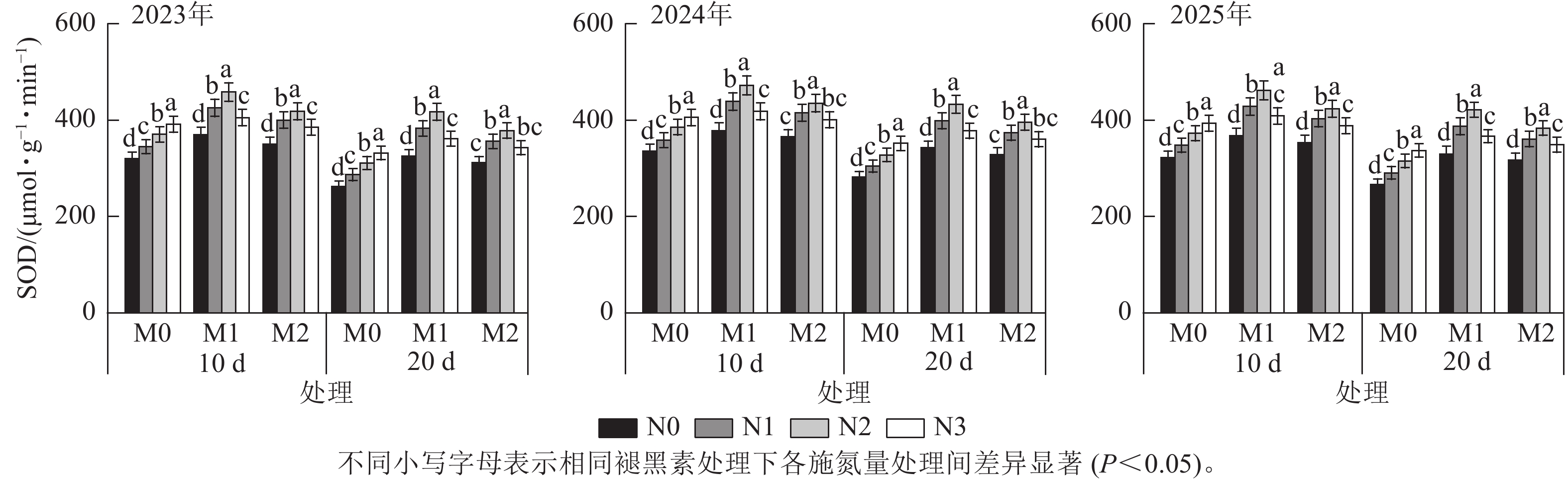
    • 图1可知:随着高温胁迫持续,所有处理在20 d时的SOD活性均较10 d时有所降低。10 d 时,相同褪黑素处理下N2效果最佳,相同施氮量下M1效果最佳,20 d时规律一致,且整体以M1N2处理效果最优。
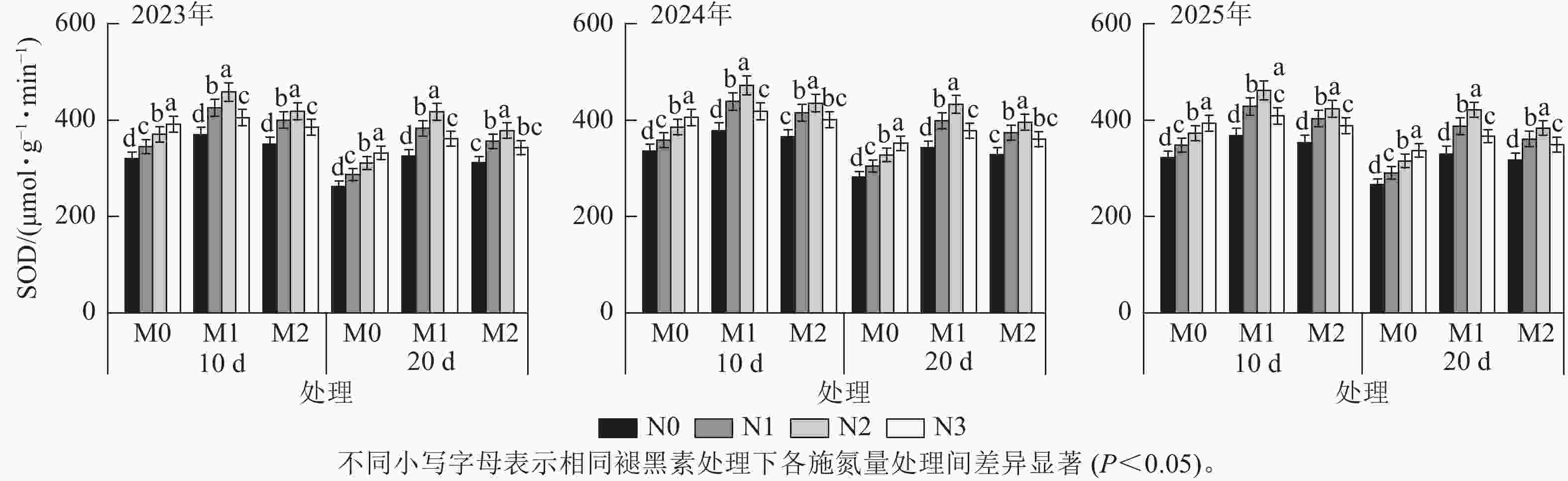
      Figure 1.  Effects of melatonin and nitrogen application rate on superoxide dismutase (SOD) activity in I. batatas

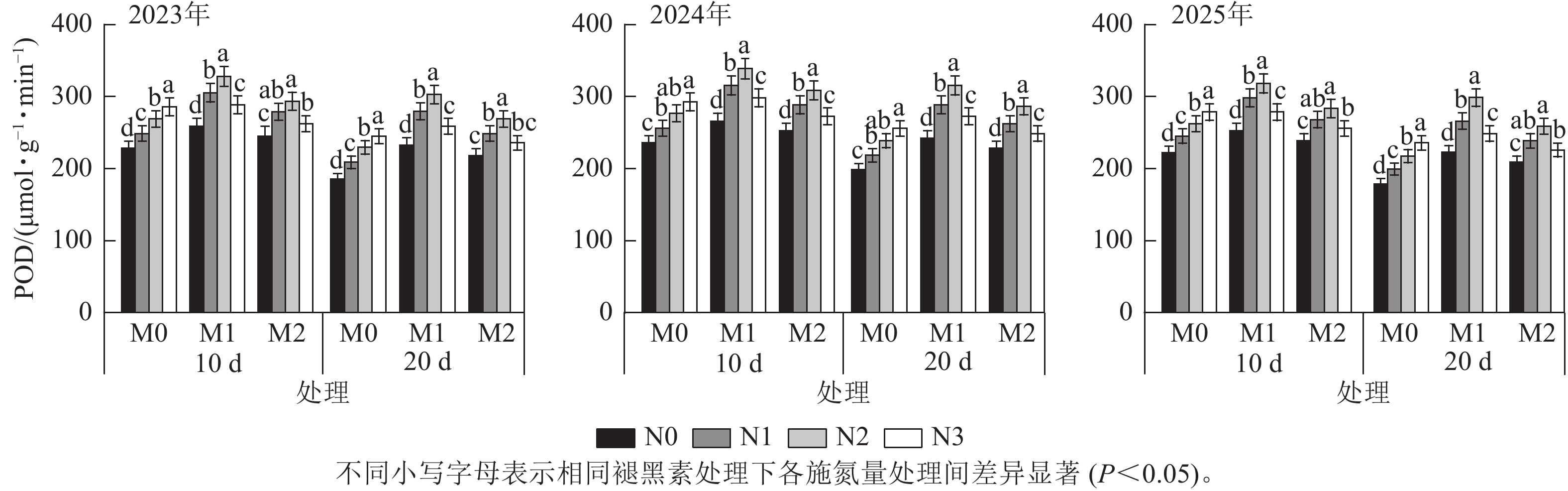
    • 图2可知:随着高温胁迫持续,所有处理在20 d时的POD活性均较10 d时明显降低。10 d时,相同褪黑素处理下N2处理效果最佳,相同施氮量处理下M1处理效果最佳,20 d时趋势相同,且整体以M1N2处理效果最佳。
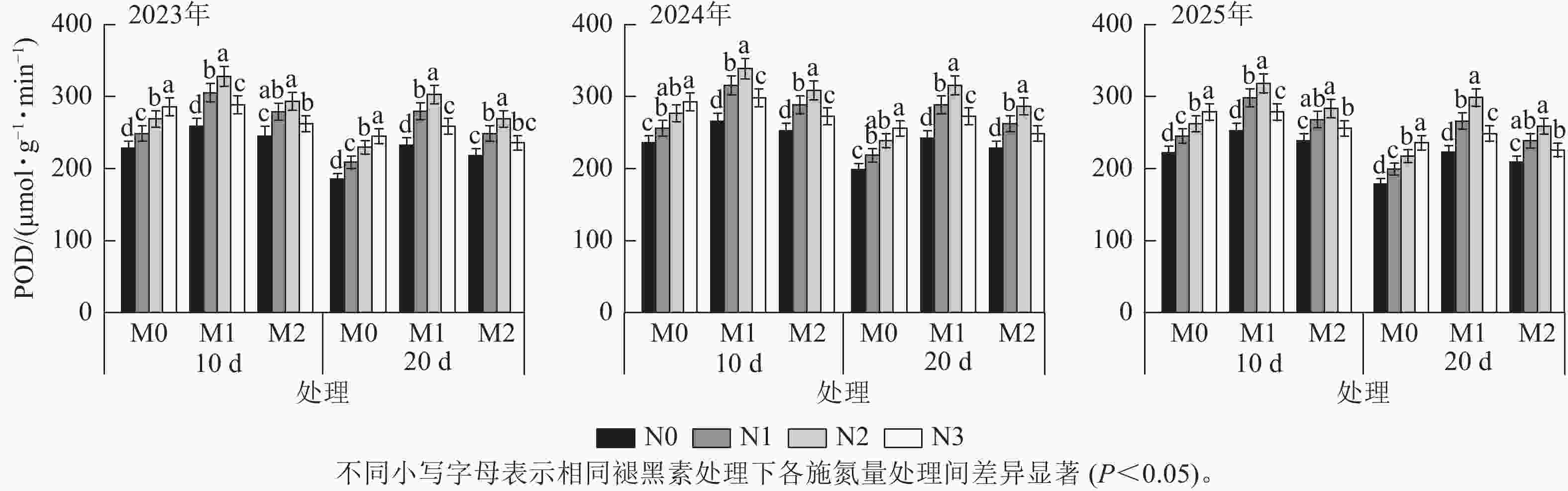
      Figure 2.  Effects of melatonin and nitrogen application rate on peroxidase (POD) activity in I. batatas

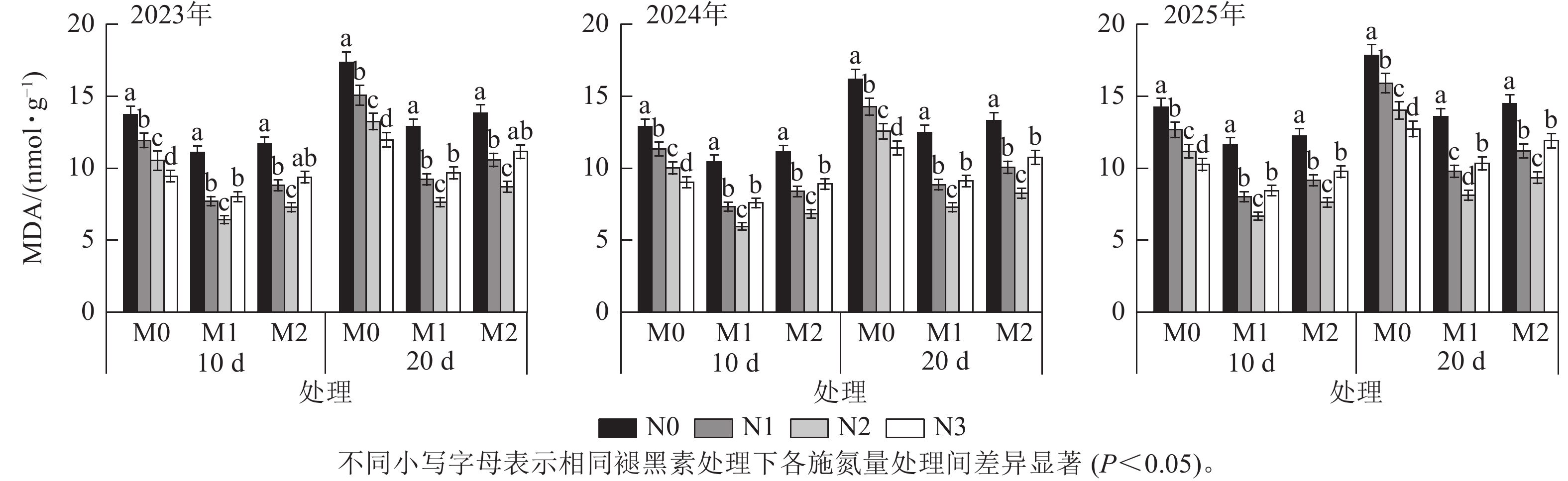
    • 图3可知:所有处理在20 d时的MDA质量摩尔浓度均较10 d时有所提升。10和20 d时的结果一致,相同褪黑素处理下N2效果最佳,相同施氮量处理下M1处理最佳,整体以M1N2处理最佳。
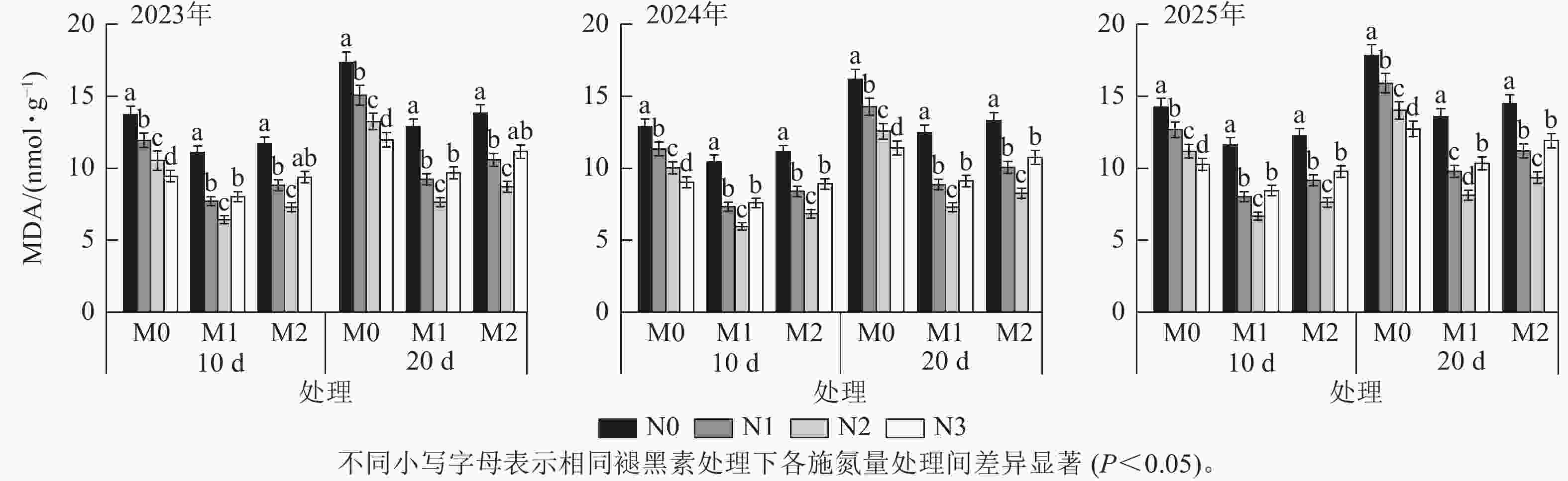
      Figure 3.  Effects of melatonin and nitrogen application rate on malondialdehyde (MDA) content in I. batatas

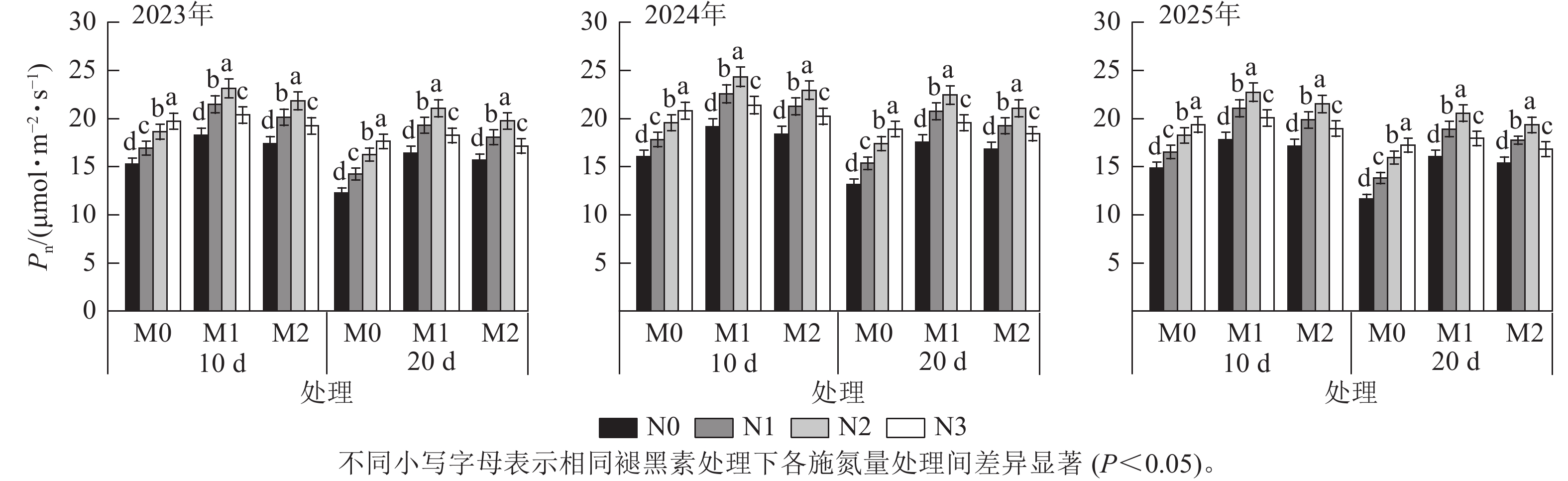
    • 图4可知:随着高温胁迫持续,所有处理在20 d时的Pn均较10 d时明显降低。10和20 d时,均表现出相同褪黑素处理下N2效果最佳,相同施氮量处理下M1效果最佳,整体均以M1N2效果最佳。
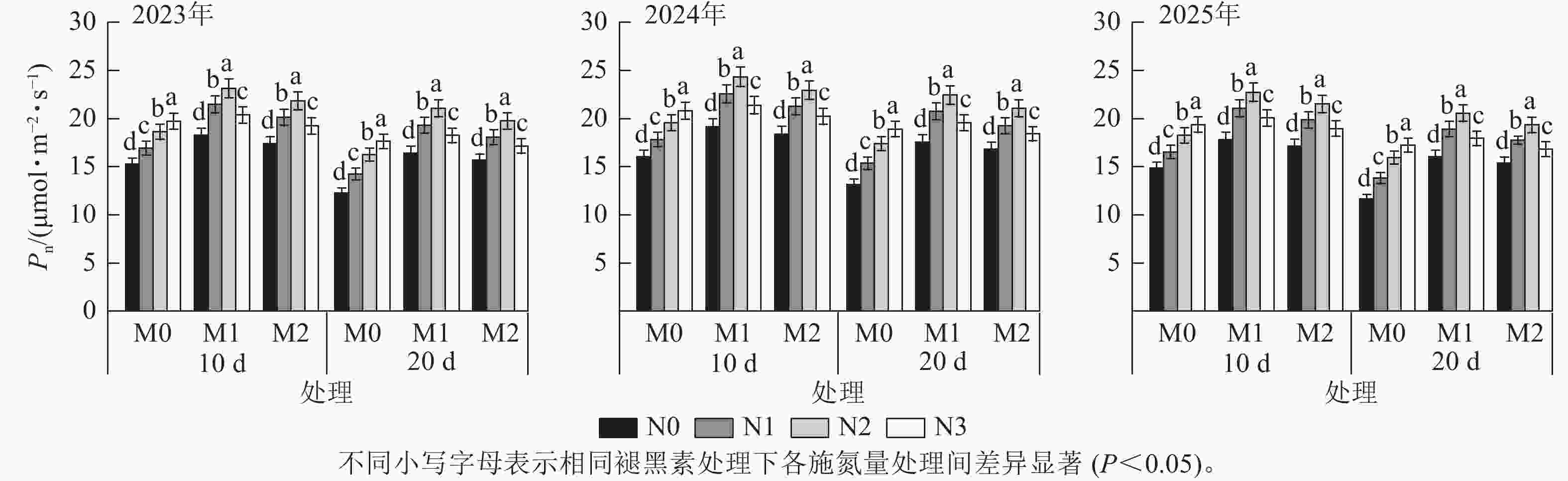
      Figure 4.  Effects of melatonin and nitrogen application rate on net photosynthetic rate (Pn) in I. batatas

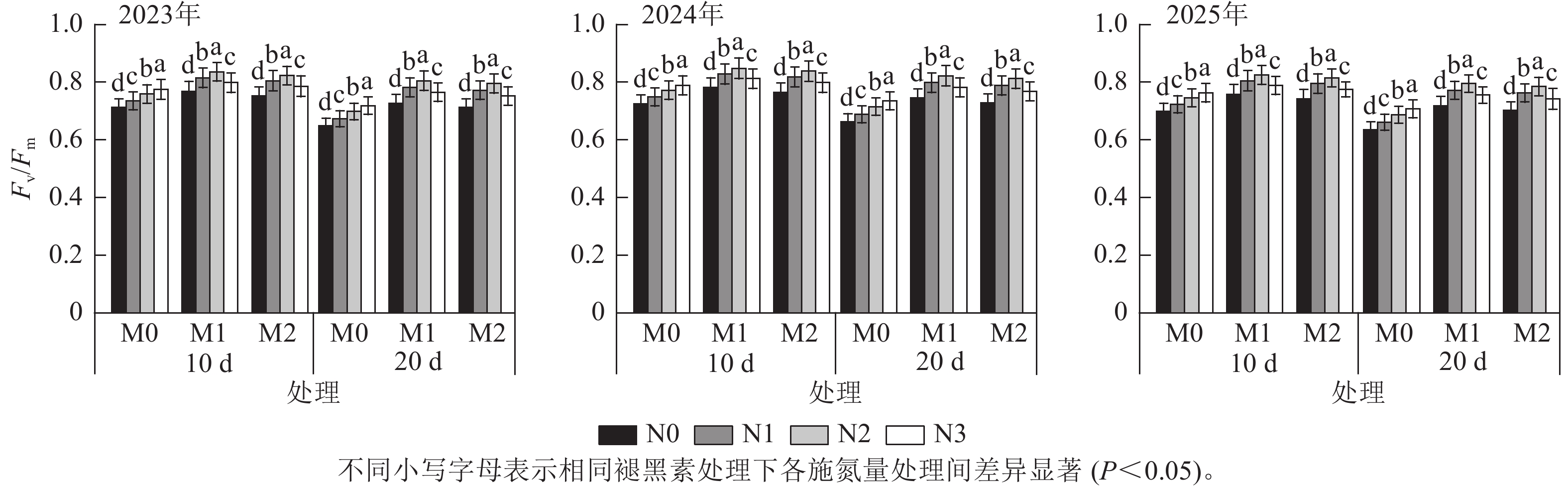
    • 图5可知:随着高温胁迫持续,所有处理在20 d时的Fv/Fm均较10 d时明显降低。10和20 d时的处理效果相同,相同褪黑素处理下N2效果最佳,相同施氮量处理下M1效果最佳,整体均以M1N2处理最佳。
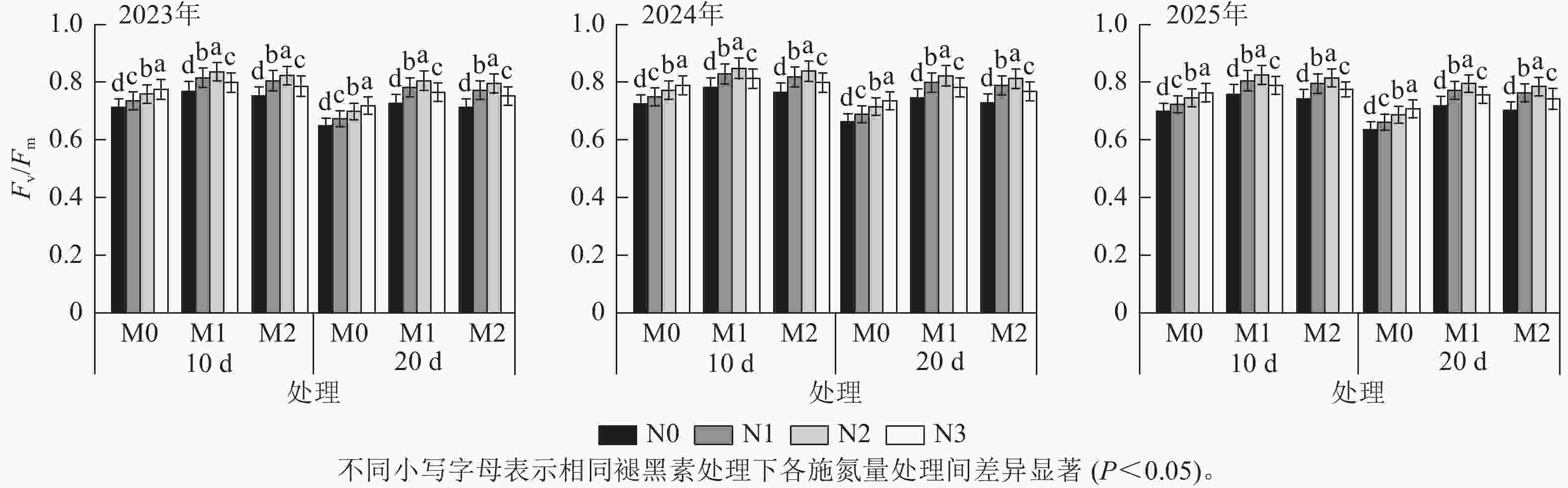
      Figure 5.  Effects of melatonin and nitrogen application rate on maximum photochemical efficiency (Fv/Fm) in I. batatas

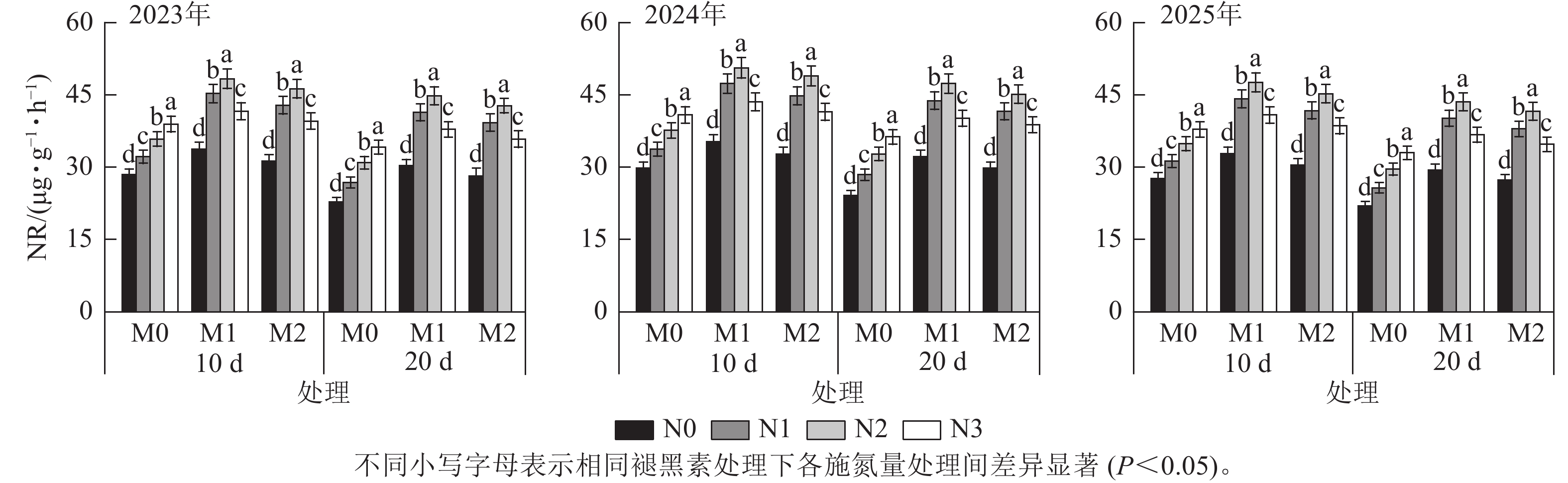
    • 图6可知:随着高温胁迫持续,所有处理在20 d时的NR活性均较10 d时有所降低。10和20 d时的处理效果相同,相同褪黑素处理下N2效果最佳,相同施氮量处理下M1效果最佳,整体均以M1N2效果最佳。
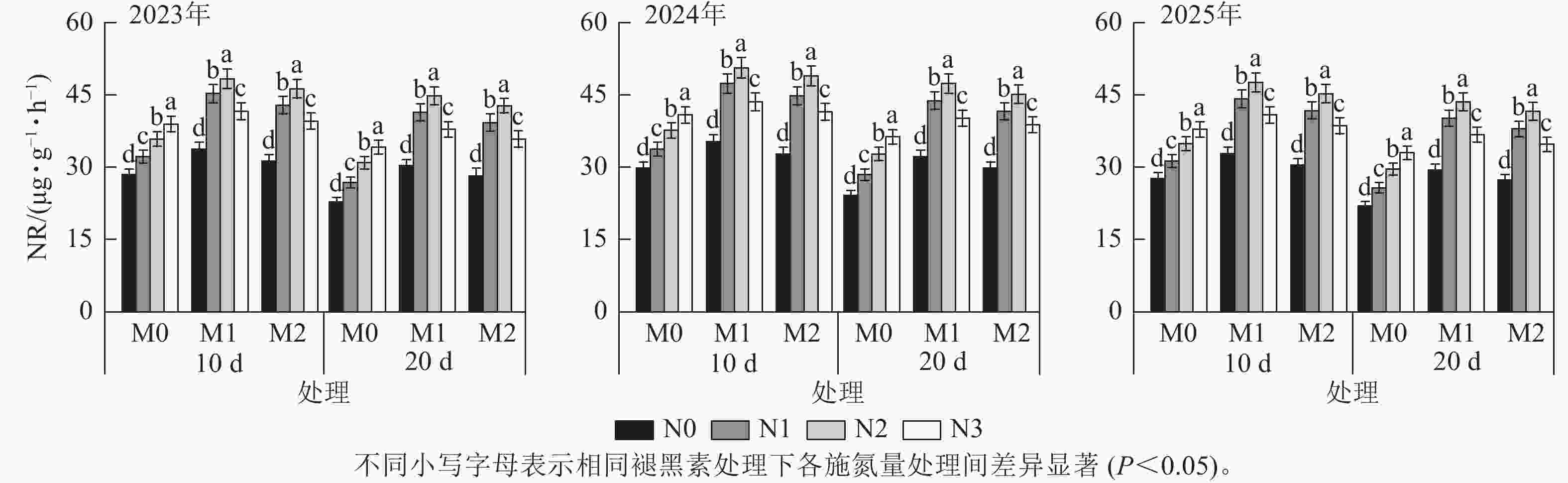
      Figure 6.  Effects of melatonin and nitrogen application rate on nitrate reductase (NR) activity in I. batatas

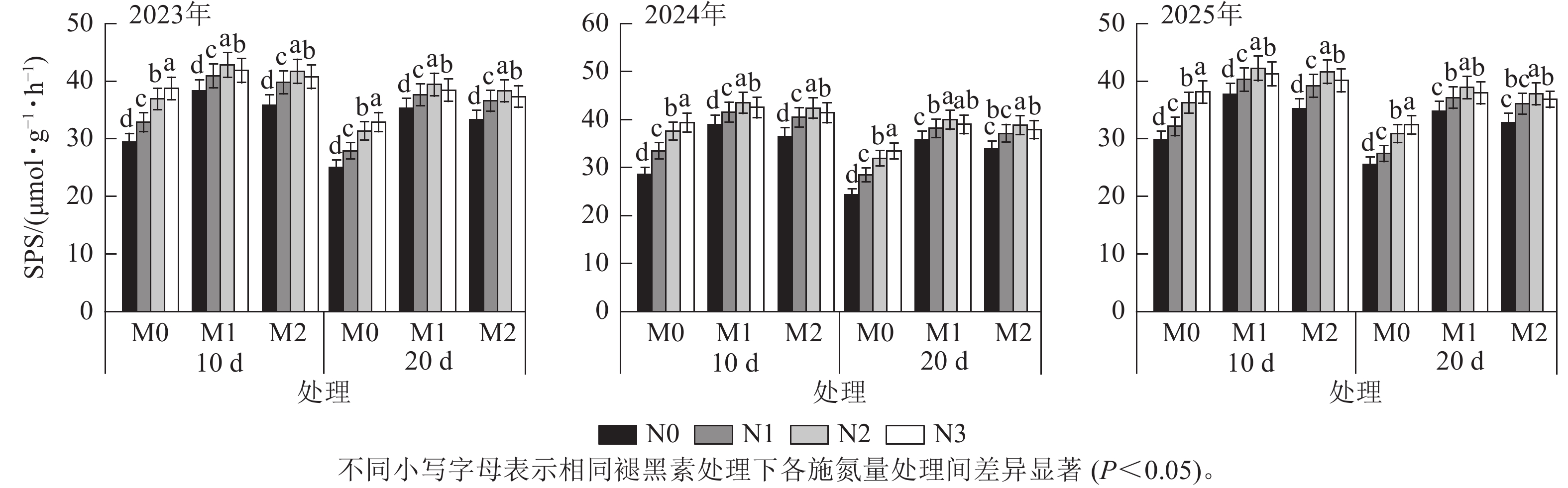
    • 图7可知:随着高温胁迫持续,所有处理在20 d时的SPS活性均较10 d时明显降低。10和20 d时的趋势基本相同,即在相同褪黑素处理下N2效果最佳,相同施氮量处理下M1效果最佳,整体均以M1N2效果最佳。
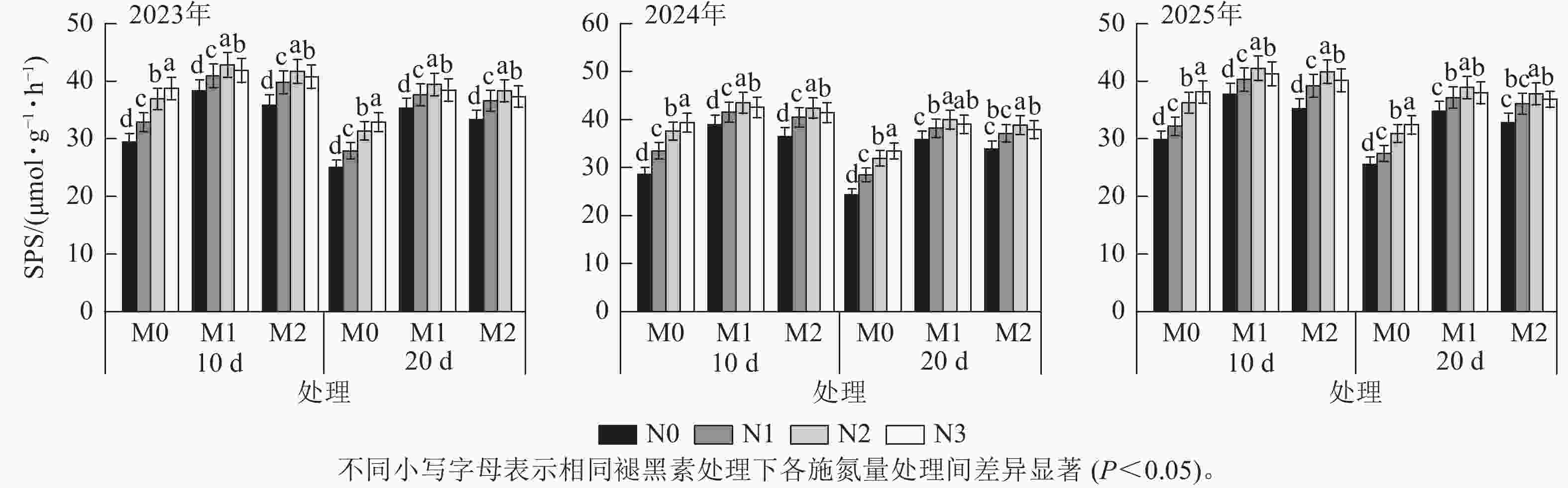
      Figure 7.  Effects of melatonin and nitrogen application rate on sucrose phosphate synthase (SPS) activity in I. batatas

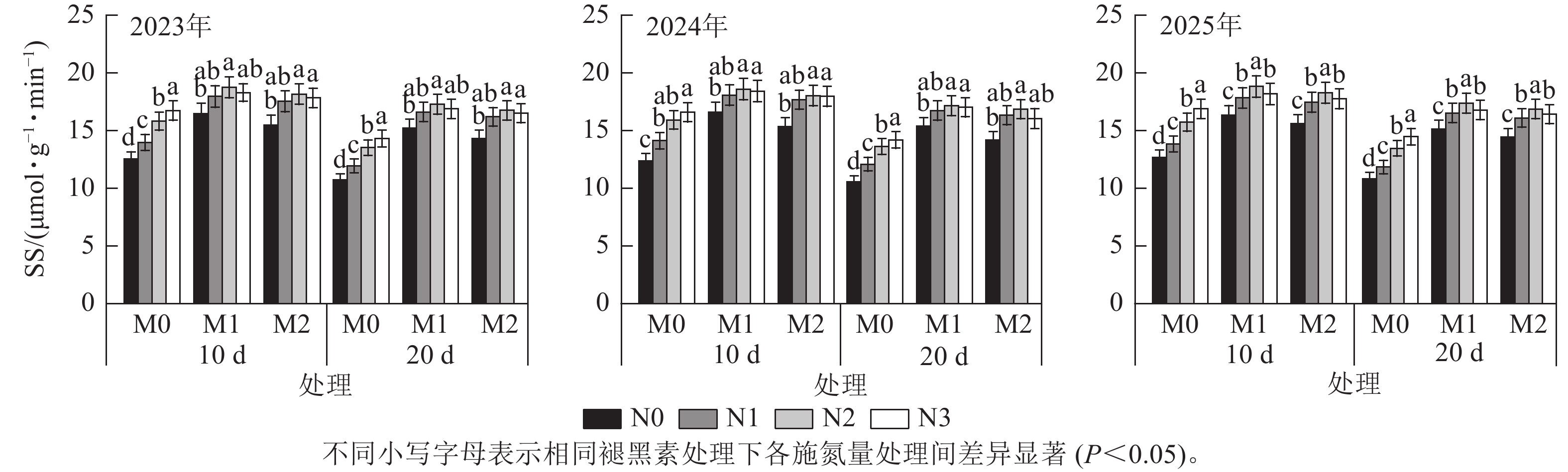
    • 图8可知:随着高温胁迫持续,所有处理在20 d时的SS活性均较10 d时明显降低。10和20 d时的处理效果基本相同,即在相同褪黑素处理下N2效果最佳,相同施氮量处理下M1效果最佳,整体均以M1N2效果最佳。
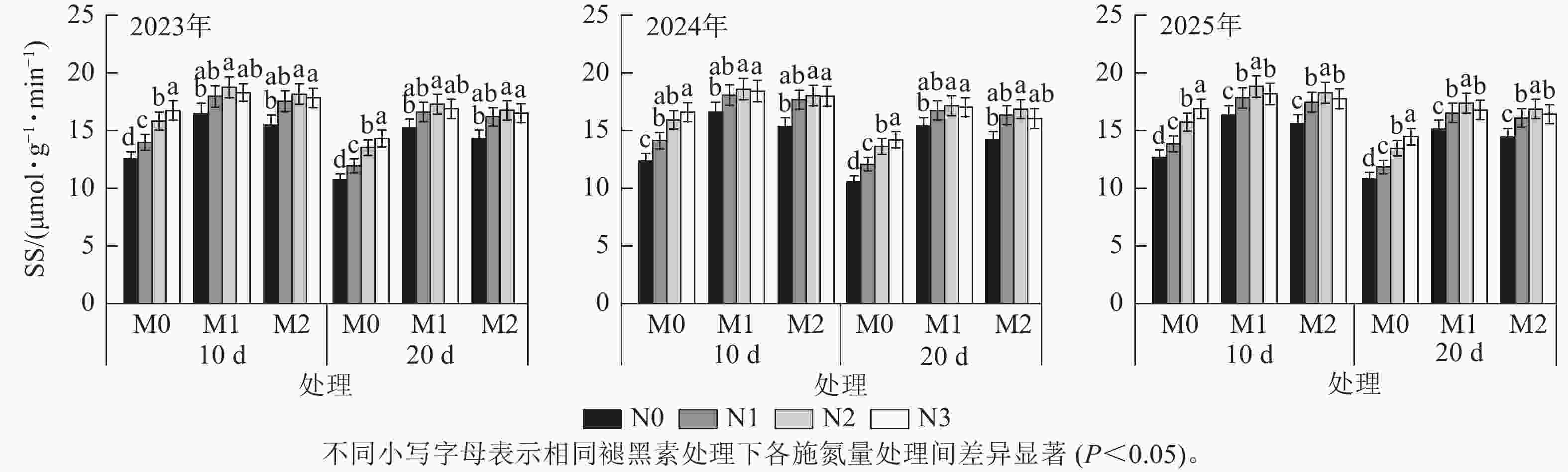
      Figure 8.  Effects of melatonin and nitrogen application rate on sucrose synthase (SS) activity in I. batatas

    • 表3可知:高温结束后,相同褪黑素处理下,根长和根系活力均以N2处理最佳;相同施氮量处理下,以M1处理最佳;整体来看,以M1N2处理最佳。

      褪黑素
      处理
      施氮量
      处理
      根长/cm 根系活力/(μg·g−1·h−1)
      2023年 2024年 2025年 2023年 2024年 2025年
      M0 N0 287.63±14.38 d 275.84±13.79 d 295.27±14.76 c 368.42±18.42 d 354.67±17.73 d 371.86±18.59 d
      N1 331.27±16.56 c 326.49±16.32 c 315.84±15.79 b 405.83±20.29 c 398.24±19.96 c 389.45±19.45 c
      N2 372.59±18.63 b 351.83±17.59 b 369.46±18.47 ab 445.16±22.26 b 438.59±21.83 b 447.28±22.36 b
      N3 396.84±19.84 a 394.27±19.72 a 379.53±18.98 a 468.73±23.52 a 465.38±23.27 a 476.59±23.84 a
      M1 N0 385.92±19.30 c 366.45±18.32 c 387.64±19.36 c 458.26±22.91 c 460.82±23.04 c 472.16±23.61 c
      N1 438.47±21.42 b 422.86±20.59 b 434.82±21.24 b 511.38±25.07 b 513.17±25.16 b 502.74±24.65 b
      N2 453.82±22.69 a 435.64±21.78 a 451.27±22.56 a 537.59±26.87 a 545.28±27.26 a 533.84±26.69 a
      N3 434.16±21.71 b 418.93±20.95 b 431.59±21.58 b 509.74±25.49 b 511.46±25.57 b 496.68±24.97 b
      M2 N0 354.38±17.72 c 348.96±17.29 c 337.45±16.87 c 428.45±21.42 c 441.83±22.09 c 435.64±21.78 c
      N1 422.63±20.63 b 405.28±19.76 b 418.72±20.66 b 494.92±24.25 bc 497.59±24.38 bc 492.59±24.13 bc
      N2 441.28±22.06 a 425.46±21.27 a 436.84±21.84 a 514.67±25.73 a 516.74±25.86 a 511.27±25.56 a
      N3 419.54±20.98 b 404.82±20.24 b 415.38±20.26 b 492.38±24.62 b 495.27±24.95 b 490.45±24.52 b
        说明:不同小写字母表示相同褪黑素处理下各施氮量间差异显著(P<0.05)。

      Table 3.  Effects of melatonin and nitrogen application rate on root length and root activity in I. batatas

    • 表4可知:高温结束后,相同褪黑素处理下,淀粉和可溶性糖质量分数均以N2处理最佳;相同施氮量处理下,淀粉和可溶性糖质量分数均以M1处理最佳;整体来看,以M1N2处理最佳。

      褪黑素处理 施氮量处理 淀粉质量分数/(mg·g−1) 可溶性糖质量分数/(mg·g−1)
      2023年 2024年 2025年 2023年 2024年 2025年
      M0 N0 153.4±7.6 c 154.2±7.0 c 152.7±8.5 c 43.1±2.6 b 44.8±2.2 b 43.7±2.4 b
      N1 168.2±8.4 b 167.8±8.4 b 168.5±9.2 b 46.8±2.7 b 46.2±2.3 b 46.5±2.5 b
      N2 184.6±9.2 ab 185.7±9.3 ab 184.2±9.6 ab 51.4±2.1 ab 52.7±2.6 a 51.8±2.8 ab
      N3 194.1±9.8 a 194.5±9.7 a 193.6±8.7 a 54.6±3.2 a 53.9±2.7 a 54.3±2.7 a
      M1 N0 188.9±10.8 c 188.3±10.5 c 189.1±9.3 c 55.3±2.8 b 54.7±2.5 c 54.8±3.0 b
      N1 204.7±10.2 b 203.6±10.9 b 205.2±10.3 b 58.4±2.6 ab 57.1±2.9 b 57.9±3.1 ab
      N2 217.3±8.5 a 218.2±11.6 a 216.5±10.6 a 61.8±3.5 a 63.2±3.1 a 62.2±2.9 a
      N3 199.5±10.6 bc 198.5±8.7 bc 199.8±12.1 bc 56.9±1.9 b 55.8±2.8 bc 56.1±2.2 b
      M2 N0 176.2±9.4 d 176.9±10.5 d 175.6±8.6 d 52.9±3.1 b 53.4±2.6 b 52.5±2.3 b
      N1 198.5±9.9 b 197.3±9.3 b 198.7±7.5 b 56.2±2.8 ab 54.9±2.8 b 55.6±3.2 ab
      N2 209.6±7.5 a 210.7±10.2 a 209.4±11.2 a 59.6±2.5 a 60.4±2.9 a 59.2±2.8 a
      N3 187.6±6.9 c 186.4±8.9 c 187.9±8.6 c 54.4±2.0 b 53.1±2.7 b 54.2±2.6 b
        说明:不同小写字母表示相同褪黑素处理下各施氮量间差异显著(P<0.05)。

      Table 4.  Effects of melatonin and nitrogen application rate on quality of I. batatas

    • 表5可知:高温结束后,相同褪黑素处理下,单薯质量和产量均以N2处理最佳;相同施氮量处理下,单薯质量和产量均以M1处理最佳;整体来看,以M1N2处理最佳。

      褪黑素
      处理
      施氮量处理 单薯质量/g 产量/(kg·hm−2)
      2023年 2024年 2025年 2023年 2024年 2025年
      M0 N0 158.65±7.92 c 161.35±8.07 c 164.15±8.21 b 28 482.50±1 509.27 d 28 721.95±1 436.58 c 28 908.62±1 483.57 d
      N1 175.86±8.79 b 182.71±9.12 b 171.45±8.58 b 31 295.83±1 564.46 c 32 228.63±1 615.39 b 29 668.71±1 727.42 c
      N2 193.94±9.71 ab 195.57±9.78 ab 198.28±9.92 a 33 829.17±1 691.12 b 34 038.75±1 701.96 a 34 548.75±1 935.23 b
      N3 201.76±10.09 a 198.43±9.93 a 202.57±9.64 a 35 397.62±1 719.65 a 34 307.92±1 715.43 a 35 742.92±1 881.25 a
      M1 N0 194.35±9.73 c 193.86±9.70 c 200.52±10.03 c 32 386.28±1 669.56 d 33 678.50±1 687.32 c 34 578.13±1 622.06 d
      N1 213.92±11.30 ab 221.10±11.06 b 223.35±11.67 b 37 629.87±1 891.23 b 35 684.85±1 852.91 b 37 728.52±1 879.35 b
      N2 225.84±10.45 a 236.29±11.53 a 237.19±11.82 a 38 654.52±1 932.46 a 38 807.45±1 656.82 a 39 542.13±1 681.42 a
      N3 207.93±10.15 b 213.24±10.67 bc 214.32±9.29 bc 35 795.81±1 789.54 c 35 338.2±1 794.57 b 36 842.3±1 457.82 c
      M2 N0 182.57±9.79 c 187.90±9.42 c 185.76±10.86 c 32 425.31±1 622.06 d 33 123.72±1 873.42 c 31 574.89±1 672.49 d
      N1 202.81±10.18 b 205.43±10.27 b 217.86±11.91 ab 35 474.53±1 753.15 b 35 887.37±1 963.78 b 36 498.54±1 783.25 b
      N2 217.70±8.32 a 228.91±11.45 a 225.09±10.35 a 37 591.67±1 879.35 a 37 612.43±1 784.65 a 37 318.08±1 784.28 a
      N3 195.63±9.57 bc 199.95±10.82 bc 204.13±8.66 b 33 671.82±1 682.37 c 35 426.84±1 852.93 b 34 857.36±1 682.57 c
        说明:不同小写字母表示相同褪黑素处理下各施氮量间差异显著(P<0.05)。

      Table 5.  Effects of melatonin and nitrogen application rate on yield and its components in I. batatas

    • 表6可知:相同褪黑素处理下,总投入以N3处理最高,总收入和净利润以N2处理最高,较N0处理分别提高23.93%、25.97%、29.49%;相同施氮量处理下,总投入以M2处理最高,总收入和净利润以M1处理最高,较M0处理分别提高17.63%、20.14%、33.55%;整体来看,总投入以M2N3处理最高,总收入和净利润以M1N2处理最佳。综上所述,外源喷施100 μmol·L−1褪黑素配合150 kg·hm2氮肥能够在保证增产提质的同时,通过优化资源配置实现投入产出效率最大化,提升甘薯生产的经济效益。

      褪黑素处理 施氮量处理 总投入/(元·hm−2) 总收入/(元·hm−2) 净利润/(元·hm−2)
      M0 N0 19 583.28±979.85 c 46 772.42±2 329.52 c 27 189.14±1 354.29 d
      N1 22 596.40±1 063.57 b 51 951.26±2 563.87 b 29 354.86±1 563.75 c
      N2 23 699.98±1 147.28 a 56 589.73±2 772.43 ab 32 889.74±1 625.82 b
      N3 23 818.28±1 231.56 a 57 267.39±2 856.49 a 33 449.11±1 753.91 a
      M1 N0 21 420.45±1 018.75 d 55 067.84±2 768.95 d 33 647.39±2 135.48 d
      N1 22 433.83±1 186.92 c 65 141.67±3 102.72 b 42 707.84±1 864.79 b
      N2 24 276.93±1 270.63 b 71 378.60±3 586.42 a 47 101.67±1 657.46 a
      N3 25 148.15±1 018.49 a 63 806.75±3 270.19 c 38 658.60±2 135.48 c
      M2 N0 19 812.23±1 186.72 d 52 218.98±2 618.48 d 32 406.75±2 329.76 d
      N1 23 034.66±1 129.66 c 61 793.64±2 952.76 b 38 758.98±2 468.58 b
      N2 25 348.25±1 135.46 b 66 101.89±3 336.12 a 40 753.64±1 975.45 a
      N3 26 403.37±1 342.52 a 59 785.26±3 274.98 c 33 381.89±2 103.51 c
        说明:不同小写字母表示相同褪黑素处理下各施氮量间差异显著(P<0.05);总投入包含农药、种苗、人工、地膜、滴灌设备、起垄作业、褪黑素、氮肥、磷钾肥等;收入按市场价格计算;数据为3 a经济效益均值。

      Table 6.  Effects of melatonin and nitrogen application rate on economic benefits in I. batatas

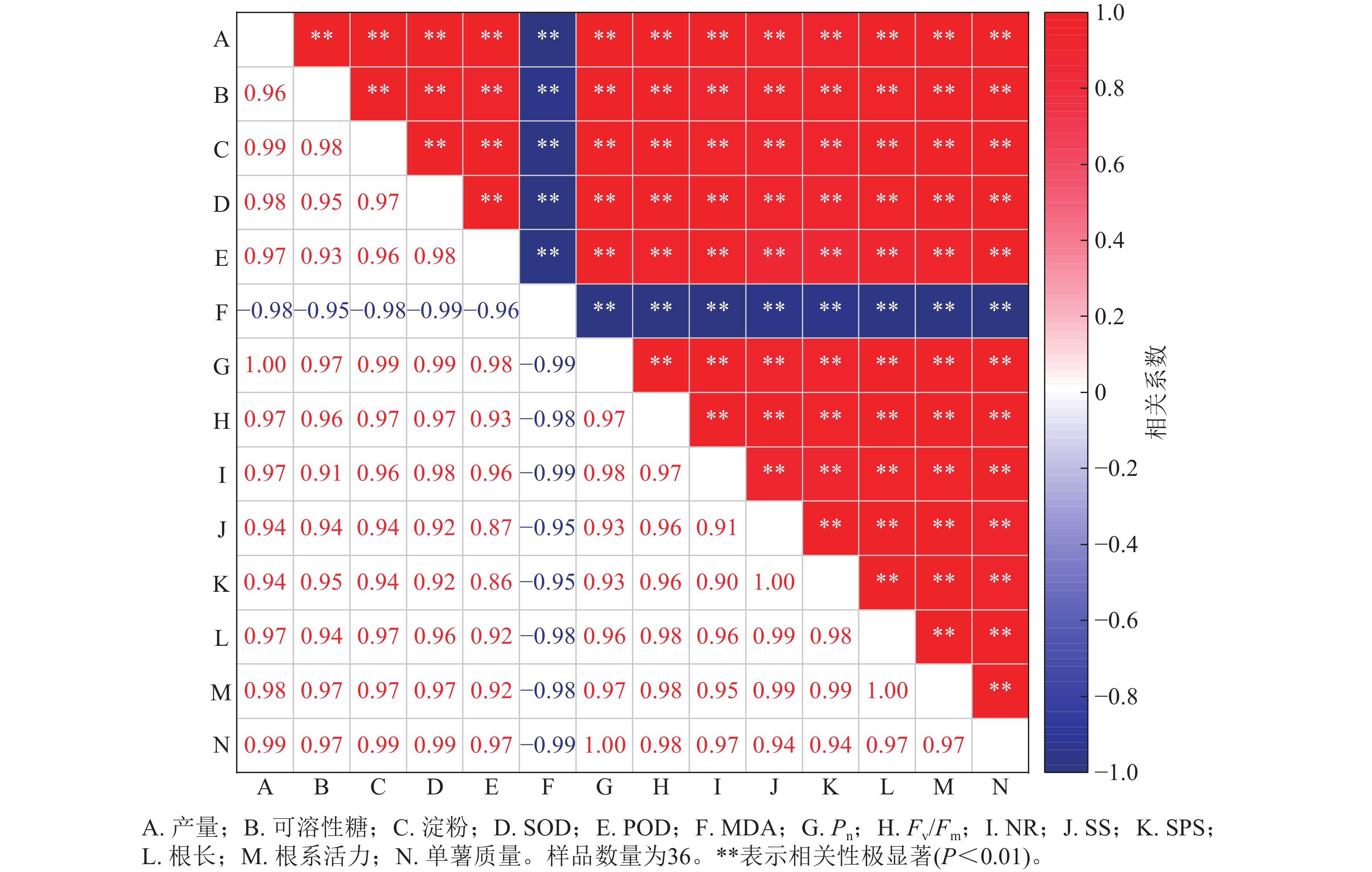
    • 图9可知:产量与抗氧化酶(SOD、POD)、光合特性(PnFv/Fm)、氮代谢(NR)、碳代谢(SPS、SS)、根系发育(根长、根系活力)及库强(单薯质量)均呈极显著正相关,与MDA呈极显著负相关(P<0.01),表明甘薯产量的形成依赖于抗氧化系统对光合机构的有效保护、碳氮代谢的高效协调以及根系发育与库强调控的协同促进。可溶性糖、淀粉与上述指标均呈极显著正相关,与MDA呈极显著负相关(P<0.01),表明可溶性糖和淀粉的积累与合成,是甘薯植株碳氮代谢优化、光合效能提升、根系发育增强及库强增大的综合体现,同时也依赖于抗氧化系统对膜脂过氧化的缓解作用。
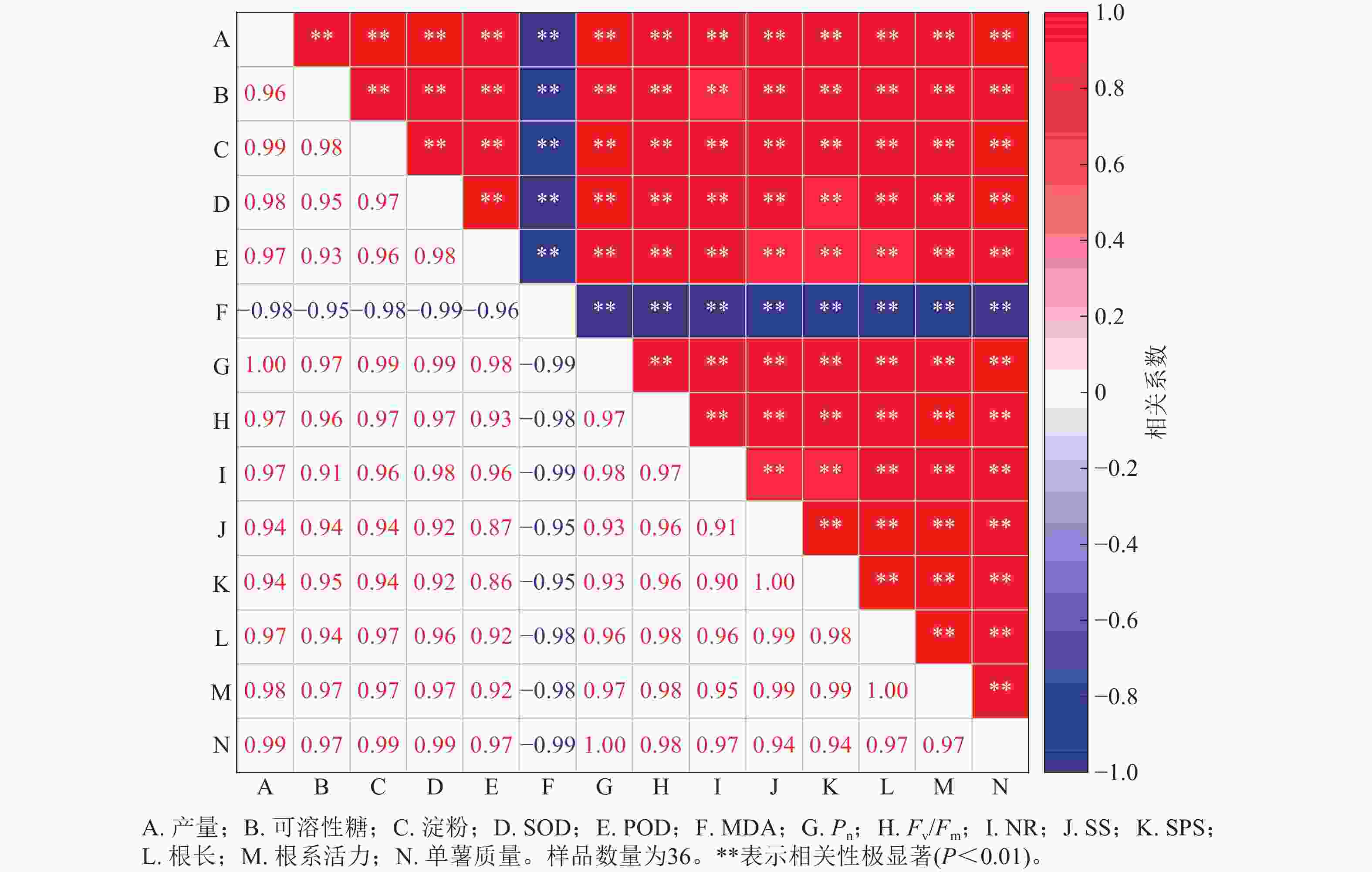
      Figure 9.  Correlation analysis of yield, quality and various indicators under high-temperature stress

    • 表7可知:在相同褪黑素水平下,各处理的综合评分均随施氮量的增加呈先升后降的趋势,其中N2处理最大,与N0相比提高了1.44;在相同施氮水平下,外源褪黑素的施用明显提升了综合评分,M1处理最高,M0处理最低;褪黑素与氮肥表现出较强的交互作用,M1N2处理在所有处理中综合评分最高,综合分值为1.00。可见,高温胁迫下外源喷施100 μmol·L−1褪黑素配合150 kg·hm2氮肥通过增强抗氧化系统活性和维持光合机构稳定性,进而协同调控碳氮代谢关键酶活性并促进根系发育,显著改善了植株的物质合成与吸收能力,最终将生理优势高效转化为产量与品质的提升。

      褪黑素
      处理
      施氮量
      处理
      评分值 综合
      分值
      排名
      产量 可溶性糖 淀粉 SOD POD MDA Pn Fv/Fm NR SS SPS 根长 根系活力 单薯质量
      M0 N0 0.00 0.00 0.00 0.00 0.00 0.00 0.00 0.00 0.00 0.00 0.00 0.00 0.00 0.00 0.00 12
      N1 0.23 0.14 0.23 0.17 0.20 0.22 0.22 0.17 0.18 0.21 0.23 0.24 0.19 0.21 0.20 11
      N2 0.53 0.44 0.49 0.34 0.38 0.41 0.45 0.35 0.37 0.48 0.50 0.49 0.45 0.48 0.44 10
      N3 0.63 0.56 0.64 0.48 0.53 0.55 0.60 0.48 0.52 0.61 0.62 0.65 0.61 0.55 0.57 7
      M1 N0 0.47 0.60 0.55 0.37 0.35 0.40 0.43 0.49 0.31 0.67 0.69 0.58 0.57 0.49 0.50 8
      N1 0.81 0.75 0.80 0.77 0.77 0.82 0.80 0.85 0.84 0.89 0.87 0.91 0.83 0.81 0.82 3
      N2 1.00 1.00 1.00 1.00 1.00 1.00 1.00 1.00 1.00 1.00 1.00 1.00 1.00 1.00 1.00 1
      N3 0.71 0.67 0.72 0.63 0.61 0.78 0.67 0.73 0.67 0.94 0.93 0.88 0.81 0.70 0.75 4
      M2 N0 0.36 0.49 0.36 0.27 0.22 0.31 0.34 0.38 0.20 0.51 0.53 0.38 0.40 0.33 0.36 9
      N1 0.70 0.63 0.70 0.60 0.52 0.68 0.65 0.78 0.73 0.83 0.79 0.80 0.75 0.66 0.70 5
      N2 0.85 0.86 0.88 0.74 0.69 0.88 0.85 0.93 0.90 0.92 0.93 0.92 0.86 0.87 0.86 2
      N3 0.58 0.54 0.53 0.50 0.39 0.61 0.54 0.64 0.58 0.86 0.85 0.79 0.73 0.54 0.62 6

      Table 7.  Analysis of membership functions of each treatment under high-temperature stress

    • 高温胁迫对作物抗氧化系统的干扰是引起作物减产的重要原因之一[13]。研究表明:环境因素会激起马铃薯Solanum tuberosum植株合成抗氧化物质进行自我保护,在施加外源褪黑素后,抗氧化酶活性进一步增强[14]。在高温条件下,马铃薯叶片SOD和POD活性均明显下降,而适宜的氮素供应能显著缓解高温胁迫危害[15]。本研究也得出了相似的结果,即在高温胁迫中期,不添加褪黑素和氮肥处理的SOD和POD活性维持在相对较低但合理的水平,表明该处理下甘薯仍保留一定的基础防御能力。随着胁迫持续至后期,不添加褪黑素和氮肥处理的酶活性较中期有所降低,而褪黑素与氮素配施处理在整个胁迫期间均保持较高的酶活性水平。这种持续的保护效应是因为:①褪黑素作为一种生理调节物质,能够激活植株抗氧化酶的活性及合成能力,有助于消除活性氧自由基,减轻胁迫所造成的损伤[1617]。②适量氮肥能够促进作物生长健壮,为抗氧化酶的合成和功能发挥创造良好条件,还为酶蛋白的合成与代谢修复提供了物质基础[18]。两者协同有效延缓了抗氧化系统功能的衰退。MDA可直接反映细胞膜的受损状况[19]。前人研究认为:高温胁迫下MDA含量的上升与抗氧化酶活性的下降密切相关[20]。本研究发现:高温胁迫提高了MDA的积累,造成细胞膜受损。而褪黑素与氮素配施能够不同程度地缓解这种膜脂过氧化现象。表明褪黑素与氮肥在减轻膜脂过氧化方面具有明显的协同效应,即褪黑素通过增强抗氧化酶活性来减少膜脂过氧化的发生,而适宜的氮素为膜脂的合成与修复提供了物质基础,两者协同抑制MDA的积累[2021]

    • 有研究发现:逆境胁迫时马铃薯光合性能受到抑制,而喷施不同浓度的褪黑素后净光合速率、气孔导度和胞间二氧化碳浓度均有不同程度的缓解作用[22]。而适当增加氮素能提高马铃薯光合性能,减轻对光系统Ⅱ的伤害[23]。马铃薯与甘薯同为薯类作物,在光合响应机制上具有一定的相似性。本研究也表明:在高温胁迫条件下,褪黑素与氮素配施处理则表现出明显的光合保护效应。其原因在于外源褪黑素可通过维持类囊体膜的稳定性,保护光合色素蛋白复合体,从而缓解高温对光合机构的损伤[24]。适量氮素供应可促进叶绿素合成,提高Rubisco酶活性,为光合作用提供充分的物质与能量基础[25]。褪黑素与氮素可高效维持膜系统稳定与光合机构完整,共同保障了甘薯叶片在高温胁迫下的光合功能稳定性。已有研究表明:高温胁迫会显著抑制碳氮代谢关键酶的活性,直接影响光合产物向贮藏器官的转运效率[26]。本研究表明:外源喷施褪黑素配施氮肥处理显著缓解了高温胁迫对碳氮代谢关键酶活性的影响。可能是外源褪黑素与氮肥协同调控,既能维持叶片光合能力,为碳代谢提供充足的物质基础,又可依托氮素供给保障氮同化进程,有效平衡高温胁迫下甘薯碳氮代谢,助力光合产物向块根转运积累[2728]

    • 根系是作物吸收养分和水分的主要器官,其发育状况直接影响作物的抗逆性和产量形成。前人研究表明:高温胁迫会显著抑制根系生长,导致根长减少和根系活力下降,进而削弱植株的水分和养分吸收能力[29]。而本研究中褪黑素配施氮肥则有效缓解根长和根系活力的降低。其原因在于外源褪黑素可作为信号分子激活植物体内的保守防御网络,有效保护根系细胞膜的完整性,促进逆境下根系的形态建成与功能维持[30];氮素则为根系生长发育提供了必需的营养支持,协同褪黑素增强植株整体的胁迫适应能力,从而共同塑造健壮根系[31]。产量和品质是衡量作物生产效益与商品价值的两大核心指标。本研究中,外源喷施100 μmol·L−1褪黑素配施150 kg·hm2氮肥处理在产量与品质形成上表现最佳,该处理在块根产量、单薯质量、淀粉及可溶性糖质量分数上均优于其他处理,这主要归因于褪黑素与氮肥可协同促进根系建成、提升根系活力,既能增强植株水肥吸收能力以缓解高温胁迫伤害,还可通过根系信号调控光合产物向块根合理分配,最终实现甘薯产量与品质协同提升[3233]。此外,本研究结合变异系数发现:高温胁迫下各测定指标在不同处理间的变异系数偏高,这主要是浙南丘陵山区田间土壤湿度、肥力存在局部差异,且该差异在高温环境下被进一步加剧。

    • 本研究相关性分析发现:产量、品质与抗氧化酶、光合特性、氮代谢、碳代谢、根系发育及库强均呈极显著正相关,而与MDA呈极显著负相关,这表明维持较强的抗氧化能力、稳定的光合性能、协调的碳氮代谢以及发达的根系是作物抵御高温胁迫、保障产量与品质形成的关键生理基础[29, 3436]。本研究通过隶属函数分析发现:不施用褪黑素时,即使施加最高施氮量,其综合评分仍低于施用褪黑素的低氮处理,这表明外源褪黑素可在相同氮肥水平下明显提升甘薯抗逆性,或在更低氮肥投入下实现相当的抗逆效果,减少化肥的用量[32]。综合来看,外源喷施100 μmol·L−1褪黑素配合150 kg·hm−2氮肥在所有处理中综合得分最高,本研究进一步揭示其作用机制:适宜的褪黑素和氮肥用量通过增强抗氧化系统活性和维持光合机构稳定性,进而协同调控碳氮代谢关键酶活性并促进根系发育,显著改善了植株的物质合成与吸收能力,最终实现了产量、品质和经济效益的同步提升[16, 27, 33]

    • 本研究表明:高温胁迫下喷施褪黑素配施氮肥可有效提高甘薯叶片SOD、POD活性,缓解MDA积累,提高PnFv/Fm,稳定碳氮代谢平衡,促进根系和块根发育,提高产量与品质。隶属函数分析发现:喷施100 μmol·L−1褪黑素配合150 kg·hm−2氮肥为最佳处理,建议在浙南丘陵山区甘薯种植中推广应用该模式来提高经济效益。

Reference (36)

Catalog

    /

    DownLoad:  Full-Size Img  PowerPoint
    Return
    Return