






-
由于林木生长周期较长,基因杂合度较高,育种效率受到了极大的限制。为了缩短育种周期和加快育种进程,育种工作者期望能够依据林木苗期、幼林期的相关性状对林木成年时的目标性状进行早期选择[1−2]。不同树种的研究均表明早期选择是有效的,并可以减少试验林测定费用[3−4]。针叶树种早期选择研究表明:10 a左右可作为马尾松Pinus massoniana的早期选择年龄[5];日本落叶松Larix olgensis的树高选择可从5 a开始,胸径的早期选择可从7 a开始,胸径是早期选择的主要指标[6];杉木Cunninghamia lanceolata优良无性系初选年龄是造林后5~6 a,精选年龄在8~9 a[7]。阔叶树种早期选择研究发现:6 a桤木Alnus cremastogyne的高生长和14 a时的相关系数达到显著程度[8];水曲柳Fraxinus mandshurica天然林和人工林早期最佳选择年龄分别为25和15 a,应以胸径为主要指标[9]。
红花香椿Toona rubriflora是楝科Meliaceae香椿属Toona落叶乔木,生长迅速,树干通直,材质曙红,木纹美丽,素有“中国桃花心木”之称,是亚热带地区重要的珍贵用材树种[10−12]。已有研究证实毛红椿Toona ciliata var. pubescens和红花香椿为同一种[13],因此,已将毛红椿校正为红花香椿[14−15]。围绕红花香椿遗传结构进行研究,发现其天然居群结构层次分明、遗传多样性较低,居群间遗传分化较大,海拔高的居群遗传多样性较高[16−19]。中国林业科学研究院等单位通过广泛收集红花香椿优树资源,开展红花香椿种源、家系遗传测定,筛选出早期速生的优良种源和家系,为红花香椿的良种选育垫定了基础[20−21]。本研究利用浙江省开化县林场红花香椿家系遗传测定林为材料,探究其不同年龄树高、胸径、枝下高、冠幅、心材率和心材材积等性状早晚相关性,对红花香椿早期选择的可行性进行了研究,确定红花香椿最佳早期选择年龄,旨在为该树种的遗传改良和可持续利用提供科学依据。
-
样地位于浙江省开化县林场国家杉木良种基地(29.15°N,118.45°E),年平均降水量为1 830.8 mm,年平均气温为16.6 ℃,年无霜期为254.0 d,属中亚热带季风性气候区,气候特征表现为四季分明,温和湿润,冬夏长而春秋短等特点。土壤以红壤为主,质地介于中壤土至轻黏土之间,弱酸性。该造林地前期为杉木林,2006年实施采伐后,2007年春季营建红花香椿试验林,造林过程中保留杉木萌芽条株。自2011年起针对杉木对红花香椿生长的竞争性影响,系统开展间伐调控措施,最终在2020年完成全部杉木的彻底清除。
-
2005年,对浙江、安徽和江西等地的红花红椿进行了树高、胸径、冠幅、枝下高、圆满度、结实和生长状况等性状的调查[20]。基于综合分析,筛选52个枝下高较大、树干通直、无病虫害且结实良好的优良家系,选用这52个家系以及7个浙江省开化县的家系作为材料,共59个家系。采用完全随机区组设计,设置10个重复,每小区单行种植4株,株行距为2.0 m×2.0 m。在2009 (3 a)、2012 (6 a)、2013 (7 a)、2017 (11 a)年对试验林进行了树高、胸径等性状调查。红花香椿幼龄期生长迅速,长期监测数据表明:该树种在栽植10~15 a后,树高和胸径生长速率趋于减缓,逐渐由高速生长期转入干物质稳定积累期(材积生长期)。因此,15 a可作为反映林木由幼龄向成熟阶段过渡的关键时期,此时性状数据对其最终成材潜力评估具有重要意义。基于此,于2021年(15 a)测定了树高、胸径、枝下高和冠幅4个生长性状,并于每木胸径处钻取木芯,使用精密游标卡尺测量心材与边材宽度,据此计算材积、心材材积和心材率等参数。
-
材积计算公式[22]如下:
$$ \mathit{V} \mathrm{=0.000\;052\;76\times } \mathit{D} ^{ \mathrm{1.882\;161}} \mathrm{\times } \mathit{H} ^{ \mathrm{1.009\;317}} \mathrm{。} $$ (1) 式(1)中:V为单株材积(m3);D为胸径(cm);H为树高(m)。
心材率计算公式[23]如下:
$$ \mathit{R} _{ \mathrm{H}} \mathrm= \mathit{W} _{ \mathrm{h}} \mathrm{/(} \mathit{W} _{ \mathrm{h}} {+W}_{ \mathrm{S}} \mathrm{)\times 100}\%。 $$ (2) 式(2)中:RH 为心材率;Wh为心材宽度(cm);WS为边材宽度(cm)。
心材材积计算公式如下:
$$ \mathit{V} _{ \mathrm{H}} \mathrm= \mathit{V} \mathrm{\times } \mathit{R} _{ \mathrm{H}} 。 $$ (3) 式(3)中:VH为心材材积(m3)。
利用R语言corrplot、FactoMineR、factoextra等程序包进行皮尔逊相关分析和主成分分析。参考王章荣等[5]的方法计算早期选择效率和最佳选择年龄。
-
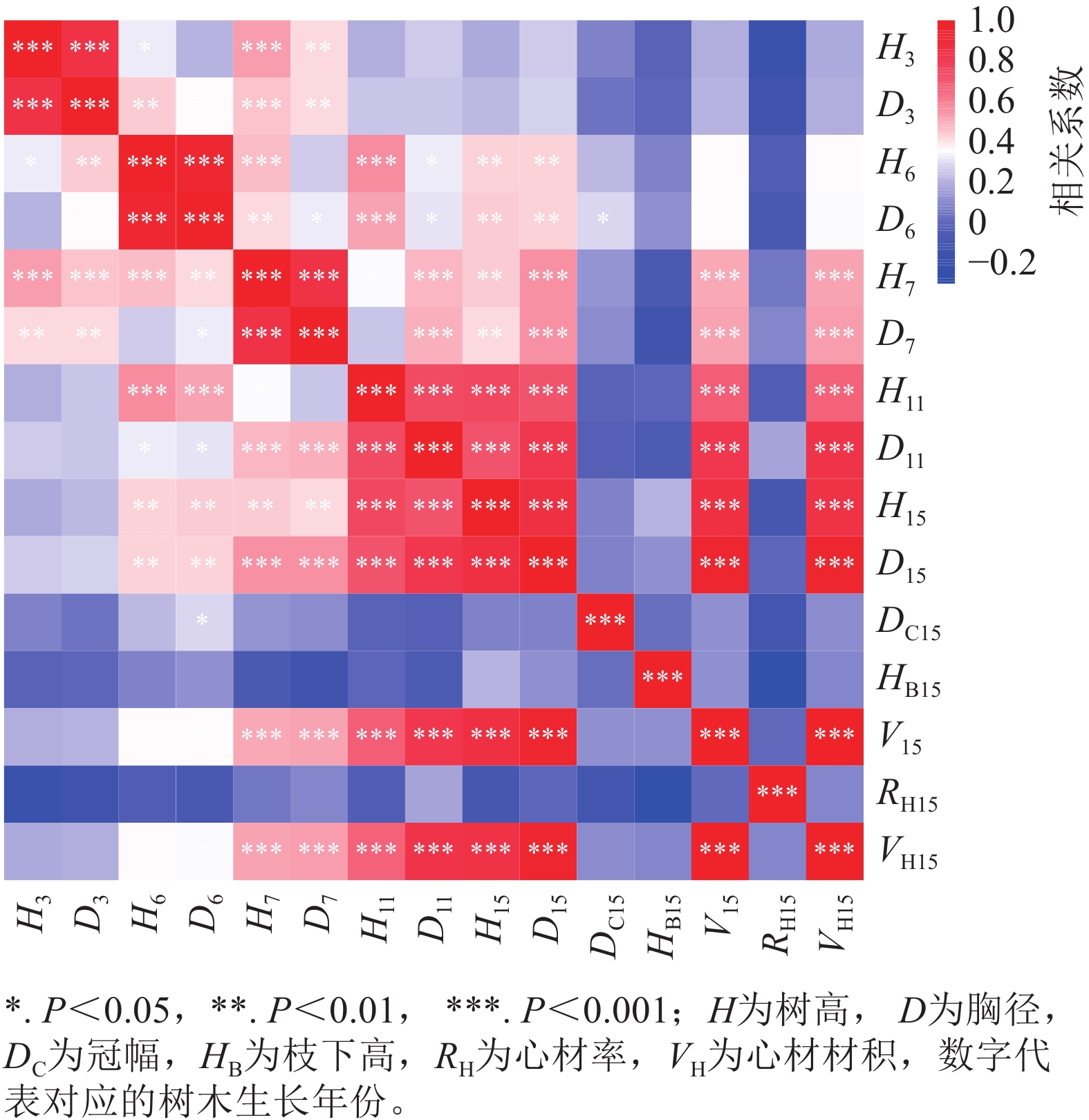
图1表明:红花香椿的生长发育呈现显著的时序特征和性状协同规律。3和6 a树高和胸径间的相关系数分别高达0.85和0.93,呈显著正相关性(P<0.05)。进一步分析显示:红花香椿早期生长对中后期性状影响呈现阶段性差异: 3 a 树高、胸径仅与7 a树高和胸径之间显著正相关(P<0.05),而与11、15 a的性状间相关性不显著;6 a树高和胸径与7 a树高、11 a树高、15 a性状(树高、胸径、材积和心材材积)之间呈现极显著正相关(P<0.01),而与心材率、枝下高和冠幅之间相关性不显著,而7 a性状与15 a性状的相关系数普遍高于6 a性状的相应值,这提示7 a可能是红花香椿发育的关键节点。此外,分析还发现:11 a胸径与材积、心材材积之间相关系数分别达0.83和0.84,说明通过对胸径的选择即可有效实现对材积和心材材积的选择目标。总体而言,随着树木年龄增长,红花香椿生长性状间相关系数有逐渐上升的趋势,表明随着年龄增长,其性状间协同性增强,呈高度一致性。

图 1 红花香椿生长和心材性状多年相关分析
Figure 1. Multi year correlation analysis between growth and heartwood traits of T. rubriflora
-
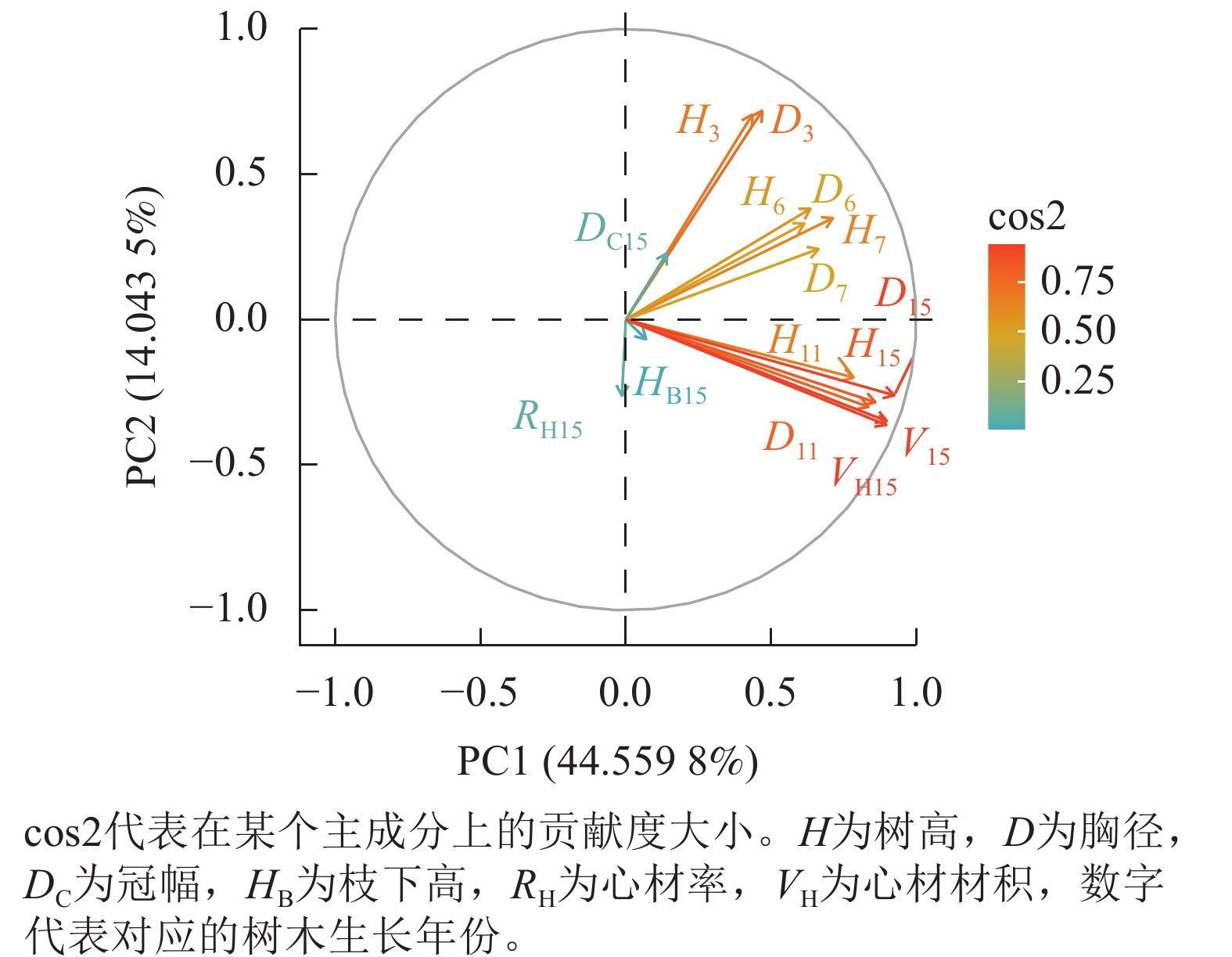
从表1可以看出:PC1和PC2的累积贡献率达58.603 3%,并且特征值均大于1 (分别为6.684 0和2.106 5),表明这2个主成分可以解释绝大部分性状的变异,包含所有性状的全部信息。以PC1和PC2绘制了红花香椿生长和心材性状与主成分的关系图(图2),图中点在PC1轴上的投影代表该样本对PC1的相关性。发现不同年龄红花香椿性状变量在PC1轴上的投影值呈现显著的梯度变化规律,具体表现为:红花香椿3 a林分(H3、D3)的投影值最小(最靠近原点),6 a (H6、D6)次之,7 a (H7、D7)进一步右移,而11 a (D11、H11)和15 a (D15、H15、V15、VH15)样本的投影值较为集中且最大(最远离原点)。表明11和15 a性状与PC1主成分的相关性较强。在PC2轴上,早期生长性状与成熟期形态特征形成显著分异,3 a的树高(H3)和胸径(D3)对PC2的贡献高于15 a冠幅(DC15)、枝下高(HB15)和心材率(RH15)对PC2的贡献,说明树木早期营养生长阶段(3 a)树高和胸径的变化与PC2相关性不强。此外,基于cos2的分析表明:年龄越大,其性状在PC1轴上的表征质量越高,具体表现为15和11 a性状的cos2较高,7 a次之,6和3 a较低,说明随着年龄增长,性状变异在PC1方向上得到了更有效的表征。
表 1 各性状主成分分析
Table 1. Principal component analysis of different traits
主要成分因子 PC1 PC2 PC3 PC4 PC5 主要成分因子 PC1 PC2 PC3 PC4 PC5 H3 0.435 0.705 −0.231 −0.340 −0.100 D15 0.924 −0.260 −0.009 −0.100 0.062 D3 0.470 0.718 −0.127 −0.240 −0.228 DC15 0.142 0.228 0.329 0.320 0.727 H6 0.635 0.382 0.414 0.418 −0.241 HB15 0.070 −0.068 0.585 −0.485 0.115 D6 0.615 0.331 0.470 0.447 −0.114 V15 0.898 −0.349 −0.008 −0.114 0.117 H7 0.713 0.349 −0.337 0.056 0.226 RH15 −0.013 −0.263 −0.519 0.556 −0.144 D7 0.663 0.243 −0.463 0.015 0.326 VH15 0.897 −0.363 −0.060 −0.065 0.110 H11 0.785 −0.199 0.191 0.080 −0.352 特征值 6.6840 2.1065 1.6226 1.2526 1.0195 D11 0.836 −0.300 −0.203 −0.024 −0.115 贡献率/% 44.5598 14.0435 10.8171 8.3509 6.7964 H15 0.859 −0.285 0.175 −0.143 −0.006 累积贡献率/% 44.5598 58.6033 69.4204 77.7713 84.5677 说明:H为树高,D为胸径,DC为冠幅,HB为枝下高,RH为心材率,VH为心材材积,数字代表对应的树木生长年份。 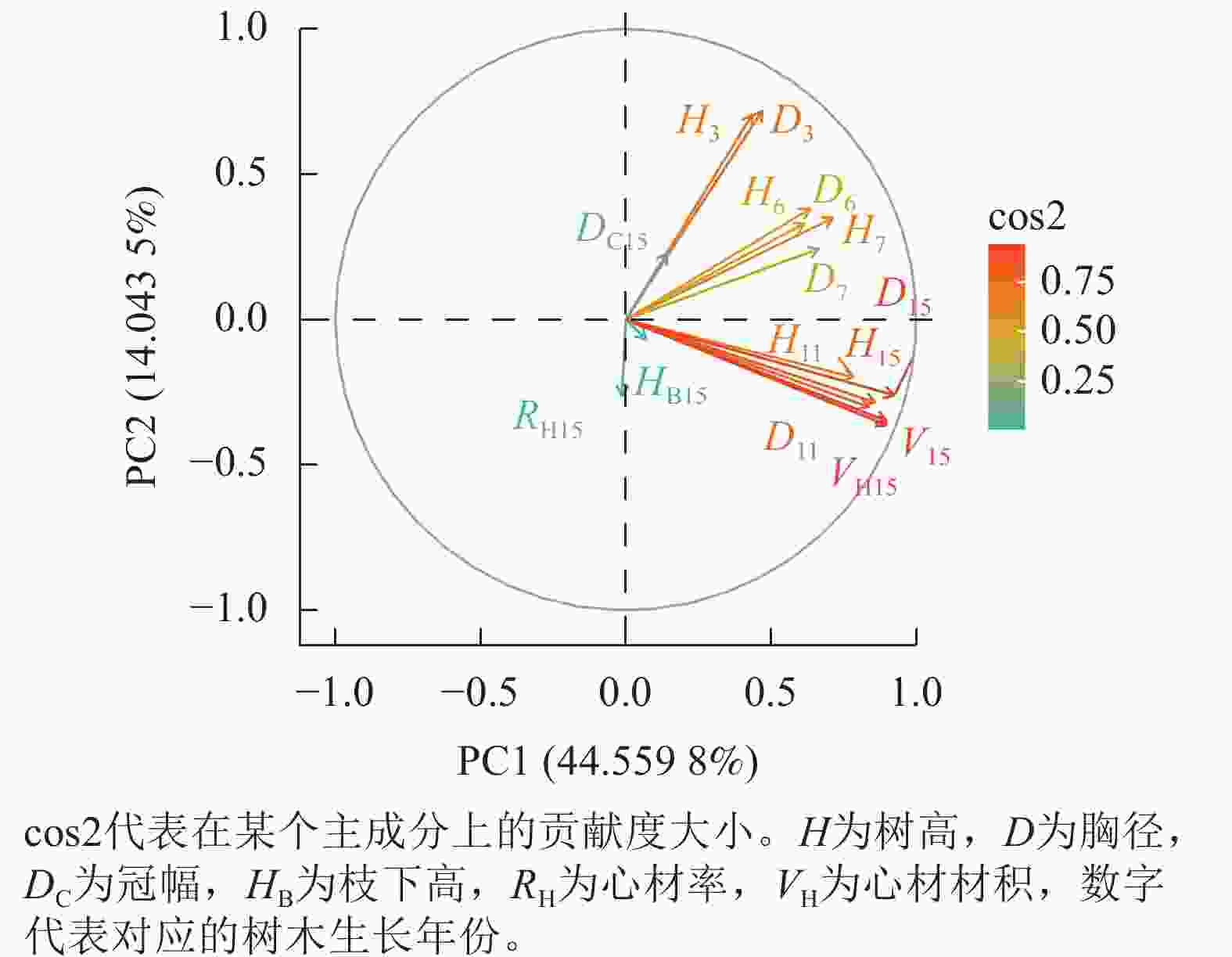
图 2 红花香椿生长和心材性状与主成分之间关系图
Figure 2. Relationship between the growth and heartwood traits of T. rubriflora and its principal components
-
早期选择应以经济轮伐期时的表型性状间的相关关系为依据,分别用树高、胸径、材积和心材材积等性状作为早期选择的性状,计算其早期选择的效率(表2)。从表2可以得出:用树高作为红花香椿早期选择的指标时,7 a对材积、心材材积2个性状的选择效率最大,选择效率分别为1.29和1.34。用胸径作为红花香椿早期选择的指标时,除3 a外,也是7 a对材积和心材材积选择效率大,选择效率分别为1.34和1.36。综合树高和胸径2个性状,在本研究测定的红花香椿生长时间范围内,7 a可以作为其早期选择的最佳年龄。
表 2 红花香椿树高、胸径、材积和心材材积早晚相关系数(r)及选择效率(E)
Table 2. Early and late correlation coefficient (r) and selection efficiency (E) of height, diameter at breast height, volume, and heartwood volume of T. rubriflora
年龄/a 树高与树高 胸径与胸径 树高与材积 胸径与材积 树高与心材材积 胸径与心材材积 r E r E r E r E r E r E 3 0.18 1.08 0.27 1.62 0.19 1.14 0.20 1.20 0.18 1.08 0.19 1.14 6 0.43 1.29 0.43 1.29 0.37 1.11 0.36 1.08 0.37 1.11 0.36 1.08 7 0.44 1.13 0.55 1.41 0.50 1.29 0.52 1.34 0.52 1.34 0.53 1.36 11 0.76 1.24 0.82 1.34 0.69 1.13 0.83 1.36 0.68 1.11 0.84 1.37 -
本研究基于红花香椿59个半同胞家系多年的生长和心材性状数据,通过相关分析[24−28]探讨了各性状间的联系及其年龄动态。结果表明:多数性状间相关系数随年龄增长呈递增趋势,揭示了性状协同性存在年龄效应,即随树木的成熟,各生长性状之间的同步性逐渐增强。这说明早期选择策略具备可行性,通过解析其早晚性状间的关联特征,可建立早期预测模型,为高效育种提供依据。这一结论与吴云燕等[29]关于毛红椿的研究结果一致。此外,红花香椿多数生长性状间的相关系数逐年上升可能源于幼龄期形态可塑性较高,性状对于环境响应相对独立,导致相关性较低;而进入成熟阶段后,资源分配、光合效率等生理过程趋于协调与稳定,促使性状发育同步性增强,相关系数显著提高。这体现了树木生长发育的多阶段性,这与树木生长阶段发育规律的相关研究相符[30]。进一步分析发现:在本研究测定的时间范围内,6 a时红花香椿树高和胸径与15 a各性状均呈极显著正相关,而7与15 a性状的相关系数普遍高于6 a的相应值,表明7 a为性状协同性显著增强的关键期,可作为早期选择的关键年龄。
主成分分析作为一种多变量统计方法,能够有效降维、去除冗余信息,提取出互不相关但可反映原变量基本信息的综合指标[31−34]。本研究系统测定包括11和15 a在内的多个近成熟年龄数据,核心目的在于获取林木成年表型基准以检验早期性状对成年表现的预测能力,并非暗示应将成年期作为早期选择的候选年龄。分析显示,主成分PC1的累计贡献率达44.559 8%。不同年龄红花香椿性状在PC1轴上的投影呈显著时序递增趋势:3、6、7、11、15 a,各年龄性状在PC1上的cos2也呈现一致变化规律,表明11与15 a性状对PC1的贡献较高,11与15 a性状与PC1的相关性较为显著。说明其在性状综合表征中占主导地位,但该年龄已处于近成熟阶段(通常成林年龄阈值为10~12 a),性状更趋稳定而非反映早期潜力,故不适用于早期选择。相比之下,7 a性状在PC1轴上不仅投影值显著高于3和6 a,且与PC1相关性最高,还处于速生期向稳定期过渡的关键节点,既规避了幼龄期(<5 a)的高度可塑性干扰[35],又较成熟林提前4~5 a实现生长和材性指标的稳定关联,这与许小娟[36]的研究结论相呼应。此外,多个针对不同树种提出的早期选择年龄建议也集中于5~8 a,汤道平[37]研究得出5 a杉木树高、胸径和材积与8 a对应性状的相关性较高,把5 a作为杉木无性系早期选择年龄;李思广等[38]依据思茅松Pinus kesiya var. langbianensis树高和胸径的早期选择效率,结合重复力、遗传和秩次相关系数,确定树高、胸径适宜的早期选择年龄为6 a;付强等[2]通过对柚木Tectona grandis无性系的研究初步确定5 a可作为柚木无性系早期选择的年龄,选准率达80%。因此,在本研究测定的时间范围内,将7 a确立为红花香椿早期选择的最优年龄,与其他树种的研究结果相符。
林木早期选择需确定易观测且有效的性状作为选择因子,树高与胸径作为反映生长速生性和材积潜力的核心指标,两者共同决定了单株树木材积大小,研究表明其遗传系数较高,具有显著的遗传协同性,可作为早期选择的联合指标[39−40]。早期选择效率是确定早期选择年龄的重要依据[41],本研究以红花香椿树高和胸径作为早期选择指标,评估其对材积和心材材积的选择效率。尽管本研究测量数据是间断的,结果有一定局限性,但可为早期生长选择提供参考[42],结果显示:以树高和胸径为选择指标时,7 a对材积、心材材积的选择效率分别达到1.29、1.34和1.34、1.36,根据选择效率大于1即表示早期选择效果优于成龄选择的标准,这进一步从选择效率角度证实了将7 a作为红花香椿早期选择关键年龄的有效性。
-
红花香椿的生长性状存在显著的年龄协同效应。随着年龄增加,多数性状之间的相关系数呈递增趋势,生长性状的同步性在树木成熟过程中逐步增强,表明早期选择可行。主成分分析进一步显示:7 a是性状协同性显著增强的关键节点,其在第1主成分上的投影值及与第1主成分的相关性均显著高于3和6 a。同时,7 a处于由速生期向稳定期过渡的关键阶段,既规避了幼龄期易受外界环境影响的不足,又比成熟林提前8~10 a实现了生长与材性指标的稳定关联。以树高和胸径作为选择指标,7 a对材积、心材材积的早期选择效率分别为1.29、1.34和1.34、1.36,均大于1,说明其早期选择效果优于成龄选择。综合判断,7 a是红花香椿早期选择的最优年龄。
Correlation between early and late growth and heartwood traits in Toona rubriflora and early selection
-
摘要:
目的 以红花香椿Toona rubriflora家系子代测定林为研究对象,测定、分析其不同年龄生长和材性性状的相关性,确定红花香椿的最佳早期选择年龄。 方法 以59个红花香椿半同胞子代家系为材料,测定其3、6、7、11和15 a的树高、胸径、枝下高、冠幅等生长性状,和心材率及心材材积等材性性状。在此基础上,利用R语言进行相关分析探究各性状间的关联性,并通过主成分分析(PCA)对多个性状进行降维处理,评价植株生长与材性性状表现。 结果 随着红花香椿年龄的增加,多数性状间的皮尔逊相关系数呈现逐年上升趋势,表明性状协同性随年龄增强。6 a树高和胸径与15 a的树高、胸径、材积和心材材积等性状之间表现为极显著正相关(P<0.01),但7 a性状与15 a性状的相关系数普遍高于6 a性状的相应值。主成分分析显示:7 a树高(H7)和胸径(D7)对前2个主成分(PC1和PC2)的贡献率高于6 a。早期选择效率评估表明:以树高和胸径为选择指标时,7 a对材积、心材材积的选择效率大,分别达1.29、1.34和1.34、1.36。 结论 红花香椿7 a是早期选择的最佳年龄,以树高和胸径作为选择指标,能够有效预测成年表现,提高选择效率,缩短育种周期。图2表2参42 Abstract:Objective Taking the progeny test forest of Toona rubriflora as the research object, the correlation between growth and wood property traits at different ages was measured and analyzed to determine the optimal early selection age for T. rubriflora. Method Taking 59 half-sibling families of T. rubriflora as the experimental materials, the growth traits such as tree height, diameter at breast height, height to the first branch, and crown width at 3, 6, 7, 11 and 15 a, as well as the wood properties such as heartwood ratio and heartwood volume were measured. On this basis, correlation analysis was conducted using R language to explore the correlations among various traits, and principal component analysis was performed to reduce the dimensions of multiple traits for a comprehensive evaluation of the growth and wood property performance of the trees. Result As the age of T. rubriflora increases, the Pearson correlation coefficients among most traits showed an upward trend year by year, indicating that the trait synergy strengthens with age. The tree height and diameter at breast height of 6 a trees were highly significantly positively correlated with the tree height, diameter at breast height, volume and heartwood volume of 15 a trees (P<0.01), but the correlation coefficients of 7 a traits with the 15 a traits were generally higher than the corresponding values of 6 a traits. Principal component analysis showed that the contribution rates of tree height (H7) and diameter at breast height (D7) to the first two principal components (PC1 and PC2) at 7 a were higher than those at 6 a. The evaluation of early selection efficiency indicated that when tree height and diameter at breast height were used as selection indicators, the selection efficiency of 7 a trees for volume and heartwood volume was high, reaching 1.29, 1.34 and 1.34, 1.36 respectively. Conclusion 7 a is the best age for early selection of T. rubriflora. By using tree height and diameter at breast height as selection indicators, it can effectively predict adult performance, improve selection efficiency, shorten the breeding cycle, and provide important support for the genetic improvement of T. rubriflora. [Ch, 2 fig. 2 tab. 42 ref.] -
Key words:
- Toona rubriflora /
- growth traits /
- heartwood traits /
- early selection
-
图 1 红花香椿生长和心材性状多年相关分析
Figure 1 Multi year correlation analysis between growth and heartwood traits of T. rubriflora
图 2 红花香椿生长和心材性状与主成分之间关系图
Figure 2 Relationship between the growth and heartwood traits of T. rubriflora and its principal components
表 1 各性状主成分分析
Table 1. Principal component analysis of different traits
主要成分因子 PC1 PC2 PC3 PC4 PC5 主要成分因子 PC1 PC2 PC3 PC4 PC5 H3 0.435 0.705 −0.231 −0.340 −0.100 D15 0.924 −0.260 −0.009 −0.100 0.062 D3 0.470 0.718 −0.127 −0.240 −0.228 DC15 0.142 0.228 0.329 0.320 0.727 H6 0.635 0.382 0.414 0.418 −0.241 HB15 0.070 −0.068 0.585 −0.485 0.115 D6 0.615 0.331 0.470 0.447 −0.114 V15 0.898 −0.349 −0.008 −0.114 0.117 H7 0.713 0.349 −0.337 0.056 0.226 RH15 −0.013 −0.263 −0.519 0.556 −0.144 D7 0.663 0.243 −0.463 0.015 0.326 VH15 0.897 −0.363 −0.060 −0.065 0.110 H11 0.785 −0.199 0.191 0.080 −0.352 特征值 6.6840 2.1065 1.6226 1.2526 1.0195 D11 0.836 −0.300 −0.203 −0.024 −0.115 贡献率/% 44.5598 14.0435 10.8171 8.3509 6.7964 H15 0.859 −0.285 0.175 −0.143 −0.006 累积贡献率/% 44.5598 58.6033 69.4204 77.7713 84.5677 说明:H为树高,D为胸径,DC为冠幅,HB为枝下高,RH为心材率,VH为心材材积,数字代表对应的树木生长年份。  下载: 导出CSV
表 2 红花香椿树高、胸径、材积和心材材积早晚相关系数(r)及选择效率(E)
Table 2. Early and late correlation coefficient (r) and selection efficiency (E) of height, diameter at breast height, volume, and heartwood volume of T. rubriflora
年龄/a 树高与树高 胸径与胸径 树高与材积 胸径与材积 树高与心材材积 胸径与心材材积 r E r E r E r E r E r E 3 0.18 1.08 0.27 1.62 0.19 1.14 0.20 1.20 0.18 1.08 0.19 1.14 6 0.43 1.29 0.43 1.29 0.37 1.11 0.36 1.08 0.37 1.11 0.36 1.08 7 0.44 1.13 0.55 1.41 0.50 1.29 0.52 1.34 0.52 1.34 0.53 1.36 11 0.76 1.24 0.82 1.34 0.69 1.13 0.83 1.36 0.68 1.11 0.84 1.37
下载: 导出CSV
-
[1] 洪舟, 杨曾奖, 张宁南, 等. 越南黄花梨种源家系生长遗传变异及早期选择[J]. 南京林业大学学报(自然科学版), 2020, 44(1): 25−30. HONG Zhou, YANG Zengjiang, ZHANG Ningnan, et al. Genetic variation and juvenile selection of growth traits of Dalbergia tonkinensis Prain[J]. Journal of Nanjing Forestry University (Natural Sciences Edition), 2020, 44(1): 25−30. DOI: 10.3969/j.issn.1000-2006.201906028. [2] 付强, 黄桂华, 周强, 等. 柚木无性系早期选择年龄的研究[J]. 中南林业科技大学学报, 2022, 42(10): 30−38. FU Qiang, HUANG Guihua, ZHOU Qiang, et al. Study on the early selection age of Tectona grandis clones[J]. Journal of Central South University of Forestry & Technology, 2022, 42(10): 30−38. DOI: 10.14067/j.cnki.1673-923x.2022.10.004. [3] HAAPANEN M, HYNYNEN J, RUOTSALAINEN S, et al. Realised and projected gains in growth, quality and simulated yield of genetically improved Scots pine in southern Finland[J]. European Journal of Forest Research, 2016, 135(6): 997−1009. DOI: 10.1007/s10342-016-0989-0. [4] LAI Meng, SUN Xiaomei, CHEN Dongsheng, et al. Age-related trends in genetic parameters for Larix kaempferi and their implications for early selection[J]. BMC Genetics, 2014, 15(suppl 1): S10. DOI: 10.1186/1471-2156-15-s1-s10. [5] 王章荣, 陈天华, 周志春, 等. 福建华安马尾松生长早晚期相关及早期选择[J]. 南京林业大学学报(自然科学版), 1987, 11(3): 41−47. WANG Zhangrong, CHEN Tianhua, ZHOU Zhichun, et al. Early-late correlation and early selection of the growth traits of Pinus massoniana Lamb. in Huaan County, Fujian Province[J]. Journal of Nanjing Forestry University, 1987, 11(3): 41−47. DOI: 10.3969/j.jssn.1000-2006.1987.03.006. [6] 丁振芳, 王景章, 方海峰, 等. 日本落叶松家系早期选择技术[J]. 东北林业大学学报, 1997, 25(3): 65−67. DING Zhenfang, WANG Jingzhang, FANG Haifeng, et al. The early stage selection technology for family system of Larix olgensis[J]. Journal of Northeast Forestry University, 1997, 25(3): 65−67. DOI: 10.13759/j.cnki.dlxb.1997.03.015. [7] 赵承开. 杉木优良无性系早期选择年龄和增益[J]. 林业科学, 2002, 38(4): 53−60. ZHAO Chengkai. A study on optimum age and gain for early selection of superior clone in Cunninghamia lanceolata Hook[J]. Scientia Silvae Sinicae, 2002, 38(4): 53−60. DOI: 10.3321/j.issn:1001-7488.2002.04.009. [8] 王军辉, 顾万春, 李斌, 等. 桤木优良种源/家系的选择研究——生长的适应性和遗传稳定性分析[J]. 林业科学, 2000, 36(3): 59−66. WANG Junhui, GU Wanchun, LI Bin, et al. Study on selection of Alnus cremastogyne provenance/family: analysis of growth adaptation and genetic stability[J]. Scientia Silvae Sinicae, 2000, 36(3): 59−66. DOI: 10.3321/j.issn:1001-7488.2000.03.010. [9] 杨世桢, 王继志, 陈晓波, 等. 长白山地区水曲柳的早期选择[J]. 东北林业大学学报, 2007, 35(2): 20−21, 28. YANG Shizhen, WANG Jizhi, CHEN Xiaobo, et al. Early selection of Fraxinus mandshurica in Changbai Mountains[J]. Journal of Northeast Forestry University, 2007, 35(2): 20−21, 28. DOI: 10.13759/j.cnki.dlxb.2007.02.008. [10] JHADE D, GAUTAM A, AHIRWAR D, et al. Pharmacognostic evaluation of Toona ciliata bark[J]. Journal of Advanced Pharmaceutical Technology & Research, 2010, 1(2): 216. DOI: 10.4103/2231-4040.72261. [11] 陈娟, 彭建, 肖兴翠, 等. 红椿与毛红椿半同胞家系早期选择研究[J]. 中南林业科技大学学报, 2020, 40(8): 17−24. CHEN Juan, PENG Jian, XIAO Xingcui, et al. Early selection study of half sib families of Toona ciliata var. ciliata & Toona ciliata var. pubescens[J]. Journal of Central South University of Forestry & Technology, 2020, 40(8): 17−24. DOI: 10.14067/j.cnki.1673-923x.2020.08.003. [12] 韦一, 范艳如, 邱勇斌, 等. 毛红椿生长、心材和材性性状遗传分析及家系选择[J]. 林业科学研究, 2024, 37(4): 33−40. WEI Yi, FAN Yanru, QIU Yongbin, et al. Genetic analysis and family selection of growth, heartwood and wood traits for Toona ciliata var. pubescens[J]. Forest Research, 2024, 37(4): 33−40. DOI: 10.12403/j.1001-1498.20230376. [13] CHENG Qiangqiang, MA Jikai, GUO Chunce, et al. Insights into the root sprouts of Toona fargesii in a natural forest: from the morphology, physiology, and transcriptome levels[J]. Forests, 2024, 15(2): 335. DOI: 10.3390/f15020335. [14] 周琳瑨, 周美才, 贾婷, 等. 红花香椿苗木质量评价与生物量投资规律[J]. 江西农业大学学报, 2025, 47(4): 1013−1022. ZHOU Linjin, ZHOU Meicai, JIA Ting, et al. Quality evaluation of seedlings and biomass investment patterns of Toona fargesii[J]. Acta Agriculturae Universitatis Jiangxiensis (Natural Sciences Edition), 2025, 47(4): 1013−1022. DOI: 10.3724/aauj.2025087. [15] 陈锋, 谢文远, 张水利, 等. 浙江种子植物资料订补(Ⅱ)[J]. 杭州师范大学学报(自然科学版), 2020, 19(6): 96−102. CHEN Feng, XIE Wenyuan, ZHANG Shuili, et al. Additional notes on the seed plants in Zhejiang(Ⅱ)[J]. Journal of Hangzhou Normal University (Natural Science Edition), 2020, 19(6): 96−102. DOI: 10.12191/j.issn.1674-232X.2020.06.014. [16] 刘军, 姜景民, 邹军, 等. 中国特有濒危树种毛红椿核心和边缘居群的遗传多样性[J]. 植物生态学报, 2013, 37(1): 52−60. LIU Jun, JIANG Jingmin, ZOU Jun, et al. Genetic diversity of central and peripheral populations of Toona ciliata var. pubescens, an endangered tree species endemic to China[J]. Chinese Journal of Plant Ecology, 2013, 37(1): 52−60. DOI: 10.3724/SP.J.1258.2013.00006. [17] 刘军, 乔卫阳, 邱勇斌, 等. 毛红椿天然群体遗传多样性及取样策略探讨[J]. 林业科学研究, 2019, 32(1): 175−184. LIU Jun, QIAO Weiyang, QIU Yongbin, et al. Discussion on genetic diversity and sampling strategy of natural Toona ciliata var. pubescens populations[J]. Forest Research, 2019, 32(1): 175−184. DOI: 10.13275/j.cnki.lykxyj.2019.01.024. [18] 刘军, 陈益泰, 孙宗修, 等. 基于空间自相关分析研究毛红椿天然居群的空间遗传结构[J]. 林业科学, 2008, 44(6): 45−52. LIU Jun, CHEN Yitai, SUN Zongxiu, et al. Spatial genetic structure of Toona ciliata var. pubescens populations in terms of spatial autocorrelation analysis[J]. Scientia Silvae Sinicae, 2008, 44(6): 45−52. DOI: 10.3321/j.issn:1001-7488.2008.06.009. [19] MCPHERSON H, VAN DER MERWE M, DELANEY S K, et al. Capturing chloroplast variation for molecular ecology studies: a simple next generation sequencing approach applied to a rainforest tree[J]. BMC Ecology, 2013, 13(1): 8. DOI: 10.1186/1472-6785-13-8. [20] 刘军, 陈益泰, 姜景民, 等. 毛红椿优树自由授粉子代幼林生长表现[J]. 浙江林学院学报, 2010, 27(6): 956−960. LIU Jun, CHEN Yitai, JIANG Jingmin, et al. Growth performance of Toona ciliata var. pubescens family progeny by open pollination[J]. Journal of Zhejiang Forestry College, 2010, 27(6): 956−960. DOI: 10.3969/j.issn.2095-0756.2010.06.026. [21] 黄红兰, 张露, 刘郁林, 等. 江西毛红椿种源的半同胞家系子代早期测定及其评价[J]. 安徽农业大学学报, 2012, 39(3): 371−376. HUANG Honglan, ZHANG Lu, LIU Yulin, et al. Early selection and evaluation of half-sib progenies of Toona ciliata var. pubescens from Jiangxi provenances[J]. Journal of Anhui Agricultural University, 2012, 39(3): 371−376. DOI: 10.13610/j.cnki.1672-352x.2012.03.028. [22] 范建华. 马尾松毛红椿混交林生长效果和土壤肥力研究[J]. 防护林科技, 2007(3): 21−23. FAN Jianhua. Growth and soil fertility of mixed stand of Pinus massoniana and Toona ciliata var. pubescens[J]. Protection Forest Science and Technology, 2007(3): 21−23. DOI: 10.13601/j.issn.1005-5215.2007.03.009. [23] 王润辉, 胡德活, 郑会全, 等. 杉木无性系生长和材性变异及多性状指数选择[J]. 林业科学, 2012, 48(3): 45−50. WANG Runhui, HU Dehuo, ZHENG Huiquan, et al. Clonal variation in growth and wood quality and the multi-trait index selection of Chinese fir[J]. Scientia Silvae Sinicae, 2012, 48(3): 45−50. DOI: 10.11707/j.1001-7488.20120308. [24] ASHFAQ M, ZHU Renshan, ALI M, et al. Adaptation and high yield performance of Honglian type hybrid rice in Pakistan with desirable agricultural traits[J]. Agriculture, 2023, 13(2): 242. DOI: 10.3390/agriculture13020242. [25] WU H X, SANCHEZ L. Effect of selection method on genetic correlation and gain in a two-trait selection scheme[J]. Australian Forestry, 2011, 74(1): 36−42. DOI: 10.1080/00049158.2011.10676344. [26] APIOLAZA L A. Basic density of Radiata pine in New Zealand: genetic and environmental factors[J]. Tree Genetics & Genomes, 2012, 8(1): 87−96. DOI: 10.1007/s11295-011-0423-1. [27] FUKATSU E, HIRAOKA Y, MATSUNAGA K, et al. Genetic relationship between wood properties and growth traits in Larix kaempferi obtained from a diallel mating test[J]. Journal of Wood Science, 2015, 61(1): 10−18. DOI: 10.1007/s10086-014-1436-9. [28] 晏姝, 韦如萍, 王润辉, 等. 南洋楹半同胞家系苗期变异及选择[J]. 浙江农林大学学报, 2024, 41(2): 306−313. YAN Shu, WEI Ruping, WANG Runhui, et al. Variation and selection of half-sib families of Falcataria falcata during seedling stage[J]. Journal of Zhejiang A&F University, 2024, 41(2): 306−313. DOI: 10.11833/j.issn.2095-0756.20230371. [29] 吴云燕, 张露, 刘远生, 等. 不同种源/家系毛红椿连年生长性状变异及早期选择[J]. 江西农业大学学报, 2024, 46(1): 106−117. WU Yunyan, ZHANG Lu, LIU Yuansheng, et al. Variation of annual growth traits and early selection of different provenances/families of Toona ciliata var. pubescens[J]. Acta Agriculturae Universitatis Jiangxiensis (Natural Sciences Edition), 2024, 46(1): 106−117. DOI: 10.3724/aauj.2024011. [30] 于洋, 李奇昌, 金光泽, 等. 树木大小和竞争对青岛市5种主要造林树种生物量分配的影响[J]. 北京林业大学学报, 2025, 47(10): 32−41. YU Yang, LI Qichang, JIN Guangze, et al. Effects of tree size and competition on biomass allocation of five major afforestation tree species in Qingdao, Shandong Province of eastern China[J]. Journal of Beijing Forestry University, 2025, 47(10): 32−41. DOI: 10.12171/j.1000-1522.20250118. [31] 崔新晓, 宫慧慧, 李艳丽, 等. 基于主成分分析的11个紫苏品系引种表现分析[J]. 中国种业, 2025(3): 98−104. CUI Xinxiao, GONG Huihui, LI Yanli, et al. Analysis of the introduction performance of 11 Perilla varieties based on principal component analysis[J]. China Seed Industry, 2025(3): 98−104. DOI: 10.19462/j.cnki.zgzy.20241212001. [32] 蔡晓洋, 张思荻, 曾俊, 等. 基于主成分分析和聚类分析的栀子种质资源评价[J]. 中国实验方剂学杂志, 2017, 23(14): 30−37. CAI Xiaoyang, ZHANG Sidi, ZENG Jun, et al. Evaluation of germplasm resources of Gardeniae fructus based on principal component and hierarchical cluster analysis[J]. Chinese Journal of Experimental Traditional Medical Formulae, 2017, 23(14): 30−37. DOI: 10.13422/j.cnki.syfjx.2017140030. [33] AZODANLOU R, DARBELLAY C, LUISIER J L, et al. Development of a model for quality assessment of tomatoes and apricots[J]. LWT-Food Science and Technology, 2003, 36(2): 223−233. DOI: 10.1016/S0023-6438(02)00204-9. [34] 沈汉, 郑成忠, 邱勇斌, 等. 10年生香椿生长与形质性状的种源变异及选择[J]. 浙江农林大学学报, 2024, 41(3): 597−605. SHEN Han, ZHENG Chengzhong, QIU Yongbin, et al. Provenance variation and selection in growth, shape, and quality traits of 10-year-old Toona sinensis[J]. Journal of Zhejiang A&F University, 2024, 41(3): 597−605. DOI: 10.11833/j.issn.2095-0756.20230481. [35] 沈秋水. 不同种源红花香椿优树子代测定及早期评价[J]. 河北林业科技, 2024(2): 25−29. SHEN Qiushui. The genetic testing and early evaluation on Toona fargesii dominant trees[J]. Journal of Hebei Forestry Science and Technology, 2024(2): 25−29. DOI: 10.16449/j.cnki.issn1002-3356.2024.02.004. [36] 许小娟. 红花香椿子代变异研究及早期选择[J]. 江苏林业科技, 2023, 50(3): 18−20, 36. XU Xiaojuan. Study on variation and early selection of offspring of Toona rubriflora[J]. Journal of Jiangsu Forestry Science & Technology, 2023, 50(3): 18−20, 36. DOI: 10.3969/j.issn.1001-7380.2023.03.004. [37] 汤道平. 福建省南部杉木无性系5年和8年生长期测定及早期选择[J]. 中南农业科技, 2024, 45(11): 43−47. TANG Daoping. Determination and early selection of 5-year and 8-year growth periods of Chinese fir clones in southern Fujian Province[J]. South-Central Agricultural Science and Technology, 2024, 45(11): 43−47. DOI: 10.3969/j.issn.1007-273X.2024.11.010. [38] 李思广, 李宏斌, 姜远标, 等. 思茅松无性系生长性状早晚相关研究及早期选择[J]. 广西林业科学, 2023, 52(6): 713−718. LI Siguang, LI Hongbin, JIANG Yuanbiao, et al. Early and late research and early selection of growth traits of Pinus kesiya var. langbianensis clones[J]. Guangxi Forestry Science, 2023, 52(6): 713−718. DOI: 10.19692/j.issn.1006-1126.20230606. [39] 陈建, 袁伟刚, 肖兴翠, 等. 香椿优树半同胞家系苗期测定及家系选择[J]. 四川林业科技, 2017, 38(5): 8−12. CHEN Jian, YUAN Weigang, XIAO Xingcui, et al. Seedling testing and family selection of Toona cillate elite half-sib family[J]. Journal of Sichuan Forestry Science and Technology, 2017, 38(5): 8−12. DOI: 10.16779/j.cnki.1003-5508.2017.05.002. [40] 肖晖, 林泽忠, 苏顺德, 等. 杉木无性系圃地测定性状遗传变异分析及超早期选择[J]. 南京林业大学学报(自然科学版), 2024, 48(3): 63−70. XIAO Hui, LIN Zezhong, SU Shunde, et al. Genetic variation analysis and selection of clones based on short-term nursery testing on Cunninghamia lanceolata[J]. Journal of Nanjing Forestry University (Natural Sciences Edition), 2024, 48(3): 63−70. DOI: 10.12302/j.issn.1000-2006.202303046. [41] 唐良民, 周衍斌. 马尾松主要生长性状遗传参数和选择效果分析[J]. 南方林业科学, 2020, 48(6): 29−34. TANG Liangmin, ZHOU Yanbin. Analysis on genetic parameters and selection effects of main growthtraits in Pinus massoniana[J]. South China Forestry Science, 2020, 48(6): 29−34. DOI: 10.16259/j.cnki.36-1342/s.2020.06.007. [42] QUE Qingmin, LI Chunmei, LI Buye, et al. Multi-level genetic variation and selection strategy of Neolamarckia cadamba in successive years[J]. Forests, 2021, 12(11): 1455. DOI: 10.3390/f12111455. -

-
链接本文:
https://zlxb.zafu.edu.cn/article/doi/10.11833/j.issn.2095-0756.20250380
 点击查看大图
计量
- 文章访问数: 946
- HTML全文浏览量: 281
- PDF下载量: 128
- 被引次数: 0
