

Turn off MathJax
Article Contents

DAI Kunrong, LIU Ya, YU Weiwu, et al. Physiological response and waterlogging tolerance of rootstocks of 9 Torreya grandis ‘Merrillii’ cultivars under waterlogging stress[J]. Journal of Zhejiang A&F University, 2025, 43(X): 1−8 doi:  10.11833/j.issn.2095-0756.20250398
Citation: DAI Kunrong, LIU Ya, YU Weiwu, et al. Physiological response and waterlogging tolerance of rootstocks of 9 Torreya grandis ‘Merrillii’ cultivars under waterlogging stress[J]. Journal of Zhejiang A&F University, 2025, 43(X): 1−8 doi:  10.11833/j.issn.2095-0756.20250398

OnlineFirst articles are published online before they appear in a regular issue of the journal. Please find and download the full texts via CNKI.

Physiological response and waterlogging tolerance of rootstocks of 9 Torreya grandis ‘Merrillii’ cultivars under waterlogging stress

DOI: 10.11833/j.issn.2095-0756.20250398
  • Received Date: 2025-07-26
  • Accepted Date: 2025-12-16
  • Rev Recd Date: 2025-12-09
  •   Objective  In regions with poor drainage during the rainy season, frequent waterlogging severely constrains the increase in yield and quality of Torreya grandis ‘Merrillii’. This study aims to systematically investigate the physiological response and waterlogging tolerance of rootstocks of different T. grandis ‘Merrillii’ cultivars under waterlogging stress, which not only helps facilitate screening and cultivating waterlogging-tolerant varieties, but also provides a theoretical basis for elucidating the waterlogging-tolerant mechanism of T. grandis ‘Merrillii’.   Method  Rootstocks of 9 T. grandis ‘Merrillii’ cultivars, namely ‘Zhenzhufei’ ‘Zaoyuanfei’ ‘Yushanyufei’ ‘Jinyehongxiangyafei’ ‘Qiefei’ ‘Changyefei’ ‘Xiaozixiangyafei’ ‘Longfengxifei’ and ‘Zhimafei’ were used as test materials. 2 treatments were set up: normal moisture (control) and waterlogging. The tolerance of each cultivar to waterlogging was comprehensively evaluated by measuring 10 physiological indices in T. grandis ‘Merrillii’ leaves, including chlorophyll a and b contents, hydrogen peroxide (H2O2) content, malondialdehyde (MDA) content, electrolyte leakage rate, proline (Pro) content, and the activities of ascorbate peroxidase (APX), catalase (CAT), superoxide dismutase (SOD), and peroxidase (POD). Then, the waterlogging tolerance index of each variety was assessed based on principal component analysis and membership function analysis to comprehensively evaluate waterlogging tolerance capacity of each variety.   Result  Under waterlogging treatment, the contents of chlorophyll a and b of rootstocks of different cultivars decreased to varying degrees compared to the control. In contrast, the physiological indicators related to oxidative stress, such as H2O2 content, MDA content, electrolyte leakage rate, SOD activity, and POD activity, all increased to varying degrees. Pro content, APX activity, and CAT activity showed an increasing or decreasing trend in different cultivars. Based on principal component analysis and membership function analysis, a comprehensive evaluation of different physiological indicators was conducted to obtain the comprehensive evaluation values of waterlogging tolerance for the 9 cultivars.   Conclusion  Rootstocks of different T. grandis ‘Merrillii’ cultivars exhibit different changes in osmotic substances and antioxidant protection ability under waterlogging stress. ‘Changyefei’ ‘Jinyehongxiangyafei’ and ‘Yushanyufei’demonstrate high waterlogging resistance, while ‘Xiaozixiangyafei’ ‘Longfengxifei’ and ‘Zaoyuanfei’ show moderate tolerance. ‘Zhenzhufei’ ‘Qiefei’ and ‘Zhimafei’ have the least capacity of waterlogging tolerance. [Ch, 1 fig. 3 tab. 29 ref.]
  • [1] XU Hui, WU Cuiyun, FANG Zhigang, JI Yinzhong, CAO Yilin, WANG Ming, SUN Yali.  Fruit quality of 5 Prunus simonii cultivars in Aksu Area . Journal of Zhejiang A&F University, doi: 10.11833/j.issn.2095-0756.20250268
    [2] ZHANG Lili, TIAN Danqing, WAN Xiao, CAO Qunyang, GE Yaying.  Comprehensive evaluation of shade tolerance of 11 colorful-leaf plants . Journal of Zhejiang A&F University, doi: 10.11833/j.issn.2095-0756.20250401
    [3] CHENG Jiajie, CHEN Rong, YU Weiwu, CHEN Wenchao, HU Yuanyuan, ZHANG Zuying, SONG Lili.  Differences in free amino acids during post-ripening process of Torreya grandis ‘Xi Fei’ and ‘Xiangya Fei’ seeds . Journal of Zhejiang A&F University, doi: 10.11833/j.issn.2095-0756.20250169
    [4] WANG Shuang, DONG Bin, WANG Yiguang, ZHAO Hongbo.  Analysis and evaluation of flower and fruit characteristics of different Prunus mume cultivars . Journal of Zhejiang A&F University, doi: 10.11833/j.issn.2095-0756.20230213
    [5] YANG Lei, ZHAO Di, HU Yuanyuan, SUO Jinwei, YU Weiwu, WU Jiasheng, LOU Heqiang, SONG Lili.  Comparative analysis of aroma components and oil quality of Torreya grandis ‘Merrillii’ nuts with different processing techniques . Journal of Zhejiang A&F University, doi: 10.11833/j.issn.2095-0756.20210304
    [6] YANG Yan, TANG Jie, LI Yongjin, TANG Yuxi, LI Lei.  Analysis and evaluation of growth and wood fiber characters of seven poplar clones in southern China . Journal of Zhejiang A&F University, doi: 10.11833/j.issn.2095-0756.20210481
    [7] YE Shuyuan, DONG Leiming, DONG Ang, YU Weiwu, DAI Wensheng, ZENG Yanru.  Estimation of genetic parameters for juvenile growth of half-sib seedlings of Torreya grandis . Journal of Zhejiang A&F University, doi: 10.11833/j.issn.2095-0756.20190542
    [8] GONG Li, HU Hengkang, HU Yuanyuan, YU Weiwu, WU Jiasheng, HUANG Jianqin, ZHANG Qixiang.  Immature embryo development and embryogenic frequency in Torreya grandis 'Merrillii' . Journal of Zhejiang A&F University, doi: 10.11833/j.issn.2095-0756.2018.05.010
    [9] CHEN Wen, WANG Jing, WU Haiping, ZHANG Ling, YE Zhengqian.  Salt tolerance of 5 typical landscape plant species in Zhoushan Islands . Journal of Zhejiang A&F University, doi: 10.11833/j.issn.2095-0756.2017.02.012
    [10] DING Shaogang, ZHU Yanran.  Constructing a synthetic evaluation system of hospital out-door environment based on analytic hierarchy process and fuzzy synthetic evaluation . Journal of Zhejiang A&F University, doi: 10.11833/j.issn.2095-0756.2017.06.019
    [11] ZHANG Guanglai, LI Lu, LIAO Wenmei.  Principal component analysis of China's forestry industry competitiveness . Journal of Zhejiang A&F University, doi: 10.11833/j.issn.2095-0756.2016.06.022
    [12] LU Chang, LI Bin, LIU Ru, XIA Liangfang, ZHU Liang, LIN Furong, ZHENG Yongqi.  Comprehensive evaluation on cold resistance of Liriodendron chinense from four provenances . Journal of Zhejiang A&F University, doi: 10.11833/j.issn.2095-0756.2016.03.012
    [13] WU Lianhai, WU Liming, NI Rongxin, YAN Fuhua.  Economic benefits of Torreya grandis ‘Merrillii’ plantings . Journal of Zhejiang A&F University, doi: 10.11833/j.issn.2095-0756.2013.02.023
    [14] WANG Rong.  Principal component analysis and evaluation of waterfowl habitats along the coastline of Fujian Province . Journal of Zhejiang A&F University, doi: 10.11833/j.issn.2095-0756.2011.03.020
    [15] WANG Gai-ping, CEN Xian-chao, PENG Fang-ren, YANG Hong-ning.  Drought resistance in seedlings of Catalpa bungei cultivars . Journal of Zhejiang A&F University,
    [16] DAI Wen-sheng, LI Zhang-ju, CHENG Xiao-jian, YU Wei-wu, FU Qing-gong.  Soil nutrients in Torreya grandis `Merrillii' plantation . Journal of Zhejiang A&F University,
    [17] DAI Wen-sheng, LI Zhang-ju, CHENG Xiao-jian, YU Wei-wu, FU Qing-gong.  Mineral elements in Torreya grandis 'Merrillii' seeds and their forest soils . Journal of Zhejiang A&F University,
    [18] HUANG Hua-hong, TONG Zai-kang, LIAO Wang-yi, BI Chun-hui, LOU Xiong-zhen.  High performance liquid chromatographic analysis and changes of endogenous hormones in female floral buds of Torreya grandis `Merrillii' . Journal of Zhejiang A&F University,
    [19] WU Zhong-liang, XU Zhi-hong, CHEN Xiu-long, JIN Guo-long, LI Su-ping, SHEN Yu-lin, LANG Xue-jun, HU Zhong-cheng, CHEN Li-hong.  Species and controls of main diseases and insect pests of Torreya grandis 'Merrillii' . Journal of Zhejiang A&F University,
    [20] LI Zhang-ju, LUO Cheng-fang, CHEN Xiao-jian, FENG Xiao-jun, YU Wei-wu.  Component analysis and nutrition evaluation of seeds of Torreya grandis 'Merrillii' . Journal of Zhejiang A&F University,
  • [1]
    ZHANG Zuying, TAO Liu, GAO Lingling, et al. Transcription factors TgbHLH95 and TgbZIP44 cotarget terpene biosynthesis gene TgGPPS in Torreya grandis nuts[J]. Plant Physiology, 2023, 193(2): 1161−1176. DOI: 10.1093/plphys/kiad385.
    [2]
    ZONGO A W, JIN Chengyu, HAO Guijie, et al. Functional compounds of Torreya grandis nuts and their processing byproducts: extraction process, health benefits, and food applications–A comprehensive review[J]. Food Research International, 2024, 197: 115232. DOI: 10.1016/j.foodres.2024.115232.
    [3]
    YAN Jingwei, ZENG Hao, CHEN Weijie, et al. New insights into the carotenoid biosynthesis in Torreya grandis kernels[J]. Horticultural Plant Journal, 2023, 9(6): 1108−1118. DOI: 10.1016/j.hpj.2023.02.010.
    [4]
    YAN Xiaosu, CHEN Hongxing, YU Weiwu. Torreya grandis-a rare dried fruit tree species unique to China[J]. Zhejiang Forestry, 2022(12): 24−25.
    [5]
    LI Zhangju, DAI Wensheng. Torreya grandis in China[M]. Beijing: Science Press, 2007.
    [6]
    LIU Zhihui, YAN Jiawen, WANG Tongtong, et al. TgLCYB1 regulated by TgWRKY22 enhances the tolerance of Torreya grandis to waterlogging stress[J]. International Journal of Biological Macromolecules, 2023, 253: 126702. DOI: 10.1016/j.ijbiomac.2023.126702.
    [7]
    TONG Qi, WANG Chen, ZHOU Xinwei, et al. Effects of waterlogging stress on physiological characteristics of Torreya grandis seedlings[J]. Xiandai Nongye Keji, 2024(7): 94−97. DOI: 10.3969/j.issn.1007-5739.2024.07.025.
    [8]
    ZHU Wei, GONG Linzhong, WANG Furong, et al. Physiological responses and waterlogging tolerance evaluation of five peach rootstock varieties under waterlogging stress[J]. Journal of Southern Agriculture, 2022, 53(10): 2937−2945. DOI: 10.3969/j.issn.2095-1191.2022.10.026.
    [9]
    XU Shanshan, LEI Jiangli, LU Ting, et al. Physiological response to waterlogging stress and evaluationo waterlogging tolerance of 8 Bougainvillea sp. [J/OL]. Molecular Plant Breeding, 2024-07-15. https://link.cnki.net/urlid/46.1068.S.20240711.1734.004.
    [10]
    YE Kang, CHEN Boxiang, DU Xiwu, et al. Response and waterlogging tolerance evaluation of three Magnolia materials to waterlogging stress[J]. Acta Botanica Boreali-Occidentalia Sinica, 2023, 43(6): 940−947. DOI: 10.7606/j.issn.1000-4025.2023.06.0940.
    [11]
    LICHTENTHALER H K, WELLBURN A R. Determinations of total carotenoids and chlorophylls a and b of leaf extracts in different solvents[J]. Biochemical Society Transactions, 1983, 11(5): 591−592. DOI: 10.1042/bst0110591.
    [12]
    LI Feifei, TANG Chaolan, JIANG Hongmei, et al. Morphological characteristics and physiological responses of Satsuma mandarin (Citrus unshiu Marc. ) with trifoliate orange rootstock (Poncirus trifoliate (L. )Raf. ) under waterlogging stress[J]. Journal of Huazhong Agricultural University, 2022, 41(5): 122−133. DOI: 10.13300/j.cnki.hnlkxb.2022.05.016.
    [13]
    MA Ruijuan, ZHANG Binbin, CAI Zhixiang, et al. Photosynthetic response of different peach rootstock varieties to flooding and evaluation of their waterlogging tolerance[J]. Acta Horticulturae Sinica, 2013, 40(3): 409−416. DOI: 10.16420/j.issn.0513-353x.2013.03.002.
    [14]
    ZHANG Zhengjie, YANG Guohua, GUO Ruihong, et al. Comprehensive evaluation of regional test of spring maize in northwest China by DTOPSIS method and membership function method[J]. Crops, 2025(3): 78−84. DOI: 10.16035/j.issn.1001-7283.2025.03.011.
    [15]
    WANG Bei, SUN Li, XIAO Ting, et al. Identification of germination ability of weedy rice seeds in Zhejiang Province under adversity[J]. Journal of Zhejiang A&F University, 2024, 41(4): 688−695. DOI: 10.11833/j.issn.2095-0756.20230521.
    [16]
    YANG Jing, QU Fei, ZHAO Xiayun, et al. Effects of water-logging stress on physiological characteristics and fruit yield of eggplant[J]. Tillage and Cultivation, 2025, 45(1): 15−20, 26. DOI: 10.13605/j.cnki.52-1065/s.2025.01.001.
    [17]
    XIA Wenrong. Effects of exogenous salicylic acid on growth and reactive oxygen species metabolism of pepper seedlings under flooding stress[J]. China Cucurbits and Vegetables, 2022, 35(9): 73−78. DOI: 10.3969/j.issn.1673-2871.2022.09.010.
    [18]
    HUANG Xiaoling, ZHAN Misha, WANG Xiaoyu, et al. Physiological responses of different peony varieties under flooding stress[J]. Northern Horticulture, 2025(9): 95−103. DOI: 10.11937/bfyy.20244224.
    [19]
    MANGHWAR H, HUSSAIN A, ALAM I, et al. Waterlogging stress in plants: unraveling the mechanisms and impacts on growth, development, and productivity[J]. Environmental and Experimental Botany, 2024, 224: 105824. DOI: 10.1016/j.envexpbot.2024.105824.
    [20]
    NGUMBI E N. Could flooding undermine progress in building climate-resilient crops?[J]. Trends in Plant Science, 2025, 30(1): 85−94. DOI: 10.1016/j.tplants.2024.07.017.
    [21]
    ZHOU Chenping, BAI Tao, WANG Yi, et al. Morpholoical and enzymatic responses to waterlogging in three Prunus species[J]. Scientia Horticulturae, 2017, 221: 62−67. DOI: 10.1016/j.scienta.2017.03.054.
    [22]
    ZHANG Binbin, SUN Maoxiang, LIU Wenxin, et al. Waterlogging resistance and evaluation of physiological mechanism of three peach (Prunus persica) rootstocks[J]. Protoplasma, 2023, 260(5): 1375−1388. DOI: 10.1007/s00709-023-01850-w.
    [23]
    LIU Zhenwei, QIAO Dandan, LIU Zhenyu, et al. Evaluation of waterlogging tolerance and responses of protective enzymes to waterlogging stress in pumpkin[J]. PeerJ, 2023, 11: e15177. DOI: 10.7717/peerj.15177.
    [24]
    AYALA A, MUÑOZ M F, ARGÜELLES S. Lipid peroxidation: production, metabolism, and signaling mechanisms of malondialdehyde and 4-hydroxy-2-nonenal[J]. Oxidative Medicine and Cellular Longevity, 2014, 2014(1): 360438. DOI: 10.1155/2014/360438.
    [25]
    GONG Zhizhong. Plant abiotic stress: new insights into the factors that activate and modulate plant responses[J]. Journal of Integrative Plant Biology, 2021, 63(3): 429−430. DOI: 10.1111/jipb.13079.
    [26]
    SAMINADANE T, JOTHIGANAPATHY K, KRISHNASWAMY P, et al. Introgression of submergence tolerance QTL (SUB1) into mega rice variety ADT (R) 46 through marker assisted back crossing (MABC) approach[J]. Journal of Plant Biochemistry and Biotechnology, 2025, 34(4): 1010−1021. DOI: 10.1007/s13562-025-01007-1.
    [27]
    NITTA H, OGASAWARA S. Characteristics of HAYWARD kiwifruit vines grown on their own roots or grafted onto Actinidia polygama or Actinidia rufa[J]. Acta Horticulturae, 1999, 498: 319−324. DOI: 10.17660/actahortic.1999.498.38.
    [28]
    BAI Danfeng, LI Zhi, GU Shichao, et al. Effects of kiwifruit rootstocks with opposite tolerance on physiological responses of grafting combinations under waterlogging stress[J]. Plants, 2022, 11(16): 2098. DOI: 10.3390/plants11162098.
    [29]
    WANG GUO yun, AHMAD S, WANG Yong, et al. Multivariate analysis compares and evaluates drought and flooding tolerances of maize germplasm[J]. Plant Physiology, 2023, 193(1): 339−355. DOI: 10.1093/plphys/kiad317.
  • 加载中
通讯作者: 陈斌, bchen63@163.com
  • 1. 

    沈阳化工大学材料科学与工程学院 沈阳 110142

  1. 本站搜索
  2. 百度学术搜索
  3. 万方数据库搜索
  4. CNKI搜索

Figures(1)  / Tables(3)

Article views(106) PDF downloads(17) Cited by()

Related
Proportional views

Physiological response and waterlogging tolerance of rootstocks of 9 Torreya grandis ‘Merrillii’ cultivars under waterlogging stress

doi: 10.11833/j.issn.2095-0756.20250398

Abstract:   Objective  In regions with poor drainage during the rainy season, frequent waterlogging severely constrains the increase in yield and quality of Torreya grandis ‘Merrillii’. This study aims to systematically investigate the physiological response and waterlogging tolerance of rootstocks of different T. grandis ‘Merrillii’ cultivars under waterlogging stress, which not only helps facilitate screening and cultivating waterlogging-tolerant varieties, but also provides a theoretical basis for elucidating the waterlogging-tolerant mechanism of T. grandis ‘Merrillii’.   Method  Rootstocks of 9 T. grandis ‘Merrillii’ cultivars, namely ‘Zhenzhufei’ ‘Zaoyuanfei’ ‘Yushanyufei’ ‘Jinyehongxiangyafei’ ‘Qiefei’ ‘Changyefei’ ‘Xiaozixiangyafei’ ‘Longfengxifei’ and ‘Zhimafei’ were used as test materials. 2 treatments were set up: normal moisture (control) and waterlogging. The tolerance of each cultivar to waterlogging was comprehensively evaluated by measuring 10 physiological indices in T. grandis ‘Merrillii’ leaves, including chlorophyll a and b contents, hydrogen peroxide (H2O2) content, malondialdehyde (MDA) content, electrolyte leakage rate, proline (Pro) content, and the activities of ascorbate peroxidase (APX), catalase (CAT), superoxide dismutase (SOD), and peroxidase (POD). Then, the waterlogging tolerance index of each variety was assessed based on principal component analysis and membership function analysis to comprehensively evaluate waterlogging tolerance capacity of each variety.   Result  Under waterlogging treatment, the contents of chlorophyll a and b of rootstocks of different cultivars decreased to varying degrees compared to the control. In contrast, the physiological indicators related to oxidative stress, such as H2O2 content, MDA content, electrolyte leakage rate, SOD activity, and POD activity, all increased to varying degrees. Pro content, APX activity, and CAT activity showed an increasing or decreasing trend in different cultivars. Based on principal component analysis and membership function analysis, a comprehensive evaluation of different physiological indicators was conducted to obtain the comprehensive evaluation values of waterlogging tolerance for the 9 cultivars.   Conclusion  Rootstocks of different T. grandis ‘Merrillii’ cultivars exhibit different changes in osmotic substances and antioxidant protection ability under waterlogging stress. ‘Changyefei’ ‘Jinyehongxiangyafei’ and ‘Yushanyufei’demonstrate high waterlogging resistance, while ‘Xiaozixiangyafei’ ‘Longfengxifei’ and ‘Zaoyuanfei’ show moderate tolerance. ‘Zhenzhufei’ ‘Qiefei’ and ‘Zhimafei’ have the least capacity of waterlogging tolerance. [Ch, 1 fig. 3 tab. 29 ref.]

DAI Kunrong, LIU Ya, YU Weiwu, et al. Physiological response and waterlogging tolerance of rootstocks of 9 Torreya grandis ‘Merrillii’ cultivars under waterlogging stress[J]. Journal of Zhejiang A&F University, 2025, 43(X): 1−8 doi:  10.11833/j.issn.2095-0756.20250398
Citation: DAI Kunrong, LIU Ya, YU Weiwu, et al. Physiological response and waterlogging tolerance of rootstocks of 9 Torreya grandis ‘Merrillii’ cultivars under waterlogging stress[J]. Journal of Zhejiang A&F University, 2025, 43(X): 1−8 doi:  10.11833/j.issn.2095-0756.20250398
  • 香榧Torreya grandis ‘Merrillii’ 属红豆杉科Taxaceae榧树属Torreya,原产于浙江会稽山脉附近,是中国南方特有的珍稀干果树种,果实营养丰富,具有很高的保健、药用和综合开发利用价值[13]。作为中国原产的经济树种,香榧种植区域覆盖浙江、江苏、福建、江西、安徽、湖南、湖北、贵州、重庆、四川、云南等11个省(市),其中在会稽山区的诸暨、东阳、嵊州、柯桥等地广泛栽培,面积逾10.6万hm2,年产值达60亿元,已成为促进山区农民增收和助力乡村经济发展的林业产业[4]。在每年5—6月的香榧生理落果期,浙江多个地区频发季节性降雨,导致种植区常发涝害。林地积水常导致正在膨大的幼果大量脱落[5],严重影响香榧产量与质量[6]。因此,选育和推广耐涝性强的香榧品种对于主产区具有重要的经济价值。同时,植物在水涝胁迫下表现出的渗透调节能力增强与抗逆性提升等特性,也为香榧的高效栽培提供了理论依据[7]。目前,已有诸多针对桃Prunus persica[8]、簕杜鹃Bougainvillea sp. [9]、玉兰Yulania spp.[10]等对涝害胁迫响应等相关研究,但有关裸子植物,尤其是香榧的耐涝性综合评价的研究鲜有报道。

    本研究以9个香榧品种砧木为材料,比较不同品种相关生理指标在淹水胁迫前后的变化与差异,并利用主成分分析和隶属函数等对其耐涝性进行综合评价,旨在为香榧的耐涝机制研究提供理论基础,为中国南方地区香榧的种植提供理论指导。

    • 供试材料为‘珍珠榧’‘Zhenzhufei’、‘早缘榧’‘Zaoyuanfei’、‘玉山鱼榧’‘Yushanyufei’、‘金叶红象牙榧’‘Jinyehongxiangyafei’、‘茄榧’‘Qiefei’、‘长叶榧’‘Changyefei’、‘小籽象牙榧’‘Xiaozixiangyafei’、‘龙凤细榧’‘Longfengxifei’、‘芝麻榧’‘Zhimafei’等9个香榧品种的1年生实生苗。幼苗置于生长室内培养。生长室的环境条件设置:白天14 h,温度为25 ℃,相对湿度为60%,光合有效辐射为500 µmol·m2·s1;夜间10 h,温度为23 ℃,相对湿度60%。栽于内径20 cm、深17 cm的塑料苗盆中。盆土为普通园土。

    • 9个香榧品种实生苗分别设置正常水分(对照)和淹水2种处理。每种处理设置3个重复,每个重复10株。淹水处理采用双套盆法,在打孔的苗盆外再套1个无孔的塑料苗盆进行淹水处理,水位保持高出土层2~3 cm。对照组正常浇水,并及时补充水分使土壤含水量保持田间持水量的75%左右。处理6 d后取样进行生理指标测定。

    • 叶绿素a和叶绿素b质量分数利用乙醇抽提后,用朗伯-比尔定律计算[11];电解质渗透率使用电导仪测定[12];过氧化氢(H2O2)质量摩尔浓度、丙二醛(MDA)质量摩尔浓度、脯氨酸(Pro)质量分数、抗坏血酸过氧化物酶(APX)活性、过氧化氢酶(CAT)活性、超氧化物歧化酶(SOD)活性、过氧化物酶(POD)活性等均使用试剂盒测定。试剂盒均购自苏州科铭生物技术有限公司。各项生理指标测定所选采样部位均为香榧实生苗叶片。

    • 耐涝系数的计算采用马瑞娟等[13]的方法:耐涝系数=(处理测定值/对照测定值)×100%。隶属函数的计算公式:Ui=(xi−xmin)/(xmax−xmin)。其中:Ui为测定各指标的隶属函数值;xi 为各指标的实测值;xminxmax分别为各指标的最小值和最大值[14]。权重计算方法:$ {W}_{i}={P}_{i}/\displaystyle \sum \limits_{i=1}^{n}{P}_{i} $。其中:i为指标数;Wi为第i个指标在所有指标中的重要程度;Pi为各品种第i个指标的贡献率。综合得分计算方法:$ {D}_{i}=\displaystyle \sum \limits_{i=1}^{n}{U}_{i}\times {W}_{i} $,其中Di为综合评价值。

      采用Excel 2023、SPSS 17.0软件进行数据统计分析。

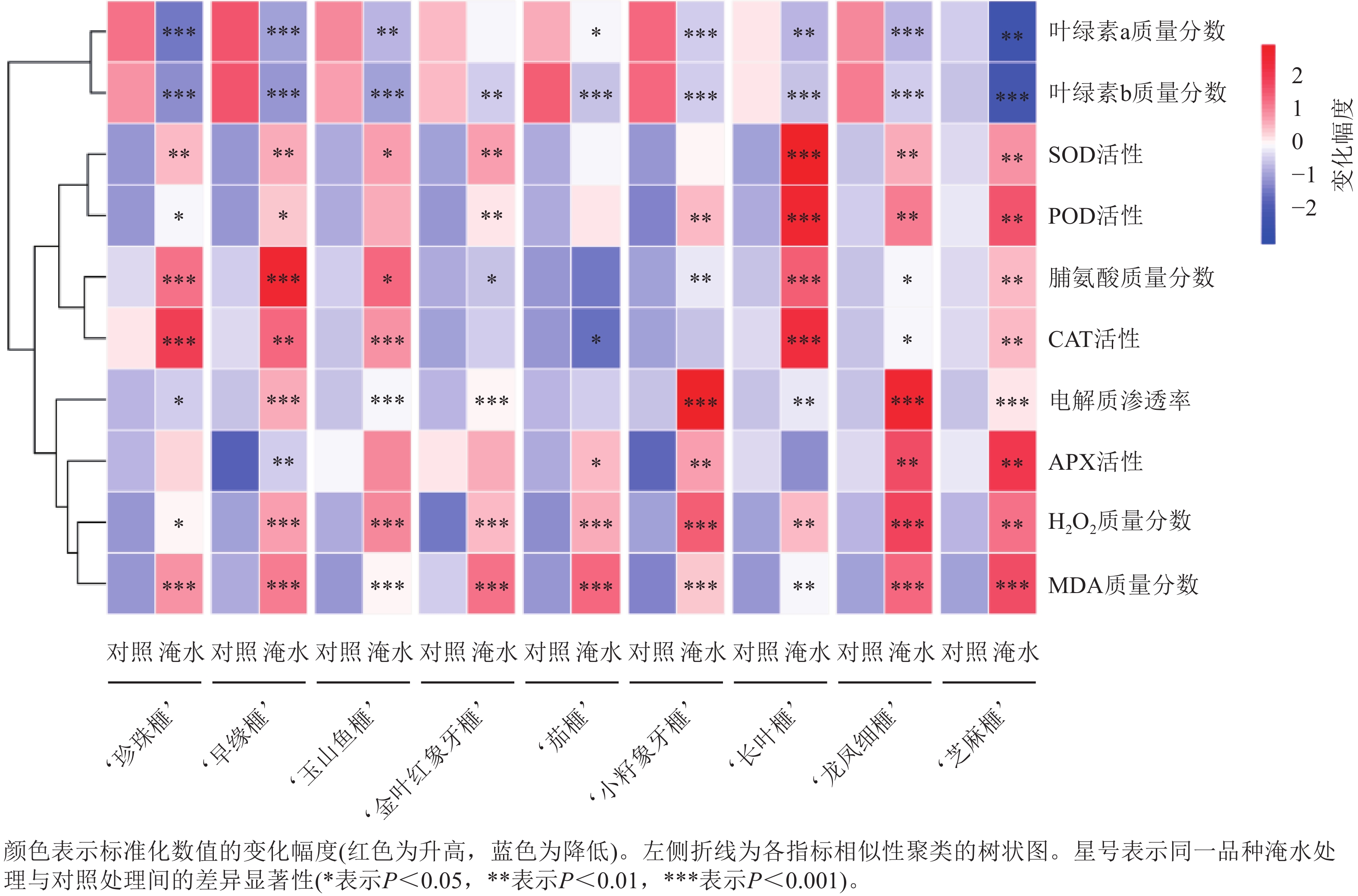
    • 各项指标的测定数据见附表(网址)。由图1可知:与对照组相比,淹水胁迫对各香榧品种砧木的生理生化指标产生了不同程度的影响。各处理组的叶绿素a质量分数均呈下降趋势,除‘金叶红象牙榧’外,其余品种均表现出显著(P<0.05)或极显著(P<0.01)差异。叶绿素b质量分数在除‘芝麻榧’外的各组中亦极显著(P<0.01)下降。H2O2和MDA质量摩尔浓度整体呈极显著(P<0.01)上升趋势,表明淹水胁迫诱导了不同程度的氧化损伤。除‘茄榧’外,其余品种的电解质渗透率与脯氨酸质量分数均显著(P<0.05)或极显著(P<0.01)升高。在抗氧化酶活性方面,‘珍珠榧’‘玉山鱼榧’‘金叶红象牙榧’和‘长叶榧’的APX活性在淹水处理后变化不显著,其他品种则表现为显著(P<0.05)或极显著(P<0.01)上升。‘金叶红象牙榧’和‘小籽象牙榧’的CAT活性在淹水处理后无显著变化,‘茄榧’则显著(P<0.05)下降,而其余品种均显著(P<0.05)或极显著(P<0.01)升高。SOD活性在各处理组中普遍升高,除‘茄榧’和‘小籽象牙榧’外,其余品种均显著(P<0.05)或极显著(P<0.01)升高。POD活性在除‘玉山鱼榧’和‘茄榧’外的其余各组中,均在淹水处理后显著(P<0.05)或极显著(P<0.01)升高。
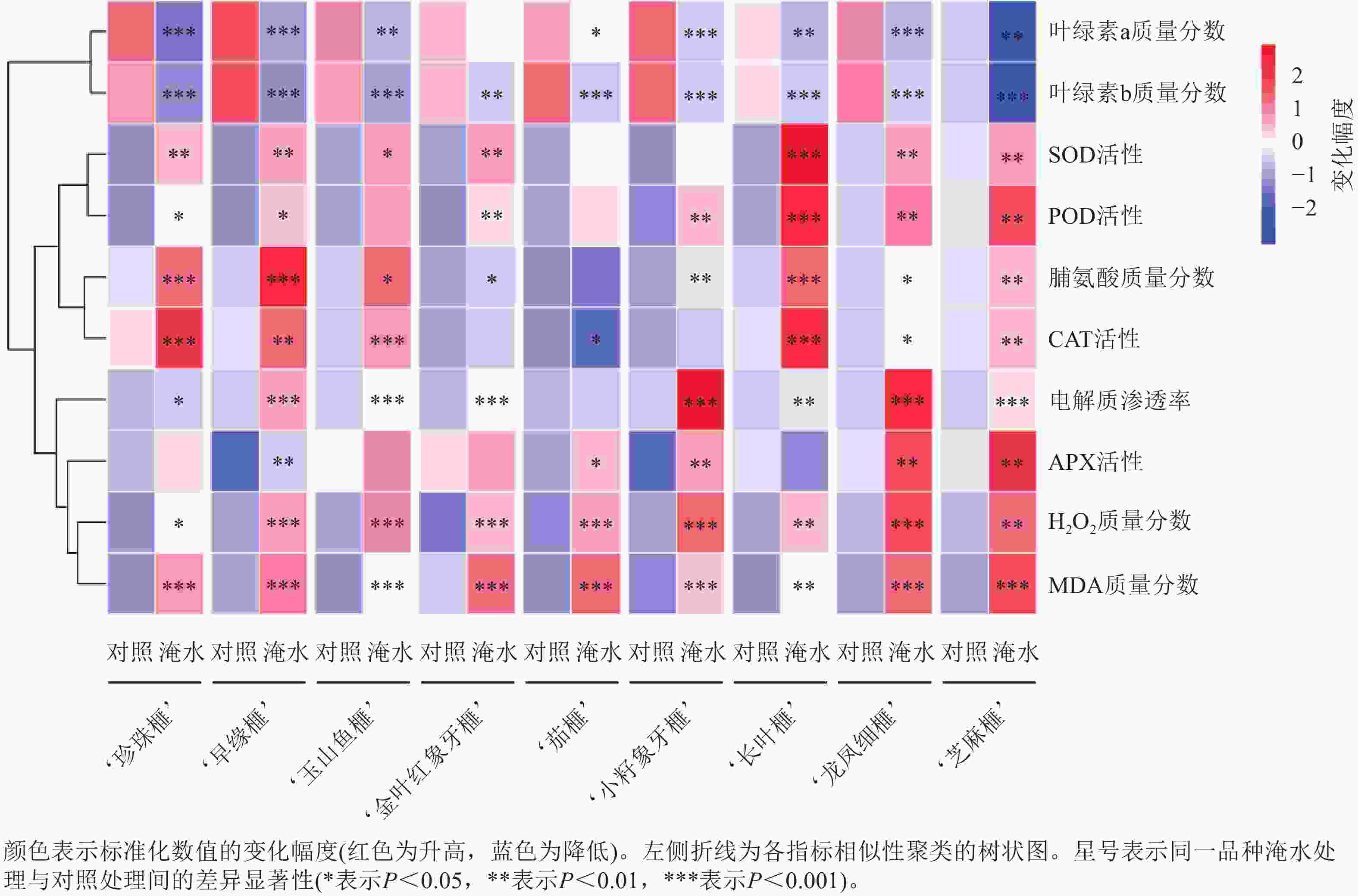
      Figure 1.  Heatmap of physiological and biochemical changes in different T. grandis ‘Merrillii’ cultivars under normal and waterlogging conditions

    • 表1可见:H2O2质量分数、MDA质量分数、电解质渗透率、SOD活性和POD活性的耐涝系数均大于100%;叶绿素a和叶绿素b质量分数的耐涝系数均小于100%。脯氨酸质量分数、APX活性和CAT活性等指标在不同品种间呈现分化趋势,即部分品种高于100%,部分低于100%。由此可见,单一指标难以全面准确反映香榧品种的耐涝性,评价结果易受个体差异影响,具有一定的片面性和不一致性。

       香榧品种耐涝系数/%
      叶绿素a叶绿素bH2O2
      MDA
      电解质渗透率脯氨酸APX活性CAT活性SOD活性POD活性
      ‘珍'珠榧’53.3058.46122.07175.64110.49131.60110.11127.52124.79111.75
      ‘早缘榧’59.0852.59131.75167.45178.96165.25116.52126.44127.71118.47
      ‘玉山鱼榧’70.2164.42132.86140.46127.86136.80110.41124.77125.26117.94
      ‘金叶红象牙榧’88.4978.95137.45150.41156.05106.89104.58107.79124.51116.21
      ‘茄榧’86.3661.27135.00192.99113.1190.64113.9991.04111.23112.75
      ‘小籽象牙榧’69.0065.24145.25170.51329.53118.43127.68105.72115.96124.40
      ‘长叶榧’81.0282.33127.89136.86121.60144.6592.20143.03159.85142.75
      ‘龙凤细榧’69.0768.96144.71183.40303.65110.54119.70107.77117.20118.64
      ‘芝麻榧’54.6654.48133.83198.65146.26118.90122.35113.40117.40121.68

      Table 1.  Waterlogging tolerance coefficients of different T. grandis ‘Merrillii’ rootstocks for each index

    • 对各生理指标的耐涝系数进行相关性分析后得到表2。结果表明:各指标间存在不同程度的相关性。H2O2质量摩尔浓度与电解质渗透率呈极显著正相关(P<0.01),脯氨酸质量分数与H2O2质量摩尔浓度、电解质渗透率等指标均呈负相关;CAT活性与脯氨酸质量分数之间呈极显著正相关(P<0.01);SOD活性与CAT活性、POD活性之间也呈极显著正相关(P<0.01)。上述结果说明:各耐涝相关指标之间存在一定的关联性,部分信息存在重叠,表明采用单一指标对耐涝性进行评价难以全面、客观地反映品种间差异。因此,有必要引入多指标综合评价方法。

      指标 相关系数
      叶绿素a
      质量分数
      叶绿素b
      质量分数
      H2O2质量
      摩尔浓度
      MDA质量
      摩尔浓度
      电解质
      渗透率
      脯氨酸
      质量分数
      APX活性 CAT活性 SOD活性 POD活性
      叶绿素a质量分数 1
      叶绿素b质量分数 0.741* 1
      H2O2质量摩尔浓度 0.281 0.151 1
      MDA质量摩尔浓度 −0.379 −0.648 0.216 1
      电解质渗透率 −0.088 0.043 0.844** 0.187 1
      脯氨酸质量分数 −0.477 −0.180 −0.474 −0.475 −0.142 1
      APX活性 −0.478 −0.670* 0.586 0.699* 0.633 −0.239 1
      CAT活性 −0.315 0.181 −0.649 −0.627 −0.335 0.846** −0.591 1
      SOD活性 0.173 0.573 −0.495 −0.720* 0.337 0.590 −0.824** 0.850** 1
      POD活性 0.193 0.558 −0.042 −0.484 0.062 0.368 −0.457 0.576 0.812** 1
        说明:*表示在 0.05水平上相关显著(双尾);**表示在 0.01 水平上相关极显著(双尾)。

      Table 2.  Correlation of flood tolerance coefficients of indicators

    • 主成分分析能够有效降低数据维度,消除数据中的冗余信息。主成分分析结果可得:前3个主成分的特征值分别为4.874、2.599和1.621,贡献率分别为48.74%、25.99%和16.21%,累积贡献率可达90.935%,表明在淹水胁迫下,前3个综合指标可以用于评价各指标耐涝性。对应的主成分表达式分别为:F1=0.195x1+0.551x2−0.597−0.806x4−0.483x5+0.596x6−0.889x7+0.862x8+0.97+0.681x10F2=0.881x1+0.797x2+0.61x3−0.263x4+0.32x5−0.597x6−0.215x7−0.415x8+0.043x9+0.257x10F3=−0.333x1+0.028x2+0.486x3−0.131x4+0.784x5+0.427x6+0.376x7+0.254x8+0.152x9+0.479x10。其中:x1为叶绿素a质量分数;x2为叶绿素b质量分数;x3为 H2O2质量摩尔浓度;x4 为MDA质量摩尔浓度;x5为电解质渗透率;x6为脯氨酸质量分数;x7为APX活性;x8为CAT活性;x9为SOD活性;x10为POD活性。

      根据各主成分的系数绝对值可发现:第1主成分(F1)中MDA质量摩尔浓度、APX活性、CAT活性和SOD活性的贡献较大,第2主成分(F2)中叶绿素a和叶绿素b质量分数的贡献较大,第3主成分(F3)中电解质渗透率的贡献较大。

    • 根据上述3个主成分表达式计算出各香榧品种砧木的综合指标值,再分别计算相应的隶属函数值。进一步根据3个主成分贡献率计算权重,计算结果分别为0.536、0.286、0.178;最后通过隶属函数和权重求出各香榧品种砧木的综合评价值(表3)。可见,9个香榧品种砧木的耐涝性从强到弱依次为‘长叶榧’‘金叶红象牙榧’‘玉山鱼榧’‘小籽象牙榧’‘龙凤细榧’‘早缘榧’‘珍珠榧’‘茄榧’‘芝麻榧’。

      香榧品种综合指标值隶属函数值综合评价值(Di)排名
      F1F2F3U1U2U3
      ‘珍珠榧’62.40836.093309.3110.53100.1510.3127
      ‘早缘榧’48.90147.320386.8470.4840.0930.5190.3786
      ‘玉山鱼榧’87.65576.725331.9890.6200.3360.2580.4753
      ‘金叶红象牙榧’45.649139.299329.1120.4720.8540.2450.5412
      ‘茄榧’−24.334110.054277.5710.2260.61200.2968
      ‘小籽象牙榧’−88.497156.930488.10001.0001.0000.4644
      ‘长叶榧’195.56295.947340.3201.0000.4950.2980.7311
      ‘龙凤细榧’−82.569152.098457.5180.0210.9600.8550.4385
      ‘芝麻榧’−13.39159.736338.7160.2640.1960.2900.2499

      Table 3.  Comprehensive evaluation of waterlogging tolerance of nine T. grandis ‘Merrillii’ rootstock varieties under waterlogging stress

    • 植物在遭遇水淹等逆境时会产生不同的生理生化反应,同时启动自我保护机制[15]。已有相关研究表明:在淹水胁迫下植物叶绿素下降,光合效能显著降低[16],一些酶类如SOD、POD等活性下降,叶片中膜脂过氧化物和电解质渗漏率升高[1718],使植物细胞膜完整性被破坏,影响植物正常生长甚至导致植物死亡。近年来,浙江多个地区频发季节性降雨,导致香榧种植区常发涝害,严重影响香榧产量与质量。因此,选育和推广香榧耐涝品种,对于香榧主产地具有重要的经济意义。探讨淹水胁迫下香榧所展现出的渗透调节功能和抗逆性等特质,也能为香榧的高效栽培提供理论依据[7]

      淹水胁迫下,植物叶片细胞膜脂过氧化加剧,MDA积累,细胞内合成代谢受阻,光合作用相关酶活性降低,影响叶绿素合成,导致叶片变黄脱落,从而影响植物的正常生长[1920]。本研究中,各香榧品种MDA均呈升高趋势,且与对照相比差异显著。除‘金叶红象牙榧’和‘茄榧’外其他香榧品种的砧木均受淹水胁迫的影响,叶绿素a和叶绿素b较对照组均显著降低,不同品种降低程度有所不同。这与前人研究结果一致[2122]。淹水胁迫所导致的缺氧会使植物细胞内的电子传递链发生功能紊乱,这一过程触发活性氧(ROS)的过量积累,细胞中ROS产生和清除的动态平衡被打破[23],进一步导致膜脂质过氧化和细胞膜通透性增加,细胞内容物大量外泄,最终致使细胞死亡[24]。本研究中,各香榧品种淹水处理后H2O2呈升高趋势,且差异显著,电解质渗透率与脯氨酸除‘茄榧’外均显著升高,说明淹水胁迫处理导致了不同程度的氧化损伤及细胞损伤。

      在淹水胁迫下,植物会激活自身的抗氧化防御系统,以减轻淹水胁迫引发的氧化损伤。在缺氧条件下, SOD、CAT、APX和POD等抗氧化酶活性显著上调,有效清除体内过量的ROS,减缓植物的氧化应激,提高植物耐涝性。这类物质活性的变化程度,也可一定程度上表明香榧各品种砧木的抗氧化能力的高低。本研究发现,淹水处理后,‘珍珠榧’‘玉山鱼榧’‘金叶红象牙榧’和‘长叶榧’APX活性变化不显著,‘金叶红象牙榧’和‘小籽象牙榧’CAT活性变化不显著,‘茄榧’CAT活性呈显著下降趋势,‘玉山鱼榧’和‘茄榧’POD活性变化不显著。其他香榧品种淹水处理后,APX、CAT、SOD与POD活性均呈显著升高趋势。此外,对于淹水胁迫的研究,未来应在上述常规生理指标的基础上增加水势相关参数(如叶水势、渗透势和主茎水势等)的测定,以更直接反映植株对水分胁迫的感知与利用规律。

      植物在生长发育过程中持续面临盐碱、干旱、涝害及极端温度等复杂多变的非生物胁迫。为保障正常生长与繁殖,植物进化出一系列保护机制[25]。耐涝性强的品种在淹水胁迫下展现出更强的渗透调节与抗氧化能力。值得注意的是,涝渍、干旱、盐碱等不同类型的胁迫常引发相似的生理变化(如渗透胁迫、氧化胁迫、离子毒害等)。例如,在杨树Populus耐涝种质中积累的渗透调节物质,也参与其在干旱胁迫下维持渗透平衡[26]。因此,具备较强耐涝性的植物通常也拥有应对这些共性挑战的有效机制,暗示其可能同时具备较强的耐旱、耐盐碱能力。这一现象提示,未来研究可进一步探讨耐涝性强的香榧品种在其他胁迫(如干旱、盐碱)条件下的适应表现,以拓展研究成果的应用范围。

      砧木与嫁接品种之间存在显著的互作效应。砧木不仅为接穗提供物理支持,还通过调控水分与养分运输、激素信号传导以及抗逆反应途径,与接穗形成复杂的生理和分子互作网络,从而影响植株在不同环境条件下的生长表现与抗逆能力。NITTA等[27]Actinidia rufa嫁接苗、葛枣猕猴桃A. polygama以及自根生长的‘海沃德’‘Hayward’猕猴桃进行研究发现:砧木类型会显著影响接穗的生长表现。将涝渍敏感的猕猴桃接穗嫁接在耐涝砧木上,可显著提高其整体耐涝能力[28]。因此,后续研究应进一步关注砧木与接穗间的互作机制,并在多砧木和多接穗组合中系统比较其在生长、生理及分子水平的差异,以揭示其对植株适应性和抗逆性的综合影响。

      不同种质的砧木面对淹水胁迫时的生理响应会有所不同,单一的生理生化指标无法保证植物耐涝性评价的客观全面。因此,使用综合评价体系和隶属函数对植物耐涝性进行综合性评价更具有代表性和准确性[29]。本研究通过对叶绿素a和叶绿素b等生理指标进行主成分分析,得到3个综合指标值并通过隶属函数和权重计算出各香榧品种砧木的综合评价值,从而得出更为客观和全面的综合评价排序。

    • 9个香榧品种砧木的耐涝性由强到弱依次为‘长叶榧’‘金叶红象牙榧’‘玉山鱼榧’‘小籽象牙榧’‘龙凤细榧’‘早缘榧’‘珍珠榧’‘茄榧’‘芝麻榧’。因此,淹水胁迫下,‘长叶榧’‘金叶红象牙榧’‘玉山鱼榧’表现出较强的耐涝性。在林业育种时可以选择这3个品种作为香榧的耐涝品种,有效避免雨季地面积水或树木被长时间淹水胁迫所导致的生长发育停滞和减产问题。此外,在育种应用的同时,也有必要在分子层面对耐涝机制进行深入研究,比如未来可选取耐涝表型差异显著的香榧品种,结合转录组测序与功能基因组学手段,系统挖掘与耐涝性密切相关的关键基因及调控因子,进一步深入解析耐涝的分子调控网络及其互作机制。

Reference (29)

Catalog

    /

    DownLoad:  Full-Size Img  PowerPoint
    Return
    Return