Turn off MathJax
Article Contents

SANG Qianqian, WANG Rui, WANG Yaqi, et al. Effects of organic amendments on soil physicochemical properties, microbial communities, and fruit quality in vineyards[J]. Journal of Zhejiang A&F University, 2026, 43(4): 1−13 doi:  10.11833/j.issn.2095-0756.20260132
Citation: SANG Qianqian, WANG Rui, WANG Yaqi, et al. Effects of organic amendments on soil physicochemical properties, microbial communities, and fruit quality in vineyards[J]. Journal of Zhejiang A&F University, 2026, 43(4): 1−13 doi:  10.11833/j.issn.2095-0756.20260132

OnlineFirst articles are published online before they appear in a regular issue of the journal. Please find and download the full texts via CNKI.

Effects of organic amendments on soil physicochemical properties, microbial communities, and fruit quality in vineyards

DOI: 10.11833/j.issn.2095-0756.20260132
  • Received Date: 2026-01-15
  • Accepted Date: 2026-04-30
  • Rev Recd Date: 2026-04-16
  •   Objective  This study aims to evaluate the effects of two organic amendments—mineral-source potassium fulvate combined with a root-guard agent (LKY) and a microbial inoculant (LW)—on soil physicochemical properties, microbial community structure, and grape fruit quality in arid regions, so as to provide data support for selecting effective soil-improvement schemes in production areas.   Method  A field experiment was conducted in a Vitis vinifera ‘Cabernet Sauvignon’ vineyard in May 2024 using a randomized block design, with three treatments: LKY, LW, and a control with no organic amendment (ck). Soil physicochemical indicators and aggregate characteristics in the vineyard at different periods were analyzed and determined. High-throughput sequencing was employed to analyze the microbial community structure of soil and fruit skin. Fruit quality, phenolic substances, and yield were also measured.   Result  (1) LKY treatment significantly reduced soil pH and increased the content of available nutrients, especially available nitrogen (P<0.05), while LW treatment enhanced soil organic matter and total nitrogen. (2) LKY treatment significantly increased the proportion and stability of medium-sized soil aggregates (P<0.05), while LW treatment primarily increased the proportion of large aggregates. (3) Both amendments significantly affected soil bacterial and microbial community structure (P<0.05). (4) The titratable acidity, hundred-seed weight, total phenols in the peel and seeds, total flavonoids in the peel and seeds, and yield under LKY treatment were significantly higher than those under LW and ck treatments (P<0.05). (5) Spearman correlation and Mantel test analysis showed that soil total phosphorus, aggregates larger than 0.25 mm, and soil pH were key factors affecting soil bacterial community structure and fruit quality.   Conclusion  Both LKY and LW treatments can improve fruit quality by modifying soil physicochemical properties and optimizing the structure of soil bacterial communities. Among them, LKY treatment achieve a comprehensive improvement in yield, flavor, and functional components by regulating soil pH and increasing soil available nutrients. [Ch, 7 fig. 5 tab. 32 ref.]
  • [1] ZHANG Zhe, ZHENG Huabao, WANG Min.  Quorum sensing of microalgal-bacterial symbiosis systems in wastewater treatment . Journal of Zhejiang A&F University, doi: 10.11833/j.issn.2095-0756.20250605
    [2] XU Hui, WU Cuiyun, FANG Zhigang, JI Yinzhong, CAO Yilin, WANG Ming, SUN Yali.  Fruit quality of 5 Prunus simonii cultivars in Aksu area . Journal of Zhejiang A&F University, doi: 10.11833/j.issn.2095-0756.20250268
    [3] GONG Junwei, CHEN Sifan, FENG Haoyu, SUO Aoli, TONG Dalong, CHEN Feng, LIU Xiaodong.  Effects of different fire severities on understory vegetation species diversity and soil physicochemical properties in Pinus tabuliformis forests . Journal of Zhejiang A&F University, doi: 10.11833/j.issn.2095-0756.20250291
    [4] LI Luyao, ZHANG Jun, YING Xuebing, XU Haozhe, WANG Zhenyuan, ZHANG Yuting, CHEN Pingmei, ZUO Zhaojiang.  Effects of red film on photosynthetic abilities and fruit qualities in 3 vegetables . Journal of Zhejiang A&F University, doi: 10.11833/j.issn.2095-0756.20240552
    [5] HUANG Haiyan, TANG Huimin, JIN Lu, SHI Yu, SONG Xiaoqian, CHEN Jiaqi, HE Haisheng, ZHANG Zhonghua, TANG Zhonghua.  Effects of tree species importance, diversity and soil physicochemical properties on soil amino sugars . Journal of Zhejiang A&F University, doi: 10.11833/j.issn.2095-0756.20230527
    [6] JIA Yajie, YANG Jianying, ZHANG Jianjun, HU Yawei, ZHANG Ben, ZHAO Jiongchang, LI Yang, TANG Peng.  Effects of stand density on biomass and soil physico-chemical properties of Pinus tabuliformis forest in the loess area of western Shanxi . Journal of Zhejiang A&F University, doi: 10.11833/j.issn.2095-0756.20240571
    [7] CHEN Tao, ZHOU Lijun, QI Shi, SUN Baoping, NIE Zexu.  Soil aggregate stability and anti-erodibility of typical forest stands in Huaying mountain area . Journal of Zhejiang A&F University, doi: 10.11833/j.issn.2095-0756.20210142
    [8] ZHANG Rong, LI Tingting, JIN Suo, YU Shunyao, WANG Yu, LI Yujiang, QI Jinqiu, HAO Jianfeng.  Effects of human disturbance on species diversity and soil physiochemical properties of Schima superba community in Mengding Mountain . Journal of Zhejiang A&F University, doi: 10.11833/j.issn.2095-0756.20190554
    [9] YAN Liangliang, YUE Kun, SONG Lihua.  Correlation between fruit quality and soil fertility and leaf nutrients of Zizyphus jujuba ‘Lingwuchangzao’ . Journal of Zhejiang A&F University, doi: 10.11833/j.issn.2095-0756.20190462
    [10] GUO Xi, LU Kouping, HU Guotao, YANG Xing, YUAN Guodong, SHEN Leilei, WANG Hailong.  Greenhouse soil properties and vegetable yield with dead pig and bamboo biochars . Journal of Zhejiang A&F University, doi: 10.11833/j.issn.2095-0756.2017.02.007
    [11] ZHANG Junye, SI Zhiguo, YU Yuanchun, LI Xuran, GUO Weihong.  Cinnamomum camphora chlorosis and soil physicochemical properties . Journal of Zhejiang A&F University, doi: 10.11833/j.issn.2095-0756.2017.02.005
    [12] WEN Yue, SU Shuchai, MA Lüyi, WANG Xiangnan, YANG Shaoyan.  Effects of gibberellins on flower bud formation and fruit quality in Camellia oleifera . Journal of Zhejiang A&F University, doi: 10.11833/j.issn.2095-0756.2015.06.006
    [13] CHEN Feng, SU Shuchai, ZHANG Bing, CHEN Zhigang, WANG Wenhao.  Hazelnut yield and fruit quality with foliar N, P, K fertilizer . Journal of Zhejiang A&F University, doi: 10.11833/j.issn.2095-0756.2014.06.016
    [14] AN Xiaoqin, LIAO Kang, SUN Huiying, LIU Juan, LI Yongxian, LIAO Xiaolong, WANG Yun.  Effect of different cultivars pollinating on fruit setting and fruit quality of Armeniaca vulgaris ‘Luntaibaixing’ . Journal of Zhejiang A&F University, doi: 10.11833/j.issn.2095-0756.2013.02.005
    [15] WANG Yu-juan, CHEN Yong-zhong, WANG Rui, WANG Xiang-nan, PENG Shao-feng, YANG Xiao-hu, YANG Yang.  Soil physical and chemical properties and growth of a young Camellia oleifera forest with straw mulching . Journal of Zhejiang A&F University, doi: 10.11833/j.issn.2095-0756.2012.06.002
    [16] FAN Huai-fu, DU Chang-xia, ZHU Zhu-jun, LI Wen-jun, YANG Li-lin, ZHANG Ying.  Growth,fruit quality and yield of large fruit tomato Lycopersicon esculentum ‘Zheza 204’with root restriction . Journal of Zhejiang A&F University, doi: 10.11833/j.issn.2095-0756.2011.03.001
    [17] YAN Xiao-jie, HUANG Jian-qin, QIU Zhi-min, NURAMINA Rahman, ZHU Min-hua, WU Jia-sen.  Soil physical and chemical properties and fruit quality with grass cover in a Myrica rubra orchard . Journal of Zhejiang A&F University,
    [18] SHAO Guo-yuan, QIN Guo-xin, WU Yu-kun, JI Kun.  Effects of leaf number on fruit quality of Vitis vinifera in greenhouse . Journal of Zhejiang A&F University,
    [19] QIAN Yin-cai, GU Zhi-kang, YAO Jian-xiang, JIANG Xiao-fan, WANG Bai-po.  Effect of bagging with four types of bags on fruit quality of different varieties of pears . Journal of Zhejiang A&F University,
    [20] WANG Bai-po, DAI Wen-sheng, CHENG Xiao-jian, YU Wei-wu, WANG Li-zhong, BAO Li-hong, YAN Rong-bao.  Adaptability of 8 types of commercial trees growing in the hilly regions and their effects on changes of soil nutrient . Journal of Zhejiang A&F University,
  • [1]
    Ningxia Eastern Foot of Helan Mountain Wine Industry Park Management Committee. Overview of Ningxia Helan Mountain East Foothills Wine Industry Park [EB/OL]. 2025-07-17. https://gxt.nx.gov.cn/zwgk/gyjbxx/yqgk/202408/t20240801_4611721.html.
    [2]
    WANG Junzheng. Study on the Application Effect of Microbial Agents in Cucumber Seedling and Substrate Culture[D]. Yangling: Northwest A&F University, 2021.
    [3]
    ZHU Huidiao, GAO Dengtao, BAI Ru, et al. Effects of fulvic acid on soil nutrients, grape quality and yield[J]. Xinjiang Agricultural Sciences, 2021, 58(4): 672−681. DOI: 10.6048/j.issn.1001-4330.2021.04.010.
    [4]
    LIU Lu, DAI Hongjun, WANG Zhenping. Effect of microbial fertilizers on the grape growth of ‘Cabernet Sauvignon’ and soil properties[J]. Northern Horticulture, 2016(17): 175−179. DOI: 10.11937/bfyy.201617043.
    [5]
    BAO Shidan. Soil Agrochemical Analysis[M]. 3rd ed. Beijing: China Agriculture Press, 2008.
    [6]
    WANG Hongyan, WU Shiwen, MA Haiyang, et al. Stability and it’s mechanism of aggregates in easily eroded soils derived from purple rock in the south of Zhejiang Province[J]. Chinese Journal of Soil Science, 2010, 41(2): 429−433. DOI: 10.19336/j.cnki.trtb.2010.02.035.
    [7]
    GOOD I J. The population frequencies of species and the estimation of population parameters[J]. Biometrika, 1953, 40(3/4): 237−264. DOI: 10.1093/biomet/40.3-4.237.
    [8]
    MARINOVA D, RIBAROVA F, ATANASSOVA M. Total phenolics and total flavonoids in Bulgarian fruits and vegetables[J]. Journal of the University of Chemical Technology and Metallurgy, 2005, 40(3): 255−260.
    [9]
    ZHU Yanyun, WANG Xiaoyu, DU Guorong, et al. Effects of polyphenols on the wine astringency by phenolic/protein interaction model[J]. Modern Food Science & Technology, 2017, 33(11): 63−69, 190. DOI: 10.13982/j.mfst.1673-9078.2017.11.010.
    [10]
    LÓPEZ-RAYO S, VALVERDE S, LUCENA J J. S, S-EDDS ligand as a soil solubilizer of Fe, Mn, Zn, and Cu to improve plant nutrition in deficient soils[J]. Journal of Agricultural and Food Chemistry, 2023, 71(25): 9728−9737. DOI: 10.1021/acs.jafc.3c02057.
    [11]
    ZHAO Yupeng, BIAN Qingyong, DONG Zhiduo, et al. The input of organic fertilizer can improve soil physicochemical properties and increase cotton yield in southern Xinjiang[J]. Frontiers in Plant Science, 2025, 15: 1520272. DOI: 10.3389/fpls.2024.1520272.
    [12]
    MUNNA M N H, LAL R. Long-term organic inputs effects on soil carbon and nitrogen sequestration in a temperate agroecosystem[J]. Soil Use and Management, 2026, 42: e70161. DOI: 10.1111/sum.70161.
    [13]
    CHANG Jie, LI Xiufang, ZHENG Lanxiang. Effects of winter irrigation with winery wastewater on soil physicochemical properties and bacterial community structure in vineyard[J]. Chinese Journal of Soil Science, 2024, 55(4): 1071−1079. DOI: 10.19336/j.cnki.trtb.2023071801.
    [14]
    SUN Haoran, DONG Qiong, LI Huixia, et al. Impact of different planting years on soil nutrient characteristics in grape vineyards at eastern foot of Helan Mountain[J]. Chinese Agricultural Science Bulletin, 2024, 40(30): 75−83. DOI: 10.11924/j.issn.1000-6850.casb2024-0185.
    [15]
    BELVISI G, GRISTINA L, SCALENGHE R. Cover crops drive soil carbon retentionin semi-arid sloping vineyards[J]. Ecological Processes, 2025, 14(1): 85. DOI: 10.1186/s13717-025-00650-9.
    [16]
    HAYES M H B, ROULIA M. Relevance of organic matter compositions, structures and associations to soil aggregates and to sustainable productivity[J]. Agronomy, 2025, 15(9): 2182. DOI: 10.3390/agronomy15092182.
    [17]
    HUANG Xiaogang, CHEN Minjie, ZHENG Chunli, et al. Effects of microbial inoculants on soil water retention and promotion of plant growth efficiency in desertified soil[J]. Bulletin of Soil and Water Conservation, 2025, 45(4): 153−160. DOI: 10.13961/j.cnki.stbctb.2025.04.012.
    [18]
    YANG Fan, ZHANG Liang, CHENG Chunying, et al. The improvement effect and mechanism of conservation tillage measures on soil structure in wine vineyards[J]. Journal of Zhejiang A&F University, 2026, 43(3): 585−597. DOI: 10.11833/j.issn.2095-0756.20250203.
    [19]
    LI Baogang, NIE Xinjun, KONG Delei, et al. Effects of biochar based fertilizer on soil nutrients and bacterial community structure[J]. Journal of Zhejiang A&F University, 2025, 42(6): 1243−1254. DOI: 10.11833/j.issn.2095-0756.20250102.
    [20]
    XU Risheng, LI Ke, CHEN Anlei, et al. Responses of soil microbial communities to abandoned paddy fields with different fertilization histories[J]. Land Degradation & Development, 2025, 36(6): 1820−1833. DOI: 10.1002/ldr.5464.
    [21]
    GAUTAM I, ANKUR A, SINGH K, et al. Breaking down the wall: solid-state NMR illuminates how fungi build and remodel diverse cell walls[J]. PLoS Pathogens, 2025, 21(11): e1013678. DOI: 10.1371/journal.ppat.1013678.
    [22]
    TIAN Yanan, SU Li, LIANG Fei, et al. Effect of inter-row planting grass on the quality of chardonnay grapes and wines[J]. Journal of Nuclear Agricultural Sciences, 2024, 38(10): 1995−2002. DOI: 10.11869/j.issn.1000-8551.2024.10.1995.
    [23]
    NIU Shengyang, LIU Chonghuai, LIU Qiang, et al. Composition and contents of organic acids in different grape germplasms[J]. Food Science, 2022, 43(12): 228−234. DOI: 10.7506/spkx1002-6630-20210704-030.
    [24]
    BAI Yufeng, ZHANG Wenxia, TIAN Yanan, et al. Screening of yeast strains with L-malic acid degradation ability from Eastern Foothills of Helan in Ningxia[J]. China Brewing, 2021, 40(1): 49−54. DOI: 10.11882/j.issn.0254-5071.2021.01.010.
    [25]
    WANG Jin, LU Yuhang, ZHANG Xuemei, et al. Effects of potassium-containing fertilizers on sugar and organic acid metabolism in grape fruits[J]. International Journal of Molecular Sciences, 2024, 25(5): 2828. DOI: 10.3390/ijms25052828.
    [26]
    LE GUYADER E, MORVAN X, MICONNET V, et al. Influence of date palm-based biochar and compost on water retention properties of soils with different sand contents[J]. Forests, 2024, 15(2): 304. DOI: 10.3390/f15020304.
    [27]
    WU Yuxia, LUO Zhengcheng, QI Liang, et al. A study of the relationship between initial grape yield and soil properties based on organic fertilization[J]. Agronomy, 2024, 14(4): 861. DOI: 10.3390/agronomy14040861.
    [28]
    MAIRATA A, VALLS-FONAYET J, LABARGA D, et al. Influence of organic mulches and soil properties on the phenolic profile of leaves, canes and grape skins in grapevine (Vitis vinifera L. )[J]. Journal of the Science of Food and Agriculture, 2025, 105(9): 4893−4904. DOI: 10.1002/jsfa.14215.
    [29]
    GUO Ziyan, TANG Wen, XU Mengyu, et al. Association between vineyard soil factors and fruit quality: an analysis of cultivar response differences[J]. Acta Horticulturae Sinica, 2025, 52(11): 2943−2958. DOI: 10.16420/j.issn.0513-353x.2024-0906.
    [30]
    YAN Fangbin, ZHENG Jingming, GONG Yinting, et al. Effects of garden waste reuse treatments on soil nutrients and microbial carbon source utilization in plantation soil[J]. Journal of Zhejiang A&F University, 2023, 40(5): 1045−1053. DOI: 10.11833/j.issn.2095-0756.20220620.
    [31]
    LUO Zhengrong, ZHENG Weicheng, TANG Zhansheng, et al. Soil microbial diversity and its influencing factors in the habitat of rare plant Emmenopterys henryi in Jiulongshan, Zhejiang Province[J]. Journal of Zhejiang A&F University, 2024, 41(5): 1013−1023. DOI: 10.11833/j.issn.2095-0756.20230532.
    [32]
    LIU Menglong, YAO Xuenan, WANG Haiqi, et al. Carposphere microbiota alters grape volatiles and shapes the wine grape typicality[J]. New Phytologist, 2025, 246(5): 2280−2294. DOI: 10.1111/nph.70152.
  • 加载中
通讯作者: 陈斌, bchen63@163.com
  • 1. 

    沈阳化工大学材料科学与工程学院 沈阳 110142

  1. 本站搜索
  2. 百度学术搜索
  3. 万方数据库搜索
  4. CNKI搜索

Figures(7)  / Tables(5)

Article views(6) PDF downloads(0) Cited by()

Related
Proportional views

Effects of organic amendments on soil physicochemical properties, microbial communities, and fruit quality in vineyards

doi: 10.11833/j.issn.2095-0756.20260132

Abstract:   Objective  This study aims to evaluate the effects of two organic amendments—mineral-source potassium fulvate combined with a root-guard agent (LKY) and a microbial inoculant (LW)—on soil physicochemical properties, microbial community structure, and grape fruit quality in arid regions, so as to provide data support for selecting effective soil-improvement schemes in production areas.   Method  A field experiment was conducted in a Vitis vinifera ‘Cabernet Sauvignon’ vineyard in May 2024 using a randomized block design, with three treatments: LKY, LW, and a control with no organic amendment (ck). Soil physicochemical indicators and aggregate characteristics in the vineyard at different periods were analyzed and determined. High-throughput sequencing was employed to analyze the microbial community structure of soil and fruit skin. Fruit quality, phenolic substances, and yield were also measured.   Result  (1) LKY treatment significantly reduced soil pH and increased the content of available nutrients, especially available nitrogen (P<0.05), while LW treatment enhanced soil organic matter and total nitrogen. (2) LKY treatment significantly increased the proportion and stability of medium-sized soil aggregates (P<0.05), while LW treatment primarily increased the proportion of large aggregates. (3) Both amendments significantly affected soil bacterial and microbial community structure (P<0.05). (4) The titratable acidity, hundred-seed weight, total phenols in the peel and seeds, total flavonoids in the peel and seeds, and yield under LKY treatment were significantly higher than those under LW and ck treatments (P<0.05). (5) Spearman correlation and Mantel test analysis showed that soil total phosphorus, aggregates larger than 0.25 mm, and soil pH were key factors affecting soil bacterial community structure and fruit quality.   Conclusion  Both LKY and LW treatments can improve fruit quality by modifying soil physicochemical properties and optimizing the structure of soil bacterial communities. Among them, LKY treatment achieve a comprehensive improvement in yield, flavor, and functional components by regulating soil pH and increasing soil available nutrients. [Ch, 7 fig. 5 tab. 32 ref.]

SANG Qianqian, WANG Rui, WANG Yaqi, et al. Effects of organic amendments on soil physicochemical properties, microbial communities, and fruit quality in vineyards[J]. Journal of Zhejiang A&F University, 2026, 43(4): 1−13 doi:  10.11833/j.issn.2095-0756.20260132
Citation: SANG Qianqian, WANG Rui, WANG Yaqi, et al. Effects of organic amendments on soil physicochemical properties, microbial communities, and fruit quality in vineyards[J]. Journal of Zhejiang A&F University, 2026, 43(4): 1−13 doi:  10.11833/j.issn.2095-0756.20260132
  • 宁夏贺兰山东麓是中国最大的酿酒葡萄Vitis vinifera产区,截至2024年酿酒葡萄种植面积为4.0万hm2,占全国种植面积近40%[1]。该产区地处干旱区,年降水量约为200.0 mm,蒸发量达2 000.0 mm。成土母质以冲积物为主,砂粒含量高,土壤结构粗糙、保水保肥性差。葡萄园长期采用清耕管理,导致耕层有机质、速效养分匮乏,团聚体稳定性差。这些因素严重制约了葡萄根系下扎、养分吸收及果实酚类物质合成。因此,如何改良该区域葡萄园土壤达到疏松肥沃且保水的目标,已成为亟需解决的问题。

    有机改良剂如矿源黄腐酸钾、微生物菌剂等因环境友好、功能多元而在干旱区葡萄园土壤改良方面受到广泛关注[2]。矿源黄腐酸钾可通过离子交换、螯合作用改良土壤结构,同时提升土壤养分供应能力。相关研究证实矿源黄腐酸钾能改善葡萄园土壤养分状况,提升葡萄果实品质与产量[3]。微生物菌剂则通过接种有益菌群优化土壤微生态,可有效改善葡萄园土壤理化性质,且不影响葡萄果皮色素形成[4]

    基于此,本研究在贺兰山东麓银川子产区张裕龙谕酒庄葡萄园,设置矿源黄腐酸钾+护卫根和微生物改良菌剂处理及对照,探究有机改良剂对葡萄园土壤理化性质、微生物群落结构和葡萄果实品质的影响,明晰关键理化因子对土壤微生物群落组成及果实品质的影响,为产区筛选经济高效且风味友好的改良方案提供数据支撑。

    • 研究区位于宁夏回族自治区贺兰山东麓酿酒葡萄种植带(37°43′~39°05′N,105°45′~106°27′E)。该区域光热资源充沛,≥10 ℃年有效积温为3 000~3 300 ℃,昼夜温差大,年日照时数大于3 000.0 h,年降雨量为150.0~200.0 mm,是典型的干旱半干旱型农业生态系统。试验样地设于张裕龙谕酒庄‘赤霞珠’‘Cabernet Sauvignon’葡萄园内。2024年5月试验前土壤基本理化性质:0~20 cm土层pH为9.08,电导率为 474.67 μS·cm−1,有机质为15.67 g·kg−1,碱解氮为10.86 mg·kg−1,速效磷为21.47 mg·kg−1,速效钾为286.85 mg·kg−1,全氮为0.24 g·kg−1,全磷为91.65 mg·kg−1;20~40 cm土层pH为8.86,电导率为446.67 μS·cm−1,有机质为14.68 g·kg−1,碱解氮为5.99 mg·kg−1,速效磷为13.86 mg·kg−1,速效钾为253.05 mg·kg−1,全氮为0.22 g·kg−1,全磷为96.52 mg·kg−1

    • 供试材料为12年生‘赤霞珠’葡萄,厂字形架型。选择矿源黄腐酸钾+护卫根、微生物改良菌剂作为本试验的土壤改良剂。矿源黄腐酸钾+护卫根选于郑州海绿王绿色科技有限公司,核心物料成分为矿物源黄腐酸、腐植酸、氧化钾,质量分数分别为56%、75%、13%,pH为10.4 (数据来源于厂家检测报告)。微生物改良菌剂选于洛阳欧克生物科技有限公司,核心物料成分为枯草芽孢杆菌Bacillus subtilis、地衣芽孢杆菌Bacillus licheniformis、解淀粉芽孢杆菌Bacillus amyloliquefaciens,比例分别为16.7、17.7、19.0亿个·mL−1,总菌数53.4 亿个·mL−1,pH为5.0 (数据来源于农业农村部委托检验报告)。

    • 于2024年5、7、9月开展试验。试验设置矿源黄腐酸钾+护卫根(LKY)、微生物改良菌剂(LW)和不施有机改良剂[ 对照(ck)]等3个处理,每处理3次重复。以15 m行长的葡萄行作为1个小区,栽培行距2.5 m,株距0.8 m。各小区常规管理措施一致:每3年秋季施有机肥1次,单位面积施肥量为30 t·hm−2,每年全生育期施无机水溶肥600 kg·hm−2,年灌溉量3 150 t·hm−2;田间采用清耕管理模式(定期人工除草)。LKY处理:各时期每个小区施用矿源黄腐酸钾0.33 kg+护卫根1.67 kg,稀释用水0.16 t,并分4次施用;LW处理:各时期每个小区施用微生物改良菌剂333 mL,稀释用水0.16 t,并分4次施用; ck处理:各时期对照小区不施用任何土壤改良剂,仅分4次施水0.16 t。

    • 土壤样品分别于7、9月采集。每个处理在各小区内采集3个重复样品,刮除地表覆盖物后,垂直采集0~20、20~40 cm土层原状土,用无菌袋封装。果实样品于9月23日采集,每小区随机选5株长势一致的结果母枝,剪取中部果穗各1串,装入灭菌保鲜袋并低温保存。将样品运回实验室用于后续实验。

    • 采用土壤理化分析方法测定土壤pH、土壤电导率、土壤有机质质量分数及其他养分质量分数[5],湿筛法测定团聚体粒级分布,采用平均质量直径、几何平均直径、>0.25 mm团聚体质量分数评价团聚体稳定性[6]

    • ①样品预处理与DNA提取。称取0.2~0.5 g土壤样品,经组织研磨仪60 Hz研磨后,采用OMEGA Soil DNA Kit提取总DNA。果实表皮微生物通过无菌棉签原位擦拭采集,液氮速冻后提取总DNA。提取方法与土壤相同。提取产物经琼脂糖凝胶电泳与NanoDrop检测完整性及纯度,以满足后续聚合酶链式反应(PCR)扩增要求。②PCR扩增与文库构建。细菌16S rRNA基因扩增区域为V3~V4区,引物为338F (5′-ACTCCTACGGGAGGCAGCA-3′)和806R (5′-GGACTACHVGGGTWTCTAAT-3′)。真菌ITS区扩增区域为ITS1,引物为ITS5 (5′-GGAAGTAAAAGTCGTAACAAGG-3′)和ITS2 (5′-GCTGCGTTCTTCATCGATGC-3′)。PCR反应体系25 μL,PCR产物经质量分数2%琼脂糖凝胶电泳检测后,使用Axygen凝胶回收试剂盒纯化。③高通量测序与数据分析。纯化后的PCR产物采用Quant-iT PicoGreen dsDNA Assay Kit定量,并按等摩尔比例混合。使用Illumina TruSeq Nano DNA LT Library Prep Kit构建测序文库,文库经Agilent 2100 Bioanalyzer质检合格后,使用Illumina NovaSeq 6000平台进行2×250 bp双端测序。

      原始测序数据使用QIIME2 (v2019.4)平台进行质控、去噪、拼接和嵌合体去除,生成特征序列(ASVs)。细菌序列采用Greengenes数据库进行物种注释,真菌序列采用UNITE数据库。去除丰度低于总测序量0.001%的扩增子序列变异体(ASVs)后,为消除测序深度差异对多样性分析的影响,所有样本按最小测序量进行抽平处理:细菌样本抽平至25 000条序列,真菌样本抽平至10 000条序列,进行Alpha多样性分析(Chao1指数、Shannon指数、Good’s coverage指数)。Good’s coverage指数(Good’s nonparametric coverage estimator)用于计算群落中非singleton物种(仅被检测到1次的ASV/OTU)占所有物种的比例,以此评估测序对群落中物种的覆盖程度。该指数越高则样本中未被检测出的物种所占比例越少,其计算依据Good[7]提出的非参数估计方法。同时进行Beta多样性分析[ 基于UniFrac距离的主坐标分析(PCoA)与非度量多维尺度分析(NMDS)]。组间差异采用置换多元方差分析(PERMANOVA)检验,共现网络分析采用SparCC算法筛选显著关联。

    • 采用手持糖量计测定可溶性固形物,根据GB/T 15038—2006《葡萄酒、果酒通用分析方法》,采用酸碱滴定法(以酒石酸计)测定可滴定酸质量浓度。果实中的总酚、总单宁、总花色苷质量分数,分别采用福林-肖卡法、甲基纤维素沉淀法、pH示差法测定。参照MARINOVA等[8]、朱艳云等[9]的方法测定葡萄皮和葡萄籽中总类黄酮、总黄烷-3-醇质量分数。

    • 每小区选取3株代表性植株,统计单株果穗数,称取单穗平均质量,并计算单株产量后,结合株行距计算总产量。

    • 采用SPSS 26.0进行数据正态性与方差齐性检验,满足条件后进行单因素方差分析(ANOVA)及Duncan多重比较(P<0.05)。不满足条件者采用Kruskal-Wallis非参数检验。使用Origin 2022绘图,Canoco 5.0进行冗余分析(RDA),采用Mantel检验分析土壤综合指标与果实综合指标的关联性。

    • LKY、LW处理对土壤理化性质的调控效果呈现时间与土层特异性。7月,LKY、LW处理均显著降低pH (P<0.05)。LKY、LW处理显著提升0~20 cm土层土壤电导率(P<0.05),分别增加13.90%、7.80%;LKY处理显著提升土壤碱解氮、土壤速效钾,LW处理显著提升土壤有机质、土壤速效磷、土壤全氮(P<0.05)。9月,LKY处理显著降低土壤pH并提升土壤碱解氮,LW处理则显著提升土壤全氮、土壤全磷(P<0.05)。在20~40 cm土层中,LKY处理显著提升土壤速效磷(P<0.05),增加了100.21%。整体而言,LKY、LW处理均能有效改善土壤养分状况,其中LKY处理降低土壤pH并提升土壤有效养分,LW处理则侧重增加土壤有机质与土壤全氮,两者的效果因土层、月份存在差异(表1)。

      月份 处理 pH 电导率/(μS·cm−1) 有机质/(g·kg−1) 碱解氮/(mg·kg−1)
      0~20 20~40 0~20 20~40 0~20 20~40 0~20 20~40 cm
      7 LKY 8.87±0.02 c 8.89±0.02 b 248.30±2.50 a 213.70±5.00 c 12.04±0.43 c 12.65±0.33 c 131.13±7.83 a 214.00±5.30 a
      LW 8.98±0.03 b 9.03±0.01 a 235.00±5.00 b 229.00±1.00 b 16.26±0.70 a 14.96±0.32 a 88.90±2.62 b 137.90±6.70 b
      ck 9.06±0.01 a 8.92±0.02 b 218.00±4.50 c 298.00±5.50 a 14.48±0.49 b 13.71±0.66 b 74.20±4.39 c 72.30±5.90 c
      9 LKY 8.91±0.06 c 8.66±0.06 c 111.00±2.00 c 108.70±2.52 c 15.30±0.20 b 11.90±0.40 c 217.93±5.44 a 137.70±7.60 a
      LW 9.04±0.02 b 9.06±0.02 a 118.70±1.53 b 145.70±4.51 a 15.30±0.20 b 14.30±0.30 b 137.90±6.81 b 102.20±8.40 b
      ck 9.13±0.02 a 8.95±0.03 b 128.30±3.18 a 118.00±3.06 b 17.50±0.50 a 16.70±0.30 a 72.33±5.90 c 66.70±5.10 c
      月份 处理 速效磷/(mg·kg−1) 速效钾/(mg·kg−1) 全氮/(g·kg−1) 全磷/(mg·kg−1)
      0~20 20~40 0~20 20~40 0~20 20~40 0~20 20~40 cm
      7 LKY 73.70±3.30 b 67.50±1.20 b 98.61±6.28 a 93.69±10.42 b 0.49±0.03 c 0.43±0.03 b 36.50±0.60 a 44.50±0.90 a
      LW 97.70±5.70 a 78.00±4.50 a 85.22±5.39 b 102.38±4.65 a 0.85±0.02 a 0.60±0.01 a 32.50±1.10 b 34.50±0.80 b
      ck 65.90±1.50 c 56.40±1.10 c 86.52±8.07 b 92.75±4.65 b 0.58±0.01 b 0.40±0.01 b 32.70±0.90 b 32.30±0.70 b
      9 LKY 62.10±2.50 a 95.10±1.10 a 86.29±8.47 b 93.04±3.57 a 0.43±0.01 b 0.39±0.02 c 50.50±1.00 a 48.90±1.40 a
      LW 62.30±6.90 a 72.50±1.10 b 90.07±4.36 a 75.83±7.30 c 0.60±0.02 a 0.46±0.02 a 42.30±0.80 b 40.60±1.10 b
      ck 62.30±3.50 a 47.50±0.70 c 77.98±5.52 c 86.57±7.81 b 0.40±0.01 c 0.42±0.01 b 38.50±1.50 c 36.70±0.80 c
        说明:不同小写字母表示不同处理间差异显著(P<0.05)。

      Table 1.  Effects of different organic amendments on the physicochemical properties of the vineyard soil

    • 7、9月,LKY处理土壤中团聚体占比显著高于LW处理与ck (P<0.05),而LW处理土壤大团聚体占比显著高于LKY处理、ck (P<0.05),ck处理的土壤粉粒+黏粒占比最高;LKY处理的土壤平均质量直径、土壤几何平均直径及>0.25 mm土壤团聚体质量分数均显著优于其他处理(P<0.05)。整体来看,LKY处理更有利于提升土壤中团聚体占比与土壤团聚体稳定性,LW处理优势集中在土壤大团聚体占比,ck处理土壤团聚结构相对较差(表2)。

      月份 处理 大团聚体/mm 中团聚体/mm 微团聚体/mm 粉粒+黏粒/mm 平均质量直径/mm 几何平均直径/mm >0.25 mm团聚体质量分数/%
      7 LKY 4.71±0.26 b 37.15±2.69 a 28.16±0.99 b 29.97±1.48 b 0.58±0.00 a 0.27±0.00 a 41.86±0.27 a
      LW 5.73±0.22 a 29.97±0.45 b 33.62±0.77 a 30.68±0.83 b 0.53±0.00 b 0.24±0.00 b 35.70±0.45 b
      ck 3.90±0.18 c 22.89±0.14 c 34.92±0.37 a 38.29±0.07 a 0.41±0.00 c 0.18±0.00 c 26.79±0.07 c
      9 LKY 4.50±0.18 b 40.97±1.26 a 26.41±0.64 c 28.12±1.46 b 0.62±0.01 a 0.30±0.00 a 45.47±0.37 a
      LW 6.94±0.19 a 33.65±1.04 b 31.21±0.66 a 28.20±0.76 b 0.60±0.00 b 0.28±0.00 b 40.59±0.32 b
      ck 4.71±0.32 b 34.46±0.88 b 29.15±0.51 b 31.67±1.07 a 0.56±0.00 c 0.26±0.00 c 39.17±0.41 c
        说明:不同小写字母表示不同处理间差异显著(P<0.05)。

      Table 2.  Effects of different organic amendments on soil aggregates of the vineyard soil

    • LKY与LW处理组的土壤细菌Chao1指数较ck处理分别提升3.94%、3.85%,但差异均未达显著水平。Shannon指数在各处理间也无显著差异,说明改良剂施用未对土壤细菌群落多样性产生显著影响。LKY处理的土壤真菌Chao1指数较ck处理提升49.67%,LW处理的土壤真菌Chao1指数较ck处理下降3.55%,LKY处理Shannon指数较ck处理上升0.96%,而LW处理Shannon指数较ck处理明显下降13.73%,2种指数在各处理间均无显著差异。结合测序覆盖度(细菌≥99.60%、真菌≥99.99%)可知,测序深度满足群落多样性分析需求(表3)。

      微生物
      类群
      处理 Chao1指数 Shannon指数 Good’s coverage
      指数/%
      细菌 LKY 3 913.04±219.72 a 10.76±0.12 a 99.73±0.05 a
      LW 3 909.59±95.45 a 10.78±0.08 a 99.67±0.06 a
      ck 3 764.66±87.86 a 10.81±0.10 a 99.69±0.09 a
      真菌 LKY 204.80±35.03 a 4.19±0.15 a 99.99±0.00 a
      LW 131.97±49.32 a 3.58±0.44 a 99.99±0.00 a
      ck 136.83±12.91 a 4.15±0.16 a 100.00±0.00 a
        说明:相同小写字母表示不同处理间差异不显著(P>0.05)。

      Table 3.  Alpha-diversity indices of soil bacteria and fungi of the vineyard soil

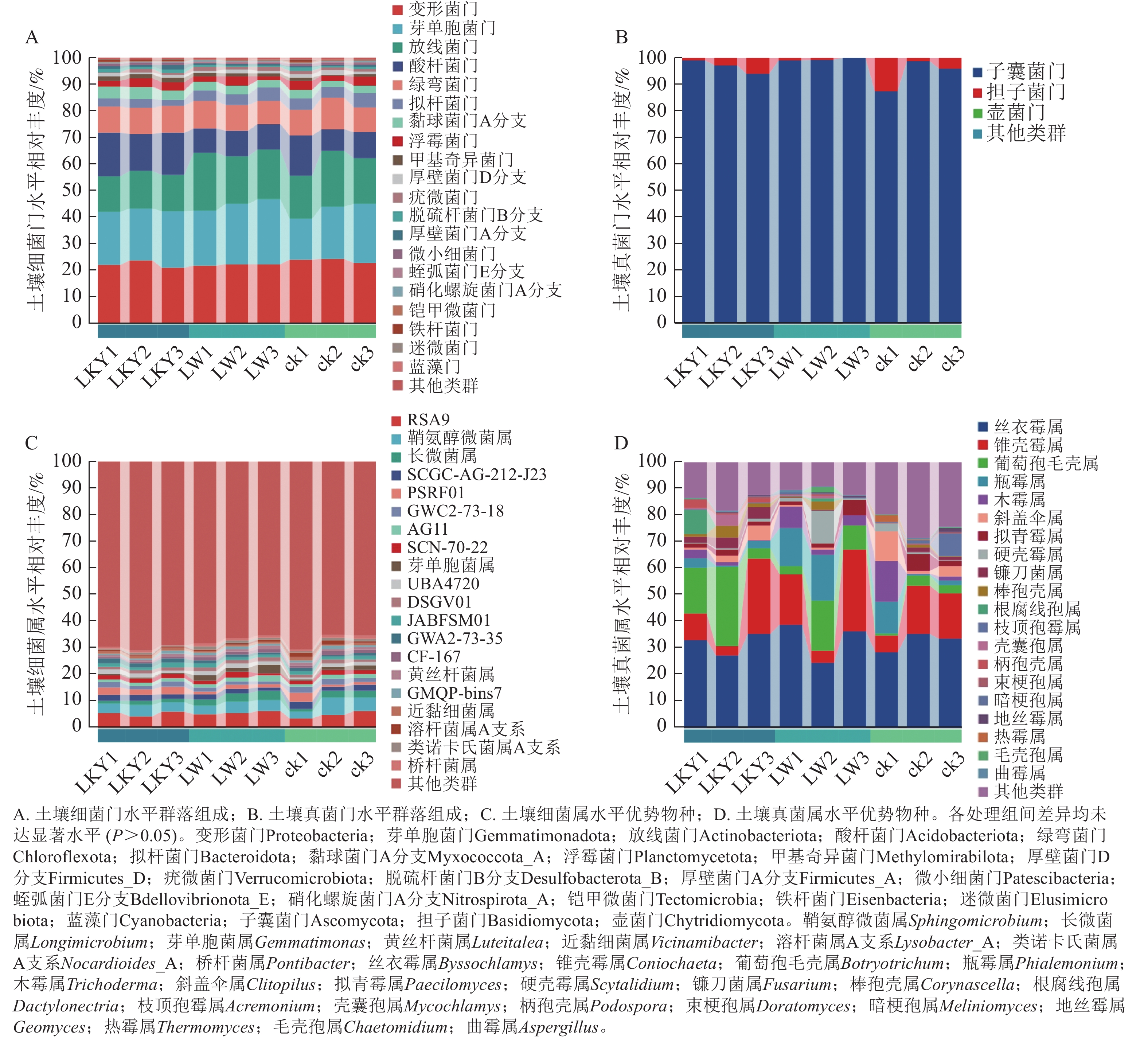
    • LKY、LW处理在土壤细菌群落门水平上的优势类群为变形菌门Proteobacteria与芽单胞菌门Gemmatimonadota,相对丰度分别稳定在21%~24%、19%~25% (图1A);在土壤真菌群落门水平上,LW处理下子囊菌门Ascomycota相对丰度最高(达99%),各处理间差异未达显著水平(图1B)。在土壤细菌群落属水平上,LKY处理的其他类群相对丰度略高(图1C);在土壤真菌群落属水平上,LKY处理提高了葡萄孢毛壳属Botryotrichum的相对丰度,达16%,LW处理提高了锥壳霉属Coniochaeta的相对丰度,达17%,但与ck相比差异均未达显著水平(图1D)。
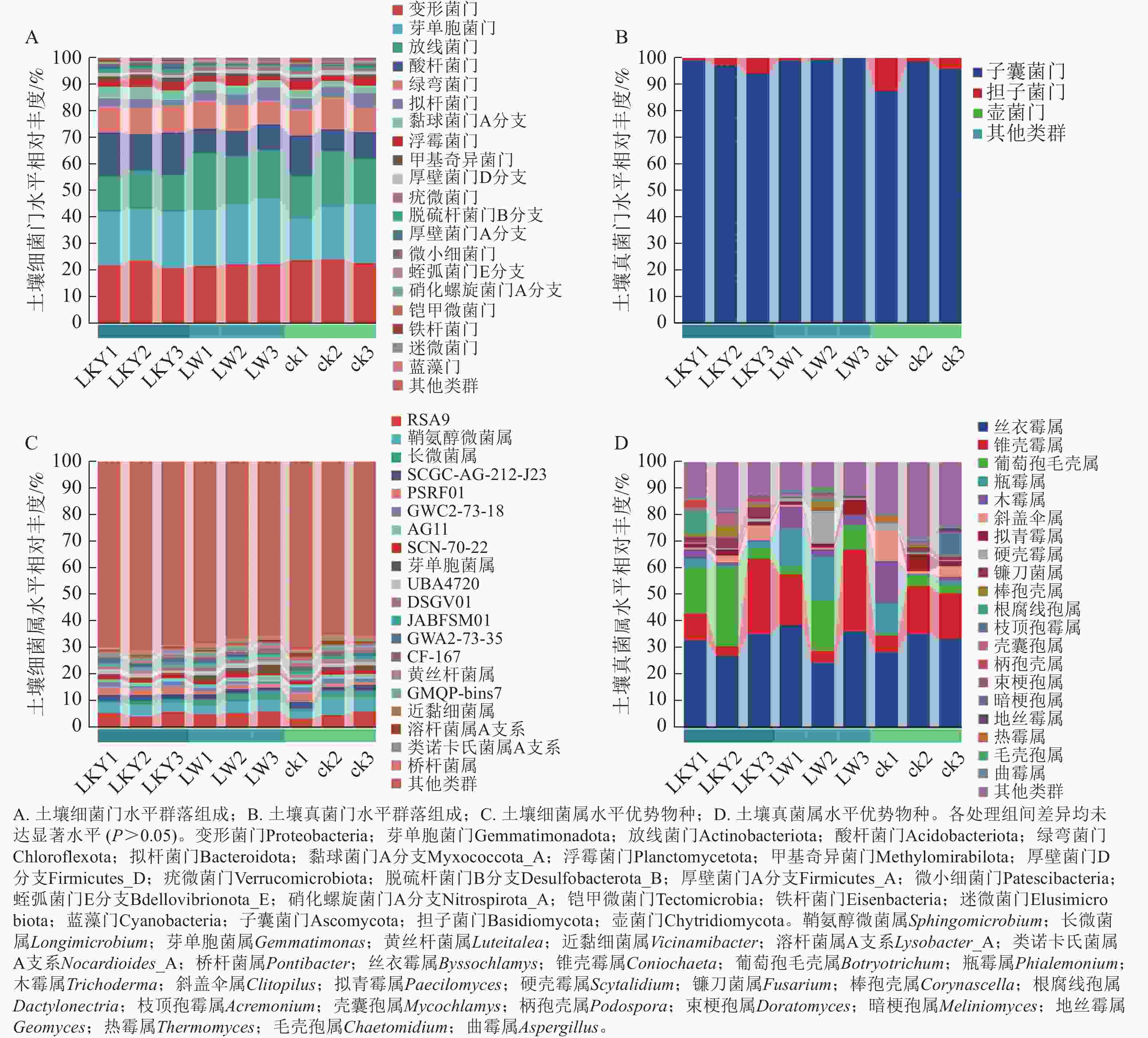
      Figure 1.  Effects of different organic amendments on the relative abundance of vineyard soil bacteria and fungi

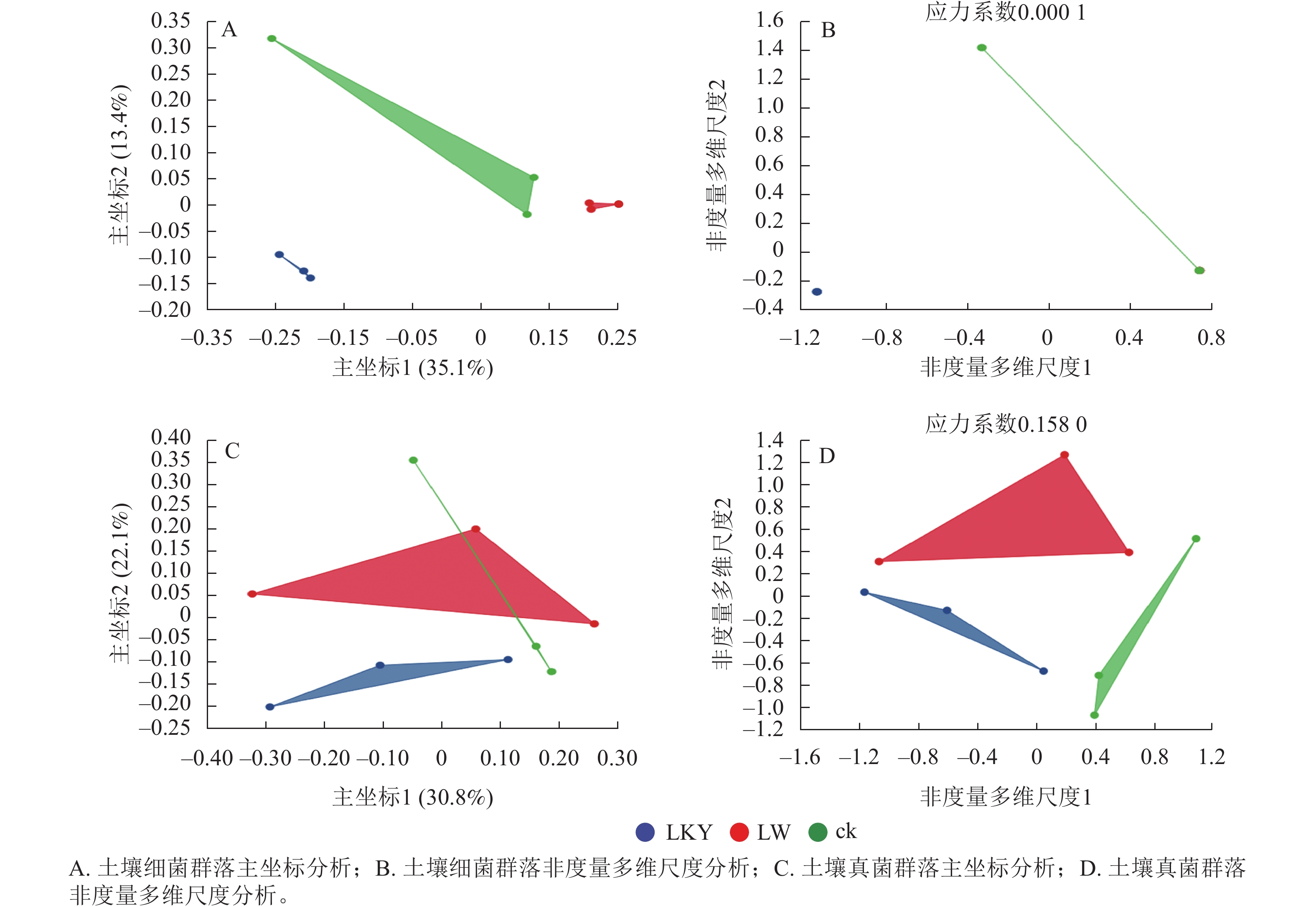
    • 主坐标分析(PCoA)结果显示:前2个主坐标轴共解释土壤细菌群落变异的48.5%(轴1为35.1%,轴2为13.4%)。不同处理样品沿第1轴明显分离,说明2种改良剂均改变了土壤细菌群落结构(图2A)。PERMANOVA进一步证实处理间差异显著(F=2.02,R2=0.40,P=0.005,表4)。NMDS应力系数为0.000 1,远小于0.200 0,表明二维图谱可准确反映样本间差异(图2B)。土壤真菌群落对改良处理的响应较弱,PCoA前2个轴共解释土壤真菌群落变异的52.9%(轴1为30.8%,轴2为22.1%),3种处理组样品在排序图上呈现分离趋势(图2C)。PERMANOVA结果显示差异不显著(F=1.08,R2=0.27,P=0.357,表4)。NMDS应力系数为0.158 0,仍低于0.200 0,说明图谱可靠(图2D)。
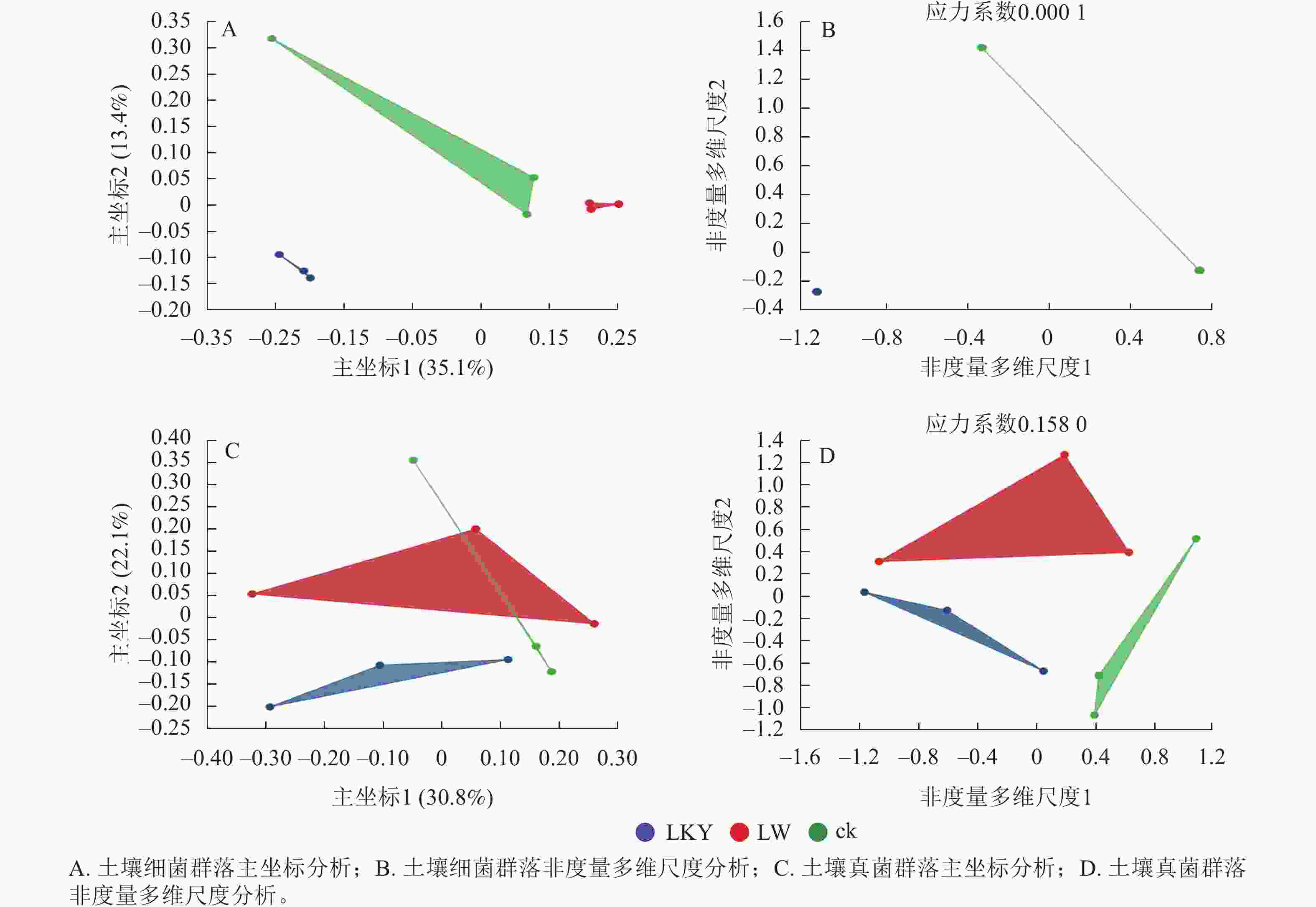
      Figure 2.  Principal coordinate and non-metric multidimensional scaling analysis of vineyard soil bacterial and fungal communities

      来源 变异
      来源
      自由度 总平
      方和
      均方根 方差
      模型
      决定
      系数
      P
      细菌 处理 2 0.44 0.22 2.02 0.40 0.005
      残差 6 0.66 0.11 0.60
      总计 8 1.10 1.00
      真菌 处理 2 0.30 0.15 1.08 0.27 0.357
      残差 6 0.83 0.14 0.73
      总计 8 1.13 1.00
        说明:-表示无此项。

      Table 4.  PERMANOVA analysis of the vineyard soil bacterial and fungal communities

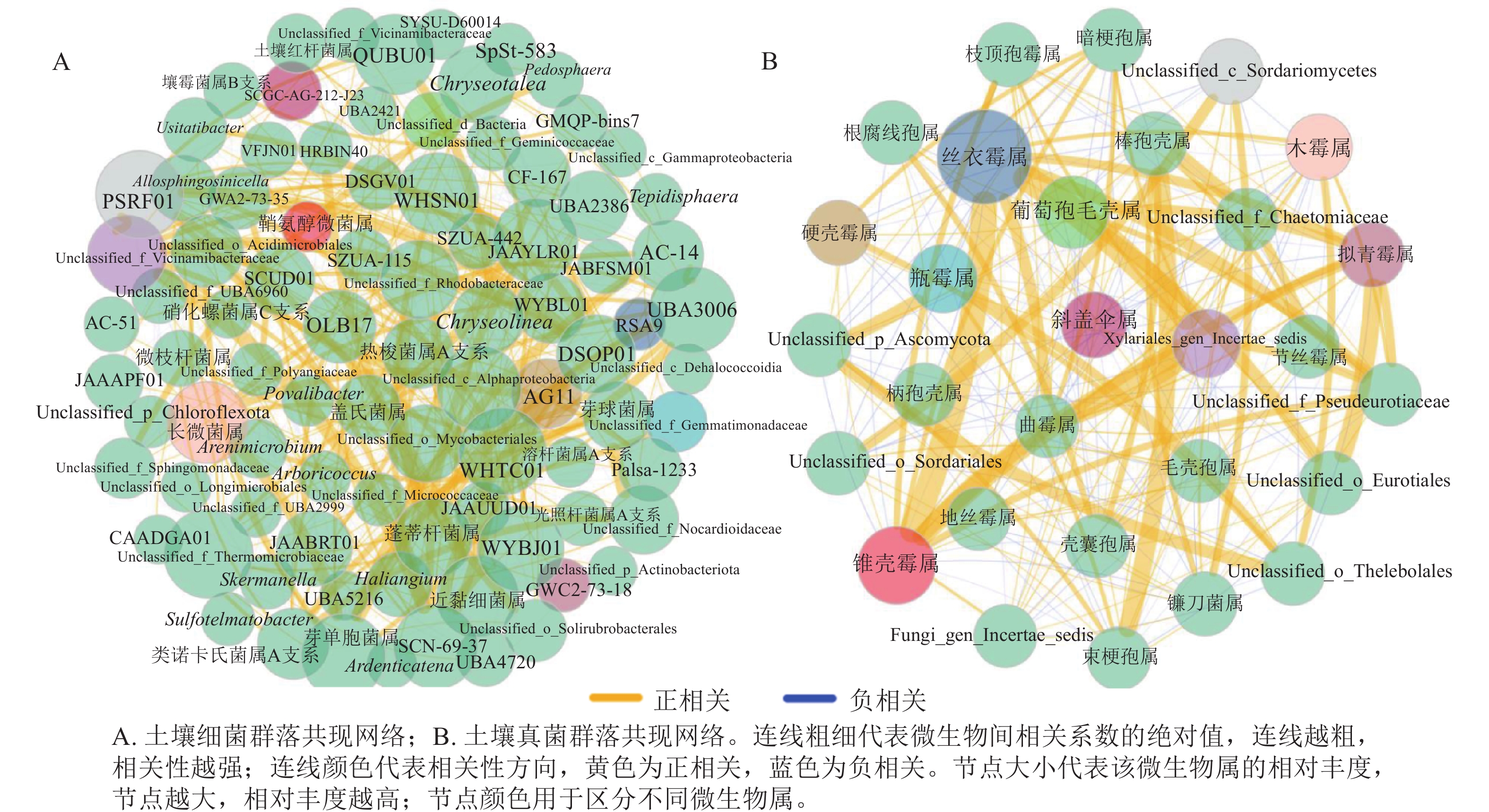
    • 基于共现网络分析,筛选出满足Connector标准(Zi≤2.5,Pi>0.62)的关键节点。土壤细菌群落中关键属为JAAUUD01和SpSt-583 (图3A);在土壤真菌群落中关键属为硬壳霉属和未分类子囊菌门属Unclassified_p_Ascomycota (图3B)。这些属在处理间起桥梁作用,参与调控微生物群落稳定性。
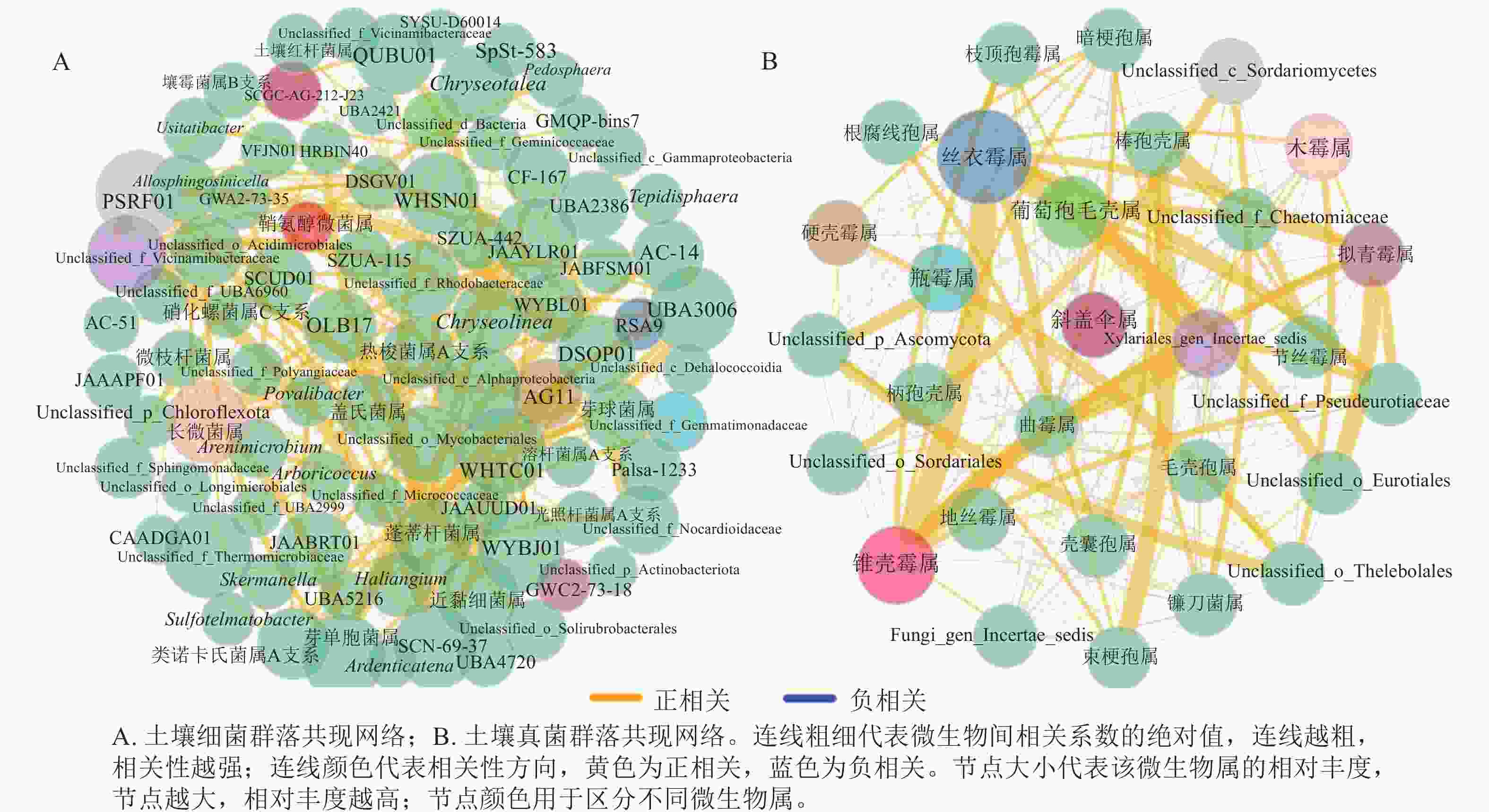
      Figure 3.  Co-occurrence network analysis of vineyard soil microbial communities

    • LKY处理可滴定酸、百粒重、产量均显著高于LW处理和ck处理(P<0.05),相比之下,LW处理仅可溶性固形物表现较好,其余指标均低于LKY处理。由此可见:LKY处理对葡萄果实的产量、果形及可滴定酸的提升效果最为突出(表5)。

      处理可滴定酸/(g·L−1)可溶性固形物/%百粒重/g纵横径比产量/(kg·hm−2)
      LKY7.88±0.23 a22.00±0.46 a126.98±2.47 a1.03±0.03 a7165.03±214.89 a
      LW3.81±0.19 c22.20±0.36 a101.19±1.15 b0.95±0.00 b3976.55±174.77 b
      ck6.15±0.19 b21.13±0.21 b97.31±2.05 b0.93±0.04 b3144.21±133.08 c
        说明:不同小写字母表示不同处理间差异显著(P<0.05)。

      Table 5.  Comparison of grape berry quality under different organic-amendment treatments

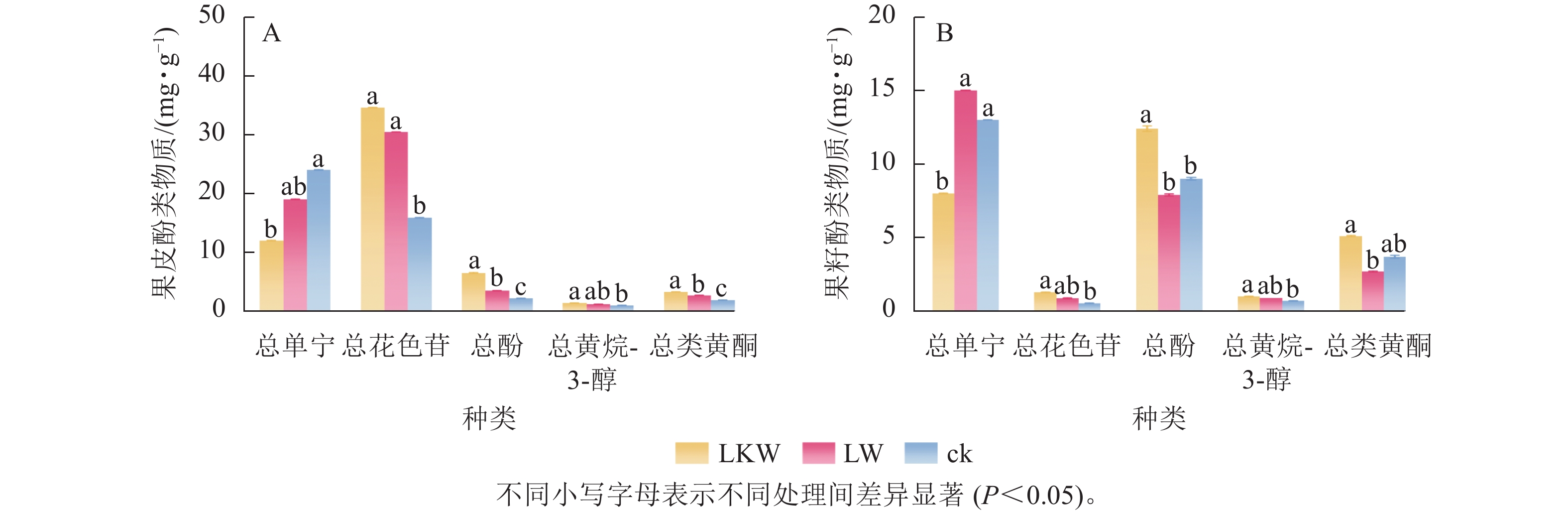
    • LKY处理的果皮总酚、果皮总类黄酮、果籽总酚、果籽总类黄酮质量分数均显著高于LW和ck处理(P<0.05),同时LKY处理对果皮总花色苷、果皮总黄烷-3-醇、果籽总花色苷、果籽总黄烷-3-醇质量分数也有明显提升,且高于LW和ck处理。整体来看,LKY处理对酚类物质的促进效果优于LW处理(图4)。
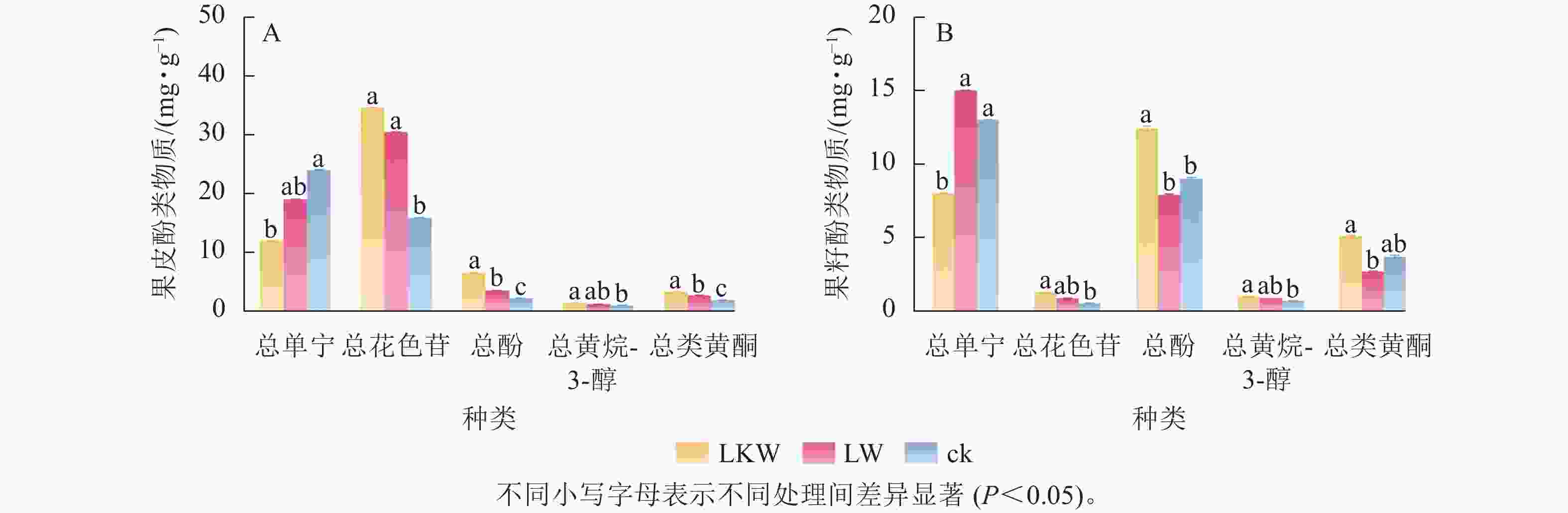
      Figure 4.  Phenolic contents in grape skin and seed under different organic-amendment treatments

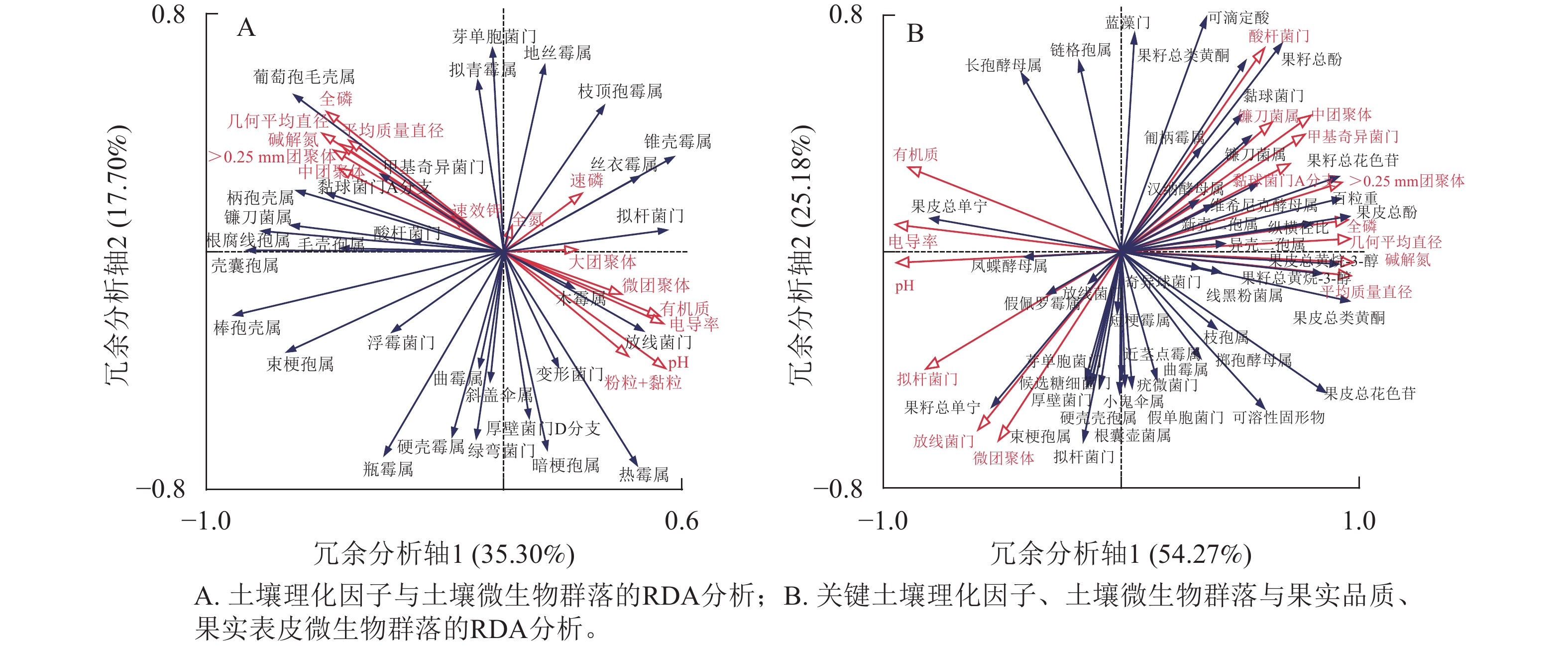
    • 冗余分析(RDA)结果表明:前2轴(RDA1、RDA2)共解释了土壤微生物群落变异的53.0% (RDA1为35.3%,RDA2为17.7%),其中土壤全磷(P=0.014)、土壤中团聚体(P=0.026)、>0.25 mm团聚体质量分数(P=0.014)的驱动作用相对突出,是改变土壤细菌群落结构的关键环境因子(图5A)。
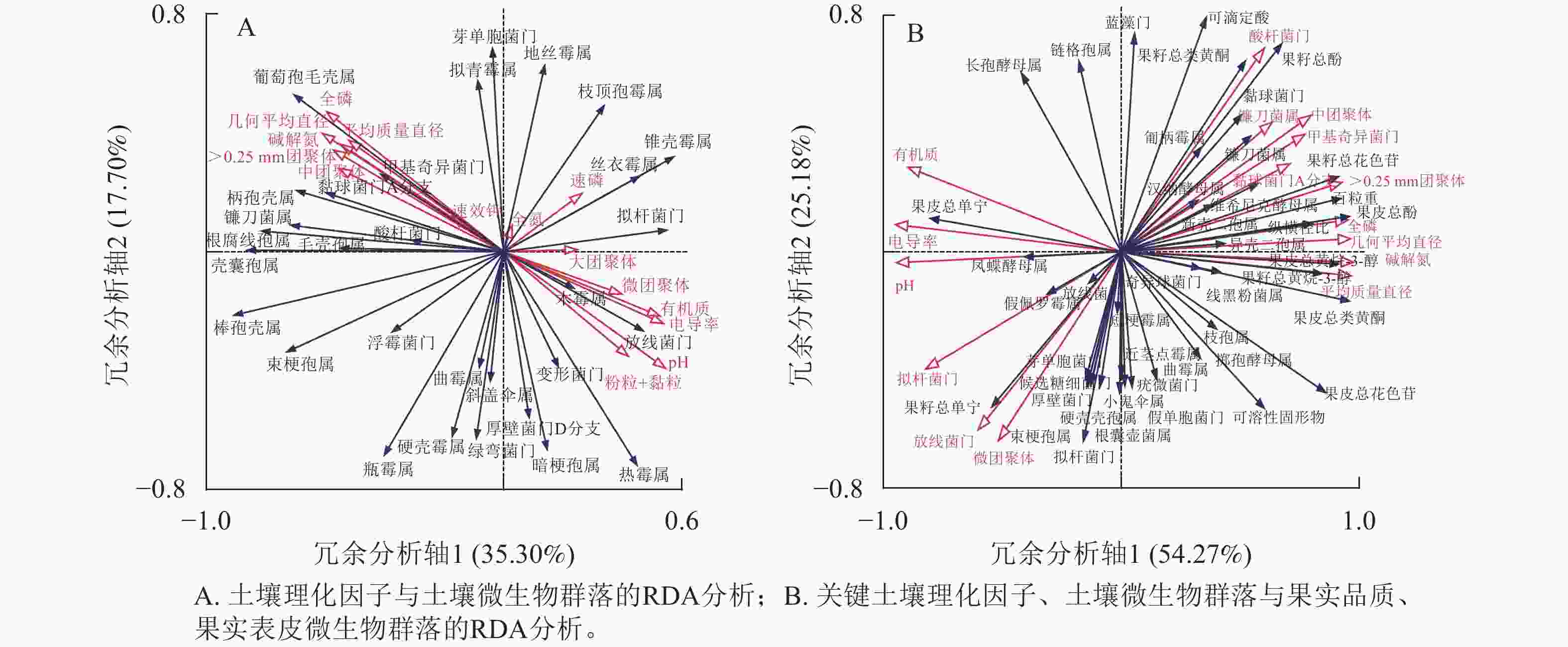
      Figure 5.  Redundancy analysis of soil physicochemical factors, soil microbial community, berry quality, and berry epidermis microbiota in vineyards under different organic amendment treatments

      为明确土壤理化因子、土壤团聚体、土壤微生物与果实品质及果皮微生物群落的相关性,RDA分析显示:前2轴(RDA1、RDA2)共解释了果实品质与果实表皮微生物群落变异的79.45% (RDA1为54.27%,RDA2为25.18%),这表明土壤环境因子对两者变化具有较强解释力(图5B)。其中>0.25 mm团聚体质量分数(P=0.002)、土壤碱解氮(P=0.002)、中团聚体(P=0.008)、土壤全磷(P=0.006)、土壤pH (P=0.002)、土壤拟杆菌门(P=0.004)、几何平均直径(P=0.002)、土壤电导率(P=0.002)的驱动作用最为突出。

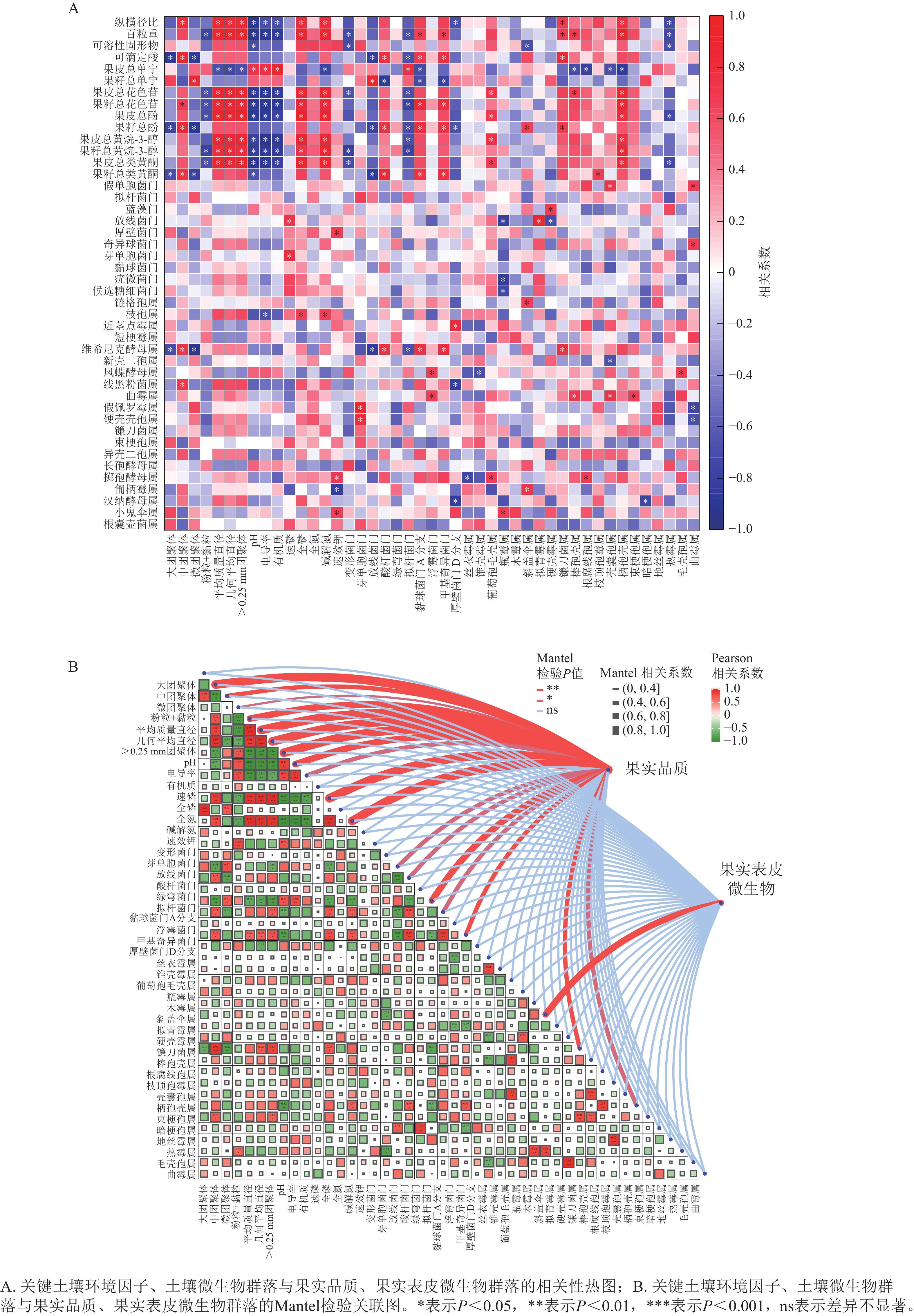
    • Spearman秩相关热图(图6A)及Mantel检验关联图(图6B)结果显示:土壤全磷、土壤碱解氮、>0.25 mm团聚体质量分数与百粒重、果皮总酚、果皮总类黄酮等呈显著正相关(P<0.05);土壤pH、土壤电导率、土壤有机质与果皮总酚、果皮总类黄酮等存在显著负相关(P<0.05)。因此,土壤全磷、土壤碱解氮、>0.25 mm团聚体质量分数、土壤pH是调控果实品质及果皮微生物群落的关键环境因子。
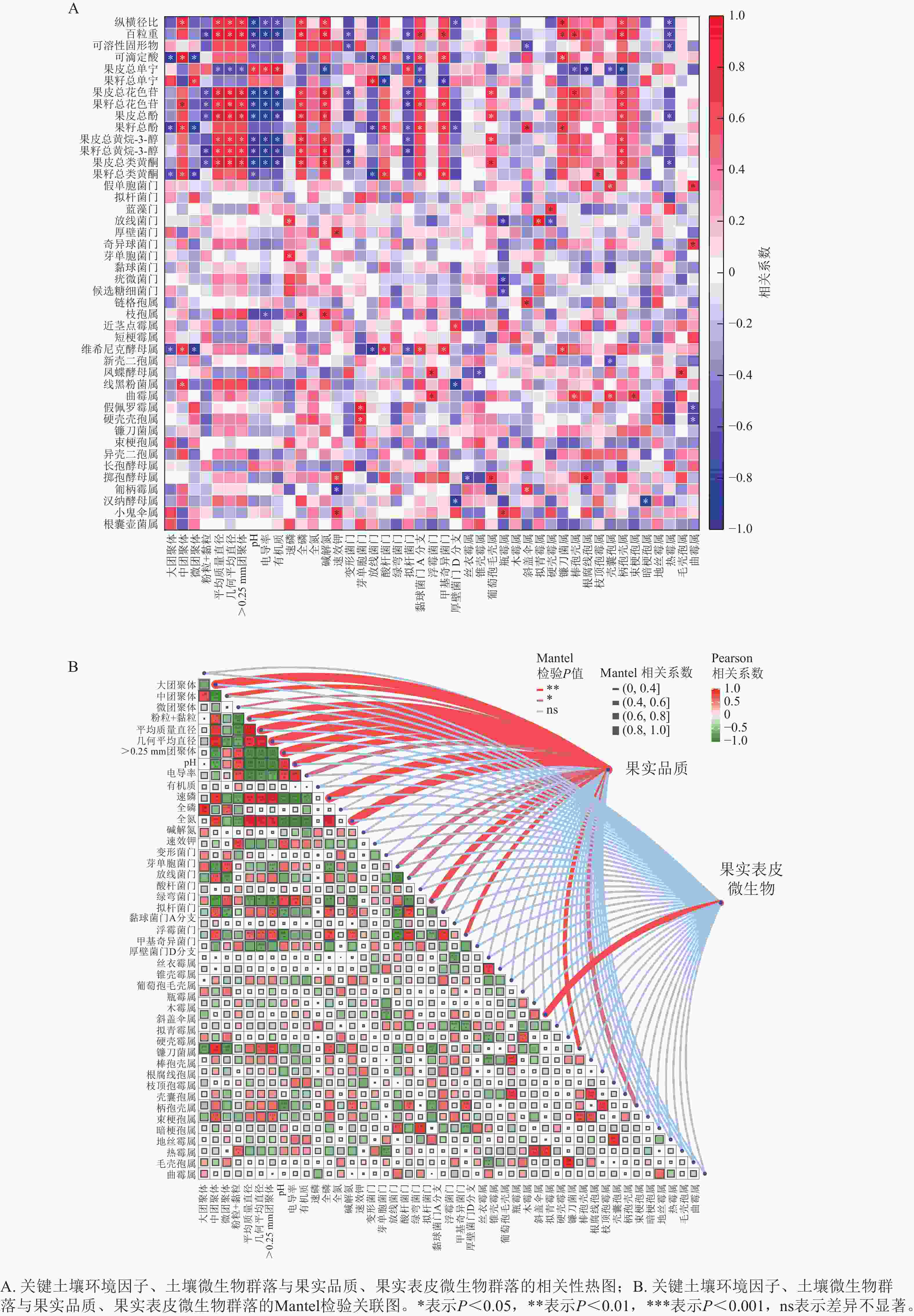
      Figure 6.  Correlation analysis among soil environmental factors, berry quality parameters, and berry-surface microbiota in the vineyard under different organic-amendment treatments

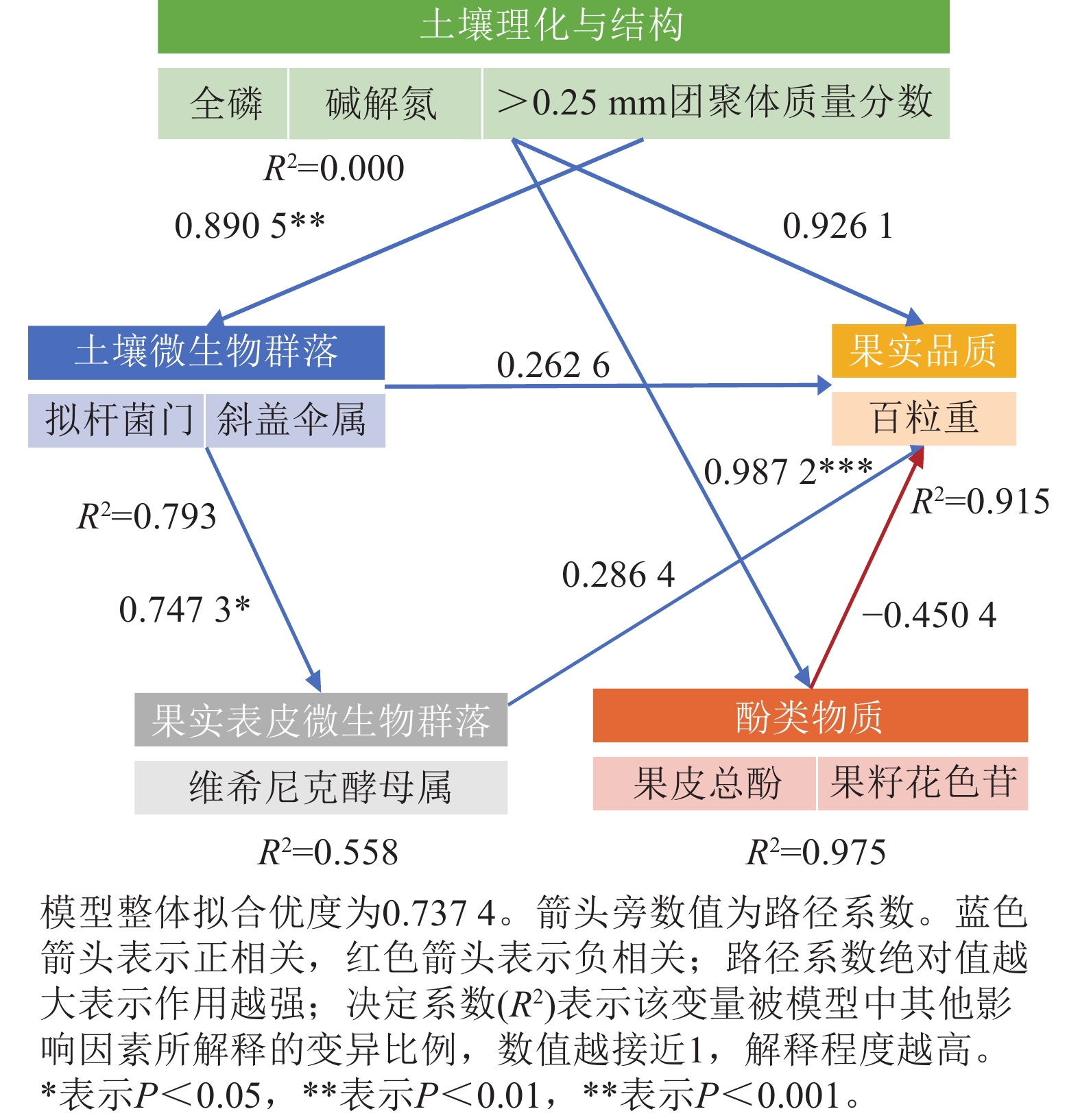
    • 偏最小二乘路径模型(PLS-PM)分析可见,模型整体拟合优度为0.737 4。解析结果显示:土壤理化性质与结构对土壤微生物群落(路径系数为0.890 5)、果实酚类物质(路径系数为0.987 2)均具有极显著的正向效应(P<0.01)。这说明土壤全磷、土壤碱解氮及土壤团聚体结构的改变是影响土壤微生物及果实酚类物质的关键因子。土壤微生物群落对果实表皮微生物群落(路径系数为0.747 3)呈现显著的正向效应(P<0.05)。其余路径的效应均未达到统计学显著水平,其潜在关联需后续研究进一步验证(图7)。
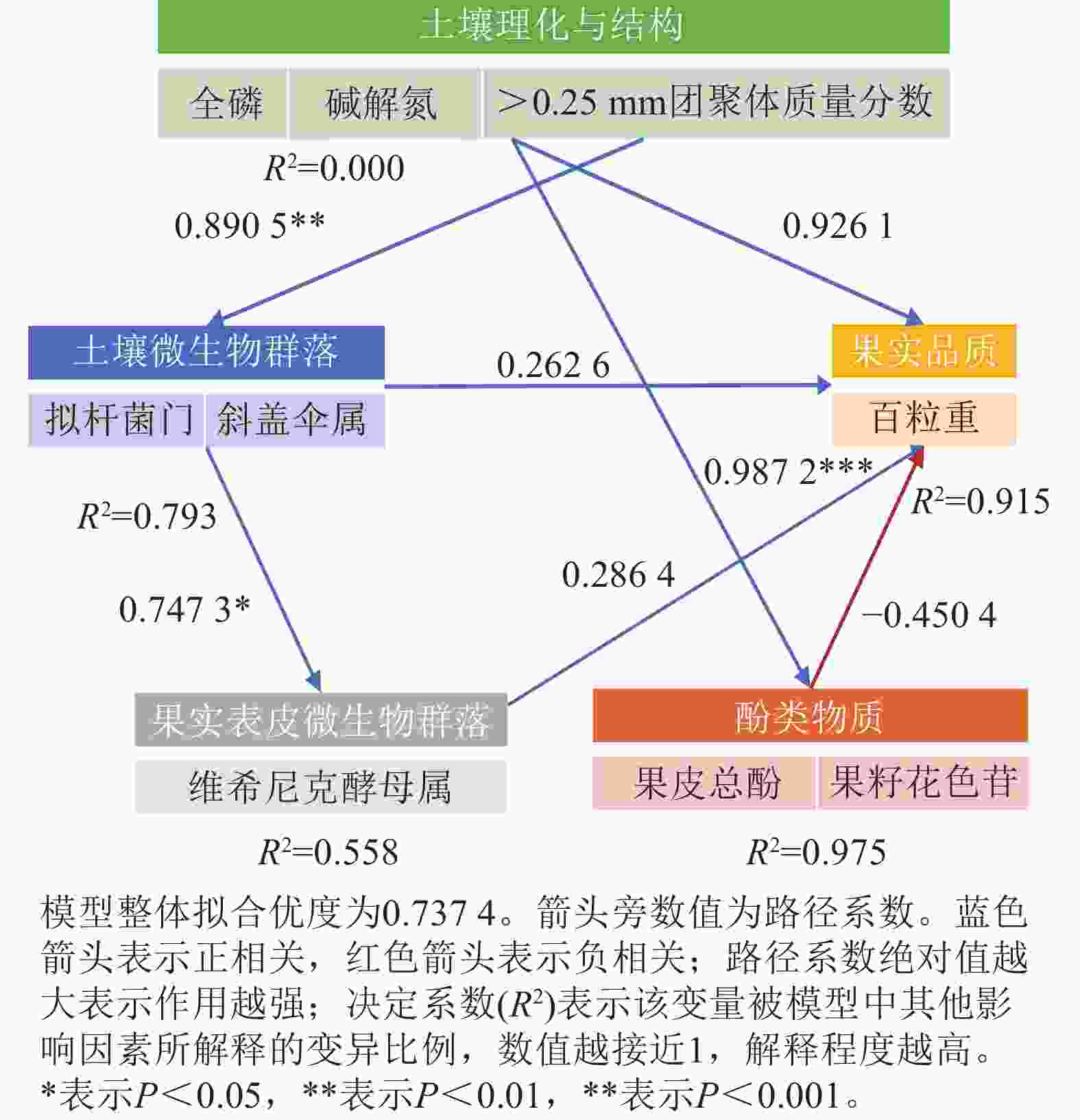
      Figure 7.  PLS-PM linking soil physicochemical structure, microbial community, and fruit quality in vineyards treated with organic amendments

    • LKY处理可显著提升土壤有效养分,与其螯合特性利于速效养分的活化与保持相关,而LW处理更侧重提升土壤全氮、土壤有机质,对土壤速效养分的提升效果较弱[1011]。LW处理通过促进土壤有机质分解、释放难溶性氮素进而补充土壤全氮库[12],而干旱区土壤砂粒含量高、养分淋溶快,使其对土壤速效养分的活化效果有限。这种功能差异随土层、时间变化:0~20 cm土层中2种改良剂在7月的效果均显著,而在20~40 cm土层中仅在9月的LKY处理对提升土壤速效磷有突出效果。这既与改良剂在土壤中的垂直迁移能力有关,也反映出干旱区深层土壤养分亏缺更严重、改良响应更慢。试验样地在5月采样前曾按酒庄常规管理进行了田间施肥,导致土壤电导率、土壤速效钾、土壤全磷等指标短暂升高。随着葡萄植株在生育期内对养分需求的增加,土壤养分逐渐下降。在7、9月施用改良剂后,土壤碱解氮、土壤速效磷、土壤全磷等指标较ck均明显提升,进一步印证了2种改良剂对土壤理化性质的改善作用,只是改良效果存在时空差异。

      7月各处理不同土层的土壤电导率明显高于9月,这主要是因为7月蒸发强烈,灌溉带入的盐分难以下渗,在各土层中快速聚集从而导致土壤电导率增加;9月葡萄进入成熟后期,昼夜温差增大、灌溉频率降低且根系吸盐能力增强,盐分随水分下渗并被根系大量吸收,耕层盐分累积量大幅减少,土壤电导率随之降低[13]。值得注意的是,9月LKY处理的0~20 cm土层土壤碱解氮质量分数较7月明显增加,20~40 cm土层则相反。这是由于7月0~20 cm土层湿度较低,导致LKY中的矿源黄腐酸活性受限、氮素矿化不足,而20~40 cm土层湿度相对稳定,根系氮素吸收量与矿化补充量基本平衡;9月0~20 cm土层经灌溉维持湿度后,矿源黄腐酸活性被充分激发,加之葡萄表层根系分泌物的刺激,有机物料矿化速率提升,氮素活化量增加,使土壤碱解氮质量分数明显升高,而20~40 cm土层碱解氮降低则是因为LKY处理的养分主要集中在表层,活化的氮素未及时向下迁移,且深层根系对氮素的吸收量大于矿化补充量[14]。此外,相较于LKY、LW处理,9月ck处理的土壤有机质显著升高,这可能与秋季凋落物输入增加有关。外源有机碳输入对土壤碳库的调控效应也已被诸多研究证实[15]

      2种改良剂不仅对土壤化学养分存在差异化影响,对土壤物理结构的改良作用也表现出明显不同。LKY处理显著提升中团聚体占比及团聚体稳定性,LW处理则侧重增加大团聚体占比。推测是因为LKY处理中功能基团更易促进微团聚体的胶结[16],而LW处理中有机质输入更利于大团聚体的形成[17]

      土壤理化性质与团聚体结构的改变进一步影响了土壤微生物群落的组成与结构[18]。有机改良剂对土壤细菌群落结构有显著影响[19],土壤真菌群落仅表现出趋势性分离。这一差异可能是因为土壤细菌世代周期短、周转速率快,对土壤微环境变化更敏感[20],而土壤真菌细胞壁结构复杂,群落结构更稳定[21],因此改良剂对土壤细菌的调控更易体现。

    • LKY处理显著提升可滴定酸、百粒重、产量、果皮总酚、果皮总类黄酮、果籽总酚、果籽总类黄酮,这是因为LKY处理提升的土壤速效养分可更高效地被葡萄根系吸收,为果实发育提供充足的矿质营养,进而促进果实百粒重和可滴定酸质量浓度的显著升高,可能与LKY处理调控土壤pH后根系对矿质元素吸收效率的改变有关[22]。值得注意的是,LW处理可滴定酸显著低于LKY和ck处理,这一现象或与其养分调控特征及微生物特性相关:一方面,LW侧重提升的土壤全氮为光合作用与蛋白质合成提供核心支撑,结合有机质分解释放的碳源与矿质元素,促进碳水化合物(可溶性糖)大量积累,进而通过稀释效应降低可滴定酸的相对含量[23];另一方面,LW作为微生物菌剂,可调节葡萄根系对钾离子的吸收效率[24],而钾离子能调控有机酸代谢酶活性以减少酸积累[25]

      LKY处理产量最优的核心原因还在于其通过提升土壤中团聚体占比及平均质量直径,增加了土壤通气性与保水保肥能力,为根系下扎及养分吸收创造了稳定的微环境,同时土壤碱解氮等有效养分的持续供应,既促进平均单穗质量增加实现增产,也为果实酚类物质合成积累提供了稳定的根际养分条件[2628];LW处理虽能增加大团聚体占比,但速效养分提升有限,难以满足葡萄生长对养分的集中需求,因此产量与果实酚类物质积累的整体提升幅度均明显低于LKY处理。

    • 在土壤-微生物-果实品质的链式关联中,土壤环境因子对果实品质及果皮微生物群落的解释力高达79.45%,充分证实了土壤环境因子是驱动葡萄果实品质形成的关键因素[29]。此外,有机改良剂处理下,土壤微生物群落与果实表皮微生物群落呈现显著的正向效应,且PLS-PM模型已验证土壤理化结构对土壤微生物群落的驱动作用[3031]。这表明有机改良剂并非直接作用于果实表皮微生物,而是通过先调控土壤微生物群落结构,再借助根际微生物与地上部微生物的跨系统互作,间接影响果实表皮微生物群落[32],最终构建起土壤环境-微生物-果实品质的链式调控网络,揭示了有机改良剂改善葡萄果实品质的深层微生物学机制。

    • LKY与LW处理对土壤的改良具有时空特异性。LKY处理侧重降低土壤pH,增加土壤速效养分及中团聚体稳定性,LW处理侧重提升土壤全氮、土壤有机质并促进大团聚体的形成,两者均显著影响土壤细菌群落结构。LKY处理对果实品质、产量及酚类物质的综合提升效果均明显优于LW处理。LW处理虽能增加土壤大团聚体占比,但其对土壤速效养分的提升有限,难以支撑产量的大幅提升。综上所述,在宁夏贺兰山东麓干旱区砂质葡萄园中,LKY处理通过靶向改善土壤pH、土壤有效养分及团聚体稳定性,明晰了土壤-微生物-果实之间的关系;偏最小二乘路径模型证实,这些关键因子构成的土壤理化结构是有机改良剂影响土壤微生物及果实酚类物质的核心驱动因子,故LKY处理是更适配该产区的有机改良剂。本研究明确了干旱区葡萄园土壤改良的核心靶点与技术方向,为产区实现绿色、高效的葡萄栽培提供了实践参考。

Reference (32)

Catalog

    /

    DownLoad:  Full-Size Img  PowerPoint
    Return
    Return