Turn off MathJax
Article Contents

LI Linxin, LI Wenchao, YANG Pengcheng, et al. Fruit quality and wine aroma characteristics of ‘Chardonnay’ grapes in different ecological zones of Helan Mountain’s east foothill[J]. Journal of Zhejiang A&F University, 2026, 43(X): 1−12 doi:  10.11833/j.issn.2095-0756.20250264
Citation: LI Linxin, LI Wenchao, YANG Pengcheng, et al. Fruit quality and wine aroma characteristics of ‘Chardonnay’ grapes in different ecological zones of Helan Mountain’s east foothill[J]. Journal of Zhejiang A&F University, 2026, 43(X): 1−12 doi:  10.11833/j.issn.2095-0756.20250264

OnlineFirst articles are published online before they appear in a regular issue of the journal. Please find and download the full texts via CNKI.

Fruit quality and wine aroma characteristics of ‘Chardonnay’ grapes in different ecological zones of Helan Mountain’s east foothill

DOI: 10.11833/j.issn.2095-0756.20250264
  • Received Date: 2025-04-23
  • Accepted Date: 2026-01-27
  • Rev Recd Date: 2025-12-30
  •   Objective  The effects of diverse terroir factors in Ningxia Helan Mountain’s east foothill production area on grape (Vitis vinifera) berry amino acid accumulation and wine aroma formation are investigated, with the goal of providing theoretical support for optimizing local grape planting terroir and upgrading wine quality.   Method  The fruit amino acid composition and content were analyzed by high performance liquid chromatography (HPLC) in 4 plots (Yuquan, Yuma, Xige, Zhihui) of ‘Chardonnay’ grape berries and wines made during the harvest period in Yongning, Qingtongxia, and Yinchuan, three sub-appellations in Ningxia Helan Mountain’s east foothill, with Headspace Solid-Phase Microextraction-Gas Chromatography-Mass Spectrometry (HS-SPME-GC-MS) was used to analyze the volatile components in the wines.   Result  The results showed that the total amino acid content of grape berries from plot Zhihui was the highest at 6 876.62 mg·L−1, Yuquan was the lowest at 3 873.65 mg·L−1, and the difference between Yuma and Xige was not significant, but there was a significant difference with the other 2 plots (P<0.05). The contents of alanine, arginine, phenylalanine, and tyrosine in the grape berries of the 4 plots, phenylalanine and tyrosine, and glycine and proline. The aroma composition of the wines from the 4 plots mainly consisted of 4 types of substances, accounting for a total of 95.1%, of which higher alcohols accounted for 49.3%, fatty acid ethyl esters accounted for 22.2%, other esters accounted for 12.6%, and fatty acids accounted for 11.0%. By using Orthogonal Partial Least Squares Discriminant Analysis (OPLS-DA), 4 plots could be better distinguished, among which the differences between Yuma and Xige groups were small and could be categorized as one group; the aroma substances that could significantly distinguish the plots were identified as eight by the VIP score plot, among which isoamyl alcohol, ethyl tridecanoate, ethyl ethyl 9-decenoate, ethyl caprylate, isobutyl alcohol were the main characteristic substances of Yuma and Xige wines; phenylethanol, diethyl phthalate, dimethyl phthalate were the main characteristic substances of Yuquan wine.   Conclusion  The accumulation of amino acids in ‘Chardonnay’ grape berries and the aroma characteristics of wines from various sub-appellations in Ningxia Helan Mountain’s east foothill were affected by the differences in terroir conditions, among which, alanine was most affected by the ecological conditions and made a prominent contribution to the higher alcohols of the wine’s aroma substances. [Ch, 5 fig. 5 tab. 33 ref.]
  • [1] CHENG Jiajie, CHEN Rong, YU Weiwu, CHEN Wenchao, HU Yuanyuan, ZHANG Zuying, SONG Lili.  Differences in free amino acids during post-ripening process of Torreya grandis ‘Xi Fei’ and ‘Xiangya Fei’ seeds . Journal of Zhejiang A&F University, doi: 10.11833/j.issn.2095-0756.20250169
    [2] WU Qinjiao, SONG Yandong, TAO Shijie, WANG Li, ZHOU Ruyi, CHEN Wu, PAN Xinhe, ZHOU Yufeng, ZHOU Guomo.  VOCs release characteristics of 5 typical stands in Baiyun National Forest Park and their relationship with environmental factors . Journal of Zhejiang A&F University, doi: 10.11833/j.issn.2095-0756.20220676
    [3] TAO Shijie, SONG Yandong, WU Qinjiao, WANG Li, ZHOU Ruyi, WU Dian, ZHOU Yufeng, ZHOU Guomo.  Characteristics of volatile organic compounds release in Phyllostachys edulis forests and their relationship with environmental factors . Journal of Zhejiang A&F University, doi: 10.11833/j.issn.2095-0756.20230249
    [4] HU Shujing, ZHANG Rumin.  Roles of volatile organic compounds in plant adaptation to stress and physiological ecology . Journal of Zhejiang A&F University, doi: 10.11833/j.issn.2095-0756.20220180
    [5] WU Jindong, HE Yong, ZHU Zhujun.  Effects of partial substitution of chemical fertilizer with organic fertilizer on growth and quality of Solanum melongena in open field . Journal of Zhejiang A&F University, doi: 10.11833/j.issn.2095-0756.20200767
    [6] JIANG Dongyue, LI Yonghong, SHEN Xin.  Components and variations of volatile organic compounds released from leaves and flowers of Ruta graveolens . Journal of Zhejiang A&F University, doi: 10.11833/j.issn.2095-0756.2018.03.025
    [7] YANG Jianfei, NING Liping, YANG Liao, WANG Jie, QIAN Yuying, CHEN Yixuan.  Structural characteristics of Lindera megaphylla wood and its volatile organic compounds . Journal of Zhejiang A&F University, doi: 10.11833/j.issn.2095-0756.2018.05.018
    [8] WANG Qi, LIU Huahong, WANG Bin, ZHANG Rumin, GAO Yan.  Component analysis of volatile organic compounds from branches and leaves in seven Acer species . Journal of Zhejiang A&F University, doi: 10.11833/j.issn.2095-0756.2016.03.022
    [9] LÜ Suhua, XU Meng, ZHANG Xinfeng, LIU Jingjing, SI Jinping.  Polysaccharides, extracts, and amino acids in hybrid Dendrobium officinale flowers . Journal of Zhejiang A&F University, doi: 10.11833/j.issn.2095-0756.2016.05.004
    [10] LIU Qing, TONG Senmiao, MA Jianyi.  Volatile compounds from bamboo vinegar with HS-SPME and GC-MS . Journal of Zhejiang A&F University, doi: 10.11833/j.issn.2095-0756.2014.02.022
    [11] WANG Qi, WANG Dan, ZHANG Rumin, GAO Yan.  Changes in constituents and contents of volatile organic compounds in Wisteria floribunda at three flowering stages . Journal of Zhejiang A&F University, doi: 10.11833/j.issn.2095-0756.2014.04.023
    [12] LIU Fang, XU Gaiping, WU Xingbo, DING Qianqian, ZHENG Jie, ZHANG Rumin, GAO Yan.  Effect of drought stress and re-watering on emissions of volatile organic compounds from Rosmarinus officinalis . Journal of Zhejiang A&F University, doi: 10.11833/j.issn.2095-0756.2014.02.015
    [13] XU Yue, SONG Min-guo, YANG Xian-yu, YUAN Jin-qiang.  The galectin-3 cDNA diversity and amino acid variation of Bufo gargarizans skin tissue . Journal of Zhejiang A&F University, doi: 10.11833/j.issn.2095-0756.2012.04.014
    [14] MA Nan, ZHOU Shuai, LIN Fu-ping, GAO Yan, ZHANG Ru-min.  Volatile organic compounds of five hedgerow plants in Hangzhou . Journal of Zhejiang A&F University, doi: 10.11833/j.issn.2095-0756.2012.01.023
    [15] ZHANG Jie, GUO Jin-xing, ZHANG Ru-zhong, WANG Xing-xing, ZHANG Xiao-ling, LIU Lin, HOU Ping, ZHANG Ru-min.  Changes in volatile organic compounds (VOCs) during storage for Myrica rubra‘Dongkui’ . Journal of Zhejiang A&F University, doi: 10.11833/j.issn.2095-0756.2012.01.024
    [16] ZHOU Shuai, MA Nan, LIN Fu-ping, ZHANG Ru-min, GAO Yan.  Diurnal variation of volatile organic compounds emitted from Cinnamomum camphora flowers . Journal of Zhejiang A&F University, doi: 10.11833/j.issn.2095-0756.2011.06.025
    [17] KONG Xin-gang, GUO Ming, MAO Sheng-feng, LI Hua, YU Fei.  Study on the bacteriostasis of 2-ethylformate-3-formaldehyde thiosemicarbazone-quinoxaline-1,4-dioxide . Journal of Zhejiang A&F University,
    [18] ZHOU Jian-zhong, LIU Li, GUO Jian-zhong, L Jian-quan, LIN Hai-ping.  Quality of monascus wine in She village of Zhejiang . Journal of Zhejiang A&F University,
    [19] HE Guang-xun.  Degeneration of soil fertility in pure Chinese fir succession . Journal of Zhejiang A&F University,
    [20] LIU Li, LIN Xin-chun, YE Li-min.  Components of proteins in shoots of various cultivars of Phyllostachys praecox . Journal of Zhejiang A&F University,
  • [1]
    STINES A P, GRUBB J, GOCKOWIAK H, et al. Proline and arginine accumulation in developing berries of Vitis vinifera L. in Australian vineyards: influence of vine cultivar, berry maturity and tissue type[J]. Australian Journal of Grape and Wine Research, 2000, 6(2): 150−158. DOI: 10.1111/j.1755-0238.2000.tb00174.x.
    [2]
    GUTIÉRREZ-GAMBOA G, CARRASCO-QUIROZ M, MARTÍNEZ-GIL A M, et al. Grape and wine amino acid composition from Carignan noir grapevines growing under rainfed conditions in the Maule Valley, Chile: effects of location and rootstock[J]. Food Research International, 2018, 105: 344−352. DOI: 10.1016/j.foodres.2017.11.021.
    [3]
    CANOURA C, KELLY M T, OJEDA H. Effect of irrigation and timing and type of nitrogen application on the biochemical composition of Vitis vinifera L. cv. Chardonnay and Syrah grape berries[J]. Food Chemistry, 2018, 241: 171−181. DOI: 10.1016/j.foodchem.2017.07.114.
    [4]
    BOUZAS-CID Y, TRIGO-CÓRDOBA E, ORRIOLS I, et al. Influence of soil management on the red grapevine (Vitis vinifera L. ) mencía must amino acid composition and wine volatile and sensory profiles in a humid region[J]. Beverages, 2018, 4(4): 76. DOI: 10.3390/beverages4040076.
    [5]
    GARDE-CERDÁN T, ANCÍN-AZPILICUETA C. Effect of the addition of different quantities of amino acids to nitrogen-deficient must on the formation of esters, alcohols, and acids during wine alcoholic fermentation[J]. LWT-Food Science and Technology, 2008, 41(3): 501−510. DOI: 10.1016/j.lwt.2007.03.018.
    [6]
    ZHU Xiaolin. Evolution of Aroma Compounds during Winemaking Process through the Treatment with Glycosidases[D]. Yangling: Northwest A&F University, 2017.
    [7]
    VALERA M J, OLIVERA V, PÉREZ G, et al. Impact of phenylalanine on Hanseniaspora vineae aroma metabolism during wine fermentation[J]. International Journal of Food Microbiology, 2024, 415: 110631. DOI: 10.1016/j.ijfoodmicro.2024.110631.
    [8]
    HE Yang, WANG Xinyuan, LI Penghui, et al. Research progress of wine aroma components: a critical review[J]. Food Chemistry, 2023, 402: 134491. DOI: 10.1016/j.foodchem.2022.134491.
    [9]
    BERGER R G. Flavours and Fragrances: Chemistry, Bioprocessing and Sustainability[M]. Berlin, Heidelberg: Springer, 2007: 241−267. DOI: 10.1007/978-3-540-49339-6.
    [10]
    LEE S H, SEO M J, RIU M, et al. Vine microclimate and norisoprenoid concentration in cabernet sauvignon grapes and wines[J]. American Journal of Enology and Viticulture, 2007, 58(3): 291−301. DOI: 10.5344/ajev.2007.58.3.291.
    [11]
    REYNOLDS A G, LOWREY W D, TOMEK L, et al. Influence of irrigation on vine performance, fruit composition, and wine quality of chardonnay in a cool, humid climate[J]. American Journal of Enology and Viticulture, 2007, 58(2): 217−228. DOI: 10.5344/ajev.2007.58.2.217.
    [12]
    REYNOLDS A G, SENCHUK I V, VAN DER REEST C, et al. Use of GPS and GIS for elucidation of the basis for terroir: spatial variation in an Ontario Riesling vineyard[J]. American Journal of Enology and Viticulture, 2007, 58(2): 145−162. DOI: 10.5344/ajev.2007.58.2.145.
    [13]
    LIU Wei, ZHONG Qi, FU Wei, et al. Effect of cultivation altitudes on phenolics compounds content, antioxidant activities and ester aromatic components of merlot and cabernet sauvignon wines[J]. Science and Technology of Food Industry, 2018, 39(20): 47−54. DOI: 10.13386/j.issn1002-0306.2018.20.009.
    [14]
    LI Dongmei, LI Chunyang, WANG Shiping, et al. Effects of different planting densities on chardonnay photosynthetic characteristics and quality[J]. Acta Agriculturae Boreali-occidentalis Sinica, 2018, 27(4): 571−575. DOI: 10.7606/j.issn.1004-1389.2018.04.014.
    [15]
    WANG Yaqin. Influence of Bunch Exposure on Amino Acid Accumulation in Grape Berries and Volatile Compound Production in Wines[D]. Beijing: China Agricultural University, 2015.
    [16]
    WEN Yaqin. Accumulation of Free and Glycosidically-bound Terpenes and Its Transcriptional Regulation in Wine Grapes[D]. Beijing: China Agricultural University, 2015.
    [17]
    CHEN Huawei, LE Xiaofeng, ZHANG Zhenwen. Analysis of physical and chemical indicators and amino acids contents during the growth and development process of Sauvignon Blanc[J]. China Brewing, 2021, 40(4): 33−37. DOI: 10.11882/j.issn.0254-5071.2021.04.007.
    [18]
    CHEN Huawei, LE Xiaofeng, ZHANG Zhenwen. Effects of different colors of rain-shelter plastic films on the amino acid content of Cabernet Sauvignon grape fruit[J]. China Brewing, 2021, 40(3): 143−148. DOI: 10.11882/j.issn.0254-5071.2021.03.027.
    [19]
    YU Huichun, GAO Jing, LI Feifei, et al. Determination of amino acids in different varieties of white wine grapes[J]. Jiangxi Science, 2016, 34(2): 173−177. DOI: 10.13990/j.issn1001-3679.2016.02.008.
    [20]
    NISHIMURA A. Regulations and functions of proline utilization in yeast Saccharomyces cerevisiae[J]. Bioscience, Biotechnology, and Biochemistry, 2024, 88(2): 131−137. DOI: 10.1093/bbb/zbad165.
    [21]
    FU Tao, WU Yueyan, WANG Liru, et al. Amino acids and aroma analysis of ‘Yinhong’ and its mutants of Vitis vinifera L.[J]. Journal of Nuclear Agricultural Sciences, 2014, 28(11): 2038−2050. DOI: 10.11869/j.issn.100-8551.2014.11.2038.
    [22]
    JORDÃO A, VILELA A, COSME F. From sugar of grape to alcohol of wine: sensorial impact of alcohol in wine[J]. Beverages, 2015, 1(4): 292−310. DOI: 10.3390/beverages1040292.
    [23]
    SABIR A, KAFKAS E, TANGOLAR S. Distribution of major sugars, acids, and total phenols in juice of five grapevine (Vitis spp. ) cultivars at different stages of berry development[J]. Spanish Journal of Agricultural Research, 2010, 8(2): 425−433. DOI: 10.5424/sjar/2010082-1186.
    [24]
    HE Shaohua, DU Zhenjiang, SHANG Hua, et al. Study of aroma profile on ‘merlot’ and ‘cabernet sauvignon’ wines in the eastern foot of Helan Mountains[J]. Sino-Overseas Grapevine & Wine, 2024(1): 55−64. DOI: 10.13414/j.cnki.zwpp.2024.01.008.
    [25]
    BELTRAN G, ESTEVE-ZARZOSO B, ROZÈS N, et al. Influence of the timing of nitrogen additions during synthetic grape must fermentations on fermentation kinetics and nitrogen consumption[J]. Journal of Agricultural and Food Chemistry, 2005, 53(4): 996−1002. DOI: 10.1021/jf0487001.
    [26]
    HOU Yangyang, YANG Zhehao, ZHANG Mengyao, et al. Effects of different amino acids on simulated grape juice fermentation[J]. China Brewing, 2021, 40(10): 95−101. DOI: 10.11882/j.issn.0254-5071.2021.10.015.
    [27]
    CAO Weiyu, LU Wenpeng, SHU Nan, et al. Research progress on wine flavor substances and their influencing factors[J]. China Brewing, 2022, 41(5): 1−7. DOI: 10.11882/j.issn.0254-5071.2022.05.001.
    [28]
    ZUO Junwei, QI Xiangyuan, ZHAO Caiyun, et al. Analysis on aroma composition in Chardonnay and Riesling dry white wines from eastern region of Ningxia Helan Mountain[J]. Food and Fermentation Industries, 2016, 42(10): 149−155. DOI: 10.13995/j.cnki.11-1802/ts.201610025.
    [29]
    GE Qian, WANG Xiaoli, WANG Yunxia, et al. Characteristics analysis of volatile aroma substances in ‘Cabernet Sauvignon’ wines from different producing regions at the eastern foot of Helan Mountain in Ningxia[J]. China Brewing, 2022, 41(2): 98−106. DOI: 10.11882/j.issn.0254-5071.2022.02.017.
    [30]
    TAO Yongsheng, PENG Chuantao. Correlation analysis of aroma characters and volatiles in Chardonnay dry white wines from five districts in China[J]. Transactions of the Chinese Society for Agricultural Machinery, 2012, 43(3): 130−139. DOI: 10.6041/j.issn.1000-1298.2012.03.025.
    [31]
    LI Hua, HU Boran, ZHANG Yulin. Analysis of aromatic composition in the dry white wine of chardonnay by gas chromatography/mass spectrometry[J]. Journal of Chinese Institute of Food Science and Technology, 2004, 4(3): 72−75. DOI: 10.16429/j.1009-7848.2004.03.018.
    [32]
    SUN Lijun. Study on the Typical Aroma of Cabernet Sauvignon and Merlot Dry Red Wine from Eastern Foothill of Helan Mountain[D]. Yinchuan: Ningxia University, 2022.
    [33]
    LI Yuanyuan, LI Demei, ZHANG Yadong, et al. Comparative study of aroma characteristics of Cabernet Sauvignon dry red wine in different sub-regions[J]. Food and Fermentation Industries, 2020, 46(6): 256−262, 268. DOI: 10.13995/j.cnki.11-1802/ts.022313.
  • 加载中
通讯作者: 陈斌, bchen63@163.com
  • 1. 

    沈阳化工大学材料科学与工程学院 沈阳 110142

  1. 本站搜索
  2. 百度学术搜索
  3. 万方数据库搜索
  4. CNKI搜索

Figures(5)  / Tables(5)

Article views(14) PDF downloads(0) Cited by()

Related
Proportional views

Fruit quality and wine aroma characteristics of ‘Chardonnay’ grapes in different ecological zones of Helan Mountain’s east foothill

doi: 10.11833/j.issn.2095-0756.20250264

Abstract:   Objective  The effects of diverse terroir factors in Ningxia Helan Mountain’s east foothill production area on grape (Vitis vinifera) berry amino acid accumulation and wine aroma formation are investigated, with the goal of providing theoretical support for optimizing local grape planting terroir and upgrading wine quality.   Method  The fruit amino acid composition and content were analyzed by high performance liquid chromatography (HPLC) in 4 plots (Yuquan, Yuma, Xige, Zhihui) of ‘Chardonnay’ grape berries and wines made during the harvest period in Yongning, Qingtongxia, and Yinchuan, three sub-appellations in Ningxia Helan Mountain’s east foothill, with Headspace Solid-Phase Microextraction-Gas Chromatography-Mass Spectrometry (HS-SPME-GC-MS) was used to analyze the volatile components in the wines.   Result  The results showed that the total amino acid content of grape berries from plot Zhihui was the highest at 6 876.62 mg·L−1, Yuquan was the lowest at 3 873.65 mg·L−1, and the difference between Yuma and Xige was not significant, but there was a significant difference with the other 2 plots (P<0.05). The contents of alanine, arginine, phenylalanine, and tyrosine in the grape berries of the 4 plots, phenylalanine and tyrosine, and glycine and proline. The aroma composition of the wines from the 4 plots mainly consisted of 4 types of substances, accounting for a total of 95.1%, of which higher alcohols accounted for 49.3%, fatty acid ethyl esters accounted for 22.2%, other esters accounted for 12.6%, and fatty acids accounted for 11.0%. By using Orthogonal Partial Least Squares Discriminant Analysis (OPLS-DA), 4 plots could be better distinguished, among which the differences between Yuma and Xige groups were small and could be categorized as one group; the aroma substances that could significantly distinguish the plots were identified as eight by the VIP score plot, among which isoamyl alcohol, ethyl tridecanoate, ethyl ethyl 9-decenoate, ethyl caprylate, isobutyl alcohol were the main characteristic substances of Yuma and Xige wines; phenylethanol, diethyl phthalate, dimethyl phthalate were the main characteristic substances of Yuquan wine.   Conclusion  The accumulation of amino acids in ‘Chardonnay’ grape berries and the aroma characteristics of wines from various sub-appellations in Ningxia Helan Mountain’s east foothill were affected by the differences in terroir conditions, among which, alanine was most affected by the ecological conditions and made a prominent contribution to the higher alcohols of the wine’s aroma substances. [Ch, 5 fig. 5 tab. 33 ref.]

LI Linxin, LI Wenchao, YANG Pengcheng, et al. Fruit quality and wine aroma characteristics of ‘Chardonnay’ grapes in different ecological zones of Helan Mountain’s east foothill[J]. Journal of Zhejiang A&F University, 2026, 43(X): 1−12 doi:  10.11833/j.issn.2095-0756.20250264
Citation: LI Linxin, LI Wenchao, YANG Pengcheng, et al. Fruit quality and wine aroma characteristics of ‘Chardonnay’ grapes in different ecological zones of Helan Mountain’s east foothill[J]. Journal of Zhejiang A&F University, 2026, 43(X): 1−12 doi:  10.11833/j.issn.2095-0756.20250264
  • 葡萄酒风味受葡萄Vitis vinifera果实品质的影响,而葡萄果实品质与营养成分密切相关。氨基酸作为葡萄果实的重要含氮化合物,对葡萄酒风味形成起着重要作用[1]。葡萄果实氨基酸积累受多种生态条件的调控,其中温度是关键因素之一。有研究表明:高温可提高‘佳丽酿’V. vinifera‘Carignan’葡萄脯氨酸含量;低温可延长成熟周期,有利于葡萄氨基酸累积[2]。水分条件亦有重要影响,水分胁迫可显著提高脯氨酸含量[3];调亏灌溉下氨基酸总量不变,但甲硫氨酸、色氨酸、丝氨酸及酪氨酸含量受其影响[4]。上述研究表明:生态条件对葡萄果实氨基酸含量的影响是复杂且多样的,不同生态因素通过不同的机制影响着葡萄果实中氨基酸的积累,进而影响葡萄酒的风味和品质。

    葡萄果实氨基酸的种类及含量与葡萄酒香气、风味密切相关。葡萄酒酿造过程中,氨基酸既是酵母生长与发酵的主要氮源,也参与香气的风味调控,部分香气物质源于以氨基酸为底物的酒精发酵[5],但高浓度半胱氨酸和赖氨酸会抑制酵母生长发酵[6]。例如,苯丙氨酸作为苯环和苯丙烷化合物合成的重要前体,可增强‘霞多丽’V. vinifera‘Chardonnay’葡萄酒花香特性并提高香气复杂度[7]。通过调控发酵过程中氨基酸的种类和数量,可精准优化葡萄酒香气特征[8]

    香气是葡萄酒品质的核心指标,葡萄果实挥发性物质及其前体直接影响葡萄酒香气成分[9]。生态条件对酿酒葡萄香气物质的积累起着关键作用。光照可增加糖苷挥发性化合物前体含量,进而影响单萜和降低异戊二烯含量[10]。水分胁迫抑制单萜类化合物合成,同时促进特征香气物质积累[11]。土壤质地影响‘雷司令’V. vinifera ‘Riesling’葡萄单萜类化合物合成[12]。海拔升高使酯类物质相对含量降低、葡萄酒感官分数升高,但过高海拔会对感官品质产生不利影响[13]

    但近年来,对不同生态区葡萄与葡萄酒风格特征的研究较少。鉴于此,本研究以宁夏贺兰山东麓3个产区4个地块采收期的‘霞多丽’葡萄果实和葡萄酒为研究对象,研究不同产区葡萄果实氨基酸积累及葡萄酒香气的产区特异性,为‘霞多丽’葡萄种植区域选择,以及不同产区‘霞多丽’葡萄酒风格特征的研究提供理论依据。

    • 该研究于2022年在宁夏贺兰山东麓产区进行,在永宁、青铜峡、银川3个产区分别设置了玉泉(YQ)、御马(YM)、西鸽(XG)和志辉(ZH)共4个地块采样。4个地块的气象数据(2022年6月1日至9月30日)均由当地气象站提供(表1)。

      地块 经纬度 海拔/m 降水/mm 日照时数/h 有效积温/℃ 平均气温/℃
      玉泉 38.27°N, 106.04°E 1 141 139.0 1 021.3 1 536.3 22.57
      御马 38.03°N, 106.08°E 1 166 72.2 1 425.6 1 783.7 24.62
      西鸽 38.07°N, 105.88°E 1 189 104.5 1 569.8 1 711.9 24.58
      志辉 38.57°N, 106.03°E 1 158 83.7 1 351.2 1 680.1 23.74

      Table 1.  Meteorological data of the grapes in 4 plots

    • ‘霞多丽’葡萄4个地块均为南北走向,采用自根苗定植,株行间距均为1.0 m×3.2 m,整体呈“厂字形”,种植效果良好。在每个葡萄园中,设置3个生物学重复,每个重复选择3行挂牌标识。于采收期10:00前完成采样,每个重复随机在葡萄植株阴阳面果穗的不同位置采摘100粒果实,用于氨基酸测定。同时,每个重复随机采样40 kg,用于酿造葡萄酒。

    • 测定方法在李栋梅等[14]的基础上有所改动。随机选取100粒葡萄果实,百粒重采用万分之一电子天平测定;可溶性固形物体积分数使用WYT-32型便携式数字折光仪测定;可滴定酸质量浓度采用酸碱中和滴定法(酚酞指示剂)测定;糖酸比为可溶性固形物与可滴定酸之比。

    • 氨基酸的测定方法在王亚钦[15]的基础上进行了适当调整。色谱条件为C18柱(250.0 mm×4.6 mm,5.0 µm),样品量为5 μL;信号值为280 nm。流动相A为10 mmol·L−1的磷酸氢二钠和四硼酸钠混合液(pH 8.2),流动相B为体积分数45%甲醇+45%乙腈+10%水,流速为1.5 mL·min−1,柱温为45℃。

    • 采用50 L不锈钢桶作为容器,经质量分数为2%的亚硫酸水消毒并冲洗干净后备用。去除葡萄果梗并破碎后榨汁,随后添加偏重亚硫酸钾(65 mg·L−1),将其装入不锈钢桶内,静置后加入果胶酶(20 mg·L−1)。在低温下静置澄清48 h后,将澄清的葡萄汁自然升温至15 ℃,随后接种维勒1号酵母(VL1),并将发酵温度控制在15~18 ℃。严格检测葡萄汁的比重,每天早中晚测定1次,比重小于0.993时,结束发酵,各地块的酒样均由单独容器酿造而成。酒精发酵后进行常规理化指标检测,原酒经过苹果酸-乳酸发酵后,澄清1个月后装瓶带回实验室检测香气物质。

    • 葡萄酒基本理化指标(残糖、酒精度、可滴定酸、挥发酸)测定方法参照国标GB/T 15038—2006《葡萄酒、果酒通用分析方法》执行。

    • 采用顶空-固相微萃取-气相色谱质谱联用(HS-SPME-GC-MS)技术分析样品中的香气物质,参照问亚琴[16]的方法进行测定。

    • 数据统计用Excel 2021完成,单因素方差分析和皮尔逊相关性分析使用SPSS 20.0完成,主成分分析(PCA)和正交偏最小二乘法判别分析(OPLS-DA)利用SIMCA 14.1完成。

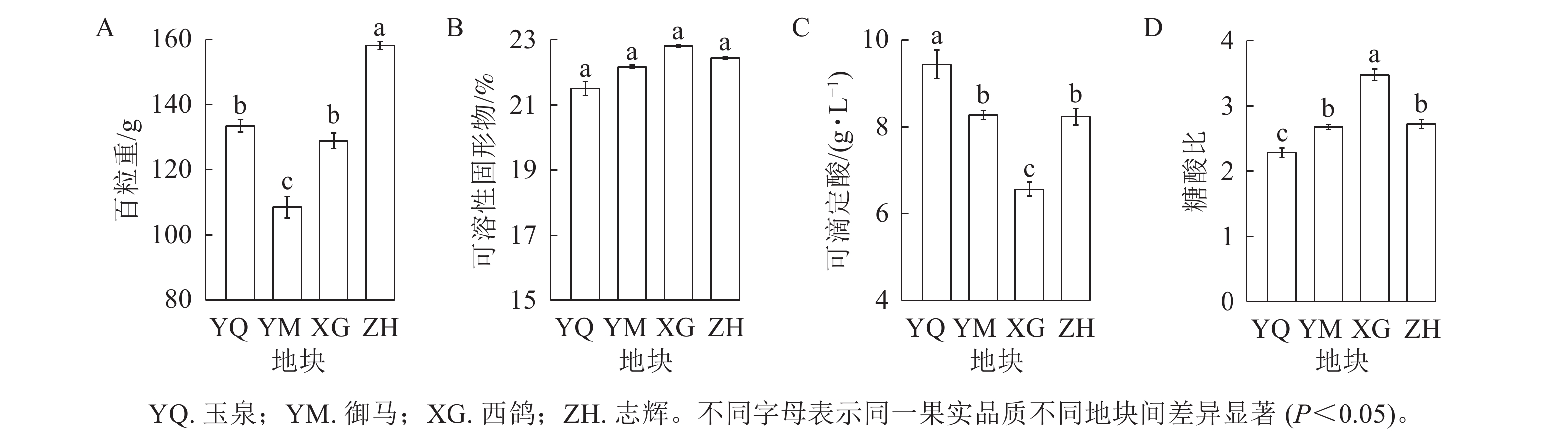
    • 志辉地块葡萄果实百粒重最大(图1A),为158.15 g,分别比玉泉、御马、西鸽高18.43%、45.82%、29.22%。西鸽地块可溶性固形物体积分数较高,为22.84%,玉泉最低,为21.52%,4个地块之间无显著差异(图1B)。玉泉与西鸽可滴定酸(图1C)、糖酸比(图1D)差异显著(P<0.05),玉泉可滴定酸较西鸽高43.75%,西鸽糖酸比较玉泉高52.49%。
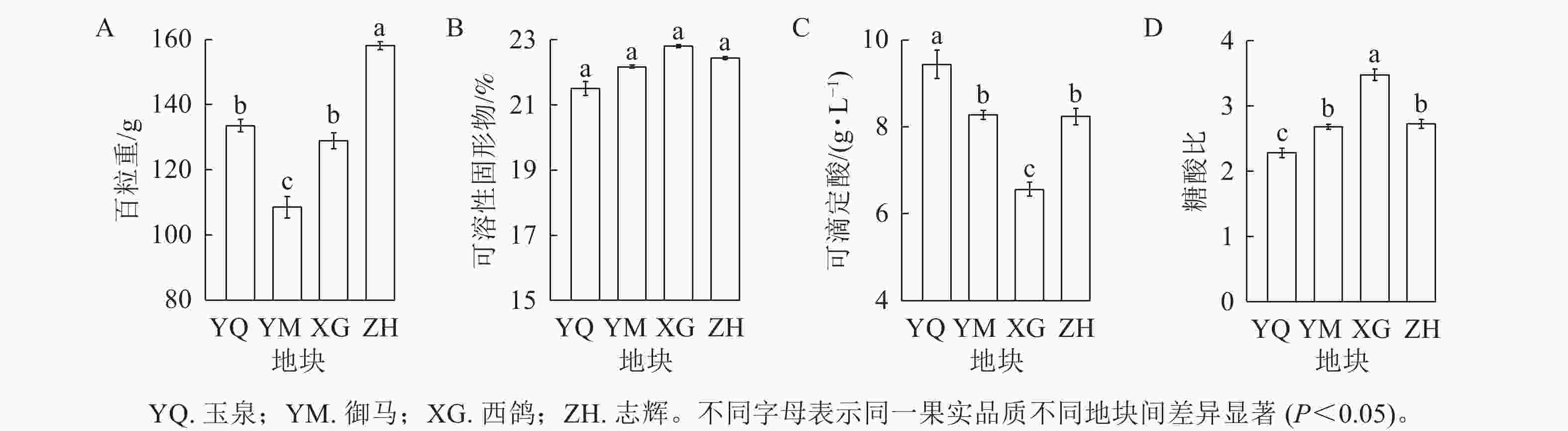
      Figure 1.  Basic physicochemical indicators of ‘Chardonnay’ grape berry at harvest in different vineyards

    • 表2可见:4个地块‘霞多丽’葡萄中均检测出17种氨基酸,总量为3 873.65~6 876.62 mg·L−1,其中志辉最高,较玉泉高77.52%;御马、西鸽居中,较玉泉分别高62.86%、59.90%,较志辉分别低9.01%、11.02%。丙氨酸质量浓度最高且变化幅度最大;御马甘氨酸质量浓度最高,较西鸽、志辉和玉泉分别高150.96%、23.50%、47.88%;玉泉脯氨酸质量浓度最低,较西鸽、御马、志辉分别低13.09%、20.17%、44.41%。

      氨基酸 不同地块氨基酸质量浓度/(mg·L−1)
      玉泉 御马 西鸽 志辉
      胱氨酸(Cys) 3.23±0.13 c 5.34±0.17 a 4.94±0.20 ab 4.47±0.50 b
      丝氨酸(Ser) 382.16±2.14 b 490.37±1.16 a 428.26±36.84 b 393.93±27.94 b
      甘氨酸(Gly) 22.18±0.86 d 32.80±1.44 a 13.07±1.39 b 26.56±1.74 c
      苯丙氨酸(Phe) 75.38±0.41 b 74.93±1.78 b 76.46±4.15 b 111.56±6.67 a
      酪氨酸(Tyr) 38.04±3.18 b 88.84±13.20 a 82.90±9.92 a 72.81±9.61 a
      天冬氨酸(Asp) 204.00±2.37 a 142.00±19.00 b 152.00±6.41 b 129.00±6.57 b
      异亮氨酸(Ile) 42.32±2.93 b 47.17±1.66 b 48.73±3.32 b 60.35±5.34 a
      赖氨酸(Lys) 47.08±1.07 a 33.62±1.22 b 33.79±1.26 b 35.15±0.22 b
      苏氨酸(Thr) 633.75±43.75 a 202.54±23.86 b 215.74±4.56 b 230.22±5.09 b
      甲硫氨酸(Met) 13.09±0.94 b 15.62±3.82 a 13.20±1.40 b 15.19±1.60 a
      精氨酸(Arg) 383.05±31.63 b 1 109.20±117.73 a 1 056.90±121.30 a 1 256.60±74.25 a
      谷氨酸(Glu) 336.98±3.13 b 291.66±24.70 b 390.45±21.72 a 316.74±22.05 b
      组氨酸(His) 556.10±6.12 c 506.41±62.06 c 1 003.00±42.08 a 673.08±46.95 b
      脯氨酸(Pro) 37.04±0.44 d 44.51±0.28 b 41.89±0.58 c 53.49±1.47 a
      缬氨酸(Val) 103.60±0.59 b 98.41±5.63 b 110.76±7.75 b 147.32±11.65 a
      亮氨酸(Leu) 26.42±0.66 c 29.34±1.24 bc 30.48±1.29 b 43.54±2.02 a
      丙氨酸(Ala) 969.23±84.64 c 3 095.70±80.30 a 2 491.60±346.67 b 3 306.60±198.66 a
      总计 3 873.65±80.72 a 6 308.47±250.76 b 6 194.16±46.96 b 6 876.62±30.58 c
        说明:不同字母表示同一氨基酸不同地块间差异显著 (P<0.05)。

      Table 2.  Content of 17 amino acids in ‘Chardonnay’ berry in different plots

    • 表3可见:4个地块葡萄酒残糖、挥发酸均符合GB/T 15037—2006《葡萄酒》干白标准。御马、西鸽葡萄酒酒精度最高,分别为10.63%和10.47%,显著高于玉泉和志辉(P<0.05)。志辉可滴定酸最高,为7.53 g·L−1,较御马、西鸽、玉泉分别高12.72%、13.06%、46.78%。

      地块 残糖/(g·L−1) 酒精度/% 可滴定酸/(g·L−1) 挥发酸/(g·L−1)
      玉泉 1.78±0.18 a 8.57±0.33 c 5.13±0.23 c 0.47±0.008 a
      御马 2.30±0.34 a 10.63±0.51 a 6.68±0.24 b 0.26±0.042 b
      西鸽 2.06±0.16 a 10.47±0.52 a 6.66±0.05 b 0.30±0.032 b
      志辉 2.39±0.23 a 9.23±0.63 b 7.53±0.19 a 0.35±0.067 b
        说明:不同字母表示同一指标不同地块间差异显著 (P<0.05)。

      Table 3.  Basic physicochemical indicators of ‘Chardonnay’ wine in different plots

    • 表4可见:4个地块葡萄酒挥发性香气物质种类相近,共检测出57种,包括C6醇类1种、高级醇类6种、脂肪酸乙酯类15种、乙酸酯类2种、其他酯类8种、萜烯类2种、醛酮类8种、脂肪酸类11种、其他类4种。其中37种香气物质质量浓度差异显著(P<0.05),十四酸乙酯、棕榈酸乙酯、棕榈酸、肉豆蔻酸和2,5-二叔丁基酚在4个地块间差异显著(P<0.05)。二乙二醇二乙酸酯、邻苯二甲酸二异丁酯、反式-橙花叔醇仅存在于志辉葡萄酒中。玉泉十四酸乙酯质量浓度最高,较西鸽、御马、志辉分别高58.89%、93.93%、2195.43%;2,5-二叔丁基酚质量浓度最低,较志辉、西鸽、御马分别低37.32%、81.31%和83.16%。


      分类
      香气物质 不同地块葡萄酒香气物质质量浓度/(µg·L−1)
      玉泉 御马 西鸽 志辉
      C6醇类
      C6-alcohols
      正己醇
      n-hexanol
      1 365.12±127.51 a 773.43±112.62 b 770.49±13.66 b 158.55±0.78 c
      高级醇类
      higher alcohols
      鲸蜡醇
      cetyl alcohol
      925.69±9.57 a 862.66±5.47 b ND 86.96±2.40 c
      3-丁烯二醇
      3-butenediol
      7 305.02±177.13 a 6 754.66±387.74 a ND 5 888.63±297.83 b
      5-十二烷醇
      5-dodecanol
      849.53±268.82 a 833.09±229.96 a ND 170.72±11.39 b
      异戊醇
      isopentanol
      67 651.73±6 792.64 c 85 388.09±720.55 c 237 743.66±14 376.85 a 111 508.16±11 219.45 b
      苯乙醇
      phenethyl alcohol
      73 491.50±4 895.14 a 35 308.36±1 865.92 b 36 362.91±104.14 b 7 550.53±466.96 c
      异丁醇
      isobutyl alcohol
      18 158.39±127.50 a 14 866.24±943.42 a 32 650.00±19 898.02 a 11 118.89±8 538.24 a
      酯类-脂肪酸乙酯
      esters-fatty acid
      ethyl esters
      正己酸乙酯
      ethyl hexanoate
      ND 849.69±71.38 a ND 713.61±204.60 a
      辛酸乙酯
      ethyl octanoate
      ND 19 395.37±13 892.03 a 7 641.74±62.88 a 3 395.78±1 548.68 a
      癸酸乙酯
      ethyl decanoate
      8 567.73±4.72 b 16 190.81±3 173.86 a 7 978.28±655.29 b 3 488.91±1 221.37 c
      月桂酸乙酯
      ethyl laurate
      ND ND ND 1 067.36±446.99
      琥珀酸乙酯
      ethyl succinate
      ND 2 335.67±89.18 a 4 039.50±6.70 a 4 538.05±1 505.90 a
      十四酸乙酯
      ethyl tetradecanoate
      4 620.70±219.27 a 2 382.70±18.12 c 2 908.18±16.55 b 201.30±55.31 d
      棕榈酸乙酯
      ethyl palmitate
      14 502.81±7.48 a 4 690.58±103.77 b 1 456.76±196.27 c 693.28±152.69 d
      亚油酸乙酯
      ethyl linoleate
      ND 3 450.27±45.91 a 2 617.03±90.62 a 3 798.95±507.89 a
      反式-肉桂酸乙酯
      ethyl trans-cinnamate
      984.33±7.65 ND ND ND
      乳酸乙酯
      ethyl lactate
      2 914.29±652.12 a 1 318.03±221.13 b 788.72±146.54 bc 159.64±14.57 c
      十三酸乙酯
      ethyl tridecanoate
      ND 53 479.00±41 818.33 a 23 658.25±3 328.17 a ND
      肉桂酸乙酯
      ethyl cinnamate
      ND 1 240.47±9.52 a 446.97±26.48 b ND
      邻苯二甲酸二乙酯
      diethyl phthalate
      67 008.84±6 023.37 a 39 122.74±7 104.50 b 7 657.22±1 278.17 c 7 694.83±1 317.32 c
      反油酸乙酯
      ethyl trans-oleate
      10 665.67±341.12 a 12 333.96±7 629.48 a 12 638.43±494.63 a 1 680.52±1 578.52 b
      十一酸乙酯
      ethyl undecanoate
      2 235.45±26.71 a ND ND 3 232.67±801.90 a
      酯类-乙酸酯
      ethyl acetate
      乙酸苯乙酯
      phenethyl acetate
      6 987.00±1 052.42 a 5 902.43±2 194.35 a 8133.66±272.24 a 1 296.31±668.19 b
      二乙二醇二乙酸酯
      diethylene glycol diacetate
      ND ND ND 2 321.69±1 265.71
      其他酯类
      other esters
      乙酸异戊酯
      isoamyl acetate
      3 716.37±149.96 a 2 262.06±741.85 b 2 249.03±115.44 b 2 129.83±515.96 b
      癸酸异戊酯
      isopentyl decanoate
      ND 3 482.61±2 893.20 a 2 081.19±1 382.78 a 259.43±29.32 a
      邻苯二甲酸二甲酯
      dimethyl phthalate
      65 241.87±6 034.52 a 37 685.92±7 253.61 b 7 643.73±1 320.54 c 8 043.62±1 523.11 c
      乙基9-癸烯酸酯
      ethyl 9-decenoate
      3 390.47±1 019.50 b 30 375.67±19 329.30 a 11 010.59±1 651.63 b 4 596.86±397.15 b
      月桂酸异戊酯
      isopentyl laurate
      ND 2 645.98±78.69 a 1 683.01±942.06 a ND
      邻苯二甲酸二丁酯
      dibutyl phthalate
      6 052.05±246.06 a 3 947.72±1 535.43 b 4 006.80±768.02 b 829.80±181.27 c
      4-羟基丁酸乙酰酯
      acetyl 4-hydroxybutyrate
      2 286.60±77.86 a ND ND 188.38±27.08 b
      邻苯二甲酸二异丁酯
      diisobutyl phthalate
      ND ND ND 210.62±99.52
      萜烯
      terpenes
      顺式,反式-金合欢醇
      cis,trans-acacodyl alcohol
      459.76±19.46 ND ND ND
      反式-橙花叔醇
      trans-nerolidol
      ND ND ND 230.60±22.71
      醛酮类
      aldehydes and ketones
      苯乙醛
      phenylacetaldehyde
      4 244.49±156.94 a ND ND 131.31±27.12 b
      5-羟甲基糖醛
      5-hydroxymethylglyceraldehyde
      3 582.81±3.85 a ND ND 1 264.46±102.78 b
      糠醛
      furfural
      ND ND ND 954.01±106.08
      2-甲基-4-甲壬酮
      2-methyl-4-methylnonanone
      878.38±57.39 a ND ND 316.90±51.13 b
      1-戊烯-3-酮
      ethyl vinyl ketone
      ND 1 155.60±157.79 a 736.63±130.77 b ND
      3-羟基-2-丁酮
      3-hydroxy-2-butanone
      10 110.69±390.08 a ND ND 404.18±76.62 b
      2(5h)-呋喃酮
      2(5h)-furanone
      2 580.11±286.21 a ND ND 479.68±20.02 b
      2-吡咯烷酮
      2-pyrrolidone
      976.11±59.04 ND ND ND
      脂肪酸
      fatty acids
      辛酸
      octanoic acid
      8 516.19±388.31 a 6 191.71±5 300.76 a 8 471.96±291.86 a 962.55±259.98 b
      正癸酸
      decanoic acid
      4 015.64±242.98 a ND ND 610.23±44.42 b
      月桂酸
      lauric acid
      1 932.98±293.18 a 1 268.05±226.11 b 1 569.32±228.88 ab 374.85±236.25 c
      己酸
      hexanoic acid
      1 325.65±111.82 a 1 849.35±551.47 a 1 298.22±793.79 a 200.86±32.67 b
      9-癸烯酸
      9-decenoic acid
      883.80±30.15 b ND ND 1 039.90±8.48 a
      氰乙酸
      cyanoacetic acid
      ND 1 266.33±18.35 a 9 287.16±7 969.69 a ND
      棕榈酸
      palmitic acid
      3 904.55±58.02 c 6 840.62±79.54 b 7 443.61±100.89 a 1 494.13±239.14 d
      甲酸
      formic acid
      5 436.64±178.02 a ND ND 194.94±8.53 b
      硬脂酸
      stearic acid
      2 318.63±58.14 a ND ND 854.48±15.98 b
      肉豆蔻酸
      myristic acid
      3 806.42±40.10 a 1 166.18±28.07 d 1 338.41±23.41 c 2 210.63±35.86 b
      其他类
      others
      2,5-二甲酰基呋喃
      diformylfuran
      1 443.87±96.54 a ND ND 151.74±15.87 b
      2,5-二叔丁基酚
      2,5-di-tert-butylphenol
      200.97±19.52 d 1 193.42±62.82 a 1 075.45±41.35 b 320.65±5.20 c
      苯酚
      phenol
      596.72±33.35 ND ND ND
      2,4-二叔丁酚
      2,4-di-t-butylphenol
      ND ND ND 85.33±4.03
        说明:ND表示未检测出。不同字母表示同一香气物质不同地块间差异显著 (P<0.05)。

      Table 4.  Aromatic substance content of ‘Chardonnay’ wines

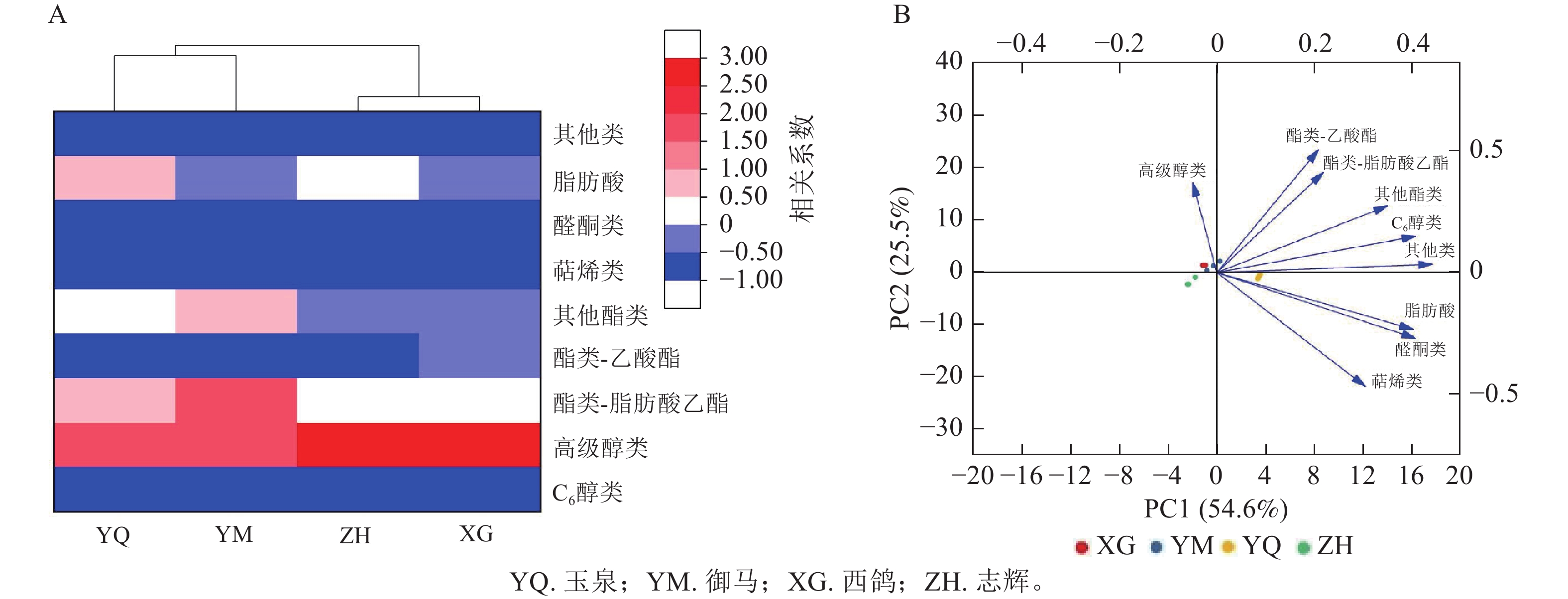
      聚类分析(图2A)显示:4个地块均以高级醇类香气物质为主,除志辉外,其余3个地块香气物质随着地理位置由南向北逐渐上升。主成分分析(图2B)表明:贡献率主成分1 (PC1)为54.6%,主成分2 (PC2)为25.5%,累计解释总变异为80.1%,区分度良好。玉泉葡萄酒样聚于第4象限,志辉位于第3象限,御马与西鸽相近分布于第1、2象限。特征物质方面,西鸽与御马在PC2上以除萜烯类等外的其他香气物质为主;玉泉在PC1上以除高级醇类外的其他物质及PC2中的萜烯类等为主;志辉特征物质为PC1的高级醇类及PC2的萜烯类等,各酒样差异较小。
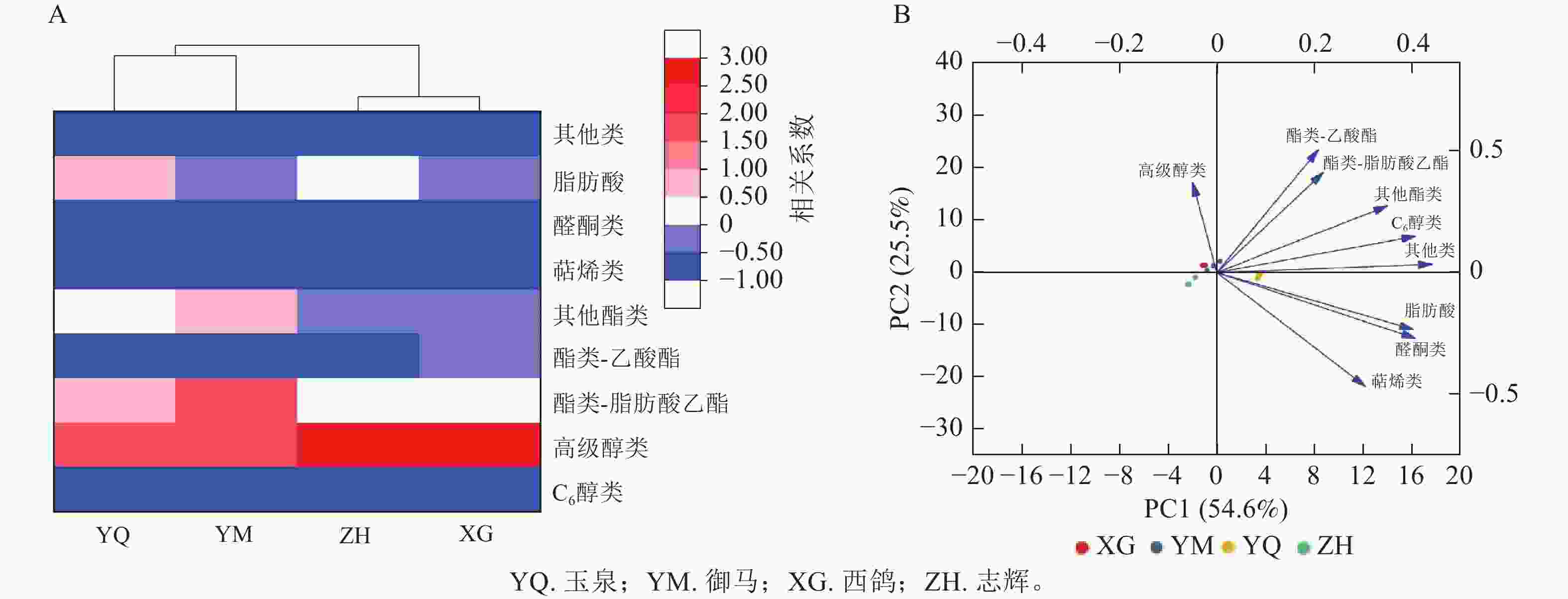
      Figure 2.  Cluster heat map (A) and principal component analysis (B) of aroma substance kinds of ‘Chardonnay’ wine samples

      表5可见:葡萄酒香气物质总质量浓度玉泉为494.47 mg·L−1,御马为410.25 mg·L−1,西鸽为455.53 mg·L−1,志辉为230.35 mg·L−1,均以高级醇类、脂肪酸乙酯类、其他酯类、脂肪酸类为主要香气物质,占比相差较大,高级醇类占比为34.03%~59.88%,脂肪酸乙酯类占比为15.78%~33.92%,其他酯类占比为7.07%~18.70%,脂肪酸类占比为4.05%~20.01%,其他物质占比约4.88%。不同地块醛酮类质量浓度差异显著(P<0.05),玉泉最高,较志辉、御马、西鸽分别高5.30、18.28、29.23倍。

      香气类别 不同地块葡萄酒香气物质质量浓度/(mg·L−1) 占比/%
      玉泉 御马 西鸽 志辉 玉泉 御马 西鸽 志辉
      C6醇类 1.37±0.13 a 0.77±0.11 b 0.77±0.01 b 0.16±0.00 c 0.28±0.04 a 0.20±0.06 b 0.17±0.01 b 0.07±0.01 c
      高级醇类
      酯类-脂肪酸乙酯
      168.38±12.00 b 144.01±0.81 c 306.76±5.63 a 136.32±15.01 c 34.03±0.72 b 35.92±6.93 b 67.34±0.02 a 59.88±6.67 a
      111.50±5.89 ab 156.79±52.50 a 71.83±3.71 bc 40.63±29.79 c 22.55±0.06 b 33.92±3.74 a 15.78±1.11 b 16.57±8.98 b
      酯类-乙酸酯 6.99±1.05 a 5.90±2.19 ab 8.13±0.27 a 2.62±2.66 b 1.41±0.14 a 1.25±0.17 a 1.79±0.03 a 1.03±0.87 a
      其他酯类
      萜烯类
      82.45±7.52 a 81.84±17.47 a 36.82±0.99 b 15.91±1.37 c 16.65±0.69 a 18.70±1.73 a 8.09±0.37 b 7.07±1.48 b
      0.46±0.02 a ND ND 0.23±0.02 b 0.09±0.01 a ND ND 0.10±0.02 a
      醛酮类 22.37±0.26 a 1.16±0.16 c 0.74±0.13 d 3.55±0.14 b 4.53±0.17 a 0.27±0.03 c 0.16± 0.03 c 1.57±0.26 b
      脂肪酸 98.70±1.95 a 18.58±5.95 c 29.41±7.36 b 30.37±1.08 b 20.01±1.40 a 4.05±0.42 c 6.44±1.50 c 13.46±2.19 b
      其他类 2.24±0.11 a 1.19±0.06 b 1.08±0.04 b 0.56±0.01 c 0.45±0.00 a 0.30±0.07 b 0.24±0.00 b 0.25±0.05 b
        说明:ND表示未检测出。不同字母表示同一香气物质不同地块间差异显著 (P<0.05)。

      Table 5.  Content and proportion of volatile substances in the wines of the 4 plots

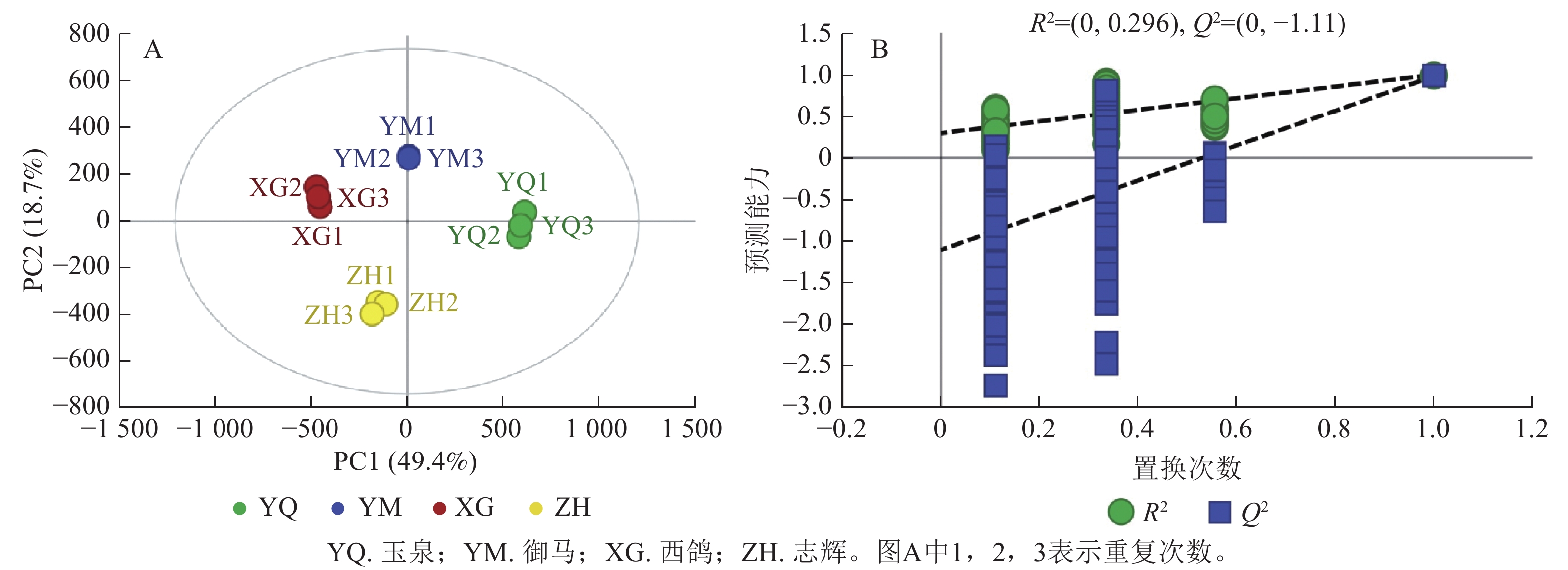
    • 图3可见:解释变量(R2x)和预测能力(R2y)分别为0.931和0.992,分类良好;预测能力核心指标(Q2)为0.957,预测能力强。主成分得分(图3A)可知:4个地块葡萄酒样明显分为4类,PC1与PC2累计贡献率为68.1%。玉泉聚于PC1正向端,志辉、西鸽位于PC1负向端;御马、西鸽位于PC2正向端,志辉位于PC2负向端,可有效区分。置换图(图3B)显示:模型无过拟合,区分能力强,可有效识别4个地块葡萄酒挥发性成分差异。
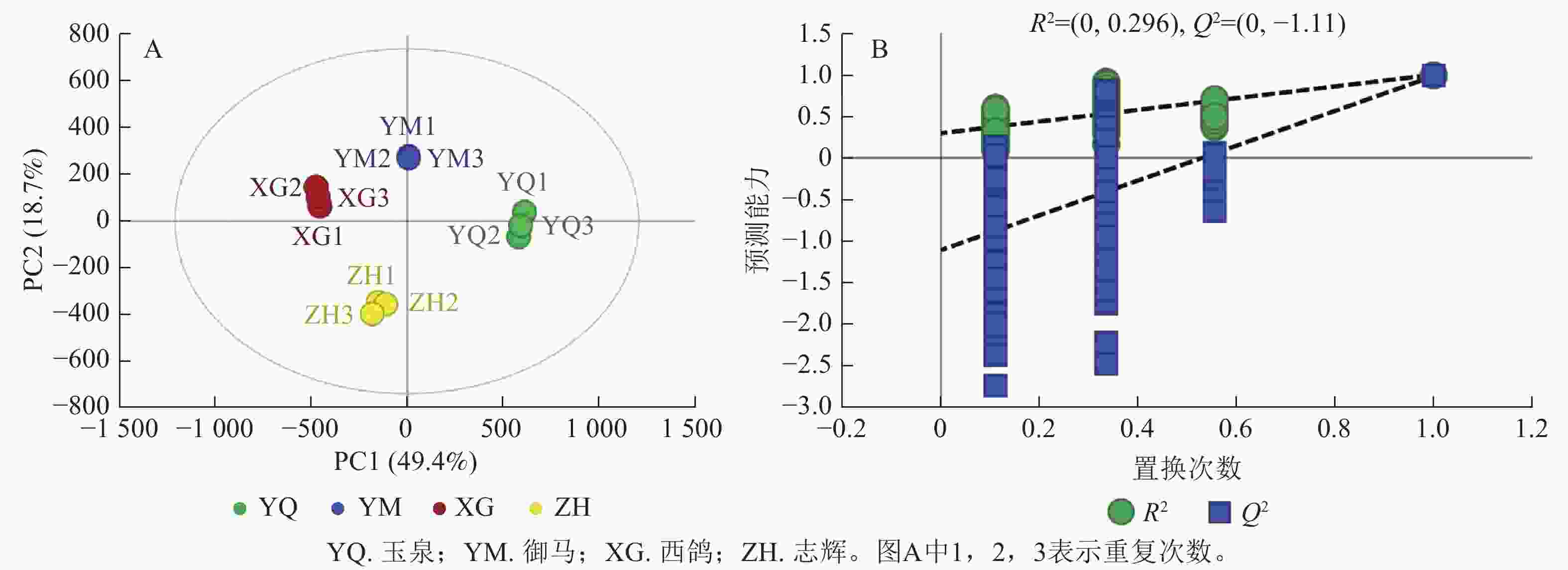
      Figure 3.  Score chart (A) and permutation plot (B) of Orthogonal Partial Least Squares Discriminant Analysis of aroma components in different plots

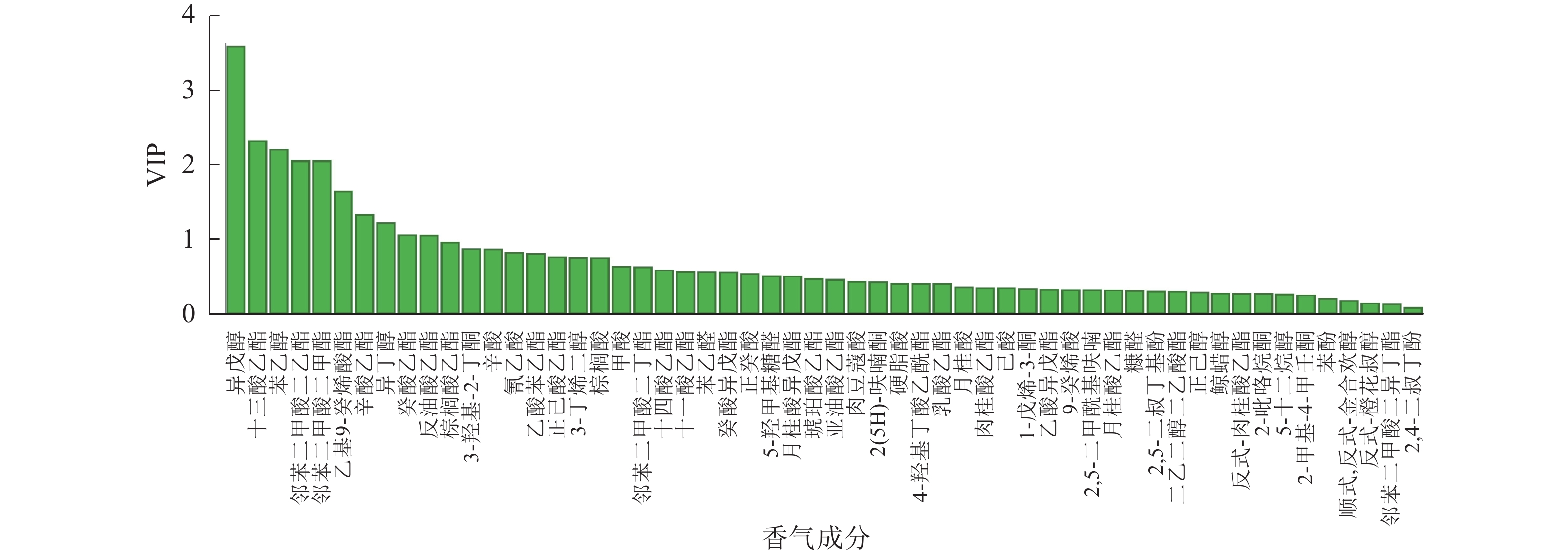
      从变量投影重要性(VIP)分布(图4)可知:8种VIP>1的香气物质为地块区分关键,其中异戊醇(VIP=3.59)、十三酸乙酯(VIP=2.33)、乙基9-癸烯酸酯(VIP=1.65)、辛酸乙酯(VIP=1.35)、异丁醇(VIP=1.23)为御马、西鸽的主要特征物质;苯乙醇(VIP=2.21)、邻苯二甲酸二乙酯(VIP=2.06)、邻苯二甲酸二甲酯(VIP=2.05)为玉泉的主要特征物质。这8种物质可作为4个地块之间香气物质相互区分的主要标志物。
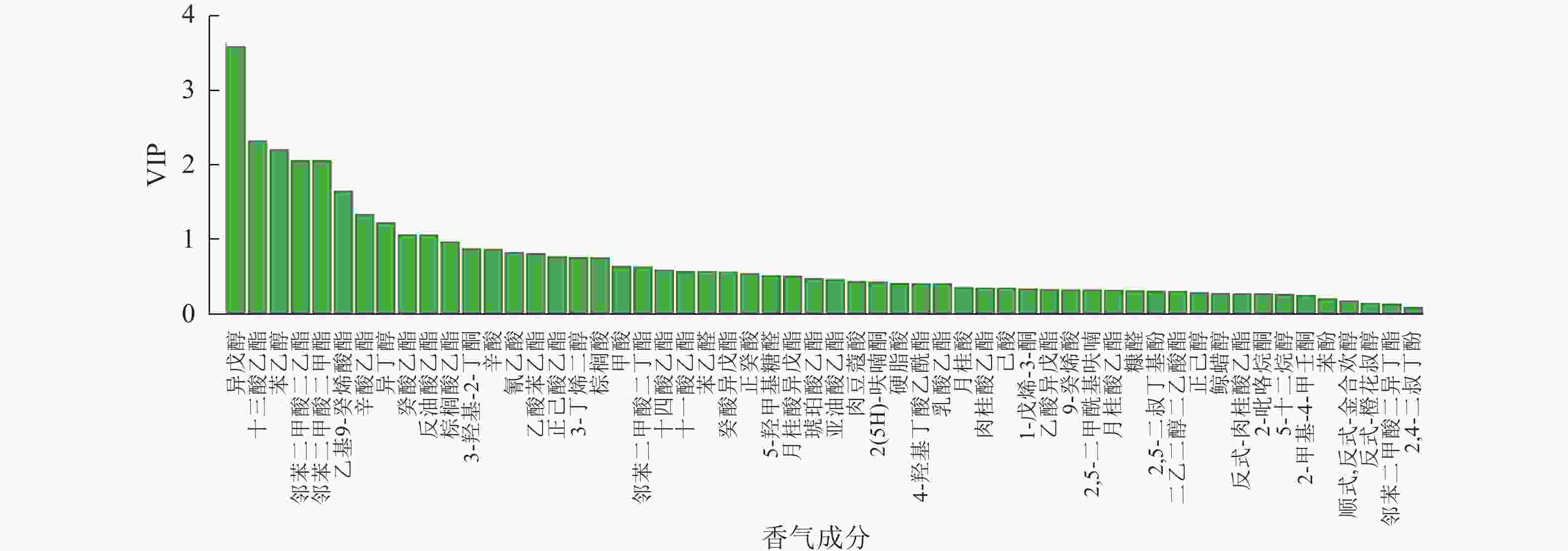
      Figure 4.  VIP figure of Orthogonal Partial Least Squares Discriminant Analysis of aroma components in different plots

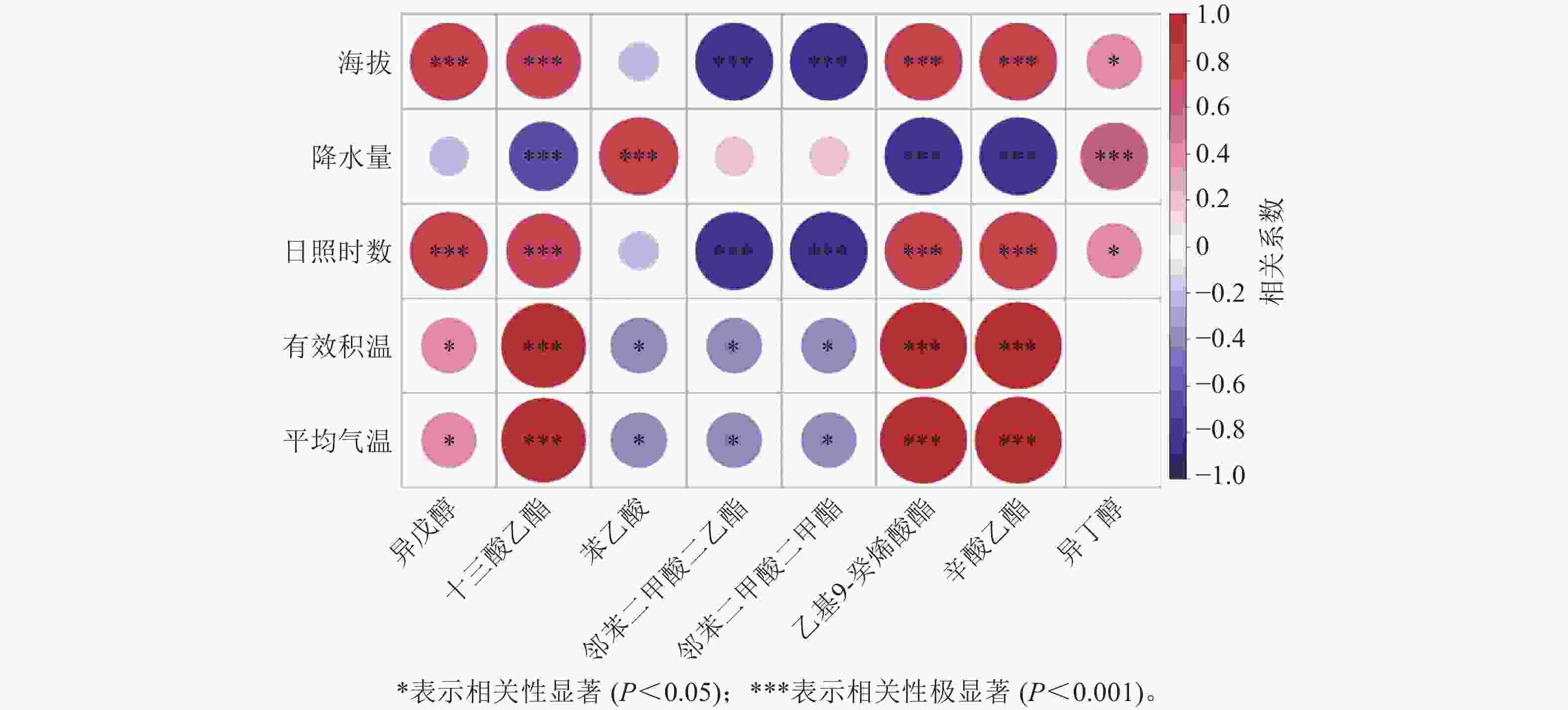
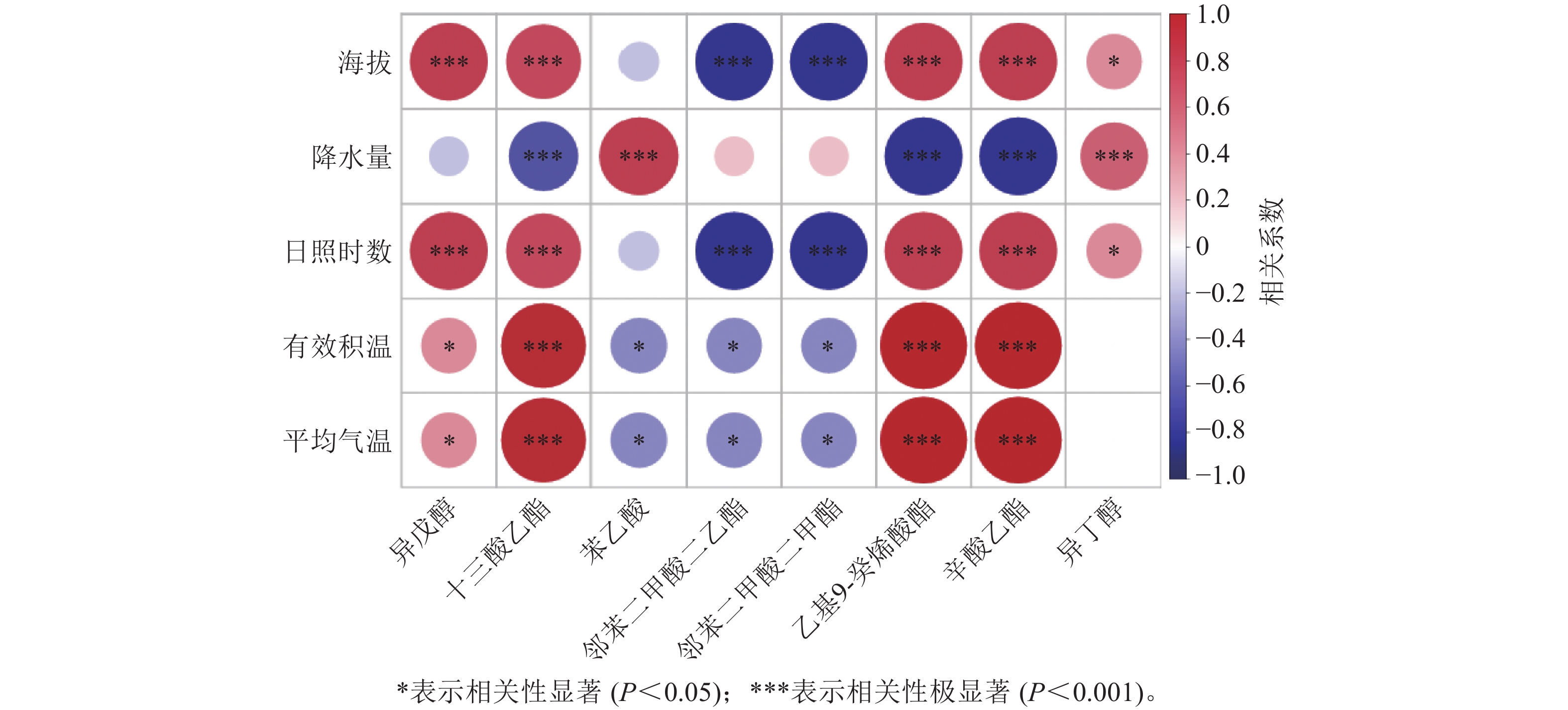
    • 将海拔、降水、日照时数、有效积温、平均气温与8种VIP>1的香气物质进行皮尔逊相关性分析(图5)显示:环境因子与香气物质存在相关性。十三酸乙酯、乙基9-癸烯酸酯、辛酸乙酯与环境因子相关显著(P<0.05),除降水外与其他环境因子呈显著正相关;邻苯二甲酸二甲酯、邻苯二甲酸二乙酯与降水正相关,与其他环境因子负相关。

      Figure 5.  Correlation analysis between environmental factors and aroma substances in wines from different ecological zones

    • 本研究结果显示:不同生态区葡萄果实氨基酸总量志辉最高、玉泉最低,这种差异与气候条件密切相关。玉泉灌水、降水量显著高于其他3个地块,同时日照时数又相对较低,这些因素共同导致了葡萄果实氨基酸质量浓度的差异。日照时数通过影响葡萄叶片光合作用直接调控果实氨基酸的合成与积累[17],当日照时数不足时,葡萄植株光合作用减弱,无法为果实氨基酸的合成提供充足的物质基础和能量;同时水分过多会改变葡萄植株的生理状态,影响其养分吸收和分配,进而干扰氨基酸的合成与积累[18]。于惠春等[19]发现白色酿酒葡萄主要氨基酸为脯氨酸、精氨酸、丝氨酸、苏氨酸和谷氨酸。甘氨酸和脯氨酸对葡萄酒风味影响最大[20],本研究则以谷氨酸、丙氨酸、精氨酸、天冬氨酸为主要氨基酸,这与于惠春等[19]的研究结果相似。付涛等[21]研究表明:‘鄞红’V. vinifera‘Yinhong’葡萄氨基酸总量为1 350~4 860 mg·kg−1,与本研究差异较大,推测不同品种的葡萄在生长发育过程中,其基因表达和代谢途径存在差异,从而导致果实中氨基酸质量浓度和组成不同。综上,葡萄果实氨基酸成分受环境和品种特性的共同影响。

      3个产区葡萄酒仅滴定酸与酒精度差异显著,表明这2个指标对产区差异敏感性较高[22]。葡萄酒酒精含量与葡萄果实含糖量正相关,而含糖量随成熟度逐渐积累[23]。同一生态区不同地块(御马、西鸽)葡萄酒理化指标无显著差异,而不同产区(玉泉、志辉)差异显著(P<0.05),说明“风土”对葡萄酒品质具有基础性作用[24]。葡萄果实氨基酸对葡萄酒香气形成贡献显著,发酵阶段谷氨酸消耗高[25],本研究中谷氨酸对葡萄酒香气贡献度较高,为葡萄酒香气的形成提供了丰富的前体物质。侯阳阳等[26]研究发现:在葡萄醪中添加苯丙氨酸、甘氨酸、丙氨酸、缬氨酸、亮氨酸和蛋氨酸等氨基酸,能够显著提升葡萄酒中的高级醇含量,进而增强葡萄酒香气的复杂性,这与本研究结果一致,即4个地块葡萄果实中丙氨酸质量浓度均最高,且葡萄酒中高级醇类香气物质占比最高,这进一步说明丙氨酸与葡萄酒中高级醇含量密切相关。

      葡萄酒的香气是其品质的重要体现,目前已鉴定出近1 000种挥发性化合物,主要分为高级醇、酯类等8类[27]。本研究鉴定出57种香气物质,与左俊伟等[28]的研究结果相近,表明生态条件对香气物质种类的影响有限。在一定范围内,不同生态区的葡萄酒在香气物质种类上具有一定的共性,这可能与葡萄品种的遗传特性以及酿酒工艺的相对稳定性有关[29]。在本研究中,4个地块葡萄酒以高级醇类(占比为49.3%)、脂肪酸乙酯类(占比为22.2%)、其他酯类(占比为12.6%)和脂肪酸类(占比为11.0%)为主,总占比超过95%,这与陶永胜等[30]对‘霞多丽’葡萄酒香气成分的研究结果相符。本研究筛选出了异戊醇、十三酸乙酯、乙基9-癸烯酸酯、辛酸乙酯、异丁醇、苯乙醇、邻苯二甲酸二乙酯和邻苯二甲酸二甲酯这8种关键特征物质,这与李华等[31]的研究结果较为一致,说明酯类香气贡献率明显高于醇类和酸类。这一结果进一步证实了酯类物质在葡萄酒香气形成中的主导作用,可能因为酯类化合物具有较低的嗅觉阈值,能够在较低浓度下显著影响葡萄酒的香气特征。主成分分析可有效区分3个生态区‘霞多丽’葡萄酒特征,但难以识别同一生态区不同地块差异,这与孙丽君[32]发现的产区之间区分不理想的结果有所不同,推测葡萄酒的香气特征受品种的影响较大,不同纬度和地理气候特征的综合影响使得不同品种葡萄酒之间表现出较好的区分度,而不同产区之间的香气特征差异则相对较小。这一结果表明:在葡萄酒香气特征的形成过程中,品种特性可能起到了更为基础和关键的作用,而产区环境则在一定程度上对香气特征进行影响。除志辉外,其余3个地块香气物质质量浓度随着地理位置由南向北递增。这与李媛媛等[33]的研究结果较为相似。由于志辉地块距贺兰山较近,受海拔、光照、辐射和气温等各方面的综合影响,该地块在纬度上的变化不明显;同时,有研究发现:大马士酮是贺兰山东麓‘赤霞珠’V. vinifera ‘Cabernet Sauvignon’葡萄酒花香和果香特性的主要贡献物质[33],而本研究未检测到大马士酮,其差异主要源于不同酿酒葡萄品种所赋予的特殊风味物质。这一发现进一步强调了葡萄品种在葡萄酒香气形成中的决定性作用,不同品种的葡萄由于其独特的代谢途径和风味前体物质,最终导致了葡萄酒香气特征的显著差异。

    • 3个产区4个地块葡萄果实丙氨酸质量浓度均最高,且对‘霞多丽’葡萄酒高级醇类香气物质贡献显著。永宁产区葡萄酒主要风味物质为苯乙醇、邻苯二甲酸二乙酯、邻苯二甲酸二甲酯;青铜峡产区葡萄酒主要风味物质为异戊醇、十三酸乙酯、乙基9-癸烯酸酯、辛酸乙酯、异丁醇;银川产区葡萄酒的主要特征物质为二乙二醇二乙酸酯、邻苯二甲酸二异丁酯、反式-橙花叔醇。

Reference (33)

Catalog

    /

    DownLoad:  Full-Size Img  PowerPoint
    Return
    Return