Turn off MathJax
Article Contents

MA Wanlu, XIA Hui, LI Zhaoyang, et al. Genome-wide identification and expression analysis of the OfHSP20 gene family in Osmanthus fragrans[J]. Journal of Zhejiang A&F University, 2026, 43(X): 1−14 doi:  10.11833/j.issn.2095-0756.20260291
Citation: MA Wanlu, XIA Hui, LI Zhaoyang, et al. Genome-wide identification and expression analysis of the OfHSP20 gene family in Osmanthus fragrans[J]. Journal of Zhejiang A&F University, 2026, 43(X): 1−14 doi:  10.11833/j.issn.2095-0756.20260291

OnlineFirst articles are published online before they appear in a regular issue of the journal. Please find and download the full texts via CNKI.

Genome-wide identification and expression analysis of the OfHSP20 gene family in Osmanthus fragrans

DOI: 10.11833/j.issn.2095-0756.20260291
  • Received Date: 2026-05-23
  • Accepted Date: 2026-10-12
  • Rev Recd Date: 2026-10-10
  • Available Online: 2026-11-03
  •   Objective  This study aims to investigate the molecular characteristics of the OfHSP20 gene family in Osmanthus fragrans and its potential role in abiotic stress responses, so as to provide a theoretical support for clarifying environmental adaptation mechanisms and molecular breeding.  Method  Based on the whole-genome sequence of O. fragrans ‘Liuyejingui’, members of the OfHSP20 family were systematically identified using bioinformatics approaches. Their physicochemical properties, subcellular localization, gene structures, phylogenetic relationships, cis-acting elements, and collinearity relationships were comprehensively analyzed. In addition, quantitative real-time PCR (RT-qPCR) was employed to examine the expression patterns of this gene family across different tissues, flowering stages, and abiotic stress conditions.   Result  A total of 37 OfHSP20 genes were identified, with their encoded protein molecular weights ranging from 15.258 to 39.932 kDa, most of which were hydrophilic proteins mainly located in the cytoplasm. Phylogenetic analysis revealed that the OfHSP20 family could be divided into 10 subfamilies, which were highly evolutionarily conserved with HSP20 genes from Arabidopsis thaliana. All of them contained the core α-crystallin protein domain, and the exons were mainly 1 to 2 in number. Promoter analysis indicated that OfHSP20 genes were rich in cis-acting elements associated with light, stress, hormones, and growth and development responses. RT-qPCR analysis demonstrated that the expression of OfHSP20 genes reached its peak at the full-bloom stage and exhibited specific expression under abiotic stress. Among them, most genes responded significantly to heat stress, while OfHSP20_3, OfHSP20_5, and OfHSP20_19 were broad-spectrum stress-responsive genes that were significantly upregulated after all four abiotic stress treatments (heat, cold, salt, and drought) (P< 0.05).  Conclusion  This study systematically characterizes the structural characteristics, evolutionary relationships and expression patterns of the OfHSP20 gene family in O. fragrans, revealing its potential role in plant growth, development, and abiotic stress responses. [Ch, 7 fig. 4 tab. 30 ref.]
  • [1] QIU Wenmin, LU Zhuchou, FAN Na, JIANG Tianheng, ZHUO Renying.  Genome-wide identification and expression patterns in response to cadmium stress of SpMTP gene family in Sedum plumbizincicola . Journal of Zhejiang A&F University, doi: 10.11833/j.issn.2095-0756.20260147
    [2] ZHANG Lei, CHEN Hui, ZHANG Zijie, SHANG Xulan, YANG Wanxia, FANG Shengzuo.  Identification of the GATA gene family in Cyclocarya paliurus and expression analysis under salt stress . Journal of Zhejiang A&F University, doi: 10.11833/j.issn.2095-0756.20250263
    [3] LIU Chen, FAN Hongrui, ZHOU Mingbing, ZHOU Xiaohong.  Genome-wide identification and expression profiling of PAL gene family in Carya cathayensis . Journal of Zhejiang A&F University, doi: 10.11833/j.issn.2095-0756.20240587
    [4] WANG Shuwei, ZHOU Mingbing.  Genome-wide identification of the ICE gene family in moso bamboo and its expression pattern under low temperature stress . Journal of Zhejiang A&F University, doi: 10.11833/j.issn.2095-0756.20230445
    [5] YANG Yong, ZHANG Junhong, HAN Xiao, ZHANG Yuting, YANG Qi, TONG Zaikang.  Identification and expression analysis of bZIP gene family under ABA treatment in Phoebe bournei . Journal of Zhejiang A&F University, doi: 10.11833/j.issn.2095-0756.20230342
    [6] LAN Zhixin, HOU Dan, WU Aimin, LIN Xinchun.  Cloning and expression analysis of PeCIGRs gene from Phyllostachys edulis . Journal of Zhejiang A&F University, doi: 10.11833/j.issn.2095-0756.20220761
    [7] ZHUO Juan, HOU Dan, LIN Xinchun.  Cloning and expression analysis of PhebHLH6 gene from Phyllostachys edulis . Journal of Zhejiang A&F University, doi: 10.11833/j.issn.2095-0756.20220553
    [8] ZHOU Junjie, WANG Yiguang, DONG Bin, ZHAO Hongbo.  Cloning and expression characterization of OfPSY, OfPDS and OfHYB gene promoters in Osmanthus fragrans . Journal of Zhejiang A&F University, doi: 10.11833/j.issn.2095-0756.20220110
    [9] HONG Fanglei, LU Yao, YU Shijiao, HU Zhinuo, MIAO Yunfeng, ZHONG Shiwei, ZHAO Hongbo.  Cloning and expression analysis of OfABFs gene in Osmanthus fragrans . Journal of Zhejiang A&F University, doi: 10.11833/j.issn.2095-0756.20220264
    [10] ZHANG Yao, WANG Jiaxuan, CAI Xuan, ZENG Xiangling, YANG Jie, CHEN Hongguo, ZOU Jingjing.  Identification and expression of OfACOs gene family in Osmanthus fragrans . Journal of Zhejiang A&F University, doi: 10.11833/j.issn.2095-0756.20220783
    [11] WANG Qianqing, ZHANG Yuting, ZHANG Junhong, LIU Hui, TONG Zaikang.  Identification of PLR gene family and expression of responsive hormones in Phoebe bournei . Journal of Zhejiang A&F University, doi: 10.11833/j.issn.2095-0756.20220351
    [12] LAI Mengxia, DU Changxia, FAN Huaifu.  Identification and bioinformatics analysis of AQP gene family in Cucumis sativus . Journal of Zhejiang A&F University, doi: 10.11833/j.issn.2095-0756.20210361
    [13] MIAO Yunfeng, ZHOU Dan, DONG Bin, ZHAO Hongbo.  Identification and expression analysis of OfNAC transcription factors in Osmanthus fragrans during flower opening stage . Journal of Zhejiang A&F University, doi: 10.11833/j.issn.2095-0756.20200474
    [14] PANG Tianhong, QIAN Jieyu, FU Jianxin, GU Cuihua, ZHANG Chao.  Sequence and expression analysis of hexokinase gene family members in Osmanthus fragrans . Journal of Zhejiang A&F University, doi: 10.11833/j.issn.2095-0756.20200370
    [15] WU Qi, WU Hongfei, ZHOU Minshu, XU Qianxia, YANG Liyuan, ZHAO Hongbo, DONG Bin.  Cloning and expression analysis of OfFCA gene at flower bud differentiation stages in Osmanthus fragrans . Journal of Zhejiang A&F University, doi: 10.11833/j.issn.2095-0756.2020.02.001
    [16] YU Dihu, ZHANG Chi, KE Fuzhi, JING Luyang, GU Xuejiao, WU Baoyu, ZHANG Min.  Cloning and expression analysis of CHS gene family in Citrus suavissima 'Seedless' . Journal of Zhejiang A&F University, doi: 10.11833/j.issn.2095-0756.2019.05.013
    [17] JIANG Qini, FU Jianxin, ZHANG Chao, DONG Bin, ZHAO Hongbo.  cDNA cloning and expression analysis of OfAP1 in Osmanthus fragrans . Journal of Zhejiang A&F University, doi: 10.11833/j.issn.2095-0756.2019.04.005
    [18] LI Bingbing, LIU Guofeng, WEI Shu, HUANG Longquan, ZHANG Jianyun.  Cloning and expression analysis of the tobacco NtPLR1 gene . Journal of Zhejiang A&F University, doi: 10.11833/j.issn.2095-0756.2017.04.003
    [19] CAI Zhoufei, CHEN Yaqi, XU Xinlu, WANG Xiaodong, WANG Junyu, ZHANG Rumin, GAO Yan.  Changes of volatile organic compounds released during flowering in four Osmanthus fragrans cultivar groups . Journal of Zhejiang A&F University, doi: 10.11833/j.issn.2095-0756.2017.04.006
    [20] FU Jianxin, ZHANG Chao, WANG Yiguang, ZHAO Hongbo.  Reference gene selection for quantitative real-time polymerase chain reaction (qRT-PCR) normalization in the gene expression of sweet osmanthus tissues . Journal of Zhejiang A&F University, doi: 10.11833/j.issn.2095-0756.2016.05.001
  • [1]
    HE Bei, CAI Xuan, ZENG Xiangling, et al. Programmed cell death events during the petal senescence of Osmanthus fragrans ‘Huangchuan Jingui’[J]. Journal of Zhejiang A&F University, 2023, 40(3): 475−480. DOI: 10.11833/j.issn.2095-0756.20220782.
    [2]
    LAN Yangang, ZHANG Kaimei, WANG Linna, et al. The R2R3-MYB transcription factor OfMYB21 positively regulates linalool biosynthesis in Osmanthus fragrans flowers[J]. International Journal of Biological Macromolecules, 2023, 249: 126099. DOI: 10.1016/j.ijbiomac.2023.126099.
    [3]
    MENG Xin, WANG Fang, FU Chaohong, et al. Effect of Osmanthus hydrolat on the aroma quality and volatile components of Osmanthus black tea[J]. Food Chemistry: X, 2024, 23: 101564. DOI: 10.1016/j.fochx.2024.101564.
    [4]
    XI Wan, JIANG Mengyu, ZHU Linlin, et al. OfWRKY33 binds to the promoter of key linalool synthase gene OfTPS7to stimulate linalool synthesis in Osmanthus fragrans flowers[J]. Horticulture Research, 2025, 12(9): uhaf155. DOI: 10.1093/hr/uhaf155.
    [5]
    CHEN Yufen, CHEN Zhizhong. Research progress on the effect of inhalation aromatherapy on anxiety in patients with surgery and physical diseases[J]. China Modern Medicine, 2024, 31(15): 184−188.
    [6]
    WU Yaoxing, ZHANG Mei, YANG Yong, et al. Effects of climate changes on the distribution of Osmanthus fragrans[J]. Journal of Northwest Forestry University, 2022, 37(4): 129−134. DOI: 10.3969/j.issn.1001-7461.2022.04.17.
    [7]
    YURINA N P. The role of heat shock proteins in plant protection from oxidative stress[J]. Молекулярная биология, 2023, 57(6): 949−964. DOI: 10.31857/s0026898423060228.
    [8]
    IYER K, CHAND K, MITRA A, et al. Diversity in heat shock protein families: functional implications in virus infection with a comprehensive insight of their role in the HIV-1 life cycle[J]. Cell Stress and Chaperones, 2021, 26(5): 743−768. DOI: 10.1007/s12192-021-01223-3.
    [9]
    WATERS E R. The evolution, function, structure, and expression of the plant sHSPs[J]. Journal of Experimental Botany, 2013, 64(2): 391−403. DOI: 10.1093/jxb/ers355.
    [10]
    LIAN Xiaodong, WANG Qiuping, LI Tianhao, et al. Phylogenetic and transcriptional analyses of the HSP20 gene family in peach revealed that PpHSP20-32 is involved in plant height and heat tolerance[J]. International Journal of Molecular Sciences, 2022, 23(18): 10849. DOI: 10.3390/ijms231810849.
    [11]
    YAO Fuwen, SONG Chunhui, WANG Hongtao, et al. Genome-wide characterization of the HSP20 gene family identifies potential members involved in temperature stress response in apple[J]. Frontiers in Genetics, 2020, 11: 609184. DOI: 10.3389/fgene.2020.609184.
    [12]
    WANG Yuansong, YANG Kangmin, ZHU Wenjiang, et al. Observation on the blooming phenology and the time of harvesting of the flowering of Osmanthus fragrans[J]. Acta Horticulturae Sinica, 1986, 13(4): 271−275.
    [13]
    WANG Y, TANG H, DEBARRY J D, et al. MCScanX: a toolkit for detection and evolutionary analysis of gene synteny and collinearity[J]. Nucleic Acids Research, 2012, 40(7): e49. DOI: 10.1093/nar/gkr1293.
    [14]
    NEI M, GOJOBORI T. Simple methods for estimating the numbers of synonymous and nonsynonymous nucleotide substitutions[J]. Molecular Biology and Evolution, 1986, 3(5): 418−426. DOI: 10.1093/oxfordjournals.molbev.a040410.
    [15]
    LIVAK K J, SCHMITTGEN T D. Analysis of relative gene expression data using real-time quantitative PCR and the 2–ΔΔCT method[J]. Methods, 2001, 25(4): 402−408. DOI: 10.1006/meth.2001.1262.
    [16]
    HOU Zhe, CHEN Liangying, JIANG Zhengzhi, et al. Identification and functional analysis of HSP20 gene family in Rosa chinensis[J]. Journal of Zhejiang Agricultural Sciences, 2025, 66(12): 3026−3035. DOI: 10.16178/j.issn.0528-9017.20240700.
    [17]
    YU Jiahong, CHENG Yuan, FENG Kun, et al. Genome-wide identification and expression profiling of tomato HSP20 gene family in response to biotic and abiotic stresses[J]. Frontiers in Plant Science, 2016, 7: 1215. DOI: 10.3389/fpls.2016.01215.
    [18]
    YAN Hengyu, DU Mingzhe, DING Jieyao, et al. Pan-genome-wide investigation and co-expression network analysis of HSP20 gene family in maize[J]. International Journal of Molecular Sciences, 2024, 25(21): 11550. DOI: 10.3390/ijms252111550.
    [19]
    GUO Liuming, LI Jing, HE Jing, et al. A class I cytosolic HSP20 of rice enhances heat and salt tolerance in different organisms[J]. Scientific Reports, 2020, 10: 1383. DOI: 10.1038/s41598-020-58395-8.
    [20]
    HUANG Junjun, HAI Zhaoxin, WANG Ruoyi, et al. Genome-wide analysis of HSP20 gene family and expression patterns under heat stress in cucumber (Cucumis sativus L.)[J]. Frontiers in Plant Science, 2022, 13: 968418. DOI: 10.3389/fpls.2022.968418.
    [21]
    ZHANG Qinqin, DAI Bowen, FAN Mi, et al. Genome-wide profile analysis of the HSP20 family in lettuce and identification of its response to drought stress[J]. Frontiers in Plant Science, 2024, 15: 1426719. DOI: 10.3389/fpls.2024.1426719.
    [22]
    WANG Xi’ao, ZHENG Yujie, CHEN Birong, et al. Genome-wide identification of small heat shock protein (HSP20) homologs in three cucurbit species and the expression profiles of CsHSP20s under several abiotic stresses[J]. International Journal of Biological Macromolecules, 2021, 190: 827−836. DOI: 10.1016/j.ijbiomac.2021.08.222.
    [23]
    REN Xinying, VORST O, FIERS M W E J, et al. In plants, highly expressed genes are the least compact[J]. Trends in Genetics, 2006, 22(10): 528−532. DOI: 10.1016/j.tig.2006.08.008.
    [24]
    SHEN Jieyu, SU Tianhan, YU Daqi, et al. Evolution by gene duplication: in the era of genomics[J]. Hereditas, 2025, 47(2): 147−171. DOI: 10.16288/j.yczz.24-215.
    [25]
    MARAND A P, EVELAND A L, KAUFMANN K, et al. cis-regulatory elements in plant development, adaptation, and evolution[J]. Annual Review of Plant Biology, 2023, 74: 111−137. DOI: 10.1146/annurev-arplant-070122-030236.
    [26]
    QI Xiangyu, DI Zexin, LI Yuyan, et al. Genome-wide identification and expression profiling of heat shock protein 20 gene family in Sorbus pohuashanensis (Hance) Hedl under abiotic stress[J]. Genes, 2022, 13(12): 2241. DOI: 10.3390/genes13122241.
    [27]
    MITTLER R, ZANDALINAS S I, FICHMAN Y, et al. Reactive oxygen species signalling in plant stress responses[J]. Nature Reviews Molecular Cell Biology, 2022, 23(10): 663−679. DOI: 10.1038/s41580-022-00499-2.
    [28]
    NYASULU M, ZHONG Qi, WANG Zhengjie, et al. Integrative transcriptomic and biochemical analysis reveals key HSP20/alpha-crystallin genes associated with heat tolerance in rice[J]. Rice, 2025, 18(1): 71. DOI: 10.1186/s12284-025-00828-x.
    [29]
    ZHANG Fujun, LI Zhaoyang, ZHANG Deen, et al. Identification of HSP20 gene family in Malus domestica and functional characterization of HSP20 class I gene MdHSP18.2b[J]. Physiologia Plantarum, 2024, 176(2): e14288. DOI: 10.1111/ppl.14288.
    [30]
    SWINDELL W R, HUEBNER M, WEBER A P. Transcriptional profiling of Arabidopsis heat shock proteins and transcription factors reveals extensive overlap between heat and non-heat stress response pathways[J]. BMC Genomics, 2007, 8(1): 125. DOI: 10.1186/1471-2164-8-125.
  • 加载中
通讯作者: 陈斌, bchen63@163.com
  • 1. 

    沈阳化工大学材料科学与工程学院 沈阳 110142

  1. 本站搜索
  2. 百度学术搜索
  3. 万方数据库搜索
  4. CNKI搜索

Figures(7)  / Tables(4)

Article views(29) PDF downloads(6) Cited by()

Related
Proportional views

Genome-wide identification and expression analysis of the OfHSP20 gene family in Osmanthus fragrans

doi: 10.11833/j.issn.2095-0756.20260291

Abstract:   Objective  This study aims to investigate the molecular characteristics of the OfHSP20 gene family in Osmanthus fragrans and its potential role in abiotic stress responses, so as to provide a theoretical support for clarifying environmental adaptation mechanisms and molecular breeding.  Method  Based on the whole-genome sequence of O. fragrans ‘Liuyejingui’, members of the OfHSP20 family were systematically identified using bioinformatics approaches. Their physicochemical properties, subcellular localization, gene structures, phylogenetic relationships, cis-acting elements, and collinearity relationships were comprehensively analyzed. In addition, quantitative real-time PCR (RT-qPCR) was employed to examine the expression patterns of this gene family across different tissues, flowering stages, and abiotic stress conditions.   Result  A total of 37 OfHSP20 genes were identified, with their encoded protein molecular weights ranging from 15.258 to 39.932 kDa, most of which were hydrophilic proteins mainly located in the cytoplasm. Phylogenetic analysis revealed that the OfHSP20 family could be divided into 10 subfamilies, which were highly evolutionarily conserved with HSP20 genes from Arabidopsis thaliana. All of them contained the core α-crystallin protein domain, and the exons were mainly 1 to 2 in number. Promoter analysis indicated that OfHSP20 genes were rich in cis-acting elements associated with light, stress, hormones, and growth and development responses. RT-qPCR analysis demonstrated that the expression of OfHSP20 genes reached its peak at the full-bloom stage and exhibited specific expression under abiotic stress. Among them, most genes responded significantly to heat stress, while OfHSP20_3, OfHSP20_5, and OfHSP20_19 were broad-spectrum stress-responsive genes that were significantly upregulated after all four abiotic stress treatments (heat, cold, salt, and drought) (P< 0.05).  Conclusion  This study systematically characterizes the structural characteristics, evolutionary relationships and expression patterns of the OfHSP20 gene family in O. fragrans, revealing its potential role in plant growth, development, and abiotic stress responses. [Ch, 7 fig. 4 tab. 30 ref.]

MA Wanlu, XIA Hui, LI Zhaoyang, et al. Genome-wide identification and expression analysis of the OfHSP20 gene family in Osmanthus fragrans[J]. Journal of Zhejiang A&F University, 2026, 43(X): 1−14 doi:  10.11833/j.issn.2095-0756.20260291
Citation: MA Wanlu, XIA Hui, LI Zhaoyang, et al. Genome-wide identification and expression analysis of the OfHSP20 gene family in Osmanthus fragrans[J]. Journal of Zhejiang A&F University, 2026, 43(X): 1−14 doi:  10.11833/j.issn.2095-0756.20260291
  • 桂花Osmanthus fragrans隶属于木犀科Oleaceae,是中国十大传统名花之一[1],兼具观赏、经济与药用价值[2]。其花中富含紫罗兰酮[3]、芳樟醇[4]等萜类挥发性成分,被广泛用于食品、化妆品及芳香疗法等领域[5]。桂花主要分布在亚热带地区[6],其生长发育易受到高温、低温、干旱和盐胁迫等环境因素限制,因此,深入解析桂花的环境响应分子调控机制,挖掘其逆境适应相关基因资源,对于拓展种植范围和促进分子育种具有重要意义。

    热休克蛋白(heat shock proteins,HSP)是一类进化高度保守的分子伴侣蛋白,可在胁迫条件下维持细胞蛋白质稳态,防止蛋白质错误折叠和异常聚集,从而维持蛋白质稳态及正常空间构象[7]。HSP20 以保守的 α-晶体蛋白结构域(ACD)为核心特征,多数不依赖三磷酸腺苷(ATP) 发挥功能,通常以寡聚体形式参与蛋白保护过程[8]。目前,HSP20 基因家族已在拟南芥Arabidopsis thaliana[9]、桃Prunus persica[10]、苹果Malus domestica[11]等多种植物中被系统鉴定,并被证实参与植物生长发育及逆境响应。然而,目前关于桂花 HSP20 基因家族成员组成、进化特征及逆境响应功能的系统研究尚未见报道。

    本研究基于‘柳叶金桂’‘Liuyejingui’全基因组数据,利用生物信息学方法系统鉴定桂花 OfHSP20 基因家族成员,综合解析其理化性质、染色体定位、基因结构、系统发育关系、顺式作用元件、共线性关系等。此外,通过实时荧光定量聚合酶链式反应(RT-qPCR)技术分析该基因家族在不同组织、不同开花阶段及多种非生物胁迫条件下的表达模式,初步揭示其在桂花生长发育和逆境响应中的潜在功能,为深入解析其环境适应机制及分子育种提供理论依据。

    • 本研究不同试验模块分别选用 3 个桂花栽培品种作为试验材料,各品种依据试验目标适配选用。‘嫦娥’‘Chang’e’品种的无性系苗遗传背景一致、个体差异小,可最大程度降低试验误差,适用于非生物胁迫处理试验;‘潢川金桂’‘Huangchuan Jingui’成年植株树体大、组织器官齐全,可获取足量根、茎、叶等不同组织样品,适用于基因组织表达特异性分析;‘柳叶金桂’开花物候期特征清晰,各阶段辨识度高,且本研究全基因组参考序列来源于该品种,适用于开花阶段表达分析及生物信息学分析。

      以‘嫦娥’无性系苗为试验材料,选取长势一致的无性系苗进行4种胁迫试验,培养条件设置:光周期为12 h/12 h (光照/黑暗)、光照强度为120 μmol·m−2·s−1、相对湿度为60%、温度为25 ℃。低温胁迫:将植株移至 4 ℃ 培养箱中培养;高温胁迫:将植株移至 38 ℃ 培养箱中培养;盐胁迫:每株浇灌 200 mL 300 mmol·L−1 氯化钠溶液;干旱胁迫:每株浇灌 200 mL 20% (m/v) PEG-6000溶液。4种胁迫分别于处理后 0、3、6、12、24、72 h 采集植株中部健康叶片。每个处理设 3 个生物学重复,每个重复由 4 株无性系苗混合取样,样品液氮速冻后于 −80 ℃ 保存。

      选取湖北科技学院内生长健壮的‘潢川金桂’成年植株作为试验材料,分别采集根、茎、叶、种子和花 5 个组织样品。以华中农业大学校园内1株生长健壮、无病虫害的‘柳叶金桂’为试验材料,连续 3个独立采集日的 10:00采集花样品,每次采样作为 1 个独立生物学重复。每个生物学重复均从植株南向枝条上采集不同开花阶段的花瓣组织,包括铃梗期(S1,簇生花序开始分散延伸,花梗逐渐伸长)、香眼期(S2,花被纹理明显,花顶端出现孔隙,香气开始释放)、初花期(S3,大部分花处于半闭合状态,花梗挺立,花色较浅)、盛花期(S4,大部分或近全部花呈开放状态,花被反卷下垂,花色较深)和末花期(S5,花完全开放,花瓣出现一定程度褶皱)[12]。样品于 −80 ℃ 冻存。

    • 从 OfIR 网站数据库(https://yanglab.hzau.edu.cn/OfIR/home/)中下载‘柳叶金桂’的全基因组序列、CDS 序列、蛋白质序列和 GFF3 注释文件。采用同源比对和结构域搜索方法对 OfHSP20 基因家族成员进行鉴定。首先,从拟南芥Arabidopsis thaliana基因组数据库(https://www.arabidopsis.org/)中下载 AtHSP20 蛋白序列作为查询蛋白,利用 BLAST 基于期望值(E,代表随机条件下获得同等匹配得分的概率,E越小同源可信度越高)<10−5 在桂花蛋白数据库中进行同源比对筛选,获得候选 OfHSP20 家族基因。其次,从 Pfam 数据库(https://pfam.xfam.org/)获取 ACD 结构域(PF00011)的隐马尔可夫模型(HMM)文件,利用 HMMER 3.0 软件,基于E<10−5 对桂花蛋白序列数据库进行搜索,筛选潜在的 OfHSP20 家族成员。合并并去除冗余序列后,经 SMART(http://smart.embl.de/)与 CDD数据库(https://www.ncbi.nlm.nih.gov/Structure/bwrpsb /bwrpsb.cgi)验证保守结构域,剔除无典型 ACD 结构域及分子量不在 15~42 kDa 范围内的序列,最终获得 OfHSP20 基因家族成员,并按染色体定位顺序命名。

      利用 MEGA 11 软件,通过 MUSCLE 方法对桂花与拟南芥 HSP20 蛋白序列进行多序列比对,采用邻接法(neighbor-joining,NJ)构建系统发育树,bootstrap 重复 1 000 次,其余参数均采用默认设置。

    • 利用 ProtParam ExPASy 工具(https://web.expasy.org/protparam/)分析 OfHSP20 蛋白的理化性质,包括蛋白质长度(aa)、分子量(MW)、等电点(PI)、亲水性等。利用 SOPMA (https://npsa.lyon.inserm.fr/cgi-bin/npsa_automat.pl?page=/NPSA/npsa_sopma.html)和 SWISS-MODEL (https://swissmodel.expasy.org/)网站,分别对 OfHSP20 蛋白二级和三级结构进行预测和可视化分析。通过 WolfPsort (https://wolfpsort.hgc.jp/)预测 OfHSP20 蛋白的亚细胞定位。

    • 利用 MEME 工具(https://meme-suite.org/meme/ tools/meme)系统解析OfHSP20家族蛋白保守基序。基于桂花基因组注释文件(GFF3)提取所有 OfHSP20 基因的基因组序列,分析其外显子、内含子和非翻译区(UTR)结构,并利用 GSDS 2.0 服务器(http://gsds.gao-lab.org/)可视化基因的结构特征。

    • 采用 TBtools 软件从桂花基因组注释文件中提取 OfHSP20 基因起始密码子(ATG)上游 2 kb 的启动子序列,通过 PlantCARE (http://bioinformatics.psb.ugent.be/webtools/plantcare/html/)进行顺式作用元件预测,并对不同功能类型的元件进行统计与可视化。

    • 利用 TBtools 软件从桂花基因组注释文件中提取 OfHSP20 基因的染色体位置信息并进行可视化。通过 MCscanX 多重共线性分析包分析拟南芥和桂花的 HSP20 基因复制事件和共线性关系[13]。利用 KaKs 计算器(Nei-Gojobori 法)计算每对重复 HSP20 基因的同义替换率(Ks)和非同义替换率(Ka)及 Ka/Ks 比值[14],以评估 HSP20 基因复制事件的选择压力及进化模式。

    • 使用 HiPure Plant RNA Mini Kit (美基生物)提取总 RNA,并使用 HiScript® III RT SuperMix for qPCR (+gDNA wiper)试剂盒(诺唯赞)将 1 μg RNA 逆转录合成 cDNA。基于桂花转录组的每千个碱基转录每百万映射读取的片段(FPKM)表达数据(FPKMmax>5),从不同亚家族中筛选 10 个表达丰度较高的代表性基因进行 RT-qPCR 验证。按照 Taq Pro Universal SYBR qPCR Master Mix (诺唯赞)进行 RT-qPCR。使用 Primer 5 设计荧光定量引物,并在 OfIR (https://yanglab.hzau.edu.cn/OfIR/home/)网站对引物序列进行 e-PCR 以检测引物特异性。所有引物由擎科生物合成(表1),引物浓度为 10 μmol·L−1。RT-qPCR 反应体系为 10 μL,包括 1 μL 10 倍稀释 cDNA、0.4 μL 正反向引物、5 μL 2×Taq Pro Universal SYBR 酶和 3.6 μL ddH2O。扩增程序:95 ℃ 预变性 30 s;95 ℃ 变性 10 s,60 ℃ 退火/延伸 30 s,共 40 个循环;随后进行 72 ℃ 延伸 10 s。每个处理包括3个独立生物学重复和3个技术重复。以 RAN1 为内参[15],采用 2−ΔΔCT 计算基因相对表达量,并通过 GraphPad Prism 软件进行单因素方差分析(one-way ANOVA)和制图。

      基因名称正向引物序列(5′→3′)反向引物序列(5′→3′)
      LYG007169CGTCAAGGAGCCTAAGCCACCTCGCCTTTGATGATTAGAGTATT
      LYG007752GGACCCATTTTTCTCCGAGCCACAATCAAATCGCTCTCTGC
      LYG003321AAAAAAATGGTGTCATCCGCTGAACAACGGACTGAACAGAGACCT
      LYG005027GGTTCCTGGGATTTGACGCCACTTATCACAAGCACATTTCCATC
      LYG009520ACCGCTCCTGCCCATAAACTCACCACCTTCAGAAACAGCC
      LYG013784CCTGTGGCAGTGGACATTCTTGGGTGTCTTCCTCTCTATCCTTATG
      LYG016771GCTTTCTCGTATTGGCTATGGCCGATTCCTTTAGGGATGGCA
      LYG022169ATCCCTTTCGGCGTTTATTATGCATTGATTTTGAAGATGTGGGC
      LYG025393ACCGAGTCTGAAGAAAAATCCCTGGCAGATTTTCCAATACCCT
      LYG012171CTCCCGACTCTCCATCCCTCTAGGCGGAGTAGATGTGAGATTCG

      Table 1.  Primer design for OfHSP20 genes

    • 经同源对比与结构域筛选,共鉴定出 37 个 OfHSP20 家族成员。根据这些基因在染色体上的位置,依次命名为 OfHSP20_1~OfHSP20_37 (表2)。理化性质分析显示,蛋白长度由 134~360 个氨基酸构成,分子量为 15.258~39.932 kDa;等电点(pl)为 4.66~9.40,其中酸性蛋白(等电点<7)占 70.27%;平均亲水系数均为负数,表明 OfHSP20 蛋白均为亲水性蛋白。

      基因名称基因编号氨基酸数量/个分子量/ kDa等电点不稳定性指数脂肪族指数平均亲水系数亚细胞定位
      OfHSP20_1LYG0005313715.5235.7744.9992.34−0.358叶绿体、细胞质
      OfHSP20_2LYG00332119021.8215.8840.6573.32−0.667细胞核
      OfHSP20_3LYG00502715717.3936.1734.4681.27−0.370细胞质
      OfHSP20_4LYG00502815617.4427.8837.9078.65−0.529细胞质
      OfHSP20_5LYG00716919622.6487.6960.5276.53−0.679叶绿体
      OfHSP20_6LYG00775216018.2946.0841.7954.81−0.622细胞核
      OfHSP20_7LYG00827517920.3726.2161.3477.82−0.515细胞质
      OfHSP20_8LYG00834415717.5576.8440.2680.06−0.456细胞质
      OfHSP20_9LYG00834815717.5036.3131.3678.22−0.425细胞质
      OfHSP20_10LYG00952021023.4866.7749.3690.90−0.417线粒体
      OfHSP20_11LYG00962621324.4857.7761.7476.71−0.617叶绿体
      OfHSP20_12LYG00962723827.3594.6667.9964.66−1.092液泡
      OfHSP20_13LYG01181015717.6477.8440.1375.73−0.518细胞质
      OfHSP20_14LYG01207015917.8475.8461.1472.89−0.613细胞质
      OfHSP20_15LYG01207216418.7326.3560.8171.83−0.616细胞质
      OfHSP20_16LYG01214713415.3716.3755.0079.25−0.475细胞质
      OfHSP20_17LYG01217113615.6046.3754.1278.09−0.459细胞质
      OfHSP20_18LYG01312222024.5049.4053.2878.45−0.617叶绿体
      OfHSP20_19LYG01378419121.5246.7546.6088.69−0.375细胞核
      OfHSP20_20LYG01396513415.2586.1950.8479.25−0.704细胞质
      OfHSP20_21LYG01416321023.7276.8560.5067.81−0.743液泡
      OfHSP20_22LYG01677119221.8126.4646.5494.58−0.348胞外
      OfHSP20_23LYG01897529633.8819.3143.8973.78−0.853液泡
      OfHSP20_24LYG02004529233.3344.8458.2876.03−0.805细胞质
      OfHSP20_25LYG02063915918.2665.8256.6370.44−0.757细胞质
      OfHSP20_26LYG02104917419.8465.5759.2668.28−0.723细胞质
      OfHSP20_27LYG02105015718.0855.5657.0671.97−0.813细胞质
      OfHSP20_28LYG02216916118.1757.8744.21100.37−0.146细胞质
      OfHSP20_29LYG02421022425.3278.6042.1376.56−0.632叶绿体
      OfHSP20_30LYG02433420222.6068.4048.7996.44−0.309叶绿体
      OfHSP20_31LYG02539322725.7697.7064.8167.40−0.782叶绿体
      OfHSP20_32LYG02679421624.5025.6354.8270.32−0.630叶绿体
      OfHSP20_33LYG02858336039.9329.2938.2165.50−0.983叶绿体
      OfHSP20_34LYG03587215417.8856.3659.8565.71−0.856叶绿体、细胞质
      OfHSP20_35LYG03977815717.5616.8438.0780.06−0.450细胞质
      OfHSP20_36LYG03978115717.5036.3131.3678.22−0.425细胞质
      OfHSP20_37LYG03986623126.1198.8246.2467.10−0.638叶绿体

      Table 2.  Physicochemical properties of the OfHSP20 gene family

      亚细胞定位预测结果显示:OfHSP20 蛋白主要分布于细胞质,为20 个,其次是叶绿体,为11个,少数分布于细胞核、液泡、线粒体及胞外,表明 OfHSP20 家族蛋白主要在细胞质中发挥作用。

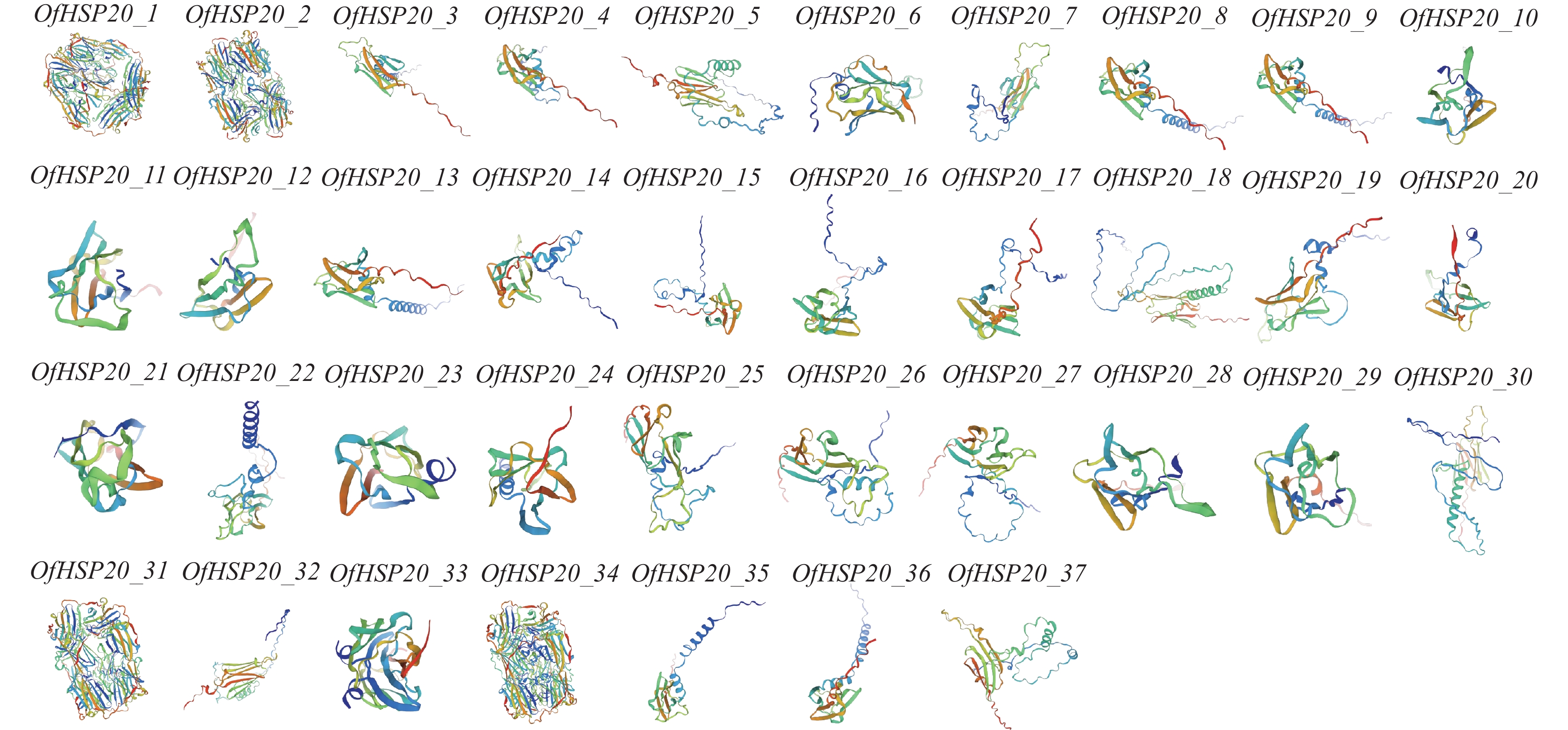
      蛋白二级结构预测显示:OfHSP20 蛋白主要由 α-螺旋、延伸链和无规则卷曲组成,其中无规则卷曲占比最高,为48.97%~70.00%(表3)。OfHSP20 蛋白三级结构同样以 α-螺旋、延伸链及无规则卷曲为主要组成单元,与二级结构预测结果高度一致(图1),进一步说明 OfHSP20 蛋白具有较保守的结构特征。

      蛋白名称 α-螺旋/% 延伸链/% 无规则卷曲/% 蛋白名称 α-螺旋/% 延伸链/% 无规则卷曲/%
      OfHSP20_1 16.06 24.09 59.85 OfHSP20_20 23.88 23.13 52.99
      OfHSP20_2 25.79 16.84 57.37 OfHSP20_21 24.29 9.52 66.19
      OfHSP20_3 28.03 20.38 51.59 OfHSP20_22 30.21 16.15 53.65
      OfHSP20_4 27.56 22.44 50.00 OfHSP20_23 22.30 8.45 69.26
      OfHSP20_5 25.00 15.82 59.18 OfHSP20_24 42.47 8.56 48.97
      OfHSP20_6 24.38 19.38 56.25 OfHSP20_25 21.38 19.50 59.12
      OfHSP20_7 25.70 18.99 55.31 OfHSP20_26 18.97 18.97 62.07
      OfHSP20_8 27.39 19.75 52.87 OfHSP20_27 19.11 21.66 59.24
      OfHSP20_9 26.11 20.38 53.50 OfHSP20_28 21.74 22.36 55.90
      OfHSP20_10 21.90 18.57 59.52 OfHSP20_29 17.86 16.52 65.62
      OfHSP20_11 18.78 12.68 68.54 OfHSP20_30 27.72 15.84 56.44
      OfHSP20_12 26.47 10.50 63.03 OfHSP20_31 24.67 13.22 62.11
      OfHSP20_13 29.30 21.02 49.68 OfHSP20_32 25.46 14.81 59.72
      OfHSP20_14 15.09 21.38 63.52 OfHSP20_33 23.89 6.11 70.00
      OfHSP20_15 22.56 18.90 58.54 OfHSP20_34 18.83 19.48 61.69
      OfHSP20_16 20.90 21.64 57.46 OfHSP20_35 26.11 19.75 54.14
      OfHSP20_17 22.06 20.59 57.35 OfHSP20_36 26.11 20.38 53.50
      OfHSP20_18 17.73 13.18 69.09 OfHSP20_37 17.32 13.42 69.26
      OfHSP20_19 21.99 19.37 58.64

      Table 3.  Secondary structure of OfHSP20 protein
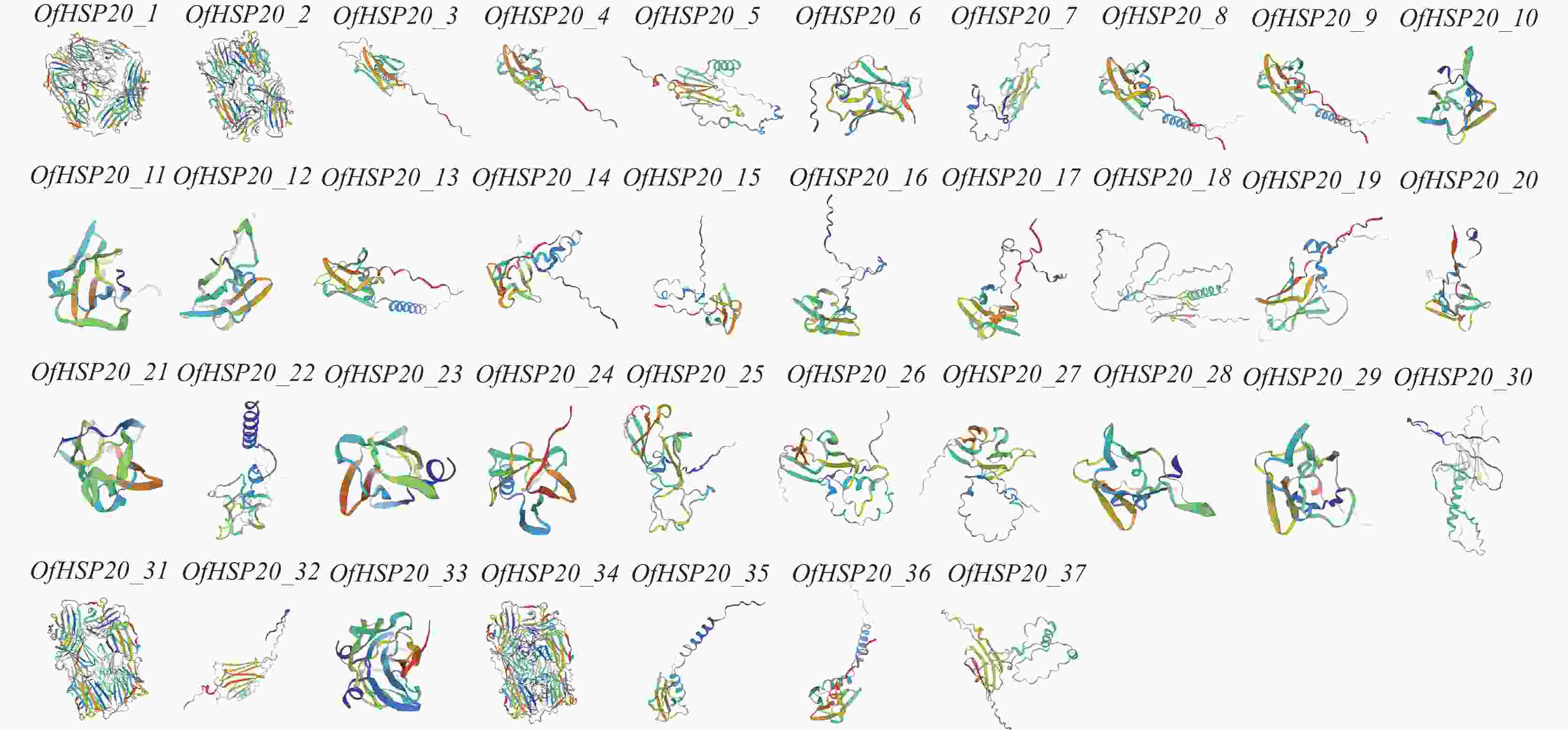
      Figure 1.  Tertiary structure of OfHSP20 family proteins

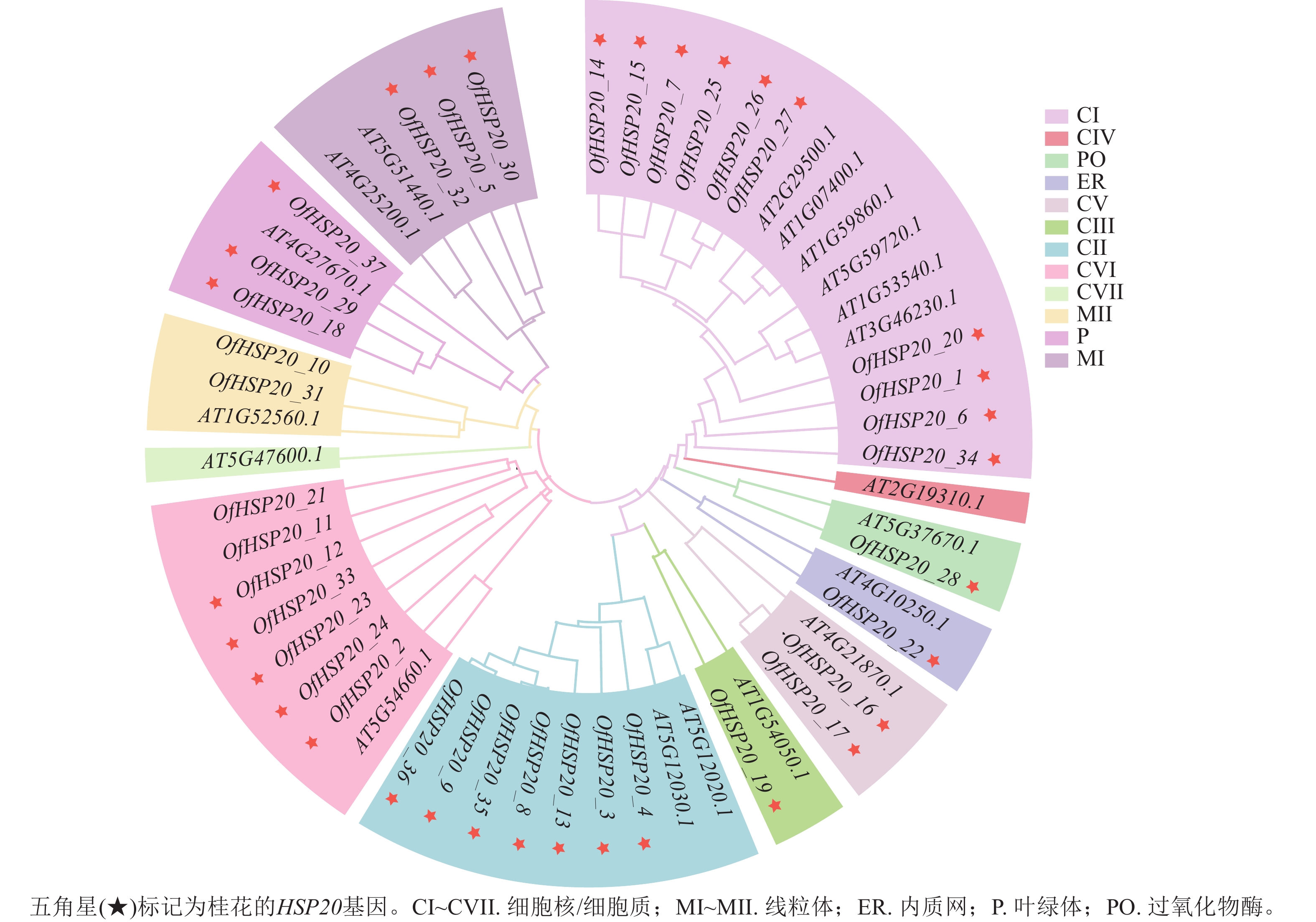
    • 对拟南芥和桂花 HSP20 蛋白进行系统发育分析,HSP20 蛋白被划分成 12 个亚家族,其中 37 个 OfHSP20 蛋白分布在 10 个亚家族(图2)。根据亚细胞定位特征,OfHSP20 蛋白被分为 5 个亚类,包括细胞质/细胞核定位的 C 类(CI~CVII)、线粒体定位的 M 类(MI 和 MII)、叶绿体定位的 P 类、内质网定位的 ER 类以及过氧化物酶体定位的 PO 类。
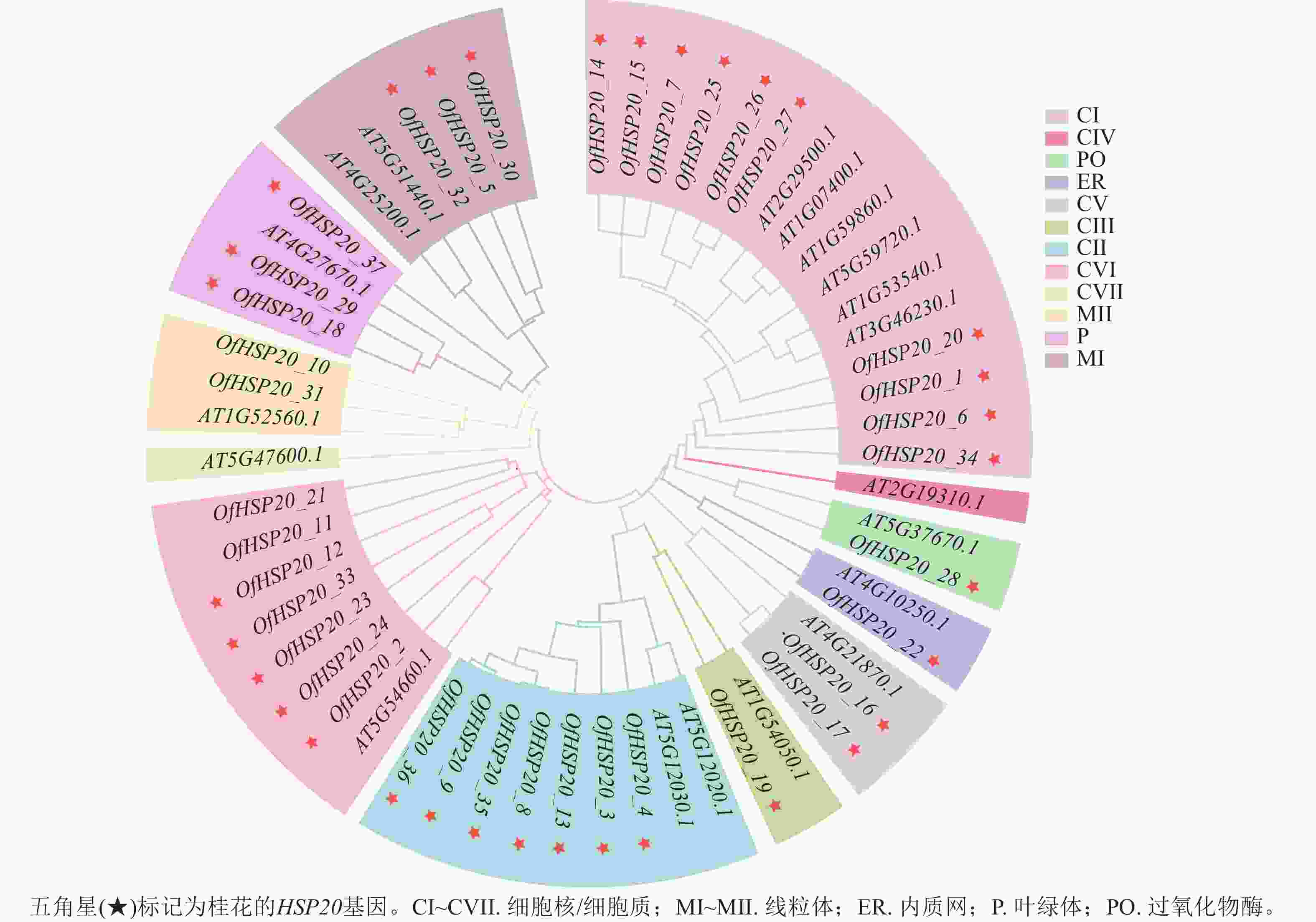
      Figure 2.  Phylogenetic tree of the OfHSP20 gene family

      OfHSP20 家族中,C 类成员数量最多,共 25 个。其中,CI 亚家族包含 10 个成员(OfHSP20_1、OfHSP20_6、OfHSP20_7、OfHSP20_14、OfHSP20_15、OfHSP20_20、OfHSP20_25、OfHSP20_26、OfHSP20_27 和 OfHSP20_34),CII 亚家族包含 7 个成员(OfHSP20_3、OfHSP20_4、OfHSP20_8、OfHSP20_9、OfHSP20_13、OfHSP20_35 和 OfHSP20_36),CIII 亚家族包含 1 个成员(OfHSP20_19),CVI 亚家族包含7个成员(OfHSP20_2、OfHSP20_11、OfHSP20_12、OfHSP20_21、OfHSP20_23、OfHSP20_24 和 OfHSP20_33),无 CVII 和 CIV 类 OfHSP20 蛋白。M 类包含 2 个亚家族,其中 MI 亚家族包含 3 个成员(OfHSP20_5、OfHSP20_30 和 OfHSP20_32),MII 亚家族包含 2 个成员(OfHSP20_10 和 OfHSP20_31)。ER 类包含 1 个成员(OfHSP20_22)。P 类包含 3 个成员(OfHSP20_18、OfHSP20_29 和 OfHSP20_37)。PO 类包含 1 个成员(OfHSP20_28)。总体而言,C 类成员占比最高,表明细胞质/细胞核定位的 HSP20 蛋白可能在 OfHSP20 家族中发挥更重要的功能作用。

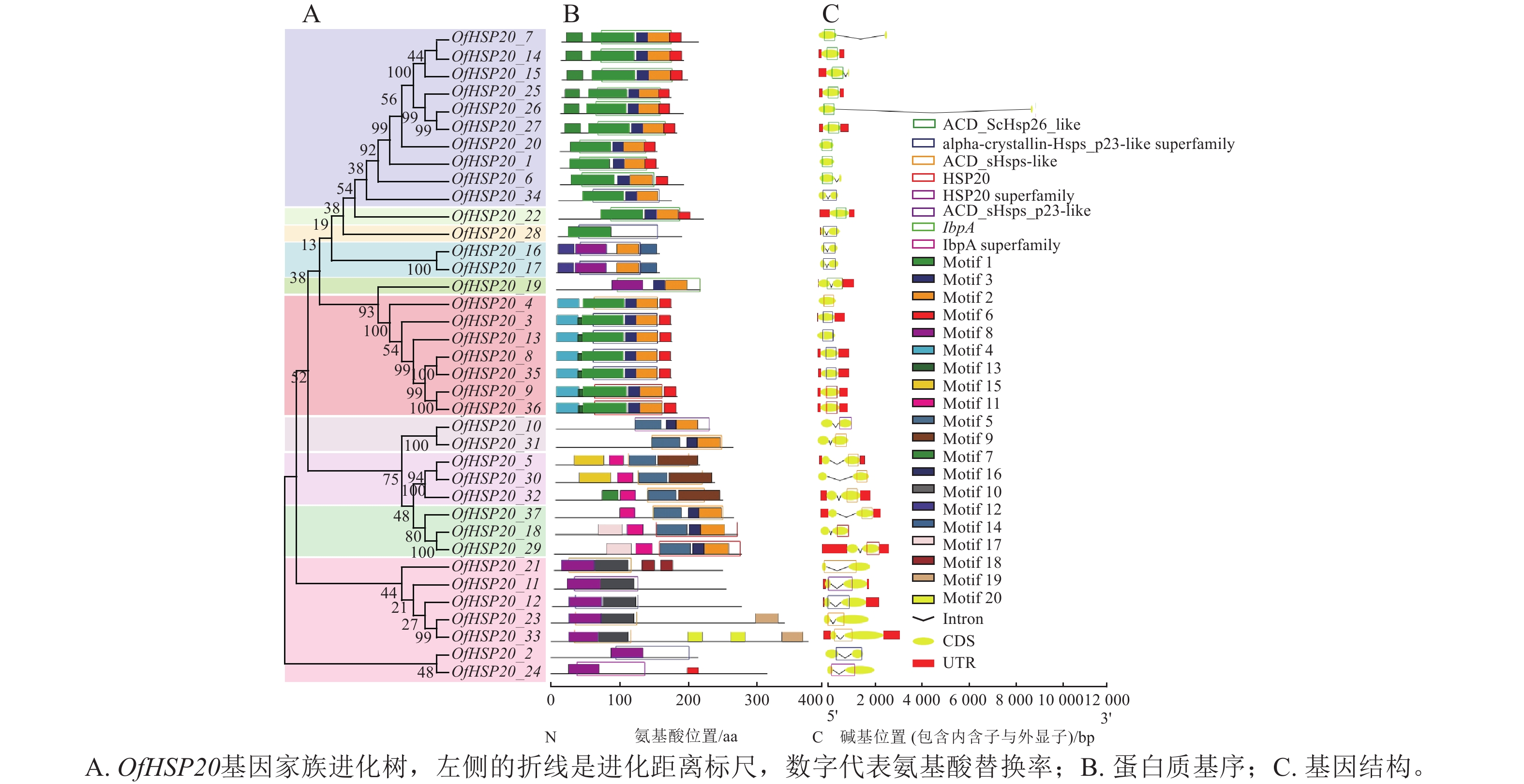
    • 共鉴定出 8 类保守结构域及 20 个保守基序(图3)。同一亚家族成员的结构域和基序组成高度相似,大多数 OfHSP20 基因都含有 HSP20 家族特征性的 ACD 和 HSP20 相关结构域(图3A,B)。Motif 2 为多数成员共有。此外,CII 亚家族中除 OfHSP20_4 外均含 Motif 1~4、Motif 6和 Motif 7,进一步支持同一亚家族成员结构保守性。
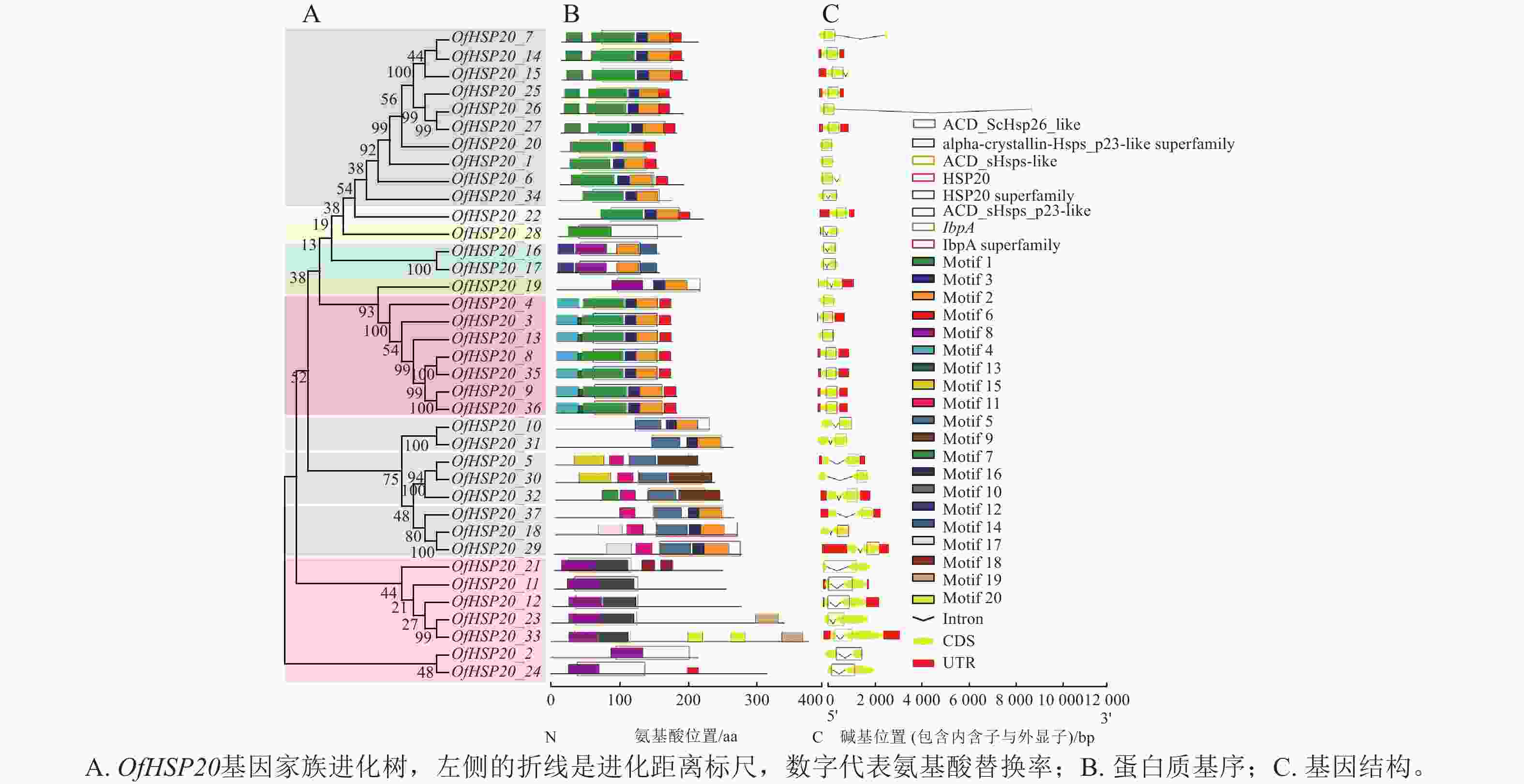
      Figure 3.  Analysis of gene structure, protein motifs, and promoters of the OfHSP20 gene family

      基因结构分析显示:OfHSP20 基因的外显子-内含子模式较为保守。其中,13 个基因(OfHSP20_1、OfHSP20_3、OfHSP20_4、OfHSP20_8、OfHSP20_9、OfHSP20_13、OfHSP20_14、OfHSP20_20、OfHSP20_22、OfHSP20_25、OfHSP20_27、OfHSP20_35 和 OfHSP20_36)仅包含 1 个内含子,其余成员主要由 1 个外显子和 2 个内含子组成(图3C)。此外,MI 亚家族的 3 个成员基因结构特征高度一致,均包含 2 个内含子(图3A,C),进一步表明同一进化分支成员具有较高的结构保守性。

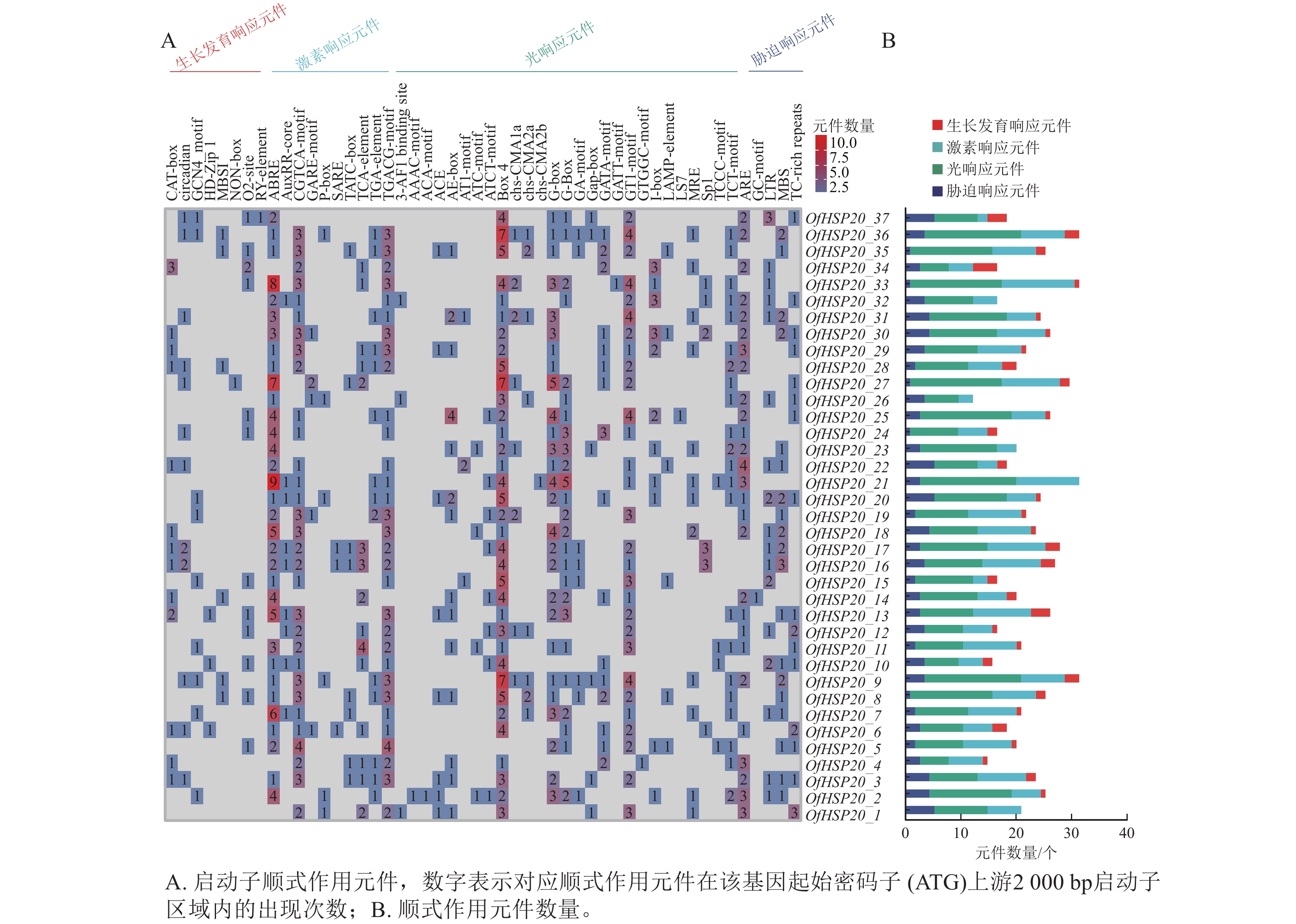
    • 顺式作用元件预测显示:OfHSP20 基因启动子包含生长发育、激素、光和胁迫响应元件(图4A)。生长发育元件主要包括 CAT-box (分生组织表达相关)、circadian (昼夜节律调控相关)、MBSI 和 HD-Zip 1 元件(分生组织和发育调控相关)。激素响应元件包括 ABRE (ABA 响应)、AuxRR-core 和 TGA-element (生长素响应)元件等。光响应元件包括 GA-motif、GAP-box 和 GT1-motif 等。胁迫响应元件包括无氧响应元件 ARE、干旱响应元件 MBS、参与病原体防御与胁迫响应的 TC-rich repeats 元件等。这些结果表明: OfHSP20 基因家族可能在多种环境胁迫响应、激素信号调控及生长发育中发挥重要作用。
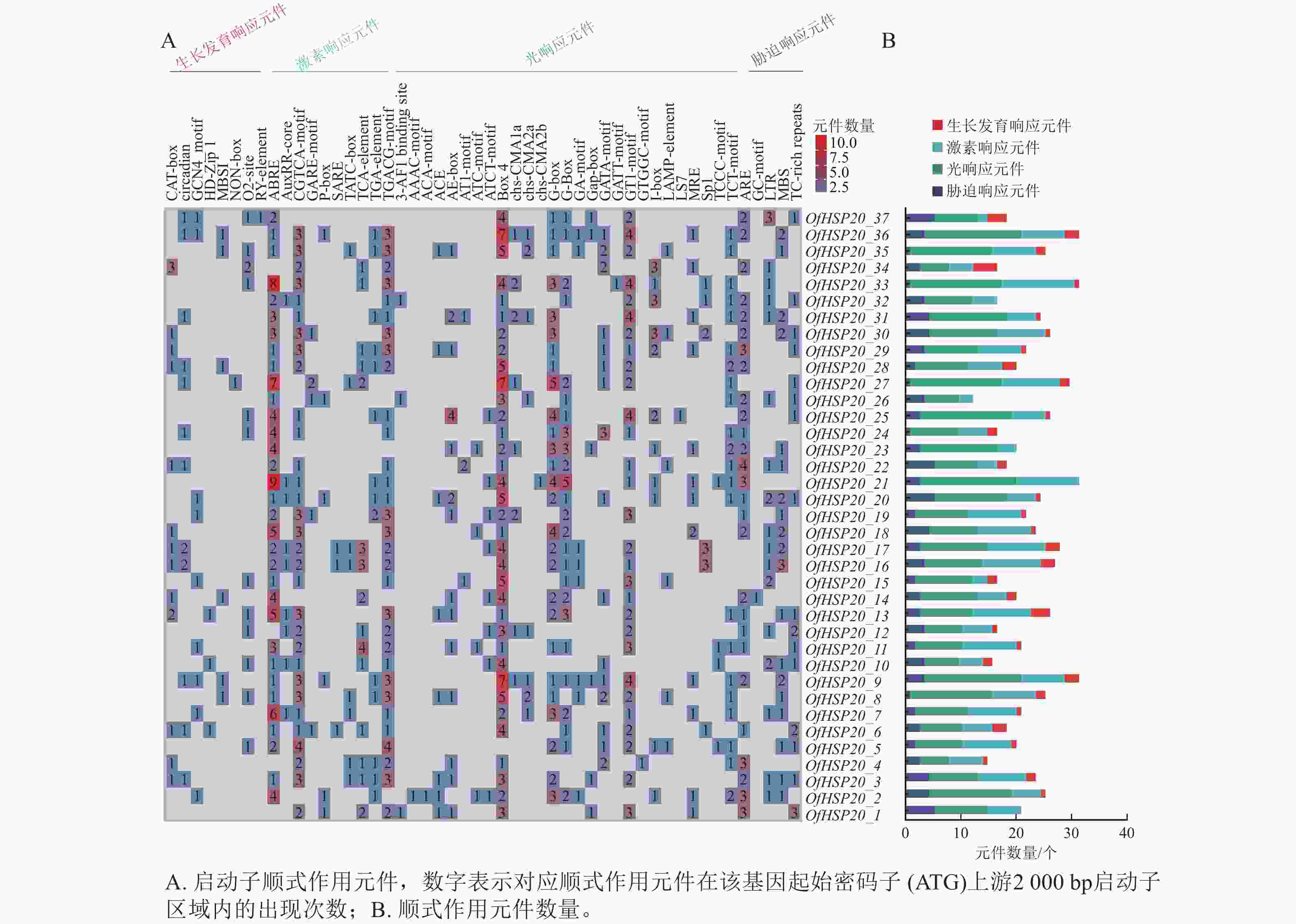
      Figure 4.  Cis-acting elements of the OfHSP20 genes

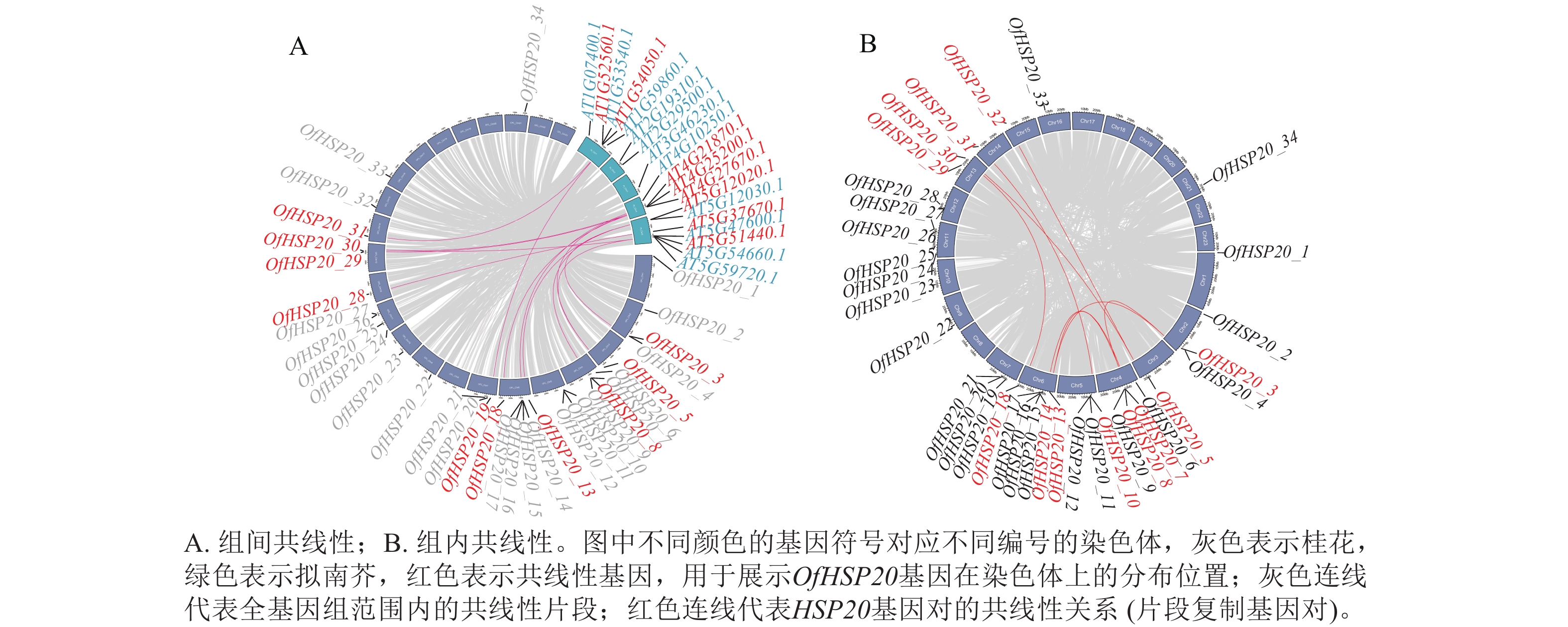
    • 为进一步解析 OfHSP20 基因家族的扩张机制及进化关系,对桂花与拟南芥 HSP20 基因家族进行共线性分析。结果显示:在拟南芥与桂花中共鉴定出 13 对共线染色体区域(图5A)。进一步对桂花基因组内共线性分析发现,OfHSP20 家族中存在 8 对片段复制基因对(图5B)。所有重复的 HSP20 基因对的 Ka/Ks 值均低于 1(表4),表明 HSP20 家族基因主要在纯化选择作用下进化。
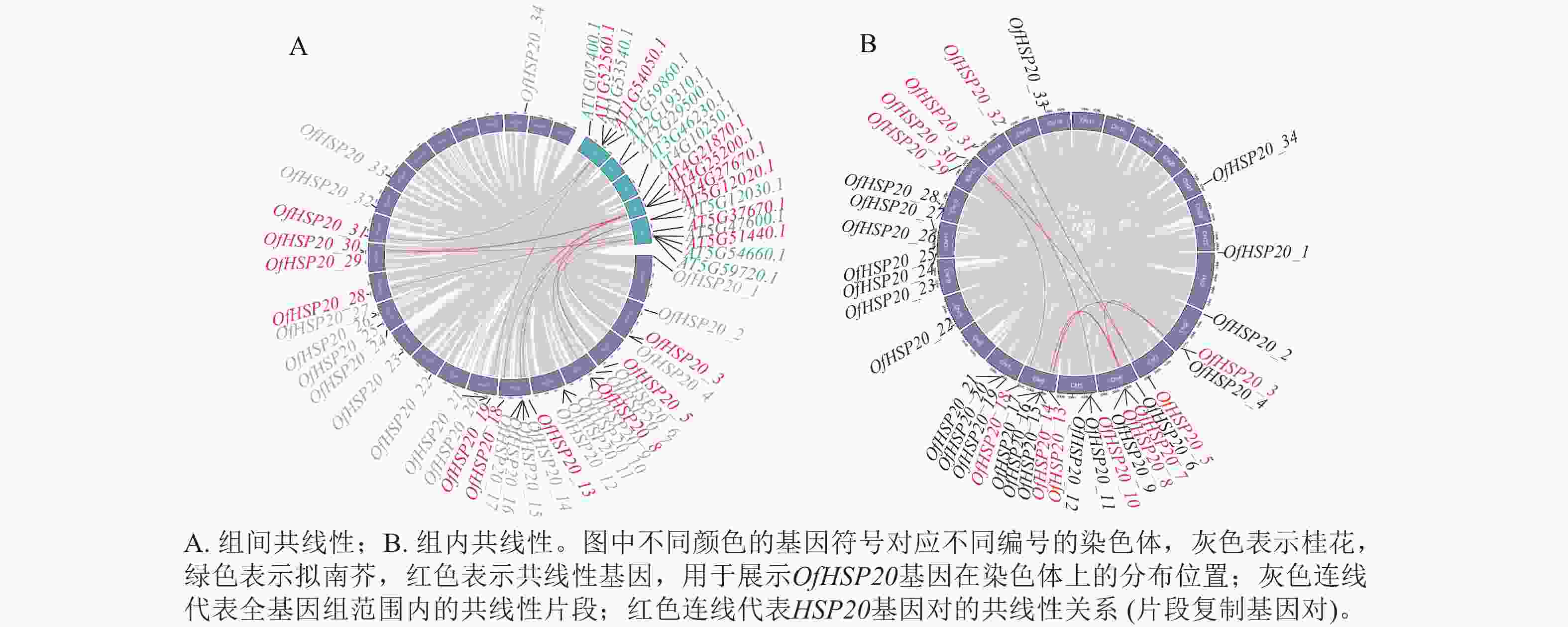
      Figure 5.  Collinearity analysis of the OfHSP20 gene family

      基因对非同义替换率(Ka)同义替换率(Ks)替换率比值(Ka/Ks)
      AT1G52560-OfHSP20_310.406 5043.237 1200.125 576
      AT1G54050-OfHSP20_190.315 7933.482 7400.090 674
      AT4G21870-OfHSP20_160.336 7563.192 1800.105 494
      AT4G25200-OfHSP20_50.275 9123.434 9800.080 324
      AT4G25200-OfHSP20_300.370 8083.059 7600.121 188
      AT4G27670-OfHSP20_180.310 6573.078 4200.100 914
      AT4G27670-OfHSP20_290.266 7233.258 6900.081 850
      AT5G12020-OfHSP20_30.219 9083.483 7600.063 124
      AT5G12020-OfHSP20_80.244 7492.690 1200.090 981
      AT5G12020-OfHSP20_130.269 5311.773 5200.151 975
      AT5G37670-OfHSP20_280.322 2953.230 2500.099 774
      AT5G51440-OfHSP20_50.300 9383.534 5000.085 143
      AT5G51440-OfHSP20_300.370 5003.137 8200.118 075
      OfHSP20_3-OfHSP20_80.146 7260.991 4270.147 995
      OfHSP20_3-OfHSP20_130.148 1160.984 2910.150 480
      OfHSP20_7-OfHSP20_140.043 6840.507 8450.086 019
      OfHSP20_8-OfHSP20_130.064 9500.308 7300.210 377
      OfHSP20_29-OfHSP20_180.254 9101.603 6400.158 957
      OfHSP20_30-OfHSP20_50.183 0051.577 7400.115 992
      OfHSP20_31-OfHSP20_100.399 3492.017 5600.197 936
      OfHSP20_32-OfHSP20_50.305 5603.146 8400.097 101

      Table 4.  Ka/Ks analysis of intra- and inter-species HSP20 gene pairs

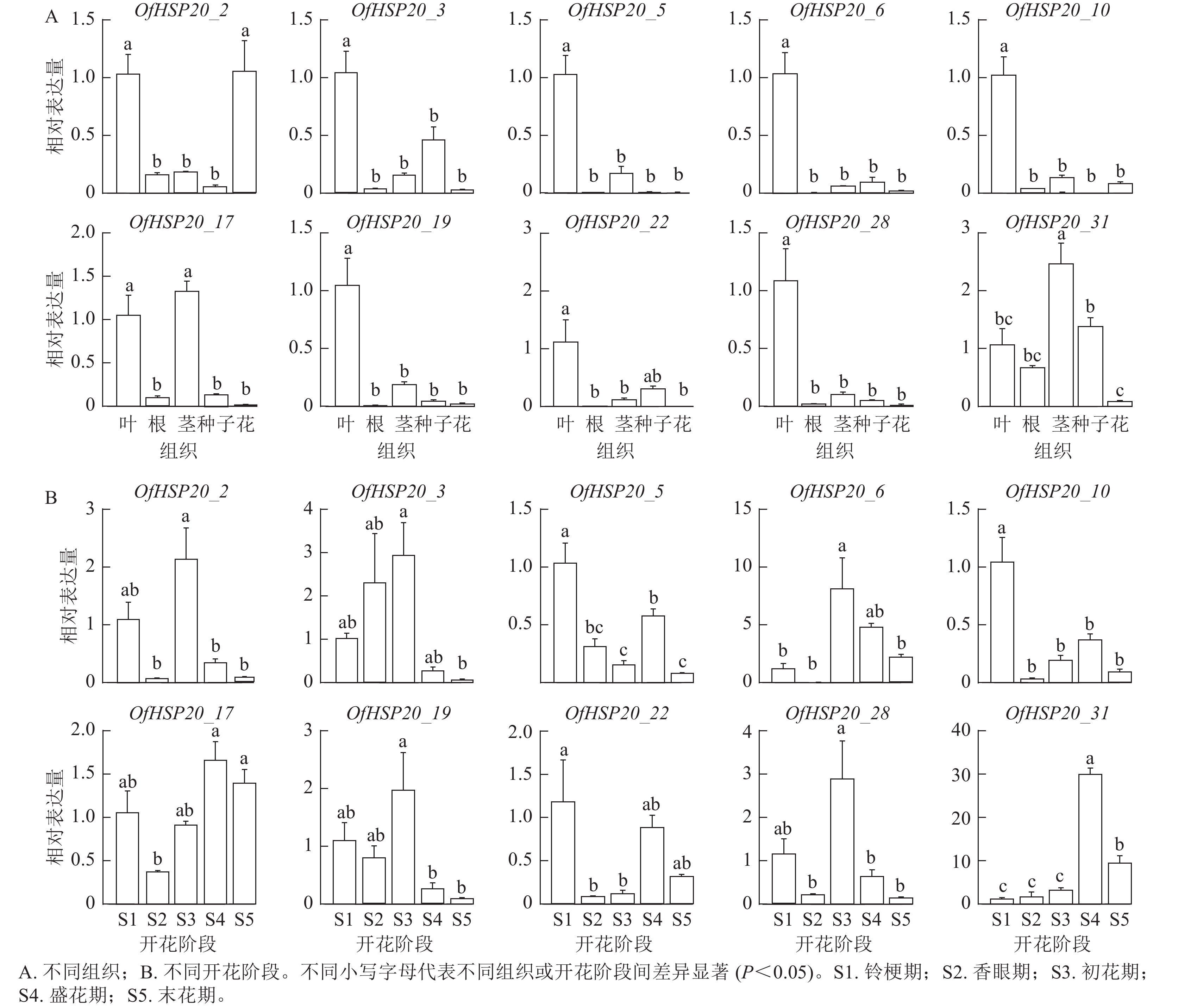
    • 采用 RT-qPCR 检测 10 个代表性 OfHSP20 基因在不同组织中的表达模式(图6A)。结果表明:所有 OfHSP20 基因均在至少1种组织中表达,且不同成员表现出明显的组织表达偏好。其中,OfHSP20_3、OfHSP20_5、OfHSP20_6、OfHSP20_10、OfHSP20_19 和 OfHSP20_28 在叶片中的表达量显著(P<0.05)高于其他组织,而 OfHSP20_31 在茎中的表达量显著(P<0.05)高于其他组织。
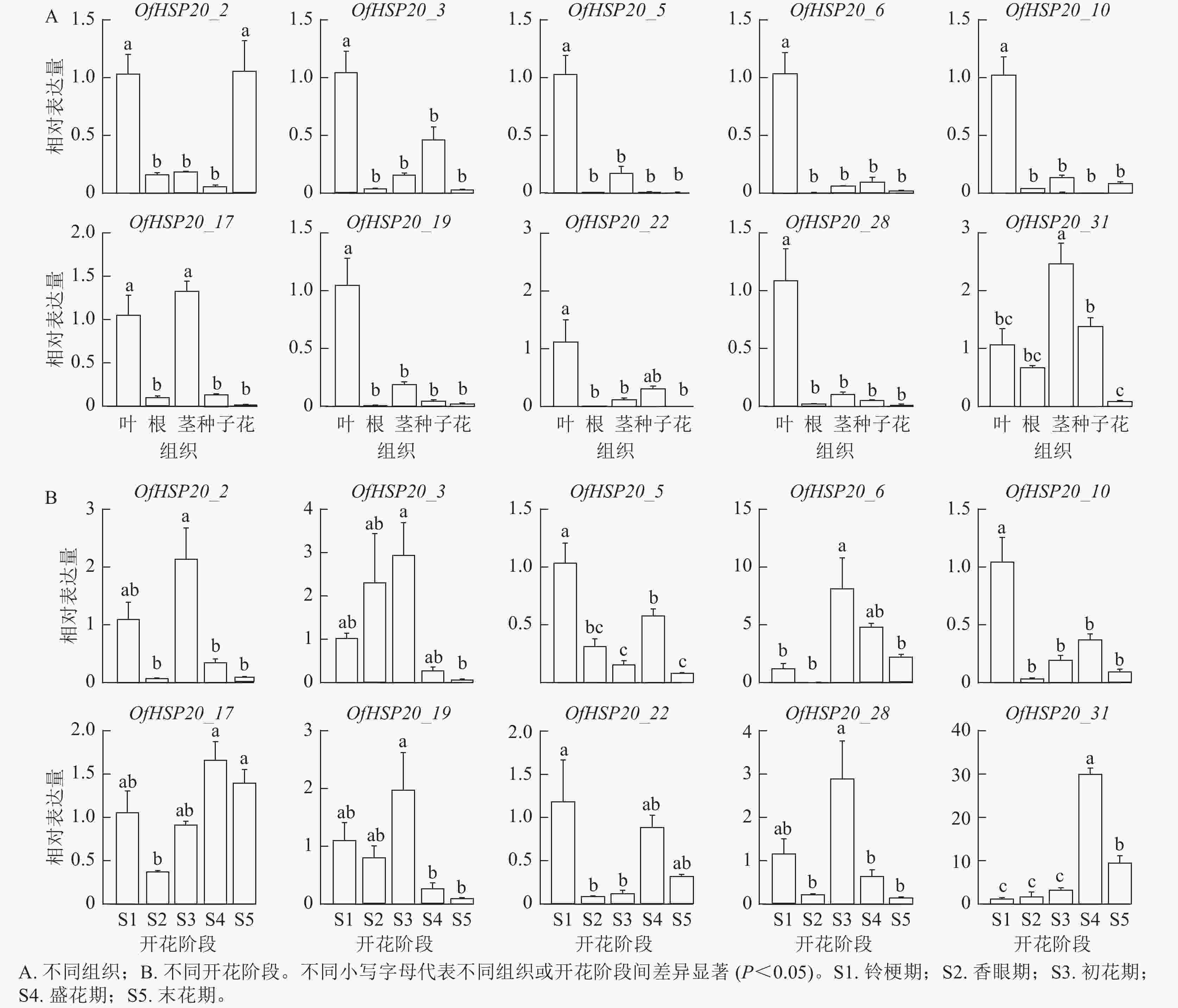
      Figure 6.  Expression of 10 OfHSP20 genes in O. fragrans

      不同开花阶段花瓣中的表达动态变化如图6B所示。除 OfHSP20_6 外,其余 OfHSP20 基因在不同开花阶段均有表达。其中,OfHSP20_2、OfHSP20_3、OfHSP20_19 和 OfHSP20_28 表达在 S4 时期达到峰值,而在 S5 时期最低,差异显著(P<0.05)。这些结果表明,部分 OfHSP20 基因可能参与花瓣开放及后期衰老过程的调控。

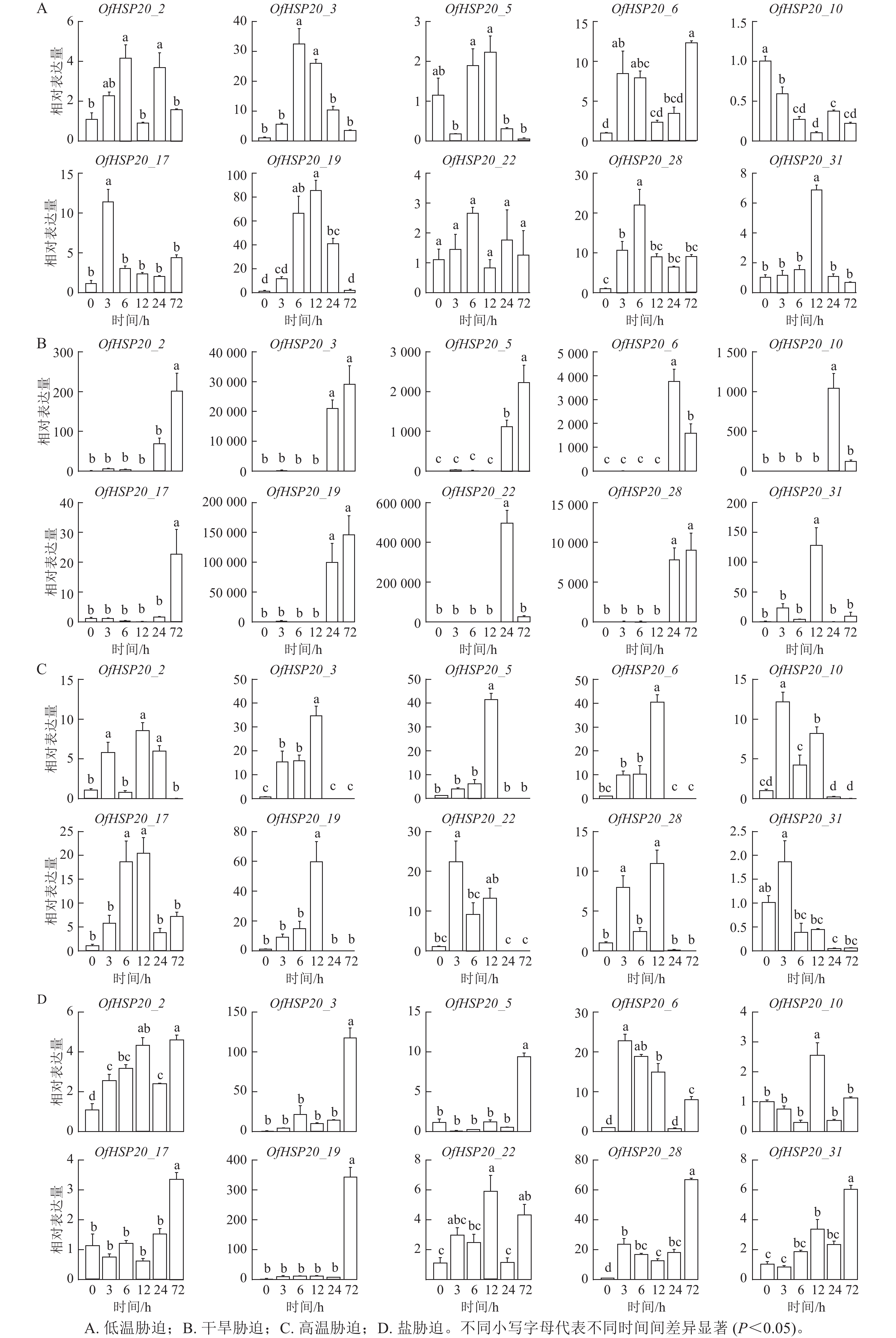
    • OfHSP20 基因在非生物胁迫下表现出明显的时间依赖性表达响应。低温与干旱胁迫下,OfHSP20_6 与 OfHSP20_28 显著(P<0.05)诱导表达,但响应峰值时间不同(图7A~B)。高温胁迫下,OfHSP20_10、OfHSP20_22 和 OfHSP20_31 响应迅速,其转录水平在处理 3 h 时达峰值,分别为对照(0 h)的 6.34~22.87 倍(图7C)。盐胁迫下,OfHSP20_3、OfHSP20_5、OfHSP20_19和OfHSP20_28的表达水平在 72 h 达峰值,分别为对照的 333.19、83.16、55.11、7.11 倍;OfHSP20_6表达在 3 h 达峰值,为对照的 16.66 倍(图7D)。OfHSP20 在不同非生物胁迫下表现出差异化的诱导模式,部分成员能够在特定胁迫下快速或持续响应,提示其可能参与桂花逆境适应过程中的多层次调控。
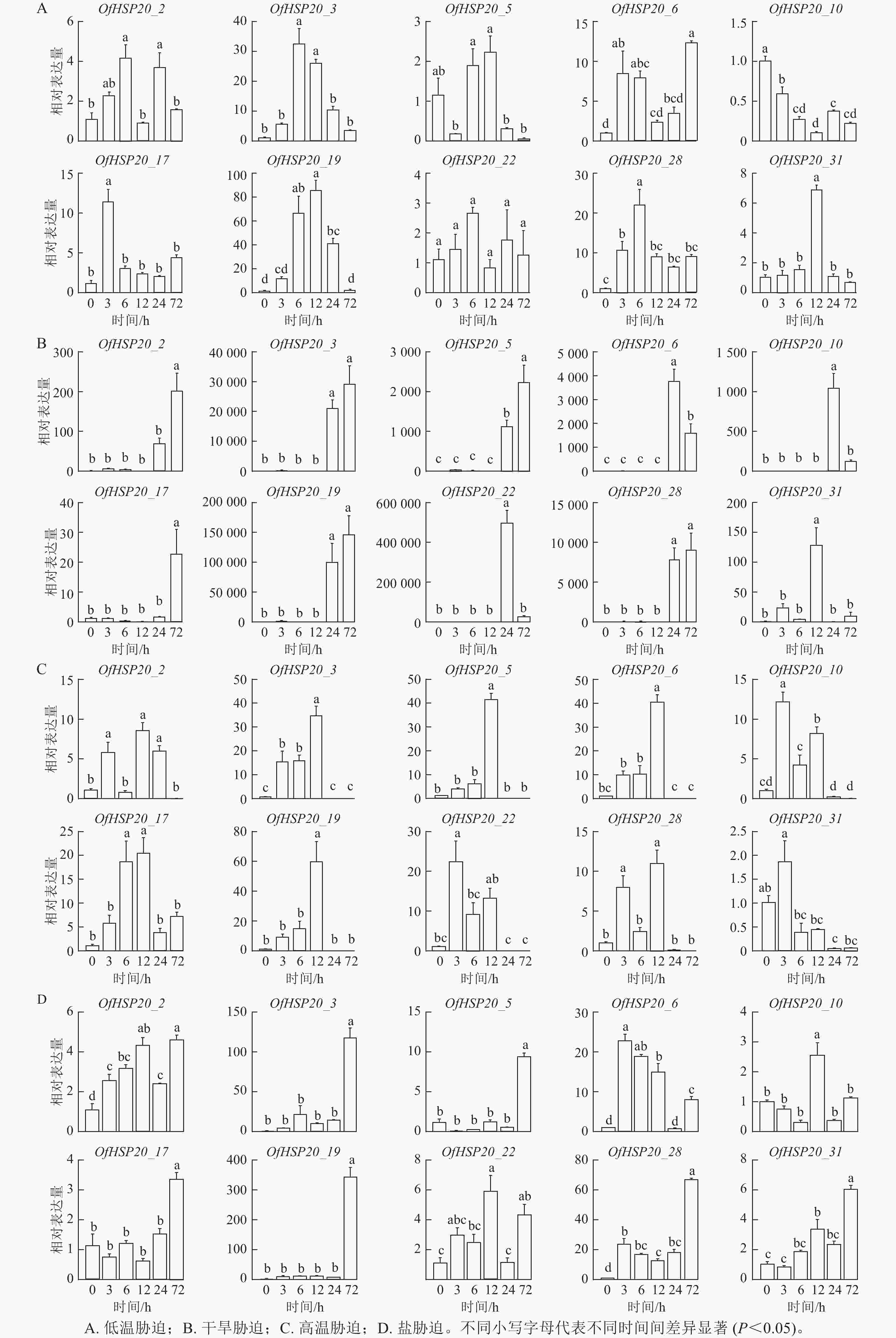
      Figure 7.  Expression profiles of 10 OfHSP20 genes under four abiotic stresses in O. fragrans.

    • HSP20 基因家族广泛存在于陆生植物中,家族规模存在明显物种差异。本研究鉴定出37 个 OfHSP20 基因,家族规模介于月季Rosa chinensis (31个)、桃Prunus persica (44个)、苹果(49个)等植物之间[10−11, 16]。这种物种间的数量差异反映了基因家族在长期进化中对物种生存环境的适应性。

      OfHSP20 蛋白的分子量为 15.258~39.932 kDa,符合植物小分子热激蛋白 15.000~42.000 kDa 的典型特征[17]。所有蛋白均呈亲水性,该特征有利于 HSP20 蛋白在细胞水相环境中保持稳定并发挥分子伴侣功能,是其参与逆境响应的重要结构基础[18]。亚细胞定位预测显示:该家族蛋白以细胞质定位为主。细胞质定位的 OfHSP20 成员可能作为主要的分子伴侣,通过捕获和稳定胁迫诱导产生的错误折叠蛋白,促进蛋白复性或降解,从而维持细胞正常代谢活动[19]。

      基因结构与保守基序特征是解析基因的表达调控与潜在功能的重要依据[20]。大多数 OfHSP20 基因包含 1~2 个外显子,这与生菜Lactuca sativa var. ramosa[21]和黄瓜Cucumis sativus[22]等植物的研究结果一致。简单的基因结构通常有利于减少转录过程中的调控复杂性,并可能促进胁迫条件下基因的快速转录响应[23],这与 OfHSP20_10、OfHSP20_22 和 OfHSP20_31的相对表达量在高温处理 3 h 达到峰值的特征相吻合。同一亚家族成员的基序高度保守,进一步支持了其进化来源和潜在功能相似性。例如 CII 亚家族中除 OfHSP20_4 外均包含 Motif 1~4、Motif 6 与 Motif 7,表明这些成员在蛋白结构组成方面具有较高一致性。结构保守性较高的部分 OfHSP20 成员表现出明显的逆境响应特征。例如 OfHSP20_3 在干旱胁迫和盐胁迫下显著诱导表达,提示其可能通过维持蛋白质稳态参与桂花对非生物胁迫的适应过程。上述结果表明:OfHSP20 基因家族中保守的结构特征与特异性的胁迫响应模式共同构成了其功能多样性的分子基础。

      系统进化与共线性分析表明,OfHSP20 家族与拟南芥 HSP20 进化关系保守。这表明 HSP20 家族的结构特征和基本功能在陆生植物长期进化过程中具有较高保守性。片段复制事件是 OfHSP20 基因家族扩张的主要驱动力,这与苹果[11]和桃[10]中 HSP20 家族的扩张模式一致。片段复制可增加基因家族成员数量,为基因功能分化、新功能获得以及表达模式多样化提供遗传基础[24]。Ka/Ks 分析显示:该基因家族成员主要受纯化选择作用。长期进化过程中,重复基因通常受到选择压力约束,以维持蛋白结构和核心功能的稳定性[9]。两者共同作用使 OfHSP20 家族在保持功能保守性的同时形成一定程度的功能分化,从而增强其对复杂环境条件的适应潜力。

      启动子顺式作用元件是基因转录调控的核心基础[25]。本研究发现: OfHSP20 基因启动子区域富含生长发育、激素响应及逆境应答相关的顺式作用元件。其中,无氧响应元件(ARE)分布最广,可介导植物低氧条件下的转录调控[26]。高温、干旱等逆境通常伴随着细胞氧化还原稳态失衡和活性氧(ROS)积累[27],因此氧化信号通过无氧响应元件快速启动基因表达,这与 OfHSP20_10、OfHSP20_22 和 OfHSP20_31相对表达量在高温处理 3 h 快速到达峰值的特征高度吻合。此外,OfHSP20_3 和 OfHSP20_5 的启动子同时富集脱落酸响应元件 ABRE、干旱响应元件 MBS 与胁迫防御元件 TC-rich repeats,使其可通过 ABA信号通路整合多种胁迫信号,介导广谱抗逆响应。这一调控机制在水稻Oryza sativa[28]等物种中高度保守,表明 HSP20 家族逆境调控通路的进化保守性。

      OfHSP20 基因在不同组织中表现出明显的差异表达模式,这与苹果[29] HSP20 家族的组织特异性表达结果一致,暗示不同成员可能具有组织特异性功能。在不同开花阶段,OfHSP20_2、OfHSP20_3、OfHSP20_19 和 OfHSP20_28在盛花期(S4)相对表达量达峰值,推测其参与桂花花瓣开放的相关调控过程。其次,在非生物胁迫响应中,OfHSP20 家族成员表现出明显的胁迫特异性和时间依赖性表达模式,其中,OfHSP20_10、OfHSP20_22 和 OfHSP20_31相对表达量在高温胁迫3 h快速达峰值,随后呈动态双峰响应模式。类似的表达模式也在拟南芥 HSP20 家族中被报道[30],表明 HSP20 基因可能通过精细调控表达动态参与植物对热胁迫的适应过程。其中 OfHSP20_3、OfHSP20_5 和 OfHSP20_19 这 3 个基因在 4 种非生物胁迫下均显著上调,表明这些基因可能属于桂花 HSP20 家族中的广谱胁迫响应成员。类似的多胁迫响应特征也在黄瓜 HSP20 家族中被观察到[22],表明 HSP20 家族功能的进化保守性。然而,目前研究仅从表达水平揭示 OfHSP20 基因与非生物胁迫响应之间的相关性,其具体功能及调控机制仍需通过基因克隆、遗传转化、过表达或敲除验证以及相关表型分析进一步解析。未来可重点关注 OfHSP20_3、OfHSP20_5 和 OfHSP20_19 等响应多种胁迫的候选基因,深入解析其在桂花逆境耐受形成过程中的分子作用机制,为桂花抗逆分子育种提供理论依据和候选基因资源。

    • 本研究共鉴定 37 个 OfHSP20 基因。结构和进化分析表明,OfHSP20 蛋白均具有保守的 α-晶体结构域,片段复制是驱动该家族扩张的主要进化机制。启动子顺式作用元件分析显示,该家族基因可能受激素和胁迫信号的协同调控。表达分析表明,OfHSP20 家族成员在不同组织、不同开花阶段及非生物胁迫下表现出明显的表达特异性,其中 OfHSP20_3、OfHSP20_5 和 OfHSP20_19 为广谱胁迫响应基因,在高温、低温、干旱和盐胁迫下均显著上调,是桂花响应多重胁迫的关键候选基因。本研究为揭示 HSP20 基因在桂花逆境适应中的功能机制和抗逆分子育种提供了潜在基因资源。

Reference (30)

Catalog

    /

    DownLoad:  Full-Size Img  PowerPoint
    Return
    Return