Turn off MathJax
Article Contents

YE Liyun, FENG Haiying, WU Xiaoping. Effect of serine and alanine on degeneration and rejuvenation of Pleurotus pulmonarius spawn[J]. Journal of Zhejiang A&F University, 2025, 42(X): 1−8 doi:  10.11833/j.issn.2095-0756.20250216
Citation: YE Liyun, FENG Haiying, WU Xiaoping. Effect of serine and alanine on degeneration and rejuvenation of Pleurotus pulmonarius spawn[J]. Journal of Zhejiang A&F University, 2025, 42(X): 1−8 doi:  10.11833/j.issn.2095-0756.20250216

OnlineFirst articles are published online before they appear in a regular issue of the journal. Please find and download the full texts via CNKI.

Effect of serine and alanine on degeneration and rejuvenation of Pleurotus pulmonarius spawn

DOI: 10.11833/j.issn.2095-0756.20250216
  • Received Date: 2025-03-20
  • Accepted Date: 2025-09-10
  • Rev Recd Date: 2025-05-12
  •   Objective  This study aimed to investigate the effects of serine (Ser) and alanine (Ala) on strain degeneration and rejuvenation in Pleurotus pulmonarius, providing theoretical insights for mitigating the industrial bottleneck of strain stability and degeneration.   Method  Using the P. pulmonarius strain JX-2, a degeneration model was established through ten successive subcultures on potato dextrose agar(PDA) medium. Comparative cultivation experiments were performed with Ser- or Ala-supplemented media. Mycelial growth rate, biomass, and biochemical parameters (crude polysaccharides, total protein content) were systematically quantified. Changes in superoxide anion production rate, hydrogen peroxide (H2O2) content, and antioxidant enzyme activities were analyzed. The rejuvenation efficacy of hyphal tip purification was evaluated across different media (PDA, Ser-PDA, Ala-PDA).   Result  Continuous subculturing induced strain degeneration. The 10th-generation strain exhibited a 15.45% reduction in growth rate and 28.67% biomass decrease compared to initial generations. Ser or Ala supplementation effectively delayed degeneration and maintained mycelial vitality. Hyphal tip purification significantly reversed degenerative traits. In PDA medium, this method increased biomass by 17.17%, elevated crude polysaccharides and total protein content by 30.66% and 30.50%, respectively, and enhanced antioxidant capacity [peroxidase (POD) activity +84.20%; superoxide dismutase (SOD) activity +20.07%]. Ser-PDA medium demonstrated superior rejuvenation effects, achieving 57.77% biomass increase and 63.70% SOD activity enhancement. Ala-PDA medium specifically boosted total protein content by 32.01%.   Conclusion  Subculturing frequency critically drives P. pulmonarius strain degeneration. Media supplementation with 2 g·L−1 Ser or Ala substantially mitigates this process. Hyphal tip purification synergized with amino acid-enriched media achieves targeted rejuvenation efficiency: Ser-PDA preferentially enhances antioxidant defenses, while Ala-PDA specifically promotes protein biosynthesis. [Ch, 5 fig. 33 ref.]
  • [1] ZHANG Han, LI Quan, GUO Ziwu, LÜ Jianhua, YING Yeqing, SONG Xinzhang.  Effects of nitrogen application on nutritional components of Phyllostachys edulis shoot . Journal of Zhejiang A&F University, doi: 10.11833/j.issn.2095-0756.20200256
    [2] ZHANG Jiling, CHEN Gang, CAO Guangqiu, LIN Sizu, ZHENG Hong, LI Yong.  Effects of mechanical damage and deep soil treatment on sprouting and antioxidant enzyme activities of Cunninghamia lanceolata . Journal of Zhejiang A&F University, doi: 10.11833/j.issn.2095-0756.20200323
    [3] XIANG Yuyong, TAO Qin, YU Shijun, ZHANG Yuanchang.  Analysis of nutrients in larva feces of Heterolocha jinyinhuaphaga . Journal of Zhejiang A&F University, doi: 10.11833/j.issn.2095-0756.20190624
    [4] GU Fan, JI Mengcheng, GU Cuihua, ZHENG Gang, ZHENG Shaoyu.  Heat and drought stress with an antioxidant defense system in Heimia myrtifolia . Journal of Zhejiang A&F University, doi: 10.11833/j.issn.2095-0756.2019.05.007
    [5] ZHANG Zeng, SHAN Shengdao, WU Shengchun, SONG Chengfang.  Carbonization with main nutrients in pig manure hydrochar . Journal of Zhejiang A&F University, doi: 10.11833/j.issn.2095-0756.2018.03.002
    [6] HAN Yilin, WANG Xinzhao, XU Xinlu, GAO Yan, WEN Guosheng, ZHANG Rumin, WANG Yukui.  Responses of anti-oxidant enzymes and the ascorbate-glutathione cycle to heat, drought, and synergistic stress in Phyllostachys edulis seedlings . Journal of Zhejiang A&F University, doi: 10.11833/j.issn.2095-0756.2018.02.010
    [7] XU Yuanyuan, LU Mingying, JIANG Weixin, CHENG Fei, TAN Ling, YANG Mei.  Al stress with lipid peroxidation and antioxidant enzyme activities in eucalyptus roots and leaves . Journal of Zhejiang A&F University, doi: 10.11833/j.issn.2095-0756.2016.06.012
    [8] JIA Li, LIU Mengmeng, ZHANG Hongqin, ZANG Xiaolin, Baoyintao getao, GAO Yan, ZHANG Rumin.  Antioxidant defense system responses of Artemisia frigida to mechanical damage . Journal of Zhejiang A&F University, doi: 10.11833/j.issn.2095-0756.2016.03.013
    [9] MAO Yuming, QIAO Weiyang, WU Kezhuang, YU Mukui, CHENG Xiangrong.  Growth, photosynthesis, and nutrition of Gynura divaricata with forest gap treatments . Journal of Zhejiang A&F University, doi: 10.11833/j.issn.2095-0756.2016.01.012
    [10] WANG Xizhou, YING Yueyue, CHEN Xuezhi, ZHANG Hao, YAO Xiaowei.  Nutritional components and content determination of the total flavonoids in Ficus pandurata var. hoiophylla . Journal of Zhejiang A&F University, doi: 10.11833/j.issn.2095-0756.2013.02.024
    [11] XU Xiao-bo, JIA Wen-qing, LIU Hui-chao.  Nutritional component differences in petal of Paeonia suffruticosa . Journal of Zhejiang A&F University, doi: 10.11833/j.issn.2095-0756.2012.05.015
    [12] YU Xiao-jie, JIN Xiao-yan, ZHOU Cun-shan, YANG Hu-qing, HE Zhi-ping, WANG Yun-xiang.  Nutritional components for kernels of two loquat cultivars . Journal of Zhejiang A&F University, doi: 10.11833/j.issn.2095-0756.2011.01.024
    [13] ZHENG Rong, ZHENG Wei-peng, FANG Wei, HUANG Yao-hua, ZHANG Shan-shan.  Shapes and nutrients of Dendrocalamopsis oldhami bamboo shoots in 12 production areas . Journal of Zhejiang A&F University, doi: 10.11833/j.issn.2095-0756.2010.06.007
    [14] LI Ying-chun, FAN Wei-guo, CHEN Shuang-lin.  Soil drought stress on membrane-lipid peroxidation and antioxidant enzymes in pear rootstock . Journal of Zhejiang A&F University,
    [15] JINGYun, LIANGYi-chi, YANGHua.  Comparison of fruit nutrition components of Castanea henryi clones . Journal of Zhejiang A&F University,
    [16] ZHONG Shan-min, HE Zhao-bin.  Analysis of nutrients of Prunus persica cv .Heitao fruit . Journal of Zhejiang A&F University,
    [17] XU Qiu-fang, YIE Zheng-qian, JIANG Pei-kun, YU Yi-wu.  Relationship between bamboo-shoot nutrition and soil nutrients . Journal of Zhejiang A&F University,
    [18] YU Xue-jun, LIU Li, JIN Ai-wu, FANG Wei, HE You-zheng.  Variation of the main nutrition constituents in Pleioblastus amarus tea . Journal of Zhejiang A&F University,
    [19] WU Jia-sen, LIN Hai-ping, PAN Yue, FU Shun-hua, GUAN Jian-feng.  Characteristics of nutrition changes and growth of Actinidia deliciosa cv .Qinmei fruits . Journal of Zhejiang A&F University,
    [20] QIU Yong-hua, SHAO Xiao-gen, ZHANG Fa-gen, HUA Wen-li, BAO Li-wen.  Analysis of physical behaviors and nutrition constituents of Phyllostachys hereroclada bamboo shoots . Journal of Zhejiang A&F University,
  • [1]
    WANG Qiao, MENG Li, WANG Xiangfeng, et al. The yield, nutritional value, umami components and mineral contents of the first-flush and second-flush Pleurotus pulmonarius mushrooms grown on three forestry wastes[J/OL]. Food Chemistry, 2022, 397: 133714[2025-03-15]. DOI: 10.1016/j.foodchem.2022.133714.
    [2]
    SHARIKA R, MONGKOLPOBSIN K, RANGSINTH P, et al. Experimental models in unraveling the biological mechanisms of mushroom-derived bioactives against aging- and lifestyle-related diseases: a review[J/OL]. Nutrients, 2024, 16(16): 2682[2025-03-15]. DOI: 10.3390/nu16162682.
    [3]
    CHEN Jing, PENG Yong, ZHUANG Bingbo, et al. Pleurotus pulmonarius polysaccharides inhibit glioma growth through the Hippo signaling pathway and regulate the structure of gut microbiota[J/OL]. Food Bioscience, 2024, 59: 104214[2025-03-15]. DOI: 10.1016/j.fbio.2024.104214.
    [4]
    AKYÜZ M, İNCI Ş, KıRBAĞ S. Evaluation of antimicrobial, antioxidant, cytotoxic and DNA protective effects of oyster mushroom: Pleurotus pulmonarius (Fr. ) quel [J]. Arabian Journal for Science and Engineering, 2023, 48(6): 7273−7283.
    [5]
    SUN Yujun, HE Huaqi, WANG Qian, et al. A review of development and utilization for edible fungal polysaccharides: extraction, chemical characteristics, and bioactivities[J/OL]. Polymers, 2022, 14(20): 4454[2025-03-15]. DOI: 10.3390/polym14204454.
    [6]
    WANG Qiaoli, KONG Zixuan, TAN Qiangfei, et al. Effects of strain degradation on the activities of related enzymes in tissue separation and subculture of Volvariella volvacea [J]. Food and Fermentation Industries, 2021, 47(8): 1−5.
    [7]
    ZHANG Dan, ZHU Qiujin, TAN Qi, et al. Study on rejuvenating degenerated strain of Flammulina filiformis by protoplast regeneration technology [J]. Acta Agriculturae Shanghai, 2023, 39(3): 10−16.
    [8]
    CUI Xiao, CONG Qianqian, WANG Qingwu. Preliminary study on rejuvenation of Pleurotus vulgaris strain by protoplast regeneration [J]. Edible Fungi, 2021, 43(2): 21−23, 26.
    [9]
    SZABADOS L, SAVOURÉ A. Proline: a multifunctional amino acid [J]. Trends in Plant Science, 2010, 15(2): 89−97.
    [10]
    MA Yuanwei, WANG Rong, GAO Qiang, et al. Rejuvenation and preventing degradation of filamentous fungi by adding exogenous amino acids [J]. Journal of Biology, 2017, 34(2): 108−111.
    [11]
    KONG Zixuan, WANG Qiaoli, CHENG Zhihong, et al. Effect of exogenous amino acids on the rejuvenation of degraded strains of Volvariella volvacea [J]. Food and Fermentation Industries, 2021, 47(20): 30−36.
    [12]
    CHANG Tingting, ZHAO Yan, YANG Huanling, et al. Optimization of compound amino acid medium for Lentinula edodes and the effect on mycelial growth and physiology [J]. Microbiology China, 2022, 49(2): 545−555.
    [13]
    CHEN Changlan, MENG Chengcheng, TONG Li, et al. Effects of different kinds of amino acids on mycelial growth and cordycepin content in Cordyceps militaris [J]. Food Science, 2012, 33(23): 236−239.
    [14]
    AN Xueming, CHEN Chao, LIU Xiaoxia, et al. Effects of degeneration of cultivated strains on fruiting body nutrients of Volvariella volvacea during subculture [J]. Mycosystema, 2020, 39(2): 390−397.
    [15]
    YE Liyun, LIN Qiang, LIU Mei, et al. The synthesis of polysaccharides and triterpenoids of Ganoderma lingzhi induced by calcium ion and salicylic acid [J]. Mycosystema, 2017, 36(2): 220−228.
    [16]
    ZHANG Chuan, WANG Yachen, CUI Shouyao, et al. The relationship between fruit tissue senescence and fruit cracking in cracking-resistant and susceptible tomato during fruit ripening [J]. Journal of Nanjing Agricultural University, 2016, 39(4): 534−542.
    [17]
    LIU Xinqian, NI Yan, WU Jieyi, et al. Difference mechanism of postharvest browning between Macrocybe gigantea and Agaricus bisporus [J]. Food Science and Technology, 2024, 49(9): 19−26.
    [18]
    WANG Jie, WANG Jinmei, LIU Hui, et al. Exploring the hepatoprotective effect of Agaricus bisporus based on network pharmacology [J]. Food Science, 2025, 46(2): 126−137.
    [19]
    ZOU Youhua, ZHAI Mengjie, LIAN Lingdan, et al. Comparison of the preservation effects of different packaging films on white mushroom [J]. Modern Food Science and Technology, 2024, 40(4): 133−141.
    [20]
    TIAN Tian, YAO Lan, FAN Dongyu, et al. Physiological and biochemical characteristics of degenerate mycelium of Flammulina filiformis [J]. Microbiology China, 2021, 48(10): 3603−3611.
    [21]
    WANG Xin, LI Xiu’e, QIU Wenxu, et al. Effects of mating-type ratio imbalance on the degeneration of Cordyceps militaris subculture and preventative measures[J/OL]. PeerJ, 2024, 12: e17648[2025-3-15]. DOI: 10.7717/peerj.17648.
    [22]
    XU Xiuhong, SHENG Siyuan, ZHU Haifeng, et al. Effect of additives on aging of liquid spawn of Auricularia auricula [J]. Journal of Northeast Agricultural University, 2019, 50(9): 19−27.
    [23]
    WANG Jing, ZHANG Fanhong, SUN Wanhe, et al. Effects of five mineral elements on mycelial growth and active oxygen scavenging ability of Volvariella volvacea [J]. Microbiology China, 2023, 50(9): 4010−4020.
    [24]
    ZHANG Fanhong, WANG Jing, SUN Wanhe, et al. Effect of exogenous serine on the productive traits and nutritional composition of degenerated strains of Volvariella volvacea [J]. Food and Fermentation Industries, 2023, 49(22): 71−77.
    [25]
    CHEN Xiao, ZHANG Zheng, LIU Xiaoxia, et al. Characteristics analysis reveals the progress of Volvariella volvacea mycelium subculture degeneration[J/OL]. Frontiers in Microbiology, 2019, 10: 2045[2025-03-15]. DOI: 10.3389/fmicb.2019.02045.
    [26]
    SONG Xinling, LIU Zhonghai, ZHANG Jianjun, et al. Antioxidative and hepatoprotective effects of enzymatic and acidic-hydrolysis of Pleurotus geesteranus mycelium polysaccharides on alcoholic liver diseases [J]. Carbohydrate Polymers, 2018, 201: 75−86.
    [27]
    WANG Jian, JIANG Quanjin, HUANG Zhenyu, et al. Nutritional quality of mycelium of edible mushrooms and its application in meat products [J]. Journal of Food Safety & Quality, 2023, 14(12): 80−90.
    [28]
    LUO Li, WU Xingyun, FAN Jiawu, et al. FBXO7 ubiquitinates PRMT1 to suppress serine synthesis and tumor growth in hepatocellular carcinoma[J/OL]. Nature Communications, 2024, 15: 4790[2025-03-15]. DOI: 10.1038/s41467-024-49087-2.
    [29]
    LI Lin, PISCHETSRIEDER M, ST LEGER R J, et al. Associated links among mtDNA glycation, oxidative stress and colony sectorization in Metarhizium anisopliae [J]. Fungal Genetics and Biology, 2008, 45(9): 1300−1306.
    [30]
    CHEN Dailiang, CHEN Hangjun, LIU Ruiling, et al. Effects of vibration stress on the browning and antioxidant capacity of Agaricus bisporus [J]. Transactions of the Chinese Society of Agricultural Engineering, 2021, 37(17): 258−265.
    [31]
    CHEN H Y, JANG S, JINN T R, et al. Oxygen radical-mediated oxidation reactions of an alanine peptide motif-density functional theory and transition state theory study[J/OL]. Chemistry Central Journal, 2012, 6(1): 33[2025-03-15]. DOI: 10.1186/1752-153X-6-33.
    [32]
    DIEHL F F, LEWIS C A, FISKE B P, et al. Cellular redox state constrains serine synthesis and nucleotide production to impact cell proliferation [J]. Nature Metabolism, 2019, 1(9): 861−867.
    [33]
    WANG Kui, LUO Li, FU Shuyue, et al. PHGDH arginine methylation by PRMT1 promotes serine synthesis and represents a therapeutic vulnerability in hepatocellular carcinoma[J/OL]. Nature Communications, 2023, 14: 1011[2025-03-15]. DOI: 10.1038/s41467-023-36708-5.
  • 加载中
通讯作者: 陈斌, bchen63@163.com
  • 1. 

    沈阳化工大学材料科学与工程学院 沈阳 110142

  1. 本站搜索
  2. 百度学术搜索
  3. 万方数据库搜索
  4. CNKI搜索

Figures(5)

Article views(20) PDF downloads(2) Cited by()

Related
Proportional views

Effect of serine and alanine on degeneration and rejuvenation of Pleurotus pulmonarius spawn

doi: 10.11833/j.issn.2095-0756.20250216

Abstract:   Objective  This study aimed to investigate the effects of serine (Ser) and alanine (Ala) on strain degeneration and rejuvenation in Pleurotus pulmonarius, providing theoretical insights for mitigating the industrial bottleneck of strain stability and degeneration.   Method  Using the P. pulmonarius strain JX-2, a degeneration model was established through ten successive subcultures on potato dextrose agar(PDA) medium. Comparative cultivation experiments were performed with Ser- or Ala-supplemented media. Mycelial growth rate, biomass, and biochemical parameters (crude polysaccharides, total protein content) were systematically quantified. Changes in superoxide anion production rate, hydrogen peroxide (H2O2) content, and antioxidant enzyme activities were analyzed. The rejuvenation efficacy of hyphal tip purification was evaluated across different media (PDA, Ser-PDA, Ala-PDA).   Result  Continuous subculturing induced strain degeneration. The 10th-generation strain exhibited a 15.45% reduction in growth rate and 28.67% biomass decrease compared to initial generations. Ser or Ala supplementation effectively delayed degeneration and maintained mycelial vitality. Hyphal tip purification significantly reversed degenerative traits. In PDA medium, this method increased biomass by 17.17%, elevated crude polysaccharides and total protein content by 30.66% and 30.50%, respectively, and enhanced antioxidant capacity [peroxidase (POD) activity +84.20%; superoxide dismutase (SOD) activity +20.07%]. Ser-PDA medium demonstrated superior rejuvenation effects, achieving 57.77% biomass increase and 63.70% SOD activity enhancement. Ala-PDA medium specifically boosted total protein content by 32.01%.   Conclusion  Subculturing frequency critically drives P. pulmonarius strain degeneration. Media supplementation with 2 g·L−1 Ser or Ala substantially mitigates this process. Hyphal tip purification synergized with amino acid-enriched media achieves targeted rejuvenation efficiency: Ser-PDA preferentially enhances antioxidant defenses, while Ala-PDA specifically promotes protein biosynthesis. [Ch, 5 fig. 33 ref.]

YE Liyun, FENG Haiying, WU Xiaoping. Effect of serine and alanine on degeneration and rejuvenation of Pleurotus pulmonarius spawn[J]. Journal of Zhejiang A&F University, 2025, 42(X): 1−8 doi:  10.11833/j.issn.2095-0756.20250216
Citation: YE Liyun, FENG Haiying, WU Xiaoping. Effect of serine and alanine on degeneration and rejuvenation of Pleurotus pulmonarius spawn[J]. Journal of Zhejiang A&F University, 2025, 42(X): 1−8 doi:  10.11833/j.issn.2095-0756.20250216
  • 秀珍菇Pleurotus pulmonarius学名为肺形侧耳,又名小平菇、袖珍菇、姬平菇,隶属真菌界Mycota担子菌门Basidiomycota伞菌亚纲Agaricomycetidae伞菌目Agaricales侧耳科Pleurotaceae侧耳属Pleurotus。秀珍菇富含人体必需的氨基酸、蛋白质、多糖、微量元素等多种生理活性物质[1],具有免疫调节[2]、抗肿瘤[3]、抗氧化[4]、降血糖血脂[5]等功效。在工厂栽培时,多次扩大培养易导致秀珍菇菌种退化,降低其子实体的产量和质量,致使其生物学效率和经济效益大幅下降。已经发生退化的菌种,必须经过复壮后才能投入生产,通常利用组织分离、尖端分离、原生质体再生等技术实现菌种复壮[68]

    氨基酸是含有碱性氨基和酸性羧基的有机化合物,参与机体物质合成、分解代谢和能量平衡等生命活动过程。氨基酸可作为有机氮源促进食用菌的生长,也可作为功能性物质调节机体生命活动[9]。马元伟等[10]研究发现:在培养基中添加一定浓度的组氨酸和赖氨酸,能够延缓或恢复丝状真菌的退化。孔梓璇等[11]通过外源添加丝氨酸,有效复壮了草菇Volvariella volvacea退化菌种的菌丝特性。常婷婷等[12]筛选出丙氨酸(Ala)、天冬酰胺(Asn)和丝氨酸(Ser)复配氨基酸培养基,可有效促进香菇Lentinus edodes菌丝生长。然而,氨基酸在秀珍菇的退化和复壮中的作用未见相关报道。基于氨基酸在微生物代谢与抗逆性中的重要作用,外源添加特定氨基酸可能延缓菌种退化或增强复壮效果。本研究通过比较生理特性、营养代谢及氧化应激水平等关键指标,探究氨基酸对秀珍菇菌种复壮的影响,旨在寻找能够延缓秀珍菇菌种退化或提高复壮效果的方法,为拓展食用菌菌种维护技术提供理论依据与实践参考。

    • 秀珍菇菌株JX-2由福建农林大学菌物研究中心提供。JX-2菌株在90 mm平板上25 ℃培养,满板后转至新的90 mm平板进行第2代培养,以此类推,连续培养至10代获得JX-2第10代菌株(JX-2-10th)。在显微镜下挑取退化菌株JX-2-10th菌丝尖端至新的培养基中得到JX-2第10代复壮菌株(JX-2-10th-TP)。

    • 对照组为马铃薯葡萄糖琼脂培养基(PDA,ck),处理组培养基为Ser-PDA、Ala-PDA,参考陈长兰等[13]的方法,Ser与Ala添加量为2 g·L−1

    • 菌丝生长速度的测定参考安学明等[14]的方法。将待测菌株活化后用直径8 mm打孔器打孔,接种至90 mm平板,在黑暗中25 ℃培养并观察菌落形态,同时记录菌丝的萌发时间,通过十字划线法测量菌丝生长速度。用打孔器取8个直径8 mm菌块接入三角瓶中,放入摇床,25 ℃、120 r·min−1培养7 d,倒掉瓶中液体,用滤纸吸干菌丝上的水分,置于平板放入烘箱60 ℃烘干2 d,得到菌体干质量,计算菌体生物量。

    • 菌丝粗多糖的提取采用热水浸提法[15],测定采用苯酚-硫酸法。菌丝总蛋白采用总蛋白检测试剂盒(南京建成生物工程研究所,南京),按照说明书测定。

    • 氧化应激指标包括超氧阴离子产生速率、过氧化氢(H2O2)质量摩尔浓度、过氧化物酶(POD)活性、超氧化物歧化酶(SOD)活性和过氧化氢酶(CAT)活性。超氧阴离子产生速率采用羟胺反应法测定[16],过氧化氢测定参考刘欣芊等[17]的方法,过氧化物酶活性测定参考王杰等[18]的方法,超氧化物歧化酶活性的测定采用SOD活性检测试剂盒(购于北京索莱宝科技有限公司,货号BC0175;酶活性单位定义:在25 ℃下,在黄嘌呤氧化酶偶联反应体系中抑制率为50%时,反应体系中的SOD酶活力定义为1个酶活力单位),过氧化氢酶活性测定参考邹优花等[19]的方法。

    • 数据分析采用Excel和SPSS;每个处理3个重复,结果以平均值±标准差表示。

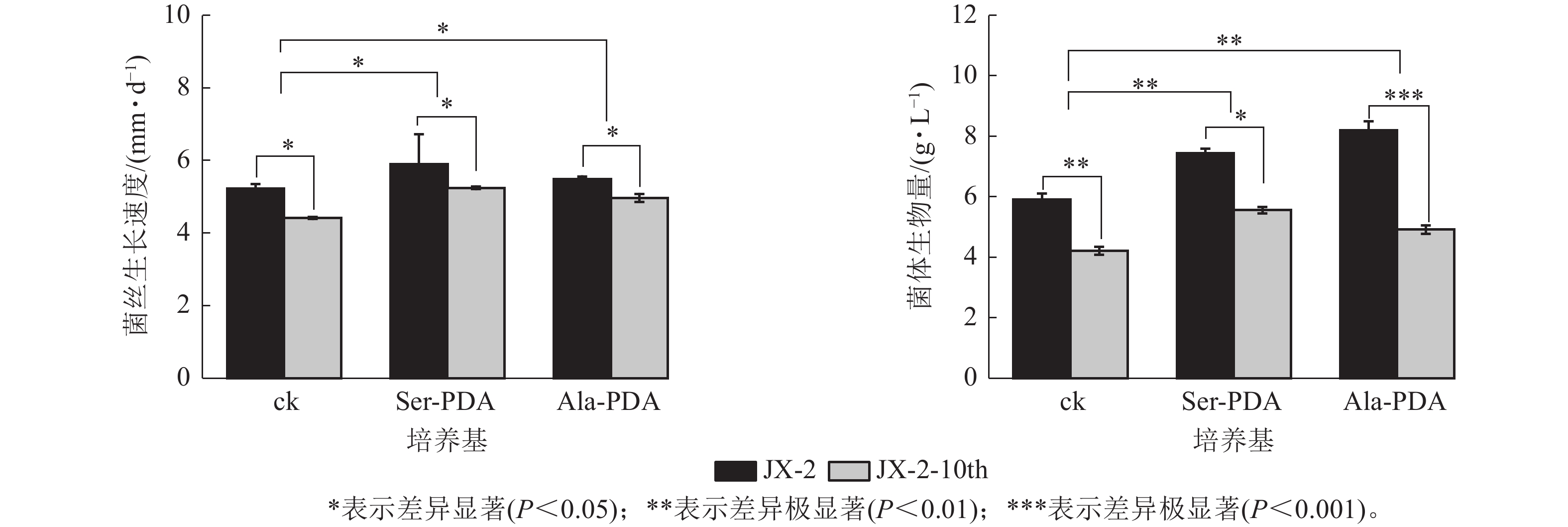
    • 将菌株JX-2分别在PDA(ck)、Ser-PDA、Ala-PDA中继代培养10代,获得多次传代菌株JX-2-10th,比对JX-2与JX-2-10th的生长速度、生物量,结果如图1所示。在PDA中继代培养10代菌株后,菌丝生长速度、生物量显著下降(P<0.05),分别降低了15.45%、28.67%。在添加Ser、Ala的培养基中进行继代培养的JX-2-10th菌株的菌丝生长速度和生物量较JX-2虽有所降低,但优于ck,菌丝生长速度分别提高7.14%、4.76%,生物量提高37.50%、22.50%,均达到差异显著水平(P<0.05)。上述结果表明多次传代后秀珍菇菌株的菌丝体生理指标出现退化特征,但Ser、Ala的添加,能够一定程度上减缓菌株传代过程中的退化现象。

      Figure 1.  Effects of Ser and Ala on mycelial growth rate and biomass of P. pulmonarius during subculturing

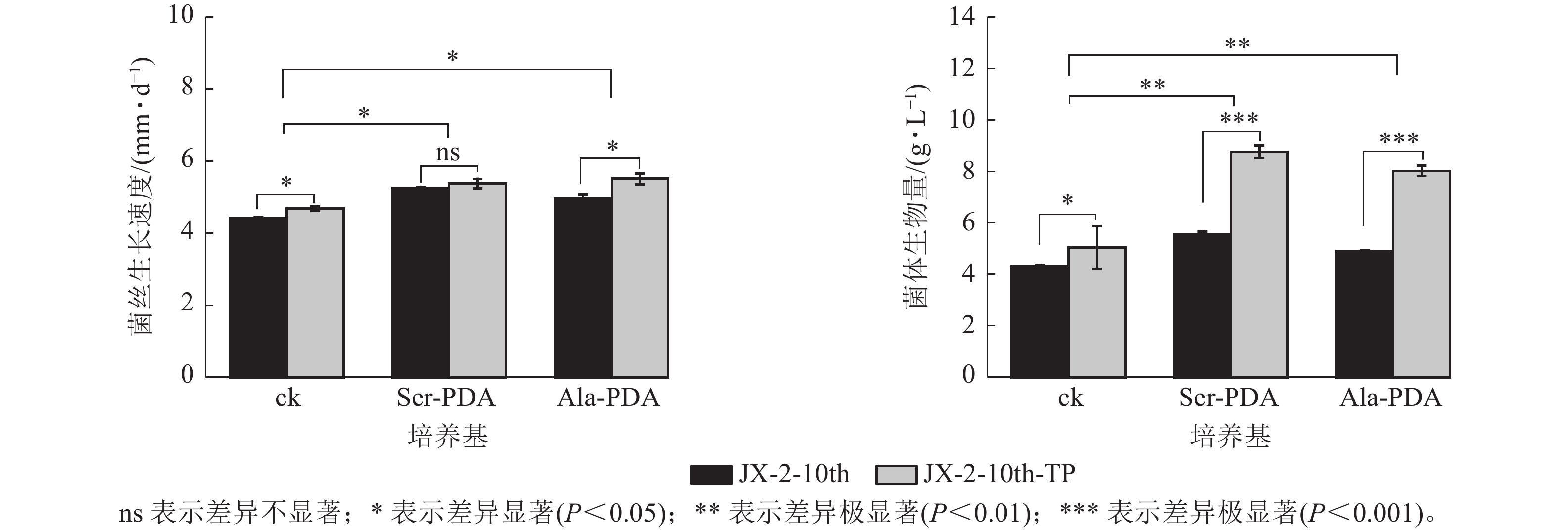
    • 对JX-2-10th进行尖端纯化获得复壮菌株JX-2-10th-TP。由图2可知:在PDA培养基(ck)中纯化菌株菌丝的生长速度及生物量分别提高了6.12%、17.17%;在Ser+PDA培养基中菌丝生物量较纯化前提高了57.77% (P<0.01);在Ala-PDA培养基中纯化菌株菌丝生长速度及生物量较JX-2-10th均显著提高(P<0.05),分别提高了10.98%、63.26%。在Ser-PDA和Ala-PDA培养基中,菌丝生长速度分别是ck的1.18、1.23倍,生物量是ck的1.69、1.57倍。由此可见,尖端纯化能够在一定程度上恢复退化菌株菌丝生长速度和生物量,添加Ser或Ala的培养基恢复效果优于ck,且在Ala-PDA培养基中效果最佳。
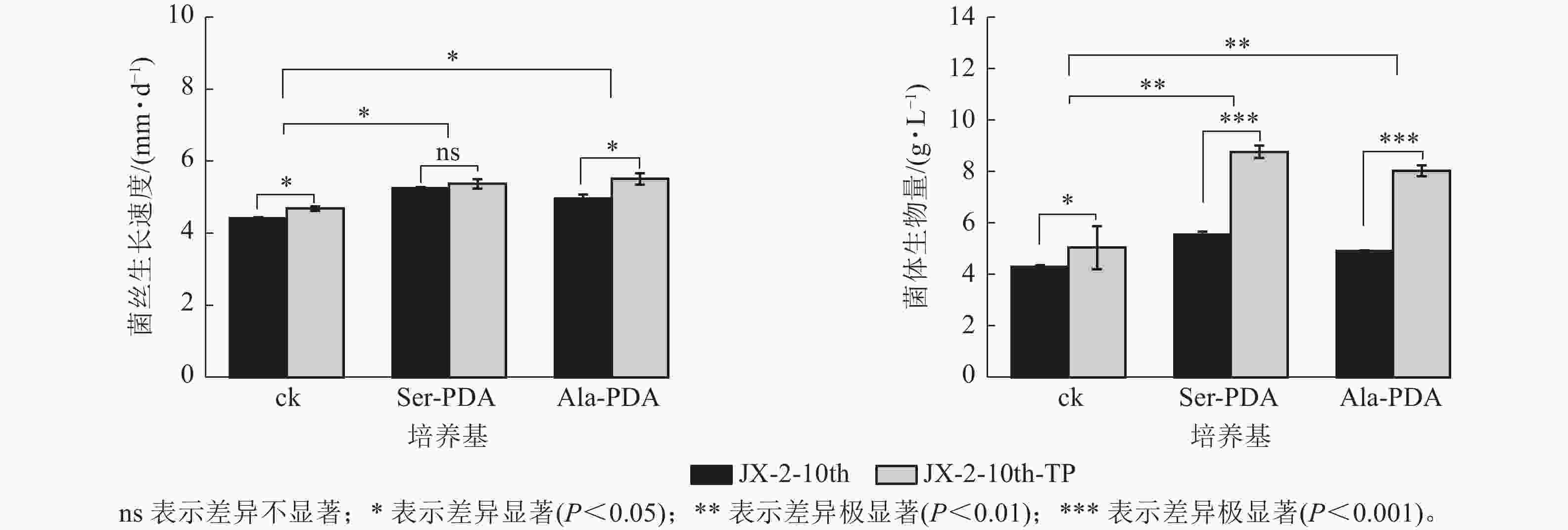
      Figure 2.  Effects of Ser or Ala on growth rate and biomass of mycelia after tip-purified

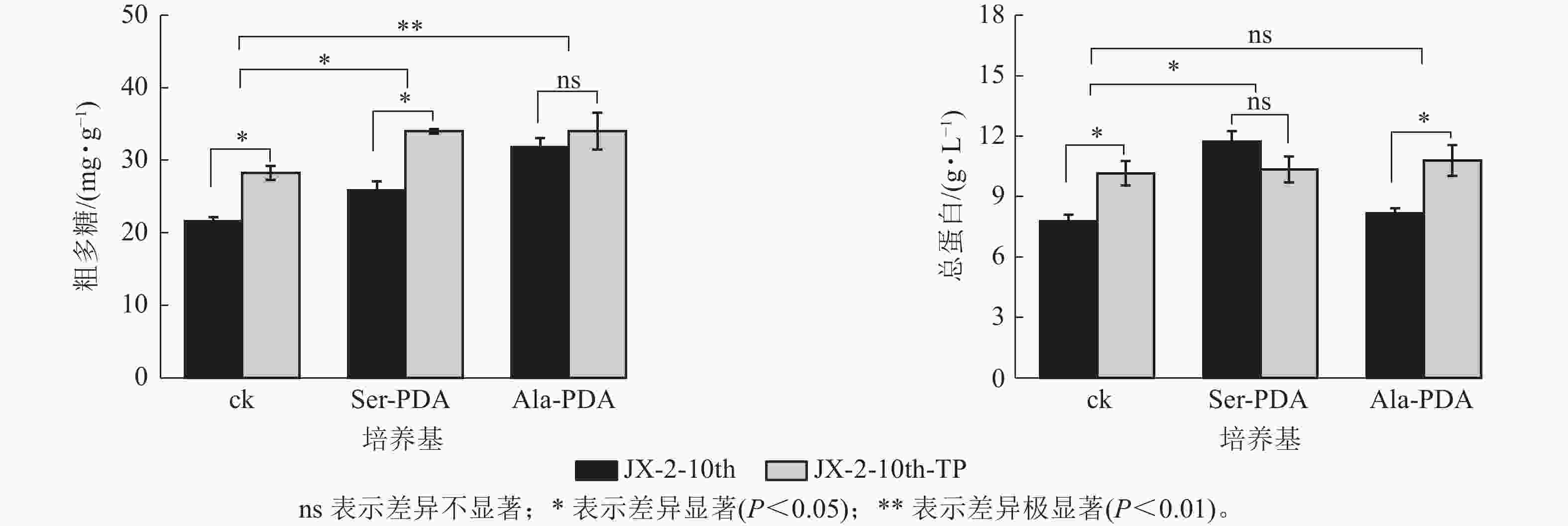
    • 图3所示:在PDA培养基(ck)中,复壮后菌株JX-2-10th-TP菌丝粗多糖质量分数比复壮前菌株JX-2-10th提高30.66% (P<0.05);在Ser+PDA培养基中,JX-2-10th-TP菌丝的粗多糖质量分数较复壮前提高31.52%(P<0.05);在Ala+PDA培养基中,复壮后菌丝的粗多糖质量分数虽然有所提升,但未达到显著水平。表明尖端纯化有助于改善退化秀珍菇菌株粗多糖质量分数降低的现象,且Ser能够促进尖端纯化效果,有效提高秀珍菇菌株中粗多糖。

      Figure 3.  Effects of Ser or Ala on crude polysaccharide and total protein contents of mycelia after tip-purified

      图3所示:JX-2-10th-TP在PDA培养的菌丝总蛋白质量浓度是JX-2-10th的1.31倍(P<0.05);在Ala-PDA培养基中,JX-2-10th-TP的总蛋白质量浓度是复壮前的1.32倍(P<0.05)。Ser-PDA培养基中JX-2-10th-TP总蛋白质量浓度略低于纯化前菌株,但未达到显著水平。说明尖端纯化可能恢复退化秀珍菇菌株总蛋白质量浓度,添加Ala后纯化效果更明显。

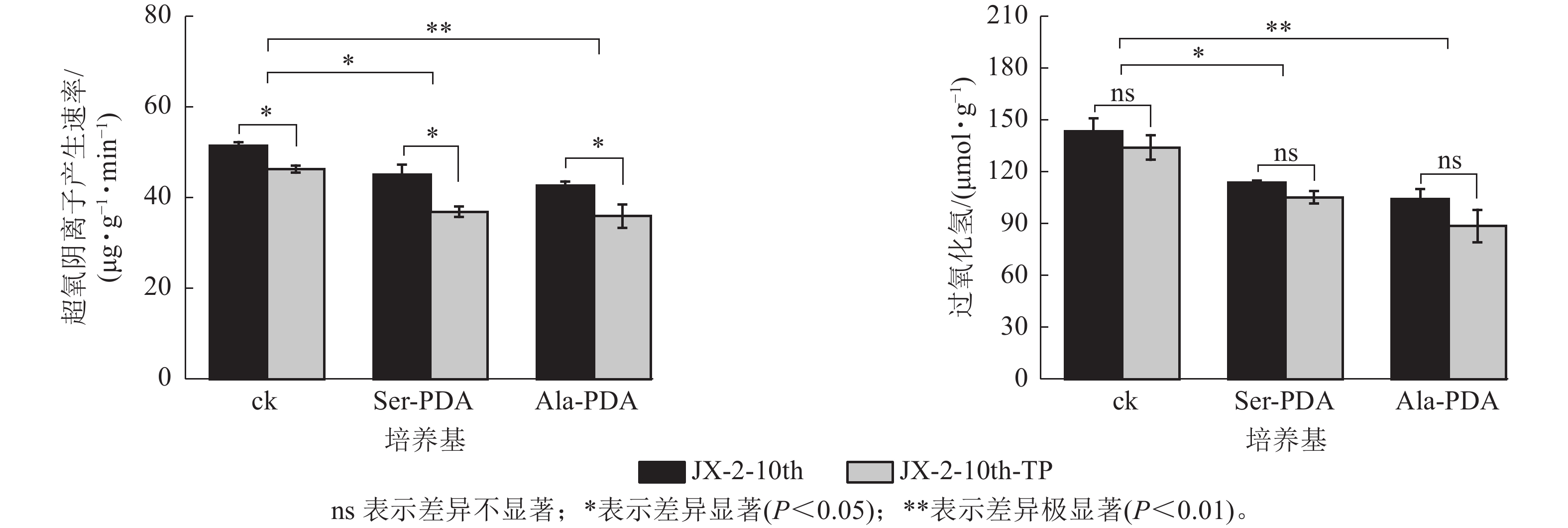
    • 图4所示:在PDA培养基(ck)中,JX-2-10th-TP的菌丝的超氧阴离子产生速率降低了9.90%,显著低于纯化前(P<0.05)。菌丝的H2O2质量摩尔浓度较JX-2-10th降低了6.51%;在Ser-PDA或Ala-PDA培养基中JX-2-10th-TP菌丝的超氧阴离子产生速率较JX-2-10th均显著降低(P<0.05),分别降低18.26%、15.80%。H2O2质量摩尔浓度较JX-2-10th分别降低7.56%、14.89%。说明尖端纯化能够有效改善退化秀珍菇菌株中超氧阴离子和H2O2的积累,且Ser、Ala处理后效果更佳。
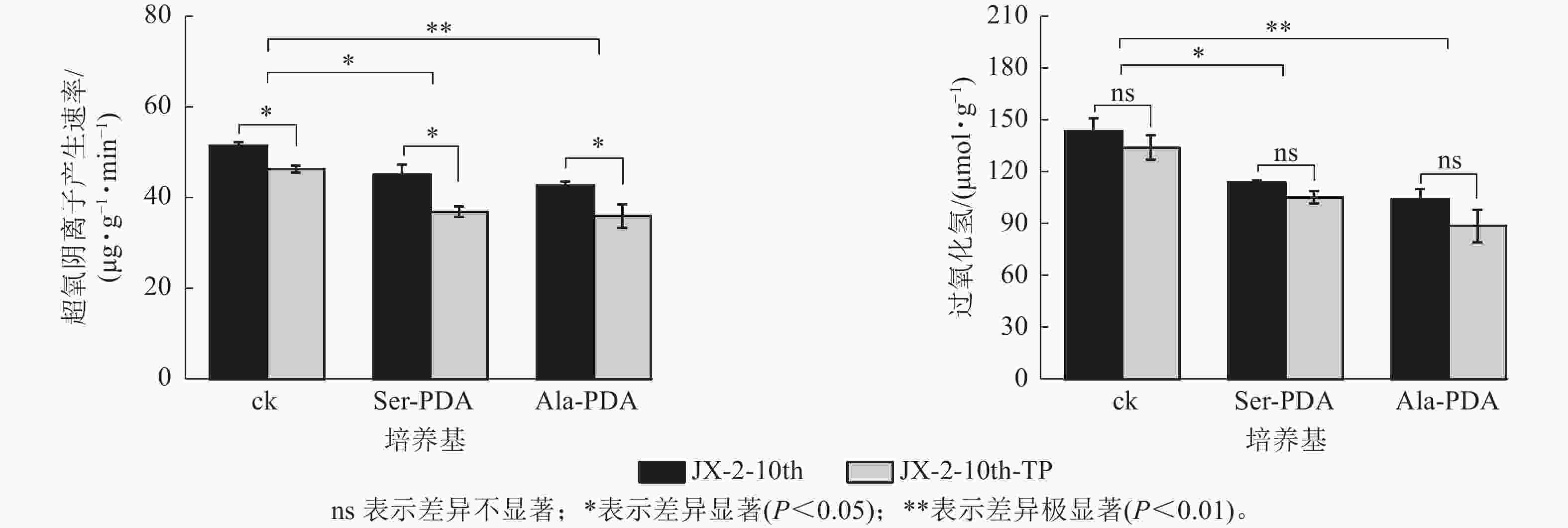
      Figure 4.  Effects of Ser or Ala on superoxide anion generation rate and hydrogen peroxide content of mycelia after tip-purified

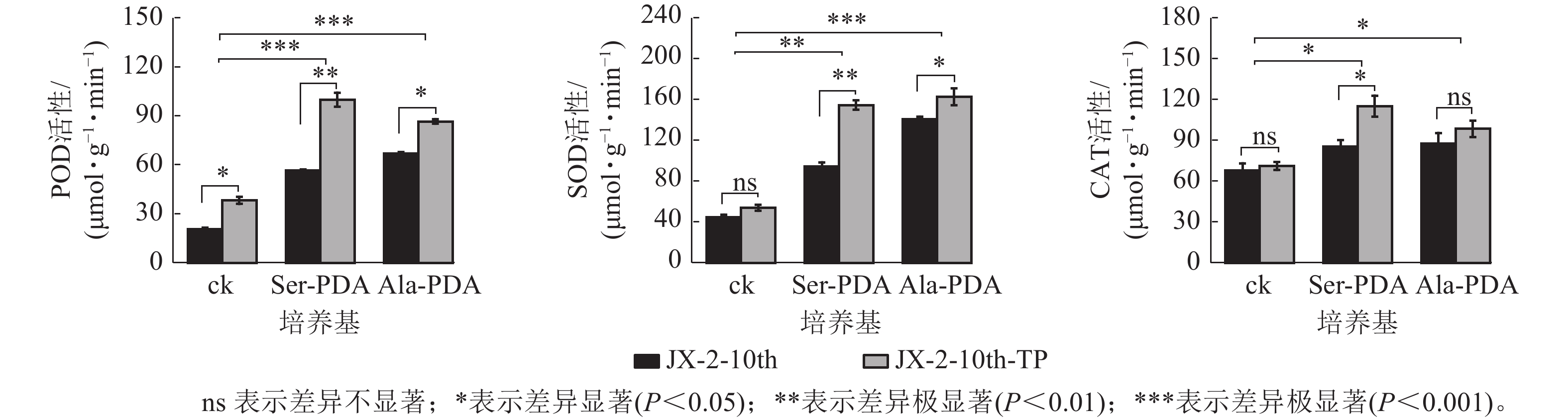
    • 图5所示:POD通过催化机体内过氧化氢发生氧化还原反应,清除体内H2O2。JX-2-10th-TP在PDA (ck)、Ser-PDA和Ala-PDA中培养的菌丝的POD活性均显著提高(P<0.05),分别比纯化前提高了84.20%、78.09%、29.41%。SOD主要通过催化超氧阴离子发生歧化反应,清除机体内积累的超氧阴离子。JX-2-10th-TP在ck的菌丝SOD活性较JX-2-10th提高了20.07%,在PDA+ Ser和PDA+Ala的培养基中,JX-2-10th-TP的SOD活性均显著提高(P<0.05),分别提高了63.70%、15.41%。CAT是主要承担机体内过氧化氢的分解,抑制过氧化氢堆积。JX-2-10th-TP在ck中培养的菌丝的CAT活性较JX-2-10th有所提高;在Ser-PDA培养基中,JX-2-10th-TP的SOD活性显著提高(P<0.05),比JX-2-10th提高34.56%;而在Ala-PDA培养基中,JX-2-10th-TP的SOD活性较JX-2-10th提高了12.56%,但未达显著差异。由上可知,尖端纯化能有效恢复退化秀珍菇菌株的抗氧化酶POD、SOD和CAT活性,且在Ser-PDA或Ala-PDA培养基中恢复效果更佳。
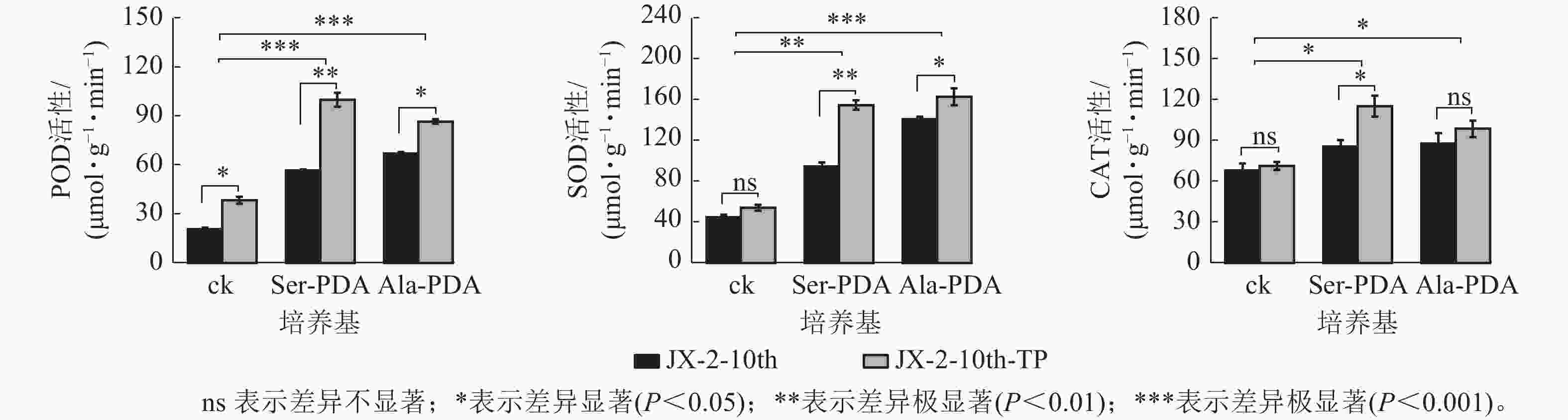
      Figure 5.  Effects of Ser or Ala on antioxidant enzyme activity of mycelia after tip-purified

    • 菌种质量在很大程度上决定了食用菌产量和品质。在工厂栽培时,退化菌种表现出菌丝稀疏、生长速率降低、子实体产量下降、优良性状丢失等现象[2021],严重影响食用菌的经济效益。本研究发现:秀珍菇菌株JX-2连续传代过程中,随传代次数增加,菌丝生长速度减缓,证明多次的继代培养会引起秀珍菇种性的退化。退化菌种不可直接用于生产,改良培养基配方或外源物质的添加,可以在一定程度上延缓菌种退化或恢复已退化性状。许修宏等[22]发现:在液体培养基中添加磷酸二氢钾、维生素B1(VB1)、硫酸镁等外源物质可有效缓解黑木耳Auricularia auricula菌丝老化现象;王静等[23]发现:外源添加硫酸锰可恢复草菇退化菌种的菌丝生长速率和ROS清除能力;张凡红等[24]发现:外源丝氨酸可恢复草菇退化菌株的出菇能力,同时提高生长性状与营养物质含量。本研究通过前期预实验选择对退化秀珍菇菌株生理性状恢复效果最显著的Ser、Ala作为外源添加物质,发现多次传代后菌株退化特征有所缓解,菌丝生长速度、生物量较对照均显著提高,且Ser的提高效果更明显,证明Ser、Ala的添加可以延缓秀珍菇菌株生理性状的退化。此外也发现尖端纯化能够有效恢复退化秀珍菇菌株的生理指标,且在培养基中添加Ser、Ala后秀珍菇复壮菌株的生长速度及生物量的恢复效果更佳,纯化效果更明显。

      食用菌中含有丰富的营养物质,菌种退化在一定程度上影响其营养物质含量[25]。多糖、蛋白是秀珍菇主要营养成分,秀珍菇菌丝体多糖对酒精性肝损伤有预防和保护效果[26];食用菌菌丝体蛋白质含量可与肉类媲美,且菌类蛋白在生产速度与经济效益上更具优势[27]。本研究表明:尖端纯化能够恢复秀珍菇菌株粗多糖及总蛋白含量,且在Ser-PDA培养基中,尖端纯化菌丝的粗多糖含量恢复效果更佳。Ser可以作为糖代谢途径中的中间产物或调节因子发挥作用。Ser可能参与磷酸戊糖途径,为多糖合成提供了重要的前体物质,如核糖-5-磷酸等[28]。这些前体物质进一步转化为合成多糖所需的单糖,从而促进粗多糖的合成。在Ala-PDA培养基中,尖端纯化菌丝的总蛋白含量恢复效果更佳。Ala是组成蛋白质的基本氨基酸之一,直接参与蛋白质的生物合成过程。培养基中添加Ala为蛋白质合成提供了充足的原料,有利于提高蛋白质含量。此外,Ala在细胞代谢中还可以调节代谢流,为蛋白质合成提供有利的代谢环境。Ala可以通过参与转氨基作用,将氨基转移给其他酮酸,生成新的氨基酸,从而维持细胞内氨基酸的平衡,保证各种氨基酸都能充足供应,以满足蛋白质合成的需要。同时,Ala代谢产生的能量和中间产物也可为蛋白质合成过程提供能量和物质支持。

      ROS堆积是造成菌种退化的关键因素之一,随菌种退化程度增加,ROS在菌体内积累量上升,对菌株造成生理性毒害,致使菌种发生退化,优良性状丢失。LI等[29]发现在丝状真菌中,菌种多次继代培养后线粒体中ROS积累,造成氧化损伤是菌种退化的重要原因之一。抗氧化酶是ROS清除系统的重要部分,当ROS含量打破机体动态平衡时,抗氧化酶活性提高,清除体内积累的ROS,同时催化有毒物质分解,降低机体受到的氧化损伤[30]。本研究发现:尖端纯化后,有效提高菌株的SOD、POD和CAT活性,ROS含量明显下降;且在Ser-PDA培养基中纯化效果更为明显。Ser和Ala自身具有一定的氧化还原性,可以直接或间接参与细胞内的氧化还原反应。Ser的羟基和Ala的氨基等基团可以与ROS等自由基发生反应,将其转化为相对稳定的物质,从而减轻氧化应激对细胞的损伤。同时,它们的代谢产物也可能参与到细胞内的抗氧化防御网络中,间接提高抗氧化酶的活性[3133]。由此推断,2种氨基酸的添加提供机体抗氧化性,提高ROS清除系统的清除效率,维持体内ROS处于低水平、动态平衡状态。

    • 本研究证实连续多次的继代培养会引起秀珍菇种性的退化,菌株JX-2连续继代培养至第10代时,与初代菌株相比,其菌丝生长速度显著下降15.45%,生物量降低28.67%。Ser、Ala能够一定程度延缓菌种退化,在添加2 g·L−1 Ser或Ala的培养基中继代培养的菌株,相比于对照,菌丝生长速度分别提高7.14%、4.76%,生物量提高37.50%、22.50%。此外,本研究证实尖端纯化能够恢复退化菌株生理指标。在PDA培养基中进行尖端纯化后,菌丝生物量提升17.17%,粗多糖和总蛋白含量分别增加30.66%、30.50%,抗氧化指标也得到显著改善,其中POD活性提高84.20%,SOD活性提升20.07%。在Ser-PDA培养基中,复壮效果更为突出,生物量提升幅度高达57.77%,SOD活性提高63.70%;而在Ala-PDA培养基中,总蛋白含量增加32.01%。本研究可为后续解决秀珍菇菌种稳定性差、易退化的问题提供参考。

Reference (33)

Catalog

    /

    DownLoad:  Full-Size Img  PowerPoint
    Return
    Return