Turn off MathJax
Article Contents

XU Hui, WU Cuiyun, FANG Zhigang, et al. Fruit quality of 5 Prunus simonii cultivars in Aksu Area[J]. Journal of Zhejiang A&F University, 2026, 43(X): 1−11 doi:  10.11833/j.issn.2095-0756.20250268
Citation: XU Hui, WU Cuiyun, FANG Zhigang, et al. Fruit quality of 5 Prunus simonii cultivars in Aksu Area[J]. Journal of Zhejiang A&F University, 2026, 43(X): 1−11 doi:  10.11833/j.issn.2095-0756.20250268

OnlineFirst articles are published online before they appear in a regular issue of the journal. Please find and download the full texts via CNKI.

Fruit quality of 5 Prunus simonii cultivars in Aksu Area

DOI: 10.11833/j.issn.2095-0756.20250268
  • Received Date: 2025-04-24
  • Rev Recd Date: 2025-06-20
  •   Objective  The research aimed to explore the differences of fruit morphological characteristics, fruit appearance, fruit texture and fruit internal quality of five Prunus simonii varieties in Aksu Prefecture, and put forward the excellent Prunus simonii cultivars suitable for Aksu Area.   Method  In 2024, a field experiment was conducted in a P. simonii orchard in Jiamu Town, Wansu County, Aksu Prefecture, Xinjiang. Five 6-year-old cultivars were used to determine and analyze the differences in fruit quality, including fruit appearance, fruit texture, soluble sugar, soluble solids, titratable acid, vitamin C, and sugar-acid components.   Result  In terms of appearance, the average single fruit weight of ‘Konglongdan’ and ‘Weihou’ is 100−120 g, and the other three cultivars are 50−80 g; the L* value and a* value of ‘Weiwang’ were 68.23 and 16.68, respectively, and the fruit color was bright. In terms of nutrition, ‘Weiwang’ had the highest vitamin C content of 0.967 8 mg·g−1 ; the soluble sugar content of ‘Konglongdan’ was the highest, which was 15.37%, and the titratable acid content of ‘Weidi’ was the highest, which was 1.65%. The soluble solids content of ‘Weidi’ was the highest, which was 20.47%. The flavonoids, total phenols and soluble protein of ‘Konglongdan’ were the highest, which were 2.29, 2.75 and 1.44 mg·g−1, respectively. In terms of sugar and acid components, the sugar component is mainly sorbitol accumulation, and the acid component is mainly citric acid accumulation.The fructose, glucose and sorbitol of ‘Fengweihuanghou’ were significantly higher than those of other cultivars (P<0.05), and the sucrose of ‘Weihou’ was 32.83 mg·g−1, which was significantly higher than that of the other four cultivars (P<0.05). The citric acid and ascorbic acid of ‘Weidi’ were significantly higher than those of the other four cultivars (P<0.05), with the contents of 10.03 and 0.34 mg·g−1, respectively. In the acid category, only ‘Weidi’ contains succinic acid, but ‘Fengweihuanghou’ does not contain fumaric acid. The fruit quality was comprehensively evaluated by principal component analysis, and the scores from high to low were ‘Konglongdan’ ‘Weiwang’ ‘Weihou’ ‘Fengweihuanghou’ and ‘Weidi’.   Conclusion  The sugar and acid of ‘Weidi’ are balanced, and the taste is relatively soft, but the fruit is relatively small, so the ranking is relatively backward. From the comprehensive point of view of fruit quality: ‘Konglongdan’ not only has large fruit, but also has high and relatively balanced nutrients, which is more suitable for large-scale planting in Aksu area. [Ch, 5 fig. 6 tab. 37 ref.]
  • [1] LI Luyao, ZHANG Jun, YING Xuebing, XU Haozhe, WANG Zhenyuan, ZHANG Yuting, CHEN Pingmei, ZUO Zhaojiang.  Effects of red film on photosynthetic abilities and fruit qualities in 3 vegetables . Journal of Zhejiang A&F University, doi: 10.11833/j.issn.2095-0756.20240552
    [2] DAI Kunrong, LIU Ya, YU Weiwu, WU Jiasheng, YAN Jingwei.  Physiological response and waterlogging tolerance of rootstocks of 9 Torreya grandis ‘Merrillii’ cultivars under waterlogging stress . Journal of Zhejiang A&F University, doi: 10.11833/j.issn.2095-0756.20250398
    [3] WANG Shuang, DONG Bin, WANG Yiguang, ZHAO Hongbo.  Analysis and evaluation of flower and fruit characteristics of different Prunus mume cultivars . Journal of Zhejiang A&F University, doi: 10.11833/j.issn.2095-0756.20230213
    [4] YANG Yan, TANG Jie, LI Yongjin, TANG Yuxi, LI Lei.  Analysis and evaluation of growth and wood fiber characters of seven poplar clones in southern China . Journal of Zhejiang A&F University, doi: 10.11833/j.issn.2095-0756.20210481
    [5] YAN Liangliang, YUE Kun, SONG Lihua.  Correlation between fruit quality and soil fertility and leaf nutrients of Zizyphus jujuba ‘Lingwuchangzao’ . Journal of Zhejiang A&F University, doi: 10.11833/j.issn.2095-0756.20190462
    [6] DING Shaogang, ZHU Yanran.  Constructing a synthetic evaluation system of hospital out-door environment based on analytic hierarchy process and fuzzy synthetic evaluation . Journal of Zhejiang A&F University, doi: 10.11833/j.issn.2095-0756.2017.06.019
    [7] QIAN Li, ZHANG Chao, QI Peng, YU Shuquan.  Sourcing and evaluating heavy metal pollution in the urban topsoil of Yongkang City . Journal of Zhejiang A&F University, doi: 10.11833/j.issn.2095-0756.2016.03.008
    [8] ZHANG Guanglai, LI Lu, LIAO Wenmei.  Principal component analysis of China's forestry industry competitiveness . Journal of Zhejiang A&F University, doi: 10.11833/j.issn.2095-0756.2016.06.022
    [9] WEN Yue, SU Shuchai, MA Lüyi, WANG Xiangnan, YANG Shaoyan.  Effects of gibberellins on flower bud formation and fruit quality in Camellia oleifera . Journal of Zhejiang A&F University, doi: 10.11833/j.issn.2095-0756.2015.06.006
    [10] AN Xiaoqin, LIAO Kang, SUN Huiying, LIU Juan, LI Yongxian, LIAO Xiaolong, WANG Yun.  Effect of different cultivars pollinating on fruit setting and fruit quality of Armeniaca vulgaris ‘Luntaibaixing’ . Journal of Zhejiang A&F University, doi: 10.11833/j.issn.2095-0756.2013.02.005
    [11] YUE Zhaoyang, ZHAO Bianjian, WANG Yulan, ZHANG Jingwen, ZHANG Xinping, WANG Chengxiang.  Risk analysis of Eulecanium gigantea in Xinjiang . Journal of Zhejiang A&F University, doi: 10.11833/j.issn.2095-0756.2013.01.023
    [12] ZHENG Rong.  Canonical correlation and principal components analysis of different production areas of Dendrocalamopsis oldhami with quality indicators of bamboo shoots and its soil nutrients . Journal of Zhejiang A&F University, doi: 10.11833/j.issn.2095-0756.2012.05.012
    [13] FAN Huai-fu, DU Chang-xia, ZHU Zhu-jun, LI Wen-jun, YANG Li-lin, ZHANG Ying.  Growth,fruit quality and yield of large fruit tomato Lycopersicon esculentum ‘Zheza 204’with root restriction . Journal of Zhejiang A&F University, doi: 10.11833/j.issn.2095-0756.2011.03.001
    [14] YAN Xiao-jie, HUANG Jian-qin, QIU Zhi-min, NURAMINA Rahman, ZHU Min-hua, WU Jia-sen.  Soil physical and chemical properties and fruit quality with grass cover in a Myrica rubra orchard . Journal of Zhejiang A&F University,
    [15] YANG Jian-hua, LI Shu-fang, FAN Zhi-yuan, XI Xue-liang, ZOU Wei-lie, LIU Jiao, PAN Li.  Principal component analysis for major economic characteristics of Carya illinoensis and selection of superior cultivars . Journal of Zhejiang A&F University, doi: 10.11833/j.issn.2095-0756.2011.06.011
    [16] WANG Rong.  Principal component analysis and evaluation of waterfowl habitats along the coastline of Fujian Province . Journal of Zhejiang A&F University, doi: 10.11833/j.issn.2095-0756.2011.03.020
    [17] JIN Xiao-xiao, CHEN Fa-di, CHEN Su-mei, FANG Wei-min.  Nutrition in 20 cultivars of chrysanthemum . Journal of Zhejiang A&F University, doi: 10.11833/j.issn.2095-0756.2010.01.004
    [18] ZUO Ji-lin, GONG Chun, WANG Jian-ping, ZHOU Wen-cai, WEN Qiang, XU Lin-chu.  Evaluation on quality of twenty-five clones of Camellia oleifera Group Gan . Journal of Zhejiang A&F University,
    [19] SHAO Guo-yuan, QIN Guo-xin, WU Yu-kun, JI Kun.  Effects of leaf number on fruit quality of Vitis vinifera in greenhouse . Journal of Zhejiang A&F University,
    [20] QIAN Yin-cai, GU Zhi-kang, YAO Jian-xiang, JIANG Xiao-fan, WANG Bai-po.  Effect of bagging with four types of bags on fruit quality of different varieties of pears . Journal of Zhejiang A&F University,
  • [1]
    YING Xuebing, CHEN Pingmei, LI Luyao, et al. Comprehensive evaluation of Solanum melongena cultivars[J]. Journal of Zhejiang A&F University, 2025, 42(2): 357−364. DOI: 10.11833/j.issn.2095-0756.20240394.
    [2]
    YANG Hongli, LI Jiangui, XU Yeyong, et al.Study on the cold resistance of six varieties of Prunus domestica planted in Aksu,Xinjiang[J]. Xinjiang Agricultural Sciences,2014, 51(10): 1782−1786. DOI: 10.6048/j.issn.1001-4330.2014.10.004.
    [3]
    LIU Weisheng, ZHANG Qiuping, MA Xiaoxue, et al. Fruit scientific research in New China in the past 70 years: plum[J]. Journal of Fruit Science, 2019, 36(10): 1320−1338. DOI: 10.13925/j.cnki.gsxb.Z07.
    [4]
    NICOLÁS-ALMANSA M, RUIZ D, SALAZAR J A, et al. Phenotypic and molecular characterization of new interspecific Japanese plum × apricot hybrids (plumcots)[J]. Scientia Horticulturae, 2023, 318: 112131. DOI: 10.1016/j.scienta.2023.112131.
    [5]
    DONG Fangyuan, WU Lianhe. Research status and development trend of Prunus simonii in Xinjiang[J]. Agriculture and Technology, 2021, 41(20): 67−70. DOI: 10.19754/j.nyyjs.20211030015.
    [6]
    LIU Yaxin, HUANG Wenjing, YANG Shaobin, et al. Effects of ascorbic acid and salicylic acid on the storage properties of Prunus domestica × Armeniaca[J]. Non-wood Forest Research, 2022, 40(4): 90−96. DOI: 10.14067/j.cnki.1003-8981.2022.04.010.
    [7]
    WANG Ruyue, LUO Shasha, ZHEN Ziyi, et al. Study on the characteristics of different maturity of apricot plum Flavor Queen fruit[J]. Acta Agriculturae Zhejiangensis, 2023, 35(12): 2865−2877. DOI: 10.3969/j.issn.1004-1524.20230049.
    [8]
    WANG Ruyue, HU Haifang, LUO Shasha, et al. Fruit quality analysis of Prunus domestica × armeniaca at different harvest maturity levels[J]. Journal of Agricultural Science and Technology, 2025, 27(2): 158−169. DOI: 10.13304/j.nykjdb.2023.0429.
    [9]
    LUO Shasha, WANG Ruyue, ZHEN Ziyi, et al. Effect of pre-harvest moisture treatments on fruit cracking and fruit quality of Prunus domestica × armeniaca ‘Fengweihuanghou’[J]. Non-wood Forest Research, 2024, 42(2): 81−90. DOI: 10.14067/j.cnki.1003-8981.2024.02.008.
    [10]
    BAE H, YUN S K, JUN J H, at al. Assessment of organic acid and sugar composition in apricot, plumcot, plum, and peach during fruit development. Journal of Applied Botany and Food Quality, 2014, 87: 24−29. DOI: 10.5073/JABFQ.2014.087.004.
    [11]
    CHEN Gang, XIAO Lijuan, ZHANG Feng, et al. Main cultivars of apricot and plum in the first division of Xinjiang production and construction corps and corresponding management measures[J]. Yantai Fruits, 2024(2): 23, 29. DOI:10.3969/j.issn.1005-9938.2024.02.011.
    [12]
    LUO Shasha, et al. Effect of irrigation time and amount on cracking rate and quality of apricot plum fruit[J]. Acta Agriculturae Zhejiangensis, 2024, 36(2): 365−372. DOI: 10.3969/j.issn.1004-1524.20221544.
    [13]
    YU Xianghe, LIU Weisheng. Descriptors and Data Standard for Plum[M]. Beijing: China Agriculture Press, 2006.
    [14]
    XU Qiang, MA Quanhui, YAN Fenfen, et al. Genetic variation and analysis of important traits of dried fruits in F1 hybrid jujube[J]. Acta Horticulturae Sinica, 2025, 52(6): 1427−1440. DOI: 10.16420/j.issn.0513-353x.2024-0746.
    [15]
    GAO Junfeng. Experimental Guidance for Plant Physiology[M]. Beijing: Higher Education Press, 2006: 144−199.
    [16]
    XIA Yilei, QIU Qianqian, YANG Zhi, et al. The QTL mapping analysis of fruit total flavonoids and phenols in jujube[J/OL]. Molecular Plant Breeding, 2022-05-06. https://kns.cnki.net/KCMS/detail/detail.aspx?filename=FZZW20220429003&dbname=CJFD&dbcode=CJFQ.
    [17]
    ZHOU Xiaofeng. Genetic Diversity Research Based on Fruit Sugar and Acid of Jujube Germplasm[D]. Ala’er: Tarim University, 2019.
    [18]
    CHEN Wannian. Analysis of SSR Marker Polymorphism in F1 Generation of Jujube ‘Yuhong’ × ‘Jiaocheng 5’ and QTL Local Isation of Fruit Sugar-acid Components[D]. Ala’er: Tarim University, 2024. DOI: 10.27708/d.cnki.gtlmd.2024.000335.
    [19]
    ZHANG Qi, PU Tingting, WANG Yiru, et al. Quality diversity evaluation of different persimmon fruits[J]. Journal of China Agricultural University, 2025, 30(2): 61−71. DOI: 10.11841/j.issn.1007-4333.2025.02.06.
    [20]
    WANG Binbin, LI Na, JIA Manli, et al. Measuring texture quality of mulberry fruit using a texture analyser[J]. Journal of Fruit Science, 2021, 38(11): 2014−2020. DOI: 10.13925/j.cnki.gsxb.20200426.
    [21]
    WANG Jiyue, CAO Sen, SHI Denghong, et al. Analysis of texture and quality of fruits with different length in Abelmoschus esculentus (L. ) moench[J]. Northern Horticulture, 2020(21): 1−6. DOI: 10.11937/bfyy.20194756.
    [22]
    ZHAO Xiansheng, QIAN Liping, HE Hongliang, et al. Performance of three Prunus domestica × armeniaca varieties in Hangzhou, Zhejiang Province[J]. China Fruits, 2024(6): 106−109. DOI: 10.16626/j.cnki.issn1000-8047.2024.06.016.
    [23]
    XU Dou. Heredity and Variation Analysis of Fruit Characters in Chinese Dwarf Cherry [Cerasus humilis (Bge. )Sok. ] Hybrid Offspring of Different Fruit Color[D]. Taigu: Shanxi Agricultural University, 2020. DOI:10.27285/d.cnki.gsxnu.2020.000419.
    [24]
    CHEN Yuling, SU Yanxiu, HUANG Zhenyu, et al. Present situation analysis and development suggestions of Prunus domestica × Armeniaca industry in China[J]. China Fruits, 2021(3): 98−100. DOI: 10.16626/j.cnki.issn1000-8047.2021.03.020.
    [25]
    HOU Xuan, YIN Kaihua, NIE Guowei, et al. Analysis and comprehensive evaluation of fruit quality of 39 sweet cherry accessions in Shanxi region[J]. Journal of Fruit Science, 2025, 42(4): 752−764. DOI: 10.13925/j.cnki.gsxb.20240598.
    [26]
    LI Taishan. Yield, Sensory Profile, and Physico-Chemical Quality Attributes of Prunus domestica × Armeniaca ‘Weidi’ Fruits as Affected by Crop Load[D]. Beijing: Chinese Academy of Forestry, 2017.
    [27]
    LI Taishan, DU Gaigai, DIAO Songfeng, et al. Crop load influences the components of sugar, acid and flavor in Prunus domestica × Armeniaca ‘Weidi’[J]. Journal of China Agricultural University, 2017, 22(5): 39−48. DOI: 10.11841/j.issn.1007-4333.2017.05.05.
    [28]
    WU Bin, SU Jinsheng, XING Wenting, et al. Evaluation of sugar and acid quality traits of different passionfruit varieties during coloration period[J]. Journal of Fruit Science, 2024, 41(12): 2532−2542. DOI: 10.13925/j.cnki.gsxb.20240276.
    [29]
    LIN Mei, YAO Zhoulin, WANG Tianyu, et al. A study on the components and characteristics of sugars and acids in 8 hybrid Citrus cultivars[J]. Journal of Fruit Science, 2021, 38(2): 202−211. DOI: 10.13925/j.cnki.gsxb.20200373.
    [30]
    WANG Shuaiting, QIU Yinsheng, MA Weifeng, et al. Effect of water stress on fruit quality of' Guirenxiang' grape at mature stage[J/OL]. Journal of Gansu Agricultural University, 2024-04-28. https://kns.cnki.net/KCMS/detail/detail.aspx?filename=GSND2024042400L&dbname=CJFD&dbcode=CJFQ.
    [31]
    ZHU Yongcong, CUI Zixiao, XU Han, et al. Comparison on fruit quality and flavor of new and fine Litchi cultivars[J]. Journal of Chinese Institute of Food Science and Technology, 2023, 23(6): 327−338. DOI: 10.16429/j.1009-7848.2023.06.033.
    [32]
    GAO Xianyu, ZHANG Faming, BAI Tianqi, et al. Analysis of sugar and acid components of 10 mango cultivars in Yunnan[J]. China Tropical Agriculture, 2019(5): 54−59. DOI: 10.3969/j.issn.1673-0658.2019.05.015.
    [33]
    ZHANG Sumin, YANG Wei, WANG Baisong. Study on sugar and acid components of five mid-late ripening peach cultivars in the field[J]. China Fruits, 2022(11): 59−62,71. DOI: 10.16626/j.cnki.issn1000-8047.2022.11.012.
    [34]
    WANG Tingting, ZHOU Yangguang, ZHU Hongxian, et al. Inheritance of sugar and acid contents in the fruits of triploid hybrids originated from two 2x × 4x crosses with Nadorcott tangor as a female parent[J]. Journal of Fruit Science, 2022, 39(7): 1147−1156. DOI: 10.13925/j.cnki.gsxb.20210674.
    [35]
    LI Yanan, YAN Leiyu, ZHANG Bo, et al. A study on sugar and organic acid components in different apple cultivars[J]. Journal of Fruit Science, 2021, 38(11): 1877−1889. DOI: 10.13925/j.cnki.gsxb.20210209.
    [36]
    DU Gaigai, LI Taishan, DIAO Songfeng, et al. Evaluation of flavor quality in relation to sugars and acids of six Prunus domestica × Armeniaca cultivars[J]. Journal of Fruit Science, 2017, 34(1): 41−49. DOI: 10.13925/j.cnki.gsxb.20160108.
    [37]
    GUO Xiangfeng, XIANG (Jin)(Le| Yue), SHI Guoan, et al. Effects of 1-methylcyclopropene on sugar and organic acid constituents in katy apricot[J]. Storage and Process, 2008, 8(5): 30−33. DOI: 10.3969/j.issn.1009-6221.2008.05.011.
  • 加载中
通讯作者: 陈斌, bchen63@163.com
  • 1. 

    沈阳化工大学材料科学与工程学院 沈阳 110142

  1. 本站搜索
  2. 百度学术搜索
  3. 万方数据库搜索
  4. CNKI搜索

Figures(5)  / Tables(6)

Article views(34) PDF downloads(1) Cited by()

Related
Proportional views

Fruit quality of 5 Prunus simonii cultivars in Aksu Area

doi: 10.11833/j.issn.2095-0756.20250268

Abstract:   Objective  The research aimed to explore the differences of fruit morphological characteristics, fruit appearance, fruit texture and fruit internal quality of five Prunus simonii varieties in Aksu Prefecture, and put forward the excellent Prunus simonii cultivars suitable for Aksu Area.   Method  In 2024, a field experiment was conducted in a P. simonii orchard in Jiamu Town, Wansu County, Aksu Prefecture, Xinjiang. Five 6-year-old cultivars were used to determine and analyze the differences in fruit quality, including fruit appearance, fruit texture, soluble sugar, soluble solids, titratable acid, vitamin C, and sugar-acid components.   Result  In terms of appearance, the average single fruit weight of ‘Konglongdan’ and ‘Weihou’ is 100−120 g, and the other three cultivars are 50−80 g; the L* value and a* value of ‘Weiwang’ were 68.23 and 16.68, respectively, and the fruit color was bright. In terms of nutrition, ‘Weiwang’ had the highest vitamin C content of 0.967 8 mg·g−1 ; the soluble sugar content of ‘Konglongdan’ was the highest, which was 15.37%, and the titratable acid content of ‘Weidi’ was the highest, which was 1.65%. The soluble solids content of ‘Weidi’ was the highest, which was 20.47%. The flavonoids, total phenols and soluble protein of ‘Konglongdan’ were the highest, which were 2.29, 2.75 and 1.44 mg·g−1, respectively. In terms of sugar and acid components, the sugar component is mainly sorbitol accumulation, and the acid component is mainly citric acid accumulation.The fructose, glucose and sorbitol of ‘Fengweihuanghou’ were significantly higher than those of other cultivars (P<0.05), and the sucrose of ‘Weihou’ was 32.83 mg·g−1, which was significantly higher than that of the other four cultivars (P<0.05). The citric acid and ascorbic acid of ‘Weidi’ were significantly higher than those of the other four cultivars (P<0.05), with the contents of 10.03 and 0.34 mg·g−1, respectively. In the acid category, only ‘Weidi’ contains succinic acid, but ‘Fengweihuanghou’ does not contain fumaric acid. The fruit quality was comprehensively evaluated by principal component analysis, and the scores from high to low were ‘Konglongdan’ ‘Weiwang’ ‘Weihou’ ‘Fengweihuanghou’ and ‘Weidi’.   Conclusion  The sugar and acid of ‘Weidi’ are balanced, and the taste is relatively soft, but the fruit is relatively small, so the ranking is relatively backward. From the comprehensive point of view of fruit quality: ‘Konglongdan’ not only has large fruit, but also has high and relatively balanced nutrients, which is more suitable for large-scale planting in Aksu area. [Ch, 5 fig. 6 tab. 37 ref.]

XU Hui, WU Cuiyun, FANG Zhigang, et al. Fruit quality of 5 Prunus simonii cultivars in Aksu Area[J]. Journal of Zhejiang A&F University, 2026, 43(X): 1−11 doi:  10.11833/j.issn.2095-0756.20250268
Citation: XU Hui, WU Cuiyun, FANG Zhigang, et al. Fruit quality of 5 Prunus simonii cultivars in Aksu Area[J]. Journal of Zhejiang A&F University, 2026, 43(X): 1−11 doi:  10.11833/j.issn.2095-0756.20250268
  • 杏李Prunus simonii属于蔷薇科Rosaceae李属Prunus植物,营养丰富具有独特的浓郁芳香,且含糖量高于普通杏P. armeniaca、李P. salicina,是受市场欢迎的特色水果之一。2024年,新疆从河南引进‘风味皇后’P. simonii ‘Fengweihuanghou’、‘味帝’P. simonii ‘Weidi’等7个杏李优良品种[13]。其果实比普通杏、李早熟且高产,味道鲜美,经济价值及食用价值较高,树体耐寒、耐旱性良好,适应能力较强[4]。阿克苏土地广阔,光照资源丰富,昼夜温差大,有利于果实营养物质的积累;但目前阿克苏地区杏李种植品种品质参差不齐,导致其发展速度缓慢,使规模化种植受到制约[5]。因此本研究从果实品质方面着手,明确新疆地区优质最适品种。

    果实的外观和营养品质共同决定着果实的经济价值。不同的土壤理化性质对杏李果实可溶性固形物和维生素C等果实品质有明显的提升,对酸度、硬度有降低作用,产量也有所提升[6]。不同的气候环境决定着物候期的变化,随着采收期的推迟,可溶性固形物含量增加、可滴定酸度含量和水分下降、单果质量增加,成熟度的增加,使得单果质量、可溶性固形物、固酸比、质膜透性、红绿值(a*)、黄蓝值(b*)及色角度值(a*/b*)均呈显著上升趋势,亮度(L*)呈显著下降趋势[7];水分含量的高低对果实糖酸、维生素C有着较大影响[89]。以上研究表明不同地区的土壤条件及气候环境对果实品质的影响较大。目前,国内研究者对杏李砧木的选择、开花授粉特性、灌溉、施肥、采收成熟度、储藏、栽培、果实风味、抗寒、防止裂果以及基因等方面做了大量研究[1012],但对于阿克苏地区杏李品种间果实品质比较的研究尚未见报道。

    近年来,阿克苏地区杏李发展前景广阔,本研究以阿克苏地区5个杏李品种为材料,通过对不同杏李品种果实外观、感官、营养品质的全面测定,通过综合评价分析,以期为阿克苏地区筛选出适宜规模化种植的优质杏李品种提供参考依据。

    • 样地位于阿克苏市温宿县佳木镇新疆林业科学院佳木国家重点林木良种基地(41°26′N,80°53′E,海拔1171.0 m),分别选取7年生‘味帝’、‘风味皇后’、‘味王’‘Weiwang’、‘恐龙蛋’‘Konglongdan’和‘味厚’‘Weihou’5个杏李品种为试验材料,每个品种选择长势良好、处于盛果期的试验树3株,每株随机采收30个树冠4个方向上结果主枝中部发育正常的果实。试验地土壤pH为7.1,有机质11.62 g·kg−1,全磷1.22 g·kg−1,全钾3.86 g·kg−1,全铁28.76 g·kg−1,全钙53.01 g·kg−1和全镁14.56 g·kg−1。基地果园栽培管理条件一致,土质为砂壤土,行株距为4 m×3 m,南北行向。分别于2024年7月13日、8月25日、8月27日、9月1日和9月11日进行采样。

    • 用电子秤称量单果质量;用电子数显卡尺测量果实纵径、横径;果皮色泽测定:利用色彩分光色差仪对果皮的色泽进行测定,记录亮度(L*)、红绿值(a*)和黄蓝值(b*),并计算色彩纯度(C)和色角度值( H°)。公式如下:$C=\left(a^{* 2}+b^{* 2}\right)^{1 / 2} $;$H^{\mathrm{\circ}}=a^* / b^* $。

    • 通过参照《李种质资源描述规范和数据标准》[13]对杏李果实形态特征测定要求。对果实形状、果顶形状、梗洼深度、梗洼广狭、缝合线、果实对称性、果粉厚度、果皮底色、果肉色泽、果皮彩色、果面着色程度、核黏离性、核形、核面、果皮剥离难易程度、果肉质地、果肉纤维、果肉汁液、果实风味、果实涩味等进行评价。经10人评价小组成员统一意见后记录。

    • 杏李果实质地品质的测定利用美国Food Technology Corporation公司生产的质构仪(TMS-PRO)进行质构品质相关参数测定,测试条件参照徐强等[14]的测定方法进行质构仪质地剖面分析(texture profile analysis,TPA)分析,略有改动,具体测试条件如下:选用P/2探头(柱形,直径2 mm),测前速度、贯入速度和测后速度设定为60 mm·min−1,TAP模式,形变量20%。测定硬度、内聚性、弹性、胶黏性、咀嚼性、黏附性。

    • 可溶性固形物采用手持ATAGO便携式数显折射仪测定;可溶性糖采用蒽酮硫酸比色法测定[15];可滴定酸采用NaOH酸碱中和滴定法测定[15];维生素C采用钼蓝比色法测定[15];蛋白质采用考马斯亮蓝法测定[15];总酚采用Folin-Ciocalteau法测定[16];黄酮采用芦丁为对照的分光光度法测定[16];糖酸组分的测定采用高效液相色谱法(HPLC)测定,参照周晓凤等[1718]

    • 采用Excel 2019进行数据整理,利用SPSS 25.0和DPS数据分析软件进行方差分析和主成分分析,采用Origin 2018进行图表的绘制。

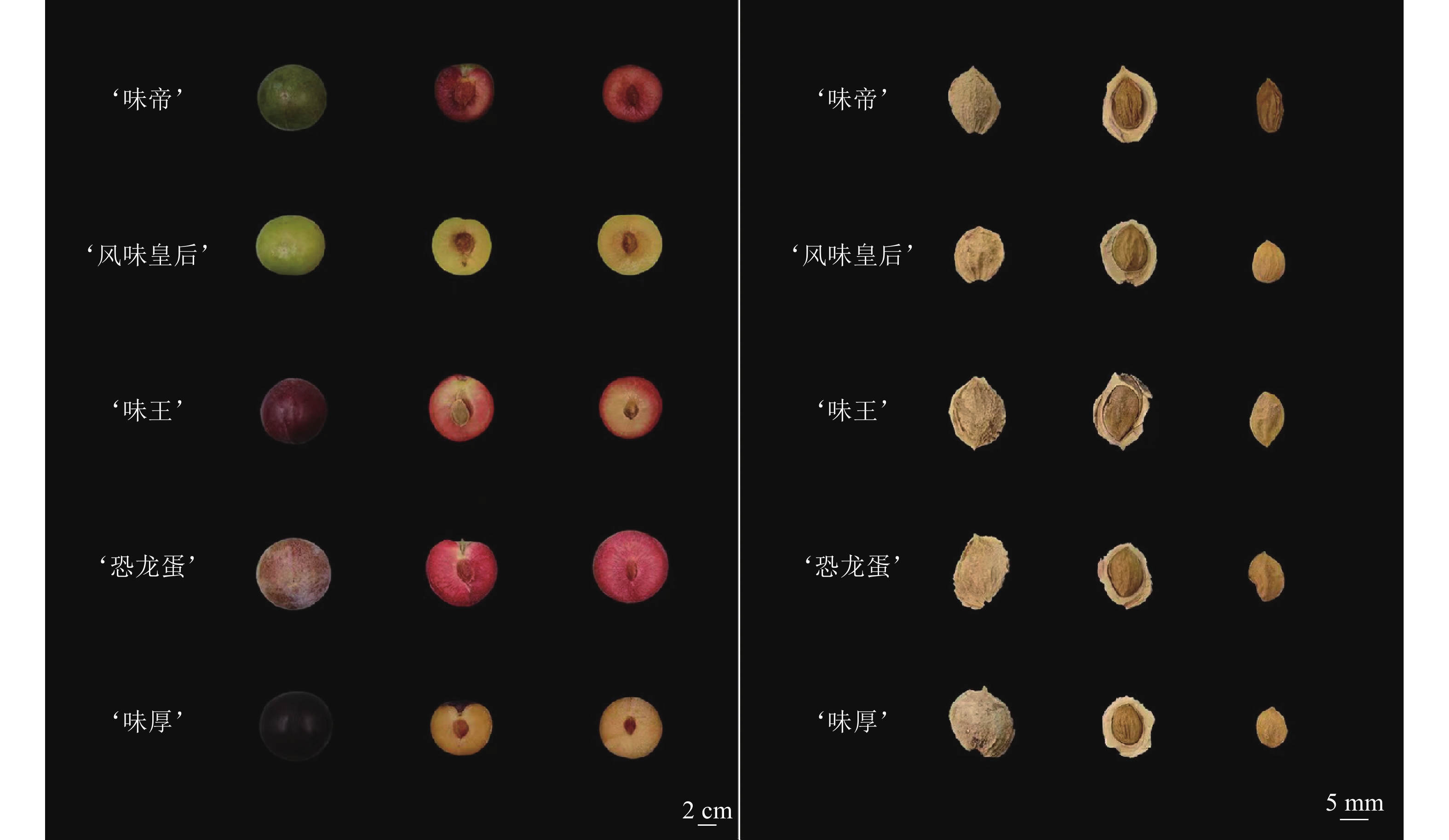
    • 图1表1可知:果形多数为扁圆形、圆形,‘味王’为卵圆形。果顶形状以凹入为主,‘味王’为圆凸,‘恐龙蛋’为平,‘味厚’为尖圆。梗洼深度以深为主,‘味帝’为中,‘风味皇后’为浅;梗洼广狭以广为主,‘风味皇后’为狭,‘恐龙蛋’为中。5个品种果实对称性以对称为主,果实整齐度较好。除‘味王’外,其他品种果粉均薄。多数品种果面大部分着色,果皮底色以绿黄为主,果皮彩色差异较大分为紫黑、橙黄、紫红3种,果肉色泽以紫红、橙黄、紫红为主。果核核黏离程度分为黏核、半离核、离核3种;核形以卵圆形为主,其次为圆形;核面以平滑、较平滑为主,‘味王’表现为粗糙。果皮剥离难易程度均表现为难剥离。
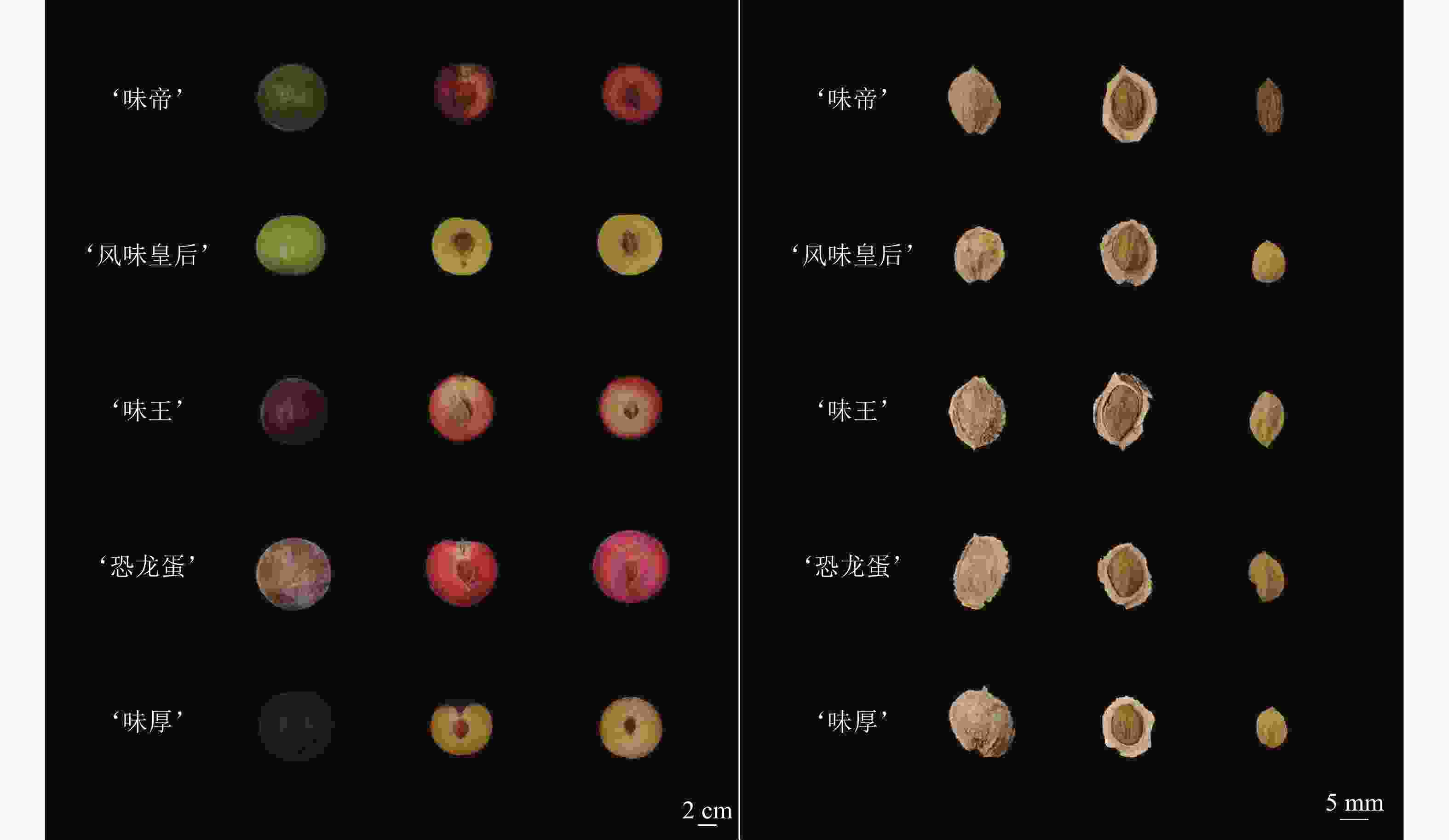
      Figure 1.  Appearance of Prunus simonii fruits and putamen

      品种果实
      形状
      果顶
      形状
      梗洼
      深度
      梗洼
      广狭
      缝合线果实对
      称性
      果粉
      厚度
      果皮
      底色
      果肉
      色泽
      果皮
      彩色
      果面着
      色程度
      核黏
      离性
      核形核面果皮剥离
      难易程度
      ‘味帝’扁圆凹入广对称绿黄紫红紫黑大部分卵圆平滑
      ‘风味皇后’凹入对称绿黄橙黄橙黄大部分卵圆平滑
      ‘味王’卵圆圆凸广对称绿黄紫红紫黑全部卵圆粗糙
      ‘恐龙蛋’对称绿黄紫红紫红大部分半离卵圆较平滑
      ‘味厚’扁圆尖圆广对称黄绿橙黄紫黑全部半离较平滑

      Table 1.  Fruit descriptive characteristics of different Prunus simonii cultivars

    • 表2可知:果肉质地大部分表现为松脆,‘风味皇后’表现为松软,‘味王’表现为硬脆。果肉纤维表现为中或多;果肉汁液大多数表现为多,‘味王’表现为少。所有品种只有‘风味皇后’和‘味厚’具有微香味,涩味无、轻或较,果实风味大部分表现为酸甜味,只有‘风味皇后’风味为甜。

      品种果肉质地果肉纤维果肉汁液果实风味果实涩味果实香味
      ‘味帝’松脆酸甜
      ‘风味皇后’松软
      ‘味王’硬脆酸甜
      ‘恐龙蛋’松脆酸甜
      ‘味厚’松脆酸甜

      Table 2.  Sensory evaluation characteristics of different Prunus simonii cultivars

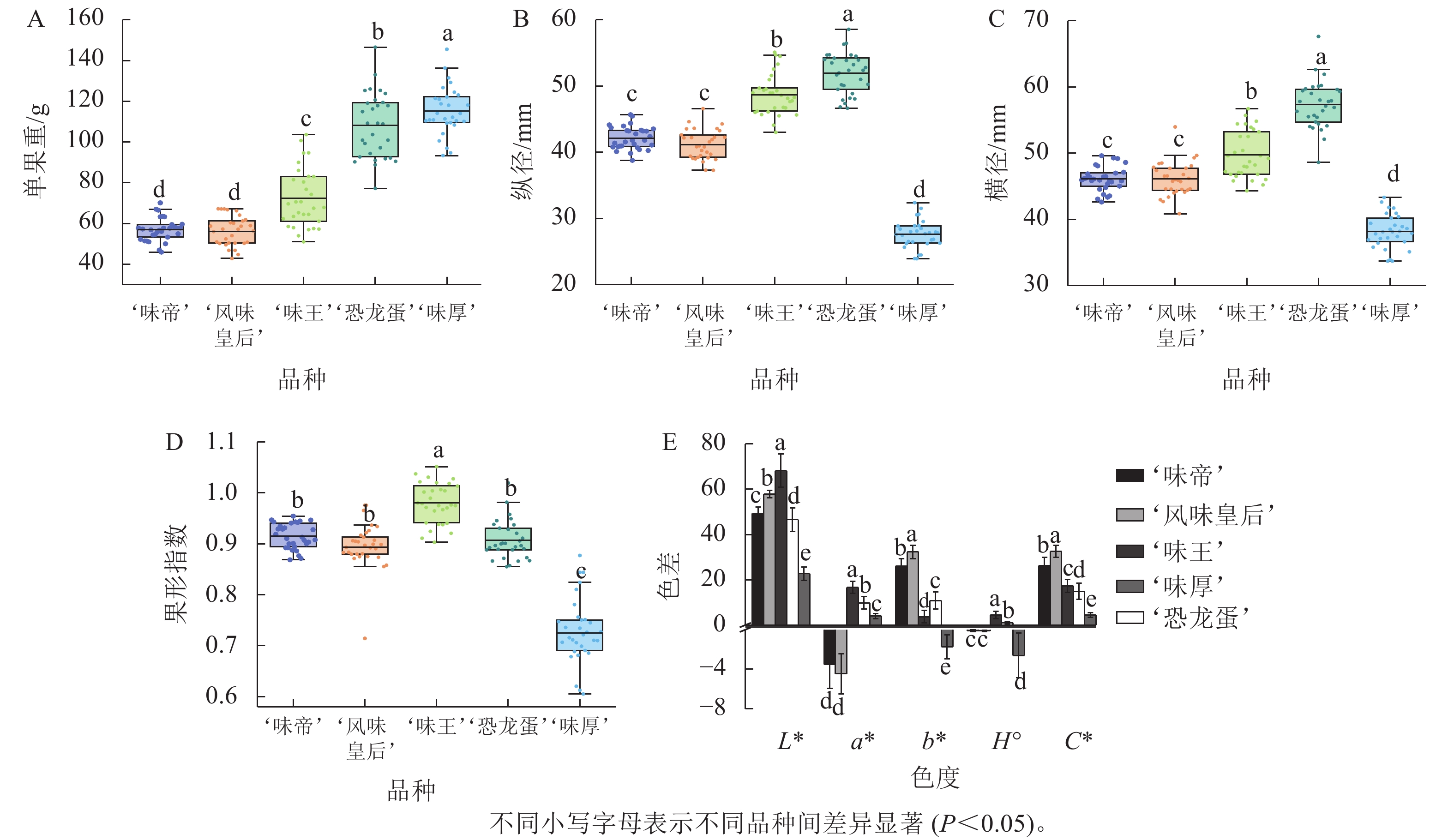
    • 图2A可知:‘味厚’的单果质量分数显著高于其他品种(P<0.05),单果质量为115.23 g。由图2B和2C可知:‘恐龙蛋’的果实纵横径最大,分别为51.94、57.31 mm,均显著高于其他品种(P<0.05)。由图2D可知,‘味王’的果形指数显著高于其他品种(P<0.05),其分别高出7.14%、9.18%、7.14%和25.51%。由图2E可知,在果皮亮度值中,‘味王’的L*显著高于其他品种(P<0.05),达到68.23,亮度最高,‘味厚’最低,为38.19;红色饱和度方面,‘味王’的a*为正,值最高,为16.68,色调偏红,‘味帝’和‘风味皇后’的a*为负,色调偏绿;黄色饱和度方面,‘风味皇后’的b*较高,色调相对偏黄,‘味厚’的b*为负,色调偏蓝;‘味王’的果皮H°显著大于其他品种(P<0.05);‘风味皇后’的C*显著大于其他品种(P<0.05),果皮颜色较纯。
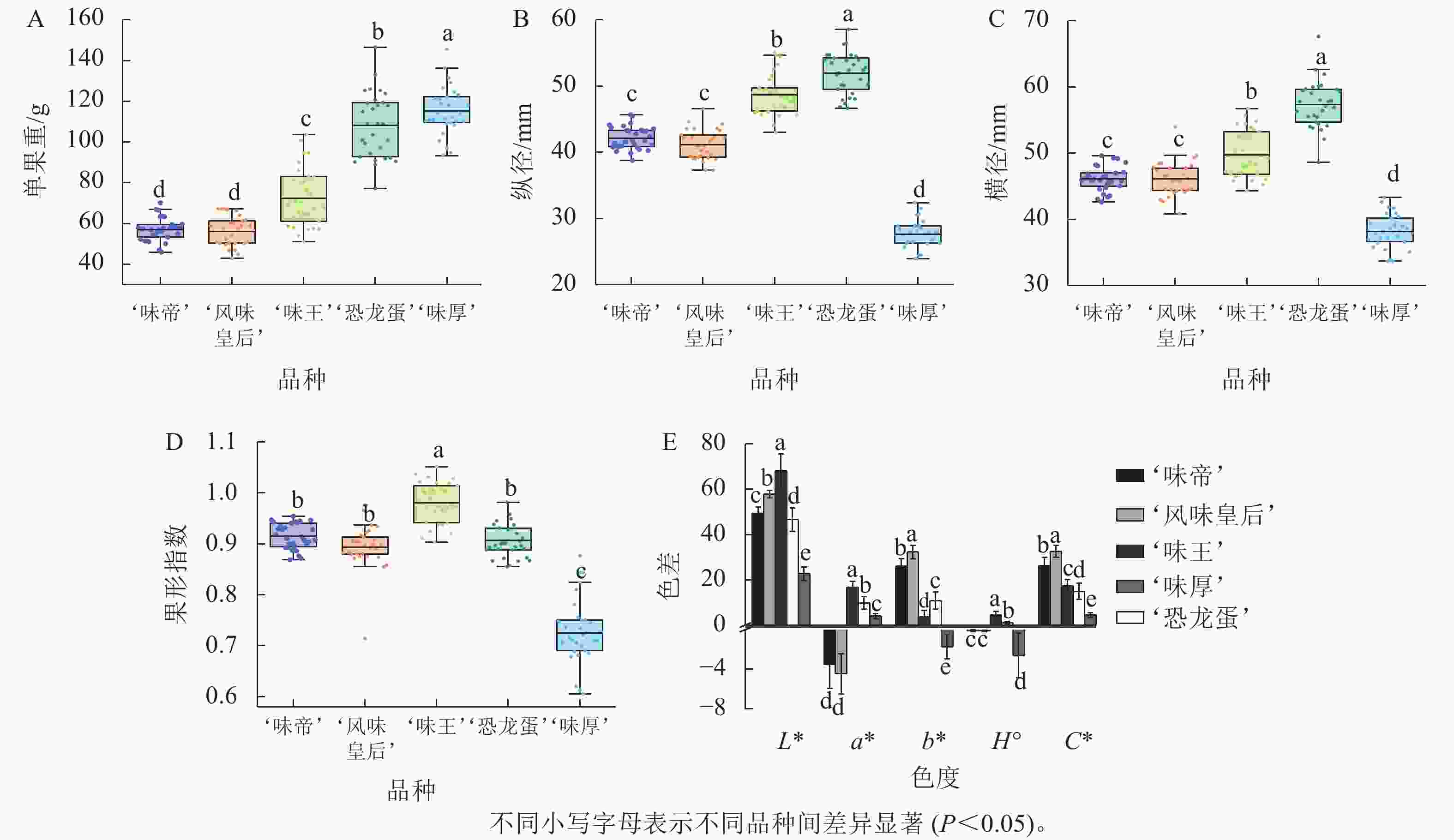
      Figure 2.  Fruit appearance quality of 5 Prunus simonii cultivars

    • 表3可知:所有品种果实硬度均没有明显差异,其中,‘味帝’的硬度最大,为6.11 N。‘ 味厚’的胶黏性和咀嚼性均显著高于‘味王’‘风味皇后’‘味帝’(P<0.05),‘味厚’的弹性和黏附性均显著高于其他品种(P<0.05),但‘味厚’的内聚性显著高于‘味帝’和‘味王’(P<0.05)。内聚性由大到小分别为‘恐龙蛋’‘味厚’‘风味皇后’‘味王’‘味帝’。‘味厚’的弹性最大,为14.79 mm,比‘风味皇后’大47.36%。胶黏性‘恐龙蛋’最大,为1.48 N,‘味帝’最小,为1.04 N。‘味厚’的咀嚼性和黏附性最大,其次为‘恐龙蛋’,‘味厚’比‘味帝’的咀嚼性和黏附性分别大56.51%和72.70%。

      品种 硬度/N 内聚性/ 弹性/mm 胶黏性/N 咀嚼性/mj 黏附性/(N·mm)
      ‘味帝’ 6.11±0.74 a 0.17±0.07 b 8.04±1.34 c 1.04±0.41 b 8.72±4.40 b 1.57±0.49 c
      ‘风味皇后’ 5.89±1.05 a 0.20±0.13 ab 7.49±1.67 c 1.13±0.57 b 9.02±5.67 b 1.85±0.53 c
      ‘味王’ 6.03±1.42 a 0.18±0.06 b 8.58±1.13 c 1.09±0.60 b 9.58±6.11 b 2.94±0.96 b
      ‘恐龙蛋’ 5.71±1.34 a 0.25±0.06 a 12.61±3.47 b 1.48±0.61 a 19.51±11.67 a 3.23±1.51 b
      ‘味厚’ 5.62±1.53 a 0.24±0.05 a 14.79±1.24 a 1.35±0.42 ab 20.05±6.84 a 5.75±2.13 a
        说明:不同小写字母表示不同品种间差异显著(P<0.05)。

      Table 3.  Fruit texture characteristics of 5 Prunus simonii cultivars

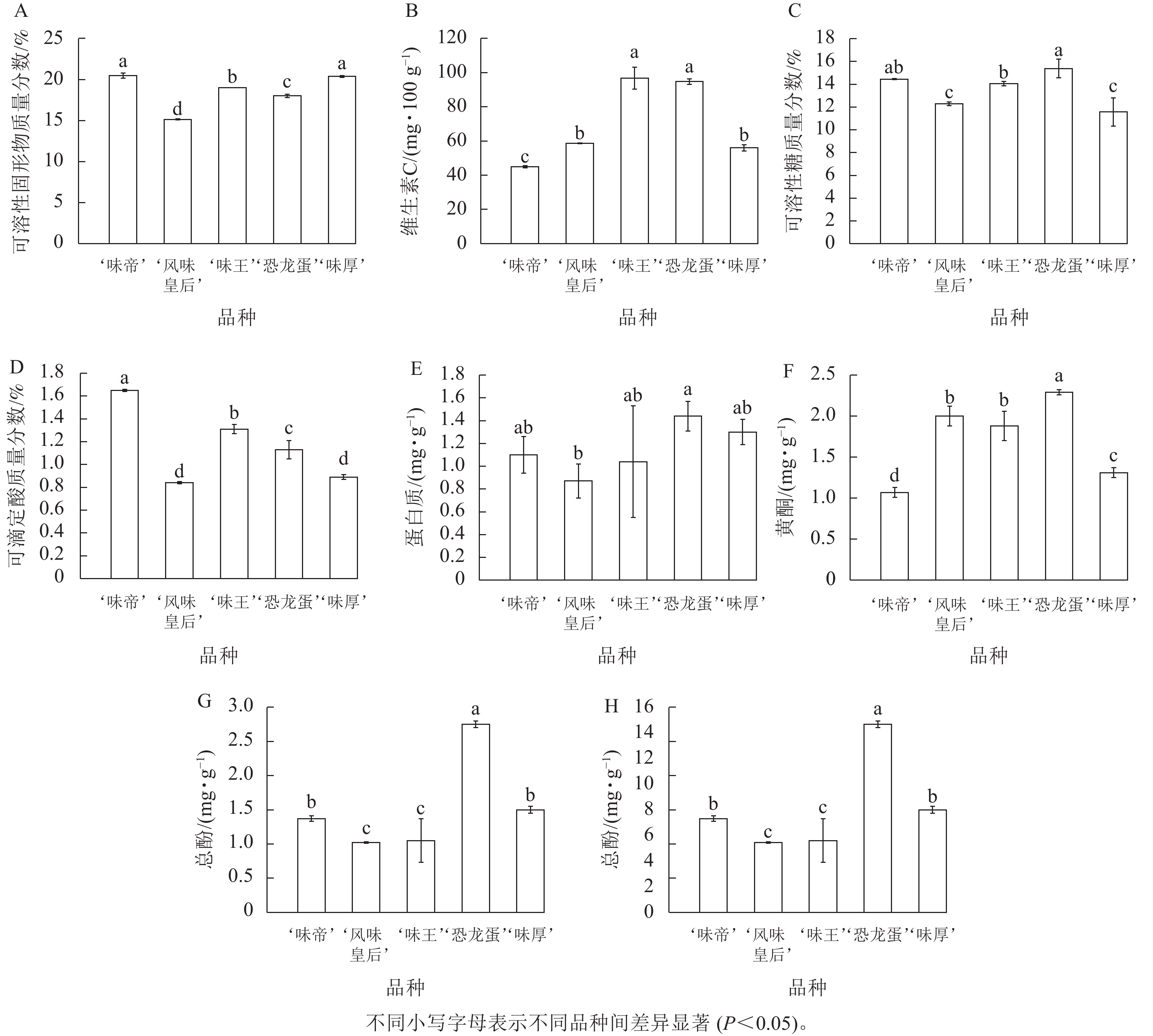
    • 图3A可知:‘味帝’的可溶性固形物质量分数显著高于其他品种(P<0.05)。‘味帝’的可溶性固形物质量分数最大,为20.47%,‘风味皇后’的可溶性固形物质量分数最低,为15.13%。由图3B可知:‘味王’的维生素C质量分数最高,为0.967 8 mg·g−1,‘味帝’的维生素C质量分数最低,为0.449 7 mg·g−1,‘恐龙蛋’的维生素C质量分数显著高于除‘味王’外的其余品种(P<0.05)。由图3C可知:‘恐龙蛋’的可溶性糖质量分数显著高于除‘味帝’外其他品种(P<0.05)。由图3D可知:‘味帝’的可滴定酸质量分数最高,为1.65%。由图3E可知:‘恐龙蛋’的可溶性蛋白质量分数显著高于‘风味皇后’(P<0.05)。由图3F~G可知:‘恐龙蛋’的黄酮和总酚质量分数显著高于其他品种(P<0.05),分别为2.29、2.75 mg·g−1。由图3H可知:‘风味皇后’的糖酸比显著高于其余品种(P<0.05),‘味帝’的糖酸比最低。
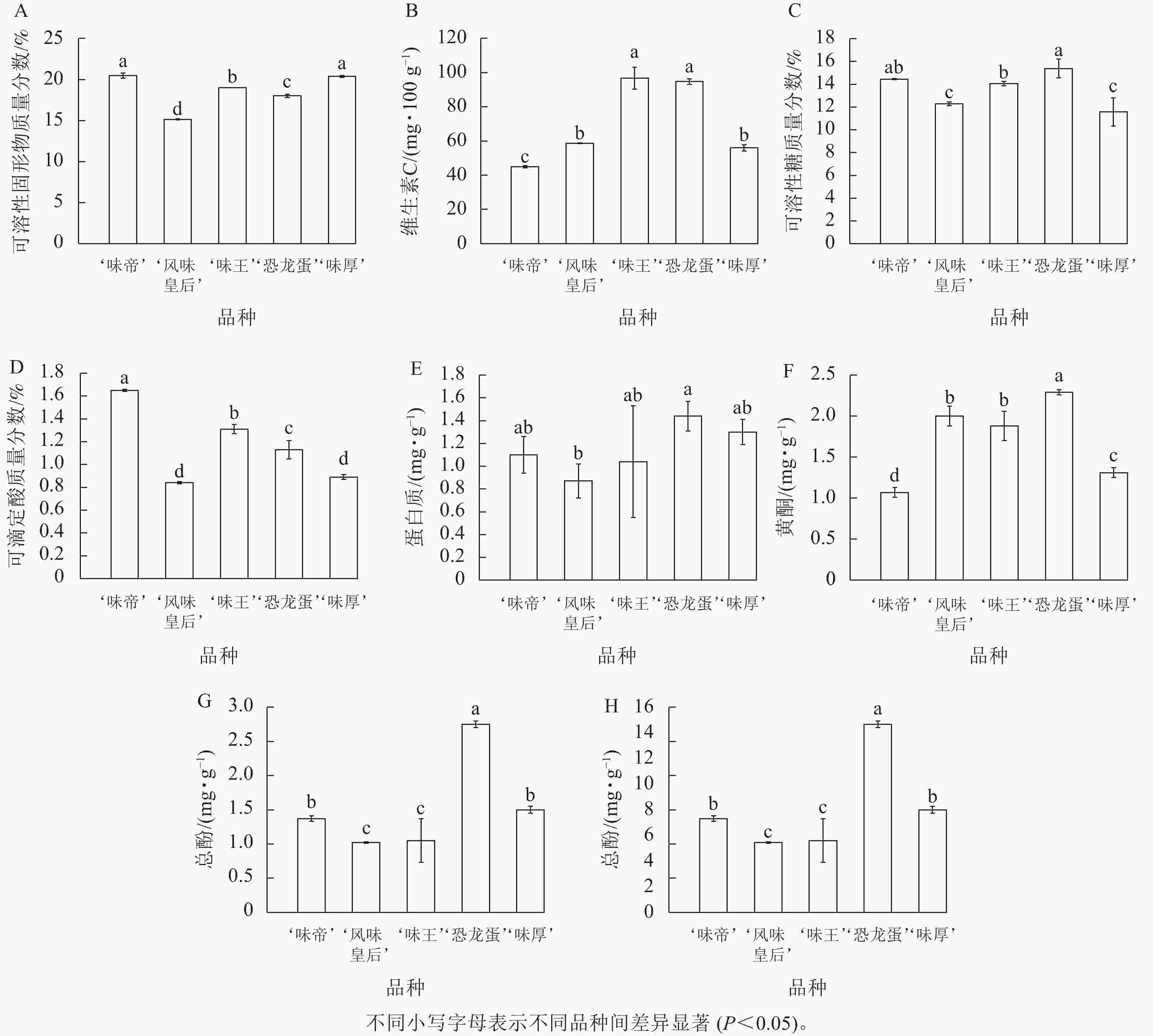
      Figure 3.  Nutritional quality analysis of 5 Prunus simonii cultivars

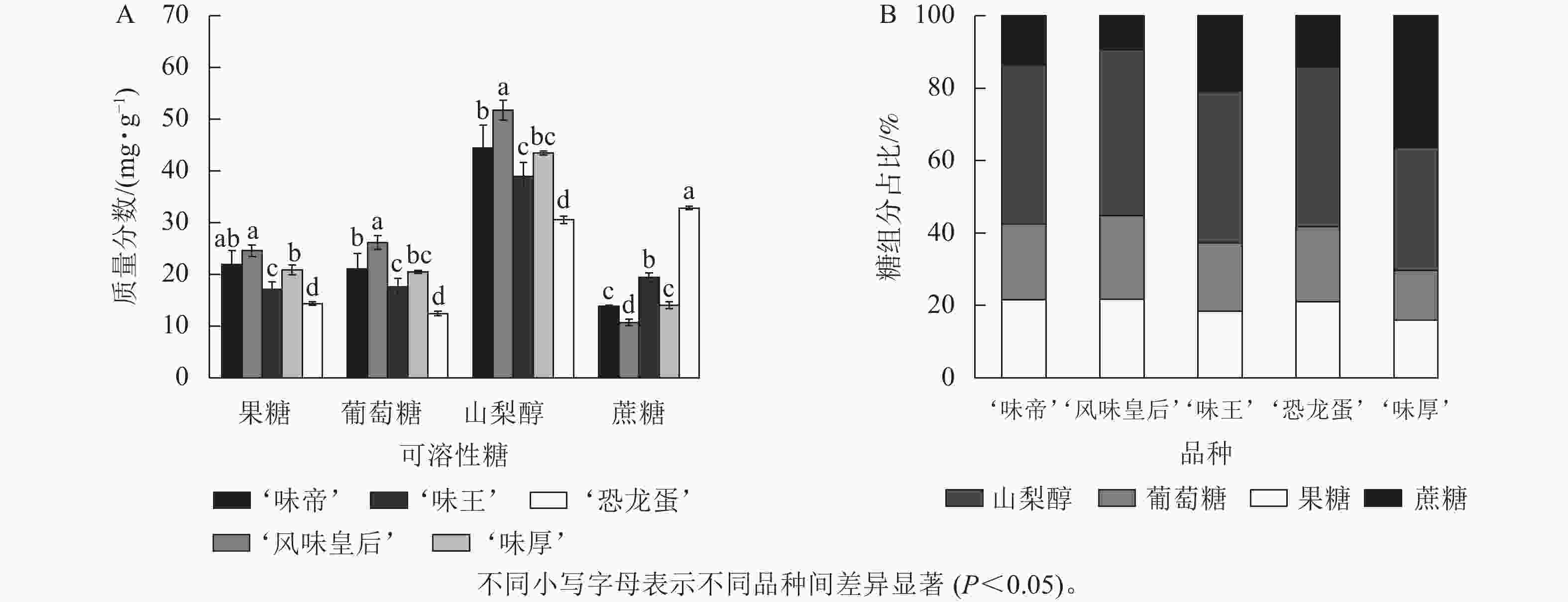
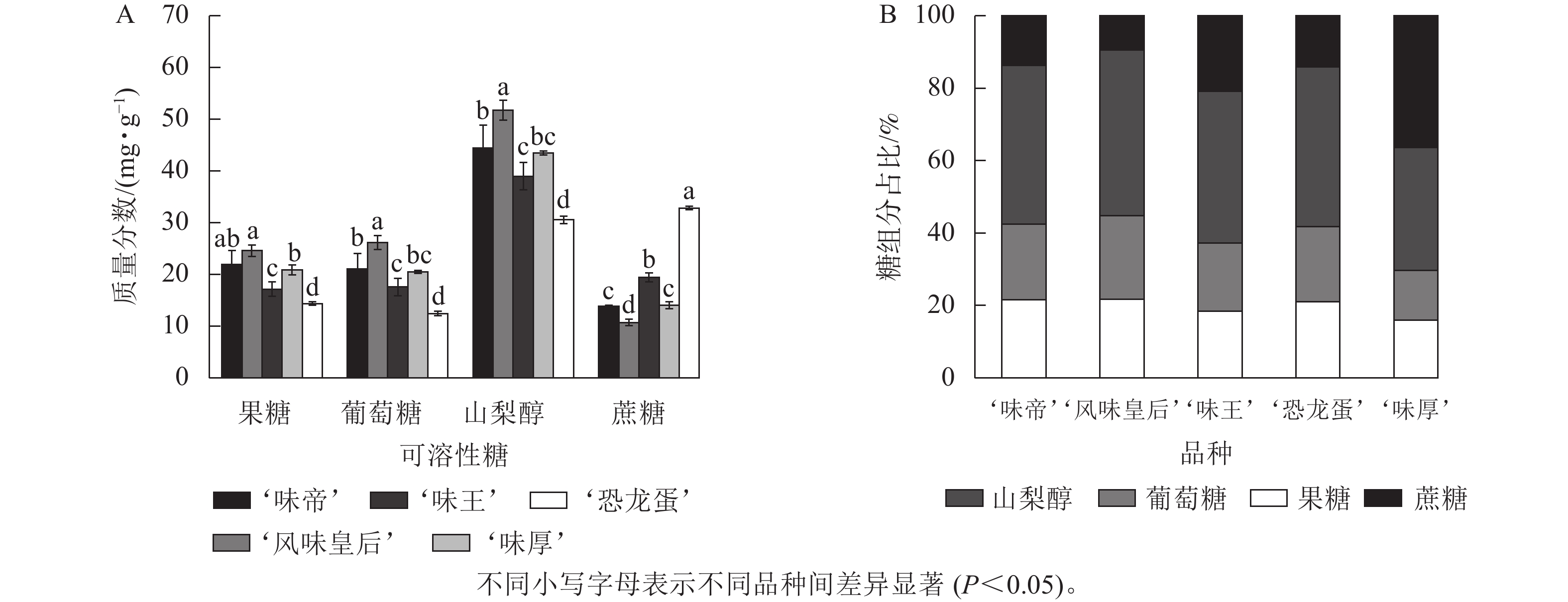
    • 图4A和4B可知:4种糖在5个品种中的质量分数从高到低依次为山梨醇、果糖、葡萄糖、蔗糖,可见这5个品种果实糖组分以山梨醇积累为主。不同品种的4种糖的质量分数不同:‘风味皇后’的果糖、葡萄糖及山梨醇质量分数均显著高于‘味帝’‘味王’‘恐龙蛋’‘味厚’(P<0.05),葡萄糖质量分数分别高出19.30%、32.83%、21.74%和52.39%,山梨醇分别高出14.21%、24.61%、15.93%和40.89%。‘味帝’和‘风味皇后’的果糖质量分数分别显著高出‘恐龙蛋’4.71%、15.14%(P<0.05),分别显著高出‘味厚’34.32%和41.51%(P<0.05)。‘味厚’的蔗糖质量分数显著高于其他品种(P<0.05),为32.83 mg·g−1,‘风味皇后’的蔗糖最低,为10.74 mg·g−1

      Figure 4.  Sugar component content of fruit of 5 Prunus simonii cultivars

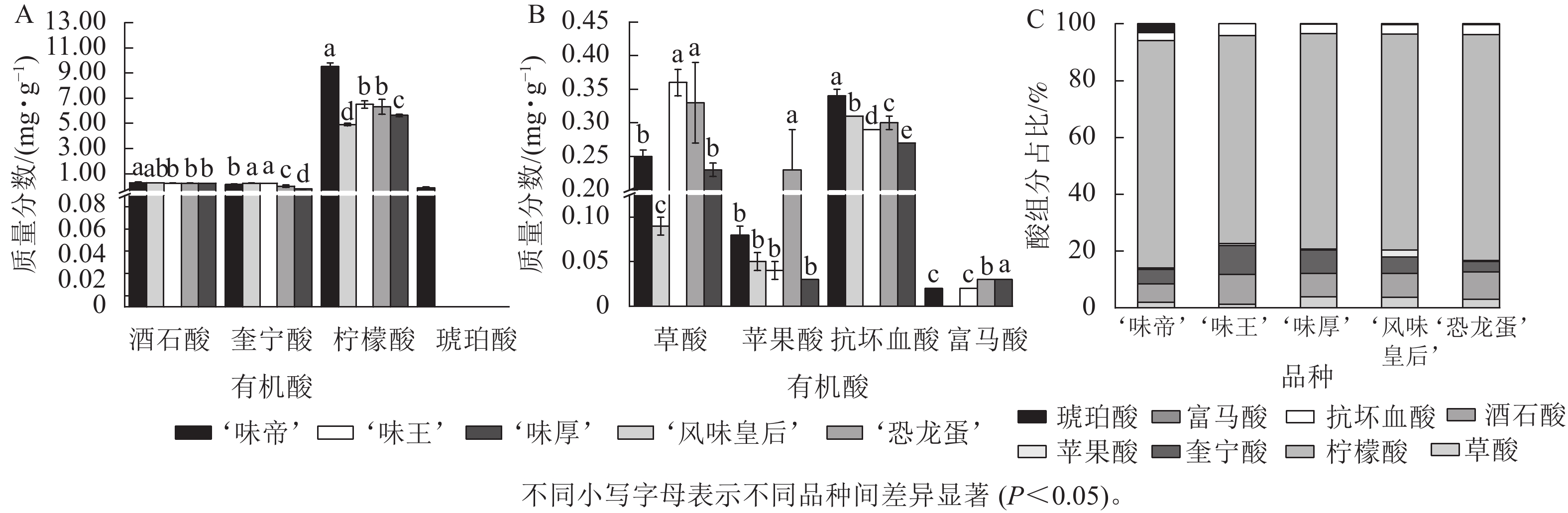
    • 图5A可知:‘味帝’的酒石酸质量分数显著高于除‘风味皇后’外的其他品种(P<0.05),为0.80 mg·g−1;‘味王’和‘风味皇后’的奎宁酸质量分数显著高于其他品种(P<0.05),其中‘风味皇后’的最高,为0.76 mg·g−1;‘味帝’的柠檬酸质量分数显著高于其他品种(P<0.05),为10.03 mg·g−1,‘味王’的柠檬酸质量分数显著最低于其他品种,为0.03 mg·g−1;仅‘味帝’含有琥珀酸。由图5B可知:‘味王’和‘恐龙蛋’的草酸质量分数显著高于其他品种(P<0.05),分别为0.36和0.33 mg·g−1;‘恐龙蛋’的苹果酸质量分数显著高于其他品种,为0.23 mg·g−1;‘味帝’的抗坏血酸质量分数显著高于其他品种(P<0.05),为0.34 mg·g−1;‘味厚’的富马酸质量分数显著高于其他品种(P<0.05);‘味厚’的富马酸质量分数显著高于其他品种(P<0.05),为0.03 mg·g−1,‘风味皇后’未检测到富马酸。由图5C可知:8种酸在5个品种的占比从高到低均依次为柠檬酸、酒石酸、奎宁酸、抗坏血酸、草酸、苹果酸、琥珀酸、富马酸。可以得出这5个品种果实酸组分以柠檬酸为主,柠檬酸平均占比为77.18%。
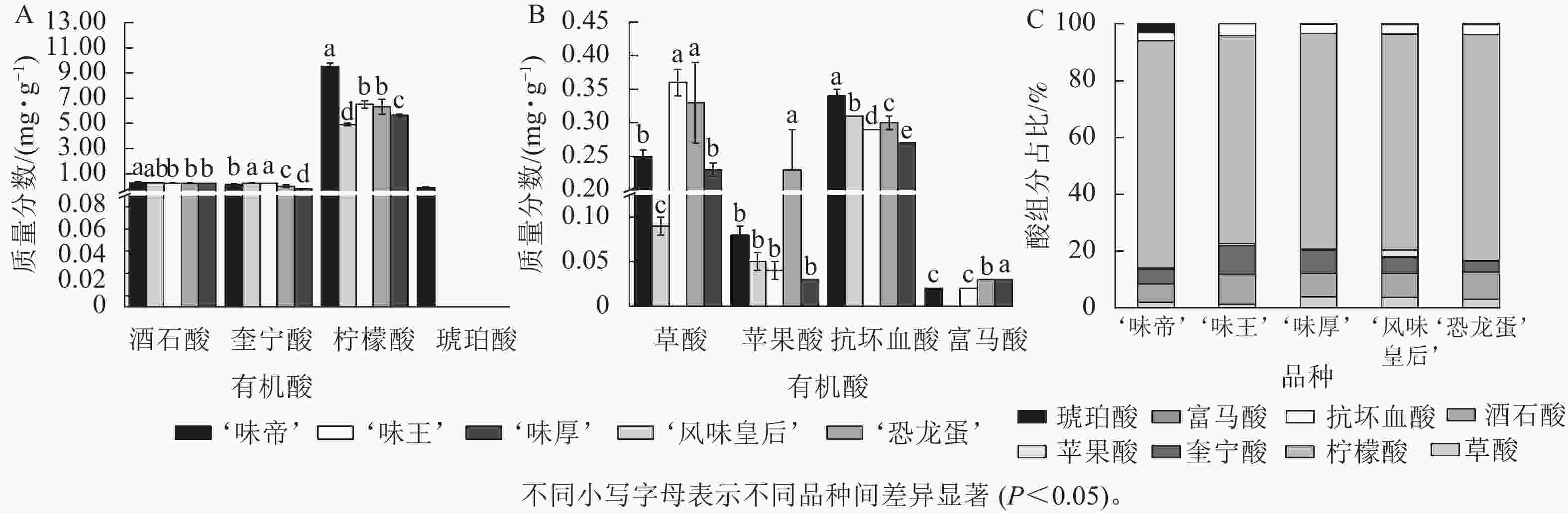
      Figure 5.  Acid group content of 5 Prunus simonii cultivars fruit

    • 对不同品种果实品质的12项主要指标进行主成分(PCA)分析(表4~5)。依据特征值>1的原则,得到3个主成分,根据旋转后成分矩阵的绝对值>0.5作为解释变量,前3个主成分的特征值分别为4.996、3.536和2.923,其累积贡献率达到95.202%,表明前3个主成分基本包含了全部变量的主要信息,因此前3个主成分可用以评价不同杏李品种果实品质的影响。第1主成分包括维生素C、可溶性糖、黄酮、果实纵径、果实横径和果形指数;第2主成分包括可滴定酸、糖酸比和单果质量;第3主成分包括可溶性固形物和蛋白质。以各个主成分对应的方差贡献率为权重,得到综合评价函数:F=(0.413 79/0.952 02)F1+ (0.294 64/0.952 02)F2+(0.243 58/0.952 02)F3。其中,F指不同品种的综合得分值,F1~F3分别指前3个主成分的方差贡献率。计算出不同杏李品种果实品质影响的综合得分和排序(表6),综合得分由高到低分别为‘恐龙蛋’‘味王’‘味厚’‘风味皇后’和‘味帝’。

      主成分 特征值 方差贡献率/% 累积方差贡献率/%
      F1 4.966 41.379 41.379
      F2 3.536 29.464 70.844
      F3 2.923 24.358 95.202

      Table 4.  Principal component eigenvalues

      指标 主成分得分 指标 主成分得分
      F1 F2 F3 F1 F2 F3
      可溶性固形物 −0.125 −0.179 0.505 蛋白质 0.111 0.263 0.487
      维生素C 0.358 0.139 0.002 糖酸比 0.018 0.474 −0.255
      可溶性糖 0.387 −0.174 0.201 单果质量 −0.007 0.407 0.362
      可滴定酸 0.120 −0.458 0.248 果实纵径 0.433 −0.117 −0.075
      黄酮 0.331 0.277 −0.245 果实横径 0.443 0.016 0.002
      总酚 0.252 0.268 0.331 果形指数 0.341 −0.294 −0.186

      Table 5.  Rotating load matrix of principal component analysis of fruit quality

      品种 主成分得分 F 排序
      F1 F2 F3
      ‘恐龙蛋’ 2.979 1.663 1.044 1.977 1
      ‘味王’ 1.224 −1.189 −0.522 0.029 2
      ‘味厚’ −2.951 1.614 1.224 −0.448 3
      ‘风味皇后’ −0.639 0.566 −2.784 −0.776 4
      ‘味帝’ −0.613 −2.654 1.039 −0.783 5

      Table 6.  Principal component analysis score, comprehensive score and ranking of fruit quality

    • 果实外观、口感、质地特性是评价水果品质的重要指标[1921]。本研究发现:杏李品种‘恐龙蛋’果实纵横径最大,与赵贤生等[22]研究相似。‘味王’果形指数最大,形状为卵圆形,与原引进区有微小变化,徐豆[23]研究认为欧李 Cerasus humilis果实大小是受微效多基因控制的数量性状,果实色差在品种上差别较大,这与陈玉玲等[24]研究结果相似,这些变化可能是由不同的生态环境对其影响所造成的,充足的光照对果实色泽和饱满度影响巨大,砂壤土和栽培方式使得果实大小出现变化。

      杏李鲜甜可口、营养物质丰富,对身体健康大有裨益[25]。本研究中,5个杏李的可溶性固形物质量分数为15.13%~20.47%,可溶性糖质量分数为11.57%~15.37%,可滴定酸质量分数为0.84%~1.65%,维生素C质量分数为0.449 7~0.947 6 mg·g−1,黄酮质量分数为1.07~2.29 mg·g−1,总酚质量分数为1.02~2.75 mg·g−1,蛋白质质量分数为0.87~1.44 mg·g−1。其中,可溶性固形物、可溶性糖、可滴定酸质量分数与李泰山等[2627]的研究结果不同,营养品质上的差异可能是由生长环境的土壤及气候条件所导致,由于南疆地区昼夜温差大、降水少、土壤结构复杂等诸多因素导致果实营养丰富。与已有研究结果[912]相似。这更进一步表明,阿克苏独特生态气候较更适宜杏李种植和发展。

      糖酸是影响口感的决定性因素,糖分是决定果实风味物质并调控果实代谢的物质,而有机酸是决定果实风味和果实品质的主要因素[2829]。糖酸组分的类别主要取决于品种差异[3035],质量分数的高低及积累类型受不同气候条件影响较大[27, 36]。本研究发现:5个杏李品种果实糖组分以山梨醇积累为主,有机酸以柠檬酸积累为主。李泰山等[27, 36]研究发现与河南等地杏李可溶性糖以葡萄糖和果糖积累型为主,有机酸以苹果酸积累为主。徐豆[23]研究表明:李可滴定酸和可溶性糖是受微效多基因控制的数量性状。但与郭香凤等[37]测定发现杏果实糖酸组分中柠檬酸质量分数最高结果相似,这进一步表明糖酸受土壤和气候条件影响较大。同时本研究发现只有‘味帝’含有琥珀酸,但‘风味皇后’不含富马酸这一特殊现象,这主要是由于不同的生长环境使得酸组分之间的相互转化,导致酸质量分数出现变化。

    • 杏李品种‘味帝’可溶性糖和可滴定酸质量分数均高于其他品种,因此口感更加柔顺,但其果实相对其他品种较小;‘味王’属于高维生素C品种,‘风味皇后’的果糖、葡萄糖和山梨醇质量分数高于其他品种。由于新疆独特地理环境,5个杏李品种的果酸以山梨醇为主,但具体机制尚不明确,有待后续进一步研究。综合评价来看:‘恐龙蛋’不仅果实大,各种营养物质较高且均衡,更有利于在阿克苏地区大面积种植。

Reference (37)

Catalog

    /

    DownLoad:  Full-Size Img  PowerPoint
    Return
    Return